The Coolness Factor of Iowa City

Hickory Hill Park in Iowa City

Coolness factor of Iowa:  6-7/10

Coolness factor of Iowa City:  9/10

On a typical day my coolness factor is low. My cool thing is bicycling instead of driving.

My coolness goes way up when we visit Iowa City, my hometown.  As we drive up Dubuque Street, past City Park, past Tudor frat houses, past shabby old houses with cupolas and porches, my heart lightens. My husband says,  “You seem happier and more confident.”
It’s probably because we can walk everywhere.

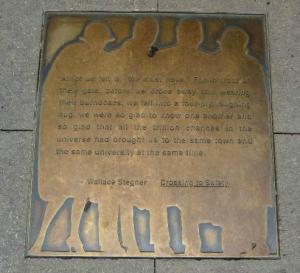
The coolness factor of Iowa City, a UNESCO City of Literature, is high.  It is a lovely university town, with tree-lined streets and a pedestrian downtown. The slightly tacky UNESCO effect is the installation of plaques with writers’ quotes on the sidewalk, which I try to ignore.  (The writers attended or taught at the Iowa Writers’ Workshop.) The town used to be cooler a few decades ago when there were actually more bookstores.  The few surviving stores have smaller collections than they used to.

What we actually like to do is walk around town. We walked to Oakland Cemetery and looked at the Black Angel.  There was a legend about the Black Angel:  it turned black because of some eerie love story gone amok, or something else we made up as girls.  Actually, the statue turned black because of an outdoor oxidizing effect on bronze.
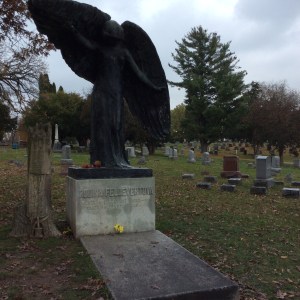
The Black Angel at Oakland Cemetery on a dark November day.

We discovered the grave of Mauricio Lasansky, an Argentine printmaker who came to teach at the University of Iowa and established the printmaking department in 1945. He was best known for the Nazi Drawings.  I love the sculpture on his gravestone.

Mauricio Lasansky’s grave.

Then we did our personal house tour of lodging houses, because both of us lived in rented rooms our senior year of college.  On the way to the graveyard, we passed the house where I lived in a minuscule room.  The house is even more run-down than it used to be, if that’s possible. They’ve put siding over the picture window, so the new lodger must  live in almost total darkness.  But I was happy there, and I liked the attic kitchen, where I ate ramen noodles with the rest of the lodgers.

I lived happily in this run-down house!

Across the street from the rooming house is an elegant private drive where we  walked to escape student life.

We used to do our laundry late at night at the apartment house (see pic below) across the street so as to avoid the laundromat.

The laundry…!

And then my husband and I walked on to the Iowa City Public Library, which is really a bustling community space these days. Although I preferred the old Carnegie library, this accommodates many more readers. And we enjoyed looking at this mural on loan.  It was originally commissioned for the Jefferson Hotel in the ’30s.

Another lovely day in Iowa City!  And we were very cool for a day.
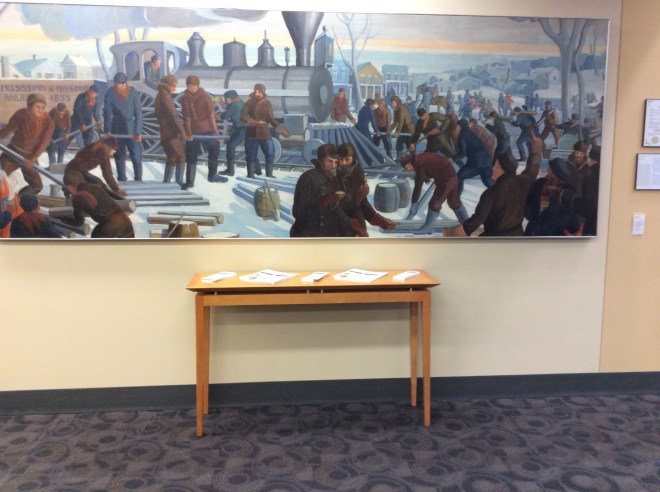
The mural shows the building of the railroad.

Mrs. Humphry Ward’s “Helbeck of Bannister”

After I read Mrs. Humphry Ward’s Marcella in 2013, I wrote here:

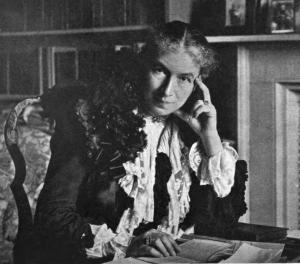
Mrs. Humphry Ward (Mary Augusta Ward, 1851-1920) is my new idol:  she was very productive in middle age.   A niece of Matthew Arnold, she began writing  compulsively after her marriage to Thomas Humphry Ward, a tutor and fellow at Brasenose College, and after she had three children.  Fortunately she had hired help:  she spent her mornings at the Bodleian library and wrote three hours every night.

Like the popular Mrs. Oliphant, Mrs. Humphry Ward was a brilliant and prolific writer:  she was the author of 26 novels, and I can attest that three are excellent, Robert Elsmere (1888), Marcella (1894), and Helbeck of Bannister (1898).

I recently found a Penguin copy of Helbeck of Bannister, the novel considered her masterpiece and often described as Ward’s VilletteI curled up with it on a gloomy day, and found it very Bronteish.  In Charlotte Bronte’s Villette, the Protestant narrator Lucy Snowe teaches at a school in Villette (a fictitious city based on Brussels) and spars with  M. Paul, a Catholic teacher, who becomes her informal French tutor.   Eventually they fall in love, though Lucy will never convert to Catholicism. A similar drama unfolds in Ward’s Helbeck of Bannister, in which Alan Helbeck, a Catholic aristocrat, and Laura Fountain, an atheist, fall in love.

The novel opens on a chilly, desolate March day.  Helbeck has invited his newly-widowed sister, Augustina, and her stepdaughter, Laura, to live with him at Bannisdale. The weather is unwelcoming, and the house is cold and bare.  Helbeck, a devout Catholic, has gutted it of its valuables to support the Catholic orphanages he has established.

There is one valuable item left:  a gorgeous Romney portrait of a girl in white, one of the Helbeck ancestors.  And this painting becomes a symbol of the differences between Helbeck and Laura.  She believes it is wrong not to keep this beautiful portrait in the family, wrong to give everything away to charity.  What of beauty?  What of history? Does he not appreciate these?

The Catholic asceticism is oppressive to Laura, but she stays at Bannisdale because she is devoted to her sweet but silly stepmother Augustina.  Augustina has reverted to Catholicism now that her atheist husband is dead.

Ward is an intelligent writer, whose style serves but does not overshadow her narrative, and I especially like her interweaving of  keenly-observed nature writing with the momentum of her narrative.  In the spring Helbeck is surprised to find himself thinking so much of Laura, and when he comes upon her sitting with the dogs  he sees her almost as if she is his ancestress in the painting.

…Something in his own movement reminded him of another solitary walk some five weeks before. And at the same instant he perceived a small figure sitting on a stone seat in front of him. It was Miss Fountain. She had a book on her knee, and the two dogs were beside her. Her white dress and hat seemed to make the centre of a whole landscape. The river bent inward in a great sweep at her feet, the crag rose behind her, and the great prospect beyond the river of dale and wood, of scar and cloud, seemed spread there for her eyes alone. A strange fancy seized on Helbeck. This was his world—his world by inheritance and by love. Five weeks before he had walked about it as a solitary. And now this figure sat enthroned, as it were, at the heart of it. He roughly shook the fancy off and walked on.

Mrs. Humphry Ward

At first Laura loathes Helbeck and finds him very cold. But gradually she is drawn to the chapel, with its beautiful paintings.  And she becomes fascinated by Helbeck, though she dislikes the priests.

But she needs a break from religion, and insists on visiting her cousins. In a sort of homage to  Emily Bronte’s Wuthering Heights, Ward describes Laura’s visit to her rough country cousins, the Masons, who live seven miles away on a farm. They are of a different class, and are adamantly anti-Catholic, and do not speak to Helbeck.

Unfortunately, her cousin Herbert, who reminds me slightly of Hareton in Wuthering Heights,  becomes obsessed with her: when he gets a job in town, he persuades his sister Polly to bring Laura up for the day.  They tour his workplace, and then the steel mill, and observe a tragic accident where a man falls into the furnace.   Laura is strong–she takes care of the victim’s small daughter, who is brought to the factory bewildered and is terrified.   Laura stays with the child for hours, and then misses her train, and  has difficulty getting away from Herbert.  She takes care of herself and manages to find her way home, but it is this incident that leads her to admit her love for Helbeck.

Although this book is often compared to Villette, the mood is more like that of Jane Eyre.  Helbeck is a gentlemanly version of Rochester, and Laura a willful woman who refuses to conform to religious custom.  Of course Laura has a little money and does not have to work as a governess/teacher, but she is intelligent, independent, and scrupulous.

By the way, Ward’s own father converted to Catholicism and eventually deserted his Protestant wife and children.  As you can imagine, Ward had strong anti-Catholic feelings, but Helbeck is an attractive character and she is very fair, I think.  Some of her critics thought she made Catholicism too attractive.

It takes a while to get into this, but I absolutely loved it.

Three New Books & The Scarlet Letter: “B” Is for Bookish

Demi Moore as Hester Prynne in “The Scarlet Letter”

I was doing very well at not buying books.

And then the urge struck me.  I bought three books and smuggled them into the house, so as not to be lectured by Himself.

I am not a bookish Puritan, but I felt a bit like Hester in The Scarlet Letter, only with a scarlet “B” for “bookish.”

But really I enjoy books too much to wear the “B.”

Here’s what tempted me:

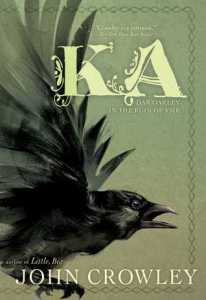
 John Crowley’s Ka.  Crowley’s books are fantasy/literary fiction, loved by critics Harold Bloom and Michael Dirda as well as by fans of brilliant, entertaining novels.  He has won the American Academy and Institute of Arts and Letters Award in Literature and the World Fantasy Award.

I have just begun his new novel, Ka.  It is the story of a crow, Dar Oakley, who is our guide through 2000 years of history.  If you loved Watership Down, you’ll find Dar’s account of crow life fascinating, and a bit  post-modern.

Here is a passage from Elizabeth Hand’s review in the L.A. Times.

So yes: John Crowley is a writer’s writer, the rare stylist whose stories can feature both downtown New York City bars and 16th century cosmologist and martyr for science Giordano Bruno. Yet Crowley is also a serious reader’s writer. As with Middle Earth, his imaginary worlds so enchant and entice that many fans read and reread his books obsessively, the closest we can come to inhabiting them. But, unlike Tolkien’s legendarium, most of Crowley’s fiction is resolutely set in our own world. Even those works that venture onto other planets maintain quicksilver ties to this one. Decades before George R.R. Martin’s series “A Song of Ice and Fire,” Crowley’s first novel, “The Deep” (1975), recounted an ancient, seemingly endless conflict that evokes the War of the Roses and its precursors. In his second novel, 1976’s “Beasts,” humans and genetically engineered sentient animals make their way across a near-future U.S. devastated by civil wars and a totalitarian government.

Virgil’s Aeneid, translated by David Ferry.  Ferry, a National Book Award winner, is one of my favorite American poets.  He is also a brilliant Latinist who knows his Virgil:  his translations of the Eclogues and the Georgics are lovely.

I reread the Aeneid every year in LatinSo why buy Ferry’s translation?  His style is brilliant, and I am anxious to see how he handles problems in translation.

As I grow older I appreciate the Aeneid more and more, particularly Virgil’s brave characterization of the first weak hero.  (I am calling it the first, but I should say my first.)  I first taught the Aeneid as a T.A. many years ago, and many, many times later as a prep-school Latin teacher.

I’ve been thinking about Latin descriptions of passion.  Virgil often uses the words amens (pronounced ah-mens, and literally meaning “out of one’s mind”).  In Book II, during the fall of Troy, Aeneas is amens  when he loses his wife Creusa as they are running away during the fall of Troy.  Ferry translates it “in my frenzy.” (And that is an excellent, popular translation.)  But I keep visualizing the more pictorial amens   (“a” means “away from” and mens “mind”):  a diagram of  a man outside his mind.  Later, in Book IV, Dido, the queen of Carthage, is amens when she falls madly in love with Aeneas.  So perhaps Aeneas was only really passionate about Creusa?  Poor Aeneas.

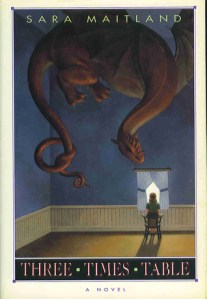
Sara Maitland’s Three Times Three.  In Shaun Bythell’s The Diary of a Bookseller, he mentions  Sara Maitland.   Three Times Three was one of my favorite novels of the ’90s.  I ordered a cheap copy online, and it arrived today.  I can’t wait to reread it!

HAVE YOU STRAYED AND BOUGHT MORE BOOKS THAN YOU NEED LATELY?  LET ME KNOW.


The First Woman to Translate Homer’s ‘Odyssey’

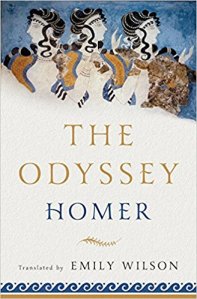
Don’t miss Wyatt Mason’s fascinating article in The New York Times Magazine, “The First Woman to Translate the ‘Odyssey’ Into English.” Emily Wilson’s new translation will be published by Norton on Tuesday, Nov. 7.

By the way, she is the daughter of the writer A. N. Wilson.

And here are the first two paragraphs of Mason’s article about Wilson and the translation:

Late in August, as a shadow 70 miles wide was traveling across the United States, turning day briefly to night and millions of Americans into watchers of the skies, the British classicist Emily Wilson, a woman of 45 prone to energetic explanations and un-self-conscious laughter, was leading me through a line of Ancient Greek. “Polytropos,” Wilson said, in her deep, buoyant voice, pointing to the fifth word — πολuτροπον — of the 12,110-line epic poem that I had come to her office at the University of Pennsylvania to discuss. On the wall hung pictures of Wilson’s three young daughters; the windows behind her framed a gray sky that, as I arrived, was just beginning to dim. The poem lying open before us was Homer’s “Odyssey,” the second-oldest text, after his earlier poem, the “Iliad,” in a Western tradition impossible to imagine without them.

Since the “Odyssey” first appeared in English, around 1615, in George Chapman’s translation, the story of the Greek warrior-king Odysseus’s ill-fated 10-year attempt to return home from the war in Troy to Ithaca and his wife, Penelope, has prompted some 60 English translations, at an accelerating pace, half of them in the last 100 years and a dozen in the last two decades. Wilson, whose own translation appears this week, has produced the first English rendering of the poem by a woman.

Tea & Tattle Podcast on Persephone Books & Readalong of New Translation of Virgil’s Classic

Do you love Persephone books?

I discovered them back in the zips, when Diana Birchall recommended Frances Hodgson Burnett’s adult novel, The Shuttle. In fact Diana recommended the book before Persephone published it.

I have read many Persephone titles since, and recently enjoyed a Tea and Tattle podcast in which  Sophie and Miranda discuss their favorite Persephone books.  The discussion is very calming:  I guarantee your blood pressure will go down!

WE INVITE YOU TO JOIN THE VIRGIL READALONG.  It may not sound sexy, but David Ferry’s new translation of Virgil’s Aeneid is so brilliant that Jen B. (an old friend from AOL) and I are organizing a Virgil readalong. Realistically, we hope that one,  or possibly two  may sign up to join us!   In January we will discuss Books 1, 2, 4, and 6, and in February discuss two or three of the last six books (to be announced).

WHY SHOULD YOU READ OR REREAD IT?  Virgil’s epic has awed and influenced generations of readers, including Dante, Christopher Marlowe, Milton, Purcell, George Eliot, Thomas Hardy, Willa Cather, T. S. Eliot, and Margaret Drabble.  Some read the Aeneid as a celebration of empire, others (myself included) as an anti-war poem.  Virgil treats love and war, the horrifying fall of Troy at the end of a 10-year war, the reluctance of the hero, Aeneas, to take charge of the survivors and try desperately to find them a homeland, his tragic love affair with the powerful queen Dido, and a long war in Italy fought so the Trojans can stay there (and eventually found Rome).

I’ll be reading the Latin along with the English.  It might be hard to get me to shut up about it.

JEN will not be reading the Latin.  You don’t have to read the Latin.

FUN FACT ABOUT THE AENEID.  Did you know that Venus wears purple (or crimson) buskins in Carthage?

So leave a comment or email me at mirabiledictu.org@gmail.com if you’d like to join us.

Shaun Bythell’s “The Diary of a Bookseller”

This week my guilty pleasure has been reading Shaun Bythell’s The Diary of a Bookseller.  I am so engrossed in Bythell’s diary that I have put off finishing a work project.  Bythell owns Scotland’s largest second-hand bookstore, The Bookshop, in Wigtown, which is designated a National Book Town and the home of the Wigtown Book Festival.  His diary entries are short, curmudgeonly, and witty, and I am absorbed by this insider’s view of  bookselling.

We’d all love to own a bookstore, or so we think, but the business isn’t always easy. Bythell identifies with George Orwell, who wrote in his essay, “Bookshop Memories,” about the difficulties of working in a bookstore.  Indeed, Orwell may be the inspiration for much of this book.  Orwell enjoyed some parts of the job, but was glad on the whole to have left.  Bythell stays, but understands Orwell.

Bythell begins the book with an epigraph from Orwell.  Then he writes,

Orwell’s reluctance to commit to bookselling is understandable. There is a stereotype of the impatient, intolerant, antisocial proprietor –played so perfectly by Dylan Moran in Black Books –and it seems (on the whole) to be true.There are exceptions of course, and many booksellers do not conform to this type. Sadly, I do. It was not always thus, though, and before buying the shop I recall being quite amenable and friendly. The constant barrage of dull questions, the parlous finances of the business, the incessant arguments with staff and the unending, exhausting, haggling customers have reduced me to this. Would I change any of it? No.

Bythell makes a bare living, mostly from the store rather than online sales, which I find encouraging, but he lives above his shop, as  so many  used bookstore owners do.  The difference between Bythell and the (obviously) older semi-Luddite booksellers of my acquaintance?  Bythell has Facebook, where he writes about customer behavior.   One day, he hears a woman whisper to her friend to shut up or they’d get written up. His amusing descriptions of eccentric customers are riveting:  the chatty customers, the smelly (some of whom have great taste in books), the hagglers, and, finally, the happy bibliophiles who spend money.

I enjoy reading about his eccentric part-time employee, Nicky, a Jehovah’s witness who seldom follows his instructions and sometimes shelves Charles Darwin in the fiction section.  Driving to estates to  assess the worth of a personal library sounded fun, until I learned it often means buying not just the books you can sell but the whole lot.

But perhaps he is most interesting about the changes in bookselling in the 21st century. In the UK Amazon is always the enemy–perhaps we have a bigger variety of  online sellers here– and online bookselling has changed the business.  The huge used booksellers with no overhead can sell in bulk very cheaply, so the prices have come down for everyone.  And the ratings can be erratic.  We’ve heard about writers’ frustrations with online ratings, but I never thought much about booksellers (because I never rate them).

Bythell writes,

Today an Amazon customer emailed about a book called Why Is There Something Rather Than Nothing? His complaint: ‘I have not received my book yet. Please resolve this matter. So far I did not write any review about your service.’ This thinly veiled threat is increasingly common, thanks to Amazon feedback, and unscrupulous customers have been known to use it to negotiate partial and even full refunds when they have received the book they ordered.

I feel a bit like Janus:  I see both sides of the online selling problem. As a non-driver in the Midwest, online shopping has been a blessing for me, because it saves me hours of bicycling or changing buses to go to malls that don’t have what I want.  Like most of us, I’ve flirted with eBay and have  sold a few books online. Usually it’s fine, but  we sold a brand-new pristine Penguin hardcover edition of Middlemarch, which I couldn’t read because the print was too small for me!  It was never read, in perfect shape. The buyer wrote angrily that the book was beaten-up and scribbled in.  Really?  By whom?  we wondered. We gave him a refund, and we did ask him to return it, but clearly that isn’t going to happen. So he got a free book.  Was it worth it?

And is that why I’m not a bookseller?

I’m a happy reader and book buyer, though, and that’s what matters.

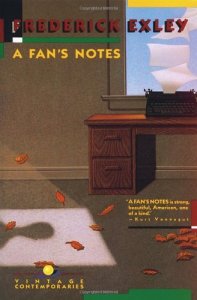
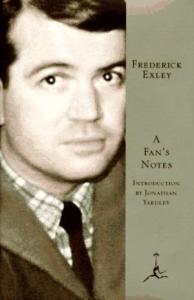
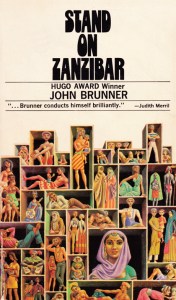
What Was Published in 1968? Frederick Exley’s “A Fan’s Notes” & John Brunner’s “Stand on Zanzibar”

The internet is sometimes Dadaistic.   Take the 1968 Club.  Sponsored by Kaggsy’s Bookish Ramblings, this whimsical group of readers is spending a week ( Oct. 30-Nov. 5) reading and posting about books published in 1968.

The task sounds simple–until you discover that none of your favorite writers published that year.  Turns out Margaret Drabble, Peter Handke, Kawabata, Lynne Reid Banks, A. S. Byatt, Clifford D. Simak, Kingsley Amis, Doris Lessing, Marguerite Duras, Merle Miller, Richard Yates, and Sue Kaufman published books in 1967 or 1969, but not in 1968.  I  looked up so many writers that it became a joke!

So what’s a girl to do? I am re-posting bits from my blog about two neglected 1968 classics, Frederick Exley’s A Fan’s Notes and John Brunner’s Stand on Zanzibar.  Enjoy!

First up, Exley.  In Frederick Exley’s A Fan’s Notes, a fictional memoir published in 1968,  the hero, also called Frederick Exley, cannot hold a job.  Exley, an alcoholic, is in and out of mental hospitals, sponges off his parents, or lives at a bachelor friend’s apartment where flamboyant, sad characters drop in all day, including an Italian who sometimes believes he is a hit man.

A Fan’s Notes should have been Top of the List for our Mental Health  Christmas.  One year my cousin became manic from a steroid prescribed for an ear infection (a side effect). At the hospital she was not herself:  she wore a bra over her sweater, sang Van Morrison’s “Days Like This” at the top of her lungs, and demanded that we bring presents for her “new friends.” And so we rather lamely distributed McDonald’s milkshakes and old books in the common room.

If only we’d had A Fan’s Notes.

Exley wittily delineates and skewers the customs and hypocrisy of the American middle class in a brilliant narrative akin to Richard Yates’s Revolutionary Road and Sue Kaufman’s Diary of a Mad Housewife.  Depressed Exley turns down advertising jobs before he gets them, teaches off and on at a high school, and drives from Glacial Falls to Watertown every weekend to get drunk and watch Giants games.

He is amazed by the limitations of the English department chairman and teachers.  One teacher informs Exley that he should not talk at meetings because “talking took time.”

This is a great American novel, by a writer whose work is out of fashion.

You can read the rest of my post about it here!

Next up, John Brunner.  I love John Brunner’s Stand on Zanzibar (1968), a post-modern science fiction classic.  Set in 2010, it is a brilliant book, the story of a future dominated by a giant too-smart computer, geneticists’ control of reproduction, and miserable citizens who hate their work.   Women don’t always have permanent homes: “shiggies” stay with men who pick them up, sometimes for a night, sometimes longer.  “Dicties” (addicts) wander the streets, and “muckers” kill people at random.

The  narrative is broken up by quotations from radical sociologist Chad Mulligan (who is rather like Marshall McLuhan) and TV blurbs from news and rumors on Scanalyzer.

Here is one of the definitions from Chad Mulligan’s book, The Hipcrime Vocab:

Hipcrime:  you committed one when you opened this book.  Keep it up.  It’s our only hope.

Here is an excerpt from Brunner’s futuristic New York Times editorial:

Like living creatures, automobiles expired when their environment became saturated with their own excreta.  We ourselves are living creatures.  We don’t want the same to happen to us.  That’s why we have genetic legislation.

The novel follows two main threads: Norman, an African-American executive in New York, is wretched and lonely.  But eventually he is chosen to rule Benini, an African country whose president, Obami (I am not kidding!), is dying and wants to hand this small, peaceful country over to someone who can unite it with the West.

Donald’s fate is much worse.  He is a spy paid to read obscure journals and books to spot trends.  Finally he is activated to be a killing machine and assassinate an Asian  geneticist who has threatened the Western world by scientific discoveries.

I’m not going to write about this at length:  it is a very complicated book.  But if you like science fiction, you will be impressed by Brunner’s writing.  Some of it is very like our present.

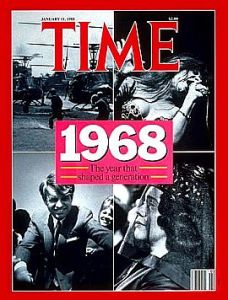
Here is TIME’S COVER FOR 1968, not a very happy time in history.  And Exley’s and Brunner’s books reflect that.

Michael Redhill’s “Bellevue Square”

“If a tree falls in a forest and no one is around to hear it, does it make a sound?” Ron Charles once jokingly used this adage (at least I think it was Charles) to describe Canadian literature.  And it certainly dovetails with my belief that we Americans don’t know CanLit because it is almost impossible to find new Canadian books in the U.S.

So this weekend I checked out the shortlist for Canada’s Scotiabank Giller Prize.  And I picked up a copy of Michael Redhill’s  Bellevue Square, because the narrator, Jean, owns a bookstore.  Yes, that’s all it takes!

The question is, does she own a bookstore?

On the surface, life is going well: Jean’s husband, an ex-cop, made a fortune investing in legalized marijuana companies, so they moved to Toronto and she opened a bookstore.

And her bookstore sounds like a fun place to hang out.

I have a bookshop called Bookshop. I do subtlety in other areas of my life. I’ve been here for two years now, but it’s sped by. I have about twenty regulars, and I’m on a first-name basis with them, but Mr. Ronan insists on calling me Mrs. Mason. His credit card discloses only his first initial, G. I have a running joke: every time I see the initial I take a stab at what it stands for. I run his card and take one guess. We both think it’s funny, but he’s also shy and I think it embarrasses him, which is one of the reasons I do it. I’m trying to bring him out of himself.

Then one day, while she is shelving books, everything changes.   Mr. Ronan, one of her best customers,  insists he saw her at the Kensington market 15 minutes ago, wearing a different outfit and with short hair.   He attacks her, and tries to pull off what he thinks is a long-haired “wig.” Stunned that the hair is real, he says she must have a twin.  (She does not.)  He apologizes, leaves, and never returns.

Shortly thereafter, another woman, Katerina, who works at the Kensington market, mistakes her for her doppelganger.   So Jean takes to hanging out in Bellevue Park, across from the market, so she can catch a glimpse of her double.

And when she finally meets her double, a woman named Ingrid Fox, a mystery writer who writes under the name Inger Ash Wolfe, Ingrid insists that she is the real one, and that Jean is a symptom of the brain tumor that is killing her.

I raced through this Dostoieveskian novel about doubles, by far the fastest-paced book I’ve read this year.  The concept is brilliant, but does it deserve the award? I enjoyed it  enormously, but the style is unassuming–perhaps a little too unassuming.  Do we want verbal fireworks?  Probably.

I recommend it because it’s a great read!

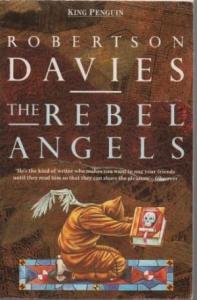
Robertson Davies’s “The Rebel Angels”

The Canadian novelist Robertson Davies is one of the best writers of the 20th century, and, though it may not be true that he is neglected, American bookstores seldom carry his books anymore.  And that’s a pity: he is in the class, I think, of Anthony Powell.  Davies’s books are still in-print, but have not yet been published as e-books.  Does electronic accessibility determine a writer’s reputation these days?

Like many Americans, I fell in love with the Deptford trilogy years ago, and then eagerly read his other books. This month, when I felt like celebrating the fall with an academic novel, I found my copy of The Rebel Angels, the first in the brilliant Cornish trilogy. (N.B.  I wonder if I was conflating the season of fall with the fall of the rebel angels, with whom one of the narrators, Maria, identifies her favorite professors.)

Davies’ scholarly characters comically discuss alchemy, tarot cards, theology, and Rabelais.   At the fictional Canadian College of St. John and the Holy Ghost (nicknamed “Spook”), Maria Magdalena Theotky, who is one of the two narrators of the novel and a graduate student specializing in Rabelais, is desperately in love with her mentor/dissertation advisor, Clement Hollier, a gorgeous, absent-minded scholar who is researching “filth studies” (don’t ask!) in the Middle Ages.  Maria has not heard from Hollier since they impulsively had sex on the couch in his office before summer vacation, but the new semester is starting, and she plans to tell him the latest gossip:  Parlabane is back.

Who exactly is Parlabane?  Everybody is talking about him.  This robust novel opens with Davies’ rapidfire dialogue.

“Parlabane is back.
“What?”
“Hadn’t you heard? Parlabane is back.”
“Oh my God!”

Hollier explains to Maria that his old friend Parlabane was a brilliant student who never fulfilled his potential, went rogue, fell in love with a gorgeous man, failed at many jobs,  briefly joined a monastery, and then asked Hollier (and others, it turns out!) to send him money so he could return to Toronto.

Maria’s first meeting with Parlabane happens in the outer room in Hollier’s office, which is her work space.

I was rearranging my papers and things on the table in the outer room after lunch and there was a soft tap at the door and in came someone who was surely Parlabane.  I knew everyone else in St. John’s who might have turned up in such a guise; he was wearing a cassock, or a monkish robe, that had just a hint of fancy dress about it that marked it as Anglican rather than Roman.  But he wasn’t one of the Divinity professors at St. John’s.

Maria and Parlabane struggle for ascendancy in Hollis’s outer office:  Parlabane sleeps on the couch, stinks up the room (he never washes), borrows money from her, and goes through her papers when she is out.  But  Maria is determined not to go back to her carrel in the library,  and is not as conventional and biddable as she at first seems.   It turns out Maria has a secret life: her wealthy businessman father left the family very well-off,  her mother is a gypsy and has an illegal business restoring violins smuggled in from the U.S., and Maria lives at home, sleeping on the couch (rather like Parlabane), even though she has money to leave,  because she does not want to hurt her mother’s feelings.  And her mother has more-or-less gone native since her husband’s death:  she wears layers of gypsy skirts and cleans herself with oil rather than soap.

The second narrator is Simon Darcourt, an Anglican priest and professor, who is writing a sort of Aubrey’s Brief Lives about the college–and the gossip he picks up is fascinating.  He is by far the kindest man in the book, and the only one who could really be called “good.” And then, at dinner at Maria’s house, Simon falls in love with Maria.

As in A. S. Byatt’s Possession, scholars scramble for rare manuscripts.  Who will get his hands on a rare document by Rabelias? Arthur Cornish, a wealthy collector of paintings, music, and manuscripts, has died and left behind many treasures.  The executors of the estate are all professors at Spook:  Hollis, Simon, and Urky McVarish, a  rival Renaissance scholar,.  When Rabelais’s documents disappear, all  know Urky took it.  But what can they do?  He denies it.

Actually, what happens is very exciting and unexpected.  Good against evil, turning into evil, evil against evil, and does evil ever save the good?  God knows!  But there are lots of parallels between characters, even when they are opposites.

I loved The Rebel Angels, and enjoyed it more than I did the first time, though I also liked it then.  Over time, I seem to have have gleaned  a little more information about alchemy and medieval philosophy.  This remarkable novel has aged very well, and is very amusing.  Davies is always erudite, but I had forgotten how very comical he is.  A great book!

Bibliobits: Arnold Bennett’s “Anna of the Five Towns” & Jeanette Watson on Hand-Selling Books

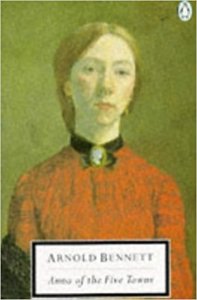
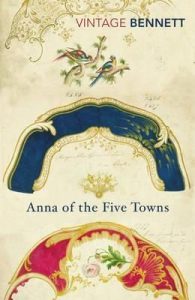
Arnold Bennett’s Anna of the Five Towns (1902) is  one of those wonderful early twentieth-century novels that carry on the Victorian tradition of telling rip-roaring stories with superb social insights.   Perhaps this classic is not in the canon–It’s hard to keep up with the evaluation of Bennett–but it is one of the best business novels of the twentieth century.  Bennett reminds me slightly of  George Gissing, another writer who chronicles the tension between love and money.  And Bennett’s portrait of the heroine Anna Tellwright, a miser’s daughter who has never handled more money than is needed to do the marketing, is sharply-observed and sympathetic.

In this brilliant novel about religion, money, and love, Bennett interweaves these conflicting elements with the dramatic shaping of scenes:  some disdain his minute descriptions of everything from a maid’s apron to an inventory of furniture in the Tellwrights’ house, but every detail matters and contributes to the drama.

In the opening chapter, we do not immediately meet Anna; instead, Bennett sketches a scene in which the most important characters in her life wait for her outside the Sunday school.  Her younger half-sister, twelve-year-old Agnes, has just burst out of the Sunday school, happy because she has won a book, a Sunday School prize.  And handsome Henry Mynors, a popular businessman who is the morning superintendent of  the Sunday school, teases Agnes about her prize while he waits for Anna.

‘I’m sure you don’t deserve that prize. Let me see if it isn’t too good for you.’ Mynors smiled playfully down upon Agnes Tellwright as he idly turned the leaves of the book which she handed to him. ‘Now, do you deserve it? Tell me honestly.’

She scrutinised those sparkling and vehement black eyes with the fearless calm of infancy. ‘Yes, I do,’ she answered in her high, thin voice, having at length decided within herself that Mr. Mynors was joking.

Most of the main characters are involved with the Methodist Sunday school in one way or another.  Accompanying Mynor is Willie Price, secretary of the men’s Bible class, a bashful young man whose father, the head of the Sunday school,  rents a run-down factory from Anna and Agnes’ father, Ephraim Tellwright–and they are in financial trouble.   And then there is Mrs. Sutton, the cheerful wife of an eminent businessman who runs the sewing society and other charitable groups.

When Anna emerges, she is perfectly poised.   It is the confident Mynors who walks her home, while Willie fades away.  Anna suspects that Mynors is infatuated with her, but she isn’t quite sure, because she has never had a friend, let alone a boyfriend.  Her father is a miser, and she is his housekeeper. They live in poverty, though he is one of the richest men in town.  She is so used to eking out pennies that she only half-realizes her father’s wealth.

On her 21st birthday, her father calls her into his office:  she inherits 50,000 pounds from her mother, who died 20 years ago.  Her father’s idea, of course, is to use her as a puppet for financial transactions.  Ironically, she owns the run-down factory Willie Price and his father rent from them, and since they are behind on the rent, he forces Anna to go collect it.

Appalled by the conditions of the factory, Anna empathizes with the Prices. They simply do not have the money.  I would like to say that Anna rebels and manages the money herself, but that of course would not be like life.  Gradually, with the help of Mrs. Sutton, who includes her in the women’s social circles and invites her on a vacation, and her relationship with Mynor,  she learns about money and manages to break free.  But her way to freedom is not entirely satisfactory…

Really, you’ll have to read it!

IF YOU WERE A BOOKSELLER, WHAT BOOKS WOULD YOU HAND-SELL?  Jeanette Watson, owner of Books & Co in New York from 1977 to 1997 and the author of a memoir, It’s My Party, writes at the Literary Hub about her favorite books to hand-sell during her bookstore days.  Among them is one of my favorites, Easy Travel to Other Planets by Ted Mooney. I thought I was the only person on the planet who had read this.

She writes,

This amazing book is about a female researcher who has a love affair with the dolphin she is studying. The love scenes are amazingly erotic and made me long for my own dolphin! Would that be considered adultery? Maybe married people could do this without guilt? We sold many copies of this too.

Watson also inspires me to want to read Tanizaki’s The Makioka Sisters.  She writes,

My customers also had an influence on my reading. I remember John Guare telling me to read The Makioka Sisters by Tanizaki. “It’s the Gone With the Wind of Japanese literature,” he said: a line I borrowed when I suggested the fabulous book to others.

A fabulous list!