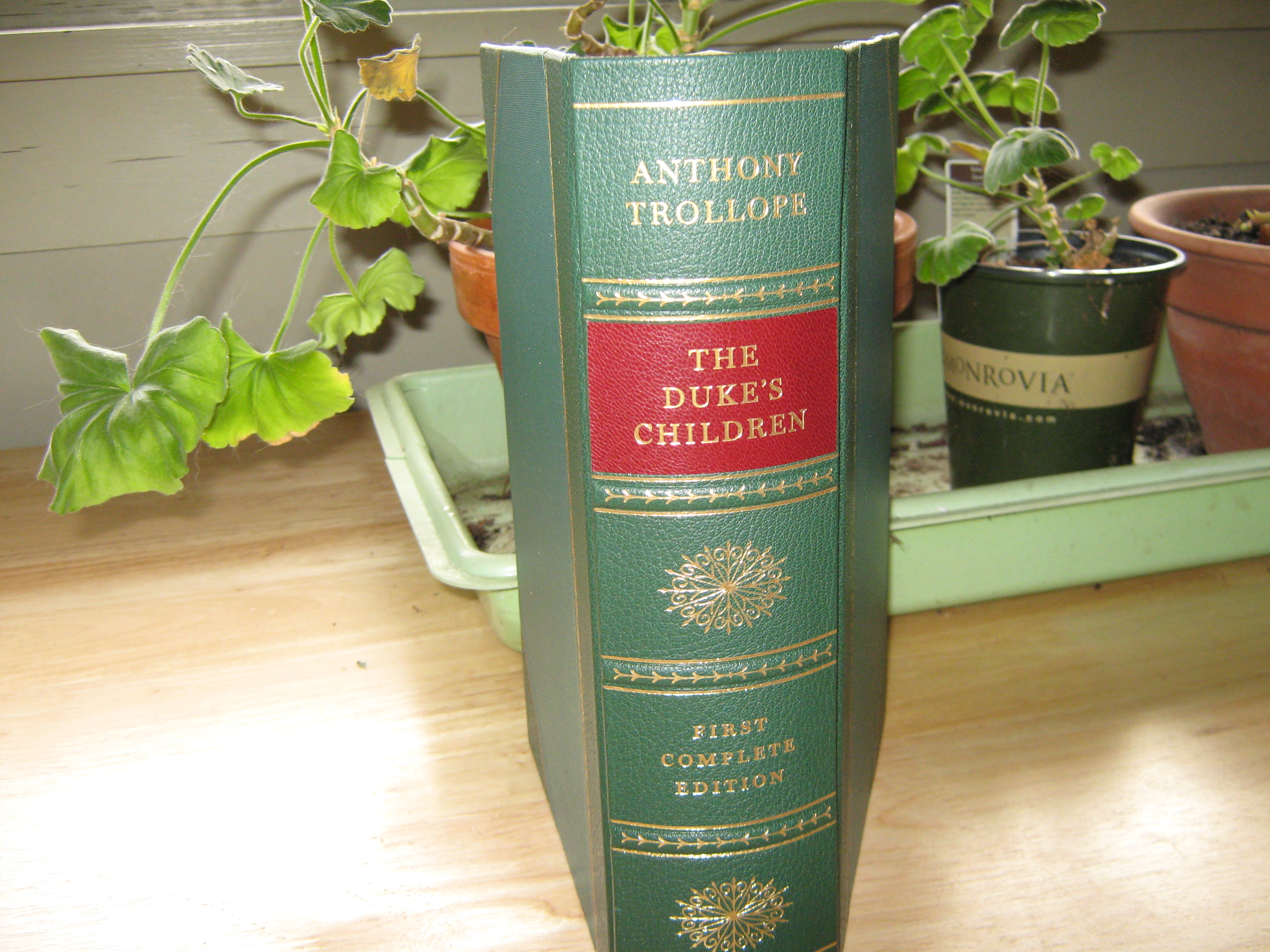
Trollope’s The Duke’s Children, with bedraggled geranium s.
I was glued to a tea-drinking scene in a 19th-century novel.
I didn’t hear the mail arrive.
I went to get tea and saw a box on the stoop.
I opened the door.
I picked it up.
The sticker said “Royal Mail” (much more awe-inspiring than USPS), and the return address sticker said The Folio Society.
Yes, my gorgeous copy of the Folio Society’s complete edition of Trollope’s The Duke’s Children arrived.
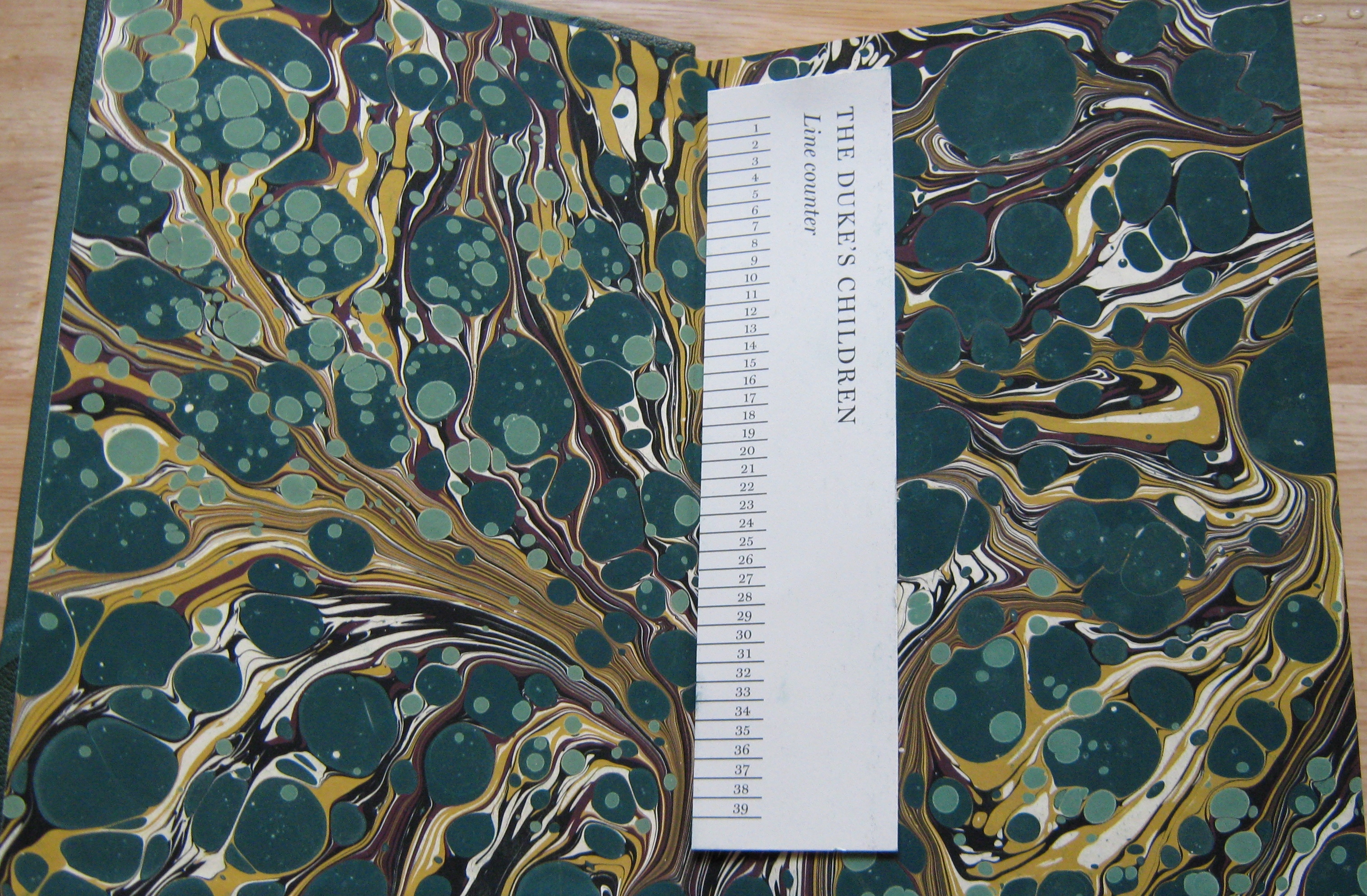
It is bound in Indian goatskin leather, with hand-marbled endpapers.
Hand-marbled endpapers, and Line counter bookmark.
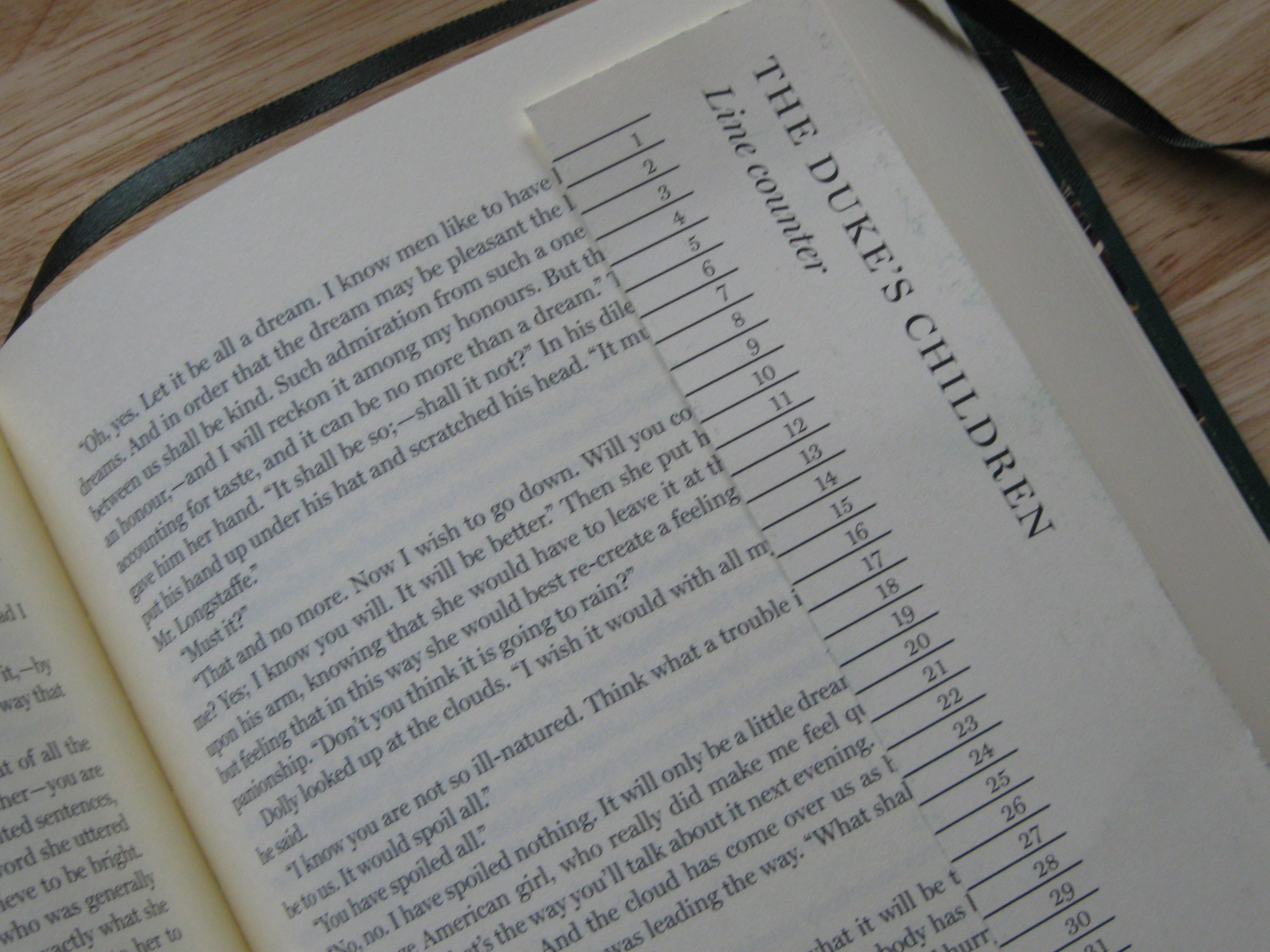
And it comes with an adorable “Line counter” bookmark. Most of the pages have exactly 39 lines. When I blog about it, I will be able to cite the line number. Fun, fun.
The copy number is written in by hand. It is 7__ of 1980. And it says that:
The first complete edition of The Duke’s Children has been typeset in Miller by The Folio Society, printed on Caxton Cream Wove… It is limited to 1980 numbered copies, and 20 lettered copies hors de commerce.
At work with my Line counter bookmark.
It has an introduction by Joanna Trollope.
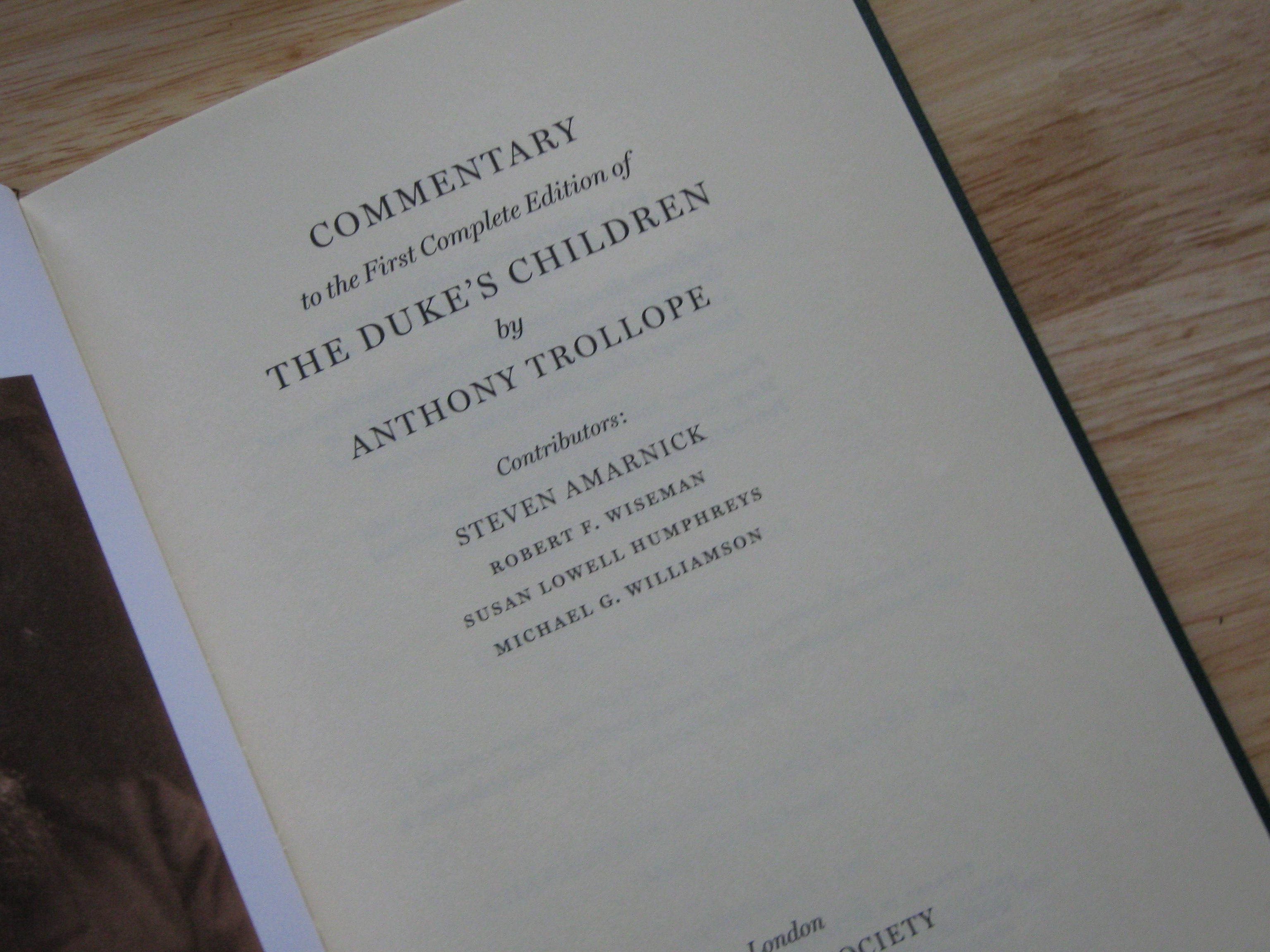
And there is a second volume, a commentary on the book.
My misgivings: I have never had a leather book before.
I am a paperback person.
My cousin the librarian is laughing at me. “You’re not a f—ing collector and what about tea stains?”
The commentary.
Trollope write The Duke’s Children as a four-volume novel and it was cut to three volumes. The complete edition is only available from the Folio Society.
I retort, “It’s not a collectible. It’s mine now.”
I am a bit worried. I read my books HARD. I throw my paperbacks down on the couch. I write in them.
Wish me luck! It is no longer a collectible… It is a reading copy!
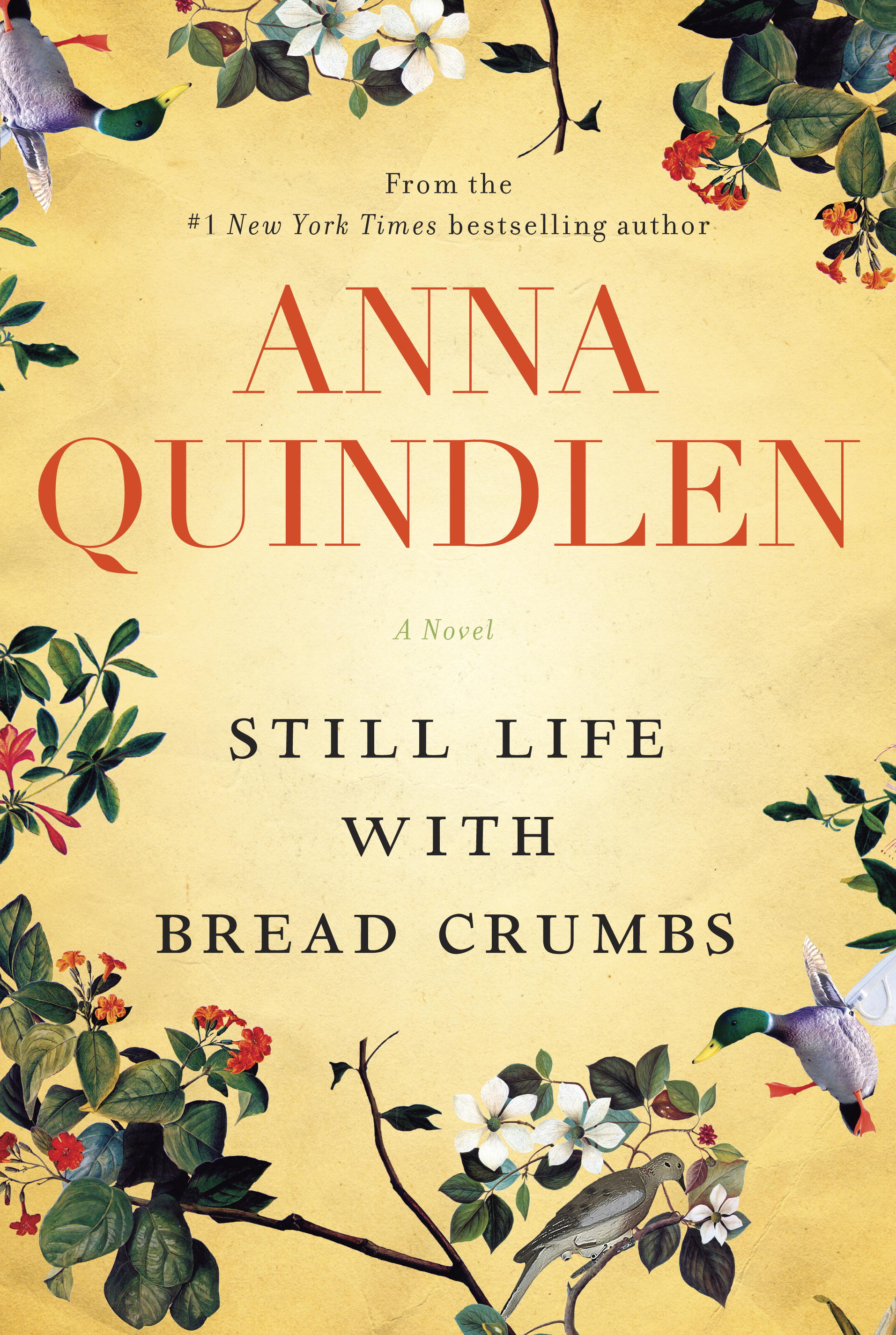
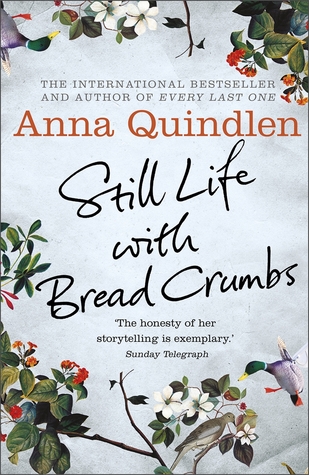
Anna Quindlen’s Still Life with Bread Crumbs is one of those good-bad novels that could have been brilliant with some tweaking. It was longlisted for the Bailey Women’s Prize last year.
Qundlen, a much-beloved former New York Times and Newsweek columnist, has written seven novels. I read Blessings, a sentimental novel about the finding of a foundling and the rejuvenation of a community, for a book group. I cannot recommend it.
With the Bailey Women’s Prize nomination, I decided it was time to reevaluate her fiction.
There is much to admire about this smart book. In Still Life with Bread Crumbs, Quindlen’s terse style reflects the heroine’s merciless honesty and minimalist style. Rebecca Winter, an award-winning sixty-year-old photographer, can no longer afford her New York apartment. She has moved into a dark, uncomfortable cottage in the country and is unhappy. There is a raccoon in her attic. She doesn’t know how to spend her time in the country.
How can she earn money? The well has run dry. Rebecca’s art has been accidental. She photographs what she sees and afterwards sees what she has photographed. Her famous “Kitchen Counter” series was unplanned: she photographed the remains of a dinner party. The most famous of this series, “Still Life with Bread Crumbs,” has been reproduced as a poster. But people are no longer interested in her work. And she has bills: her mother is in a nursing home, she can barely afford her rent, and her royalties are diminishing.
Gradually, life in the small town revitalizes her energy. When she discovers crosses in the woods decorated with old family photos, trophies, and yearbooks, she begins to photograph them. The “White Cross” series renews her career.
She meets wonderful people: almost too wonderful.. There is Jim Bates, the hunky fortysomething roofer who also works for the State Wildlife Service tracking birds. There is Sarah, the Anglophile owner the Tea for Two (And More). There is Tad, a clown. And Rebecca begins to work part-time with Jim photographing birds for the Stae Wildlife Service.
But the last third of the book goes to hell. Rebecca has an affair with JIm. Yes, okay. Maybe this could happen. But probably as a one-night stand, right? Even beautiful women in their thirties and forties have trouble finding a man, because men tend to go younger. And Rebecca hasn’t even had plastic surgery!
Not only does Rebecca find love: almost everybody in the book couples.
Does every person in the world find love? In this book they do.
Still, the structure is surprisingly experimental and satisfying: chapters have titles like “How She Wound Up There–The Inspirational Version” and “How She Wound Up There–The Money Version.” There is a minimalist feeling about the book. A few of the chapters are very short. In “The White Cross Series–The Present,” there are two short paragraphs about her new photographs. In “The White Cross series–Much Later,” a short announcement tells us of the future of the photographs.
And I loved the descriptions of Rebecca’s photography.
She went back to the other cross, put down her camera on a flat rock, and circled the area, squinting at the ground. A yearbook often had the owner’s name embossed on the cover in gold leaf, but this one didn’t. The two pieces of the cross were held together with a short nail, and the centering wasn’t exact, so that one side of the crossbar extended farther than the other. The first time she’d just taken the photographs, but now she studied the tableau. It was a bit like one of those roadside shrines that appeared along the roadside when some teenager–it was always a teenager–crashed his car into a tree and died behind the wheel.
But the last third of the book turns saccharine. Why does Quindlen have to get sentimental? What is it about too, too happy endings? Did m-o-n-e-y dictate?
I found much of this delightful, but it could have been a really good book.
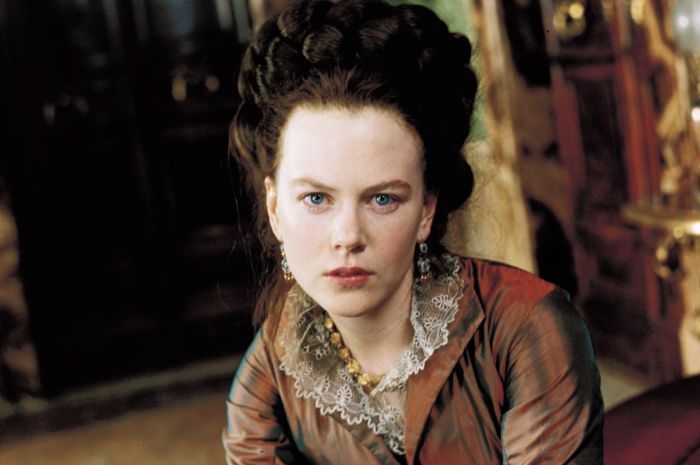
Nicole Kidman as Isabel Archer in Jane Campion’s film “The Portrait of a Lady.”
Years ago I was convinced I was a Henry James heroine. Was I an innocent American? Check. Was I an Anglophile? Check. Would I err in marrying an Italian prince who wanted my money? No money, no check. I was devoted to Isabel Archer of The Portrait of a Lady, Maggie Verver of The Golden Bowl, and Milly Theale of The Wings of the Dove.
James, born in New York City, spent much of his life in England. In 1907 he expressed regrets. In Colm Toibin’s introduction to the Modern Library edition of The Ambassadors, we learn that James told the novelist Hamlin Garlan:
If I were to live my life over again, I would be an American. I would steep myself in America, I would know no other land, I would study its beautiful side. The mixture of Europe and America in me has proved disastrous. It has made of me a man who is neither American nor European. I have lost touch with my own people and I live here alone. My neighbors are friendly but they are not of my blood, except remotely.
His American heroes are similarly torn. They fall in love with the beauty of Europe, but too often discover that sophisticated Europeans are debauchees or preying on them for money. He perfects this theme in the early twentieth century during his “Golden period” in his three masterpieces, The Golden Bowl, The Ambassadors, and The Wings of the Dove.
Of these three stunning novels, The Ambassadors is my least favorite. Nonetheless, it is a very great book. I recently reread it and admired it very much.
The hero, Lewis Lambert Strether, in his mid-fifties, travels to Europe for the first time on an errand for his fiancee, Mrs. Newsome, a rich widow who funds the journal he edits. Her son, Chad, is entangled with an “undesirable” French woman: Strether is to lure him home with the offer of a lucrative job in the family factory.
Just off the boat in Chester, England, at the hotel where he is to meet his fussy, gloomy American friend, Waymarsh, he becomes acquainted with Maria Gostrey, an American who lives in Paris. These two have similar senses of humor.
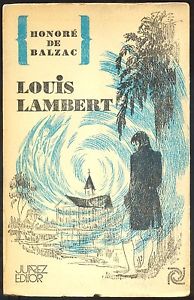
When she hears his name, she recognizes it as the title of a Balzac novel, Louis Lambert.
Oh I know that!” said Strether.
“But the novel’s an awfully bad one.”
“I know that, too,” Strether smiled. To which he added with an irrelevance that was only superficial: “I come from Woollett, Massachusetts.” It made her for some reason–the irrelevance or whatever–laugh..
James was a Balzac freak, though the connection between Louis Lambert and Strether is “woolly” to me. Louis Lambert is one of Balzac’s philosophical novels: when Louis, a philosopher and a former child prodigy, goes to Paris, he has trouble balancing his despair over materialism with love for a beautiful woman. In some ways, Strether has the same problem balancing what he sees in Paris with actual human relationships.
In Paris, Maria is his touchstone: she interprets the city for him. And it is complicated. Chad’s relationship with a beautiful married French woman, Madame de Vionnet, is perplexing. She is separated from her husband, who will not divorce her. And at first Chad is confused: he thinks her lovely daughter has bewitched Chad. It doesn’t occur to him that Chad and Madame de Vionnet are committing adultery.
The brilliant Madame de Vionnet sets out to charm him. He sees how much she has “improved” Chad. Gradually Strether decides Chad is better off in Paris, and writes to Mrs. Newsome praising Madame de Vionne. Mrs. Newsome is furious: she sends her daughter and son-in-law to Paris as ambassadors, along with her son-in-law’s sister, a charming American girl who is also meant to lure Chad.
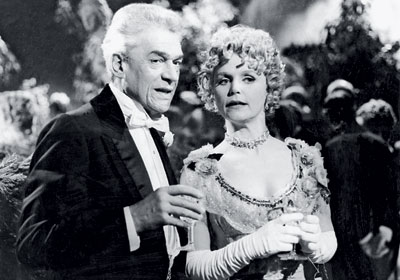
Paul Scofield and Lee Remick In The Ambassadors (BBC)
Strether fights for Chad’s Parisian life. Later, Strether discovers that his romantic view of the relationship between Chad and Madame de Vionnet is not quite accurate.
James takes us into his multilayered world and we are inside the head of a hero from Woollett.
We forget what it’s like to be 21st-century Americans.
Thanks to the late Harry Weber, a professor of Russian at the University of Iowa, for introducing me to Turgenev in his Russian literature in translation class. Nowadays, with language departments and liberal arts under attack by proponents of the bottom line, I realize how lucky I was to have such a wealth of academic choices. I felt both awe and affection for my best professors.. I remember nudging my boyfriend one day when Dr. Weber walked past us in the snow at City Park wearing a tall fur hat. (Didn’t you love it when your professors were the celebrities, and wouldn’t it be a better world if they still were?) Without his class, I am not sure that I would have gone beyond Fathers and Sons, the only one of his masterpieces commonly stocked in bookstores.
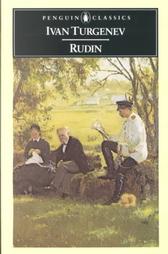
The Richard Freeborn translation.
Rudin, Turgenev’s first novel, is one of my favorites. I have read it again and again. It is elegant, lyrical, and also disturbing in its revelations about the malleability of human nature. Each character is portrayed as delicately as a figure in a water-color painting, vivified by physical description, humor, and dialogue. Rudin, the intellectual stranger who arrives unexpectedly at the wealthy Darya Mihailovna’s estate, immediately dominates the household and turns relationships topsy-turvy as he discourses on philosophy and human nature. As each character gradually finds that Rudin is not quite who he seems to be, Rudin himself undergoes a transformation.
Rudin is simple, and yet not simple. Turgenev’s brevity expresses more than many long-winded writers can in books twice as long. I recently reread Rudin in Constance Garnett’s beautiful translation, which is available in a Faber Finds paperback or as a free e-book for the Kindle or the Nook.
Rudin begins with some of the most gorgeous prose I have ever read, a description of a summer day in rural Russia.
It was a quiet summer morning. The sun stood already pretty high in the clear sky but the fields were still sparkling with dew; a fresh breeze blew fragrantly from the scarce awakened valleys and in the forest, still damp and hushed, the birds were merrily carolling their morning sun. On the ridge of a swelling upland, which was covered from base to summit with blossoming rye, a little village was to be seen. Along a narrow by road to this little village a young woman was walking in a white muslin gown, and a round straw hat, with a parasol in her hand.
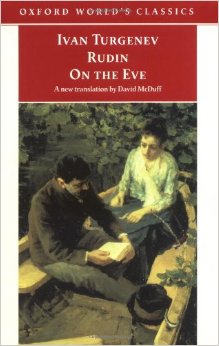
David McDuff’s translation.
Many of the main characters are introduced during the course of a walk. (Walks are so important in literature, aren’t they?) Alexandra Pavolvna Lipin, a young widow, is on her way to visit a sick old woman in the village On her way home Alexandra Pavolovna runs into Mihailo Mihailitch Lezhnyov, an intelligent, practical farmer who teases her and asks if she is thinking about giving up projects like hospitals and schools now that she is spending so much time with Darya Mihailovna, who dismisses all but personal philanthropy as fads. Alexandra laughs and says she doesn’t always agree with Darya Mihailovna.. Then she meets Pandelevsky, one of Darya Mihailovna’s charming, flirtatious parasites, who brings her a letter inviting her there for dinner. She also runs into her brother Volintsev, who is in love with Darya’s daughter, Natalya.
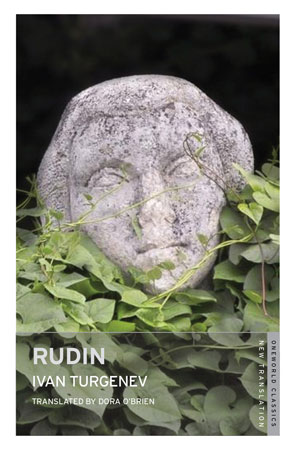
Dora O’Brien’s translation.
That evening, gathered at Darya Mihailovna’s , all are surprised when Rudin arrives, sent by his friend the Baron. Most of the guests are charmed and fascinated by his eloquence. He speaks of pride, egoism, and Hegel in a vague but impressive manner. But Pigasov, a cynical, misogynistic neighbor, is furious at being upstaged and leaves. Natalya, Darya’s passionate daughter, falls in love with Rudin; Rudin secretly courts Natalya, and that is what brings him down. And Mikhail, who knows Rudin’s story, is not surprised by what happens, but oddly Rudin’s fall changes his mind about him.
In the very dated 1894 introduction to my e-book, S. Stepniak writes,
The plot of Dmitri Rudin is so exceedingly simple that an English novel-reader would say that there is hardly any plot at all…. What the novelists of the romantic school obtain by the charm of unexpected adventures and thrilling situations, Turgenev succeeds in obtaining by the brisk, admirably concentrated action, and, above all, by the simplest and most precious of a novelist’s gifts: his unique command over the sympathies and emotions of the readers.
I declared an embargo on book-buying after I inadvertently joined the Folio Society.
Was I hypnotized by an article in The Guardian about the new complete edition of Anthony Trollope’s The Duke’s Children? (Memo to self: Stop reading book pages.)
I am a mad Trollope fan and so I ordered the book.
I prefer paperbacks, but who knows whether this will appear in a Penguin?
And so I’ll buy no more books this year, or possibly ever.
I will never go into a bookstore again.
I will read only books from my own shelves.
I will only buy books from the Planned Parenthood Book Sale.
Do I sound like a Cathy Guisewite cartoon?
I have been pretty good lately.
But today…well… something happened
Everything at Half Price Books was 40% off.
People love their Half Price Books. It is a chain, but it does have some wonderful books. I almost bought a nice hardcover Penguin of Evelyn Waugh’s A Little Learning, but realized I didn’t particularly want to read his autobiography.
But I did buy a couple of books.
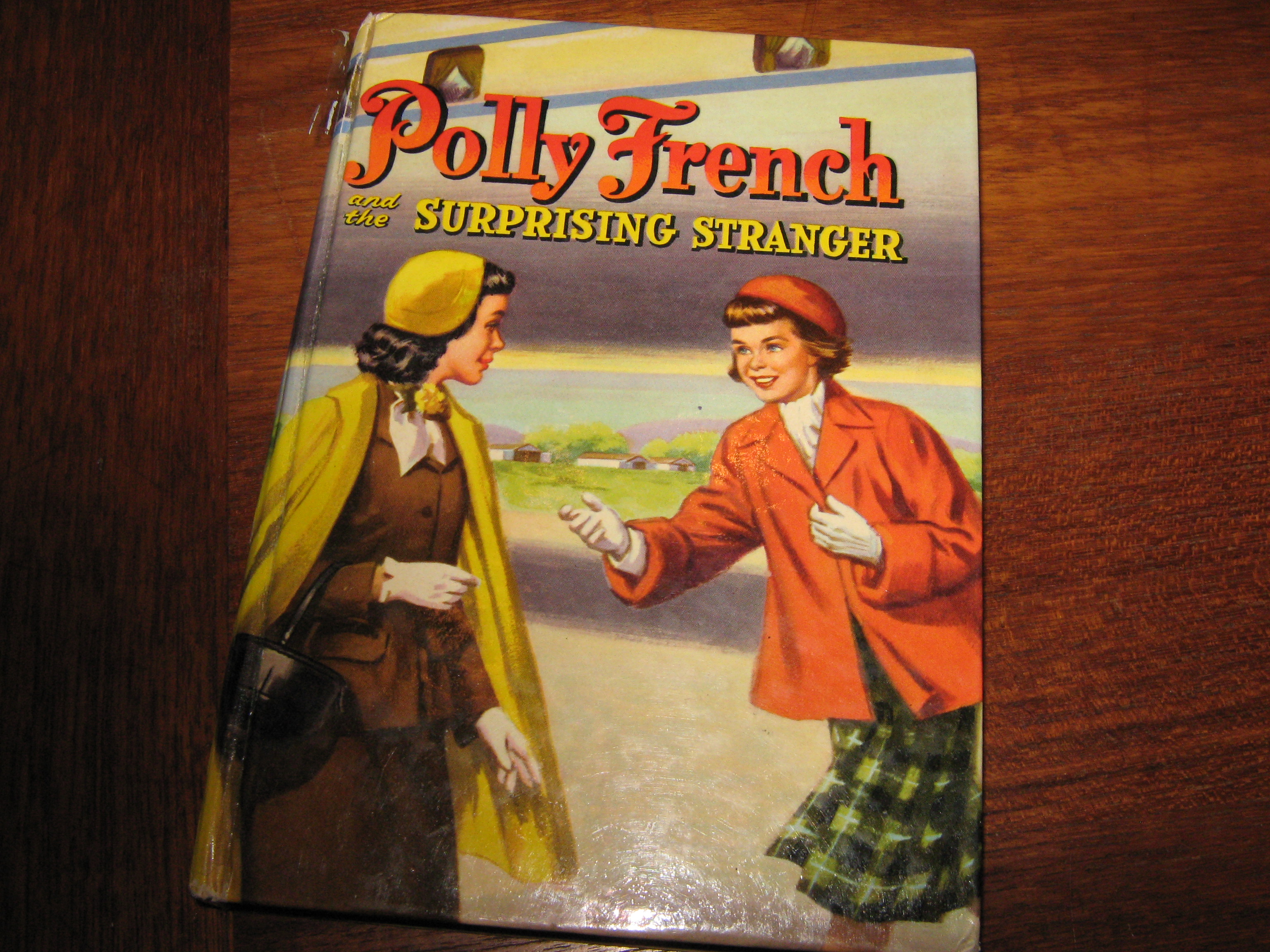
First, Francine Lewis’s Polly French and the Surprising Stranger,
I couldn’t resist this vintage kitsch, one of those Whitman books we used to buy at the grocery store for 59 cents. (Trixie Belden, Little Women, Heidi…all introduced to me by Whitman editions.) Francine Lewis was a pseudonym for Helen Wells, who wrote the first Cherry Ames books.Polly is the vice-president of the G.O., whatever that may be, and the visiting stranger is an exchange student named Lita. Is this a mystery? I’ll find out.
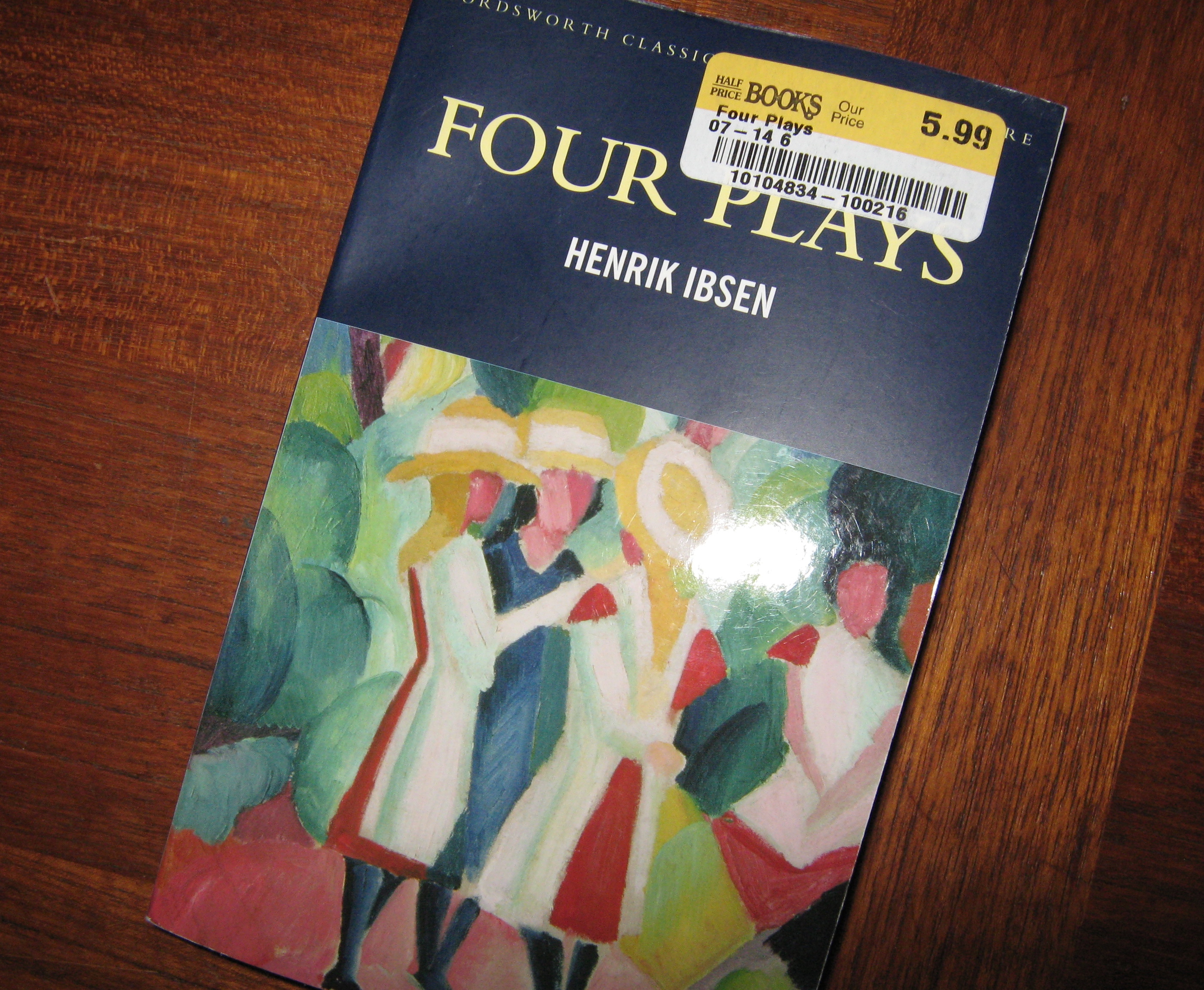
My replacement edition of Ibsen.
My Ibsen fell apart (it was a frail paperback from my Drama in Western Culture class of many years ago). I have been wanting to reread The Doll’s House.
And then I got home and there were two Rumer Godden books from Amazon (I only paid a penny plus postage: $3.99 each!).
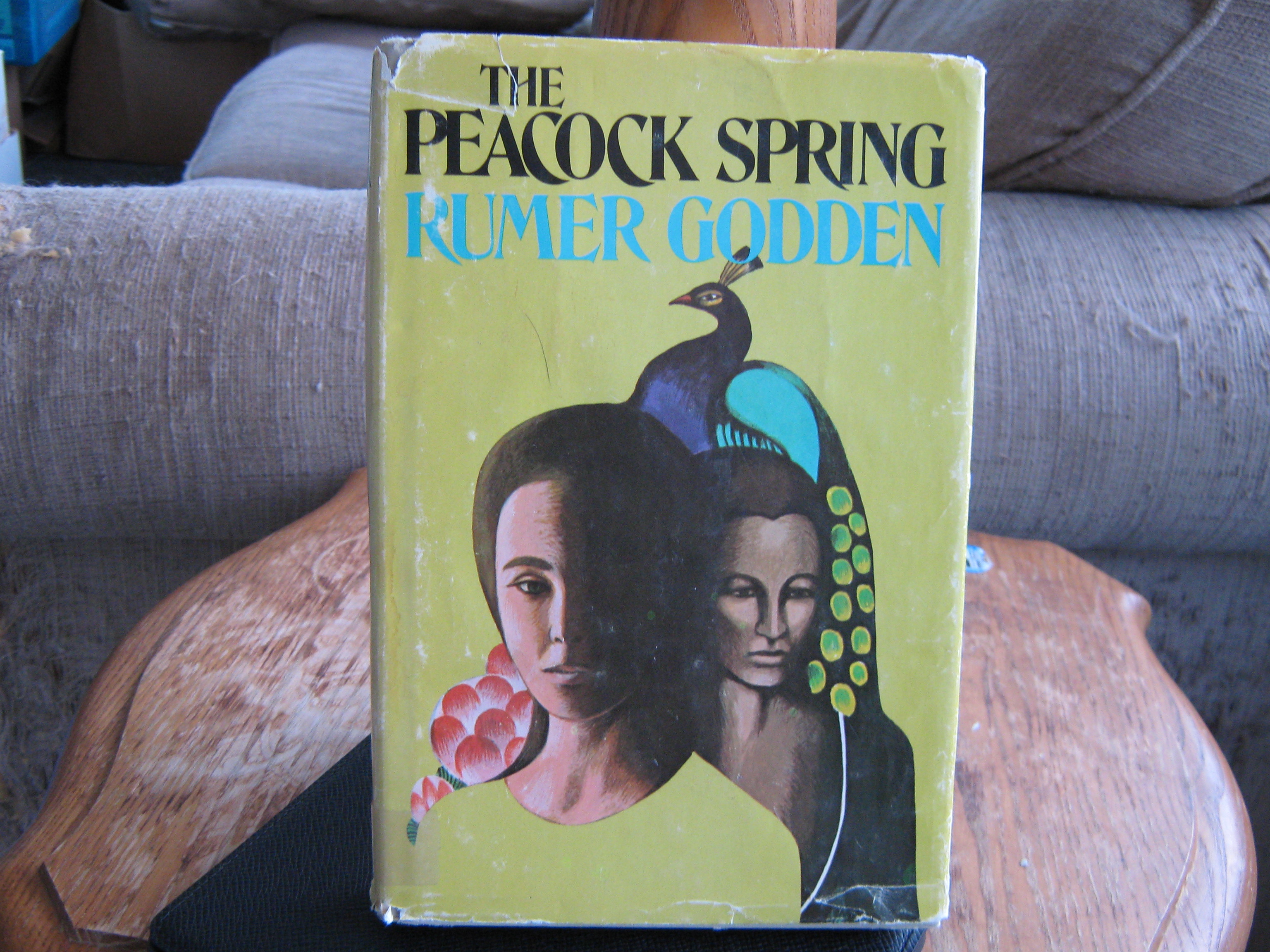
A friend recommended Godden’s The Peacock Spring.
Another book makes its way onto the porch.
Here’s the descriptions:
“Una and her younger sister Hal have been abruptly summoned to live in New Delhi by their diplomat father Sir Edward Gwithiam. From the first meeting with their new tutor and companion, the beautiful Eurasian Alix Lamont, Una senses a hidden motive to their presence. But through the pain of the months to come, the poetry and logic of India do not leave Una untouched. And it begins with the feather, a promise of something genuine and precious . . .”
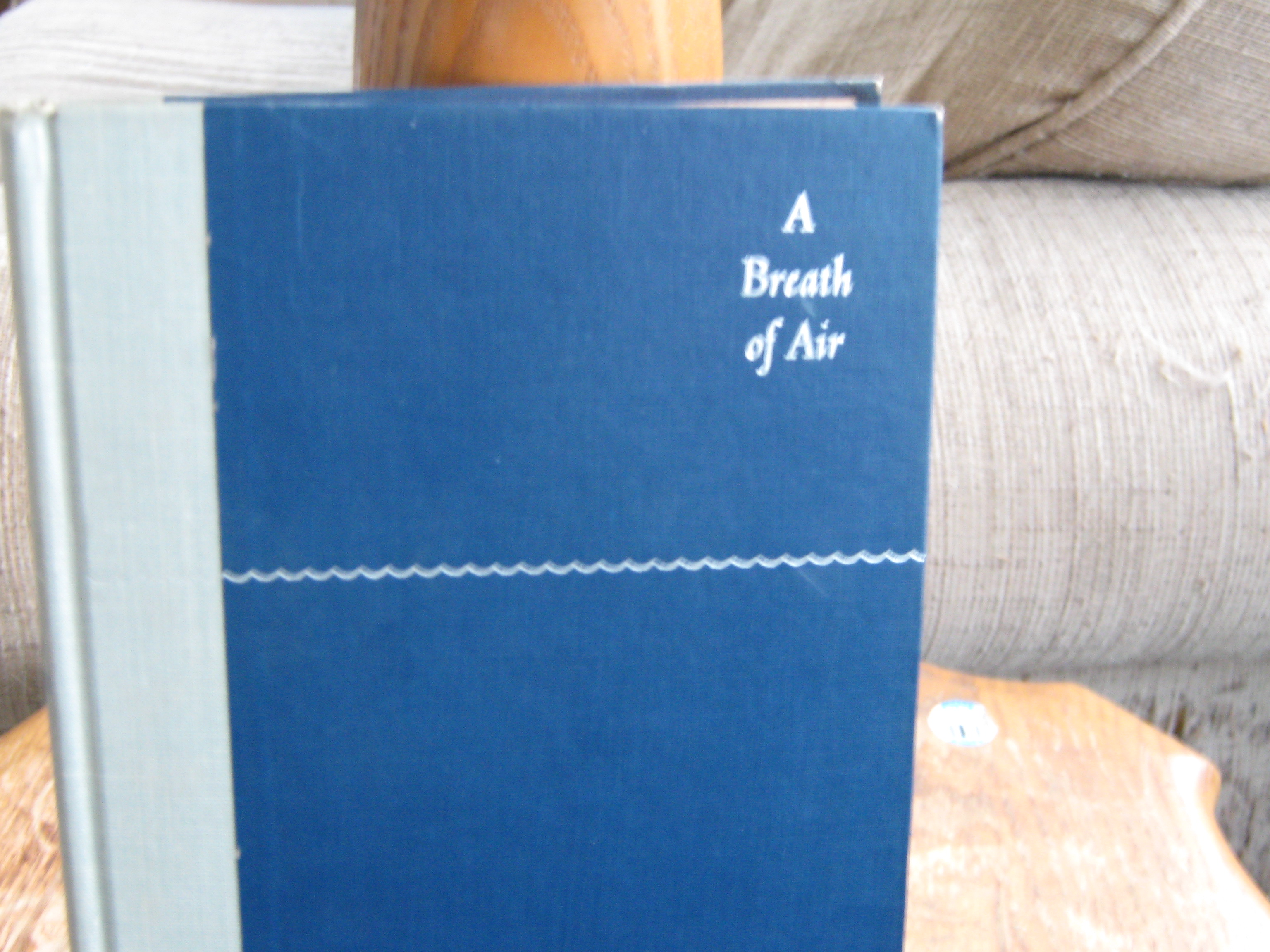
Godden’s A Breath of Air is a retelling of The Tempest.
Goodreads reviewers are very tough on this one, but who knows?
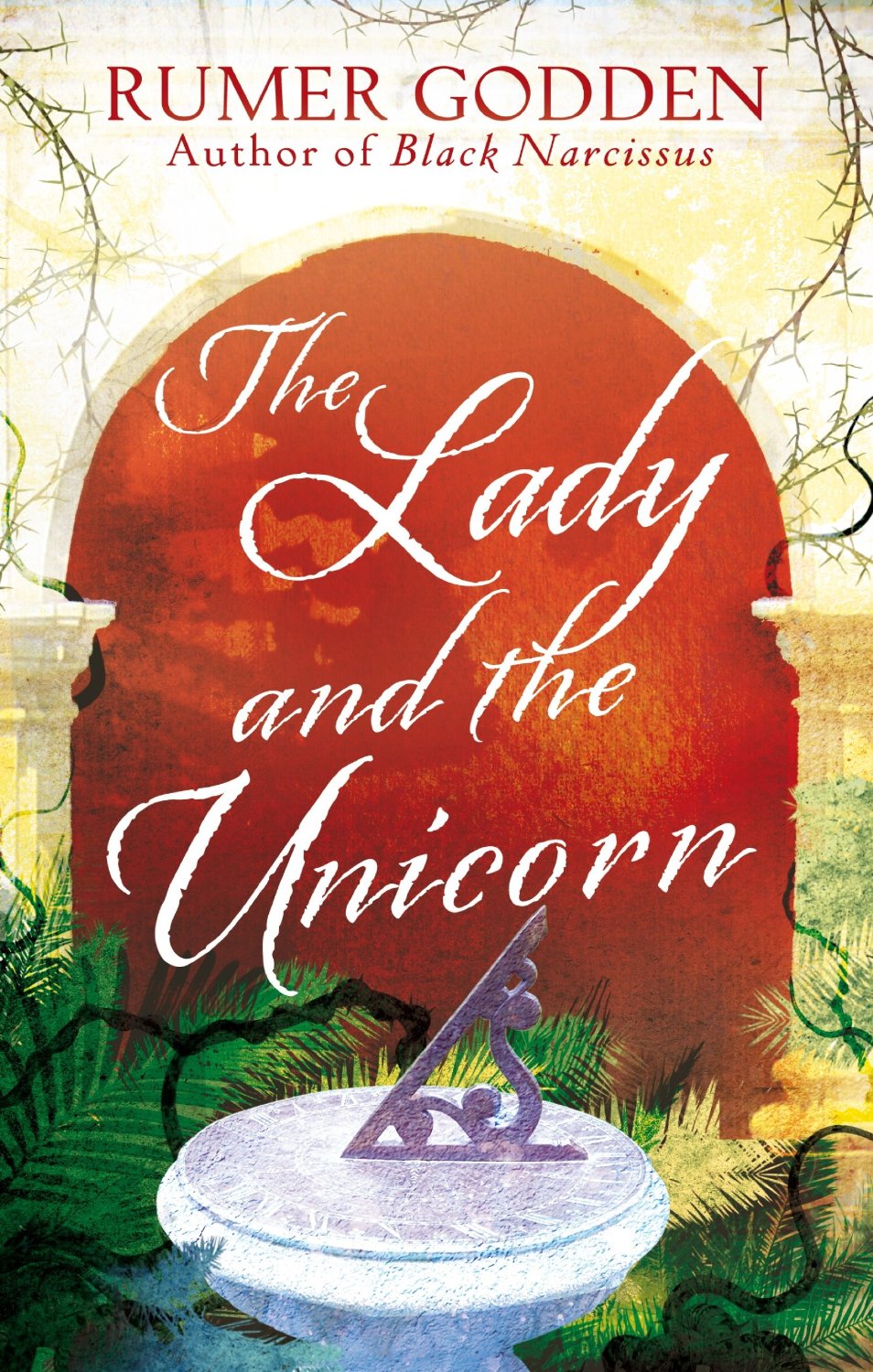
Virago has reissued several of Rumer Godden’s books, and recently reissued her lyrical second novel, The Lady and the Unicorn. Have you ever heard of this book? I had not.
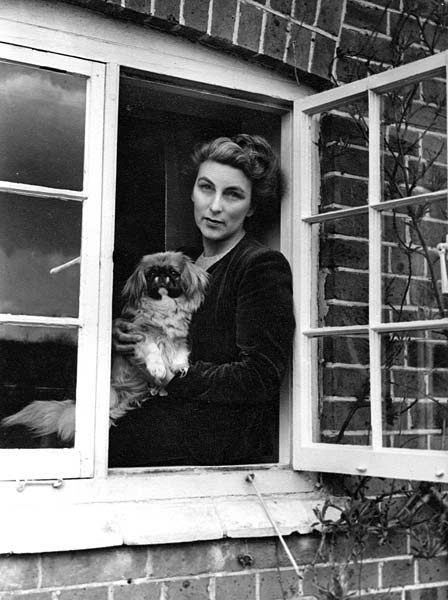
Rumer Godden
I love Godden, a once best-selling novelist whose neglected work is relegated to the dusty back tables at the Planned Parenthood Book Sale and charity bookshops. In 2009 I went on a Godden binge, reveling in old favorites like In This House of Brede (the best nun novel ever) and discovering several I’d never gotten around to. My favorite is Kingfishers Catch Fire , her autobiographical novel about an impoverished mother of two children who moves to Kashmir to “live simply.”
Godden, the daughter of a shipping agent who rejected a safe career as a stockbroker in England, had an idyllic childhood in India, returned to England with her sisters to be educated, taught dance in Calcutta for 20 years, and lived in Kashmir before returning to Britain permanently. Many of her novels are set in India. Her writing is lyrical, her voice sometimes whimsical, the scenes vividly imagined, and surprising twists lead to unpredictable outcomes.
Godden’s poignant second novel, The Lady and the Unicorn, tells the story of the Lemarchants, an eccentric, poor Eurasian family who rent a suite in a crumbling old mansion in Calcutta. It is also a ghost story revolving around a glamorous, sobbing lady and a little dog. Catholicism is a strong influence on the Lemarchants’ lives and imaginations: the novel opens with the visit of a priest. He has come to say that the pretty, sassy Belle must leave the Catholic school because of her inexplicable wickedness. He says her quieter twin sister Rosa must leave , too.
Mr. Lemarchant wants to know what Belle has done.
She has actually done nothing,” said the priest slowly. “She has, actually, said nothing. She has behaved exactly as she has always behaved, but with a difference! It is her attitude, an attitude of mockery, if I have to say it, an attitude of diabolical mockery. A terrible change has come over her. She was so quiet, so modest, and now she seems to taunt us.”
Belle and Rosa are twins, in their late teens, and don’t have much to lose from expulsion anyway. In describing their plight, Godden also vigorously explores the status of Eurasian women, who were despised by the British and the Indians as “half-caste.” Belle is well aware of what the men think of her, that she is loose, easy, and doesn’t need commitment, but she is determined to use the system to get ahead: she knows how to make herself attractive to Mr. Harmon at a party. Suddenly she is his “secretary.”
At that same party, Rosa meets Stephen Bright, a young man from England on his first day in India. He is extremely friendly.
He had been told by his cousin that the girls at the B party were not to be taken seriously.
What’s a B party?”
“A and B girls.”
“Oh, I see… What happens?”
“Usual thing…. They behave very well and we behave very badly, and then they behave worse.”
“Oh.”
Stephen considers Rosa pretty and sweet, and befriends her family. When he finds an old European sundial buried under the jasmine, he wants to investigate its origins. The twins and the landlord’s son, Robert have seen the ghost of a lovely woman who looks like Rosa and Belle, and their younger sister Blanche has seen an adorable Pekingese dog, Echo, running after her.
Stephen becomes obsessed with uncovering clues about other artefacts in the house. He is the only one who cannot see the ghost (because he is European?). But when Rosa gets pregnant, he breaks a very important promise to Rosa. He will not marry her. Abortion is mentioned, but Rosa and Auntie are horrified.
The story of the ghost is tightly connected with the Lamarchant family.
Don’t let me forget Blanche, the little sister: she is the dark-skinned girl in the family, an embarrassment to Belle. This strong-willed girl wants a dog, sees the ghost’s dog, Echo, clearly, and saves Rosa from their father’s threatened breach-of-promise suit by grabbing Stephen’s letters and throwing them into the fire.
I thoroughly enjoyed this novel.
By the way, at my old blog, Frisbee: A Book Journal. I wrote “review-ettes” of Kingfishers Catch Fire, China Court, Breakfast with the Nikilides, The Greengage Summer, The Battle of the Villa Fiorita, and the first volume of her autobiography, A Time to Dance, A Time to Weep. )
I am a fan of the underrated novelist Mary McCarthy, and, like all McCarthy fans, am a fan of The Group, her entertaining novel about the lives of eight Vassar graduates, class of 1933.
I could not resist checking out a book with the title Exhuming Mary McCarthy.
In Jessica Lamirand’s intense new memoir, she chronicles her four years in the 1990s at Colorado College, emphasizing her friendship with six girls who call themselves “the group” (after McCarthy’s book). In their free time, they confide, bicker, and experiment with sex, drinking, and drugs.
Written in novelistic fashion, this memoir contains such vivid dialogue and so many well-crafted scenes that I kept flipping back to the title page to make sure it was indeed a memoir, not a novel.
Lamarind’s education at Colorado College, located in Colorado Springs, was an intense experience: students take one class at a time in three-and-a-half-week blocks instead of semesters. Jessica is not a perfect student: she struggles at times, and is content with a mix of A’s and B’s. Mark my words: this readable memoir is an important document of the education of a woman at a small Western college. Most college books are set at Harvard, Yale, Princeton, the Seven Sisters colleges, Oxford, or Cambridge. (Indeed, It would seem to us Anglophile readers that, except in David Lodge’s novels and D. J. Taylor’s short story, “Wonderland,” in Wrote for Luck, there are only two schools in England, Oxford and Cambridge.)
The girls are immature when they arrive at CC, though some are more experienced than others. As a freshman, Jessica is a sweet, kind girl who has never dated or been kissed. She brings her complete set of Anne of Green Gables to her dorm room. Indeed, she pays as much tribute to L. M. Montgomery as she does to McCarthy. Her ideal man is Gilbert. She wishes a boy/Gilbert would call her “Carrots” so she/Anne could break a slate over his head and fall in love.
I share Jessica’s enthusiasm for the Anne books. She writes,
The Anne of Green Gables series had always been my very favorite books. From the first time I read them in sixth grade, I had been guilelessly enchanted by Anne and all of L. M. Montgomery’s other characters. I thought Anne and I were a lot alike. WE both daydreamed too much and then got in trouble for not paying attention. We both made lots of laughable mistakes and were none the wiser for having survived them. We both knew that imagination was a gift not to be wasted…. We both longed to find kindred spirits.
Jessica Lamirand
Jessica’s strongest bond in the group is with Sophie, another avid reader and a fan of L. M. Montgomery. The group also includes: Selena (a pothead who has a lot of tantrums), Aspen (a Native American who has a pet rabbit and wants to be a virgin until she marries), Hannah (anorexic, depressive, and promiscuous), Julie (a science major), Leigh (a loud pro-choice advocate who is also, oddly, a Nixon fan and becomes a pothead), and Cassandra (a Spanish major who is balanced and loyal and remains one of Jessica’s closest friends after they graduate).
The girls seem very young: they write about their crushes in their “Stalker’s notebook,” anxiously go to dances and ogle boys in the cafeteria, and smoke pot and drink. Jessica does not smoke pot: the one time she does, she is traumatized and terrified. They also listen to a lot of R.E.M. One of their favorites songs is “Exhuming McCarthy,” i.e., Joseph McCarthy, not Mary.
Jessica has her ups and downs. She starts out an English major, but switches to art history. As a sophomore, she falls in love with Malcolm, aka Thomas, an unemployed stoner and member of the Society for Creative Anachronism, who has been passed around from Julie to Hannah and now to Jessica. He is not a student, and though he occasionally works at Subway, she ends up supporting him at two jobs. When she is seriously ill, Malcolm always leaves, saying he can’t afford to get sick.
Majoring in” boyfriend,” as I call it, is always a problem for women. I doubled in School of Letters and “boyfriend” as an undergrad, and in classics and “boyfriend” as a grad student. If you major in boyfriend, you have to make tough choices: you can’t be all there for every class because you have a relationship to tend.
Let me be up-front: this really does read like a novel. It is slightly reminiscent of Pamela Dean’s classic novel, Tam Lin, which takes us year by year through English major Janet’s life at Blackstock College (Carleton College in Minnesota). But since I like novels, writing like a novelist is a good thing.
The group eventually splinters, and some go down the dark road of drugs, but these friendships remain a seminal experience in Jessica’s life.
I very much enjoyed this, though the McCarthy connection is unclear at first. The most detail is given to the first year, and afterwards it is occasionally repetititious, but by the end of the book you understand why she has structured it as she has, and it is powerful. (You have to stick it out to the end.)
Uneven, but a good read, and a historical document!
P.S. And here is R.E.M. singing “Exhuming McCarthy.”
I was groggy. Was I back on the commune in the ’70s? I wondered. That was the last time anyone cooked pancakes for me. But no one was wearing overalls, listening to Blind Faith, or feeding scraps to a cute dog from the pound, so I figured it was 2015.
I was reading an article about Hilary Clinton’s private e-mail account when the smoke alarm went off. BLEEP-BLEEP. “Where is it?” That is always the question. There is hunting, there is following the loud bleep, there is climbing on a chair, and there is disconnecting. Then there are black-crusted pancakes. They were burnt, but delicious with real maple syrup.
It was a surreal sitcom morning.
Here’s what we learned. When in doubt, cook it on medium. My motto: Cook everything on medium except boiling water. You boil that.
Bike Woes and Biking to Indianola
My Cannondale is the one with green pedals.
The weather has been heavenly. It was 68 degrees today.
Biking weather.
I have had a few bike woes lately.
Do you, like us, have several bikes? A city bike, a long-distance bike, and an old back-up? Maybe a few more in the basement? When the back-ups break down, you know you’re in trouble.
My woes started last year when my 2003 Cannondale got creaky. Everything had been replaced: seat, pedals, chain, derailleur, brakes, you name it. I didn’t like the new noise, so I bought an inexpensive Raleigh.
My husband was a little upset by the cheap Raleigh, and said I needed a better bike. But my reasoning goes like this: Why spend a lot of money on a bike when you can buy books?
The lovely cheap Raleigh has collapsed, less than a year after buying. And so I am back on my Cannondale. It creaks like mad, but it is much faster and easier to ride uphill. And now I know: it is the better bike. He was right.
And so CREAK-CREAK-CREAK: Yesterday we rode our bicycles on the Summerset Trail from Carlisle to Indianola, Iowa. The 11-mile trail (22 miles round-trip) is VERY EASY. And that’s why you want to ride it. Your first long trip of the year eases you into riding. And so you ride past the wetlands with the frogs croaking and then you are in a state park with a lake.
Uncommon Grounds, Indianola
If you are lazy, you can stop by the small lake (six miles into the ride) and have a picnic. We go on to Indianola,though, because I really, really like coffee.
You can go to Uncommon Grounds, a coffeehouse-cum-deli with great coffee, delicious sandwiches, and dessert, if you get there before 2 p.m., when everything on the square closes up.
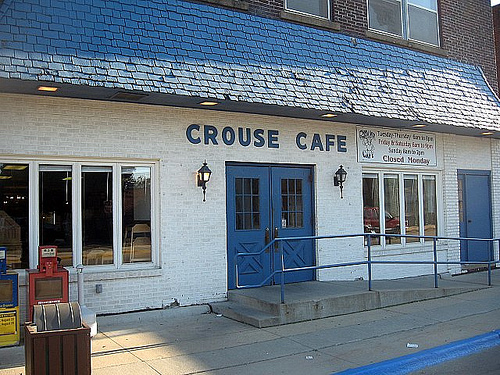
Crouse Cafe, Indianola
If you have a big appetite, you can go to Crouse Cafe, which is open all day. It has wonderful home-cooking specials like chicken with noodles, rigatoni, or catfish. I’m not sure about the coffee.
I am so happy to take a long bike ride so early. (Last year, we weren’t on the Summerset Trail till April 26: read about it here..) No jacket, or wear just a sweatshirt–we’ve got to be kidding, right? And the weather’s going to be nice all week.
Last spring I traveled to London. I drank coffee at Costas, saw the Blue Chicken at Trafalgar Square, broke my camera while photographing a Roman tiara at the British Museum, and purchased at least 20 books during frequent visits to Skoob, Foyles, and the London Review Bookshop.
The local newspaper reports that Midwestern tourists are annoyed at having bought expensive tickets to exotic places when the weather this spring is gorgeous right here. (I’m staying home.)
Nonetheless, I am recommending Spring Break reading for y’all. If you’re flying from O’Hare (and God help you if you are), your plane will be late or canceled or rescheduled and you will be there for five hours before you get on the f—g plane. When the stewardess offers you free drinks, a disgruntled passenger will shout, “Seriously? Just get us home.”
I hope you brought some books with you.
First up, Katie Fforde’s Love Letters.
Do you love to laugh? Of course you do. Fforde writes high-end chick lit that borders on literary fiction. I chose this novel because the heroine, Laura Horsley, is a voracious reader who works at a bookstore. Unfortunately, this bookstore is about to close.
When barracuda agent Eleanora Huckleby shows up at a client’s reading at the bookstore, she is impressed by Laura’s critical knowledge of contemporary fiction and organizational skills: Laura organizes the readings. And so she manipulates Laura into helping organize a new literary/rock festival (something like Gloucester). Laura travels to Ireland to beg their favorite writer, Dermot, to give a reading at the festival. He tells her at the pub that he will go if she sleeps with him. Laura is so drunk that she agrees but falls asleep immediately Technically she has slept with him, but she can’t remember if they had sex. (They didn’t.)
To make this comedy even more delicious, Dermot is so smitten with Laura that he comes to England to teach a week-long writing course, and deviously arranges for her to be his assistant. He insists that Laura screen the manuscripts (most are dreadful and very few have a plot) and work as his assistant during the course
When Dermot asks her if she understands how much a PR glitch interferes with his creativity, the prim Laura suddenly says,
No, because, thank the Lord, I’m not a creative person. I’m just the little Jane Eyre character who makes it all possible for you pathetic, irritating, solipsistic, up-themselves “creative people”!
Go, Laura!
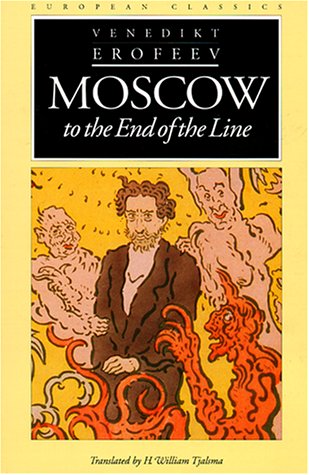
Second up, Venedikt Erofeev’s Moscow to the End of the Line.
How do you feel about Russian satire? This short Russian classic, written in 1969 and published in Europe in the ’70s but not in the Soviet Union till 1989, is a hilarious-sad send-up of Russian life, literature, alcoholism, and the Kremlin. I love it so much that I intend to reread it shortly.
The hero-writer, who is coincidentally named Venedickt Erofeev, has been kicked out of his job as a foreman of cable fitters, beacause he spent his work hours drinking and graphing the employees’ drinking, and a colleague sent the graphs to headquarters. Disgraced and drunk, Venedickt takes a train journey from Moscow to Petushki: he says he wants to see his new lady-love and his sickly child
But he begins with the Kremlin.
Everyone says, ‘The Kremlin, the Kremlin.” I hear about it from everybody, but I’ve never seen it myself. How many times (thousands) I’ve walked, drunk or hung over, across Moscow from north to south, east to west, from one end to the other, one way or another, and never did I see the Kremlin.
The circular emphasis on the Kremlin in the first paragraph–it is named in the first and last sentence– anticipates the circular journey Venya is about to make from Moscow to Petuskhi and back to Moscow–and the Kremlin. With a suitcase full of liquor, he drinks heavily in the vestibule of the train and chats to other drunken passengers. They often mention Pushkin, Gogol, and Turgenev (one of his and my favorite Russian writers) and in fact the passengers decide to recreate Turgenev’s First Love, which begins with the characters taking turns turns recounting stories of their first love.
Venedikt makes some jokes about First Love.
Of course,” I added, “in Turgenev it’s a little bit different, in Turgenev, they all get together around the hearth, in top hats, holding jabots in outstretched hands. Oh well, OK, even without the hearth we’ve got something to warm up with. And what do we need with jabots? Even without the jabot we can’t see straight.”
By the way, on the train he also talks to angels and Satan..
The slangy, very readable, entertaining translation is by H. William Tjalsma (European Classics, Northwestern University) . I loved it. And I hope I’ll find something else by Erofeev at a used bookstore one of these days.
My Iowa Summer Writers’ Festival catalogue arrived in the mail.
Mind you, I don’t plan to enroll in any workshops, but I esteem the concept of creative vacations.
Bread Loaf Writers’ Conference
Writers’ conferences are a big industry nowadays, and it could be argued that they exploit aspiring writers. Can you write a sentence? Then I guarantee you will be accepted in a workshop. But even if most of your fellow students are mediocre, and possibly strung-out when they discover their book is not material for the next Oprah Book Club, it is still likely that 9-to-5ers or tired teachers and journalists will enjoy chatting with others about writing and even gain some constructive criticism.
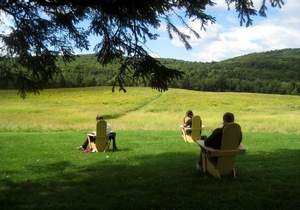
There is a boom in writers’ conferences. The first and most famous is Bread Loaf, founded in 1926, at Middlebury College in Vermont. But nowadays one can mercilessly edit one’s poetry at a conference on a beach in Hawaii, or scribble that novel in Adirondack chairs in the Carolina mountains.
I really should get that novel out of the drawer. I wonder where the hell it is. It might be fun to revise it and attend a workshop on Novel Craft, or perhaps Where to Begin in Fiction?
At a career crossroads a few decades ago, I went to a writers’ conference. I carefully honed the short story I planned to workshop: the overeducated young heroine, who idealized the poor, found herself unhappily ensconced in an urban neighborhood where junkies smoked behind her garage and immigrants walked goats down the street.Did the teacher like the story? No. He hated it. He finally praised one of my stories, after I had removed all adjectives, adverbs, and, if I remember correctly, commas.
Oddly, I did learn a lot. His tough criticism (did he have to be so brutal?) and unequivocal exercises taught us to focus, shape a plot, and ramble less.
The best thing about the conference, though, was hanging out. The other students were fun, charming, and supportive. We walked on the beach, jogged around campus, and tried to keep the prima of the workshop from f—-g every guy in sight. She was such a good writer, but never published a book. Talent doesn’t always win.
Although writers’ conferences are continuing education programs, and have nothing to do with MFA programs, creative writing programs are constantly under attack. People are critical of what they call “workshop” fiction, though what that means I do not know, and I doubt that they could define it. Many brilliant writers come out of these programs. Alumni of the Iowa Writers Workshop alone include Flannery O’Connor, Rita Dove, Charles Wright, Andre Dubus, T. C. Boyle, Jane Smiley, Alan Garganus, Michelle Huneven, Lucy Grealy, Karen E. Bender, and Paul Harding.
In the Feb. 27 issue of The Stranger, Ryan Boudinot’s article, “Things I Can Say About MFA Writing Programs Now That I No Longer Teach in One,” attacks MFA programs. He dismisses the majority of the MFA students as talentless. He writes,
I recently left a teaching position in a master of fine arts creative-writing program. I had a handful of students whose work changed my life. The vast majority of my students were hardworking, thoughtful people devoted to improving their craft despite having nothing interesting to express and no interesting way to express it. My hope for them was that they would become better readers. And then there were students whose work was so awful that it literally put me to sleep. Here are some things I learned from these experiences.
Heavens, what did Boudinot expect? They are students, not professionals. The MFA programs give them time to write, and some will develop their talent. Although most will not publish much (I’ve known some very smart MFAs who have simply vanished after graduating), it is not necessarily a wasted experience. Does creativity always have to lead to publication?
Of course writers’ conferences are different from MFA progams. Students are amateurs, though some are very good. Perhaps they are not the next Oprah book club writer, but I do know five people who have published books after attending these conferences.
And so, my philosophy is, go to the conference if you want to, if you’re stuck, or need some help, or just want to chat to people who write. Write. Enjoy. And worry about the publishing tomorrow.