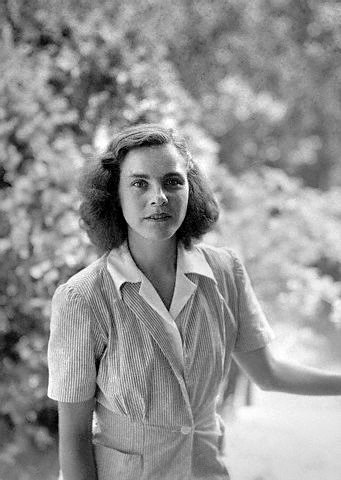
 Mary McCarthy is best-known for The Group, her outrageously candid, entertaining novel about eight Vassar graduates, class of 1933. It has the funniest scene ever about being fitted for a diaphragm.
Her bad moment came when she was learning how to insert the pessary by herself…. As she was trying to fold the pessary, the slippery thing, all covered with jelly, jumped out of her grasp and shot across the room and hit the sterilizer. Dottie could have died.
 And I have been reading McCarthy’s earlier satires, which are actually more effective than her famous women’s novel.
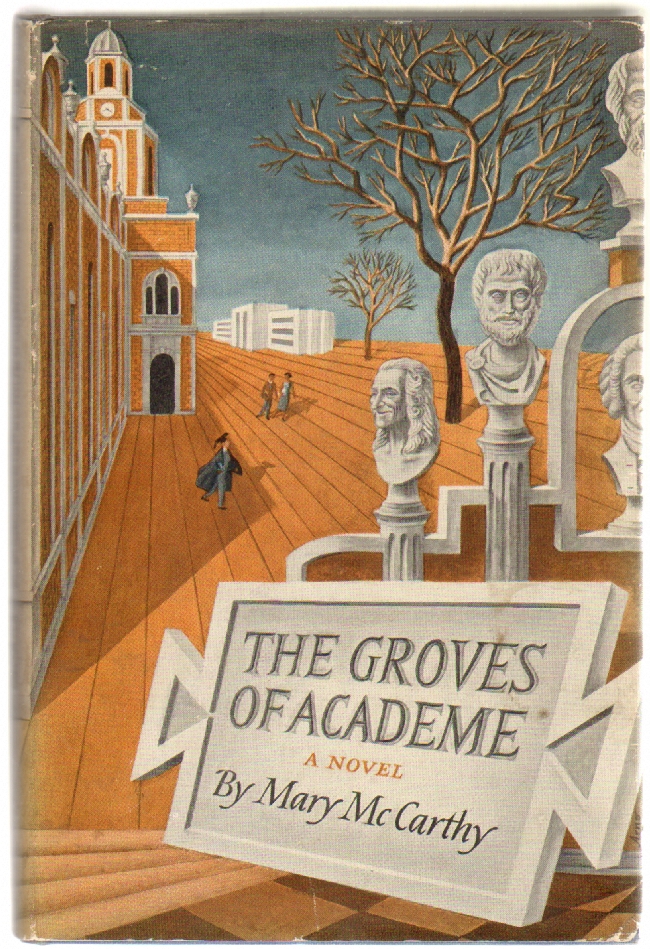
The Groves of Academe, a satire of an experimental college during the (Joseph) McCarthy era, is clever, polished, and surprisingly twisted. It was published in 1951.
If you expect Kingsley Amis’s Lucky Jim or David Lodge’s Changing Places, brace yourself: the intellectual McCarthy generates a harrowing hilarity born of liberalism and her rejection of Catholicism. McCarthy, who was a member of the Partisan Review group in the 1930s and taught at Bard College and Sarah Lawrence College in the 1940s, takes no prisoners in her bitter skewering of academia. Every brilliant, bitter, sinuous sentence glitters with the mix of venom, idealism, maneuvering, lying, camaraderie, hostility, and cliquishness that characterizes academic politics.
And, as if to completely discombobulate the reader, the hero is unattractive and not even sympathetic.
Henry Mulcahy, a Joyce scholar and instructor at a small “progressive” college in Pennsylvania, learns that his contract will not be renewed. It is not a good time to be a leftist: he was fired from a university in California because of his radical writings in The Nation. He was hired as an instructor at Jocelyn solely because friends called in favors to Maynard Hoar, the liberal president of the college. Hoar stood up for freedom of political beliefs; now the budget has been cut and he has decided to stand down.
Henry has a satiric view of his situation, but he knew Jocelyn was the end of the line for him and his family.
He sat down at his desk, popped a peppermint into his mouth, and began to laugh softly at the ironies of his biography: Henry Mulcahy, called Hen by his friends, forty-one years old, the only Ph.D. in the Literature department, contributor to the Nation and the Kenyon Review, Rhodes scholar, Guggenheim Fellow, father of four, fifteen years’ teaching experience, salary and rank as instructor–an “unfortunate” personality in the lexicon of department heads, but in the opinion of a number of his colleagues the cleverest man at Jocelyn and the victim, here as elsewhere, of that ferocious envy of mediocrity for excellence that is the ruling passion of all systems of jobholders.
 Seeing no alternative, Hen manipulates his friends to intercede on his behalf: he says his wife Cathy has a severe heart condition and that any shock could kill her, and he implies that the FBI is out to get him and that Hoar has caved to pressure. He has a group of earnest supporters, including Domna, the youngest, most loyal member of the Literature department, and Alma Fortune, the department chair, who resigns on principle.
But when they learn that Hen has lied (Cathy was ill after her last pregnancy, but isn’t now, and Hen was never a member of the Communist party), the group is furious. Although Hen is brilliant and popular, he is a lazy teacher, he doesn’t take the tutorials seriously, and turns in his paper work late. How far must they go to protect him?
McCarthy sketches a hilarious picture of the “progressive” college. The students have tutorials instead of classes, and major in whatever they want, even if it is Broch’s The Death of Virgil and they don’t know Latin. The faculty argues over the correct spelling of “catalogue” and whether the students should have a two-week field work period in January. (The teachers go on vacation during field-work period). Then there is the never-ending poetry conference where one of the more flamboyant poets speaks on Virgil.
The majority of the students present had never heard of the person being alluded to as the Mantuan; they supposed he was a modern poet whom their faculty had not yet caught up with–a supposition correct in a sense, as Howard Furness, maliciously grinning, remarked in his slippery voice afterwards.

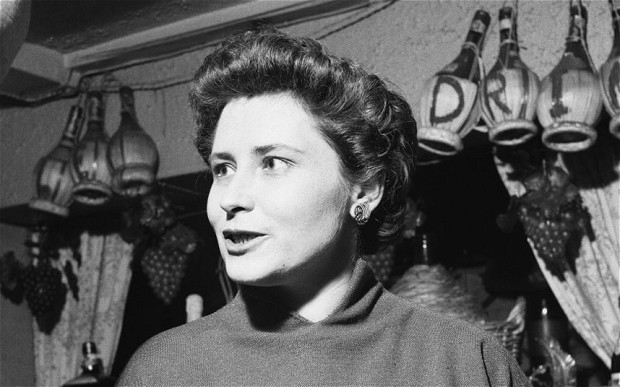
Mary McCarthy and Dick Cavett
I love McCarthy’s work, but she was a bit of a hellion. I remember in 1980 watching the Dick Cavett Show when she called Lillian Hellman a liar. She said, “[E]very word she [Hellman] writes is a lie, including `and’ and `the.'” Hellman sued , and the lawsuit only ended with Hellman’s death four years later. Two great underrated American women writers at each other’s throats! Tsk,tsk.