Not AA, not NA, nothing exciting.
It is the first meeting of a book group for fifty-plus women, or, as I call it, the Post-Menopausal Grrrls.
I’m expecting to find a cadre of wild white-haired bibliophiles, the female equivalent of the quixotic dreamers in my SF/fantasy book group. The SFers are endearingly knowledgeable about eBay deals on first editions of Alfred Bester’s The Stars My Destination and engineering problems in The Martian. I always enjoy the unexpectedness of their dialogues.
Who will the fifty-plus-ers be?
Book groups in my city tend to be small. And so I am not surprised to see there are only six women. No one with white (bike) helmet hair (like mine); all are professionally dyed and coiffed. The kind leader, who gives me a nametag, tells me there’s coffee in the urn. I tell her I love coffee, but only fresh-ground from whole beans.
How I’d love to be a member of this group. But it’s not what I expected. These pleasant women are all grandmothers, poring over pictures of grandchildren on their phones. Even after menopause, they can’t stop talking about reproduction.
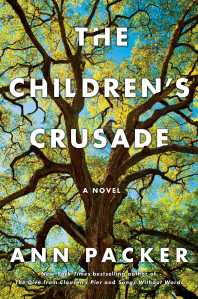 Finally we discuss Ann Packer’s The Children’s Crusade, a classic “bad mother” novel.
In this brilliant novel about five decades in the lives of the Blair family, Packer asks questions about the American family: is the “bad mother” responsible for all her children’s woes? Is she even necessary when her husband, a saintly pediatrician, is the perfect parent? The women at the group are no-holds-barred angry about the artist Penny Blair’s withdrawal from her family. Having seen many styles of parenting, some much worse than Penny’s, I suggest that Bill, who responds to every crisis with caring questions and psychoanalytical language, is also part of the problem. But censure of Penny is the order of the day.
Some book groups have it, some don’t. This particular group responds emotionally to parts but not the book as a whole. The SFers would have a more interesting take on it.
At the end of the meeting, I recommend Carolyn See. Has anybody read her? (My SF group likes her novel Golden Days.)
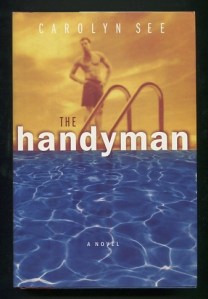 Carolyn See, the American novelist, memoirist, and critic, is one of my favorite authors. She writes with uncanny clarity, interweaving brilliant insights about modern American life with graceful descriptions of the quotidian. I recently reread The Handyman, the story of an artist who finds his vision while working as a handyman.
See cleverly frames the story with a Guggenheim application in 2027 by an art historian, Peter Lauce, who wants to study the early and intermediate period of Robert Hampton’s art. Then it segues from the application to the events of the summer of 1996, when Hampton abandons his plan to live in Paris for a year and turns around and flies home to L.A..
Robert wonders gloomily, Does an artist have to live in Paris? Can art be made in L.A.? He thinks of Anthony Hernandez and Carlos Almaraz.
He posts his handyman flyers. Desperate people hire him to bring order to their lives. He cleans the houses of depressed housewives, arranges help for a young man from Ohio trying to care for his lover dying of AIDS, clears out a beautiful widow’s husband’s belongings and becomes her friend (and more), and paints the cement around a rich family’s swimming pool cerulean blue. Suddenly he notices a toddler curled up on the bottom of the pool with his thumb in his mouth. He saves the drowning child’s life, and is forever bonded with Angela, Tod’s mother. She is a simple, charming, honest woman, living on a different plane from her abusive rich husband. Her philosophy of life is immediate and mellow.
She tells Robert,
“I’ve never had any ambition. I just want, like what we have today. Like…that time in the day when nothing’s happening. As if it were three in the afternoon, on a weekday. Or four. Everything’s in order. You don’t have to start dinner for a couple of hours. And you’re out in the backyard. Or on the porch.”
Don’t we all live for those mellow hours? She influences Robert more than he realizes as they become friends. No wonder he falls in love with her.
Love makes art! (I think.) Or something like that!

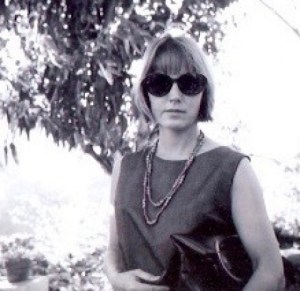 Carolyn See, one of the best American writers of the twentieth century, died on July 13. Barbara Eisenberg wrote in The L.A. Times:
 “Who let A.S. Byatt publish Peacock and Vine?”
 mirabile dictu