
 One day a friend in her fifties, feeling confident and beautiful, walked along the beach wearing a bikini. A young man came up behind her and then blanched when he saw her face.
“That’s when I knew I was middle-aged,” she said.
Many of us have moments like this, but we secretly remain confident, loving our crow’s feet, our gray hair, and our bodies.
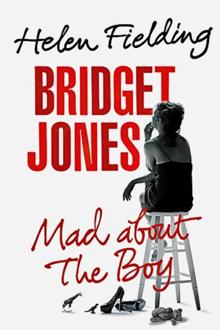
And so a lot of us are laughing aloud at the moxie of Bridget in Helen Fielding’s new novel, Bridget Jones: Mad About the Boy.
Bridget, 51, now a widow and a single mother, is attempting to get out of the house and meet men. It is a jungle in clubs and on Twitter and she makes many faux pas. She tells “Leatherjacketman,” a man she meets at a club, that she hasn’t had sex in four and a half years. And when she is on a date with a younger man, he takes away her phone so she won’t tweet the whole date.
Reviewers hate this book, and why it should be reviewed in the first place–it’s light, it’s charming, it’s not literature–I do not know. It is not a comedy in the class of, say, Cathleen Schine’s The Three Weissmanns of Weissport, a retelling of Sense and Sensibility. If reviewers expect Bridget to be a role model, they are not good readers.
Jen Chaney at The Washington Post says,
While parenthood and profound loss may have forced Bridget to grow up in some ways, she hasn’t grown up much. And that’s one of this novel’s key problems. Readers may expect a middle-aged woman who has dealt with such loss to have lowered her narcissism levels a tad. Not Bridget Jones . . . or, pardon me, @JonesyBJ.
Bridget is middle-aged, not dead.
Bridget is still in what I call the flirt zone, and that, too, is a problem for some reviewers. One of Bridget’s suitors is 21 years younger, and of course we know it won’t last. But, as Bridget points out, younger men like older women because they’re “refreshingly not looking to them to be bread-winners and not thinking about babies any more.”
And Bridget says of the fifties:
It used to be the age of Germaine Greer’s ‘Invisible Woman,’ branded as non-viable, post-menopausal sitcom fodder. But now with the Talitha school of branding combined with Kim Cattrall, Julianne and Demi Moore, etc., is all starting to change!
Well, Ashton left Demi…but I like Bridget’s viewpoint.
Reading about middle-aged women is empowering for those of us who are middle-aged. Though women are believed not to age as well as men, that is probably a power thing: we’re still doing everything we’ve always done, just as middle-aged men are. And, frankly, we want to read about people our age now and then. Young men and women can be…well…boring…if very sweet.
I have enjoyed other novels about aging women.
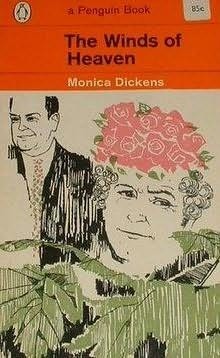 In Monica Dickens’ The Winds of Heaven, Louise Bickford, a 57-year-old widow, spends part of each year living with each of her three daughters. (Thank God I didn’t reproduce, though I’ll probably regret it in old age.) She spends the winter at a hotel owned by a friend who doesn’t want her.
In London, which seems unbearably exciting and sophisticated to Louise, she waits in a tea room for her daughter, wishing she were more attractive.
“Louise was always much concerned with how people were thinking of her and summing her up; not knowing that a small, middle-aged woman with stubby features and hair no longer brown and not yet grey usually goes unnoticed.”
But she does attract Gordon, a fat mystery writer, whom she meets in a tea room. She has read his books. They become good friends.
And Louise gradually finds herself. This is a charming comedy-drama, not great literature, but entertaining.
Of course Colette’s Julie de Carneilhan is great literature, not a pop novel. Julie, the beautiful heroine, in her early forties, still regrets her divorce from her second husband, Herbert. Her brother tells her that people will talk if she goes out partying with her younger boyfriend, Coco, while Herbert is very ill.
Julie asks, “Am I expected to put on mourning in advance for a man who was unfaithful to me for eight years and has been married again for another three?”
She is bitter but deeply cares for Herbert, and has a revelation when she visits him. This is a graceful, lyrical novel about the consequences of divorce.
I’m always interested in “middle-aged” literature. So what are your favorite books about middle age and old age? (And I don’t mean that book about menopause that recommends we have an orgasm a day to stay healthy. I’m still laughing about that.)

 mirabile dictu