
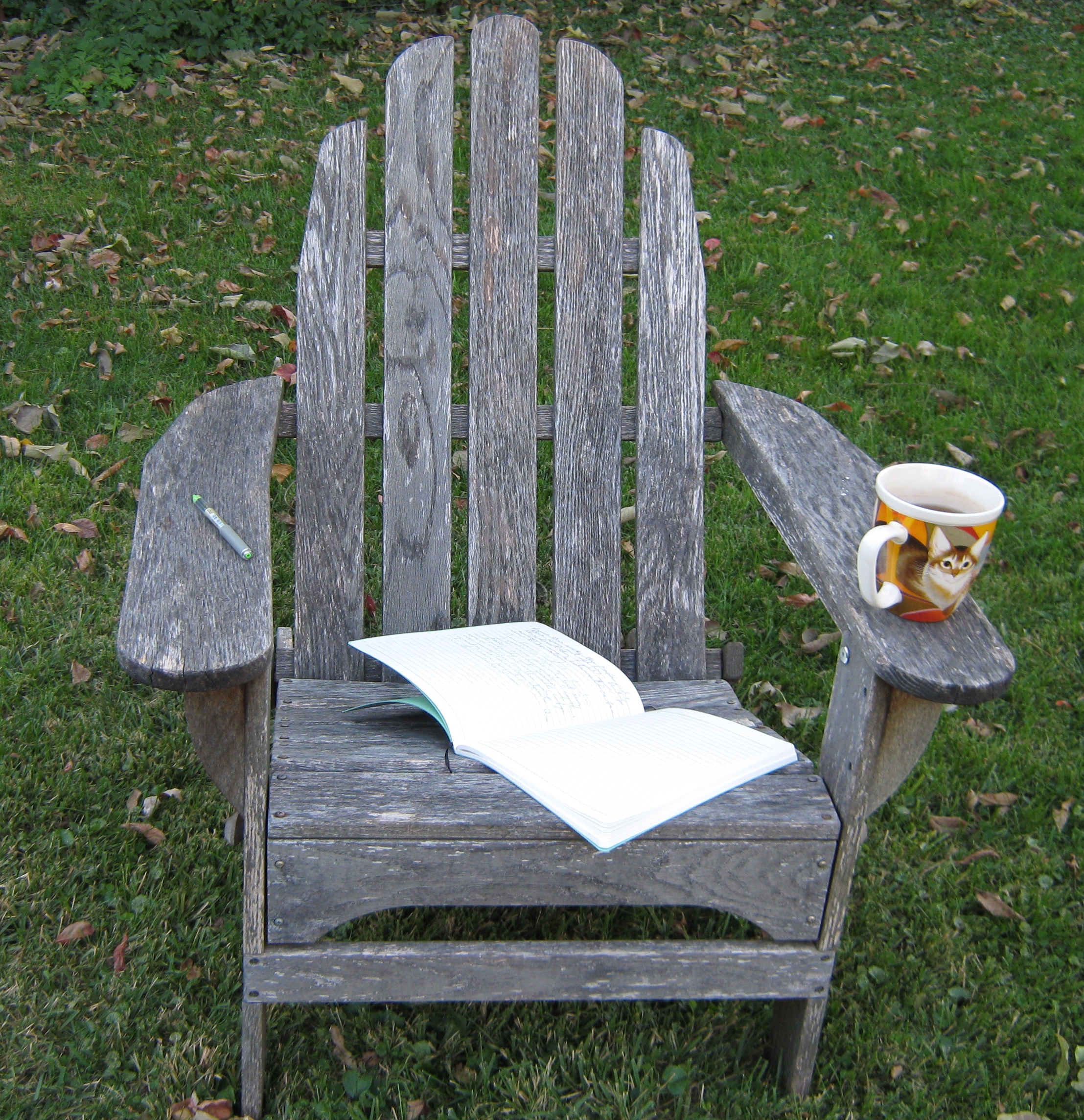
Yup, it’s tea time in the back yard.
I’m calmly drinking my home-brewed tea after a week of gulping Grande javas at sidewalk cafes. My home cafe is like Starbucks without the Starbucks, or Costa without the Costa. I love the beautiful parks and squares in London, but it is really better to sit under a tree in your pajamas and drink coffee out of a kitschy cat mug.
And so as I read Lynne Reid Banks’s elegant, moving novel, The L-Shaped Room, a 1960 feminist classic about an unmarried pregnant woman in her late twenties, I not only admired the exquisite writing but noted how much coffee and tea is imbibed.
 The narrator, Jane Graham, a former actress who works in PR, is confused and sad and daren’t tell her friends about her pregnancy. Instead, she throws herself upon the expertise of middle-aged men. A Harley Street doctor assumes she will want an abortion. And when she tells her father she is pregnant, he says she is no better than a street-walker. Fed up with the patriarchy, Jane leaves home and moves into a seedy L-shaped room in a dilapidated house.
We tend to forget the stigma of unwed pregnancy, since it is celebrated in sitcoms and movies (Friends, Mom, The Switch, etc.). Abortion is still a guilty secret, because of the mad Fundamentalists who picket and protest Planned Parenthood and abortion clinics. At the moment, funding for Planned Parenthood is under attack by the Republicans. It wearies me to think my days as a volunteer coordinator for NARAL in the 1970s made so little difference.
But I am fascinated by this novel, not because of the pregnancy, but because I love reading about Jane’s cheap digs and the people who rent rooms there. They band together, as people do when they have a bad landlady and bedbugs terrorize them. Jane makes friends with Toby, a witty writer who would rather talk to Jane than write; John, a black jazz musician who does needlework ; the two kind prostitutes, Jane and Sonia; and Mavis, the retired costumer for a theater company. John is always making tea and meals for Jane and Toby. Mavis makes the best coffee. Jane loves coffee, and also drinks it at Frank’s, a neighborhood cafe.
In college we all rented rooms unless we had trust funds. (Those with trust funds owned their own houses, and generously offered to let us live there, but then you had to buy Christmas trees with them… and it wasn’t worth it if you were depressed). I could barely squeeze a bed and tiny bookcase into my room, but it was my own. All of us got to know each other in the shared kitchen, and we went to discos together (such bad music!), sunbathed on the roof, and occasionally shared Ramen noodles and cake mixes.
Jane’s house was bigger than our three-story. Jane says,
My room was five flights up in one of those gone-to-seed houses in Fulham, all dark brown wallpaper and peeling paint outside. On every second landing was a chipped sink with one tap and an old ink-written notice which said ‘Don’t Leave Tap Dripping.’ The landing lights were the sort that go out before you can reach the next one. There were a couple of prostitutes in the basement; the landlady had been quite open about them. She’d pointed out that there was even an advantage to having them there, namely that nobody asked questions about anybody.
I love this kind of book. So I’ve been thinking about other novels where characters live in lodging, and please let me know your favorites!
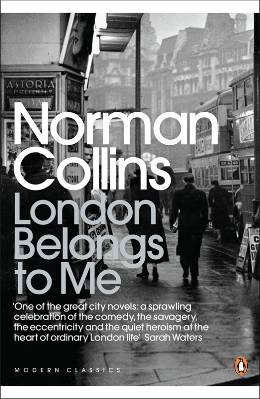 Norman Collins’s London Belongs to Me. In this charming novel, Collins interweaves the stories of the residents of Number 10 Dulcimer Street in London. Th stingy landlady, Mrs. Vizier, broods in her basement apartment, wondering if any of her tenants are bringing the tone of her house down. But her tenants are a plucky lot, and they support one another through innumerable troubles, including a murder. (I wrote more about this novel here.)
- Monica Dickens’s The Heart of London. I read this years ago, so here is an excerpt from the Kirkus Review: “The happenings in an urban section of London, Cottingham Park, have for their background the threats and rumors of the widening of the road through, of an expressway and the demolition involved — all of which become a reality, and link and interlink the of a large collection of people.
- The Yacoubian Building by Alaa-Al-Aswany. From the Amazon description:
“All manner of flawed and fragile humanity reside in the Yacoubian Building, a once-elegant temple of Art Deco splendor now slowly decaying in the smog and bustle of downtown Cairo: a fading aristocrat and self-proclaimed “scientist of women”; a sultry, voluptuous siren; a devout young student, feeling the irresistible pull toward fundamentalism; a newspaper editor helplessly in love with a policeman; a corrupt and corpulent politician, twisting the Koran to justify his desires.”These disparate lives careen toward an explosive conclusion in Alaa Al Aswany’s remarkable international bestseller. Teeming with frank sexuality and heartfelt compassion, this book is an important window on to the experience of loss and love in the Arab world.”
And that’s all she wrote for now! Please let me know your favorite lodgings in literature!
 mirabile dictu