After six years, I am moving from Mirabile Dictu to Thornfield Hall, my new book blog. I have written the first post and look forward to your visits. Here is the link:


After six years, I am moving from Mirabile Dictu to Thornfield Hall, my new book blog. I have written the first post and look forward to your visits. Here is the link:
If you read blogs or Goodreads reviews, you often see this odd last line: “Thank you to Netgalley [and X Publisher] for the advance copy in exchange for an honest review.”
And you may ask, What the heck is Netgalley? Well, it is a website where critics, bloggers, and consumer reviewers can request e-galleys from publishers.

My favorite new book of the year.
Netgalley is a mixed blessing. I have read the best Netgalley books; I have read the worst Netgalley books. The biggest temptation: requesting too many books. I’ve been lucky lately. Three of my favorite books this year are from Netgalley: Alice Mattison’s counterculture classic, Conscience (which I posted about here), Laura van den Berg’s surreal The Third Hotel (here), and Pat Barker’s retelling of the Iliad, The Silence of the Girls (here).
But what if you dislike a book? Yes, we’re doing it “in exchange for an honest review” (theoretically), but I only trash books I have paid for! I put aside The Splintering of the American Mind (a controversial book about identity politics) and Zachary Mason’s Metamorphica (a collection of retold myths) because they “were not for me.”
Since professional reviewers do not indulge in public expressions of gratitude–the reverse is far more likely–I email my thanks to publishers. (Yes, I have manners.) Though it is lovely to get new books, it is unnecessary to write a thank-you note in the actual review.
My rule: don’t let Negalley take over my life. I don’t want to be that person who allows Netgalley to dictate my reading. Nope, I’ve got to read classics.
Here’s a typical day in the life of a Netgalley reviewer.
And now I think I’ll read a classic, because I need a break.
 1 I was tempted by this “I heart Mr. Darcy” bag at Barnes and Noble, but I actually “heart” Captain Wentworth.

Catullus bag
2 Here is Catullus’s popular two-line poem (85). And here is my literal translation: “I hate and I love. You probably ask why I do so./ I do not know, but I feel myself suffer and am tortured.”
 3. I doubt Doris Lessing would appreciate this.
 4. This bag shows the title of Robert Heinlein’s 1960s cult classic, Stranger in a Strange Land. Loved this book!
 5. Who doesn’t want this cute Mrs. Dalloway bag?
 6, I can’t resist this Dickens knock-off: A Tale of Two Kitties
 7. I love this Jane Eyre bag.
Do let me know your favorite literary tote bags!
 In the last two years, women have boasted about victimhood.
Yes, I know. It’s very sad. But we are powerful women now, aren’t we? And it’s time to tune into that.
I was a victim of statutory rape. And I pitied the lesbian teacher who seduced me, because she manipulated me with stories of how difficult it was to be gay because people constantly rejected her. When I wrote about it here a few years ago, readers misinterpreted it as “a gay thing.” That’s because I wrote about it from my perspective as a teenager, not as a Woman of a Certain Age. The worst things at age 16 were the bad sex and boredom.
Women need to rediscover their strength and self-reliance! Lightening up is the only way I keep from gnashing my teeth! The Iowa state govenment, under the auspices of Governor Kim Reynolds (a woman), has defunded Planned Parenthood and shut down five clinics with devastating repercussions for women’s health. And, remember, we’ve got to vote for the Democrats in November to refund Planned Parenthood.
AND NOW FOR LITERARY LINKS.
 1. Patti Smith writes brilliantly at The Paris Review about Louisa May Alcott’s Little Women. (It is actually the foreward to the Penguin Deluxe edition of Little Women. Here’s the first paragraph.
Perhaps no other book provided a greater guide, as I set out on my youthful path, than Louisa May Alcott’s most beloved novel, Little Women. I was a wiry daydreamer, just ten years old. Life was already presenting challenges for an awkward tomboy growing up in the gender-defined 1950s. Uninterested in preordained activities, I would take off on my blue bicycle, to a secluded place in the woods, and read the books I had checked out, often over and over again, from the local library. I could hardly be found without book in hand and sacrificed sleep and hours at play to enter wholeheartedly each of their unique worlds.

2. Philip Styrt writes a stellar piece at Tor about epigraphs: “Always Read the Epigraph: A Lesson for Fantasy Readers.”
Begin at the beginning,” the King said gravely, “and go on till you come to the end: then stop.”— Lewis Carroll, Alice’s Adventures in Wonderland
Stop!
see you there, with that novel in your hand. Turning to page 1 (or, given the vagaries of publishers, maybe page 3), are you? Starting with the prologue, or the preface, or good old Chapter 1? Well, I’m here to tell you to turn that page back in the other direction and take a look at what you might find lurking in the front matter of the book. No, I’m not talking about the publication information (though I’m sure the Library of Congress would love to feel appreciated) and not even the acknowledgements and the dedication (though while you’re here, why not find out who the author loves?). I’m talking about the epigraph. The little (often italicized) sayings or quotations nestled in the very beginning, right before the action starts: right ahead of that opening paragraph on page 1 you were about to read.
 3. Jon Meacham writes at the New York Times that “Henry Adams’s 1880 Novel, ‘Democracy,’ Resonates Now More Than Ever.”
Meacham wrties,
The enduring relevance of “Democracy” is a tribute to the gifts of Henry Brooks Adams, whose identity as the author was revealed by the publisher after Adams died in 1918. Few people in the midst of the post-Civil War Gilded Age had a better feel for American democracy than Adams. Great-grandson and grandson of presidents, historian, professor and journalist, Adams had left Boston in 1877 for Washington. “I gravitate to a capital as a primary law of nature,” Adams wrote a friend. “This is the only place in America where society amuses me, or where life offers variety.”’
As he worked on his monumental histories of the early Republic, Adams took time to write “Democracy,” a novel that one might have expected if Anthony Trollope and Ward Just had somehow managed to collaborate across time and space. Mrs. Lee, a widow and an idealist about public life, is a desirable catch. Two suitors are especially drawn to her: John Carrington, an aristocratic young Virginian, and the practical and ambitious Senator Silas Ratcliffe, a rising man from Illinois.

A photo from the ’60s.
Do you feel overwhelmed? And stiff!
Here’s my latest exercise challenge: shopping with my husband.
Although I bicycle, nothing prepared me for this shopping trip. Usually I make the list and he shops (because I distract him with my extravagant love of name-brand canned tomatoes). But now he has his arm in a sling, so I went with him.
He picked the fruit, I the vegetables. He made me put them back because they were organic. Too expensive.
He also taught me to arrange the cart properly. I wondered, WHY CAN’T THE PIZZA CRUST GO IN THE BACK OF THE CART? WHY DOES IT GO IN THE FRONT? AND WHY DOES THE MILK GO BENEATH THE CART? AND WHY DOESN’T THE CAT LITTER GO UNDERNEATH?
This is why we seldom go grocery shopping together.
The most taxing part: pushing the full shopping cart up the hill to the top of the parking lot. He tried to pull it from the front, but I would not allow this.
P.S. He is healing, and that’s what I care about!
BASSETT BY STELLA GIBBONS.
 Stella Gibbons, best-known for her satiric first novel, Cold Comfort Farm, the winner of the Femina Vie Heureuse Prize in 1933, wrote over 30 novels and collections of short stories.
And I have enjoyed her realistic novels thoroughly–even more than Cold Comfort Farm, if truth be told. (See my posts on The Charmers and Westwood.)
Over the summer I read Bassett, a charming novel published in 1934. Time flies–I meant to post on it earlier–but I’m just getting around to it (and am a little vague on it by now.) In this delightful novel, Gibbons cleverly explores the worlds of two loosely-connected sets of characters: a couple of middle-aged women who go into business together, and a mismatched young couple down the road who fall in love–but will it last?
This witty novel begins with Gibbons’s description of the eccentric Miss Hilda Baker, a Londoner who works in a pattern-cutting office. “Museums and galleries, dens and historic haunts of peace lay all around Miss Baker, yet she lived as narrowly as a mouse in its hole; and went backwards and forwards between her lodgings and the offices in Reubens Place, for 21 years without much change being made in her dark ordinary house.”
In the opening scene, Miss Baker is speculating on how she should invest her savings of 300 pounds. She doesn’t want a car, or to travel. She doesn’t want to fritter away the money. And so she is intrigued by an ad in Town and Country: Miss Padsoe, a spinster in a country town, needs a partner in the conversion of her house into a rooming house. Miss Baker checks it out: she has a long, uncomfortable trip to the country and is not at all crazy about it. But when her boss sacks her (he is downsizing), she accepts Miss Padsoe’s offer. And the adventures of Miss Baker and Miss Padsoe–which begin with Miss Padsoe being locked out by the bullying servants–are great fun to read.
Less amusing are the adventures of the aristocratic Shelling family down the road. Queenie Catton, a naive young woman with no job skills, takes a job as Mrs. Shelling’s companion. George, the sophisticated son of the house, falls in love with Queenie, though his sister Bell warns him Queenie is not their kind and that it would be wrong to seduce her. If only Queenie had realized that he was a little too close to his sister Bell–but Queenie doesn’t understand their near-incestuous relationship.
I loved the parts about Miss Baker and Miss Padsoe. A lively novel–so much fun! even though it is uneven.

I recently bought a Planner notebook. On facing pages we have a Daily Agenda section and To Do List–which are exactly the same thing, but I like writing everything twice.
I bought the Planner to track daily appointments. My husband was hit by a car while riding his bike in the bike lane; he was hospitalized with a broken collarbone and a collapsed lung. Appointment with trauma doctor–check. Appointment with orthopedic surgeon–check. Pick up Extra Strength Tylenol for pain and the cat’s meds–check. Everyone in this house is on meds now!
Checking items off a list is calming. And then I realized I could eke out my tranquil planner time by scheduling my reading for book clubs.
 I have two book clubs in October. I calculate the number of pages I need to read per day. Soon the Planner is a jumble of dates, numbers, and arrows pointing back and forth. Do I really need to read 200 pages of Wives and Daughters and 57 pages of Pussy, King of the Pirates on the same day? That can’t be right– and I’m not even talking about the miscalculation. Elizabeth Gaskell and Kathy Acker do not go together!
Of course any inattention to the schedule will wreak havoc. I will be over-prepared for the Gaskell discussion at the Victober (Victorians in October) group at Goodreads, though I may not even participate, and know zip for the FTF group Acker discussion. But since I dislike Acker’s book, who cares?
 Here’s the thing: it doesn’t feel right to stick to a strict reading schedule. I prefer a flow in reading: it’s a natural thing, not a forced activity. And yet Kerri Jarema and other Millennial bloggers often complain about feeling overwhelmed by reading goals. Is the frantic worrying about numbers and goals a result of social media?
In a slightly frenetic essay at Bustle, “5 Reasons A Seasonal TBR Will Help You Smash Your End Of Year Reading Goals,” Jarema wrote,
It happens to me every year: September rolls around and I start to panic about my reading goals. For some, their yearly reading challenge is the most important part of their bookish life. These readers make strict numbered goals, and write extensive year-long TBR lists that they want to complete by the time Dec. 31 rolls around. And even though I made my own goals less harsh this year — choosing to focus instead on reading mindfully — I’ve still got to read 16 new-to-me books before the end of the year to fulfill my own challenge.
I have a glimmer of her feelings now that I have a Planner notebook. I know exactly what I should read when. I look at my planner and think, “I should reread Colette so I can go to the Colette movie tomorrow.” Merde! That is insane! I’ve reread Colette many times!
So, much as I love the Planner, I must take it less seriously. I’ll calculate the number of pages of one book I’d like to read next month and leave the rest to chance.

My first copy of Anne Bronte (though mine didn’t have a book jacket).
As a child I did not read Anne Bronte. Neither the library nor local bookstores carried her two novels. It’s a shame, because I would have enjoyed them. I was a fanatical Bronte-ite: I devoured Charlotte’s Jane Eyre, Villette, and Shirley, and Emily’s Wuthering Heights. I needed a t-shirt that said: I AM JANE EYRE, LUCY SNOWE, CAROLINE HELSTONE, AND CATHERINE EARNSHAW!
Anne’s books must be second-rate, I thought, since the gods of booksellers and librarians didn’t sanction them. When I finally found an old Everyman’s hardback copy of Anne’s two novels, I thoroughly enjoyed it. And I was incredulous that they were so hard to find.
Is Anne the neglected Bronte?
These days her books are widely available; Barnes and Noble even publishes Agnes Grey in their B&N classics series. Anne has her fans. Bloggers and vloggers adore her. A few years ago Nick Holland published a biography of Anne and Samantha Ellis a bibliomemoir about her reading relationship with Anne. (And there will be more books soon: her 200th birthday is in 2020!)
 That said, I enjoy Anne’s novels but she lacks her sisters’ poeticism. And there isn’t much narrative drive to Agnes Grey, a worthy autobiographical first novel about a governess. But brace yourself: reading The Tenant of Wildfell Hall is an electrifying experience. It is a hybrid of Jane Eyre and Wuthering Heights–if you can make it through the first 130 pages.
The structure is like that of Wuthering Heights, with a double narrative. And the first narrator, Gilbert Markham, tells his story in the form of a letter which is based on other letters and journals. It centers on his love affair with Helen Graham, a mysterious widow who moved into a dilapidated house in the country with her son and his nurse. He is drawn to her, because she is smart, fiery, and strong. And as a farmer, he finds excuses to work near her house and meet her.
Soon there is gossip in the village about Helen: Gilbert’s former girlfriend is one of a group who spreads the lie that Helen is having an affair with her landlord (who we learn later is her brother, not her lover). Gilbert confronts her, and Helen, who needs to protect her identity, lends him her journal so he will understand who she really is.
Helen’s journal, the second narrative, makes this novel worth reading. The writing immediately fires up: Anne is obviously meant to write about women. Helen is the wife of an abusive alcoholic who has all the worst characteristics of Mr. Rochester and Heathcliff. He not only descends into debauchery but thinks it funny to encourage their four-year-old son to drink wine. Eventually she escapes with her son and his nurse and lives under an assumed name. She paints and sells her work in London.
Love the journal, and there are many secrets and much action, but eventually we revert to Gilbert. My heart sank. Still, Helen’s journal is SO GOOD that I strongly recommend this book.
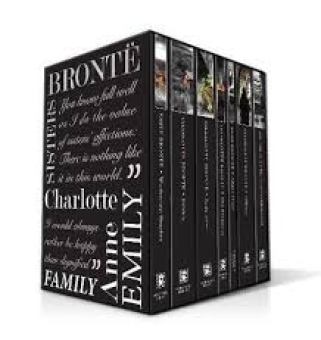
AND NOW SOME GORGEOUS BRONTE SETS!
Juniper Books sells a gorgeous set of hardcover Bronte books with ” custom purple jackets, a design modeled after the antique leather bindings that were commonly seen in the Brontë’s time.” The books are Everyman’s Library hardbacks with new covers.
 I am a fan of Penguin hardcover classics. I admire Coralie Bickford’s cover designs.
 This design of this set of three Vintage Bronte paperbacks is abstractly nature-inspired.
 The Folio Society has reissued these stunning editions of Jane Eyre and Wuthering Heights. The illustrations are lovely.


Aren’t these White Books editions fabulous? They came up on Google…


Wordsworth paperbacks are inexpensive. I’m not sure the boxed set is available in the U.S., but you can acquire the individual novels very cheaply.


How old are you? Rude question, isn’t it? Tempus fugit.
The seasons go faster and faster. Yes, it’s fall–again! There are pumpkins at the grocery store and the homemade ice cream stand has closed for the season.
And since I seem to get older every year, I ponder on aging in literature. Is it harder for men or women? And isn’t it odd that the two women’s novels above, Fear of Dying and The Summer Before the Dark, have dark covers and titles, while the men’s novels about aging, The Old Devils and An After-Dinner’s Sleep, have light green on the covers?
Aging women in literature face the challenge of losing the power of their sexuality. In Erica Jong’s Fear of Dying, a brilliant novel about aging, sex, and death, sixty-year-old Vanessa, a retired actress who played a villainess in a soap opera, hates the thought of being past her prime. She has had plastic surgery, but misses the days when men ogled her. Her rich husband, Asher, is in the hospital after an aneurism. When she is not at the hospital, she is visiting her parents, who are in their nineties and not always cognizant of who she is. They have 24-hour caregivers and are dying in their apartment when they are not ill in the hospital.
You know what Vanessa badly needs? Sex. Who can blame her for looking at Zipless.com? But does it turn out well? Of course not. Still. she comes to terms with what she wants from life.
In Doris Lessing’s The Summer Before the Dark, the forties prove just as difficult as the sixties. The 45-year-old heroine Kate comes to term with middle age. Her husband is away in America for the summer (and having an affair), and she had planned to stay home with their son. When her son takes off on a trip, she accepts a summer job as an interpreter at a food conference. She has bought beautiful clothes and is newly attractive; she has an affair, which is nice, but ephemeral. Later, after the conference, she has a kind of controlled breakdown in a rented room in a young drug-taking hippie’s house. Kate lets her hair go and experiments with walking in front of construction workers in different outfits. Naturally, they whistle when she looks young, and ignore her when she wears baggy clothes. By the end of the summer she knows herself and returns to her family. She stays the same for her family–except for her hair, which she stops cutting and dying. This is a beautifully-written short book, one of Lessing’s best.
Is aging easier for men? Well, no, judging from literature. In Kingsley Amis’s Booker Prize-winning novel The Old Devils, one of the aging characters has a difficult time dressing himself but he still imbibes an incredible quantity of alcohol with his friends. In Stanley Middleton’s brilliant novel, An After-Hour’s Sleep, the 65-year-old protagonist, Alistair, is mature: he feels that he is getting old, mainly because he is retired and feels stiff after walking several miles. He he not only meditates on the past, but embarks on a friendship with an ex-girlfriend. And he finds a new purpose through writing. Like Jong’s Vanessa and Lessing’s Kate, he comes to term with aging.
 I wonder if I can count E. F. Benson’s Lucia books as novels about aging? Probably not, but the characters are not young.
What are your favorite novels about aging?
Stanley Middleton won the Booker Prize in 1974 for Holiday.
On a jaunt to London, I discovered his books at Waterstones. I wondered, Why haven’t I heard of him before? But Middleton’s work is not widely acclaimed in the U.S. A critic at The New York Times in 1989 called Entry into Jerusalem a “tight-lipped novel by the prolific British writer” and further said “This mannered repression leaves much space in the novel for the author to fill with tedious detail.”

My favorite novel of the year!
It is exactly my thing! I adore British repression. I love Anita Brookner, of whom Middleton slightly reminds me, Kazuo Ishiguro, and A. S. Byatt. In fact, these British writers represent the pinnacle of 20th-century British literature to me.
It is true that Middleton’s remarkable novel, An After-Dinner’s Sleep, which was published in 1986, is quite buttoned-up. And I love it! The protagonist, Alistair Murray, a 65-year-old widower, has a lot of time on his hands. He loves music and plays Bach on the piano, reads widely, and takes long walks. He is a retired Director of Education who was once a powerful man in the Midlands. Now he must shape his days by routine activities. And he is sitting alone one night when Eleanor Franks, with whom he had a brief sexual affair years ago, shows up at his house.
Middleton’s writing is brilliant but not showy. The first exchange between Alistair and Eleanor subtly reveals their disparate characters.
‘I’m not interrupting anything important?’
‘You’re not interrupting anything. I was sitting here reading, but if you questioned me I’d have some difficulty recalling what it was. There’s nothing I want on the telly, and the Prom’s full of stuff I don’t want to hear. When I was young Friday night was Beethoven.’
‘And Amami,’ she said. ‘A shampoo.’ She giggled, but her face straightened at once.
Eleanor is an impulsive socialite lacking compelling interests. She claims she has dropped in because she is disturbed by a news item. But it becomes clear that it was an impulse, perhaps born of loneliness. Eleanor, too, is a widow.
Middleton’s quiet descriptions of daily life fascinate me. Every word is carefully chosen, and the characterization of Alistair reveals a capable man who is trying to find his way alone in old age. He misses his wife, Janet, an ambitious woman who pushed him into his successful career, which he is convinced was over-valued and riddled with mistakes. He escapes self-deprecating rumination by spending time with his son, Sebastian, a famous TV journalist, and his wife Francesca, a lawyer.
Eleanor is an important character, but not the center of his life. He is too cautious; she is too flighty. Alistair and Eleanor begin an off-again, on-again friendship. She drinks too much, invites him over to help entertain her older sister, who is dying of cancer, and accompanies him to a classical music concert where Alistair is uplifted and she is obviously bored. Quite often she takes off on impulse to stay with friends in Portugal or France. But Alistair is used to solitude, and he disciplines himself to study various subjects. He is writing an article about education, which is not going well; Middleton’s description of writing gone amok is pitch-perfect. (Haven’t we all been there?)
I love Middleton’s wit. When Eleanor’s sick sister retires to bed with Mansfield Park, Eleanor asks Alistair, “Would you choose Mansfield Park if you were dying?” (No, I would not!)
And the title comes from Shakespeare’s Measure for Measure:
Thou hast nor youth nor age
But as it were an after-dinner’s sleep
Dreaming on both.
A brilliant novel!

R.E.M. performing in Germany, 2003.
“All the Way to Reno: You’re Gonna Be a Star” is my favorite R.E.M. Song. It is a sweetly ironic song about a singer who believes he will get famous in Reno. I love the YouTube video of this bittersweet song. I’ve known artists, writers, and singers who make it “all the way to Reno” but alas! nowhere else.
And this song also makes me think of bloggers. Here is an excerpt from the lyrics:
Humming
All the way to Reno
You’ve dusted the non believers
And challenge the laws of chance
Now, sweet
You were so sugar sweet
You may as well have ‘kick me’
Fastened on your sleeve
You know what you are
You’re gonna be a star.
You know what you are
You’re gonna be a star
I love the wildly different voices of bloggers: some are witty and entertaining, others preposterously earnest. But, oddly, there is little connection between blogging and professional gigs. Over the years I have wondered, “Hm, why doesn’t this blogger write a novel?” But I have never found a novel by a blogger, though surely it must have happened?
I myself think in terms of nonfiction, which is easier to publish. (I must get to work on that novel!) And I do know of several bloggers who have succeeded in writing memoirs, cookbooks, and self-help. Here is a list of four books by bloggers, though I’ve read only the second on the list. Do let me know if you’ve read any of them or know of others, especially novels!
 1. Anne Bogel, author of the popular lifestyle blog Modern Mrs. Darcy, has published a bibliomemoir, I’d Rather Be Reading: The Delights and Dilemmas of the Reading Life. It looks charming, and I have reserved it at the library.
 2. You’ve doubtless heard of Julie Powell’s memoir, Julie and Julia: My Year of Cooking Dangerously, which is based on her blog about a year of cooking all the recipes in Julia Child’s Mastering the Art of French Cooking. The enjoyable film of the book was written and directed by Nora Ephron.
 3. Ree Drummond’sThe Pioneer Woman began as a lifestyle blog. This witty rancher’s wife, homeschooling mom, and blogger has since published cookbooks, an autobiography, and starred in her own cooking show. Last I heard she’d opened a restaurant! Where does she get her energy?
 4. Gretchen Rubin’s best-selling book The Happiness Project began as a blog. I confess I haven’t read this book, but I do remember it got good reviews. Here’s an excerpt from the book description:
Gretchen Rubin had an epiphany one rainy afternoon in the unlikeliest of places: a city bus. “The days are long, but the years are short,” she realized. “Time is passing, and I’m not focusing enough on the things that really matter.” In that moment, she decided to dedicate a year to her happiness project.
Okay, I’m sure there are more of these books, so do recommend some!
 I am a fan of day-long readings of classics. Such readings usually fall on anniversaries of an author’s birth or the publication of a book. You probably know about Bloomsday, June 16, the day on which James Joyce sets his novel Ulysses. Some years ago, my husband and I popped into a pub where there was a Bloomsday reading of Ulysses. People milled and thronged, drank beer, and listened to the reading. I wonder: did they really read aloud the entire book in a day? Or did it take longer? It was both moving and boring, and we left after a couple of hours.
This weekend there is a similar event for Willa Cather fans. On Saturday, Sept. 22, the Willa Cather Foundation is sponsoring a daylong reading of My Antonia to celebrate the 100th anniversary of the publication of the book. (The official publication anniversary is Sept. 21, but Saturday is obviously a better day for gathering.)
The Willa Cather Foundation reports:
This event is free and open to the public and will take place at Omaha’s Gallery 1516. It will begin at 10:00 a.m. and end in the early evening, to be followed by a talkback discussion and no-frills closing reception. Attendees may drop in at any time of day or come and go throughout the event. A live stream will also be available on the Willa Cather Foundation’s YouTube channel.
Alas, we will not make it to Omaha for the Willa reading because…
BAD NEWS AND GOOD NEWS

Our bikes parked in front of a cafe.
THE BAD NEWS: I have spent a lot of time this week riding the bus back and forth to the hospital. My husband, a bike commuter, was hit by a car on his way home from work. He was riding in the bike lane when a car swerved in front of him to turn into an alley. My husband was pitched over the handlebars and his body slammed into the car. He was hospitalized for a broken collarbone and collapsed lung. Witnesses assured the police that it was the driver’s fault, but the driver is long gone.
Since my husband has never been hospitalized, you can imagine that this did not sit well. It was a battle of wills to get him to sit down: he wanted to give his chair to guests. He wildly talked of driving the car home with his arm in a sling. He also thought he was could saunter down to Starbucks with his arm in a sling and carry back his own tea.
“No, I’ll get your tea.”
He insisted the doctor and I were over-protective!
THE GOOD NEWS. He is home, thank God. I have NEVER been so worried in my life.
I offered to get him a cup of tea. “I’m not an invalid,” he said.
“You are, dummy,” I said.
Anyway, I would prefer him to rest, but he is not used to sitting around. He has, however, promised not to bike or drive for a while. Thank God!
And if anyone has any tips on taking care of an extremely healthy person who has been in the hospital and who won’t sit still, tell me!
 mirabile dictu