
 Mary Hocking’s irresistible novels have been compared to Barbara Pym’s.
Is she like Barbara Pym? Well, no. I find her sharp, gracefully-written fiction more like the tart novels of Penelope Lively crossed with the family sagas of Elizabeth Jane Howard.
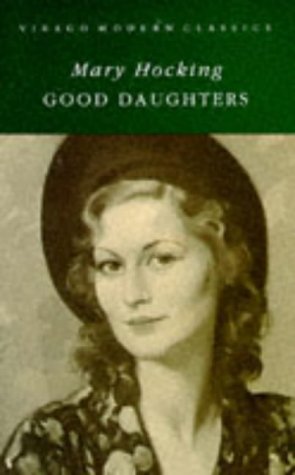
Last week I jotted notes about Hocking’s An Irrelevant Woman, a poignant novel about a middle-aged woman’s mental breakdown. I have since read two other novels by Hocking: Good Daughters (1984), a family saga about three sisters growing up in London in the 1930s; and A Particular Place (1989), a novel about a new Anglican vicar’s effect on the inhabitants of a small market town.
In the plot-driven family saga, Good Daughters, which is the first novel of a trilogy, much of the narrative is related through the consciousness of Alice, age 12. Alice’s ingenuous voice reflects the impossibility of her understanding the world beyond the domestic realm.
It begins:
In later years, Alice heard people talk as if those who grew up during the period between the two wars had lived their youth beneath the shadow of the swastika. But it had not seemed like that at the time.
Although in her childhood older people talked of the war that was just finished, and then, some ten years later, began to talk of the war which was to come, no shadow seemed to touch her until she was sixteen.
Absorbed by school and friendships, the three Fairley sisters, Louise, Alice, and Claire, ignore their father Stanley’s preoccupation with world events. Stanley, a dramatically devout Methodist who has moved his family from Sussex to be a headmaster at a boys’ school in Acton (he wants to work with the disadvantaged), is obsessed with newspapers: finding the Daily Herald on his doorstep instead of the News Chronicle can ruin his day. His level-headed wife, Judith, frequently expresses annoyance at his pomposity and theatricality. It is her practicality that holds the family together: the girls go to her for support, not to pious Stanley.
Alice, the middle child, is a mediocre student but an excellent writer; she is torn between devotion to her parents and loyalty to her rebellious friends. She is proud of her “burgeoning” maturity (she likes the word “burgeoning”) and has learned to keep secrets, unlike her eight-year-old sister, Claire, who blurts out everything. Still, it makes Alice’s “tummy hurt” when she must censor reports of her activities. She feels guilty about her misadventures with her careless, confident best friend, Daphne: when Alice sneaks out in the middle of the night to search for secret passages at Daphne’s house, the two giggling girls open a trap door in the kitchen that turns out not to hide a secret chamber: soot pours out all over the floor. In the morning, Daphne’s parents call the police, thinking someone broke in.
Alice is also utterly loyal to her 17-year-old sister, Louise, who feels no compulsion to tell her parents everything: when Louise tries out for a play at the coed St. Bartholomew’s Dramatic Society, she tells her parents she auditioned for the school play (they attend a girls’ school). She orders her sisters not to tell.
There’s no need to say anything to Mummy and Daddy about it until I know if I’ve got the part.” It was all too much, and Alice had one of her tummy upsets that night.
Of course, Claire tells.
In her year of acting in the theater and capturing the attention of three boys, Louise pursues the most handsome of them, Guy, an aspiring actor with blatant sexuality. She finally compels her parents to realize she does not want to go to the university.
Gradually the coming of the second world war affects the Fairleys: a tragedy occurs in the Russian Jewish family next door.
This is a perspicuous, moving, immensely entertaining book, not great, but good. I cannot wait to read the second book, which spans 1939 to the late forties.
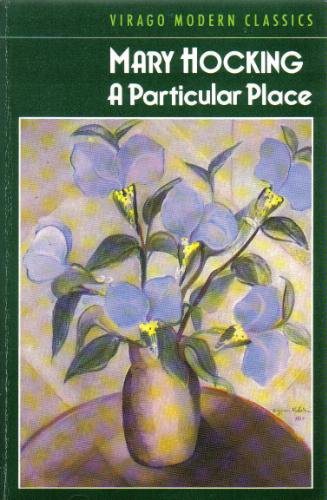 Hocking’s A Particular Place is a sharp, almost perfect novel, with an ecclesiastical core. It centers on a new Anglican vicar’s effect on the inhabitants of a small market town. His impact is partly religious, but also, quite surprisingly, romantic. When most of the characters meet at a candlelit Holy Saturday Vigil at St. HIlary’s, they are certainly not looking for love.
Charles, an agnostic, brittle, lonely teacher, is curious about the new vicar; sharp-tongued Hester, a children’s book writer who is sympathetic to her imperfect neighbors though she prefers to be alone, attends because Michael is her nephew; Valentine, Michael’s wife, an ironic, whimsical beauty whose avocation is amateur theatricals, can think of places she’d rather be than St. Hilary’s; and Norah Kendall, an outspoken feminist nurse, is sincerely interested in the church, but perhaps attends also because her husband visits only on weekends and their marriage isn’t working out.
As the parishioners move from the graveyard up the stairs of the church, Norah falls. The fall foreshadows a love affair and a tragedy.
Close by, with no warning, someone fell. Charles Venables, stepping from his shelter, found himself a member of a concerned group. The vicar hurried up. ‘Oh dear, what have we, a casualty already?’ Irritation only just concealed at this disaster striking before the performance had got under way.
What happens when one falls in love? Married love, new love, deliriously happy love, lost love, grief over being too old to love. Hocking explores all love. As many of the characters come to terms with love, choosing to act or not to act on their feelings, their lives are characterized by happiness or grief. At the center, Hocking’s novel is deeply moral. None of these characters is truly malevolent; none sets out casually to destroy relationships. It is a witty, sensitive, never mawkish, novel, the best I’ve read by Hocking.
 mirabile dictu
I am surrounded by people reading Hocking! She does sound very readable though – and I am hoping to be near some of my favourite charity bookshops soon…. !
LikeLike
No, really! Her books are very enjoyable: A Particular Place and An Irrelevant Woman are more literary than Good Daughters, which is a pageturner.
LikeLike