Lily Tomlin in “Grandma”: Can You Sell Your First Editions?

Lily Tomlin in

Lily Tomlin in “Grandma”

The paucity of roles for older women in Hollywood is proverbial.

A rare exception is the witty, unsentimental film, “Grandma,” written and directed by Paul Weitz.  It is splendid to see  Lily Tomlin, the stand-up comic and award-winning actress, in a dazzlingly authentic role at the age of 76.

Tomlin is believably acerbic and vulnerable as Elle, a lesbian poet at an emotional crossroads. She desperately misses Violet, her partner of 40 years, who died a year and a half ago; breaks up with her girlfriend, Olivia, a brilliant young Ph.D. dropout  (Judy Greer); and then her granddaughter, Sage (Julia Garner), shows up needing an abortion.  Elle does not have the money.  She recently paid off her debts of $27,000 and made a mobile of her cut-up credit cards.

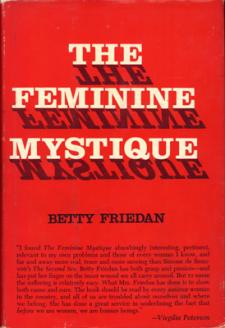
Friedan The_Feminine_MystiqueSo how can they get the $600 for Sage’s appointment later that day?   Elle wildly believes she can get thousands of dollars for first editions of Betty Friedan’s The Feminine Mystique (signed), Germaine Greer’s The Female Eunuch, and Simone de Beauvoir’s Coming of Age. 

Naturally, Sage has never heard of these books. And Elle is more upset about Sage’s  cluelessness about feminism than the low price of The Feminine Mystique ($60) on eBay.

They travel around town in Elle’s vintage Dodge, trying to borrow the money from Elle’s friends. Elle renews her bond with a transgender tattoo artist (Laverne Cox), but alienates the rest.  She screams at Carla (Elizabeth Peña), owner of a feminist cafe, when she offers only $60 for the books.  Carla leaps over the counter to throw her out.

I loved the scenes with Oscar-winning Marcia Gay Hardin, who plays Elle’s daughter, Judy, a hard bitch businesswoman who had Sage by sperm donor.

I’m really blogging because of the bookish connections—first editions aren’t worth what they used to be because of the internet –but I loved this affecting, unsentimental movie.

Filthy Jokes in Aristophanes’ The Frogs

woman writing typing+woman

           “But is it fun?”

I enjoy writing Mirabile Dictu.

But is it still fun, we ask ourselves?

Writing about MasterChef is fun.

Writing about Fashion is Spinach is fun.

Wrriting about great literature is not always fun.

Time is precious. It goes very fast.  As Ian McEwan wrote in The Guardian when he was 64, “If I’m lucky, I might have 20 good reading years left.”   Having recently had a big birthday, I know what he means.

I hate to lose my spark, so today am entertaining myself with a short piece on filthy jokes in Aristophanes.

When Michael Stipe, the lead singer of R.E.M., listed Four Plays by Aristophanes, translated by William Arrowsmith, in The New York Times as one of his 10 favorite books, I was delighted.  One for the classics!

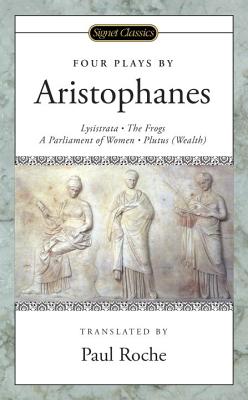
I like this translation by Paul Roche.

I like this translation by Paul Roche.

Many years ago, I fell in love with Aristophanes’ poetic comedies in a Greek seminar. His most accessible comedy is Lysistrata, a hilarious anti-war play.  But his masterpiece, The Frogs, requires a little background  (a short introduction should do it).    The Frogs is a rollicking slapstick comedy, but it is also riddled with fierce literary criticism.

In The Frogs, Dionysus, the god of wine, also associated with Greek tragedies, is disgusted with “modern” trends in playwriting.  There is no poet above ground, Dionysus says, who can write good tragedy anymore.  And so he descends to the underworld with his slave Xanthias to bring back the tragedian he calls a “clever rogue,” Euripides.

Aristophanes’ jokes are very silly, often smutty, often scatological.

And the filthy jokes frequently need a gloss.

I recently reread The Frogs in Greek.  Translating the jokes can be very difficult.

Dionysus and Xanthias are on the road, and Xanthias is in charge of the baggage.  Dionysus is telling him which stock jokes on the subject of baggage he cannot endure,

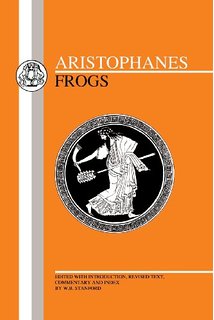
In the notes of the W. B. Stanford edition of the Greek text, he translates a joke Dionysus objects to as: “[Saying] as you change over your carrying pole that you want to ease yourself.”

Stanford goes on to explain that slaves carried baggage on the end of a short pole resting on their bladder.

A translation of “you want to ease yourself,” courtesy of me, is:  “you want to crap yourself.”

ARistophanes frogs 41bBlK7F+FL._AC_UL320_SR214,320_Actually, I’m not sure if it’s urinating or defecating.  The definition of the verb in Liddell and Scott’s dictionary is “ease yourself” or “drop dung.”

I’m trying to visualize this as I read Xanthias’s answer, which is another bad joke:  “Not even [the joke] that I’ll burst out from carrying so big a load, if someone does not relieve me, and that I’ll break wind?”

The jokes about loads, defecation, and farting are even ruder than on HBO.

But one suspects the jokes are much filthier than the dictionary lets on.  The scholarly dictionary by Liddell and Scott, published in the nineteenth century and still used by scholars, often substitutes circumlocutions for risque words.  So trying to untangle what is happening in the jokes can be arduous.

I have  always very much enjoyed Moses Hadas’s snappy translation (1962).  He translates the two lines above as:

Dionysus:  To shift your load, and say that you are pooped?

Xanthias:  Or, if nobody will relieve the strain, I’m going to ‘relieve myself’?

Paul Roche’s 2004 translation is more explicit. His version of the lines above:

Dionysius:  About your having to shift your pack and have a crap.

Xanthias:  What the heck!  I can say, surely, that if somebody doesn’t come and help, my bottom’s going to let out a yelp.

It is actually much funnier after you get past the bad jokes on the first page.  I am sure that if we were in the audience we’d be laughing hysterically.  We wouldn’t need footnotes.

I do not have access to scholarly articles or books on Aristophanes’s jokes, but it is fascinating to translate the Greek oneself, and then look at the English translations.  Writing Aristophanes in English is hard work!

Loser vs. Loser: Why We Love Reality Shows

The finalists on Masterchef: Stephen, Claudia (the winner), and Derrick.

The finalists on Masterchef: Stephen, Claudia (the winner), and Derrick.

Everybody loves to see a loser win.

Tonight on MasterChef, finalists Stephen, Derrick, and Claudia struggled to cook the best dishes for a prize of $250,000 and the publication of their own cookbook.

But would reality TV be so popular without the rise of amateur culture on the internet?

The internet and reality TV came of age together in the ’90s and the first decade of the 21st century.

According to French philosopher Jean Baudrillard via the Stanford Encyclopedia of Philosophy, the production and consumption of commodities have been replaced in postmodern society by the “hyperreality” of simulations:   images, spectacles, and the play of signs replace the concepts of production and class conflict.

Certainly Americans like their simulations:  according to Nielsen reports, the average American adult spends 11 hours per day using electronic media (TV, smartphones, computer, etc.).

And now that amateurs have their own culture online, we want to watch it on TV, too.  Losers have their chance to win.

Day job:  waitress.  Night life:  blogger and artist.  Yup, she writes film criticism, posts her quirky illustrations, and tapes her dramatic one-woman show of the Ophelia scenes in Hamlet.   Is she as mad as Ophelia? She is sure one of her blog readers is Benedict Cumberbatch (Hamlet in the production at the Barbican)!  If she dyes her hair blond and sleeps with a director, she WILL be on a reality show and then play Ophelia!

The internet is fun because we don’t have to be too serious.  We can post casual reviews or essays.

At one time I thought it might provide the ideal community. Remember the Well?  But in 20 years, I have seen dozens of online groups rise and fall. Even with a glossier presentation of the real self, the online personae frequently crack up. There are many, many silly, trivial arguments in Yahoo discussion groups, where membership  has waned drastically in recent years, replaced by other social media.  Online friends turn on each other, because they’re narcissistic or nerdy, mad or malicious.  Here’s a good thing: I don’t see arguments at Goodreads.

Reality shows are more honest than the internet, you think.  You see who the winners and losers are.

Well, hardly.

The contestants are losers, as defined by our culture.  On MasterChef, they’re usually working-class, artistic but underemployed, or barely white-collar.  Derrick is a drummer from Fort Myers, Florida; Claudia, a Mexican-American mom and an events manager who lives in a really crummy one-bedroom apartment; and Stephen Lee is an urban gardener who wildly heckles other and seems borderline-Tourettes. Yet they were neck-and-neck in creating beautiful, delicious food.

Artistic Derrick should undoubtedly have won for his eclectic contemporary gourmet food:  the pan-seared venison with root vegetables in huckleberry sauce in a puff-pastry lattice cage was breathtaking.  The lattice cage formed an arch over the venison.  Actually, the judges adored it and were wowed by his plating.

But they gave the prize to Claudia, a lovely, poised person who elevated Mexican food.  I got the impression they gave it to her because they liked her story.  Perhaps they liked the idea of helping a single mom.  She always cooked Mexican food.  Derrick was a gourmet, a true artist.

And so winning is arbitrary, no?

What I’m Reading Now: Elizabeth Hawes’s Fashion Is Spinach

Elizabeth Hayes Fashion Is Spinach yhst-137970348157658_2381_953741503At my house, fashion means black slacks with no cat hair on them.  I am elated if an outfit can double for a bicycle trip and shopping at the supermarket.

Not being fashionable, I was surprised to fall in love with  Fashion Is Spinach (1938), a witty, addictive book by Elizabeth Hawes,  a twentieth-century fashion sketcher, reporter, critic for The New Yorker, and designer of her own line of clothing. Part autobiography, part critique and history of the fashion industry in the 1920s and ’30s, this engrossing book makes me think of the  humor writing of Cornelia Otis Skinner crossed with the radical criticism of Mary McCarthy.  It has recently been reissued by Dover.  Her eight other books are out of print.

Hawes writes dramatically, “I, Elizabeth Hawes, have sold, stolen, and designed clothes in Paris.”

Born in Ridgewood, New Jersey, in 1903 , she always loved sewing.  As a child she made hats for her Kewpie dolls and designed and sewed her own dresses.  By the age of 12, she was selling children’s dresses to a store in Pennsylvania.  She gave this up in high school because she wanted more social life, but continued to make her own clothes.

I used Vogue and Harper’s Bazaar freely, copying sketches or changing them.  This further enforced the French legend on my mind.  All beautiful clothes were designed in France and all women, including myself, wanted them.

She is thankful that she “escaped going to art school” and went to Vassar, which was a family tradition.  At first she had no direction.  She was bored by English and history.

My first year at Vassar was marked by nothing much in particular.  My sister was a senior and had a good many men for weekends.  I tried to fall in with the same plan.  It worked with fair success until the end of that year when I lost the beau I had kept hanging over from high school.  He went to Williams and, after having me to one house party, outgrew me.  I was quite unattractive and as I became progressively more serious-minded during the next three years, I had fewer boyfriends.

Having fewer boyfriends was a good thing at Vassar.  Hawes became enraptured by economics, including Labor Problems and Socialism.  She was entranced by the economic theory of Labour Party co-founder Ramsay MacDonald, and wrote her thesis on it.  Outside classes, she continued to make clothes.

After graduation, she went to Paris on a shoestring.  A couple of poorly-paid freelance fashion reporting jobs paid the rent for a small room with a basin.  (She had to give up baths.)  She knew hardly any French, and it took months to pick up.

But it didn’t prevent her working, and in Paris she learned the difference between style and fashion.

Elizabeth Hawes

Elizabeth Hawes

She tells us bluntly that there are two types of women:  “One buys her clothes made-to-order, the other buys her clothes ready-made.”

The former are lucky, the ones who had a real style and clothing created by French designers.  The rest of us must wear whatever Macy’s decides to sell.

Hawes writes:

Fashion is that horrid little man with an evil eye who tells you that your last winter’s coat may be in perfect physical condition, but you can’t wear it.  You can’t wear it because it has a belt and this year “we are not showing belts.”

Fashion gets up those perfectly ghastly ideas, such as accessories should match, and proceeds to give you shoes, gloves, bag, and hat all in the same hideous shade of kelly green which he insists is chic this season whether it turns you yellow or not.

Elizabeth Hawes

                Elizabeth Hawes

Paris fashion for Hawes in the ’20s was a crazy wild rush of  making up fashion news (there were only two big shows a year by designers), and working at copy houses that tried to get illicit previews of designers like Chanel.  Hawes got a job as a sketcher at a copy house, a dressmaking shop “where one buys copies of the dresses put out by the important retail designers.  The exactitude of the copy varies with the price… ” (Generally they were about half the price.)   She was sent to fashion shows to “copy” the clothing in sketches (which she had to do hastily afterwards from her notes on programs, and sometimes her programs were seized by the attendants.   The copy house also paid American manufacturer buyers to let them see the latest clothing before it was sent by a fast ship to the U.S.  One of their regulars was Madame Ellis.

Madame Ellis did not want to be seen at the copy house.  She insisted that someone be sent to her.

Hawes writes,

I had a very large beaver coat.  A fur coat in Paris is quite a rarity among the working class.  Mine turned out to have a special value.  I was requested to don it one day in November and go to the resident buying office through which Madame Ellis worked.  It was toward the end of the mid-season buying, the day before a large boat was to sail.

Madame Ellis opened the boxes of Chanel dresses, told her to put them under her coat, “and get them back here as fast as you can.”

This is an absolutely compelling read.  I love Hawes’s stories and her radical take on fashion.  Ready-made clothes should be made for real women, who should be asked what they want.  I couldn’t agree more.

Eventually she is disgusted by the theft of designs and finds work as a designer. And then she goes home to the U.S. to design and sew.

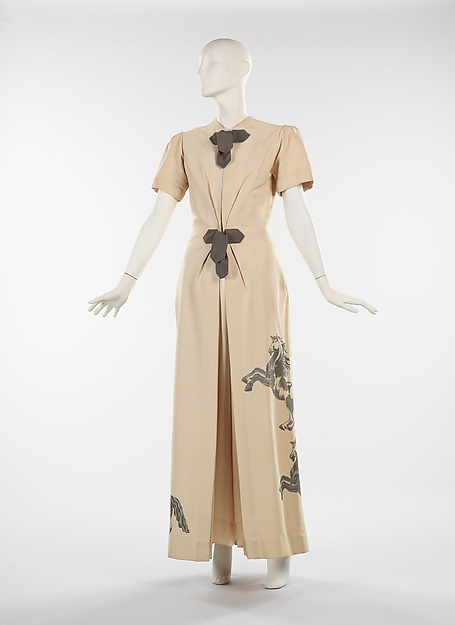
I long for these silk lounging pajamas.  You can see them at the Metropolitan Museum of Art.

By the way, Hawes was blacklisted during the McCarthy era in the ’50s.  Her career never recovered.

lounging pajamas (Metropolitan Museum of Art)

  Hawes’s lounging pajamas (Metropolitan Museum of Art)

Light Reading: J. Jefferson Farjeon’s Thirteen Guests

Yes, it's cozy and I enjoyed it!

Mystery fans have different tastes.  Some prefer cozies, others read only police procedurals.  Although I love the tough-guy-and-gal detectives of Sara Paretsky and  Elmore Leonard, I usually go for the cozies.  I am very fond of Golden Age Detective Classics of the 1920s, ’30s, and ’40s.

I recently read J. Jeffererson Farjeon’s Thirteen Guests (1936).

If you do not know Farjeon, you are not alone.  He wrote over 60 novels, but most are out of print. A few have recently been reissued in The British Library’s Crime Classics, a series of mysteries rediscovered in the British Library.  Poisoned Pen Press is now publishing the series in the U.S.

Thirteen Guests is a country house party mystery.  If you have read Agatha Christie’s The Affair at Styles (and countless others like it), you are familiar with the “closed circle” of suspects:  one of the guests is the murderer.

Farjeon is an expert plotter but the setting-up of the plot is slow.  I plodded on, trusting in the British Library.  It begins at a train station: John Foss has an accident disembarking from a train.  Nadine Leveridge, a charming widow who disembarked before him without incident, insists on giving him a ride to the village doctor’s house.  When they learn the doctor is at Bragley Court, which happens to Nadine’s destination, they drive on.  It is the home of Lord Aveling, a Conservative politician giving a house party.

Once we arrive at Bragley Court, the pace picks up and the writing gets sharper.   Lord Aveling invites John, who cannot walk on his injured foot, to stay.  The savvy politician thinks it might be good PR:  he has invited a gossip columnist for the weekend.  He is slightly concerned about having thirteen guests now, among whom are a mystery writer, a Liberal politician, and an actress.   But it will be the thirteenth to arrive, the menacing Mr. Chater, who will be unlucky.

Things soon start to go wrong.  Two of the better-developed characters are Leicester Pratt, an artist, and Lionel Bultin, a gossip columnist.  Both have sold out for fame.  First, Pratt finds that his painting of Lord Aveling’s daughter Anne has been defaced in the studio.  Then a dog is discovered with its throat slit.  The next day, a stranger (who is not a stranger to at least one of the guests) is found strangled.   Chater disappears during a fox hunt and is discovered dead.  Bultin takes elaborate notes for his column and notices odd things no one else does.  Bultin and Pratt discuss the murders.

There is much anxiety and fear, and when a brash detective is called in, he depends to a large extent on Bultin’s notes and John’s impressions.  John, confined to a loungehall and anteroom, outside of the action, is an excellent observer. But he is afraid to tell all he knows.  He worries that the likable Ann, the daughter of Aveling, might be guilty.  Nadine assures him that it cannot be so.

The chemistry between John and Nadine is charming.

This is an entertaining whodunit, and there are, as Dorothy Sayers said of his work, some “creepy” elements, like the death of the dog.  Not all the characters are well-developed, but there is plenty of suspense.  Farjeon’s Mystery in White: A Christmas Crime Story was a best-seller in the UK last Christmas.  It is always great fun to discover a new (old) writer, and I look forward to reading more of his books.

Friendship and Elena Ferrante’s Neapolitan Novels

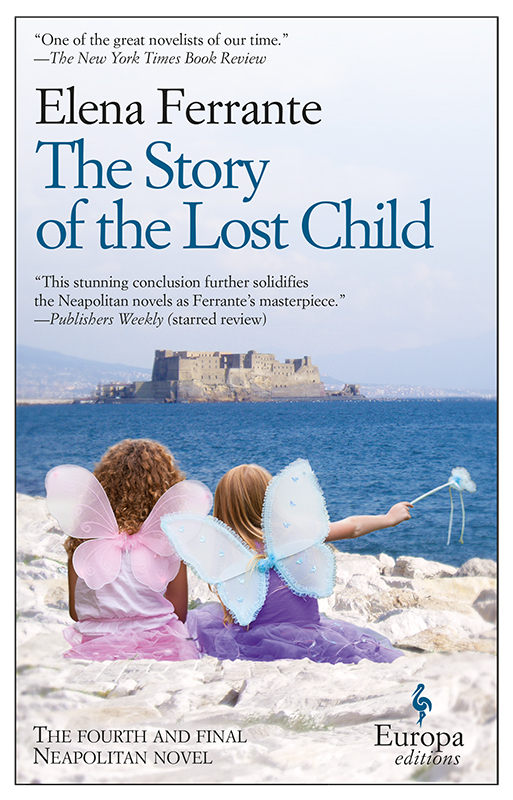
Elena Ferrante's The Story of the Lost Child Cover3Peter Stothard, the editor of the TLS, wrote enthusiastically in his Editor’s Column (9-11-2015) about Lidija Haas’s critical essay on Elena Ferrante’s The Story of the Lost Child and the Neapolitan quartet as a whole.

Stothard writes,

For four years the fame of the Italian novelist Elena Ferrante has been gaining strength. To use one of the classical parallels that her own characters like to employ, her rise in stature has been like that of Fama in the Aeneid, spreading relentlessly the love of Dido. As Lidija Haas describes this week, the pace of Ferrante-following has now so quickened that the pastel-coloured paperbacks are almost as familiar on London Transport as free newspapers. Book One – in which two Neapolitan slum girls argue (inter alia) about Latin and Greek – has now culminated in Book Four (whose plot late-adopters may prefer not to know). Haas joins the admiration of a “magic” writer and considers too the critical response – from praise for a revival of the best of nineteenth-century realism to the view that the quartet could have been written only with the postmodern at its heart. The pseudonymous author herself, also like Virgil’s Fama, remains hidden from view with her head in the clouds.

As a Latinist, I always love Stothard’s classical references. But Fama can be fickle:  in the Aeneid, IV.174, Fama is malum qua non velocius ullum (“an evil than which not any is faster”) as she spreads the rumor about Dido’s affair with Aeneas.  In the case of Ferrante, Fama is  more benevolent:  she gossips happily about the Neapolitan tetralogy in The New York Times, the TLS, at many blogs (Heaven Ali has written about Ferrante), and at a public library book club with equal fervor.  Whether Fama has done a good deed (surely not a bad deed) will be revealed by critics of the post-apocalyptic future. pic of first three books of neapolitan novels ferranteThe Neapolitan novels tell the story of a rocky decades-long friendship between two women.  (I blogged about  My Brilliant Friend in 2013.)  I haven’t read Haas’s essay yet:  I can’t until I’ve read all four.  I got up this morning and rushed out to buy the second, third, and fourth.  I had to comb the store to find the last copy of The Story of the Lost Child.

I started the second book, The Story of a New Name.  A shock of recognition rocked me when I read page 18.  The heroine, Elena, who is angry and jealous of her best friend, Lila, destroys a box of eight notebooks Lila entrusted her with so her husband would not find them.  Why does Elena destroy the notebooks?

I couldn’t stand feeling Lila on me and in me, even now that I was esteemed myself, even now that I had a life outside of Naples….  I placed the box on the parapet [of the Solferino bridge], and pushed it slowly, a little at a time, until it fell into the river, as if it were her, Lila in person, plummeting, with her thoughts, words, the malice with which she struck back at anyone, the way she appropriated me, as she did every person or thing or event or thought that touched her…”

After our friend D’s death, an artist friend and I did something similar.

When D was dying, she refused to let us visit her. Those she loved she now rejected.  She allowed everyone else to visit, and I do mean everyone:  a passive, pretty, shallow woman no one else liked (“D can dominate her,” the artist suggested), people she’d volunteered with, old neighbors, her lovely mother’s friends.  She talked to us lucidly on the phone, but only on the phone. Hearing from others about her deterioration, we were devastated.  At the end of her life, in pain, unable to swallow, her face puffy with steroids, she insisted that all personal things be removed from the room and she kicked out her husband.  It was a furious death: she looked at the living and couldn’t believe she was the one who was dying.

The artist, with whom she’d gone to art school, and I, the freelance writer sidekick who had recommended her work to editors, had what she wanted.  I understand this but I didn’t know death.  People in novels are always dying in each other’s arms.  D wouldn’t let anyone in the room.

She was a good poet who didn’t publish.  A former neighbor who had known D since childhood paid for a vanity press publication of  her poems.  I wonder how D felt about this.   I had seen her run her wheelchair angrily over a rejection letter.

The artist didn’t go to the funeral.  I, eternal good girl, did.  But we got together  a few months later and burned our copies of the “vanity” book.  I loved her poetry, but we were emotional wrecks.  I kept the print-out copies of her poems.  I sent them out to literary magazines.  They were rejected.

She asked me near the end of her life (on the goddamned phone) if I thought a life spent reading was worthwhile.

I do.  Serious as a marriage vow.

I think she was shattered that she didn’t have time to prove herself as an artist or a writer.

All that freelance writing:  what did it mean?  We should have gone to low-residency MFA programs.  Poetry for her; nonficiton for me.

Sometimes I think of her when I read.  I am sorry that she can’t read Ferrante’s novels, because she would have loved them.

As teachers we bonded in the lounge over Calvino’s Cosmicomics. We quit to become freelance writers. Although she was a paraplegic, she drove (I do not), and we used to go to the mall to shop at The Limited and Banana Republic.  Then we drank coffee and discussed the books we shared: Cynthia Heimel’s humor book, Sex Tips for Girls, Sharon Olds’ poems, Donald Barthelme’s City Life, Raymond Carver’s short stories, Faith Sullivan’s The Cape Ann, Gail Godwin’s A Mother and Two Daughters, Sue Grafton’s mysteries, Philip Larkin,  and Louisa May Alcott’s An Old-Fashioned Girl.  We went to bookstores.  Malls were much more wheelchair-friendly than the city places where I hung out.

One sees so many beautiful things as one grows older: landfills turning into prairies (though probably still not quite safe), urban trails that go past eerily beautiful closed factories and junkyards, the gorgeous blue blue lakes in Minnesota, pelicans, eagles, mountains, books.

Years after her death, a priest asked me about D’s loss of faith.  I told him I knew nothing about it.

The Book in My Bike Bag: Trollope’s He Knew He Was Right

bike council bluffs path img_0932Every summer I carry a Big Book in my bike bag.

On bike journey breaks, I flip down my kickstand (I am the last person with a kickstand), sit on a bench, and read.

It is always a Very Big Book.
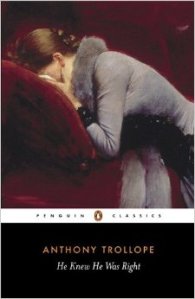
He Knew He Was Right trollope 41RJjyDTOLL._SY344_BO1,204,203,200_This being Trollope’s bicentenary,  I have reread four of his books this year.  And I now admit it is possible to read too much Trollope.   I ODed on my rereading of Trollope’s He Knew He Was Right (my bike book of the summer)It  is a very great book, one of Trollope’s best, and an engrossing novel about jealousy, madness, marriage, and money.  It is a retelling of the Othello story, set in the 19th century.   I wonder if I am  critical of the flaws in the characterization of Louis Trevelyan, Trollope’s Othello,  and the looseness of the structure, because I have read too much Trollope.

He is very good, he is often great, but he wrote too much:  47 novels.  His work is uneven.

On the other hand, He Knew He Was Right is 823 pages long, so a little rambling is in order.

Trollope writes easily and well, and has a gift for comedy.  In this novel, and also in Phineas Redux, which I read earlier this year, he also shows his gift for tragedy.  (I cried at the end of He Knew He Was Right.)

The novel begins with the story of a happy marriage.  Louis Trevelyan has married Emily Rowley, the penniless daughter of the governor of the Mandarin Islands.  Louis generously invites Emily’s sister, Nora, to live with them  in London.  She is more likely to make a good marriage in London.

Louis has everything.  He is smart, “but not a book-worm.”  He is a “handsome, manly fellow, with short brown hair, a nose divinely chiselled, an Apollo’s mouth, six feet high, with shoulders and arms and legs in proportion–a pearl of pearls!”

And then Trollope adds,

Only, as Lady Rowley was the first to find out, he likes his own way.

Emily also likes her own way.  In fact, almost everyone in this novel likes his or her own way, as Trollope is quick to tell us.
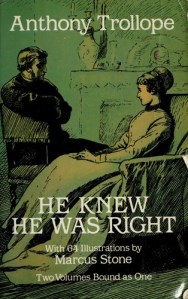
HE KNEW HE WAS RIGHT TROLLOPE DOVER 7154878-LLouis and Emily are very happy at first.  But they soon begin to struggle because her father’s oldest friend, a fiftyish colonel, visits her often  and flirts with her.

Louis asks her not to see the Colonel. He is an agony of jealousy.  She says she has done nothing inappropriate and refuses to ban her father’s oldest friend.  She does not believe the Colonel is flirting.  (He is.)  Her sister, Nora, does not think there is any flirting, either, but she begs Emily to humor Louis. Should Emily or shouldn’t she have?  Would it have made things better, or would he have just become more tyrannical?

And then it takes a tragic turn.  Trevelyan is driven mad by jealousy (though is that enough to account for his madness?), and eventually he and Emily have a terrible disagreement, resulting in a separation, his spying on her, the kidnapping of their child, etc.

There are comic courtship subplots, which lighten the mood.

Louis Trevelyan’s best friend, Hugh Stanbury, is in love with Emily’s sister Nora.  She hesitates, though.  What’s wrong with him?  Well, he is poor.  He gave up the law to be a journalist.  And though Nora is in love with Hugh, she very much wants to be in love with her rich suitor, Mr. Glascock, the son of Lord Peterborough.  Why oh why can’t she be in love with the right man?   But she has to refuse Mr. Glascock.

Hugh was his rich spinster aunt Miss Stanbury ‘s favorite until he began writing for a “penny paper.”  Now she has invited his younger sister, Dorothy, to live with her, and hopes to marry her off to Mr. Gibson, the smug, conceited curate. But it is just as well that Dorothy dislikes him (she has fallen in love with someone else):  Mr. Gibson has flirted for years with two card-playing spinster sisters, Arabella and Camilla French, and his fate lies with them, if only he can figure out which one.

The third marriage subplot is smooth and without conflict.  And Mr. Glascock, Nora’s rejected suitor, falls in love in Italy with a pretty American girl, Caroline Spalding, the niece of the American ambassador. Even though Nora is engaged to Hugh, she feels jealous of Caroline.

Why read Trollope?  He’s a bit of a shaggy-dog storyteller.  Even his best books, the Palliser novels and the Barsetshire novels, ramble.

Yet he is an addictive, cozy writer.  Some will bridle at the word “cozy,” but it is true. He will not shock you. He will entertain you. We read him because he is an addictive storyteller. He is neither George Eliot nor a Dickens–but he is reliably entertaining. He is one of the best storytellers of the 19th century, and you can’t do much better than that.


Steven Brust’s The Sun, The Moon and the Stars

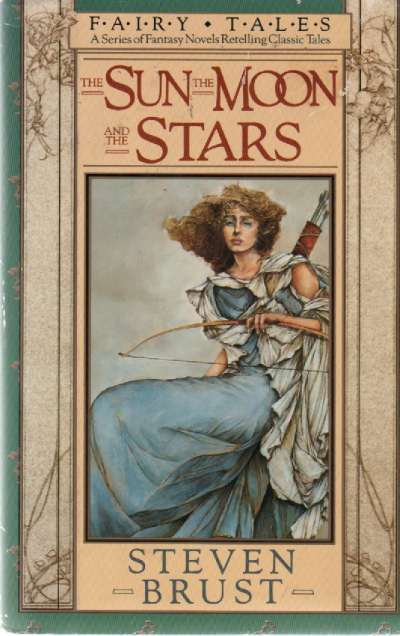
Steven Brust The Sun, The Moon, and the stars image1Last week I devoured Mervyn Peake’s modernist fantasy classic,Titus Groan; over the weekend I read another unclassifiable novel, Steven Brust’s The Sun, The Moon, and the Stars.

I picked up this lovely hardcover book because it is the first in the splendid “Fairy Tale Series” edited by Terri Windling, who recruited several fantasy writers to retell fairy tales for adults.  Some of the versions are traditional; others have a more original slant.  The gorgeous covers were designed by Thomas Canty.

The Sun, The Moon, and the Stars (1987) is a clever, carefully-crafted account of an artist’s struggle to create. The narrator, Greg Kovacs, shares a studio with four artists in Minnesota.  After dropping out of college, he earned a degree in drafting, but he has never had a drafting job, because  his photographer girlfriend supports him. Sometimes he fells guilty that she has sacrificed her art so he can paint.  He does not sell his work, nor do his friends.  And they are approaching a crisis in the studio:  they need to have a show or break up.

I am fascinated by Greg’s work:  he is creating his own myth about the Greek gods Uranus (Sky), Apollo, and Artemis, and painting it on a giant canvas he calls the Monster.  But it is the  structure of the book that dazzles me.

Each chapter is divided into six short sections, and each section bears the title of a painting.  (I didn’t figure that out until I was well into the book.)  I  am sure the paintings relate to the text, and I look forward to rereading this with an art history book in hand (or, more likely, Wikipedia).

"The Death of Marat" by Jacques-Louis David

“The Death of Marat” by Jacques-Louis David

The narrative describes Greg’s aggressive interactions with friends, and also his strong-minded philosophy of art.  He opposes modern, abstract art, but the book is modernist.

He is completely unpretentious.  He needs to look at art constantly.  In a section called “The Death of Marat,” Greg tells us that  he  looks at prints for inspiration.  Looking at the real paintings is the ideal.

He gets to know famous artists through their work.  He writes,

I do know artists who say, ‘I can’t look at other people’s work while I’m painting because their style creeps in.’  The first time I heard that, I did a cartoon of Gauguin’s style creeping into Cezanne’s work, and I called it, “Such tragedy.”  I thought it was pretty obvious, but the people who ought to get it never do.

The other artists are slowly sketched in, though we don’t get to know them well.  They ruthlessly criticize each other’s work.  Greg is very aggressive, and spares only. Karen, the only woman,  who paints landscapes and has no talent, he thinks.   (The others suggest he is sexist; his girlfriend Debbie reminds him that he doesn’t even help with the housework.)  The brilliant Dan works in a  style Karen calls “post-urban subway.”  David is a body-builder. (Naturally, I thought of the sculpture.)  Rob likes to go dancing at night.

In every chapter, one section is devoted to Greg’s telling the others a Hungarian folk tale he half-remembers, half-invents.  A taltos (wizard) has  said he will put the sun, moon and stars in the sky in exchange for king’s daughter and half the kingdom. And then there will be light!   He takes his two brothers to help.  There is fighting of dragons and their human wives and mothers-in-law.  The tale is half-humorous.  I am frankly baffled by how it fits in with the rest.  I  will pay more attention to it next time.  (Yes, I will reread it.)

I very much enjoyed this short novel.  The writing isn’t perfect, but the perfect structure shows off the writer’s brilliance.  The book has elements of fantasy, but can be read as a realistic novel about art.

Steven Brust says of The Sun, the Moon, and the Stars :

I think at a certain point, every writer has to ask himself why he writes, and what he’s hoping to do. I wrote this one to answer that question…. I have mixed feelings about it—I think I did all right with it, but it is too personal to have a very wide appeal. Still, I’m glad I wrote it, and I’m always pleased to run into people who like it.

The Case of the Missing Comments: Lost, Spammed, or Moderated?

Anne Taintor "funny I don't recall asking for your opinions' 5398_OpinionBeverageNapkin-500x500There are magical, unexplained, supernatural things on the internet.

Having grown up on the novels of E. Nesbit, where the Psammead/sand fairy grants wishes in a really twisted way, and  a magic wishing ring is likely to backfire on you, I always find the internet fantastical.  You mean it’s not magical?  Well, can’t explain any of it!

But there are also mechanical glitches.  Unless it’s witchcraft!

For instance, I have only sporadically received email alerts lately about comments posted here.  Strange.  I always got them before.  But I am not concerned about it.

And then a reader informs me that his/her comments are not appearing on my blog.

What comments?  I wondered.  I checked spam and found one.  I retrieved a perfectly intelligent comment about Mervyn Peake’s Titus Groan and approved it.

I don’t know what triggered the magic spam-sorter, which apparently did not want me to know there is a fourth Titus Groan title!

I welcome most comments.

But I have the right to moderate comments.

Yup.  It’s my blog.

Some commenters believe that blogs exist to host contentious debates.  I will write something I think is perfectly normal, and then the “trigger alert” types will go mad.  What?  I don’t wish to fight with them?   How dare I not?  They WILL be heard.

Fine, okay, just not here.

I welcome comments, but this isn’t a public forum.

People on the internet do occasionally go off on strange tangents.  In the pre-internet days before the newspapers and magazines began to die, people wrote letters to the editor.  (How quaint!)  Some letters are/were published, others are/were not. Do they believe it is their “right” to be published?

In this day and age, you do have to watch out for the “trigger alert”censorship  people. They are very “sensitive”:  just not to you!  It is where the “far left” control-freaks meet the “far right” control-freaks.  And that is way too far for most of us.

Examples:

  1.  Last spring some writers at PEN (not a majority, thank God!) boycotted the dinner in New York at which a special award was  given to Charlie Hebdo.  All I can say is thank God for Salman Rushdie, who very  articulately argued against this disgraceful protest and pointed out that today his controversial novel, The Satanic Verses, would not have been published.
  2. According to New York Magazine, a theater group at Mount Holyoke College decided not to put on The Vagina Monologues because “the material excludes women without vaginas.” I do have a controversial feminist thought: It is a fact that women have vaginas.   People with penises do not have a right to define us.
  3. Some Christian fundamentalist students at Duke objected when lesbian writer Alison Bechdel’s graphic novel, Fun Home: A Family Tragicomic, was recommended summer reading.  And according to an excellent article at the Atlantic:  “some students have called for warnings that Chinua Achebe’s Things Fall Apart describes racial violence and that F. Scott Fitzgerald’s The Great Gatsby portrays misogyny and physical abuse, so that students who have been previously victimized by racism or domestic violence can choose to avoid these works, which they believe might “trigger” a recurrence of past trauma.

Oh, God!  What a sad state of things!   There are many offensive things in the world:  reading classic  novels is not one of them.

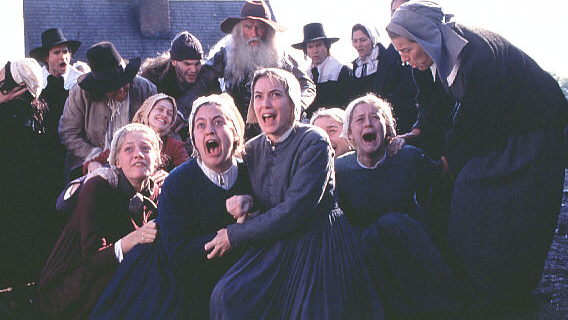
Perhaps they should read Arthur Miller’s play, The Crucible.

The Crucible (1996) movie

The Crucible (1996) movie