Not Much of a Crier

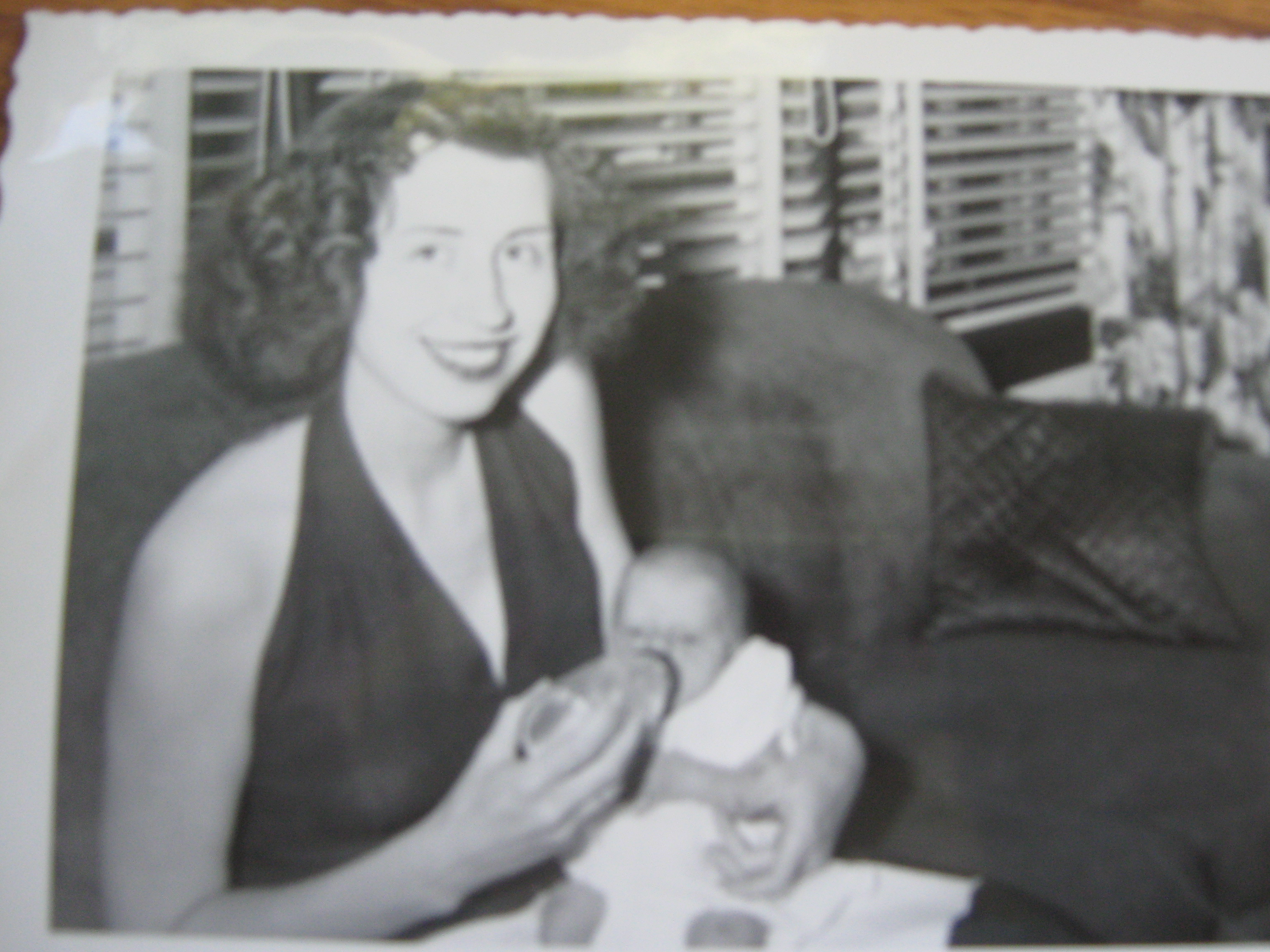
Mom, age 30, and I.

Mom, age 30, with me.

I’m not much of a crier.

I sat in the back yard listening to R.E.M. after my mother died.

Crying has never done me any good.

Better to rock.

Jumping around to rock helps, too.

I learned not to cry.

I was sitting at a coffeehouse today when my eyes filled with tears.  I went out on the patio and wept. I had a sudden memory of the day before my mother’s death, when she rocked herself back and forth in pain, muttering: “I’m sorry” (after a certain age your parents WILL vaguely apologize to you), “I might die,” (“You might but you might not!”), and  “Help me.”

I helped her.

I asked the nurse if Ativan or Ambien might help her sleep.

She explained the morphine, instead of tranquilizing my mother, had made her hyper.  That happens sometimes with old people.

So they took her off the morphine, which had kept her awake and in pain.

And then the next day she slept.

“I love you, Mom!” Crying as I went out the door.

Two hours later she was dead.

She is the only person close to me who has died.

But the crying thing…

Perhaps if I’d cried more at the time…

I wouldn’t have become temporarily cyberaddicted…

If you cry when it’s appropriate…

The not-crying thing started at the funeral when I had an epiphany that there is no life after death. Perhaps the epiphany was because of the bad behavior at the funeral, relatives not speaking to relatives, etc.  I had another epiphany today:  there’s a 50/50 chance.

I couldn’t cry at the funeral because I hadn’t saved her. I arrived at the nursing home too late (I had been sick) to insist they send her to the hospital across the street.  Two years ago I saved her at an assisted living facility from someone who had ignored, or not been informed of, a doctor’s recommendation of hospitalization.

Strange how you can NOT know someone and miss her so much. Mom, the mother of me, the adult, and I had little in common.  She belonged in a Dickens novel (Miss Flyte, only with knickknacks and no canaries) and I am a contemporary novel by…  well, Frederick Exley plus Muriel Spark plus War and Peace = ?

But Mommy–when did she become Mom?– was ALWAYS in my corner, to the extent that, all evidence to the contrary, I believe I AM the best at everything (except sports!).  Yes, the best!

Thanks, Mom!

AND NOW ON TO MARY WEBB’S GONE TO EARTHA couple of bloggers (is it a male thing?) mocked Mary Webb last year.

But Precious Bane, her masterpiece, which won the Prix Femina Vie Heureuse Prize,is powerful and lyrical: her heroine, Prue Sarn, has a harelip but a very good figure, and when she is accused of murder, she prevails through her intelligence and friendships.  Webb’s style is reminiscent of Thomas Hardy’s, though three notches down in style.  Precious Bane is a romance.

GonetoEarth mary webbI read Gone to Earth a few weeks ago and have meant  to write about it, but what to say?  It’s a pageturner, not a good book, but an entertaining book, and it’s really just for women.

You see, Hazel Woodus loves her fox, Foxy.  She “had found Foxy half dead outside her deserted earth…. Hounds symbolized everything she hated, everything that was not young, wild, and happy.  She identified herself with Foxy, and so with all things hunted and snared and destroyed.”

I love Foxy!  I want a pet fox, too.

Anyway, men are hunting Hazel, one good man, Edward, a minister, who marries her but does not have sex with her (a mistake), and Jack Reddin, the squire, a guy who crudely rapes her in the woods, but she goes to live with him because she needs sex.

Instinctively she felt that she belonged to Reddin now, though spiritually she was still Edward’s.”

And then it is back and forth between the men.

Hazel is like Tess in Tess of the D’urbervilles, only blatantly sexy and much less conventional  Edward is Angel and Reddin is Alec.  Threesomes never work.

And Hazel is also a bit like Marty in  Hardy’s The Woodlanders, the poorly educated minor character who is far more interesting than the well-educated heroine, Grace. Both Hazel and Marty are working girls:  they do”bark-stripping”:

What is bark-stripping?  Hazel explains,

“It’s fetching the bark off’n the felled trees ready for lugging.”

This is Hardy for girls.

Actually, I could write a long defense of this novel, but I am not in the mood tonight.

Webb is obsessed with nature, sex, and symbolism.

The structure of Gone to Earth is perfect, though the style is a bit clumsy.

Trust me.  It’s not good, but it’s entertaining.  FOR WOMEN ONLY.

Humans in the Shadow World

First you use machines, then you wear machines, and then…?
Then you serve machines.  It was obvious.–John Brunner’s Stand on Zanzibar

Stand_on_Zanzibar_workingA few days ago I mentioned I had spent half a day online.

Half a day. That’s a lot of hours.

It upset me.

There I was, teary-eyed because I couldn’t get offline.

Ridiculous, I know.

I don’t look like an addict.  I don’t/can’t drink.  I don’t/can’t take drugs.

I’m now like a character in an SF novel.

Suddenly the computer takes over and….

No, it’s not 1968, the year John Brunner’s Stand on Zanzibar was published, but everyone should read this postmodern science fiction classic.

As Brunner knew, the computer can be used for the good or the bad.

And so I went offline for several hours yesterday to read.

I almost finished Miklos Banffy’s They Were Counted, a Hungarian classic written in the ’30s, the first of the Transylvanian trilogy. Set in the last years of the Austro-Hungarian Empire, this brilliant novel shimmers with vividly detailed descriptions of parties (one lasts 100 pages), hunts, gambling, politics, and adulterous love.  It is reminiscent of Tolstoy’s War and Peace and Anna Karenina, two of my favorite books, yet somehow I hadn’t made much progress this month.  It was all the online stuff.

I read 100 pages.

I am relieved.

I am still here.

Yes, the same person I always was.  A reader.

I value my online friends, their emails, and their blogs, but being online can be addictive.

When you’ve been off the computer for a day, you know what hurts your eyes?  Twitter.

It looks like this:

Europa Editions ‏@EuropaEditionsOur first ever hardcover at @banksquarebks in CT–looks delicious! Also catch @JonCG at @TheIvyBookshop tonight! pic.twitter.com/5kGi47TlL8

What the f___ does that even mean?  (though I love you, Europa Editions!)

FOR GIRLS ONLY.  My vivacious cousin the librarian has gone on four dates this month.

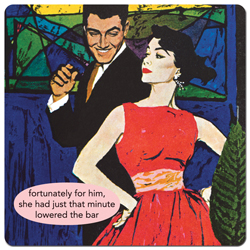
taintor magnets-fortunately-for-him-she-had-just-that-minuteShe has gone out three times with a guy who used to be “in the military.”

“What does that even mean?” I ask.

“He’s 40, a retired…officer?”

We dragged in a table from the porch and I arranged my plants on it.

There!  A Christmas cactus and three geraniums.

Having the plants there makes me want to look at the computer screen less.

“He’s very reliable…seems to be…and pays for everything…but…”

There is always a “but…”

“But he was half an hour late and…there was lipstick on his shirt.”

Probably his own lipstick, I thought despondently.

“And then he admitted he had been on another date…”

I knew this story wasn’t going anywhere I wanted it to go.

“Well, at least he was honest.”

“Honest?  Do you like him?”

She was quiet.  No, not that much obviously…it’s October…find someone now or you’re alone all winter.

“Honey, no!”  I said absent-mindedly.

Story, characters, sadness. That’s not what we’re all about in my family.

And we’re not really much about the military, either.

We looked at her latest match.com email.

“You have 16 new matches…  Because you interacted with ____, _____, and _____, we think you may like these matches.”

“It’s better than hanging around in a bar,” she said in a quavering voice.

Is it?  Yes, of course it is.

We start reading profiles.

“Maybe I’ll just have a tiny drink,” she says.

I forbid drink, but give her an oatmeal cookie.

Mirabile Does Middlebrow: Margery Sharp’s Martha in Paris & Am I a Middlebrow Novel?

I am mildly obsessed with middlebrow women’s novels. They tell me who I am, was, and will be.

Certainly I know more women who enjoy Bess Streeter Aldrich’s middlebrow novel, Spring Came on Forever (which relates to our female ancestors’ Midwestern past),  than Proust’s  Remembrance of Things Past (though I am reading Swann’s Way next month for the centenary).  As individuals, we are not just women.   We are stories.  And though my favorite novel is George Eliot’s Daniel Deronda, I am far from being the tragically beautiful heroine of an English novel.

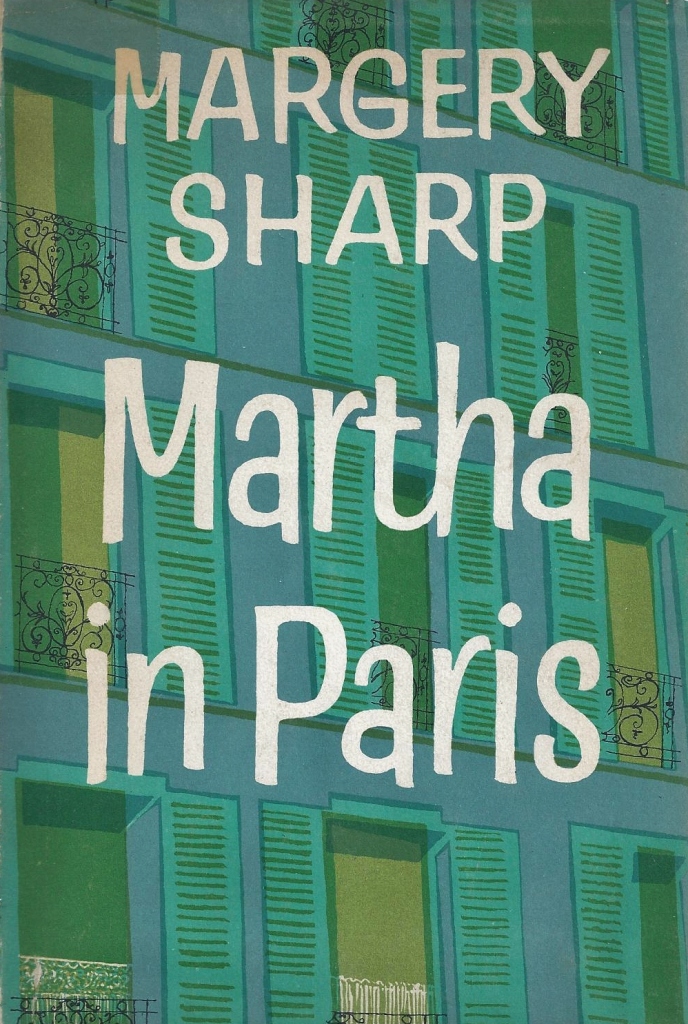
Often middlebrow novels describe the lives of women who live outside our imaginations, like Martha in Margery Sharp’s light comedy, Martha in Paris. Sharp takes our image of fat women and throws it in our face.   Art matters, not fat, and Martha is a fat artist.    A sexual experience jeopardizes Martha’s aspirations, but she overcomes it, despite pregnancy.

martha-in-paris-margery-sharp-001Sharp, the author of The Rescuers (a novel about mice, which was made into a Disney movie), is also the author of The Eye of Love (Virago), in which Martha first appears.

In Martha in Paris, Mr. Joyce, a furrier, has informally “adopted” Martha, the fat 18-year-old orphan who lives with her aunt and uncle.

Aunt Delores cannot understand why Mr. Joyce is interested in Martha.

…what Mr. Joyce had seen in Martha’s youthful drawings was a deeper mystery still.  To Dolores, with the best will in the world, they looked no more than a muddle of criss-cross lines, and to Harry like some sort of blue-print:  the fact remained that Mr. Joyce had been so unaccountably struck by them, he was now paying not only her fees at an art-school, but also three pounds a week toward her keep.  Since Martha ate like a horse, it made a quite substantial difference to the Gibson’s narrow economy.

Mr. Joyce decides to send Martha to Paris to study art. He is sure Martha will not “get into trouble,” even in Paris:  she weighs ten stone.

In Paris, Martha amuses us by drawing and painting stoves and pipes instead of people.  Sitting on a bench eating her lunch one day, she meets a dull English banker who lives with his mother. When she finds herself pregnant and he offers to marry her, she realizes marriage is not what she wants.  I can’t give away the plot, but it is very, very funny.  And she is the best artist in her class.

AM I A MIDDLEBROW NOVEL?  One wonders.

Here’s my day:  Worked on Apollo and Daphne vampire novel for NANOWRIMO (National Novel Writing Month).  Yes, if I can’t tur  Ovid’s version of the myth into a vampire story, what’s the point of NANOWRIMO?   But the day passes in secretly reading Proust and  checking email when I should decide whether Apollo or Daphne will be the vampire.

Checked my email again (though I have proudly cut back on online time).  Then I spend five minutes writing a comical email that should win the P. G. Wodehouse Prize, but what if my witty online friend thinks I’m a stalker?  Really, I am too hilarious!

Then I stuff my wet-from-shower hair under a hat, put on a LOT of lipstick (to look respectable), and  go on a long walk.  I am crouching in front of the Little Free Library when a friendly runner approaches.  It is my husband.  “Are any of these books yours?”

Yes, I donated two.

And now here’s the R.E.M. song of the day, “Imitation of Life” (performed live, Michael Stipe’s makeup running and Mike Mills’ hair soaked from performing in rain)

Stuck on the Internet

At the coffeehouse.

At the coffeehouse.

I have been online half the day.

“Get out of the house!” I told myself.

I know addictive behavior when I see it.

I had no pleasure in surfing the net, and yet I couldn’t stop.  It had been like that for a couple of days.

I am the person who was never supposed to be an addict. See me?  “That’s me in the corner…” chatting, drinking Diet Coke.

That’s me in the corner
That’s me in the spotlight
Losing my religion
Trying to keep up with you
And I don’t know if I can do it
Oh no, I’ve said too much
I haven’t said enough
–“Losing My Religion,” R.E.M.

“You’ll never have an addictive personality,” my doctor once said with satisfaction.

But, alas, on my Nook tablet, I click all afternoon between my book and my email.  I preferred my Original Nook (which broke), because it barely could get on the internet.

So I go out and walk.

I can breathe outside. I am not clicking on a screen.  It’s raining, but I smell the mud and watch the leaves fall.

I stop for coffee.  There is a minimal sense of human connection at a coffeehouse, which I very much need after a day on the internet.  You recognize the same people from day to day, or at least some of them, and you can nod to them if you’re feeling sociable.  And you don’t have that crazy impulse to (almost) reply to a tweet of Ron Charles, the Book Editor of the Washington Post, when he says he is the last one to publish a review of Donna Tartt’s Goldfinch  (on the actual publication date).  He might have been surprised to hear from me, since he doesn’t know me:  “Thanks! I get tired of reading reviews before the books are out.”

No, I love my coffee.

“Friedrich’s is the best,” another walker said as I strolled down the street sipping from my cup with the logo.

“Yes, I agree!”

If it had been a little quieter at the coffeehouse, I might have sat in a comfortable chair.  I had a book with me, The Diary of Anais Nin.

But it’s a bit crowded today.

And so I go on.

Down the tree-lined street with the meridian, past the houses for sale that I always want to buy even if they’re in a bad neighborhood, past the Little Free Library, which is not kept well-stocked, and features mainly thrillers and Guides for Idiots, and for once there are no dog walkers.

And I am not online.

And I want to read my book.

And I don’t know how I’m going to read if I have to be online all the time.

Today Brian Loging at his excellent blog The Wannabe Saint discussed our society’s obsession with zombies.

I have seen the undead at times walking in the mall, waiting in a check-out line, jogging down a street. Heads down, mouth mumbling, staring at a screen.

And I hate to think that this is me.

I don’t actually have my device out in public, because I don’t have a phone.

But I need more quiet than I’ve had lately.

I know how to provide this quiet.  Turn everything off.

Vampirically Preppy with Too Much Lipstick

Detail, "House of Fire II," by James Rosenquist

Detail, “House of Fire II,” by James Rosenquist

My mother briefly worked as a cashier.

One day I walked into the drugstore and there she was.

I ducked out.  Horrible of me, I know, but I was stunned to see her working a minimum-wage job.  I lived with my father, who had custody of me, and I had not realized she would need to work after their divorce.

She was no longer young, and despite her college degree, there was no suitable work.  Later she got an office job.  Still underemployed, but at least not humiliated.

And now we, too, are middle-aged, well-educated, and unsuitably, under-, or un- employed.

Retail could be our future.

I thought about this idly on Saturday when I was shopping for clothes.  Department stores employ quite a few middle-aged and older people.  Maybe I could hang up garments.  I once had a job where I sat outside the dressing rooms and gave out plastic hangers telling the number of garments people were trying on.

I don’t see anyone doing that job now.

On Saturday one helpful clerk, possibly in her sixties, was so charming and funny that one did not notice her age.

Another was ancient. She would not smile.  That is what made her seem old.  This unmannerly woman, with long, carefully-combed gray hair, was wrinkled and miserable. Perhaps in her seventies?   What was wrong?  I wondered.  She looked ill.  Was she ill?   I adjusted my face from smiling to sympathetic.  Still no reaction.   She wanted me to open a charge card.  I made a joke about cards.  No smile. She repeated the charge card offer.  No smile.

I gave up.  She hated me because I was shopping, not working.

If my mother had been there, she would have assured me that I was the best, most delightful, kind, polite woman in the world–yes, in the world?  Got that!– and that the cashier was mad or undeserving of sympathy.

We would have gone out for coffee or Diet Cokes.

As it is, I felt slightly worried about the rude woman.  What was wrong with her?

I missed my mother again today.

I was shopping at a box store. She loved box stores; I do not.  I was dressed in a “vampirically preppy” outfit (black sweater, blue turtleneck, and black jeans) of which she would have approved except for the black, which means she wouldn’t have approved.

And later I wore too much lipstick.

When I say too much lipstick, I mean too much lipstick.

It was new lipstick.  Two for one and a half.

I’ve never had red lipstick before.  Let’s face it, I’ve only owned three lipsticks in my life.  Would the red distract from the weathered look…?

That was my thought.

I smeared it on.

In the mirror it looked…red!

Hours later my lips were terribly red, and, worse, there was a puffiness.

Puffy lips!  No, I don’t want the puffy lips look!

It was a slight allergic reaction to the lipstick.

Again, my mother and I would have laughed about it, unsurprised, because I am allergic to most makeup.

I do miss her.  “Throw it away.”  That’s her voice in my head.

I threw the lipstick away.

Back to the crayon thing that barely colors lips (I’ve had it for years) and is perhaps just a fancy chapstick!

Interview With Karen E. Bender

Karen E. Bender

Karen E. Bender, novelist

Karen E. Bender, author of A Town of Empty Rooms, agreed to be interviewed by email.

In her remarkable novel,a Jewish family moves to the South after the heroine, Serena Hirsch, steals $8,000 worth of jewelry on her boss’s corporate credit card in Manhattan during a breakdown over her father’s death.  Serena is fired and blacklisted, and her husband, Dan, finds a job in Waring, North Carolina, which feels like a foreign country to them.

Mirabile Dictu:  What inspired you to write the story of Serena and her family?

Karen E. Bender

Karen E. Bender

Karen E. Bender:  To misunderstand someone and be misunderstood are such common human experiences; We all live with such different narratives and histories rolling through our heads, we all process our immediate interactions very differently, and it can be difficult to step back and think about what someone else is saying or feeling. How do we reach out through our solitude? I wanted to delve into the ways people don’t connect and also how they do, both looking at people who are very close to each other, and also between people who are mostly strangers.

Mirabile Dictu:  Religion is a refuge for Serena, though not for her husband, who attempts to be super-conventional and even disavows his Judaism. Was it difficult to write a novel “about” these different attitudes to religion?

Karen E. Bender: I love writing about religion because people’s attitudes toward it can be so
particular and strange and interesting. Within my own family, I see an array of ways people connect to their Judaism and can find it comforting or disavow it. Religion evolved, partly, to help us process life cycle events—birth and adolescence and marriage and aging and death. Serena and Dan both experienced recent losses, and I thought it would be interesting to see how each used a different sort of religion or institution to comfort or distract them. For Serena, it was the Temple, and for Dan was the Boy Scouts; but each strategy had its own complications.

Mirabile Dictu:  When and why did you begin writing?

Karen E. Bender: I began writing when I was six years old, after a rock flew through the air and hit me on the head at a birthday party; writing became a way to process this rather upsetting event. Writing then became a way to release feeling, to shape an experience, to invent the world in a wholly new way. And writing is one of the few places in our culture where we can be completely honest, even (in fiction) while lying. To me, that is the most sacred element of great writing; the fact that honesty gives you a way to connect with another person; a good story is this amazing bond with someone. I find that so moving.

Mirabile Dictu:  Do you write on paper or on computer?

Karen E. Bender: I write on a computer.

Mirabile Dictu: Who are your favorite writers?

Karen E. Bender: There are so many! Some who I read over and over are Philip Roth, Alice Munro, Flannery O’Connor, James Baldwin, Cynthia Ozick, JD Salinger, Stanley Elkin, Lorrie Moore, Grace Paley. For A Town of Empty Rooms, John Cheever, Paula Fox, and Richard Yates were especially nourishing. I love those beautiful, dark realists.

Thank you for the interview, Karen!

Born in L.A., Karen went to the Iowa Writers’ Workshop, where she met her husband, the writer Robert Anthony Siegel. She is the author of two novels, Like Normal and A Town of Empty Rooms, and is co-editor of the nonfiction anthology Choice: True Stories of Birth, Contraception, Infertility, Adoption, Single Parenthood, and Abortion.

She and her family live in Wilmington, North Carolina.

You can read more about her at her website:  http://karenebender.com/

Not a Sweater Girl

Emma Peel (Diana Rigg) in The Avengers:  Was that the idea?

Emma Peel (Diana Rigg) in The Avengers: Was that the idea?

Everything in my wardrobe is black or gray.

Because I can wear that little black dress anywhere and be au fait?

Because I’ll look like Emma Peel (Diana Rigg) in The Avengers?

The effect is, alas, nunnish.  I look pale.

I must replenish the wardrobe.  Just look at this sweater drawer.

  • Black turtleneck, with hole in shoulder.  How did it rip?  It’s not on a seam; it’s just a gap. Must make gap look intentional.  With scissors?  Bad idea.  Can’t wear black in house because it attracts cat hair.
  • Black cardigan, with strange little flower sewn at top button. So much cat hair clings to it that I will have to de-cat-hair with a whole roll  of masking tape.
  • Old black turtleneck, once size medium, now so stretched out and boxy it still more or less fits.  But can’t be worn in house because of cat hair.
  • Gray cardigan, with same strange flower as black sweater.  Thank God I have something to wear.
  • Then there are the thick Fair Isle wool sweaters that I’ll wear when it’s five below.  They’re too hot most of the time.

And so I go to the department store to replenish my wardrobe.

I tell my ride it will be five minutes.  I shop fast.

Oh, no.

No!

Hundreds of baggy cardigan sweaters without buttons hang on hangers.   What is the point of a cardigan without buttons?  The point of a cardigan is to button up if cold, unbutton if warm.  I want a sweater, not a thing to wear over a silk top.

If I don’t want to wear a cardigan I can wear a…cat sweatshirt!  Or a pumpkin sweatshirt or a Thanksgiving sweatshirt.  My mother gave me many such comfortable sweatshirts.  But I have one rule:  NEVER WEAR THEM OUT OF THE HOUSE.  Last time we went out for pizza, a group of elderly women were wearing cat sweatshirts.  I desperately cling to middle age and have decided that even black sweaters with holes are better than cat sweatshirts.

All right, I find a few sweaters.

I try on a fuzzy shawl-neck sweater which gets tangled in my earrings.

I try on a fuzzy turtleneck that seems to be made of intentionally linked diamond-shaped holes, and it also gets tangled in my earrings.

I try on a vaguely ’80s-looking gray sweatshirt with studs sewn on the front.  It falls off the shoulder, not a good look for me.  I realize somebody in a heavy metal band might have worn it in the ’80s, or  Jennifer Beals in Flashdance.

Finally I buy three warm heavy cotton zip tops that are not fashionable but at least look warm and anonymous.

Then I wander through the handbag department and almost buy a $395 Coach bag, which I can’t afford, and then almost buy a $165 Sak Bag for 40% off, which I also can’t afford.  Neither bag suits my bicycling needs, so I get out of there before I’m hypnotized and open a new charge card so I can get 20% off and…

Twitter?

Twitter is, well, silly.

I am @MsMirabileDictu.  I don’t know why I am @.

I feel like Bridget Jones in Bridget Jones:  Mad About the Boy.

9:45 p.m.  Have got onto Twitter site but do not understand.  Is just incomprehensible streams of gibberish half-conversations with @this and @that.  How is anybody supposed to know what is going on?

I also like:

9:15 p.m.  Cannot figure out how to put up photo.  Is just empty egg-shaped graphic.  Is fine!  Can be photo of self before was conceived.

Spambots follow her, unfollow her, people she knows follow her, unfollow her, strangers follow her, unfollow her, and it is all very, very funny.

Twitter?  What’s it for?

I use it to “follow” (is that another word for “stalk”?) book review publications, writers, bloggers, and a couple of critics.  When the Washington Post posts a new book review–click!  I’m there.

Heavens, I was there every day before I went on Twitter.  The Wash Post and other review publications can confirm that by cookies.

So much for stalking!

I know very few people in “real life” who are on Twitter.  My role model cousin, who tells me about Amish general stores without electricity and CSA (Community Supported Agriculture, where one can order vegetables directly from farmers), thinks Twitter is hugely time-wasting.  She is on Facebook.

I don’t actually know what Facebook is for, either.

I prefer Yahoo Groups, though some of those have become moribund.

And I have already looked at the blogs on my blogroll and discovered that only a couple of you are on Twitter (or at least you don’t list it if you are).

So why or why not are you on Twitter?

Aging Women in Horace & Bridget Jones

Horace loebToday, a perfect gray fall day for curling up with a good book, I read Horace’s Odes and Epodes and mused about the women in his poetry.

Horace dislikes older women, which is perhaps not unusual, though we don’t often read about it in poetry.

In the elegant, if angry, Ode I.XXV, Horace addresses an aging woman, Lydia.  He says that young men bang less often on her shutters than they once did; they no longer deprive her of sleep.  Does Lydia miss this, I wonder?   Now “the door loves the threshold, while before it often moved on its hinges.” That is a sexual metaphor in Latin poetry.  Whenever they talk about doors…

I wonder whether the windows and doors are really open for women today in the age of “hook-ups,” or whether choices are narrower and cause more anxiety.   In the late twentieth century men never banged on our windows, though they banged on the door sometimes. Once my boyfriend and I were sleeping when a strange man turned on the light.  Oh, sorry, he was looking for my roommate.

My roommate was really more the Lydia type than I. Men might have serenaded her, as the young men do in Horace’s Lydia poem, in the days before the Pill, if we had been adults then;  I was as far from Lydia as one could get, the type who hung out at the coffeehouse, chatted nonstop, sat through Days of Heaven again and again, and went jogging.   One day my roommate informed me that I “owed” her and must attend a champagne breakfast and go out on a boat with her and two of her men friends.

This spawned my famous dating advice, “Don’t get on the boat.”  Once you are on the boat, you are likely to be bored for hours, because there you are, with nothing to do but drink beer…  The champagne is gone.  You have little in common with the guys.  Sure, they are nice, and I appreciate the invitation, but…

Horace doesn’t give dating advice.  He complains instead about impotence with older women.  I would now, according to his calculations, be an older woman,  because I am  older than Lydia, who might not have lived to be very old back in Rome of the first century B.C.

In Epode XII, an early, rude poem, he complains about a woman’s wrinkles and smell.  This is David West’s translation.

The sweat and nasty smell get worse all over
her wrinkled body, as my penis droops
and raging passion cools
and all the while the powdered chalk
and crocodile shit run on her face as she ruts away…

And one can see why we didn’t read Horace’s early poems, the Epodes, in grad school.  About one-third of us were women, and we would have been terribly offended.  I am not shocked by poetry nowadays.   One can see the greatness of his poem about Lydia, the second-rate-ness of the Epode.  Did one come from the other?

And in Epode II, he again is impotent, and again complains.

You dare to ask me, you decrepit, stinking slut,
what makes me impotent?
And you with blackened teeth, and so advanced
in age that wrinkles plough your forehead,
your raw and filthy arsehole gaping like a cow’s
between your wizened buttocks.

Not quite the gorgeous language one would expect in poetry.

Ode I.XIII is another graceful poem about Lydia, or at least a Lydia (I’m not sure if it’s the same one, and I have no reference books about Horace).  Again, what a difference between the Odes and the Epodes.  The following literal translation is my own, and captures the shortness of the lines, though certainly not the grace.

When you, Lydia, praise Telephus’
rosy neck, Telephus’ wax-
white arms, oh, my
liver swells with angry passion.

And something else perhaps swells too.  That is the way Roman poetry works.  That is what the word tumet (swells) implies.  Catullus, Horace, and Ovid used it, as critics tell us.  The poets were  risqué.

Anyway, it’s been an interesting, quiet day of Latin, not answering the phone, and considering the way women live now and the way we don’t.

N.B. Bridget Jones:  Mad About the Boy is being trashed online by both men and women, partly a copycat effect, I think.  Bridget is condemned for being an older woman with a sex life.  This charming novel, which should be passed around instead of reviewed, is making me laugh out loud.

What do you think of views of aging women in our times?

Steve Yarbrough’s The End of California

Steve Yarbrough’s brilliant new book, The Realm of Last Chances, a novel about dislocation, is my favorite novel of the year.  (I wrote about it here.)

steve_yarbrough_the_end_of_california_300x448And so now I am slowly making my way through Yarbrough’s oeuvre, and I just finished The End of California, a compelling novel about family, relocation, and the meaning of fidelity.

Yarbrough writes from multiple points of view, centering on Pete Barrington, a doctor who moves back to his hometown in Mississippi with his wife, Angela, and daughter, Toni.  An affair with a patient resulted in his leaving his practice in California.

It is a traumatic move for all of them.  Pete, a former high-school football star who left for California on a football scholarship, never expected to return and practice medicine in Loring.   His best friend, Timothy, a depressed lawyer and part-time assistant football coach whose ex-wife and daughter live in another town, finds him a part-time job as an assistant coach.  Tim and Angela also connect, partly because she and Pete have not been able to reestablish a caring relationship.  And so we have a triangle here, but it is not the triangle that destroys the family.

Yarbrough’s description of Pete’s discovery of the affair is sadly realistic, in that he knows before he knows he knows.   He notices that Tim has lost some weight and is dressing better and realizes he must have a woman.  “There must be a damn good reason why his friend of more than thirty years hadn’t told him about something this important.”

And then he watches Angela and everything becomes clear.

That evening Angela sat at her vanity looking at her face, as she often did these days.  At first she’d been startled that her appearance had not changed.  Visible evidence ought to accompany a transformation of the type she’d experienced, but no such evidence existed.  At least not to her eye.

His eye saw what her eye missed.  Normally, she did things while she sat there, examining her skin for blemishes, squeezing a pustule if she found one, rubbing cold cream on her neck, plucking her eyebrows.  But lately she just looked.  Her movements around the bedroom had grown languid too, and she no longer guarded her nakedness.  Right now, for instance, she wore a white silk pajama top but was naked below the waist.  Last night she’d stepped straight from the shower and walked over to the dresser with water dripping from her pubic hair.  If she was still ashamed of her thin legs, small breasts or the fold of fat below the transverse scar from her C-section, she no longer showed it.

The slowness and heaviness of Pete’s observations as he attempts to repress his own knowledge is the kind of thing that happens in every marriage at some time.

Oddly, it is not the triangle that catalyzes violence, but their daughter Toni’s relationship with her boyfriend, Mason.   Mason’s father,  Alan, the Christian manager of a Piggly Wiggly store, hates Pete, because in high school his mother, Edie, had affairs with boys who were seniors in high school; Pete was one of them. Alan tries to stop his son from seeing Toni.

Violence changes the course of the book.  Although it is not a mystery, and we know who committed the crime,  the police are involved and evidence slowly comes to light.

I admired this novel very much.  The Realm of Last Chances is a masterpiece; The End of California is merely brilliant.  Both are among the best novels I’ve read this year.

And you can read my interview with Steve Yarbrough here.