
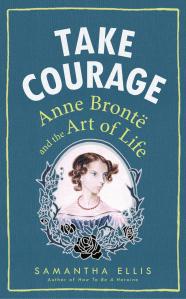
 Last month I planned to read Samantha Ellis’s new bibliomemoir, Take Courage: Anne Bronte and the Art of Life, and to reread Anne’s two novels, Agnes Grey and The Tenant of Wildfell Hall. What could be more fun? While waiting for Ellis’s book to arrive from the UK, I binge-read the Annes and my favorite Charlottes. Well, I was thrilled when Ellis’s book finally arrived, but it has proved to be yet another overrated new book. It is a desperate mix of biography, trivial memoir, and pedestrian attempts at criticism.
The bibliomemoir is a strange genre. Who has succeeded? Who has not? I loved Robert Dessaix’s Twilight of Love: Travels with Turgenev, but then Dessaix is an award-winning Australian writer, scholar, Russian professor, and novelist. Rebecca Mead’s My Life in Middlemarch is earnest and touching–she knows her Middlemarch and loves it–but the prose is clumsily journalistic. Then there’s Geoff Dyer’s Out of Sheer Rage: Wrestling with D. H. Lawrence, which is a mainly the writer’s comic musings on why he can’t face rereading the novels to write his book on Lawrence and prefers the letters.
Did I expect Take Courage to be in this class? It was enthusiastically reviewed in The Guardian and elsewhere. The first hint I got of its possible flaws was when Margaret Drabble in the TLS called it a “selfie memoir.” This was the death knell–though Drabble was otherwise very positive.
Ellis is all about voice, and if you like her voice you may like the book. You certainly don’t read it for her critical judgment. Her prose is spiky, slangy, and spare. When she writes about herself, she is in control. And she is probably an excellent playwright: she has a talent for sketching a vivid autobiographical scene in a few short sentences.
No, the problem is with her criticism. She does not write in a meaningful way for intelligent readers, though she desperately tries to prove herself. This book might be appropriate in a high school classroom.
In Chapter 1, “Maria, or how to know who you come from,” which I call the origin myth (Maria, their mother, died when the children were young), Ellis writes, “Charlotte’s novels are haunted by perfect mothers.” I was taken aback: I would say they are haunted by perfect spinsters. She tries to force the theme of the perfect mother into Anne’s novel, Agnes Grey, a story of a governess which is based on Anne’s own adventures.
Ellis writes,
…when Agnes is trying to keep her pupils in line, she thinks the worst she can do is to threaten not to kiss them goodnight. She’s astonished that they don’t care. The passage just aches with Anne’s longing for a mother to kiss her goodnight.
But it isn’t all sweetness and light. Agnes has to muster all her courage to fight her mother for independence. She wants to go away and earn her own living. Her parents think she’s too young.
A very odd reading: Agnes is not looking for independence but to contribute to the impoverished household. She has not only to persuade her mother, but her older sister and their father. All want to protect her: and her governess jobs are as bad as they had imagined.
Ellis also eccentrically interprets Charlotte’ Bronte’s Jane Eyre. She wonders if Jane shouldn’t have stuck with Rochester after the wedding was interrupted by the fact of the mad first wife in the attic.
She fancies him. She’s got no family to be ashamed of her living in sin, she’s already decided she doesn’t want to be a martyr like her (dead and perfect) friend Helen Burns, and she hates the hypocritical faith she was taught at school. Maybe it’s time to throw off the shackles of religion and move into Rochester’s love nest on the shores of the Mediterranean.
She blames Jane’s decision to leave Rochester not on the force of her character, passion, morals, and commonsense, but on the appearance of her “mother,” i.e., the moon. Jane loves Rochester, longs for him, but has a strong ethical base and is horrified by the secret of the first wife . And, oddly, Ellis does not consider the case of the mad wife. Nowadays, the mad wife is often key. (As in Wide Sargasso Sea in the ’60s!
I trusted the reviews too much. The blurb on the front cover says it all.
“I was wowed and moved.”–Tracy Chevalier
Alas! I was not.















 mirabile dictu