Zombiefied by the Olympics

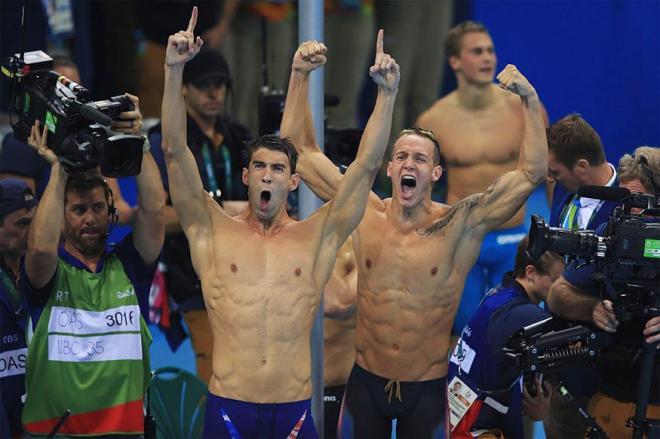
Michael Phelps wins 19th Gold Medal!

Michael Phelps wins 19th Gold Medal!

I am zombiefied by the Olympics so I cannot write about LITTERACHURE.  We sat with saucer eyes in front of synchronized diving, gymnastics, and Michael Phelps.  Hurrah, go Team USA, and Michael Phelps won his 19th gold medal, but IT IS TOO MUCH TV.

I had planned to write about Booth Tarkington’s  magnificent novel The Magnificent Ambersons, which won the Pulitzer in 1919. Did you know it is the great urban sprawl novel as well as the story of the decline of a wealthy family?

Well, I’ll write about it soon.

Here is a poem about watching the Olympics by J. Allyn Rosser (July 2012, The Smithsonian).  Enjoy!

Only five of us were arguing about the score
of a forward one-and-a-half triple twist
with absolutely rip entry, executed
by an unpronounceable stiff-stepping Russian,
because the sixth was busy in the kitchen.
I couldn’t help noticing how Jane had made
every surface sparkle, clutter-free, neat tray
of snacks, napkins fanned on the coffee table,
fresh daisies on the mantel and by the door.
The Russian’s entry was smooth, minimal splash,
but his come out had been a tiny bit clumsy.
So Jane’s future ex-husband said, anyway,
and when he called out that he wouldn’t mind
another beer as long as she was up,
and she called back that she’d just brought him one,
he had to say something.  Because there it stood,
still frosty, darkening the coaster at his elbow.
He said now that’s the sign of a good wife,
like a good waitress, you’re hardly even aware
when she’s there.  By now Jane had entered,
her arms crossed in a kind of tuck position.
Her approach was understated but forceful,
and the deftness of the look she sent him
when he finally looked up at her
was so pure and deep and swift, it left
hardly a ripple there in the room among us.

My Colette Paperbacks Are Falling Apart!

IMG_3852Alas, woe is me, oimoi! My faded Colette paperbacks are falling apart.  I had a set of 16 FSG/Noonday Press editions, but the bindings cracked and I’m down to seven.  I love the delicate drawings on these white covers now faded to cream.  I found them at the Union bookstore as a freshman and charged the books on my student ID.  Reading Colette made me feel sophisticated (says she who wore bell-bottom jeans and t-shirts).

Sure, my cat used the top edge of  My Mother’s House and Sido as  a scratching post, but  all remained readable until the glue began to dissolve.  The bindings have cracked: p.  84, The Pure and the Impure, p.  26, The Vagabond, etc..

I’ve replaced The Blue Lantern, Break of Day, The Shackle, The Complete Claudine, Mitsou/Music-Hall Sidelights, My Apprenticeships, and Gigi, to name a few.  Several are in print from FSG, thank God.  But most of mine are used:  an   NYRB, an old hardcover Colette omnibus with an introduction by Erica Jong,  old Penguins, a Dover,  and  Peter Owens.

How can I replace this pretty edition of Sido and My Mother’s House?  (Mine is not as pretty as this picture of someone else’s online.)

My Mother's House and Sido colette 0374512183.1.zoom

Well, it is in print from  FSG, but with a different cover.

my mother's house sido colette new fsg 51IOr+jGOJL._SX310_BO1,204,203,200_

And what about The Vagabond?  I am very attached to this book.

the vagabond colette noonday 904293My favorite Colette is The Vagabond, the first one I read.  The heroine, Renee, is a witty, sophisticated, reserved writer-turned-music-hall artist,  enjoying casual friendships with  the troupe and life on the road, while trying to avoid her fan, “Big Noodle,”  who sends her flowers and is determined to seduce and marry her. Renee is divorced and resists a new relationship. She prefers to spend time with her bulldog.  I wanted to be just like Renee, but how would that would have would been possible?  Should I have been a mime/dancer instead of a Latin teacher/flunky editor/perpetual student/waitress?  Well, I can’t mime or dance…but I do know Latin.

colette erica jong il_340x270.766889536_leuuFortunately, The Vagabond is included in an omnibus edition of Colette with an introduction by Erica Jong, so I’m covered if this one falls apart.

Omnibuses are the salvation of biblio-civilation!

Do your books fall part?  Can they be saved?  What is their shelf life (ha ha)?  I have turned on comments just for this post.

What Critics & Bloggers Think of the Man Booker Longlist (& Why I’m Supposed to Read The Leatherstocking Saga)

A friend says, “Enough Anglophilia!”

I was thinking of reading Charlotte M. Yonge when he launched a protest about my gaps in the American canon:  how can I read third-rate Victorian novels when I haven’t read James Fennimore Cooper’s The Leatherstocking Saga?  And so I am reading The Last of the Mohicans, and,  I admit,  there is a certain charm in sentences like,

“Chingachgook grasped the hand that, in the warmth of feeling, the scout had stretched across the fresh earth, and in that attitude of friendship these intrepid woodsmen bowed their heads together, while scalding tears fell to their feet, watering the grave of Uncas like drops of falling rain.”

Yet I will go crazy if I don’t read something British, so I am poring over the Man Booker Prize longlist (posted here), which, astonishingly,  features five Americans.   The only book I’ve read on the list is Elizabeth Strout’s  brilliant Booker-worthy novel, My Name Is Lucy Barton. 

Even more fun  than the longlist is the fuss about it.  Critics and bloggers have their favorites.

At the TLS blog, Toby Lichtig  analyzes the longlist and shares his personal longlist.  He writes,

When it comes to the Man Booker I’m firmly with Julian Barnes on the “posh bingo” front. As I discussed last night on Front Row with Alex Clark and John Wilson, this year’s is a particularly surprising list, blindsiding the critics with several novels that have barely been reviewed in the British press. Having not seen all 155 submitted books – and having, frankly, not read many of the ones on the current list – it would be unfair of me to criticize the choices. But while many of the entries are no doubt worthy of recognition, I could quite imagine an alternative reality in which all of these thirteen were replaced by thirteen deserving others. And certainly the list as a whole looks a little narrow to me. Everyone on it is either North American or British, with the exception of J. M. Coetzee, who represents the whole of African and Australasia. There are no Irish writers and no Asian ones (Madeleine Thien is a Canadian of Chinese parentage). There are fewer doorstops this year than in previous ones, and fewer sweeping narratives, with an emphasis on the family, the domestic.

I have read none of the books on Lichtig’s list (read the post!), but I do have Edna O’Brien’s The Little Red Chairs on my e-reader.  Does that count?

Then there’s The  Guardian Every summer it sponsors an informal Not the Booker Prize. There are 100 or more on the list, and you can vote for two choices.

Sam Jordison writes,

OK, I’m happy to admit that the main prize has a few things going for it. But I always feel that its longlist is just as notable for its omissions as the books that are chosen. This year was no exception. A few good books sometimes sneak on there – but dozens more don’t make it. And you know what? The Booker’s so-called longlist isn’t even that long. Not like the Not the Booker. As you will see below, our list really is long.

Well, I’ve only read three on this list.  Are they Not the Booker-worthy?  Here are my thoughts:

lionel shriver the mandibles 41m4GoRGmnLLionel Shriver’s The Mandibles, a brilliant, comical,  often dark  dystopian novel about money, is three-fourths Not the Booker-worthy. It’s fascinating, but some of the information about money (which we learn in dialogue) seems dumbed down.  (I also noted this dumbing down in the movie Money Monster with George Clooney and Julia Roberts.  People think we’re dumb about money–and yet…)

The Girls Cline 9780812998603Emma Cline’s The Girls, an eerie atmospheric novel about a woman looking back at her 1960s adolescence and her peripheral involvement with a Manson-like cult, is definitely Not the Booker-worthy (but British reviewers don’t seem to get it, so I think it’s an American thing, and that’s why it didn’t make the actual Booker list).

Charlotte Wood’s The Nature of Things, an Australian dystopian novel in the tradition of Margaret Atwood’s A Handmaid’s Tale.  It’s brilliant, but a bit slow in the beginning.  Is it Not the Booker-worthy?  It won the Stella Prize in Australia, but it wouldn’t be my choice.

WHAT ARE THE BLOGGERS SAYING ABOUT THE ACTUAL BOOKER LONGLIST?

At A Little Blog of Books, Clare writes,

Like many others, I had particularly high hopes for The Essex Serpent by Sarah Perry and ‘The Tidal Zone’ by Sarah Moss but unfortunately both of these titles either missed out or were not submitted for entry. The Noise of Time by Julian Barnes and Ian McEwan’s forthcoming ‘Nutshell’ are other notable absentees. However, as well as ‘Eileen’ and ‘My Name is Lucy Barton’, I also picked out ‘Do Not Say We Have Nothing’ by Madeleine Thien as a potential longlisted book in my predictions list and I am looking forward to reading it over the summer. I must also confess that I didn’t realise until today that ‘Purity’ by Jonathan Franzen was actually eligible last year – for some reason, I thought it had been published in November in the UK rather than September last year so apologies if I misled anyone with that!

The Essex Serpent and Do Not Say We Have Nothing haven’t been published here yet, but I do want to read them.

Phillip Edwards at PGE’s Booker Blog analyzes,

…this list reminds me of 2011 – not because of its “readability” – but because I see a lot of also-rans.

I had a hunch back then that the wide open longlist full of unknowns left the way clear for Julian Barnes, who was far and away the biggest name on the longlist, and this time around I’m wondering if the same applies to JM Coetzee.

Coetzee would figure highly in any list of the world’s greatest living writers (even when no-one is quite sure who, or what, he is writing about) so if The Schooldays of Jesus is anywhere close to his best work he could be heading for a Booker hat-trick. Although Booker judges love to be unpredictable, and do usually drop the favourite at the shortlist stage…

Now there’s somebody who knows his Booker!

What books on the longlist do you recommend?  What do you think is missing?

I wonder what happened to Tessa Hadley’s The Past, which I wrote about here.  Was it published too early in the UK for this year’s Booker?

In Twenty Years by Allison Winn Scotch

In Twenty Years Allison Scotch 51iNY+plaLLAllison Winn Scotch’s new novel, In Twenty Years,  is my favorite beach book of 2016.  It has a lot in common with Emma Straub’s widely-reviewed light novel, Modern Lovers.  Both center on the midlife crises of a group of old college friends–and, coincidentally, one of the group members in each book is a rock star.

Scotch’s novel is more focused:  it takes place during a weekend reunion. Five friends gather for the 4th of July weekend in the house they shared as students in Philadelphia. The twist?  It is not their idea. Their friend, Bea, who died in a car crash 13 years ago, was the one who kept the group together.  They learn that Bea bought the old house before her death when they receive invitations from Bea’s lawyer (at her written request) to convene for what would have been her fortieth birthday.

None of these characters is happy.  Lindy, a petulant rock star, loves to write songs, but the studio wants to keep her music “young,” and now gives her studio songs to pass off as her own.  Annie, a wealthy housewife, suffered from postpartum depression and had a problem with prescription psychotropic drugs, but now posts on Facebook and Instagram to convince herself she’s happy.   Catherine’s blog, The Crafty Lady, has become a big business, and she is under pressure and never home.   Her husband, Owen,  a  househusband, is as directionless as Annie.  (it’s hard to stay home.)  And Colin, a former neurosurgeon, switched fields to cash in on plastic surgery in L.A. They are no longer the simple people Bea loved.

The structure is slightly formulaic:  we see each character’s reaction to the invitation, their discomfort during their initial interactions, and finally the tension builds to a crisis.  It’s predictable, yet I loved it.  I kept highlighting passages, especially about the effect of social media on women’s lives.  (The men characters don’t seem to need it).

I’m  fascinated by the social media issues, because of blogging (my only social medium online).  Catherine’s Crafty Lady blog has grown from a fun project with 125 hits a day into a big business–and it is a nightmare.   She is constantly thinking about the competition.

The Crafty Lady has seen a treacherous slide over the past year; copycat bloggers have produced content faster and fresher, with younger demographics and hipper ideas. So if she doesn’t work these late nights, doesn’t slave over the right color of napkins, then the treacherous slide will evolve into a full-blown avalanche. And then what? They’ve built their whole lives around her success. Owen included.

For Annie,  social media saves her from actual communication.  Throughout the weekend she tweets, updates Facebook, and posts to Instagram. She feels comfortable if she doesn’t have to interact, especially with Colin, whom she has always loved.  As soon as she arrives she takes a photo of the house for Facebook.

Maybe she won’t have to toy with the pigmentation too much to shift it from a photo of a sort-of pretty, but nothing special, house with navy bricks and white shutters (they used to be teal bricks with purple shutters—no one was ever sure why, but they affectionately nicknamed it “Bruiser,” and the moniker stuck) to something magical. Something emotive. Something that the women from school or Pilates or spin class (none of whom Annie really thinks of as friends because, well, she doesn’t have a lot of real friends) will see and think, OMG! Annie, I wish I was there with you, wherever you are! Xoxoxoxoxoxo!!!!! She takes the photo four different times, satisfied with the last version, aware that the distraction has calmed her nerves, blocked out the dizzying noise clattering inside her mind. She posts it to Facebook. Filter: vintage

Lindy doesn’t use social media much–her publicist writes hers.  But when she is recognized at a bar in Philadelphia, students post about her on Facebook, Twitter, etc.  Suddenly everyone, including a very nice man in New York she has been sleeping with, knows where she is.   She has lied to her girlfriend in California and to her publicist about her whereabouts.

Well, eventually everyone comes together–sort of.  But, believe me, this is not The Big Chill or The Return of the Secaucus Seven.

A really enjoyable light book with a little bit of darkness!   For women only, just so you’ll know. 🙂

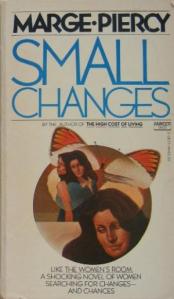
Small Changes by Marge Piercy

Marge Piercy Small Changes 1457469478_Piercy_SmallChanges

Women in Marge Piercy’s novels have messy lives, and I wonder if that’s why Small Changes got short shrift in a one-line review in The New York Times in 1973:  “A rambling story of two women, one working class, the other middle class, and their doomed stratagems for escaping hellish marriages.” No mention of the fact that the two women are radical feminists, or of Piercy’s messy, brilliant details about how we lived then:  applying diaphragm jelly, going on gay rights marches, and burning bread.

Small Changes is a fast-paced novel with fascinating characters, but it is also a brilliant study of the women of the counterculture of the 1960s. Piercy interweaves the stories of two radical women, Miriam, a flamboyant, sexy mathematician-turned-computer-scientist-genius who is in love with and has sex with two egotistical men, and Beth, a working-class woman who runs away from a controlling husband,  works for low wages as a typist, and eventually forms a women’s commune.

Few novelists successfully managed to capture the earnest feminist politics and experimental living arrangements of the ’60s and ’79s.  Piercy is savvy not only about feminism but about communes: she knows both the loosey-goosey house-sharing and the politically-motivated structures. The few communes I knew of were essentially house-sharing for the poor.  I  heard much more about “collectives”:  A friend’s parents lived briefly in a collective, organized around radical politics.

When we first meet Beth in Syracuse, she cannot believe she fell into the marriage trap.  Beth muses about how women’s magazines encouraged her best friend Dolores and herself to build a life around men.

If your hair didn’t please, you cut it or you curled it or you straightened it, and if your parents let you, you streaked it or dyed it. If your voice didn’t please, you went around trying to talk in your throat. You did exercises supposed to make your breasts grow and your waist shrink, and always you dieted. You shaved your legs and under your arms and bought creams and lotions and medicines to fight pimples. The constant message in the air was that, if you didn’t attract boys, you must change your body, rearrange your head, your personality, your ideas to fit in with what was currently wanted.

Small Changes Marge Piercy paperback 9780449236710-us-300When her husband flushes her birth control pills down the toilet, she runs away to Boston and changes her name. She reads widely and gets to know some interesting peoplein a commune.  When she tires of the power struggles between the men and women, she starts her own commune for women.  They want to form an identity outside the world of the nuclear family and consumerism.  At night they do improvisational theater.

Miriam, a brilliant computer science student at M.I.T., is sexy friendly, and maternal, and worries about and coddles Beth. Some men love Miriam, but she is working in a man’s field, and weak men resent her success.

The night before, something gratuitously nasty had happened. She had run into Barnett from her course in compiler generator systems and he had asked her how she had done. At her answer he had given her a mean squinty smirk and said, “Maybe if I had tits to shake in his face I’d ace it too.” He had walked off leaving her feeling daubed with vomit. As if she hadn’t been eating and sleeping and breathing that course.

Who of my generation hasn’t had such an experience in school?

And Miriam has such bad taste in men.  It is very painful to read about her experiences with Phil, a poet who writes sexist songs that insult Miriam, and Jackson, Phil’s sadistic best friend.  Miriam, Miriam, Miriam!  Get out!  But when she marries another computer scientist, things get even worse.  And then we see the worth of Phil.

I very much enjoyed this novel: it really is a (fictional) record of women’s history.  Most of Piercy’s novels have been reissued as e-books by Open Road Media.  She won the Arthur C. Clarke Award for her science fiction novel, He, She, and It.

Doris Lessing’s Martha Quest

martha quest doris lessing 431584The Nobel Prize winner Doris Lessing (1919-2013) had a powerful effect on my thinking as a young woman. I started with The Golden Notebook, her experimental novel about “free women” (as she ironically says) and the breakdown of personality.  In her early novels, Lessing illuminated aspects of women’s sexuality, radical politics, marriage, and the nuclear family.  Later, she  wrote experimental novels and science fiction about the consequences of war, nuclear power, pollution and the disintegration of society.

I recently reread Martha Quest, the first in her autobiographical five-book  Children of Violence series. This series is Lessing’s masterpiece, truly representative of the wide range of her work. Written over 17 years (1952-1969), it has held up better even than The Golden Notebook, and it surpasses much of her later work.  It is a bildungsroman:  the first four books, set in Africa, are conventional novels.  Lessing traces the history of the heroine, Martha Quest, from adolescence on an African farm to her years as a young woman in a small African town, where she works as a secretary, marries disastrously twice, and then becomes  involved with a communist group.  In the last book, The Four-Gated City,  an experimental novel, Lessing follows Martha to London at 30.

Last year when I reread The Children of Violence, I skipped the first book, Martha Quest.  And, having just reread it, I understand why. In this realistic novel, Lessing’s description of the destructive relationship between Martha and her mother is very painful. The generational divide is unbridgeable.
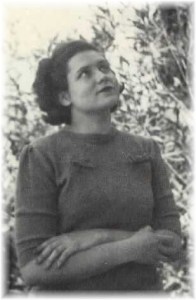
Doris Lessing in 1949, just before she left for London.

Doris Lessing in 1949, just before she left for London.

When the book opens on the African farm, Martha, a 15-year-old dropout,  is irritably reading Havelock Ellis on sex, while her mother, a former English nurse, gossips on the veranda with Mrs. Van Rensberg, a Dutch housewife.   The Quests consider themselves superior to the Van Rensbergs, and Martha feels guilty about it, but  she considers both families equally hypocritical, especially the women: Mrs. Quest denies Martha’s maturity even though she is bursting out of her childish clothes, while Mrs. Van Rensberg lets her daughter Marnie dress in the latest fashions and hopes to marry her off as soon as possible.

Since women’s conversation doesn’t suit Martha, her main social contact is with the radical Jewish Cohen brothers, who live in the village where their father has a store and lend her books.  She reads everything:  English novels and poetry, books on politics, sexuality, and psychology.  But the cultural abyss between literature and  the reality of  life on a farm in Zambesia (a fictional country in Africa) is enormous.  She doesn’t read about any young women who rebel against their parents as she does.

What fascinates me is the way Lessing interweaves ideas and questions with the narrative.

…she was seeing herself, and in the only way she was equipped to do this—through literature. For if one reads novels from earlier times, and if novels accurately reflect, as we hope and trust they do, the life of their era, then one is forced to conclude that being young was much easier then than it is now. Did X and Y and Z, those blithe heroes and heroines, loathe school, despise their parents and teachers who never understood them, spend years of their lives fighting to free themselves from an environment they considered altogether beneath them? No, they did not; while in a hundred years’ time people will read the novels of this century and conclude that everyone (no less) suffered adolescence like a disease, for they will hardly be able to lay hands on a novel which does not describe the condition. What then? For Martha was tormented, and there was no escaping it.
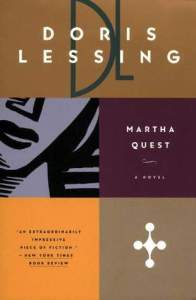
Martha Quest Lesing perrennial 423874I find this fascinating, because I gather (perhaps erroneously) that mother-daughter relationships are smoother than they used to be.  In my day, we were not only dying to leave home, but to leave our hometown as soon as possible!  (It took me a while, as it did Martha.)  So will the literature of this century reflect an entirely different set of beliefs?

Martha has to rebel and fight her mother to be herself. Everything becomes a battle.  She gets a ride to town and buys cloth at the Cohens’ store and begins to make her own dresses, though her mother forbids her to and screams at her for spending her father’s money.  She is not allowed to walk to or from town, so her father, an invalid,  finally intervenes and occasionally take her side.  Eventually he suggests she move to town, because he can’t stand the fighting, and Martha is hurt.  But when the Cohens find her a secretary job at their uncle’s law firm, Martha is elated.

But she cannot be true to herself. Soon she goes every night to  sundowner parties, drinks too much, and gets too little sleep.   Donovan, a closeted gay man, escorts her to restaurants and the sports club, and teaches her how to dress.  At the sports club she dances with many beefy men, who admire her and moan, “Oh, baby, you’re killing me.” When Marnie Van Rensberg shows up and they shower attention on her, Martha is jealous, but then she realizes that the newest girl always gets the attention.

And Stella, a beautiful Jewish woman married to handsome Andrew, takes Martha under her wing and insists on bringing her and the man of the moment back to her flat.  Martha becomes afraid to be alone.  She is exhausted–she seldom sleeps more than a few hours a night– and finally has to call in sick for a few days so she can read and recover herself.  But then she becomes entangled once again with Stella and the club, and when she meets Douglas Knowell, an intelligent, kind man who also reads The New Statesman, she falls, if not in love, in like.

Martha has always said she would rather die than be conventional.  She doesn’t want to marry or have children.

If someone had asked her, just then, if she wanted to marry Douglas, she would have exclaimed in horror that she would rather die.

But Martha cannot be the person she wants to be yet.  She is young, she is silly, and she is caught up with a crowd.

And that’s what it’s like to be a young woman, isn’t it?  It takes a while to be yourself.

Who’s Reading the Man Booker Prize Longlist This Year & Will the Prize Go to an American Woman?

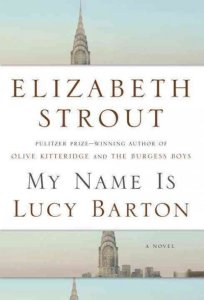
strout my name is lucy barton 9781400067695_custom-3102f059730b66633fef44e3287ef91337c0495f-s400-c85

We’re always excited when the Man Booker Prize longlist is announced. Over lunch I read the list to my husband.  I have read only one of them, Elizabeth Strout’s My Name is Lucy Barton, a stunning, lyrical novel about a  writer’s  complicated relationship with her mother. (I wrote about it here).

Here is a sample of Strout’s gorgeous prose.

It was May, and then June, and I remember how I would stand and look out the window at the sidewalk below and watch the young women–my age–in their spring clothes, out on their lunch breaks; I could see their heads moving in conversation, their blouses rippling in the breeze. I thought how when I got out of the hospital I would never again walk down the sidewalk without giving thanks for being one of those people, and for many years I did that–I would remember the view from the hospital window and be glad for the sidewalk I was walking on.

It is Booker-worthy, but will they give it to an American woman?

The award has not yet gone to an American, let alone an American woman. In 2015 Karen Joy Fowler got robbed . (Many of us women bloggers thought so.) In her quirky short  novel, We Are All Completely Beside Ourselves, the narrator Rosemary relates the story of her search for Fern, the chimp who was raised as her sister for the first five years of her life by Rosemary’s psychologist parents in Bloomington, Indiana. Fowler won  the PEN/Faulkner Award last year.  But  I rather get the idea that slim, lyrical women’s novels do not get the respect in the UK they did in the ’90s.

My husband has read none of the books on the list, but is very excited about Coetze’s The Schooldays of Jesus, though it will not be published in the U.S. until next February.

In the early innocent days of book blogging (I’m dating it 2006, though it may have been later), several English and Canadian bloggers earnestly read the complete longlist year after year. I thought it was very sweet, and I participated (though I didn’t read the whole longlist ever! And I’m sure there were other American bloggers, though I can’t think of them.).  At our house we depended on Kevin of Canada, a good critic who was unswayed by others’ judgment.  Alas, he died this year, and I’m not sure if the Booker blogging goes on without him.

In 2009, my husband and I read several on the longlist.  I wrote at my old blog :

One hundred pages into A. S. Byatt’s stunning novel The Children’s Book, I’ve decided she wins the Booker Prize. I don’t have to read the rest of the contenders. The longlist was announced today, and Byatt’s on it, so she has a good shot, though my other nominee, Geoff Dyer, didn’t make it. I’m putting ALL my money on Byatt. It’s a good list this year – a relief after last year’s White Tiger debacle, when so many first-rate novels were winnowed from the list in favor of unpromising first novels. What happened to Hensher’s brilliant novel, The Northern Clemency, and Ghosh’s Sea of Poppies? My husband hated White Tiger, and I abandoned it after 30 pages.

My second on the list was  the quirky Me, Cheeta, which our library solemnly catalogued as a biography.  (Thank you, Library of Congress!)  In my post, I flippantly categorized it as  “a monkey comedy classic and spoof of celebrity autobiographies. Cheeta, the chimp who is Tarzan’s sidekick in the movies, tells all, bitching about the stars, animal rights, his own choice to be an actor rather than replaced by digital pixels, the pranks of Johnny Weissmuller and David Niven, the cocaine parties, the obnoxiousness of Lupe Velez, and more.”

Neither my first choice nor my second choice won. I was a little less enthusiastic for the next two years, and then I simply gave up the project because I wanted to read old books!

But I intend to try at least one of them this year.

The Man Booker longlist this year comprises the following:

Paul Beatty (American), “The Sellout”

J.M. Coetzee (South African-Australian), “The Schooldays of Jesus”

A.L. Kennedy (British), “Serious Sweet”

Deborah Levy (British), “Hot Milk”

Graeme Macrae Burnet (British), “His Bloody Project”

Ian McGuire (British), “The North Water”

David Means (American), “Hystopia”

Wyl Menmuir (British), “The Many”

Ottessa Moshfegh (American), “Eileen”

Virginia Reeves (American), “Work Like Any Other”

Elizabeth Strout (American), “My Name Is Lucy Barton”

David Szalay (Canadian-British), “All That Man Is”

Madeleine Thien (Canadian), “Do Not Say We Have Nothing”

Quotation of the Week: Florence in Trollope’s “The Claverings” on Her Fiance’s Cheatin’ Heart

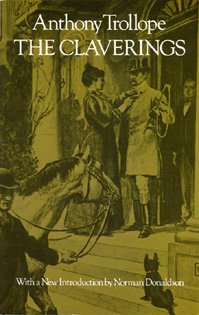
the claverings trollope dover 41-F6ogPTXL

What do you read when you’ve read Trollope’s Barsetshire series too many times?  Well, try The Claverings.  It is not his best book, but I loved it.   I disappeared inside the pages for hours and thought about the characters when I was walking or bicycling. I wanted to know who would marry Harry.  God knows he didn’t know!

The hero, Harry Clavering, the son of the rector of Clavering, has almost too many choices:  he is handsome, brilliant, and a Fellow at Cambridge, but he doesn’t want to take Holy Orders.  He apprentices himself to a surveyor/engineer, but when he gets a job in London he doesn’t apply himself.

And what about love?  At the beginning of the novel, he is  jilted by Julia Brabazon, the most beautiful, witty, and only slightly wicked character in the novel: she is his cousin Lord Hugh Clavering’s sister-in-law.  Why does Julia dump Harry?  She says outright she is marrying Lord Onger for money.  Harry soon consoles himself and  gets engaged to kind, sweet, smart Florence Burton.   Meanwhile, Julia has suffered like a character in Dante’s Inferno.  She has been degraded by association with the dissolute, drunken Lord Unger, and  gossip has linked her name with one of his friends.  When Lord Unger dies and Julia returns to London, Lord Hugh will not receive her.

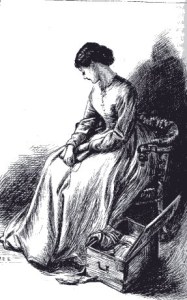
Florence grieving and preparing a packet of letters to return to Harry.

Florence grieving and preparing a packet of letters to return to Harry.

But then Harry meets her again, and he is attracted. He doesn’t tell Julia he is engaged.  He flirts and then gets physical.  After she hears of his engagement,  Harry assures Julia that he wants to marry her.  What is Julia to think?

So what is Florence do about his treachery?  She still loves him. Is she engaged to him, or is Julia?  Florence’s  sister-in-law visits Julia, who says that  Harry must decide the question of marriage.

Florence grieves, weeps, is depressed, but also is furious.  She asks her sister-in-law:

“Does she say that she loves him?”

“Ah, yes;–she loves him. We must not doubt that.”

And he;–what does she say of him?”

“She says what you also must say, Florence;–though it is hard that it should be so. It must be as he shall decide.”

“No,” said Florence, withdrawing herself from the arm that was still around her.  “No; it shall not be as he may choose to decide.  I will not so submit myself to him.  It is enough as it is.  I will never see him more;–never.  To say that I do not love him would be untrue, but I will never see him again.”

You go, girl!  Well, it isn’t as simple as that, because she still loves him.  I won’t tell you WHO decides whom Harry should marry, but it is surprising that Harry is so indecisive. If only he could have listened to Hank Williams’ “Your Cheatin’ Heart.” That would have turned him around.  As it is…

But I can’t give it away!

Loved the book!  Not great, but I loved it.

Memories of Bookstores and The Guardian on Prairie Lights

Prairie Lights Books

Prairie Lights Books

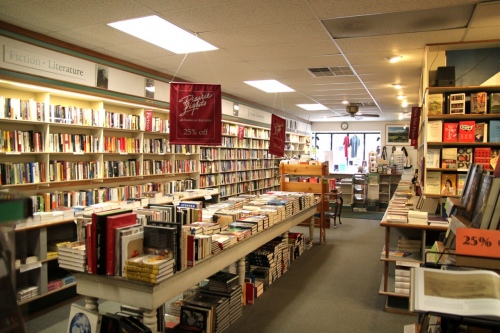
Prairie Lights Books in Iowa City is featured in The Guardian’s “Interview with a Bookstore.” Not only do I sometimes shop at Prairie Lights, but so does Obama (see YouTube, March 25, 2010).

Founded in 1978, it is the oldest bookstore in town except for Iowa Book (founded in 1920). It stocks classics, literary fiction, poetry, history, local history, biography, nonfiction, SF, mysteries, travel, small press books, and journals.  Until recently, it even stocked Loebs.  It hosts readings three or four times a week.  We have attended readings by Joy Williams, Tobias Wolff, and Sherman Alexie.

What I like most about the Guardian piece  is the quotes from the staff.

If you weren’t working in a bookstore, what would you be doing?

Kathleen: Writing the books? Would rather sell the books. It’s easier, and the quality is better.

Don’t you love that answer?   I’ve always dreamed of owning a bookstore, but not ardently enough!

And Kathleen says her favorite regular is IndieBob, who has an excellent blog, The Indie Bob Spot, about visiting independent bookstores in the U.S.

Here are two more staffers’ answers to the question about what they would do if they didn’t work at a bookstore:

Terry: Night watchman at a cranberry silo.

Tim: I’d probably still be in the restaurant business, either waiting tables or tending bar, bemoaning my existence and spending too much money on books.

A fun article!

2epsteinbros-1395-640-375x500

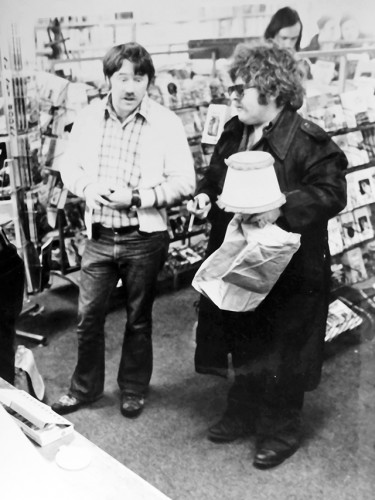
The Epstein brothers at Epstein’s Books in a temporary module in 1974.  (I have no idea why Harry is holding a lamp.)

MEMORIES OF BOOKSTORES IN IOWA CITY.   Growing up in I.C., I loved Iowa Book and Supply (then saucily referred to as Iowa Book & Crook, and even looted once in the ’60s).   There I discovered E. Nesbit, Catcher in the Rye, Tolstoy, Doris Lessing, Robertson Davies, Sisterhood Is Powerful (edited by Robin Morgan),and Lawrence Ferlinghetti. On Career Day, when my non-career-oriented friends and I claimed we wanted to own a bookstore in Scotland (were we absurdists, or just absurd?), we spent 20 minutes at The Paper Place, a now defunct paperback bookstore, and then decamped to Burger Palace.  Later,  Epstein’s was the hip place to buy  small-press books,  poetry chapbooks, and paperback classics, and attend readings by the Actualist poets:  Ansel Hollo, Darrell Grey, Allan Kornblum (later founder of Coffee House Press), Dave Morice, and Morty Sklar.   Alas, urban renewal and a relocation to a temporary building on a torn-up street drove Epstein’s out of business in 1977.

I have so many bookstore memories!  I just wish more bookstores were still in business.

Poetry: Tess Gallagher’s “Refusing Silence”

Tess Gallagher

Tess Gallagher

I have long been a fan of Tess Gallagher.  I recently came across her book,  Amplitude: New and Selected Poems (Graywolf Press, 1987).   Here is one of my favorite poems.

“Refusing Silence”
By Tess Gallagher

Heartbeat trembling
your kingdom
of leaves
near the ceremony
of water, I never
insisted on you. I admit
I delayed. I was the Empress
of Delay. But it can’t be
put off now. On the sacred branch
of my only voice – I insist.
Insist for us all,
which is the job
of the voice, and especially
of the poet. Else
what am I for, what use
am I if I don’t
insist?
There are messages to send.
Gatherings and songs.
Because we need
to insist. Else what are we
for? What use
are we?