Hanging on by a Thread: Bookstores, Translation, & Literary Links

Hanging-By-A-Thread

O tempora!  O mores!”–Cicero

It’s the end of the world as I know it, and I feel fine.–R.E.M.

We are hanging on by a thread, whether because of political anxiety, bad hairdos, global warming, or the uselessness of melatonin on hot nights. And we book junkies wonder what direction our lives will take if the printed word is censored in the new isolationist frenzy at home and abroad:  newspapers (dying or dead),  magazines (dying or dead), proofreading (dying or dead: I found a Latin error the other day in a great new novel),  foreign language study (budget cuts have eliminated many language departments), and communication via misspelled texts instead of letters on stationery (oh, long done!).
the swerve 51chpVixqKL._SX330_BO1,204,203,200_Well, thank God there’s a wide selection of backlisted and used books for sale online.  It is a vast improvement over having to travel hundreds of miles to find out-of-print books or obscure classics. I am not Poggio Bracciolini, the book scout who discovered the manuscript of Lucretius’ De Rerum Natura (On the Nature of Things) in a German monastery (The Swerve: How the World Became Modern by Stephen Greenblatt).  Travel is expensive.

Nor do I romanticize independent bookstores, which are and always have been rich people’s hobbies. Some are good and some are bad, and there are few in these parts, but I hear they’re coming back.  Print book sales are up, they say, but since an e-book now costs almost as much as a paperback, isn’t that a deciding factor?  Well, they don’t admit that, but they are admitting to a coloring book boom.

Many years ago, an independent bookseller told me that if a book review ran in the newspaper before the book’s publication date, it hurt his business.  If the buyer couldn’t find it right away, he or she usually forgot about it and the bookseller lost a sale.  Now that we can “pre-order,” it must be even more disheartening.  I do quite often read reviews of books a week or month ahead of publication.

But not all is lost! We still have contact with the world.   Here are literary links to three articles about literature in translation. Let’s bring back language study, too.

1. Sam Jordison mentioned the rise of translated fiction in the UK when he asked The Guardian book club to choose a book in translation for  June.  (They chose The Master and Margarita.)

The fact that translated fiction now accounts for 7% of sales in the UK market is a welcome change. It feels like a long time since I wrote an article lamenting the lack of traction that foreign fiction had in the UK. If I were to attempt a similar provocation now, I might be tempted to suggest things are heating up too much. Every other book that publishers send me for review at the moment seems to be translated. On the one hand, this stream of books makes me worry about the thoughtless following of fashion and the many-limbed, no-headed mass of the mainstream publishing industry. On the other hand, it’s a heck of a lot better than books on mindfulness or beating titles like The Man Who Caught the Smugsmug Train to Cozylandia.

2. Words Without Borders recently published an interview with Lydia Davis on translation.  Her is an excerpt.

Q.  Does a translator need to dominate the culture of both the language she is translating to and the culture of the language she is translating from?
madame bovary lydia davis 515JL42NLCL._SX329_BO1,204,203,200_LD: By “dominate,” do you mean “master”? Or, even better: “have a deep and thorough understanding of it”? I want to clarify, because the attitude of a writer, including a translator, toward his or her own culture, as well as the culture of the original text, should be that of a seeker rather than a dominator. One is always seeking to understand. One gains some understanding, but one never understands completely—true of any culture in which one is working or living.

But to answer more simply: let’s assume that the translator has a good, deep understanding of her own culture. Then the question is how deep does her understanding of the other culture need to be? I found, in translating Madame Bovary, that a good deal of the text was understandable, and translatable, without that deeper knowledge of nineteenth-century French culture in a provincial town. Certain human behavior seems to be fairly universal, or at least common, to Western civilizations of the last couple of centuries. (I should beware of generalizations—there are always exceptions!) Other habits, customs, expressions are not as familiar to us in the twenty-first century. Still, translating the way I do, staying close to the original—even when it comes to expressions such as “to put straw in one’s boots” or “other dogs to beat” (yes? is that what Homais says to the beggar?)—rather than seeking equivalent expressions in English, the customs, habits, even modes of thinking of Flaubert’s time come through quite well. But I may translate accurately what is on Emma’s mantelpiece without knowing what her taste in decor “means”—and it would be good to know, even though that wouldn’t change my translation, in this case. For Flaubert, of course, what she had on her mantelpiece indicated her slavish following of current fashion, her striving for bourgeois gentility. His readers at the time would have known that. I use many reference books, learn what I can, write endnotes to help readers of the translation, but I do not feel I have to become a scholar of the culture Flaubert was writing about, or within. (Long answer! Third cup of coffee!)

3. At Words without Borders, Aaron Poochigian speculates in “Have We Lost The Lofty? Virgil’s Aeneid and the History of English Poetry” about changing literary tastes and new translations of the Aeneid.  Here is the opening paragraph.

aeneid dryden e2cde76d4ee8730e958f4bd11f157370.600x510x1In two months’ time Farrar, Straus and Giroux will release Seamus Heaney’s translation of Book Six of the Aeneid. In the same way as the epic was, in the words of his daughter Catherine Heaney, “a touchstone . . . to which he would return time and time again through his life,” so the often-translated epic itself has been a touchstone for changing literary and cultural tastes throughout the course of English literature. Translations of the Aeneid have, in fact, inaugurated major literary movements. Now seems a good time to review the history of this very Roman poem in English. Translations and re-translations are fascinating because they reveal the tastes (and limitations) of past ages and our own. Though poets of yore found in it a justification for British imperial ambition, the epic feels in places as if it were written with the express purpose of turning off contemporary readers—the hero’s great virtue is the Roman ideal of pietas (“piety, dutiful respect”), and the narrative is a kind of literary empire-building. We here in the twenty-first century want heroes with a rebellious spirit and abhor empires for their oppression of native peoples. No, the Aeneid’s politics are not for us.

By the way, I love Lydia Davis’s translation of Madame Bovary, and of course I read The Aeneid in Latin.

Post-Apocalyptically Hot & John Brunner’s The Sheep Look Up

brunner omnibus 412eODF6XqL._AC_UL320_SR210,320_It is post-apocalyptically hot outside.  Miles and miles of eerie, empty streets.   The  humidity frizzes our hair as we ride our bikes:  we all suddenly have 1972 perms. Wear your good clothes:  Sweated-up L. L. Bean gets more respect than  J. C. Penney.  Stop frequently for water.

Here are some temperatures to consider:  103 in Phoenix, AZ; 95 in Little Rock, AR; 97 in Dallas, TX; 91 in Washington, D.C.; 90 in Omaha, NE; 91 in Des Moines, IA;  90 in New York, NY.  (Put them in a column and it’s a poem.)

We had a heat wave in June;  now the heat is back.  Who is responsible for climate change?  What a long list: industrialists, politicians,  power companies, etc.,  going back to the 19th century.  We have all had the information about pollution and global warming since the ’60s, and yet we are all fossil fuel junkies. The car and truck emissions cause one-fifth of all U.S. emissions, according to the Union of Concerned Scientists.  And I don’t know about you, but I have my air conditioner on.

A few good things:  the air is actually cleaner (though not very clean) since the Clean Air Act  in 1973. (There is a long way to go, but the EPA measures air emissions and at least there’s no lead in the air now!)  And Science magazine reported last week that  the Antarctic  hole in the ozone layer has begun to heal.  The scientists say it’s because of the Montreal protocol, an international agreement in 1987 that phased out the industrial production of ozone-destroying chlorofluorocarbons (CFCs).

john brunner the sheep look up 0345236122I recently read John Brunner’s The Sheep Look Up , a 1972 dystopian classic.  In this terrifying post-modern literary SF novel,  pollution has rendered the U.S. practically a wasteland.  The poisoned air blows into Canada and sometimes across the ocean to Europe (sound familiar?);  everyone is sick; antibiotics no longer work; fleas and rat infestations in houses and apartment house can no longer be controlled because they are immune to poison; the acid rain in NY is so bad that you need to wear plastic outside; the water is poisoned (there are frequent “no-drink water” days); intelligence levels are dropping (lead in the air and water); a virus causes spontaneous abortion; the oceans are so polluted that people vacation in Colorado rather than California; and big businesses are profiting by selling air filters, water filters, etc.

There is a huge cast of characters, but at the center of the novel is Austin Train, a radical environmentalist who has gone undercover. The novel is not ABOUT him, but all the characters (journalists, nurses, policemen, factory workers, drop-outs, housewives, rich industrialists)  react to his ideas.  Most of them are distorted by his followers, known as Trainites. And there are dozens of men who call themselves Austin Train.  Many of them urge violence.

The narrative is broken up into fascinating short segments:  traditional narratives, radio broadcasts, news, announcements, poems, etc. One segment is called “Signs of the Times.  The signs are arranged in rectangles on the page, making it look like a flow chart,  but I can’t duplicate that here. Anyway, here are the signs:

THE BEACH NOT SAFE FOR SWIMMING

NOT DRINKING WATER

UNFIT FOR HUMAN CONSUMPTION

Now Wash Your Hands (Penalty for noncompliance $50)

FILTERMASK DISPENSER (Use product only once – maximum 1 hour)

OXYGEN (25 cents)

John Brunner

John Brunner

Some of the most horrifying incidents in The Sheep Look Up revolve around hunger.  An industry that manufactures food for international relief ships a poisoned batch to a country in Africa experiencing famine:  people who eat it go crazy and kill each other.  The same thing happens in the Honduras.  There are cover-ups.  But no one really knows what happened.  And then a “worm” imported from South America kills most of the food being grown in the U.S.

Austin Train knows there’s no hope for the U.S., but there might be for the planet.
Let us hope there’s hope for all of us!

A very gloomy book, but it does show us what the future could hold. A little too long, but a great novel!  You really don’t need any more dystopian novels after you’ve read this.

Outsider in Amsterdam by Janwillem van de Wetering

outsider in amsterdam janwillem van de wetering 5161-dBqzeLSoho Crime has reissued the first novels in 24 of the small press’s most popular crime series.  This new introductory series is called “Passport to Crime.”

Full confession: I  started with the Dutch writer Janwillem van de Wetering’s  Outsider in Amsterdam (1975), because  I read  his autobiographical books on Zen, The Empty Mirror: Experiences in a Japanese Zen Monastery and A Glimpse of Nothingness: Experiences in an American Zen Community.  For a couple of months I  attempted (uncomfortably) to meditate 15 minutes a day while kneeling with my butt on a cushion.

Van Wetering (1931-2008) had a fascinating background.  Not only  was he once a Zen Buddhist monk, he was also a police officer in Amsterdam.

In the preface, he explains that he returned to Amsterdam after a long trip and received a letter saying he had to serve in the Army.  When he complained that he was over 30 and didn’t want to be a soldier,  a middle-aged woman behind a desk suggested he work as a policeman in his spare time instead.

He writes,

The idea staggered me.  I never knew that one can be a policeman in one’s spare time.

But one can, and for several years now I have been a member of Amsterdam’s Special Constabulary ….  I have been in a number of adventures in the inner city of the capital and some of them inspired me to write this story.

In Outsider in Amsterdam, the first volume in the Amsterdam Cops series, Detective-Adjutant Gripstra, a brilliant, overweight, middle-aged officer whose  years of experience help him unravel the most difficult puzzles, and Sergeant de Gier, his moody contemplative,  much stronger young partner,  investigate the suicide of Piet, the leader of a religious cult called the “Hindists.”

outsider in amsterdam hardcover van de wetering 46961But is it suicide?  They are not sure.  When they knock on the door of the house where Piet lived and ran his religious business, a tiny Papuan black man, Jan Karel Van Meteren,  insists on checking their ID (which never happens).  Van Meteren, a traffic cop who used to be a police officer in his own country,  got to know Piet and lived free in the house, along with four hippies who work in the Hindist restaurant in the house.   Van Meteren says he had nothing to do with the religion.

Gripstra and De Gier pass the restaurant on the first floor and pause to look at a statue in a niche of a female deity doing an erotic dance. The statue is important later.

Van de Wetering, who wrote these books in English, is a master of the convoluted plot and has a strong but straightforward style that does not occlude the story. He also adroitly captures the liberal mood of the 1970s and the mid-twentieth-century interest in Eastern religion, sex, and drugs. The police officers are both well-developed, unique characters who have compassion for the victims: they do not take life and death lightly

The description of the corpse is grisly, but the violence takes place offstage. Once Van Meteren leads them upstairs to Piet’s room

De Gier had a feeling that they had now penetrated into the secret part of the house; perhaps the silence of the corridor motivated the thought.  The music of the restaurant didn’t reach this lofty level.  Gripstra entered the room and sighed.  He saw the corpse and it moved, exactly as he had expected. It would be the draft, of course, all phenomena can be explained, but the slow ghastly movement chilled his spine.  De Gier had now come in as well and watched silently.  He noticed the small bare feet with their neat toes pointed at the floor.  His gaze wandered upward and recorded the protruding tongue and the wide open bulging blue eyes.  A small corpse that had belonged to a living man.  A little over five feet.  A thin man, well dressed in khaki trousers of good cloth, nicely ironed, and a freshly laundered striped shirt.  Some forty years old.  long thick dark red hair and a full mustache, hanging down at the corners by its own weight.  De Gier moved closer and looked a the corpse’s wristwatch.  He grunted.  A very expensive watch, worth a small fortune.  He couldn’t remember ever having seen a gold strap of such width and quality.

Van Meteren, who discovered the body, does not take it for granted that it was suicide. It could have been murder.  But there are so many suspects:  the residents of the house, especially Piet’s pregnant girlfriend, who threw a book at him which left a bruise on his head shortly before he died:  Piet’s wife, who may or may not have been in France at the time of the murder; the well-heeled businessmen who supported the venture; and Van Meteren himself.  And how did Piet make his money?  He was very rich.

Some of the odder scenes seem very  ’70s:  at one point Grjipstra, De Gier, and Van Meteren have a musical jam session in an empty room in Piet’s house.  (Amsterdam cops are different from Americans?  But what do I really know about musical cops?)

This book is well-written, and, like all the best mysteries, short.

I can’t wait to read the next book in the series.

Superior Women’s Novels: Alice Adams’s Listening to Billie & Superior Women

alice adams 920x920

Alice Adams

In the late twentieth century, the writer Alice Adams was well-respected and widely reviewed. Her short stories were published in The New Yorker and she published 11 novels.  I read her books as they came out and loved them,  but regarded them as read-and-weed books.

Perhaps many of us undervalued Adams’ work.

How to evaluate Adams?  I recently reread two of her novels, Listening to Billie (1975) and Superior Women (1984).  They are not quite classics, but are superior women’s novels.  I clearly see the influence of Doris Lessing, Mary McCarthy, and Alison Lurie.  I admire her subtle interweaving of brilliant insights into the complex framework of her compelling narratives.

listening to billie alice adams 41odFTamZwLThese elegantly-written “middlebrow” novels are the kind of books reissued  by Virago and Persephone. Plot does not define them so much as intelligence, though the plots are absorbing.   In Listening to Billie, the heroine, Eliza, a poet, the daughter of a selfish, eccentric nonfiction writer, is a Billie Holiday fan. She marries her boyfriend, Evan, a professor, after she gets pregnant.  Evan turns out to be a very unhappy homosexual.  He stalks a student, the oblivious Reed Ashford, the most beautiful boy he has ever seen, and when he realizes he can never have him, he commits suicide.  Eliza does not allow her life to be ruined:  she moves to San Francisco and establishes a fulfilling life with her daughter. She works part- time as a secretary and begins to sell her poetry to magazines like the Atlantic.    She is a very kind character and a good friend:  I would love to know her.  Oddly, she meets Reed Ashford in San Francisco, and they are instantly attracted, two beautiful blondes.  They have an affair, which is perfect while it lasts.
I see the influence of Doris Lessing in the following passage.  Like Lessing’s heroines, Eliza asks herself questions about her identity during a sexual affair.  What will she wear to meet her lover tonight?

It was not simply the rare warm weather that had created a problem; after all, she had some cotton clothes. It was rather that she was not sure, that day, how to dress—who to be. She would go downtown, she thought; would perhaps buy something to wear tonight, but as what person would she go downtown, in what persona? As an upper-middle-class white woman in her thirties (Miriam’s friend), or as a young poet “in love”? And what could she possibly buy, what could she wear with Reed Ashford? For the moment, she settled on an old cotton dress in which she would be comfortable, if not invisible, which was what (and why?) she had at last understood that she would like to be today.

Listening to Billie is a well-crafted novel, but not a classic.

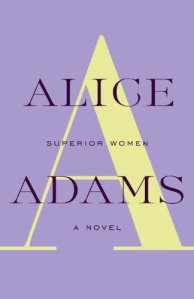
Alice Adams Superior Women 41xTsBHIaNLNor is Superior Women, thought it is a more satisfying novel. This riveting story of forty years in the lives of five women who meet at Radcliffe in 1943  is reminiscent of  Mary McCarthy’s The Group.  But  Adams, a graduate of Radcliffe, spends much more time detailing the joys of college.

The central character,Megan, the sexy daughter of a junk shop owner and a  car hop in California, falls in love with New England and her clique of close friends. She has sex with affable George Wharton, and  is shocked when he marries someone else.  It had not occurred to her that she was not good enough for a man with old money.  She  discovers that men love to make love to her but don’t want to marry her.  Fortunately, she begins to read Henry James,  moves to New York, where she has always wanted to live, and works first in publishing and then as a literary agent.  Much as she loves literature, however, work proves disappointing. After her publishing house gets gobbled up by a corporation,  she becomes a partner at aliterary  agency.  She works with  the writers and editors while the firm’s founder Barbara does the contracts.

One of their most important clients is a Gothic novelist .  Megan chats with her on the phone when she has a crisis.

And Jane Anne Johns, a Gothic novelist, calms down. She loves to talk to Megan. She is a very nice, now very old woman, with blue rinsed hair and a French château in Miami. She is given to diamonds and orchids and white mink coats. She is a great success. Her novels are consummate trash, a fact Megan tries not to think about; she is thankful that she does not have to read them, she only sells them, serialized, to magazines.

But the job is high-pressure:  constant parties Megan has to attend to schmooze with publishers, and readings to support her authors.  Eventually, she burns out.  She is happily in love with Henry Stuyvesant, a radical professor at the University of North Carolina, and sometimes wonders what will happen if they get married. Would she move to North Carolina?

As she thinks this, Megan is stricken with a vast distaste for the work that she does, in New York: all those nonbooks decked out for marketing. So much execrable prose. The sheer unreality of it all.

superior women adams knopf 9780394536323-usAll the idealism and brilliance in college, and this is where it goes.

But the other women in the group fare less well than Megan.   Lavinia, rich, beautiful, and prejudiced against Jews and blacks, is a fan of Proust who compares herself to Madame Guermantes.  Like Megan, she has trouble enticing men to fall in love with her.  She marries for money and position, and it turns out to be a terrible mistake:  she cannot have orgasms with her husband.  Her whole life centers on occasional affairs.  And she hates Megan.

The others also have problems.  Cathy, a devout Catholic, gets pregnant by a priest.   Peg also gets pregnant, dislikes her husband, and has five children and a nervous breakdown. The fifth woman, Janet, a Jew, is only Megan’s friend:  the others did not socialize with her.

But all of the women except Lavinia eventually make their way in the world.  And hatred is the only thing holding her back.

The Fourth of July Reading List

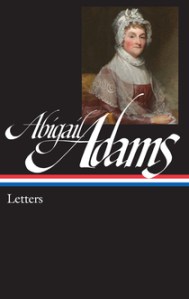
abigailadams-portrait-letter

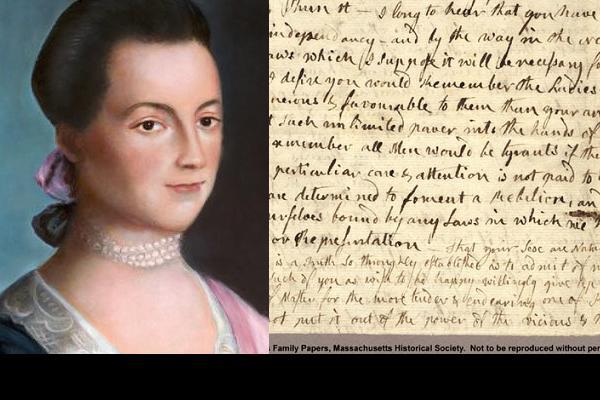
A portrait of Abigail Adams & a letter.

The Fourth of July is a wonderful holiday if you like fireworks, but it’s also a redneck holiday.  You know–guys in wifebeaters arrive with a case of  beer at dawn at the park to reserve the best place for viewing the fireworks.  For us it’s about grilling burgers, worrying about the salmonella factor of deviled eggs and potato salad,  swigging Arnold Palmers, eating cupcakes with red, white, and blue sprinkles, and twirling a few sparklers.

Why do we like it?  Well,  it is the sine qua non of  the Declaration of Independence and subsequent classics by Hawthorne,  Thoreau, Emerson, Harriet Beecher Stowe, Theodore Dreiser, Upton Sinclair, Martha Gellhorn, Hemingway, Kay Boyle, Dawn Powell, Grace Paley, Ann Beattie, Philip Roth, and on and on and on…

Usually I prefer history books about the Romans or the Tudors, but I plan to read at least a few pages about the American Revolutionary War before the 4th. Here is  my list of

BOOKS TO READ ON INDEPENDENCE DAY!

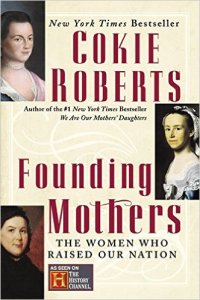
Cokie Roberts Founding Mothers 51X5yUDIPhL._SX330_BO1,204,203,200_1. Cokie Roberts’s Founding Mothers:  The Women Who Raised Our Nation. I’ve always admired Roberts’ journalism on NPR, and this might be the book to kick off my interest in American women’s history. Goodreads says it’s the story of “women who fought the Revolution as valiantly as the men….. Drawing upon personal correspondence, private journals, and even favoured recipes, Roberts reveals the often surprising stories of these fascinating women, bringing to life the everyday trials and extraordinary triumphs of individuals like Abigail Adams, Mercy Otis Warren, Deborah Read Franklin, Eliza Pinckney, Catherine Littlefield Green, Esther DeBerdt Reed and Martha Washington–proving that without our exemplary women, the new country might have never survived.”

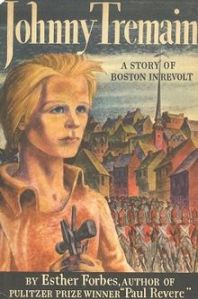
Esther Forbes Johnny_Tremain_cover)2. Esther Forbes’s Johnny Tremain, winner of the Newbery Award in 1944. This stunning historical novel, usually shelved in the children’s or Y.A. section, is really for all ages.  It is the story  of Johnny Tremain, young silversmith’s apprentice, who, after a crippling accident, can no longer work with silver.   He finds a job delivering a Whig newspaper, and gradually gets to know John Hancock and John and Samuel Adams.  Lots of history:  the Boston Tea Party, spying for the Sons of Liberty, and Paul Revere’s ride.  My husband and I love this book!

Paul Revere and the World he lived int 41uzp-ytBLL._SX331_BO1,204,203,200_3.  Esther Forbes’s Paul Revere and the World He Lived in.   I’ve never actually seen this biography, but Forbes won the Pulitzer Prize for it in 1942.  If I ever find it…

LOA jacket templateAbigail Adams Letters (Library of America).  The correspondence of Abigail Adams portrays”the American war on the home front,” says the LOA website.  Adams, the wife of John Adams, the second president of th U.S. , andthe mother of John Quincy Adams, the sixth President, wrote about politics, government, daily life, and travels to Europe as the First Lady.

american revolution writings from the loa 97818830119185 The American Revolution: Writings from the War of Independence 1775–1783 (Library of America).  The LOA description says:  “Drawn from letters, diaries, newspaper articles, public declarations, contemporary narratives, and private memoranda, The American Revolution brings together over 120 pieces by more than 70 participants and eyewitnesses to create a unique literary panorama of the War of Independence”.  And, by the way, it is on sale for $2.95 at the LOA website.

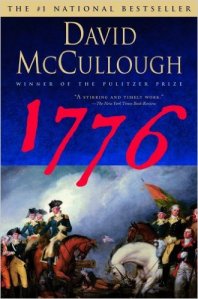
1776 mccullough 51ctyoISRHL._SX328_BO1,204,203,200_6 1776 by David McCullough, a historian who has won two Pulitzer Prizes, the Presidential Medal of Freedom, and the National Book Foundation Medal for Distinguished Contribution to American Letters. According to Goodreads, it is “the intensely human story of those who marched with General George Washington in the year of the Declaration of Independence – when the whole American cause was riding on their success, without which all hope for independence would have been dashed and the noble ideals of the Declaration would have amounted to little more than words on paper.”

alexander hamilton chernow 51P1c42DyLL._SX322_BO1,204,203,200_Alexander Hamilton by Ron Chernow.  This biography was the inspiration for the musical “Hamilton.” According to Goodreads: “Few figures in American history have been more hotly debated or more grossly misunderstood than Alexander Hamilton. Chernow’s biography gives Hamilton his due and sets the record straight, deftly illustrating that the political and economic greatness of today’s America is the result of Hamilton’s countless sacrifices to champion ideas that were often wildly disputed during his time. ‘To repudiate his legacy,’ Chernow writes,’ is, in many ways, to repudiate the modern world.’  (If only the cover were less boring…)

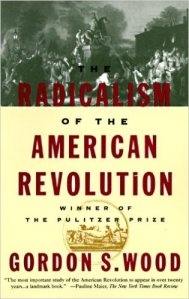
radicalism of the american revolution wood 51xuCQy-2mL._SX313_BO1,204,203,200_8 The Radicalism of the American Revolution by Gordon S. Wood. Goodreads says this Pulitzer Prize-winning book is “a grand and immemsely readable synthesis of historical, political, cultural, and economic analysis, a prize-winning historian depicts much more than a break with England. He gives readers a revolution that transformed an almost feudal society into a democratic one, whose emerging realities sometimes baffled and disappointed its founding fathers.”

book of ages lepore 51A78ibbzjL._SX321_BO1,204,203,200_9 Book of Ages: The Life and Opinions of Jane Franklin by Jill Lepore.  Goodreads says,   “From one of our most accomplished and widely admired historians-a revelatory portrait of Benjamin Franklin’s youngest sister, whose obscurity and poverty were matched only by her brother’s fame and wealth but who, like him, was a passionate reader, a gifted writer, and an astonishingly shrewd political commentator.”

burr vidal 51Ch+y2dXUL._SY344_BO1,204,203,200_10 Gore Vidal’s Burr.  You can’t go wrong with Gore Vidal, a masterly writer of historical fiction.  Goodreads says, “Burr is a portrait of perhaps the most complex and misunderstood of the Founding Fathers. In 1804, while serving as vice president, Aaron Burr fought a duel with his political nemesis, Alexander Hamilton, and killed him. In 1807, he was arrested, tried, and acquitted of treason. In 1833, Burr is newly married, an aging statesman considered a monster by many. Burr retains much of his political influence if not the respect of all. And he is determined to tell his own story. As his amanuensis, he chooses Charles Schermerhorn Schuyler, a young New York City journalist, and together they explore both Burr’s past and the continuing political intrigues of the still young United States.”

Enjoy!  And let me know your own favorite Independence Day books.

The Gothic vs. the Internet: J. Sheridan Le Fanu’s Uncle Silas

uncle silas le fanu oxford 9780192815415-us-300

In the days before I purchased a computer (for work) and began to waste time on the internet, I read more books.  I didn’t realize quite how many more books I used to read until I took a break this week.

I am not alone.  Americans are reading fewer books, The Atlantic reported in 2014. Jordan Weissman wrote, “In 1978, Gallup found that 42 percent of adults had read 11 books or more in the past year (13 percent said they’d read more than 50!). Today, Pew finds that just 28 percent hit the 11 mark. ”

A few years ago the novelist Gary Shteyngart said in an interview at Salon:

“Our attention span is shorter; even I have trouble opening up a gigantic book and getting right into it. I find that when I travel somewhere and there is no Wi-Fi and no connection that I can finally get into a book and read it from cover to cover and really get into the way it’s structured and the narrators and appreciate it in a way that I used to appreciate books all the time.”

And so I launched an experiment I am calling The Internet vs. the Book.  By taking an extra day off from blogging, lo and behold!  I had more reading time. In a day I devoured Le Fanu’s stunning Gothic novel, Uncle Silas (400 pages).   I love my blog, but I do think I might take an extra day off now and then–for reading.

I confess, this is not my first reading of Uncle Silas. My aunt was fond of slightly offbeat 19th-century novels, and her shelves were filled with George MacDonald, George Meredith, Le Fanu, and Elizabeth Gaskell.   During a visit to Michigan when I was 12, she gave me a box of books. I barely looked up from Uncle Silas on the drive back to Iowa.

uncle silas dover good pic 9780486217154-uk-300Well, Uncle Silas still has that effect on me.   And so it was the perfect book to read for my experiment.

Le Fanu, an Irish writer best known for his ghost stories, is one of the most accomplished of nineteenth-century Gothic novelists. In his masterpiece, Uncle Silas,  Le Fanu paints a  vivid portrait of a heroine’s secure childhood under the supervision of a rich, eccentric, adoring father and then contrasts it with her orphaned adolescence under the care of a mysterious,  impoverished guardian.  As Maud looks back from a secure adult viewpoint at the events that befell her when she was 17,  the narrative is so vivid that we soon forget the distance between the past and present and are terrified for Maud.

The opening paragraph establishes the secure atmosphere at Knowls, Maud’s childhood home:  domesticity and comfort shore up all doubts and protect the family from outside forces.  The weather is dark; the house is cozy.

It was winter—that is, about the second week in November—and great gusts were rattling at the windows, and wailing and thundering among our tall trees and ivied chimneys—a very dark night, and a very cheerful fire blazing, a pleasant mixture of good round coal and spluttering dry wood, in a genuine old fireplace, in a sombre old room. Black wainscoting glimmered up to the ceiling, in small ebony panels; a cheerful clump of wax candles on the tea-table; many old portraits, some grim and pale, others pretty, and some very graceful and charming, hanging from the walls. Few pictures, except portraits long and short, were there. On the whole, I think you would have taken the room for our parlour. It was not like our modern notion of a drawing-room. It was a long room too, and every way capacious, but irregularly shaped.

Like the drawing room, the character of Maud’s beloved father, Austin Ruthyn,  may be said to be irregular.  He is a recluse and an intellectual, with some very strange but harmless ideas about spirituality.  He is a Swedenborgian: Maud doesn’t quite know what that means, but  she is afraid it will somehow take him away from her.  He spends hours closeted with tall, dark, ugly Dr. Bryerly, his doctor and spiritual advisor.  He is concerned about his daughter’s isolation and about what might happen if he had to “go away on a visit,” so he encourages Cousin Monica, a witty, smart woman of his own generation, to take her under her wing.   And he also makes a huge mistake:  he hires a governess ,Madame d la Rougierre, a sinister, hard-drinking, balding old woman who lies, cries at will, makes copies of keys, and snoops around the house.  From early on we see her hatred of Maud.  And we suspect she is in someone’s pay, scheming Maud’s downfall.

The Folio Society edition of Uncle Silas.

One day Austin says he can no longer postpone making a “visit” for business purposes, and he gives Maud  a key to a cabinet.  He makes her promise the cabinet will be opened only by Dr. Bryerly.  Austin dies shortly thereafter, and poor Maud is broken-hearted, realizing the “visit” was death.  And when they finally track down  Dr. Bryerly, he finds a very strange will in the cabinet.  Maud’s guardian will be Uncle Silas, Austin’s ne’er-do-well brother,  who was accused of murder in his youth.  She is to live with him till she is 21.   Cousin Monica and Dr. Bryerly are shocked:  they view Uncle Silas as the most inappropriate of guardians.  Dr. Bryerly, who turns out to be a sympathetic character and is one of the trustees, does not like the will. He explains to Maud that if she dies, Silas inherits all, and that even a better man than Silas might be tempted.   Maud doesn’t really understand what he’s saying.  And in the end she has to go to Silas.

At first Maud is happy at Uncle Silas’s house, though she sees little of Silas, an “invalid”/opium addict (who frequently ODs, because he refuses to measure the dose), who is very pious and pleasant on the surface.  Maud loves his daughter Milly, a wild Heathcliffian youngster who speaks in the dialect of servants and wears short dresses and gives clever nicknames to friends and servants.   But Milly is smart and funny, and the two girls are so innocent and devoted:  they laugh, take walks, and read Sir Walter Scott, and because Bartaram-Haugh is all they know, they do not realize the atmosphere is dangerous.  The contrast between Maud’s father’s house, Knowl and uncle’s is dramatic.

I had not half seen this old house of Bartram-Haugh yet. At first, indeed, I had but an imperfect idea of its extent. There was a range of rooms along one side of the great gallery, with closed window-shutters, and the doors generally locked. Old L’Amour grew cross when we went into them, although we could see nothing; and Milly was afraid to open the windows—not that any Bluebeard revelations were apprehended, but simply because she knew that Uncle Silas’s order was that things should be left undisturbed; and this boisterous spirit stood in awe of him to a degree which his gentle manners and apparent quietude rendered quite surprising.

Maud is in danger.  There are strange goings-on in the woods, Mr. Bryerly rebukes Uncle Silas for chopping down Maud’s trees and selling them as charcoal, and the gates are locked so that Maud and Milly cannot leave. Friends are forbidden to visit. And the plot thickens…

A terrifying novel!  Remember the episode of Friends where Joey is so frightened by Stephen King’s The Shining that he put it in the freezer?   That’s how I felt about Uncle Silas!

The Epic As Beach Book: Homer, Virgil, & Others

Robert Fagles' translation is stunning.

Robert Fagles’ translation (Penguin)

At Barnes and Noble, the last bookstore in our fair city, I was delighted to find a copy of The Odyssey on a “Beach Reads” table. It was a very old translation by George Herbert  Palmer, but never mind.   I love to imagine a reader picking up Homer for the first time since ninth-grade English, or a freshman Classics in Translation class.  I read Greek, so I don’t bother much about translations, but I have seen students inspired by the translations of Lattimore, Fitzgerald, or Fagles.

iliad 41zzK2KjwzL._AC_UL320_SR208,320_Epic poems make great beach books, because narrative is as important as the language. It is easy to lose oneself, slathered with sun block under the umbrella, in Homer’s riveting poem about Odysseus’ adventures on the return trip home from the Trojan War, impeded by storms, Cyclops, sirens, and witches.  I read and reread Milton’s suspenseful epic rendering of devious Satan’s tempting of Adam and Eve in  Paradise Lost.  It’s a pity so many of us find Satan sympathetic:  that was not Milton’s intention.  But in Paradise Regained, he is the  unreconstructed villain we remember from the New Testament.

What else would I like to see on that Beach Reads table?   Homer’s Iliad, Virgil’s Aeneid, Dante’s Divine Comedy, Derek Walcott’s Omeros,and Alice Oswald’s Memorial.  (Let me know your favorite beach epics!)

The best beach epic of all, and possibly the best epic poem in any language, is Virgil’s Aeneid,  the story of the founding of Rome by a refugee of the Trojan War.  In the essay “What Is a Classic?” T. S. Eliot explains why Virgil’s epic is a  “classic”.

A classic can only occur when a civilizsation is mature; when a language and a literature are mature; and it must be the work of a mature mind. It is the importance of that civilization and of that language, as well as the comprehensiveness of the mind of the individual poet, which gives the universality.

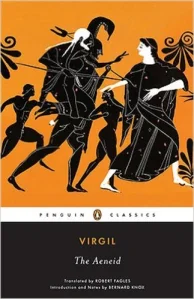
the aeneid virgil 51bBUTqwlZL._SX321_BO1,204,203,200_Virgil’s sense of history, the maturity of Roman literature, and his knowledge  of both Latin and Greek literature gives him a rare command of style, consciousness, and vocabulary.  The Aeneid has been read as a celebration of empire; it has also been read as an anti-war poem: there is evidence for both readings. It is a homage to Homer’s Iliad and Odyssey, the texts studied by educated Roman schoolboys.  Books I-VI of The Aeneid are about homecoming, or rather about traveling to find their fated home in Italy, and it is loosely based on the Odyssey.  Books VII-XII is a story of war, a  Roman Iliad:  after the Trojan refugees arrive in Italy, Aeneas and his men must fight for the right to stay and Aeneas must marry Princess Lavinia.

Virgil begins the poem:

arma virumque cano…

A literal translation is “arms and the man I sing…”

The first word arma refers to the war described in the last six books. The second word, virum, refers to the man , Aeneas, whom we meet during his trials in the first six books., as The Odyssey is about the man Odysseus.  Note that these two words, the subject of The Aeneid, open the poem.

Without knowing anything about Roman culture, it can be tough to understand The Aeneid. I wonder how Seamus Heaney’s new translation of Book VI, in which Aeneas visits the Underworld, fares with the common reader who has not read the entire poem.  There is a lot to take in:  the homage to the Odyssey, the odd behavior of the Sibyl, the significance of the golden bough, the pageant of the future…

The best bet, even if you decide just to read the Heaney, is to get a copy of Robert Fagles’s translation of The Aeneid for background.  First reaason:  the whole poem is there.  Second Reason:  the brilliant Bernard Knox, who was probably as close to a celebrity classicist as the U.S. has ever had,  writes the introduction beautifully and succinctly, and intelligently gives you all the background you need.  Of pietas, he writes:

Pietas describes another loyalty and duty, besides that to the gods and the family. It is for the Roman, to Rome, and in Aeneas’ case, to his mission to found it in Hesperia, the western country, Italy.

As state budget cuts threaten or slash language departments at public high schools and the state universities where , by the way, the majority of Americans study languages, classics departments bite the bullet and peppily teach culture classes.  SUNY Albany eliminated it classics department, along with French, Italian, Russian, and theater.  I worry that in the not-so-distant  future classics will  be yanked from business-oriented curricula and taught only at the most exclusive expensive prep schools and private universities.   If that day comes, the division of the rich and poor will be even more exaggerated than now:   only the elite will have knowledge of ancient languages and culture. I am not exaggerating:  that is our heritage.  But Budget cuts are making war on the middle class.  Without Latin and Greek, we would be a poorer civilization.

Dating in Alice Adams’s Superior Women & Tolstoy’s War & Peace

barbie queen of the prom 859b73499fc1bc9866aebc53112bb08cI often think of Barbie Queen of the Prom when I think of dating. In this Monopoly-like 1961 board game, you roll the dice to acquire, among other things, a date to the prom.  The possible dates are Ken, Bob, Tom, and Poindexter (pictured left).  Needless to say, Poindexter is the geek. Cards give you directions like:  “YOU ARE NOT READY WHEN HE CALLS. MISS 1 TURN.”

But the game is much more fun than dating.  Actual dating so often means getting stuck on a sailboat with a virtual stranger, or discovering he/she has no bookshelves.  Instead of “dating,” I hung out with bookish men I met at parties, at work, or in language classes.  Yes, I married one.

But would it work for Peg, the fat, plain character in a group of friends at Radcliffe in the 1940s in Alice Adams’s novel, Superior Women (1984)? This stunning  novel, reminiscent of Mary McCarthy’s The Group, follows a group of friends over four decades.  At Radcliffe, the maternal Peg plies her friends with cookies and tea and is much more intelligent than they think.    Lavinia, the beauty, is an aristocratic Southerner who wants total control:  she mourns a boyfriend who died in World War II, neglecting to say he dumped her before he shipped out. Plump, sexy Megan is irresistibly attractive to men, who tell her she is different because she likes sex (they don’t actually want to go on dates, though); Janet, a Jewish woman who criticizes Megan’s WASPy “technical virgin” friends, is in love with an  Irish Catholic whose  mother opposes the match.  Cathy, a smart Catholic, goes out with a flashily-dressed Catholic from Ohio (known as Flash by snobs) with whom she shares a taste for good steak.  Are they in love…?  Well…

You see Peg’s dilemma.

Alice Adams Superior Women 41xTsBHIaNLWhen her friends  learn Peg is going on a date with a Yale man she hasn’t seen since childhood, they humiliate her by helping her get ready.

Thus it works out that getting Peg ready for her date is a group project. With a variety of emotions that includes both genuine kindness and an incredulous condescension (Peg, on a date? what will he think when he sees her, no matter what she has on?), the three friends, her “best friends,” gather in her room; they watch and they make suggestions, helpful and otherwise. They make silly jokes. Megan and Cathy and Lavinia, all concentrated on poor Peg.

And not one of them has the slightest idea of what is going on in Peg’s mind. In close physical proximity to her, looking at her and talking, not one of them recognizes what is actually a serious anxiety attack; they do not feel Peg’s genuine panic.”

The Maude translation (Everyman)

The Maude translation (Everyman)

Adams, who graduated from high school at 15 and Radcliffe at 19, is very smart: the preparation-for-the-date scene is a homage to a scene in Tolstoy’s War and Peace.  In Tolstoy’s masterpiece, Princess  Mary,  a young, very kind, very plain  woman who lives in the country with her severe father, is excited because a suitor, Prince Anatole, is coming to meet her. Her  French companion, Mademoiselle Bourienne , and her pregnant sister-in-law, Princess Lise, help her prepare for the “date,: only to find that she actually looks worse in chic clothes and the new hairdo.  Here is a passage from the Maude translation.

It was not the dress, but the face and whole figure of Princess Mary that was not pretty, but neither Mademoiselle Bourienne nor the little princess felt this; they still thought that if a blue ribbon were placed in the hair, the hair combed up, and the blue scarf arranged lower on the best maroon dress, and so on, all would be well. They forgot that the frightened face and the figure could not be altered, and that however they might change the setting and adornment of that face, it would still remain piteous and plain. After two or three changes to which Princess Mary meekly submitted, just as her hair had been arranged on the top of her head (a style that quite altered and spoiled her looks) and she had put on a maroon dress with a pale-blue scarf, the little princess walked twice round her,

In neither Peg’s nor Mary’s case, does the date go well.  In Superior Women, the plain, red-faced Yale man, Cameron, gets drunk and almost rapes Peg, who fortunately is strong enough to shove him off her.   In War and Peace, Princess Mary is very shy and stilted, but Anatole will marry her for her money. But the next day, but after finding him making out with Mademoiselle Bourienne, she turns down the proposal.

Whether it is the nineteenth century or now, dating can be grueling.

Hannah Rothschild’s The Improbability of Love

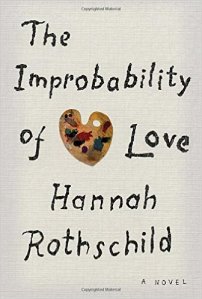
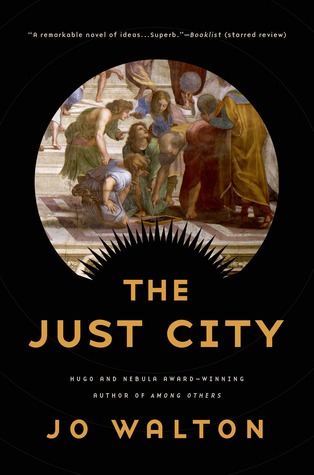
hannah rothschild the improbability of love 51WS3JA5AyL._SX334_BO1,204,203,200_Want to know about the biological clock?  It is a reading clock that starts ticking when you realize your own mortality.   Nowadays I am fussy and cautious about committing to new books, though I loved the trendy literary novel of the summer, Emma Cline’s The Girls,  thoroughly enjoyed Jo Walton’s science fiction novel based on Plato’s Republic, The Just City, and am relishing the Collected Poems of Adrienne Rich (1950-2013).

For every hour I spend on a second-rate book, however, I are depriving myself of an opportunity to read a classic.   Reviews are often unreliable.  How on earth does one find good new books?

By consulting the shortlist for this year’s Baileys Women’s Prize, I discovered Hannah Rothschild’s entertaining novel, The Improbability of Love.  Though it is not perfect, I loved it!  It is a fascinating story of the competition in the art world to acquire a lost painting by Watteau, “The Improbability of Love,”and prove its authenticity. This clever novel about establishing the provenance of art is slightly reminiscent of A. S. Byatt’s Possession.

The prologue opens on the night of the auction. Celebrity bidders, among them  a rapper, a rich Russian thug in exile,  and a savvy American widow, climb out of their limos  and are snapped by the Paparazzi.  As Earl Beachendon, the organizer of the auction, fantasizes about the money he will earn from his commission, a young Chinese man approaches the velvet-colored plinth in plain sight of the Earl and security cameras–and he and the painting vanish.

hannah-rothschild

Hannah Rothschild

Then Rothschild pedals back six months in time to explore the mystery of the painting.  The narrative is told from multiple points of view, and, delightfully, one of them is the painting itself.  We are most interested in Annie, the central character,  a chef who  purchases the grimy Watteau in a junk shop, intending to give it to a lover who dumps her on his birthday by calling to cancel the meal she has spent all day cooking.   Does she have any idea it is a Watteau?  No.  On a walk the next day, she discovers the junk shop has burned down.

And, ironically, she is the temporary chef  for Memling Winkleman  and his daughter Rebecca of Winkleman Fine Art, one of the most famous art houses in the world.  They are desperately seeking “The Improbability of Love,” which Memling, a Jewish survivor of the camps, has acquired by shady means and stowed temporarily in the junk shop.  Meanwhile, oblivious of their search, Annie parks the painting in a bag in the kitchen and researches recipes for a banquet centered on a newly-discovered painting by Caravaggio, “Judith Beheading Holofernes.”  The Winklemans are inviting guests who may be interested in buying  the painting.  Although the surprisingly uncreative Rebecca requires fish every night and says she wants nothing fancy at the dinner party, Annie has decided to recreate a menu that “reflects the element of danger and brio” of Caravaggio and dishes that could have been eaten by cardinals, popes, and nobleman in post-Renaissance Italy.

Annie went to look at the painting, which was already hanging int he main vestibule of the gallery. It was an unappetizing image:  a man’s throat cut, the blood spurting over a white cloth, his life ebbing away with each heartbeat; the perpetrator, a beautiful black-haired woman, looked at the viewer triumphantly, holding a bloody blade in her hand, watched by a wizened old hag.  Fingering her letter of resignation, Annie decided there was little to lose by preparing a fantastical feast; at least she would be fired for something she was proud of.

Annie has problems: her mother, Evie, an alcoholic, temporarily moves in with her, and  it is her flamboyance, taking the painting out of the bag at the Wallace Collection and holding it up beside some Watteaus, that attracts the attention of a painter working as a guide.  He  falls in love with Annie at first sight and helps her investigate the provenance of the painting with his contacts in the art world, historians, critics, and art experts.

There are intertwined stories of numerous characters who covet or are interested in the painting, including the collectors and an art expert who was fired by Winkleman for objecting to his selling art that was stolen by the Nazis.  Here’s what we learn:  don’t mess with the powerful dealers!  Memling has a shocking secret, provenances are faked, and character assassination and even murder are coolly undertaken. But, in the end, this is more a comedy than a drama.  All’s well that ends well.

Rothschild’s knowledge of art is impressive:   she is  the chair of the trustees of the National Gallery Board and a trustee of the Tate Gallery and Waddesdon Manor, as well as a documentary filmmaker.

A very enjoyable book!

Jo Walton’s The Just City

jo walton the just city 22055276“I read Plato way too young for which I’d like to thank Mary Renault,” writes Jo Walton, a Welsh-Canadian science fiction writer who has won the Hugo Award, the Nebula Award, the Tiptree Award, the Locus Award, and the Mythopoeic award. Later, she read Plato as a classics major at the University of Lancaster.

In Walton’s brilliant, if very strange, philosophical novel, The Just City, the bookish Athene, goddess of war and wisdom, decides to found a city based on Plato’s Republic.   Her brother, Apollo, bemused by the nymph Daphne’s dramatic rejection of his sexual advances (she prayed to Artemis for help and was turned into a tree), decides to participate in the experiment, because he, too, has read Plato, and he wants to be reborn as a mortal to understand the human condition.

The city is still in the planning stages, but Athena has already time-traveled through the ages to rescue any person of either sex who has read The Republic in Greek and prayed to be transported there. Some very famous philosophers are working to set up the city, among them Krito, Cicero, Plotinus, and Boethius. They will buy ten thousand child slaves to be educated by the masters. Robots will do the manual work of the city.

The narrative is told from three viewpoints, that of Apollo, reborn as a farmer’s son,Pytheas, and brought in slavery to the city; Simmea, one of the most brilliant of the children, an artisan, athlete, and philosopher; and Maia, a nineteenth-century woman who  studied Greek and Latin with her father when it became clear she was doing her brother’s work for him.  Maia is fascinated byThe Republic , particularly Plato’s belief in the equality and education of women.

Maia muses,

Like everyone who reads Plato, I longed to stop Socrates and put in my own arguments. Even without being able to do that, reading Plato felt like being a part of the conversation for which I had been so starved.  I rad the Symposium and the Protaogoras, and then I began The Republic. The Republic is about Plato’s ideas of justice–not in terms of criminal law, bur rather how to maximize happiness by living a life that is just both internally and externally.  He talks about both a city and a soul, comparing the two, setting out his idea of both human nature and how people should live, with the soul a microcosm of the city.  His ideal city, as with the ideal soul, balanced the three parts of human nature:  reason, passion, and appetites.  By arranging the city justly, it would also maximize justice within the souls of the inhabitants.

It is Maia’s discovery of Book Five, when he talks about the education of women, that leads her the next day in a church to pray:

“Oh Pallas Athene, please take me away from this, let me live in Plato’s Republic, let me work to find a way to make it real.”

Are there problems? Yes. When Sokrates is snatched against his will from the hemlock cup and brought to the city, he  reveals that the city was certainly not his idea–and that he does not want to be here.  He  challenges the wisdom of giving money to slavers, even though the children are educated, and talks to the robot workers, whom he suspects are sentient.  Not everyone is best pleased with his investigations.

One of the things that amuses me most is that characters converse in Socratic dialogues.  I love Socratic dialogues.  And yet they sound natural.

This is the first of a trilogy and, despite a slow start as Walton fills us in on the background, it is one of the most original novels I’ve read this year.

I, too, am a fan of Plato.  I was one of those sweet young women who wanted to maximize the graduate school experience and concentrate on as many language and literature classes as I could, even if it meant adding an independent study.  After my Greek philosophy seminar I convinced my advisor I needed to read yet more Plato, so he graciously offered to do an independent study with me. I have always associated the Protagoras with rattling my teacup as I nervously tried to balance the text, my notebook, and the cup and saucer.  There was no coffee table in the sparsely furnished living room.  I finally stood up and carried it into the kitchen.