Reading Ovid’s Amores

Livia roman sculpture 498349221

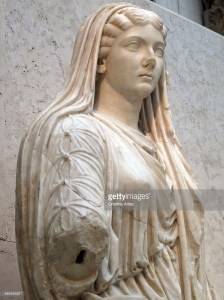
Roman statue of Livia Drusilla, wife of the Emperor Augustus. She would have sat through many poetry readings.

In a previous life I may have been a Roman matron who raptly listened to poetry readings at dinner parties.  Latin was my third foreign language, and perhaps because it was the third I found it easy.  I breezily won the Latin prize in college and was one of two students to pass the Ph.D. Latin exam my year.  Latin is complex and highly inflected, and I quickly realized that some of my very intelligent fellow students enjoyed the study of history or linguistics but were incapable of translation.  We who could translate stuck together (and salute you)!

Throughout my long life, I have been especially fond of Ovid, a brilliant poet who eventually was banished to an island by Augustus for carmen et error (a poem and an error, perhaps one of his racy poems).  He is best known for his epic poem, The Metamorphoses, which is superbly funny and clever and the source of our knowledge of Greek and Roman myths.  It is also one of the few Roman poems that is really wonderful in translation.

Ovid’s love elegies (Amores), addressed to a fictitious mistress, Corinna, are very light and saucy. He is the last of three Roman elegists whose work is extant, the others being Propertius and Tibullus.  Ovid  incorporates the stock themes, style, vocabulary, and situations of elegy.  It seems odd that it would have flourished only in the first century B.C., but its roots are in Roman comedy.  It does not go back to Greek lyric poetry.
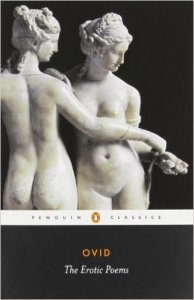
Ovid Amores 419-MO1CbKL._SX320_BO1,204,203,200_Ovid’s elegies in Book I are frivolous and fun.  A love affair with a married mistress is not easy, and we learn it often involves metaphorical chains.   In Amores I.6, the narrator begs a doorkeeper to take the chains (catena) off the door and make a small gap so he can slip in sideways and see his married mistress.  He says he has shrunk so he can do this.  I love the idea of a guy dieting so he can sneak in.

I went on to Amores I.7 , expecting more silliness, but the use of chains in this poem are different.  The narrator has assaulted his mistress:  he asks to be put in chains by any friend who may be present. And it is one of Ovid’s poems that shock us  feminists (we all love Ovid, but scholars have written about  rape in Metamorphoses) because the treatment of the violence is light.  We see it from a Roman male point of view, and there is repentance, but perhaps not very seriously.

Here is the opening of the Latin elegy (my translation is below)

adde manus in vincla meas (meruere catenas),
dum furor omnis abit, siquis amicus ades:
nam furor in dominam temeraria bracchia movit;
flet mea vaesana laesa puella manu.

Here is my literal translation.
N.B. The word order in Latin is flexible, so the impact of the original is very different. (You only get approximations.).

Put my hands in bonds  (they deserve chains)
until all madness leaves, if any friend be here.
For madness moved my rash arms
My girl cries wounded by my raging hand.

The narrator has struck his mistress. Violence against women is common in our society, and against men too, but we do not expect to read a love elegy about it.  The narrator regrets his actions, but his hyperbolic mythical comparisons don’t apply–in fact, they undermine the expression of his sorrow.  He compares himself to Ajax, driven mad by Athena so that he slaughtered sheep instead of the Greek leaders he wants vengeane on.  The narrator’s mistress is like Cassandra, the prophetess who was dragged from a Trojan temple by the Greeks, “except that Cassandra’s hair was bound with a priestess’s headband.”  Ovid has torn her hair, but he adds that she didn’t wear a headband.  And he adds that disordered hair is becoming to her.

And yet we forgive Ovid.  He realizes that if he had struck a Roman citizen, he would have been punished. He mocks himself, comparing himself to a military hero who is celebrated in Rome, where the crowd that follows the chariots will cry, “Oh, a girl has been conquered by this brave man!”

Her face is scratched and her tunic is torn.  It is while he looks at her, pale as a marble statue, that he first began to know he hurt her.  He says her tears are his blood.  But he lightens up again: at the end he advises her to scratch his eyes and tear his hair.

This subject of violence against a woman is common in Roman poetry.  It has also been treated by Propertius and Tibullus.

I must admit, I do not know what to make of this poem.  And I do not know of a very good translation of Amores.  Peter Green’s translation for the Penguin, The Erotic Poems, is adequate but wordy.  Some poetry does translate better than others.

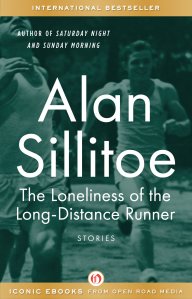
Quotation of the Week: Alan Sillitoe’s The Loneliness of the Long-Distance Runner

Colin (Tom Courtenay) stops running in "The Loneliness of the Long-Distance Runner."

  Tom Courtenay in “The Loneliness of the Long-Distance Runner.”

The critics labeled the English writer Alan Sillitoe one of the Angry Young Men, a group of working-class and  lower-middle-class writers of the 1950s who mocked the hypocrisy and constraints of upper-class society.  Among these writers were John Braine, Kingsley Amis, John Osborne, and Philip Larkin.

Perhaps you do not know Sillitoe’s books, but you may have seen the 1962 film, The Loneliness of the Long-Distance Runner. The screenplay was written by Sillitoe and based on his short story of the same title. The hero is a Borstal boy who has been recruited by the governor to run a long-distance cross-country race on Sports Day.

Alan Sillitoe loneliness of book 81yM5TwPOxLThe title story of his brilliant collection of short stories, The Loneliness of the Long-Distance Runner, is a remarkable study of class warfare as practiced by the 17-year-old narrator, Colin.  He  explains he is no race horse for the “snotty-nosed dukes and ladies” who give speeches on Sports Day.  The governor chose him because of his skinny build. He adds,  “…I didn’t mind it much, to tell you the truth, because running had always been made much of in our family, especially running away from the police.”

Class enmity with the police is no exaggeration.  The police and the governor are enforcers of the rules of upper-class society.  After the death of Colin’s abusive father, the family receives insurance money and for the first time has enough to eat well and buy a telly.   When the money runs out, he hates being poor.  He and his friend Mike stare in the windows of the shops at all the things they want.  They steal a cash box from the baker’s.  When the police catch him, he ends up in Borstal and finds it a cushy berth.  But he hates it and especially the people who run it.

The governor thinks the race will make Colin one of them.  If he runs a good race, they’ll help him get a start in the world.  Colin explains that the out-laws (like him) and the in-laws (like the governor) are always on opposite sides.

And I’ll lose that race, because I’m not a race horse at all, and I’ll let him know it when I’m about to get out—if I don’t sling my hook even before the race. By Christ I will. I’m a human being and I’ve got thoughts and secrets and bloody life inside me that he doesn’t know is there, and he’ll never know what’s there because he’s stupid.

The other stories in this collection are equally stunning.   Sillitoe’s style and subject matter are often reminiscent of  D. H. Lawrence.  In “Noah’s Ark,” two boys cheat and steal to get into a fair and buy food and ridesin the surprising story,  “On Saturday Afternoon,” a young boy witnesses a man’s determination to commit suicide; in “Mr. Raynor the Schoolteacher,” a bored teacher stares out the window of the classroom at the girls in the draper’s shop across the street, but when raucous boys act up, he automatically disciplines them to keep in charge; in “Uncle Ernest,” a homeless, shell-shocked veteran, once a war hero,  buys lunch for two hungry children and is warned off by the police; in “The Fishing-Boat Picture,” a postman’s ex-wife repeatedly visits him and admires the fishing-boat picture that was a wedding present; and  in “The Decline and Fall of Frankie Buller,” a mentally disabled man  in his 20s leads a group of boys in warfare against a slum neighborhood;

In April, Open Road Media will reissue The Loneliness of the Long-Distance Runner as an e-book, and several of his novels in April and May.  Most have long been out-of-print in the U.S.

A Two-in-One Post: Kenzaburō Ōe’s Death by Water & Margaret Drabble’s The Millstone

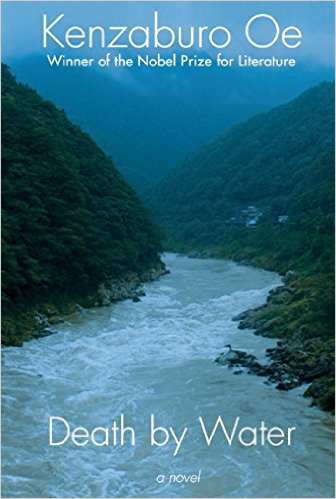
kenzaburo oe death by water 51sQSVkiUjL._SX334_BO1,204,203,200_

Here is a two-in-one post.  Why?

Occasionally I get behind in keeping my book journal.  I read many books I admire and enjoy but do not want to devote an entire post to (says she who has written more than 800 posts).   And so here are two brief “post-ettes” about two very different books,  Kenzaburō Ōe’s Death by Water and Margaret Drabble’s The Millstone.

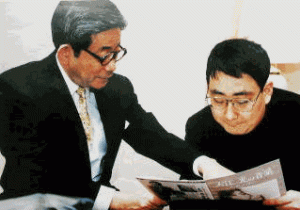
Oe and his son, Hikari.

Oe and his son, Hikari.

Death by Water by Kenzaburō Ōe. This elegant new novel by Ōe, the Japanese Nobel Prize for literature winner in 1994, is  meditative, thematically-diverse, and not big on plot.   But if you are a theater person, I guarantee you will be fascinated by the writer-narrator’s complicated relationship with a theater group devoted to dramatizing his work.

This is the latest of Ōe’s  semi-autobiographical novels narrated by  his thinly-veiled alter ego, Kogito Choko, a famous writer who is also the father of a brain-damaged son, Akari.  (Ōe’s son Hikari was brain-damaged at birth.) The first of these novels, A Personal Matter (1964), is about Choko’s coming to terms with his son’s disability.

In Death by Water, the narrator, Choko, is now in his 70s and is a blocked writer.  He has long dreamed of writing a novel about the death of his father, a right-wing activist who,  during World War II, plotted a quixotic mission with friends at a military training camp, and  took off in a boat, packed only with a red leather trunk, on the river near their house during a storm and drowned.

But Choko’s mother, fearing a scandal about her husband’s politics, denied Choko access to the papers in the red leather trunk that was in his father’s boat.

Ironically, a joke made by Choko’s mother gave him the idea for what he calls “the drowning novel.”  When he was a student and his uncle expressed distress over his majoring in French literature,  his mother said,

“Well, if he can’t find a regular job, then he’ll most likely become a novelist!” This pronouncement was greeted with stunned silence, but the tension was quickly dispelled by my mother’s next remark. “In fact,” she went on, “there’s more than enough raw material for a novel in the red leather trunk alone!” That made everybody laugh.

Ten years after his mother’s death, his sister Asa calls to say the will specified that he would now be allowed to see the contents of the trunk.

After he inspects the trunk (which turns out to be a bust), he explores the history of his father’s drowning through dreams, memory, and conversations with his father’s friends.  But it is the theater group, the Caveman Group, that inspires him most.  He becomes especially close to Unaiko, a young woman who is both manipulative (she stages their meeting by showing up on the trail where he takes his daily walk) and creative.  And she has her own interactive theater project, which is based on rape and war crimes.

Choko also has problems with his son, now middle-aged and a composer, and some of the mediation between the two men is done by women in the Caveman Group.

I admired but didn’t love this brilliant book, translated by Deborah Boliver Boehm.  It is a very great book and some of you will love it.

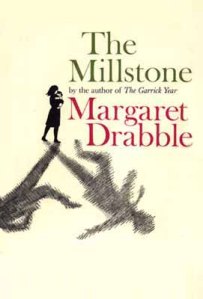
drabble the millstoneMargaret Drabble’s third novel, The Millstone (1965), won the  John Llewellyn Rhys Memorial Prize.  It has been highly praised by the writer, Tessa Hadley, , who last year wrote an essay for The Guardian, saying “For my money, it’s the seminal 60s feminist novel that Doris Lessing’s The Golden Notebook is always supposed to be.”

And so I decided to reread it.

This charming comedy is what I call “Drabble-lite,” though it is a perfect book, a ’60s classic.  The narrator, Rosamund Stacey, a brilliant scholar,  has the bad luck to get pregnant the first time and only time she has sex, with a  fey BBC announcer who mutters something afterwards about the act’s being “pointless.”  She does not want the baby, and tries the gin and hot bath folk remedy, but friends interrupt her and drink most of the gin, and in short it doesn’t work.  Fortunately for Rosamund, there is a fairy tale aspect to the novel: she doesn’t have to deal much with the unwed mother stigma. Her  professor parents are in Africa for a year and she is living in their desirable flat, so the address impresses the NHS doctors and then the hospital nurse.  Her friend, Lydia, a writer, moves in and helps with the babysitting.  Rosamund loves her baby, and the baby has some serious health problems, but this is basically a ’60s fairy tale, with an optimistic, confident, lucky heroine we love to spend time with .

Drabble is one of my favorite writers. We Drabble fans all have our  favorites.  Mine is The Realms of Gold.

A New Edition of Valley of the Dolls, Kate Millet’s Sexual Politics, & Bridget Jones

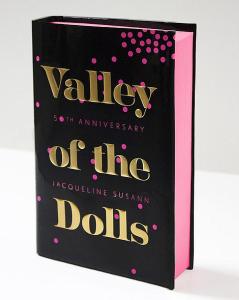
Valley of the dolls susann grove press ST_20160320_DOLL_8_2151126Yes, it’s trashy, but it’s also great, and it tapped into the zeitgeist  in 1966.  As a fan of pop women’s fiction, I was interested to read in The New York Times that a 50th anniversary edition of Jacqueline Susann’s The Valley of the Dolls will be published by Grove Press in July.   Judy Hottensen, the associate publisher of Grove Atlantic, told the Times  she hopes it will appeal to young women raised on “Girls” and “Sex and the City.”

It took me many years to get around to Valley of the Dolls, and it pleasantly surprised me.  Susann’s pop classic proceeds along the lines of Nancy Hale’s The Prodigal Women and Mary McCarthy’s The Group: it is the story of three young women who move to New York, become friends at the beginning of their careers, and climb the ladder of the entertainment industry, not without much popping of pills.  Anne, the emotionally stable one from New England, works as a secretary and then becomes a model.  She doesn’t need pills (well, only very briefly).    But you can imagine what the pills do to Neely, the Broadway star who becomes a screaming home-wrecking harridan, and Jennifer, the lovely, sweet,  pill-dependent woman who decides to act in French art films because no one values her for anything except her body.

Here’s the jacket copy from my old paperback:

 Dolls: red or black, capsules or tablets, washed down with vodka or swallowed straight–for Anne, Neely, and Jennifer, it doesn’t matter, as long as the pill bottle is within easy reach. These three women become best friends when they are young and struggling in New York City and then climb to the top of the entertainment industry–only to find there’s nowhere to go but down–into the Valley of the Dolls.

All right, this book is not for everybody–but it is for the beach!

2 in The New Republic, Maggie Doherty says Kate Millet’s best-selling 1970 classic of feminist criticism, Sexual Politics, still speaks to us.  (I read this in the seventies, and though I certainly didn’t agree with Millet about D. H. Lawrence, I thought she was astute about Henry Miller and Norman Mailer.)

Kate Millett sexual politics 51h99VUCohL._SX331_BO1,204,203,200_3 Barbara Ellen at The Guardian thinks that single women now have things harder than Bridget Jones did in the ’90s. She writes, “The issue is that Bridget Jones is a true creature of the 1990s, and the 1990s not only seem a painfully long time ago, but painfully innocent, too.”

Are Historical Novels Literary? Not Really! The Robe & a List of Favorites

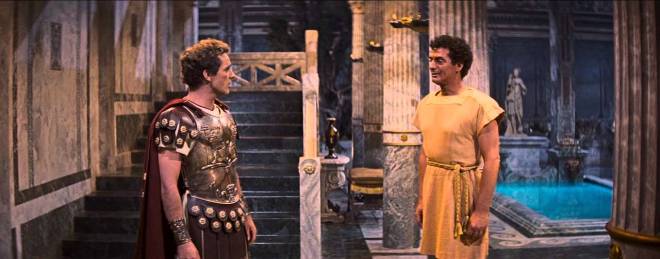
Marcellus (Richard Burton) and Demetrius (Victor Mature), his slave, in The Robe/

Marcellus (Richard Burton) and Demetrius (Victor Mature), his slave, in The Robe.

I do not read many historical novels.  Why?  Because they are genre books.   Yes, historical novels are respectable these days, every literary writer has to write one, and the Man Booker Prize has often gone to historical fiction in recent years.  Even I concede that Hillary Mantel’s Wolf Hall is a classic.  But when it comes right down to it, most historical novels are simply pop entertainments.  (The exception?  My favorite book, Tolstoy’s War and Peace.)

So if I’m such a snob, what was I doing today watching The Robe and perusing the best-selling novel by Lloyd C. Douglas?

It’s a nostalgia thing.

And they both turned out to be very good pop entertainments.

Every Easter when I was growing up, there was a choice of two old movies on TV:  The Robe, the story of a Roman tribune, Marcellus (Richard Burton), who carries out Pilate’s orders in the crucifixion of Jesus and, after winning Jesus’s robe in a dice game and trying the robe on, goes temporarily mad; or The Ten Commandments,  starring Charlton Heston as Moses.  Our Catholic family skipped The TEn Commandments but was glued to The Robe  and my husband reports that at Catholic school  they watched it more than once in the gym.  (Even nuns need a break.)

So how is The Robe?

The movie is actually very good:  too long, and the set looks fake, but the script is excellent and I enjoyed the (fake) scenes in Rome, where Marcellus (Richard Burton) alienates Gaius Caligula (Jay Robinson) and is banished to Palestine, and I also liked the scenes in (fake) Capri where Marcellus’s fiancée, Diana (Jean Simmons), pleads on his behalf to Tiberius, who brings him back. Filmed in a different time, but the Hollywood blockbuster is still fascinating, whether you are a Christian or not.  Richard Burton was nominated for an Oscar for Best Actor and the film for Best Picture.

So how’s the book?

book TheRobe-01The Robe was the  first Roman historical novel I read:  I was 11 when I checked it out of the library (it is a decline of the Roman empire novel, with the Christians rising).  It was a page-turner then, and it is now.  All right, there are some stylistic problems, but it is an excellent story, once you get underway.

I was not hopeful at first. The beginning is contrived , there is too much frowning darkly and snapping, but somehow it becomes very interesting very, very fast.  Much information is presented in dialogue about the late emperor Augustus’s corruption, Tiberius henpecked by his wife Julia in retirement in Capri, and the mad emperor-to-be Gaius Caligula raising havoc in Rome.  I love the hero Marcellus’s father, Senator Gallio, who rants about the corruption of Rome.  The speeches sometimes go on for pages.  And they are effective.

But–look at our government!  A mere hollow shell!  It has no moral fibre! Content with its luxury, indolence, and profligacy, its extravagant pageants in honour of its silly gods; ruled by an insane dotard and a drunken nonentity!  So, my son, Rome is doomed!  I do not venture to predict when or how Nemesis will arrive–but it is on its way.  The Roman Empire is too weak and wicked to survive!

Anyway, I recommend it if you just want a really good pop read.

Below I have compiled a list of Literary and Pop Historical Novels set in the Ancient World

Top Ten Literary & Pop Novels Set in the Ancient World

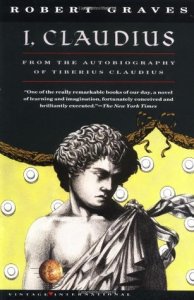
1 Robert Grave’s I, Claudius (1934).  Written in the form of the autobiography of Claudius, it details the crippled, catarrh-riddern future empire’sh survival through the reigns of Augustus, Tiberius, and Caligula, and his own inadvertent succession to emperor.

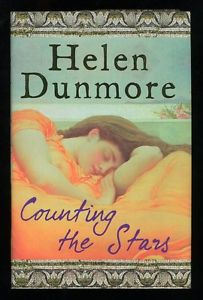
I CLAUDIUS GRAVES 187652 Helen Dunmore’s Counting the Stars (2008).  A lyrical historical novel about the poet Catullus and his love affair with Clodia Metelli. Absolutely stunning.  Unfortunately, it wasn’t published in the U.S., so I had to order it from the UK.

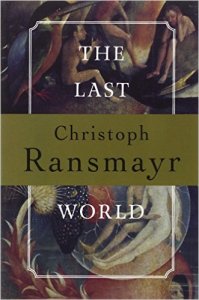
COUNTING TH ESTARS DUNMORE $_353 Christoph Ransmayr’s The Last World (1990).  Translated from the German by John E. Woods, this brilliant novel is about the quest of a young poetry fan for Ovid, who has been exiled in 8 A.D. It’s been a while since I read it, but here’s an exceprt rom the jacket copy of the Grove Press edition:  “The poet Ovid, in his distress over his banishment from Rome, consigns the manuscript of his masterpiece, Metamorphoses, to the flames; years later, when rumors of his death reach Rome, his youthful admirer Cotta follows him to the remote Black Sea port of Tomi. Out of this story Christoph Ransmayr has fashioned an astonishing novel about a journey of adventure that has become Europe’s most recent critical and best-selling literary sensation.”

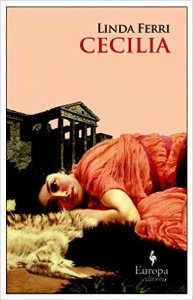
ransmayr the last world51F4BFNEdHL._SX329_BO1,204,203,200_4 Linda Ferri’s Cecilia (2010). Translated from Italian by Ann Goldstein (translator of Ferrante’s books) and  published by Europa Editions, this beautifully-written novel is loosely based on the life of St. Cecilia, the patron saint of music. It unfolds in a series of vignettes, some realistic, some dream-like. Ferri’s delicate, meditative style is more reminiscent of Marguerite Yourcenar than Robert Graves, but it’s safe to say that fans of both Memoirs of Hadrian and I, Claudius will enjoy it. If you’re familiar with Roman literature, you will especially love this novel, full of allusions to Virgil, Ovid, Martial, Lucretius, and others. And the well-educated Cecilia, who is also a musician, is a delightful character in her own right.

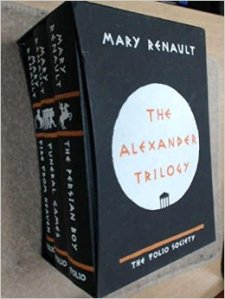
cecelia ferri 51GiNbQ8rVL._SX319_BO1,204,203,200_5 Mary Renault’s Renault’s  Alexander the Great triology: Fire From Heaven, The Persian Boy, and Funeral Games.  Beautifully written, well-researached, and stupendous! Renault’s best-sellers are now near-classics:  the TLS went so far as to publish the itnroduciton to the Folo Society edition’ a few years ago.

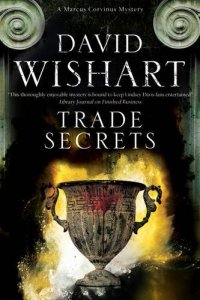
renault alexandria trilogy 51H-HDA++UL._SY344_BO1,204,203,200_5 David Wishart’s Marcus Corvinus mysteries.  Fun historical mysteries, solved by witty Patrician slueth Marcus Corvinus, set during Augustus’ reign.  They’re all good:  the latest one is Trade Secrets.

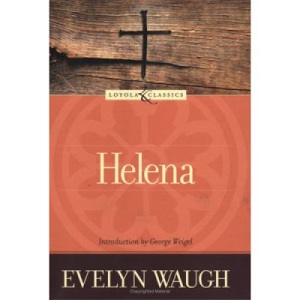
trade-secrets-by-david-wishart6 Evelyn Waugh’s Helena (1950). Said to be the favorite of his books, it is a slight, spare, comical fable about the life of Saint Helena, the mother of the emperor Constantine and a Catholic convert who searched in her later years for the true cross on which Christ was crucified.

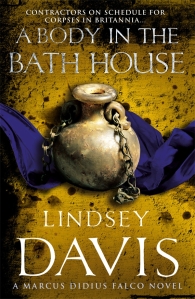
helena-waugh-cover7 Lindsey Davis’s Marcus Didius Falcus mysteries.  This witty sleuth solves mysteries in Rome and elsewhere in the empire.  Great fun!

lindsey davis body in the bathhouse 97800995151808 Michelle Moran’s Cleopatra’s Daughter (2009).  The orphaned children of Cleopatra are brought to  Rome in chains after the death of their parents and must learn to survive.  Tense, exciting, lots of historical detail, and fun!  Moran is a versatile writer of pop, but well-researched, historical novels.

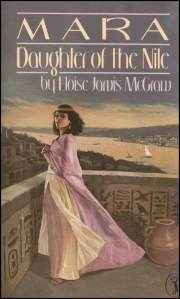
9 Eloise Jarvis McGraw’s  Mara Daughter of the Nile. It gave us Egypt fever when we were nine.  There were no sphinxes in Iowa City.  Darn!  In this brilliant children’s novel, Mara, a slave, must  live by her wits to survive in ancient Egypt.  She becomes a double agent, and unfortunately cannot eradicate herself from the double dealings even when she falls in love.

mara daughter of the nile magraw 006211

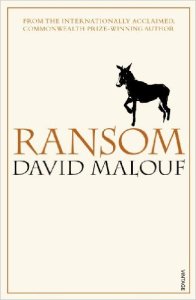
David Malouf’s Ransom (2009)  This poetic novel inspired by the Iliad focuses on the Trojan king Priam’s visit to Achilles in the Greek camp after the deaths of Patroclus and Hector. A beautiful book that should have won awards for this celebrated author.

ransom david malouf 41Nabzt9kIL._SX324_BO1,204,203,200_


Let me know your favorite historical novels, whether they be literary or junk!

An “Anita Brookner-thon” & Look at Me

image

                           The “Anita Brookner-thon” at a cafe!

I am not a marathoner.  I got extremely sick the one time I ran, and actually completed, a half-marathon in my twenties.  But my addiction to the novels of Anita Brookner, the brilliant chronicler of single women’s lives who won the 1984 Booker Prize, surely counts as a marathon.  I have read five of her books in the last week.

Today I took the “Brookner-thon” outdoors.  It was a lovely day, in the fifties, and I went out with a copy of her third novel, Look at Me. (More on how I found the perfect outdoor spot later in this post.)

What makes a Brookner book a Brookner?  Her heroines (and sometimes heroes) have problems connecting with people:  they are solitary, have few or no friends, read incessantly, and take long walks.  If they are married, they do not love their spouses.

In Look at Me, the narrator, Fanny, works in the reference library “of a medical research institute dedicated to the study of problems of human behavior.” She catalogues photographs of images of Melancholy and Death, and lives in her dead parents’ flat in a building inhabited by old people. Her best friend is Olivia, a colleague who lives with her parents and is slightly more irritable than Fanny with the eccentrics in the reading room. Fanny is a writer, taking notes every night on the strangeness of the library staff and regulars for a novel:  writing is her way of saying, “Look at me.” But  Fanny stops writing after she is befriended by a handsome doctor’s charming,  gregarious girlfriend, Alix,.  Suddenly she has an active social life, eats dinner at restaurants instead of tiny meals on trays prepared, and is invited out almost every night. Alix throws her together with James, an introverted psychiatrist who lives with his mother and believes in pharmacology.  But the two do not have sex, and it turns out Alix is not the friend you trust with that.  Indeed, she seems to be a very dangerous friend.

Many of Brookner’s heroines are spinsters.  Am I a spinster? No.  Was she a spinster?  In a way:  she was single. Apparently I am a spinster inside myself. (Are we all?) Perhaps it is because I vowed as a young feminist I would never marry, and have been married (almost) ever since.   We often identify with characters who are completely different from us.  Why do we read about Frances/Fanny, whether in Look at Me or  Austen’s Mansfield Park.  The writers make us see these strangers so vividly.  And we can share thoughts of characters we will never meet; even characters the writer may never meet.

I’m sure that others of you will be taking your reading-thons outdoors now that it’s spring. Here’s what you need if you plan on a “Brookner-thon.”

  1. A cafe or restaurant.  Brookner’s characters, solitary though they are, often eat in public. They dine at Harrods, in Chelsea,  in fine restaurants in Geneva, or at the Italian restaurant around the corner.  But do they dine al fresco, as I did today?  (See photo at top of post.)  Well, surely sometimes.
  2. A strong cup of coffee.  You must “woman-up” and drink coffee while you read and observe the world through Brookner’s eyes.  Tea is too tepid for the reader fo the very grown-up books of Brookner.  It might not be a bad thing to take an even stronger drink.  You could, of course, Bring Your Own Thermos.
  3. A glass of something cold as a “chaser.”  You might need a cold glass of water after all that coffee. Go figure, but the cafe claimed it did not have water.  I was given a free drink of something pink with no calories.
  4. Paperbacks are preferred on your outings.  Thar way if you have to get up for a minute, you can absent-mindedly lay the book face-down on the table, since you forgot your bookmark, and the only paper in your purse is an old Kleenex.  (The heroines of Brookner’s books would doubtless disapprove of this treatment of a paperback, but at least is isn’t an e-book.)
  5. A Brookner-thon can be held in a park.  Brookner’s heroines spend much time walking in the beautiful parks in London.  I do not, alas, live near such a park.  There are many memorial benches on the trails, but people have taken to decorating thing with rosaries, strings of beads, potted plants, and are they places to sit? They used to be!  I biked through a park past what I mistook for a sculpture of giant Adirondack chairs.  Each is taller than a tall man and would fit two or three or four people.  I was assured that these were chairs, not a sculpture, but I didn’t fancy scrambling up and then heaving myself out of it later.
Giant Adirondack chairs: not ideal!

Giant Adirondack chairs: not ideal!

Enjoy your weekend reading, whatever the book might be!

Quotation of the Week: MFK Fisher on Potato Chips

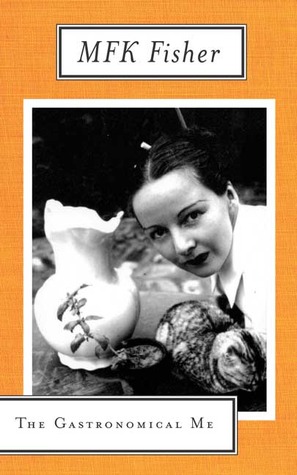
gastronomical me mfk fisher 304032I love MFK Fisher’s food writing, though it is more than food writing.

She was one of the most accomplished American essay writers of the twentieth century.  We are not talking restaurant reviews or recipes:  her delightful books are a mix of travel, memoirs, and meals.

I recently read The Gastronomical Me, published in 1943.  This collection of autobiographical essays begins in 1912 with her first conscious culinary experience: at the age of four she delighted in “the grayish pink fuzz my grandmother skimmed from a spitting kettle of strawberry jam.” She writes humorously about learning to cook:  her sister politely tries to eat “Hindu Eggs,” but the curry sauce is so hot that tears run down her face after a few spoonfuls. As a college freshman in Illinois in 1927, Fisher devours dorm food, but is especially fond of  TheCoffee and WaffleShop, where she and her cousin Nan devour four waffles or a five-course meal for 40 cents after exams.   She describes delicious meals in France, Germany, and Switzerland in the 1930s, two marriages and bizarre kitchen arrangements in European apartments, the gourmet cooking of impecunious landladies who haggle over almost-spoiled food at the market, learning how to eat alone on several ship voyages, the beginning of the war, and widowhood. The book ends in Mexico in 1941, with the story of a transgender mariachi singer who has fallen in love with her married brother, who exults in his power over Juanito.  Even the delicious enchiladas with delicate herbs cannot make up for the desolation she witnesses.

But I especially like Fisher on  potato chips.  She and her first husband Al ate their first European potato chips in Strasbourg.  Her description of the chips is tantalizing.

The first time, on our way to Germany, we had sat downstairs while our meal was being made.  There were big soft leather chairs, and on a dark table was a bowl of the first potato chips I ever saw in Europe, not the uniformly thin uniformly golden ones that come out of wax packages here at home, but light and dark, thick and paper-thin, fried in real butter and then salted casually with the gros sal served in the country with the pot-au-feu.

They were so good that I ate them with the kind of slow sensuous concentration that pregnant women are supposed to feel for chocolate-cake-at-three-in-the-morning.  I suppose I should be ashamed to admit that I drank two or three glasses of red port in the same strange orgy of enjoyment.  It seems impossible, but the fact remains that it was one of the keenest gastronomic moments of my life.

And here is a link to a recipe in The New York Times for” MFK Fisher’s potato chips,” devised by Craig Claiborne.I have not yet tried it, but maybe this weekend!

Anita Brookner on a Chilly Friendship: The Rules of Engagement

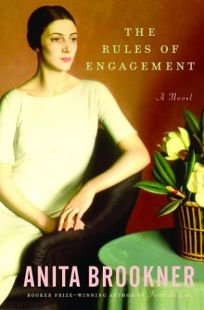
Rules of Engagement brookner 2e1c123e613b659bf8215d5b9d890a22-w204@1xI wonder if The Rules of Engagement is my favorite Anita Brookner novel.

As I read it, it occurred to me that it might even be the right Brookner for fans of Elena Ferrante.  It is not that Brookner shares Ferrante’s emotional tone:  on the contrary, she is chilly and forbidding.  But just as Ferrante traces the friendship of doubles Elena and Lila in the Neapolitan Quartet, so  Brookner’s heroines Elizabeth and Betsy  meet at school and shadow each other in their parallel adult lives. But, as you might expect, Brookner’s novel is a much more uncomfortable read.

Brookner is known for her solitary heroines, but these two are different, in that they marry. The narrator, Elizabeth, is cool and in control, not emotionally involved with friends or, later, her husband. Sound familiar?  But hold on:  both Elizabeth and her double, Betsy, are widowed while relatively young. And another thing sets them apart:  their childless state.

it takes a while for Elizabeth to address their childlessness.   She begins with a description of the inception of her long, uncomfortable friendship with the ebullient Betsy.

The chilly tone is established in Brookner’s first paragraph.

We met, and became friends of a sort, by virtue of the fact that we started school on the same day.  Because we had the same Christian name it was decreed that she should choose an alternative.  For some reason–largely, I think, because she was influenced by the sort of sunny children’s books available in our milieu–she decided to be known as Betsy.  When we met up again, several years later, she was Betsy de Sainte-Jourre.  Not bad for a girl initially registered as Elizabeth Newton.

In the 1950s, the motherless Betsy tries too hard with Elizabeth’s mother, who despises her, partly because she despises Betsy’s father, a doctor, known for an excruciating mistake that killed a patient.  Soon the doctor himself dies, and the orphaned Betsy continues to live with her spinster aunt.   Betsy and the aunt go to the cinema for excitement on Saturday night.  Elizabeth despises them.

As adults, Elizabeth and Betsy grow apart, but are unprepared for the sixties.  They had the fifties dreams of marriage and family.  Elizabeth takes a cooking class in Paris and spends her leisure walking alone and going to foreign films; Betsy goes to university to study languages and, while living in Paris, marries a very handsome radical activist.  Meanwhile, Elizabeth marries Digby, a stolid, much older friend of her parents.  At the wedding, Betsy widens her eyes when she sees Elizabeth’s unattractive husband.  (There are moments when we dislike Betsy for widening her eyes, though she is the more likable of the two friends.)  Elizabeth does not, cannot, love Digby.  But she is very comfortable in their flat.

So it would seem that Betsy is the more adventurous of the two, as well as the more emotional.  But Elizabeth, who is honest  and critical, but perhaps not an altogether reliable narrator, does not see it that way.  She sees herself as smart and Betsy as the failure.

Surprisingly, Elizabeth has an affair with one of Digby’s friends, the beautiful Edmund Fairlie.  She suspects his wife, Constance, knows all about it, because they meet at Edmund’s flat, obviously rented for his affairs.  Elizabeth lies to Digby:  she says she is taking evening classes. She reads so much that he doesn’t question this.  During Digby’s vacation, she makes an error:  she picks up a book at random, she thinks, and it is Madame Bovary.  She immediately feels uncomfortable and puts it down.  Digby picks it up.

“You won’t like that,” I warned him.

“I never have liked it.  It’s a woman’s book, really.”

“Yet it was written by a man.”

“Yes, only a man would have killed her off.”

“She died because she had got into debt,” I reminded him coldly.

That’s Elizabeth all over.

Digby dies of a stroke.  He does not want to die in the hospital, and she does not call a doctor.  Then she  breaks off her affair with Edmund.  She is very much alone. When Betsy, also widowed, after her unstable husband dies in an accident, she comes back to London and, eerily, takes up Elizabeth’s life.  Edmund is attracted to Betsy, and they have an affair.  But this is not all:  she tries to insinuate herself into his family life with Constance and the children.

Elizabeth views all this with despair.  She sees what Edmund is doing, and knows Betsy still longs for a family.

Later, when Betsy is ill, Elizabeth begins to understand Betsy, the significance of her being an orphan.  She grimly realizes their real problem:  childlessness.

What united us, Betsy and I, in this strangest of pairings, was the fact that we had never had children, and that we had therefore failed the one essential test that all women feel obliged to pass.  Even celibates measure their success or failure by this standard, and those who remain childless through their lives wonder what faculty has been lacking to bring this about.  Yet neither of us had been maternal in our outlook, though Betsy gazed fondly on any child she encountered.  She was, perhaps, too busy being her own child, the child she had to nurture in the absence of anyone else able or willing to do so.  As for myself, I saw any potential children as an impediment to my freedom, for at the back of my mind I kept in readiness a plan of flight from circumstances I could no longer tolerate.

It is for Brookner’s brilliant insights that one reads. I am fascinated by doubles:  we all have one, don’t we?  And I am childless.  I have always admired working mothers:  how on earth can they go to work,  raise the children, and then even read at night?  Sometimes I look back and realize that a whole alternate life would have unfolded had if I had been careless with birth control.  But I was not particularly maternal, and was horrified by friends who complained the only time they were  alone was in the shower.

I need my solitude.

This is one of Brookner’s best.

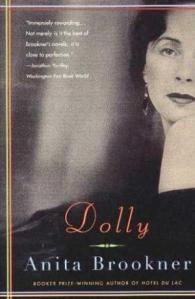
Dolly by Anita Brookner

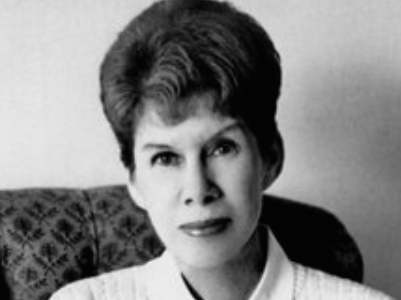
anitabrookner

                                 Anita Brookner

Anita Brookner’s death last week at the age of 87 has prompted a “Brookner-thon” at my house.  I can read one of her short elegant books in a day, and this week I have raced through Dolly and A Closed Eye.  

Brookner is a stunning writer, reminiscent of Henry James.  I am astonished by the crystalline quality of her prose.   She wrote 24 novels, and I took her for granted:  I had been looking for the new Brookner.  I never thought of her getting older.  I only thought of my need to read her exquisite, perfectly shaped sentences.

When I read her books as a young woman, I was enthralled by her accounts of independent women.  Now I love the books, but also find them painful.  Her heroines are usually single, emotionally remote, and shut out of everyday relationships.  They spend their time reading David Copperfield and wandering through art museums in London.  (Brookner was also an art historian.)   Perhaps I understand these heroines better now that I am older, and even better because I have finally visited London.  I have seen the paintings that fascinate her heroines. I know some of the neighborhoods.

dolly anita brookner 9780394224381-uk-300Dolly, published in 1993, is a small masterpiece, much more complex than her early work.   It explores the relationship between Jane, a  young woman, and her Aunt Dolly, who turns out to be a hustler.   The narrator, Jane Manning, a very quiet writer of children’s books, grew up in a peaceful household in London:  her well-to-do parents, Paul and Henrietta, read for recreation and certainly did not go in for luxury. Hence Jane is fascinated when her exuberant, well-dressed Aunt Dolly, who lives for bridge, dancing, and  social engagements, breezes in from Brussels with Uncle Hugo, a former mama’s boy now very much under Dolly’s thumb.  Dolly isn’t very nice to the Mannings:  essentially she stole Hugo from his mother and considers his sister, Henrietta, a nonentity. Henrietta anxiously tries to please the couple by taking them to dinner at the Ritz, but Dolly  is accustomed to the best restaurants and bored.  Dolly and Hugo go out in the evenings to play bridge:  Dolly is frantic when she learns that Henrietta and Paul do not play.  Henrietta explains they prefer to read.

“Oh, read,” said Dolly.  “Well, of course, I am a great reader myself, but in our circle one has to mix, otherwise one would know no one.”

“I suppose you have a great many friends,” said my mother.

“Yes, I can certainly say that we are well liked.  Not that we mix too much with the expatriate community, except for bridge, of course.  Our dear friend Adele Rougier is the one we see most constantly.  Her husband was our ambassador to Zaire, you know….”

I find this dialogue both comical and heartbreaking.  Dolly is so snobbish, yet she reads romances and is oblivious of the Mannings’ different values.  I find Henrietta’s supposition that Dolly has  friends poignants.  Jane, who sees all this,  regards  Dolly as a monster, and Dolly dismisses her because she is quiet, intelligent, and dully dressed.  But after Hugo’s death, Dolly, who was raised in France by her mother, a Jewish dressmaker who sewed for the neighborhood prostitutes and was saved during the Occupation by these women’s relationships with Nazis, now is unwilling to be deprived of luxury.  She decides her best bet is to live with Hugo’s rich mother, who sends her packing with a small allowance.  Dolly is an opportunist:  she borrows money often from Henrietta.  But after Henrietta’s death, Jane begins to understand Dolly better.

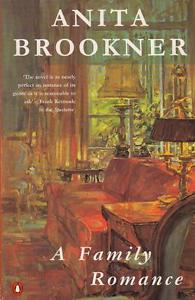
The British edition.

The British edition of Dolly.

I love Jane, but she breaks my heart.   She is content with her routine, her job at a cuttings agency, her walks, and her books.  After her parents die, her only real friend is John Pickering, her parents’ solicitor. After the cuttings agency closes, she writes her first children’s book and studies fairy tales.  When she speaks on “Sleeping Beauty” at small American women’s colleges, she prefers the middle-aged women in their fifties to her feminist peers.   Although the feminists worry about sexual harassment and study gender in 1950s melodrama, they turn out to be “reconstructed” when they learn Jane doesn’t have a husband.   They regard her lack of a relationship with a man as a failure, much as Dolly does.

Jane writes,

It is not that they would necessarily want me to find love and marriage, in the sense of a happy ending. But if I were sharing household chores with some cheerful fellow in jeans and a shirt ironed by himself they could understand me better.  How then to disappoint them by telling them that I prefer the fairy-tale version, and will prefer it till I die, even though I may be destined to die alone?

Brookner is so quietly barbed it almost went past me.  “Some cheerful fellow in jeans and a shirt ironed by himself”:  didn’t we all marry him?  I know that Jane’s solitude is not as hard for Jane as it would be for some of us, but it is not easy, either.  Surely women who live alone find it easier if they have friends.  But Dolly has friends who are not real friends:  she is lonely.  And  Jane’s coming to terms with Dolly is perhaps the loveliest thing in this graceful, pitch-perfect novel.

Women’s Literary Prizes: What’s Not to Like?

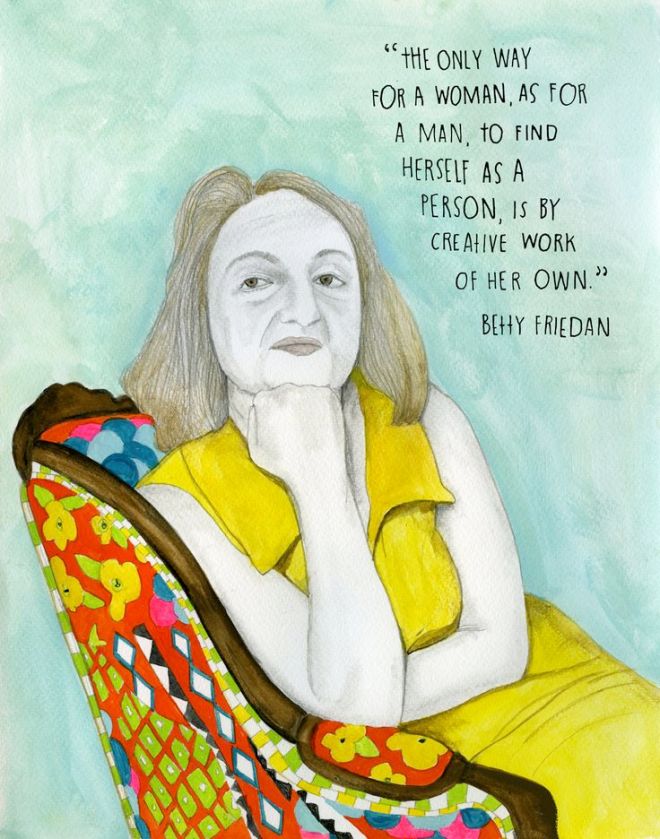
Betty Friedan creative work d00140b4732e9537de970c5c359fc302

I often tire of gender issues.  Don’t we all?  By the time I passed a Certain Big Birthday, I hoped I would no longer worry about equal pay for equal work, legal abortion, or free day care on demand. But the battle continues:   Republican politicians, including the circus of very strange Republican presidential candidates, threaten to withdraw funding for Planned Parenthood and criminalize abortion.  Reproductive control is the tipping point of women’s freedom.

As if that weren’t enough to make us anxious, the gender struggle continues even in the literary world.

I am a fan of the Orange Prize for the best novel by a woman written in English, which is now  called The Baileys Women’s Prize.  This year, I’m rooting for Elizabeth Strout’s I Am Lucy Barton (which I wrote about here). Without the Orange Prize, I would never have discovered Helen Dunmore.

But the need for the prize goes deeper than to introduce me to Dunmore’s work.  The award-winning novelist Nicola Griffiths, author of Hild, did a study on the last 15 years’ results for six fiction awards: Pulitzer Prize, Man Booker Prize, National Book Award, National Book Critics’ Circle Award, Hugo Award, and Newbery Medal.  When it comes to literary prizes, more men than women win, and when women do win, the subject of the narrative is usually male.  She writes,

…the more prestigious, influential and financially remunerative the award, the less likely the winner is to write about grown women. Either this means that women writers are self-censoring, or those who judge literary worthiness find women frightening, distasteful, or boring. Certainly the results argue for women’s perspectives being considered uninteresting or unworthy. Women seem to have literary cooties.

Women are divided on the issue of women’s prizes.   A recent panel discussion on International Women’s Day, called “What sex is your bookshelf?”and sponsored by the Man Booker Prize, sparked a debate. According to the Bookseller, the novelist Lionel Shriver, winner of the Orange Prize for her novel, We Need to Think About Kevin, said during the discussion that she doesn’t see the need for a women’s prize.

This whole thing of treating women specially, as if they need special help and special rules, is problematic and obviously backfires. It is the big downside to the Orange Prize. Having won it, I never want to seem ungrateful, and I don’t bad mouth the Orange Prize. Kate Mosse who runs it is very approachable on how the prize has its problematic side. But I would still feel perfectly comfortable saying it is not as meaningful to me to have won the Orange Prize as say it would have been to win the Booker. Most people who win that prize surely say the same thing: you have eliminated half the human race from applying. …I took the money! But there is this problem of suggesting that we need help, that men have to leave the room and then we’re prize worthy.

Well, this is eccentric, but Shriver also outrageously said that International Women’s Day is “creepy.”  Shriver is a stunning writer, of course, but I must ask this question:  WHAT WAS SHE DOING ON THE INTERNATIONAL WOMEN’S DAY PANEL?

On the panel, Sarah Churchwell, Professor of American Literature at the University of London, defended the Bailey Women’s Prize and International Women’s Day.  “I believe both are necessary because we have not yet achieved equality. When we do achieve equality then it will be nice to have a world in which those are not necessary.”

Thank God for a sensible take on a sensitive issue.

Even on a local level, the issue of special prizes for women is debated.  A female editor friend, very feminine but male-oriented,  laughed at the local women’s journalism awards and said they didn’t matter. (The men didn’t laugh, doubtless because they’d never heard of them.)  But  I must confess, I garnered several local  prizes over the years. Two were from women’s organizations.

Did I disdain these women’s awards?  No.  I am honored.  Sure, I wasn’t a war correspondent, but writing on women’s issues requires its own kind of toughness.  You would be surprised how many enemies you make when you write on sex discrimination cases or abortion.  Whether the prizes were from co-ed associations or women’s organizations, no money changed hands. They gave me framed certificates or plaques, always useless, which perhaps end up in boxes or the garage.   The prizes look good on my resume.  My husband recently reminded me of a prize I’d forgotten. We got a fancy dinner, but no certificates!

In England, the big literary prizes, The Booker Prize and the Baileys Prize, get lots of attention.We all like the glamor of the longlist and the shortlist, and the gossip and the scandal.  Somebody always says the wrong thing somewhere.  We don’t have much of that in the American papers.  I guess people aren’t interested in literary awards here.

I do have a couple of observations on the British prizes.  I would say both the Man Booker and the Baileys have changed their emphasis in the 2010s.  I have read 11 of the Orange Prize winners  over the years, but since 2014, the prize has gone to so-called “experimental” novels.  I felt an instant rapport with all the mainstream publishers who rejected Elmear McBride’s A Girl Is a Half-Formed Thing, and discovered I have a very limited tolerance for Ali Smith’s prose: “and now me falling upward/ at the rate of 40 horses dear God old .Fathermother please spread extempore.”

The Man Booker Prize has also gone astray, in my opinion. It has  been awarded to historical novels since 2012.  Why historical novels?  Whatever happened to brilliant, poetic literary fiction? Does it have to go to the Tudors or prisoners of war very year?   Give it to Elizabeth Strout or Tessa Hadley.   For God’s sake, they’re great writers of extraordianry lyrical prose.  And they’re women.

What do you think about women’s prizes?  Pro or con?