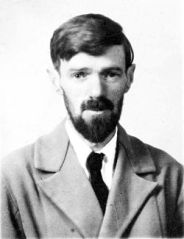
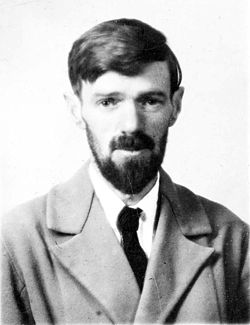
D. H. Lawrence
After I scribbled some notes about D. H. Lawrence’s Women in Love (at my old blog), a very kind writer emailed me and suggested that I might enjoy Lawrence’s poetry.
And now I am reading Lawrence’s poetry, and am awed by its odd grace.
I have also been reading Lawrence’s short stories. I feel considerably less awed by their equal grace, but only because reading fiction is my forte.
I have long been a fan of Lawrence. I read The Plumed Serpent in Veracruz, relieved to have found an English novel in a Mexican bookstore. (I had run out of things to read.) It was a ghastly trip: I got bad sunburn and stayed in the hotel applying vinegar to my burns; I read all our books, George Eliot’s Romola (which was supposed to last me a week), Gabriel Garcia Marquez’s A Hundred Years of Solitude, and my husband’s book, Zen and the Art of Motorcycle Maintenance.
And then we tried to trade books with some tourists at the hotel, but most of the tourists were German. The American family was frankly unwilling to trade. “I’ve read those,” the guy snapped, while his wife pleaded with him to give me a book.
Bookless in Mexico! It was terrible.
I must say The Plumed Serpent is a very strange book.
I’m sure Lawrence would have written a book if he’d been bookless in Mexico, but I had to read one.
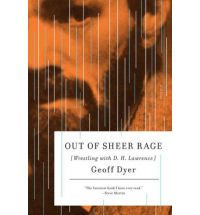 Critics have vastly different views of Lawrence. Kate Millett, in her feminist book of criticism, Sexual Politics, hates his depiction of women, and I do know many women who feel the same; Geoff Dyer, in his witty book, Out of Sheer Rage: Wrestling with D. H. Lawrence, writes of traveling around the world trying, or not trying, to write a book about Lawrence, and often writing about himself. He says of his delaying tactics that he had planned for years to write a homage to Lawrence and:
…as part of my preparation for realizing this cherished ambition I had avoided reading anything by Lawrence so that at some point in the future I could go back to him if not afresh the at least not rock-stale. I didn’t want to go back to him passively didn’t want to pick up a copy of Sons and Lovers aimlessly, to pass the time.
I do know what he means about going back to the novels passively. Sometimes they are overwhelming.
Not having any intention of writing a homage, I will now dash off a few remarks about Lawrence’s short story, “Strike Pay.”
I am especially interested in strikes, not that I have ever had a chance to strike. One day my father came home and told my mother that the factory workers were going on strike. She entreated him not to strike. “You won’t get your job back.” They were of different classes: she the daughter of a successful businessman, he the son of a poor farmer. I never heard them talk about the strike again, but my mother usually had her way. Either he didn’t strike, or the strike didn’t last long.
 Lawrence, the son of a miner and an ex-teacher, did not work in the mines, but obviously knew them. In his story, “Strike-Pay,” a group of men collect their strike pay at the Methodist chapel, and then go off for a day of fun. Lawrence crafts the nine-page story as adroitly as an architect designs a building (or perhaps more as a writer crafts a novel than a short story), with dense background details and dialogue skillfully enhancing the form. In fact he begins by describing a building, the Primitive Methodist Chapel where the miners go to collect their weekly strike money. The chapel is an enormous, ugly edifice “built, designed, and paid for by the colliers themselves.” It was so poorly designed that it threatened to fall down and they had to bring in an architect.
This seems a sad comment on the miners. They want independence, they need to live like human beings, they need more money, yet they are bound to the pit. They have no other work experience. They cannot build.
The men and their families also live at the Square where the chapel is.
Forty years ago, when Bryan and Wentworth opened their pits, they put up the ‘squares’ of miners’ dwellings. They are two great quadrangles of houses, enclosing a barren stretch of ground, littered with broken pots and rubbish, which forms a square, a great, sloping, lumpy playground for the children, a drying-ground for many women’s washing.”
Lawrence writes poetically, whether he is writing prose or poetry: the transcendent beauty of the white clothes “waving in the wind from a maze of clothes-lines” on Wash Day, and the women calling to their husbands and children, is far too vivid to be merely lyrical.
And the banter of the men while waiting for their pay is pitch-perfect and very funny. One man says to the union agent who distributes the pay:
Tha’rt hard at work today, Ben.” This was sarcasm on the idleness of a man who had given up the pit to become a union agent.”
“Yes. I rose at four to fetch the money.”
“Dunna hurt thysen,” was the retort, and the men laughed.
 After the men get their pay, one group sets off on a nine-mile walk to Nottingham for a football match. On the way they see the pit ponies in a field, inert and lazy, not knowing what to do above ground, missing the pits. Young Ephraim, 22 and only two months married, says, “It’s like a circus turned out.” He and his friend Sam decide to ride the horses; Ephraim is thrown twice. Afterwards, he realizes he has lost his money, but when they go back to the field they cannot find it. Each man gives Epraim two bob. They stick together.
They go to a bar, bet on a skittles game, and then go to the football match. But even the match does not make Ephraim happy. He sees an accident near the football field, where a man working on drainage problems falls through a crust of ooze and is killed. The horse is saved, but its neck nearly broken by being pulled out. Ephraim goes home “with a sense of death, and loss, and strife.”
And at home there is more strife. His mother-in-law is furious because he has brought home such a small amount of money. His wife, however, says nothing, and it is clear that at least these two are amicable. This is not one of Lawrence’s stories where the men and women struggle in love.
So there is a kind of peace, but it is tenuous. There is too much going on, the strike in the background, the unsettled feeling of agitation.
All of Lawrence’s stories are brilliant. There is a kind of romantic sensuality about many of them.
Although I am not writing about poetry today, here is Lawrence’s poem, “What Is Man Without an Income?”, which complements the short story very well.
“What Is Man Without an Income?” by D. H. Lawrence
What is man without an income?
–Well, let him go on the dole!
Dole, dole, dole
hole, hole, hole
soul, soul, soul–
What is man without an income?
Answer without a rigmarole.
On the dole, dole, dole
he’s a hole, hole, hole
in the nation’s pocket.
–Now then, you leave a man’s misfortunes alone!
He’s got a soul, soul, soul
but the coal, coal, coal
on the whole, whole, whole
doesn’t pay,
so the dole, dole, dole’s the only way.
And on the dole, dole, dole
a man’s a hole, hole, hole
in the nation’s pocket
and his soul, soul, soul
won’t stop a hole, hole, hole
though his ashes might.
Immortal Caesar dead and turned to clay
would stop a hole to keep the wind away.
But a man without a job
isn’t even as good as a gob
of clay.
Body and soul
he’s just a hole
down which the nation’s resources roll
away.

 Rereadings: Seventeen Writers Revisit Books They Love, edited by Anne Fadiman, is a little-known classic. When I first read this charming collection of essays, I was inspired by Evelyn Toynton’s “Revisiting Brideshead” to reread Evelyn Waugh’s Brideshead Revisited. The first time I’d read it, I was teaching at a lovely snob school, and so steeped in classics that Brideshead did not measure up. When I reread it in 2005, I admired the exquisite style and the witty dialogue. Toynton, on the other hand, disliked it.
 The essays follow a pattern of discovery and reassessment, and quite often the book turns out to be different from the writer’s memory of it. In my favorite essay, “Love with a Capital L,” Vivian Gornick revisits Colette’s The Vagabond and The Shackle, its sequel. And what she loved in her twenties is not what she loves now.
 Gornikc found the experience of rereading Colette “unsettling.” She writes, “The wholly unexpected occurred: I came away from them with mixed feelings.” She loved the lyricism but was surprised by the emptiness of the narrator Renee, whose life revolves around love. Although The Vagabond is my favorite of Colette’s books, I know what she means. In The Vagabond, Renee rejects a charming lover who isn’t quite as intelligent as she: she feels it wouldn’t work. But in The Shackle she falls for a man who has beaten his previous girlfriend. Why? What happened to Renee that she would find him attractive?


 mirabile dictu