Who’s the Ship? The iPad and I

the ship who sang anne mccaffrey 9780345018816-us-300A few years ago, after Anne Mcaffrey died, I resolved to reread my favorite of her SF novels, The Ship Who Sang.  Alas, I couldn’t find my copy. But, as I recall, the heroine, Helva, a human being born with severe physical disabilities, is implanted in a spaceship as its brain. She chooses  a human partner to live and work with:  the human provides the brawn.  Sadly, they have different life spans:  she outlives her partners and is “widowed” more than once.

I love SF, and any excuse to read it will do. But I also thought  it might illuminate the complexity of our modern communion with computers.

I love my new iPad, but today, after several hours reading on it, I developed a headache.  The screen was too bright:  I haven’t quite got the hang of adjusting it.  And once again I thought of The Ship Who Sang. I wondered about my relationship with my tablet.  Which of us is the brain and which the brawn?  Which of us is Helva?

It’s hard to say.

Well, I’m not goofing around with Siri or any complicated smart apps, so I consider myself the brain and the tablet the brawn.   I confess I am using it as an e-reader, because it provides e-book apps for the Kindle, Nook, Kobo, and iBooks.  Between us, my husband and I have had six e-readers of various persuasions over the years (they don’t last forever).   On my iPad,  I have access to ALL my different  e-libraries except the Sony Reader.  It’s great!

It is ironic that I am getting serious about e-books when others are going back to the book, or so the newspaper articles say.  But, honestly, I have so many books that it verges on clutter.  I never thought I’d say that. I don’t mind all the bookcases, but I don’t even know what we have in the boxes.  I give away books the minute I finish them these days.

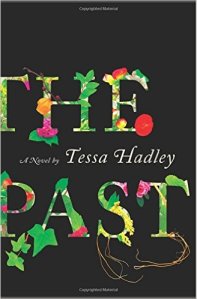
Then there are the local bookstore problems.  I mentioned last week that I could not find a copy of  Tessa Hadley’s The Past at an indie.  What I didn’t tell you was that I couldn’t find it at our local B&N, either.

Sigh.

So I bought the e-book.

Hadley’s The Past is very enjoyable.  Four siblings spend three weeks in the old house where they grew up, which is disintegrating yet redolent of enchantment and fairy tales.  The middle sister, Alice, 46, adores the cottage and  loves her grandmother’s letters, the beautiful china, and especially their childhood books.  She picks up a copy of E. Nesbit’s The Wouldbegoods and is transported to another time.

And here’s where I know I’m letting down the side by reading e-books.

The very weight of the book in her hands, and the thick good paper of the pages as she turned them, and the illustrations with the boys in their knickerbockers and the girls in pinafores, seemed to bring back other times–the time when she had first read this, and behind that the time when such children might have existed.

Heavens, E. Nesbit was my favorite writer when I was growing up.  I even know those illustrations by H. R. Millar!

So what am I doing with these e-books?

Well, it’s modern life.  What can I say?
Nancy Hale’s The Pattern of Perfection

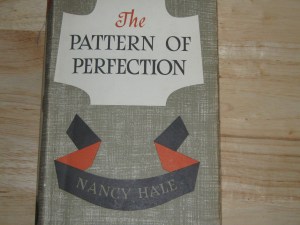
IMG_3576Nancy Hale‘s work is out-of-print, but she is a great American writer.

Some of her books are masterpieces.   A descendant of Harriet Beecher Stowe, she was a journalist, novelist, and memoirist. Eighty of her stories were published in The New Yorker.  I am a fan of her comical novel, Dear Beast, the story of a Southern woman who writes an anonymous novel about her small town, and her stunning memoirs, A New England Girlhood and A Life in the Studio.  In 2012, a collection of seven of her short stories, along with critical essays on her work, was published,  Nancy Hale: On the Life & Work of a Lost American Master.

I recently read The Pattern of Perfection, a collection of 13 stories.  I have 10 sticky notes marking the pages of my copy, not for criticism but because the passages are delightful.

In my favorite story, “The King of Fancy’s Daughter,” the heroine, Isabel Congdon, takes out the trash and catches her husband in the driveway embracing the “bosomy, perfumed Mrs. Clarity, the baby sitter.”  She puts the two children in the car and drives hundreds of miles to her parents’ house.  On the way, she keeps going over and over her conversation with her husband.   When she said, “I suppose you’ve been having affairs with everyone in the neighborhood while I’ve been totally unaware of anything,” he denid it.  But he asks coldly if they always have to talk baby talk.  She is shattered, because she had felt their little family was united against the world.

Her well-bred parents behave as though there’s nothing unusual about Isabel’s visit.  They talk about their collections of antiques and books.  Mr. Hooper has begun collecting science fiction.

“Space travel,” Mr. Hooper repeated, laying down his knife with a gratified air.  “Those chaps are doing extraordinary things.  Bradbury.  Asimov. Leinster.  I’ve made rather a study of science fiction in recent months.  I fancy I own everything in the field worth reading–a very sound investment in firsts,” he added modestly.

Isabel discovers that her parents’ marriage is imperfect, too: they have separate bedrooms.  But she cannot get rid of the image of her husband and Mrs. Clarity.  Nothing is decided.

In the brilliant story, “In a Penthouse,” Bernadine has a vague undiagnosed illness that prevents her leaving their New York penthouse to follow her husband to Michigan.  The dialogue in this story is priceless.  “Oh, hon,” she cried.  “Don’t I just wish I could?  But I just don’t dare go that far.  Doctor Lewis says I should continue to play it cautious and conservative.”  Doctor Lewis does not believe her husband loves her, but Bernadine is rightfully secure.  By the time Doctor Lewis asks her out, Bernadine has figured out she wants to fly away.

In “A Summer’s Long Dream,” Penelope and her mother and aunt spend a month in the late Miss Carrie Lennox’s summer cottage, The Ledges.  Penelope spends most of her time cooking and administering medication to the old people. At a garden party, the old people bloom, but poor Penelope becomes involved in an impossibly complicated explanation of how they come to be staying in the house when Miss Carrie Lennox is dead.

These stories are great fun, and the best are great.

A Walk on the Wild Side

The Bookworm in Omaha is one of our favorites.

The Bookworm in Omaha is one of our favorites.

I shop at Amazon and Barnes and Noble, but I would like to be a cool person who shops at independent bookstores.  For years we’ve been told indies are better.  Writers prefer indies to corporations.  All right! Go, writers!  Obama shops at Politics and Prose.  Hurrah, I voted for him twice!

But take a walk on the wild side in the Midwest.  You won’t find what you’re looking for at indies (if they exist at all) in:

a) Cedar Rapids, Iowa (where you can smell  the Quaker Oats factory when the wind is right )

b) Cedar Falls (a university town)

c) Des Moines (the capital of Iowa, sometimes called “Dead” Moines)

e) Mankato, Minnesota (Maud Hart Lovelace’s hometown, known as Deep Valley in the Betsy-Tacy books)

I took a walk today.  My brain told me I would be able to buy Tessa Hadley’s The Past at the local indie. Everybody is reading Hadley, right? She was interviewed in the “By the Book” feature in The New York Times.

So I took a brisk walk and then burst into the bookstore, in the space that used to be Hair Ph.D.

AND THEY DID NOT HAVE IT.  Nor did they have Elizabeth Strout’s new book, My Name Is Lucy Barton.  So I said I was browsing.  I finally bought a paperback.  I’ll read it eventually, I suppose.  But the sad truth is that I should have gone to  Amazon or B&N.

God, I miss bookstores!

I could make a list of dozens of great bookstores that went under in the ’90s.  (And I miss Borders.)

Sorry, I have to wait till I go to Omaha or Iowa City, London or New York,  Washington or San Franciso, to support independent bookstores.  I tried!

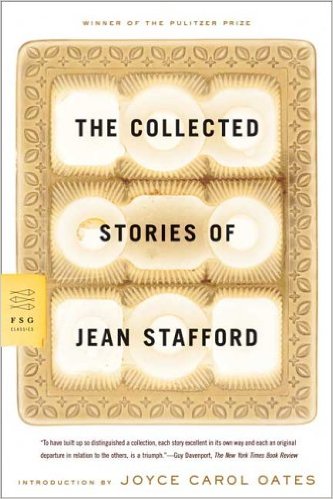
The Collected Stories of Jean Stafford

jean stafford the collected stories 51VK74FJJ8L._SX331_BO1,204,203,200_

I love The New Yorker.  I always look forward to the fiction.  Stars rise and fall. I wonder whether even  publication in The New Yorker can ensure a writer’s future.

Jean Stafford is a neglected New Yorker writer.  Her books are still in print, but her name is seldom mentioned.  One of her stories, “The Interior Castle,”  was anthologized in The Best American Short Stories of the Century, edited by John Updike, but she is missing from the new anthology, 100 Years of the Best American Short Stories, edited by Lorrie Moore.  Stafford died in 1979, so  perhaps we have to skip back a few generations to find fans of Stafford.

The Collected Stories of Jean Stafford won the Pulitzer in 1970.  I love her work. I used to drink coffee and read her stories  as I sat on the bank of the Iowa River behind my (now defunct) high school.

IMG_3577

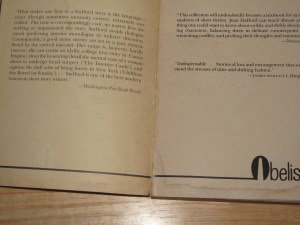
Scotch tape is the answer: the pages are loose!

Stafford’s stories are Jamesian, powerful, comical.  How can such a brilliant writer be so little-known?

The masterly stories in her Pulitzer-winning collection were published between 1944 and 1969.  It was the era of the polymath, of  a love of arcane multi-syllabic words.  These perfectly-wrought stories, set in Europe, New England, and the West, are  both subtle and shocking; her descriptions and dialogue are precise and pellucid. Does she go too far for our pseudo-sensitive smiley-face sensibilities?  Are her  New England spinsters too rich, mean,  and snobbish for the modern reader?  Is the shocking culture clash between Americans and Germans after Nuremberg  too graphic? (It is a horrifying story.) Are the pretentious teachers with new master’s degrees too condescending?  (Yes, they are, but that’s so realistic!)  Is the obese philology student in Heidelberg too monstrous:  she eats whole cakes,  uses a sucker as a bookmark, and ominously talks about a dead thin twin.  ( I’m fat, and not at all offended!)  What about the cruise captain who exaggerates his racial prejudice (or does he?) to tease a liberal young woman described as “a natural victim”?  (At the end,  she is far from a victim.)  These characters are vividly portrayed, realistic,  and are sometimes as obnoxious as people we know in “real life.”

Rereading Stafford’s stories is a delight. In the Jamesian story “Life Is No Abyss,” Lily, a young woman whose pilot parents ironically died in a plane crash, is scandalized by a visit to 80-year-old Cousin Isobel in the poorhouse.  Lily has vivid memories of Isobel and her ancient father, the Judge, entertaining the whole clan in their rich, elegant North Shore summer house.  Yhe elderly Cousin Will, described as “the worst and most ingratiating investor who had ever lived,” has ruined Cousin Isobel through bad invesments, and she insists on living in the poorhouse to get revenge.  She refuses to move into the apartment on Will’s renovated third floor, or the even more opulent apartment in rich Cousin Augusta’s house.

Cousin Isobel is hilariously, if nastily, eloquent.  She is as astute as a social worker when she desribes the conditions of the poorhouse  where she doesn’t have to live.

“The whole place is a scandal. It is a public shame.  If they would give me pen and paper–don’t ask me why they won’t, for their regulations are quite incomprehensible to my poor brain–I would write to people in high places, where I daresay the name the name Judge James Carpenter has not been forgotten.  I have never gone in for seances; I have never been taken in by the supernatural; if she telephoned me personally, I would not believe that Mary Baker Eddy was ringing up from her tomb in MOunt Auburn Cemetery.  But I swear I know that good man, the august Judge, turns in his grave when his immortal soul considers where I am.  He never liked Will Hamilton.  Small men are shifty.”  Before arthritis had shortened her, Cousin Isobel had stood six feet in military heels.

I love these stories.  My copy is starting to fall apart, though.  The cover is torn and the opening pages are loose!  I’ll have to find another copy after this reread.

My Tablet’s in the Next Room!

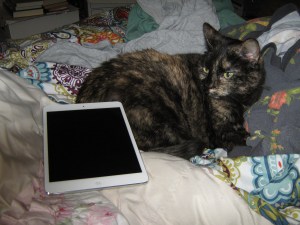
Cat with IPad!

Cat in nest of sweatshirts, with IPad!

I have no idea where I am, but my tablet might.  Call it Siri.

As you know, I am far, far behind the electronic gadget curve.   I have a land line, a laptop, and an e-reader, while you have smart phones, iPads, and whatnots.

And now I, too, have acquired a whatnot.   I bought an iPad because my old Nook tablet died.  Now I can fly with the  blasé travelers who  keep their library and office on the same small machine!

The Nook was primitive, as tablets go.  I bought it in 2011 when my mother was in the hospital in Iowa City. During a blizzard, the phone and TV went dead at her house.  The wind howled unnervingly while I tried to read in my old bedroom.  We had 15 inches of snow, and  I felt as isolated as a character in a Laura Ingalls Wilder book.  When I finally made it to the hospital, climbing over snowbanks and falling on the ice several times, I uttered a sigh of relief because there was wifi.

After the blizzard in Iowa City, Wednesday, Feb. 2, 2011

After the blizzard in Iowa City, Wednesday, Feb. 2, 2011

And now, lo and behold! I now have a small  iPad that can do everything:  take pictures (but I already have a camera), navigate via Siri (but I prefer maps), find my iPhone (but I don’t  have one!), surf the web, play R.E.M. videos, and has Kindle, Kobo, the Nook, and iBooks apps.

It can almost do too much, you know what I mean?  I keep it in another room so I don’t constantly go online and check out a link….and then another link…  A dedicated e-reader is better for reading e-books, if the internet tempts you too much.  But the iPad is a sleek machine, and it will be lovely for travel.

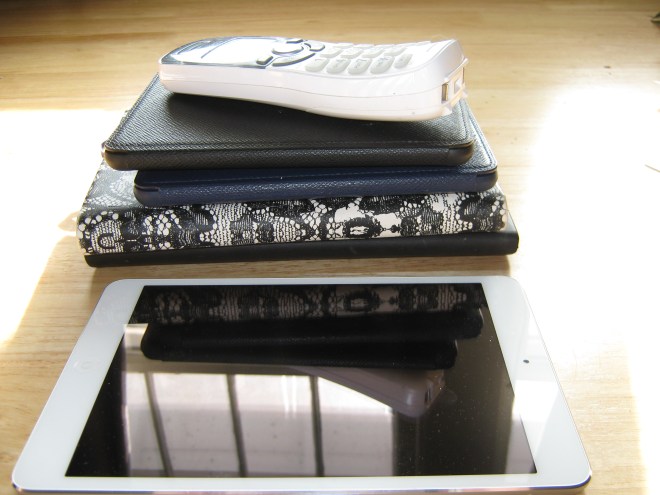
I am a Luddite by some standards, but we have many gadgets (some alive, some dead).  Check out this picture of portable “apparati,” as Gary Shytengart calls electronic gadgets et al in his comic novel, Super Sad True Love Story.   Alas, where are the antiques? Our Sony Reader and a palm pilot are missing…

Some of our gadgets!

Some of our gadgets!  (Yes, that’s a real landline phone on top!)

A Short, Nearly Perfect Book: Ruth Prawer Jhabvala’s A Backward Place

a backward place jhabvala 81295_320In the twentieth century, many classics were only 200-300 pages long. Think Barbara Pym, Eudora Welty, and Peter Taylor.

Then, suddenly, in the twenty-first century, books started getting longer.  I love Hilary Mantel, but her historical novels are doorstops.  And, according to a study by James Finlayson of Vervesearch, the length of books has increased by 25 percent, from 320 pages in 1999 to 400 pages in 2014.

And hence my inauguration of  a new  “Short Book of the Week” feature: today’s post is on the underrated writer Ruth Prawer Jhabvala’s A Backward Place.

Ruth Prawer Jhabvala ph_0111204734-Jhabvala

Ruth Prawer Jhabvala

Jhabvala (1927-2013), who is best known for winning the Oscar for her screenplay of Howards End, also won the Booker Prize in 1975 for  Heat and Dust, a luminous novel that alternates the story of a young English woman in India in the 1970s with that of her grandmother, Olivia, a rebellious English wife of a civil servant who caused a scandal by challenging the mores of colonial society.

A Backward Place, a brilliant comic novel published in 1965, is another masterpiece.  Set in Delhi, it delineates the connected lives of several expatriates and their Indian friends and spouses.  Every beautifully-crafted sentence is  evocative of character and place.

At the center is Judy, the English wife of an aspiring Indian actor.  Judy rather  harriedly works as a secretary to support Bal and their two children. While she struggles to pay the bills, Bal hangs out in coffeehouses and dreams of becoming a movie star.  They share a house with Bal’s brother and his wife, Shanti, to cut expenses.  And they have taken in an impecunious widowed aunt, who has moved from family to family.

Judy is content in India:  she doesn’t miss her life in England, where her father worked in a factory.  She fell in love with Bal at 17.  She hangs on fiercely to her job at the Cultural Dais, a society that sponsors lectures by writers and academics. (Jhabvala’s witty descriptions of the tedium are hilarious.)  Judy is an assistant to the General Secretary, Sudhir Bannerjee, who conspires with her to cover up her mistakes.  When Sudhir, an intellectual who thinks he is wasting his life, talks about leaving Delhi, she is terrified.  She doesn’t think she could keep the job without him.

Many of her expatriate friends are richer, more urbane, and more carefree than she.  The novel opens with her sophisticated Hungarian friend,  Etta,  eating a cream cracker in bed and lecturing Judy on why she should leave her husband. (Etta has had a few husbands and many lovers of her own.)

“My dear Judy, you’ve made a mistake… but if you would only face up to it and get out before it’s too late.”

Judy  loves Etta . Still, there are limits, even when you have a sense of humor.

Judy was tempted to say that it was already too late (after all, she had been here nearly ten years and had two children) but she refrained, because she knew Etta didn’t care to have her assertions contradicted.  And anyway, as far as Judy was concerned, the discussion was purely theoretical, so she didn’t mind much what was said.

Etta has some money and a beautiful European apartment, but her relationship with a rich  Indian hotelier is waning and she is panicked.   Clarissa, an English expatriate, scorns her upper-class family in English and lives in a filthy little room in Delhi, but frequently visits rich friends.  She, too, is terrified when she learns she is about to be evicted.  Mr. and Mrs. Hochstein, a German couple who are living in India for only a couple of years, have a secure perspective:  they don’t expect too much from India, because they don’t have to stay.

Much of the novel revolves on the founding of a  theater group.  Bal had the idea, but lost interest after a visit from a film star friend from Bombay.  And so the theater group comes into being without Bal, and with a minimum of talent..

It is, oddly, the Indians who want to leave Delhi, while Judy wants to stay.   Bal wants to be a film star in Bombay, and Sudhir wants to teach in a backward place.   It is English security vs. Indians’ dreams and taking chances.  Who in the end is right?

Really a stunning novel, with an unexpected ending!  The details are minuscule, unexpected, and crystalline.  And the theater group’s production of Ibsen’s A Doll’s House is quite droll.

I loved it. I look forward to reading more Jhabvala!

The Cats’ New Toy & Three Literary Links

IMG_3541

“Books are fine,” the cat said before the electronic mouse came to stay.

The cats have everything.

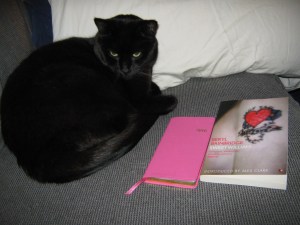
A pink 2016 calendar with a ribbon bookmark, a copy of a Beryl Bainbridge novel,  and their own personal  couch with a furry slipcover!

What more can they want?

While my husband was away on a business trip, I became their cat. They insisted on “Modern Family” reruns from 6-6:30, a lovely dinner of Whiskas, and then requested Shawn Colvin.  They prefer “Sunny Came Home” and “Window to the World!” to alternative rock.  Who knew?

Okay, we were fine.  I was a little tired after they figured out how to open the bedroom door, but then I barricaded the door.  I was in charge!

And then…

A friend brought a gift for them.  It is an electronic mouse, attached to a piece of yarn on a stick.  When you swing the stick, it chirps and its eyes blaze electronically.  I’m scared to death of it!

The cats want to see it move all day long!

Reading?  No way, Mom.

Play with the mouse! they say.

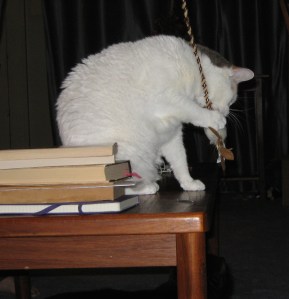
Cats with new electronic mouse!

Cats with new electronic mouse!

I’m not sure I approve of electronic toys for cats.  Is this how my mother felt about Chatty Cathy, the talking doll?  I pulled the ring over and over so she would chat:    “I love you,” “Can I have a cookie, “Take me with you” all day long!

And the mouse?  Chirp, chirp, chirp!

Moby on coffee table with mouse


Only the white cat is truly enthusiastic.  The others are slightly apprehensive.  They just like to watch the white cat play with it.

I plan to reinstitute kitty soccer this weekend.  I’m sure the plastic balls with bells in them are somewhere…

AND NOW FOR SOME LITERARY LINKS!

1 I enjoyed D. J. Taylor’s article in The Independent, “How the Books We Read Shape Our Lives.” He discusses the importance of the books we  read as children and muses on how our tastes develop.

…the sociological questions that lie behind what might be called the origins of the literary sensibility are a great deal less easy to answer. How do people learn to read? How do they fashion their own individual tastes? How do they establish why they prefer one type of book to another type? Where do they acquire the information that enables them to make these selections, and, having acquired it, what do they do with it? After all, there are no hard-and-fast rules about aesthetic choice and how it operates: it was Anthony Powell who, presented by an admirer of his novel sequence A Dance to the Music of Time with an ornamental clock on which the names of Poussin and Proust had been engraved, truly remarked that books “have odd effects on different people”.

2 In The New York Times, Michiko Kakutani reviews Tom Holland’s Dynasty: The Rise and Fall of the House of Caesar, a fascinating history I immensely enjoyed and do plan to write about eventually. She writes,

Mr. Holland, the author of “Rubicon,” about the last years of the Roman republic, writes with great authority and relish. His book is less analytic and less panoramic than “SPQR,” Mary Beard’s excellent recent history of ancient Rome. By confining his study largely to the Julio-Claudians (as the dynasty of Augustus is conventionally known), Mr. Holland gets to tell the story of Rome through a series of portraits of some of its most notorious emperors, immortalized in seminal works by Tacitus and Suetonius as larger-than-life autocrats and monsters.

3 In The Weekly Standard, Joseph Bottum writes about Michael Dirda’s new book, Browsings.

… Michael Dirda is a reader, down at the root of his being. A man who gained his scholarly knowledge and critical sensibility from reading whatever came to hand as he pawed through the dusty shelves of used bookstores. Writing—well, yes: If you’re going to keep from starving as a reader, you’ve got to find a bookish job, and writing is one of the possibilities, especially writing book reviews. He is, really, only what he claims for himself: Bookman, plain and simple. “An appreciator,” he adds, “a cheerleader for the old, the neglected, the marginalized, and the forgotten. On sunny days I may call myself a literary journalist.”

Enjoy the links!

A Use for the London Review of Books & You Can’t Be a Snob in a Caucus State

IMG_3538

The other day, I  found a use for the London Review of Books.

We like to keep the LRB in the plastic sleeve until it’s time to recycle it.

“Please get that out of here,” my husband says every time it arrives.

“There must be something in it,” I said.

Oddly, there was nothing that interested us.

According to VIDA, the LRB is London’s most sexist intellectual bimonthly review. And, indeed, much as I want to believe I am a chrone beyond gender, I can only find it in my heart to read one really famous sexist London publication a year. (We prefer the  TLS, which does a stupendous job covering classics and literature in translation.)  Last year in the LRB, I plowed through a few of Jenny Diski’s spiteful essays on Doris Lessing and an unbelievably sexist article on Hillary Clinton.  As you  see, I favor articles by or about women.  Essentially, the only regular woman writer in the LRB is Diski.

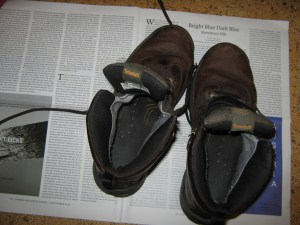
Tired of cold boots, I finally had an LRB brainstorm.  I brought the boots in from the mud room and plopped them on top of the LRB to dry.

Yup, our year’s free subscription was not for nothing.

caucus 43rd_Legislative_District_Democratic_Caucus_1

                                  Democratic Caucus, 2008

THE CAUCUSES.  We’re gearing up for the Democratic Caucuses here. It’s the Olympics of the hinterlands, only it’s political!  And there’s nothing else to do here in the winter.

Only thirteen states have caucuses: Alaska, Colorado, Hawaii, Kansas, Maine, Minnesota, Nevada, North Dakota, Wyoming and Iowa. The rest of the states  have primaries.  I favor the secret ballot, but live in a caucus state.  We’re raising hands in school gyms here.

The caucuses are a lot of work.  Are you sociable?  You’ll love it.   You mill and throng with fellow Democrats (or Republicans, if that’s your preference) at a designated location in your precinct on a winter’s night, usually a school auditorium or church.  You chat and drink a glass of cider (we Democrats are hip and that’s what we serve),  and then you stand up for your candidate, and there is a count of heads or hands.

I went to the caucus in 2004,  and we spent a lot of time persuading one of our fellow Howard Dean supporters not to go over to the “dark side,” i.e., John Edwards.   “If you go, Dean’s out of the running,” we pointed out.  And so she stayed, though she wanted to hang with her friends, and Dean, by one vote, came in third.  That was John Kerry’s year, though all the magazines said the polls favored Dean.

Hillary is said to be a sure bet this year. Do the polls know?  My mother loved Hillary and hoped to see her elected president. Hilary is a hard worker, if a bit uncomfortable at times, and I have always liked her.   I think she should have won the Nobel Peace Prize for her work as Secretary of State.  (Obama won it in 2009, essentially just for being elected.)

Actually, I don’t want to go to the caucus.

If I go, I am not sure whether to vote for Hillary or Bernie. They have the same stances on most issues, but he is slightly to the left.  And I love that “socialist” and “social democrat” thing he has going.  (Read the blog at The New York Review of Books for information on his views.)

I’m a Socialist in theory, though I never vote socialist.   In reality, I’m  a liberal Democrat. I vote Democrat, because you throw away your vote in a presidential election if you go third-party.

I am astonished by Bernie’s popularity here.  There are throngs of Bernie signs in our neighborhood.  I have seen a couple of Hillary signs and a couple of  Trump signs, but nothing for other candidates.  This is, however, a liberal precinct.

I would like to see a woman elected president.  Feminism is very important to me.   Am I beyond gender, or am I not?

I am torn. I like both candidates.  (I am sure O’Malley is going nowhere here.)  If it were a primary, I would vote, but the caucus is a lot of work.

Whether I go to the caucus or not, I will vote for the Democratic candidate in the election in November.

You Look Good!

We're not Holly Golitely!

We’re not Holly Golitely!

“It’s me,” I said.

It is not that my father has dementia.  It’s that I’ve grown older.  My hair is wild and completely white.

You look good,” he said.

I thought, Well, finally, Dad.

“You look good” is what we women deserve.  We are not Holly Golightly and we don’t breakfast at Tiffany’s.  A few years ago, my family gathered at a small-town cafe, the kind that serves chicken-fried steak and homemade pie. We all had the special (chicken-fried steak) except a second cousin I barely know. He bizarrely told me, “You could be on The Biggest Loser.”

My dad laughed and sneered.

So that’s what you really think of me, I thought calmly.  Here they were, two older men, not prizes themselves, and they thought they could judge me on my weight.  “That’s enough,” I said.

Ten years ago I gained a LOT of weight after being prescribed a medication.  So go ahead, judge me.

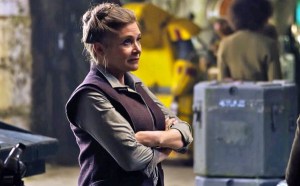
Women are judged on their looks, whether they are thin or fat, young or old.  Take Carrie Fisher, age 59.   Since appearing as General Leia Organa in Star Wars: The Force Awakens, she has been under fire for her looks.  Here’s what I want to know:  what’s wrong with them?

Carrie Fisher as General Leia Organa in "Star Wars: The Force Awakens"

Carrie Fisher as General Leia Organa in “Star Wars: The Force Awakens”

She lost 30 pounds for the film. If she hadn’t, think what they’d say.  In an interview with Good Housekeeping, she said, “They don’t want to hire all of me — only about three-quarters!  Nothing changes, it’s an appearance-driven thing. I’m in a business where the only thing that matters is weight and appearance. That is so messed up. They might as well say get younger, because that’s how easy it is.”

And then Kyle Smith, a New York Post columnist, attacked her for complaining about the weight loss.  He said it was a health thing.  Uh huh.  That’s what the studio wanted.  Health.  (Yup, take away my med with weight gain side effect, and you’ll see health–ha.)

He writes,

No one would know the name Carrie Fisher if it weren’t for her ability to leverage her looks. George Lucas only cast her in the first place because she was young, slim and cute at the time. (She turned out to be a talented writer as well, but it’s an open question whether the second career would ever have gotten off the launch pad without the fuel provided by her first. Mostly she has written about what it’s like to be Carrie Fisher.)

Good God, that’s so creepily sexist! If you don’t like Star Wars, try Hannah and Her Sisters. I am a Star Wars fan, but  I wouldn’t have bothered with the enjoyable new film if not for Fisher and Harrison Ford.  It is fun, fast-paced, and clever, almost as good as the originals, and Carrie Fisher and Harrison Ford are charming in their interactions with the new generation of actors.  I only wish Fisher had a bigger role.  (Maybe next time.)

I’m not one for Twitter, but I liked Fisher’s tweet in response to The New York Post:

Ok, I quit acting. NOW,can I not like being judged for my looks?Tell me what to do & who to be, oh wise New York post columnist.u GENIUS

That reminds me. It might be time to reread Fisher’s remarkable novel, The Best Awful, a sequel to Postcards from the Edge.  It is brilliant, hilarious and grimly truthful in its portrayal of addiction and madness. When  Suzanne’s husband, a Hollywood studio executive,  reveals he is gay and leaves her for a man, she decides to go off her meds. It is a tragic trip.  But it does end well eventually…

Read it!

Nancy Hale’s The Prodigal Women

Nancy Hale

               Nancy Hale

“I specialize in women, because they are so mysterious to me. I feel that I know men quite thoroughly, that I know how, in a given situation, a man is apt to react. But women puzzle me.”–Nancy Hale in an interview at The New York Times.

I am a great fan of Nancy Hale.

Never heard of her?  Her  work is out of print.

Not for long, though.

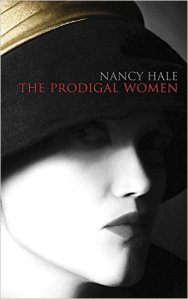
In September, Dover Books will reissue her 1943 bestseller, The Prodigal Women.

Raised in Boston, Hale was the daughter of two painters, Philip L. Hale and Lilian Westcott Hale, and a descendant of Harriet Beecher Stowe.  She escaped from stuffy, WASPy New England to New York and became a journalist, novelist, memoirist, and short story writer.  (She was the first female reporter at The New York Times.)  A few years ago I discovered her work in an anthology , Short Stories from the New Yorker, 1925 to 1940.   I became an avid reader of her work.  My favorites are the brilliant novel, Dear Beast (which I wrote about here),  and her stunning memoirs, A New England Girlhood and A Life in the Studio (which I wrote about here and here.)

Fortchoming Dover edition

Fortchoming Dover edition

I very much enjoyed The Prodigal Women.  It is unputdownable, the equivalent of a text munchie. Want to read and read until you forget it’s fiction?  Imagine a fusion of Mary McCarthy’s The Group, Dreiser’s An American Tragedy, and Jacqueline Susann’s Valley of the Dolls.

Set between 1922 and 1940, this well-written blockbuster vividly portrays three very different heroines.  Leda March, the intellectual daughter of a well-to-do Boston family, is friendless and longs to fit in with other girls:  she is victimized first at the Country Day School in Hampton and later at a girls’ schools in Boston.  Her life changes when the Jekylls, a Southern family, move to Massachusetts because Mrs. Jekyll wants culture:  the youngest daughter, Betsy, takes Leda under her wing,  and both adore her lovely older sister, Maizie, who is surrounded by men.

As the girls grow older, their interests diverge.  Leda, who once wanted to be a debutante, rebels and moves to New York, where she becomes a successful writer.  Did Hale chose the name “Leda March” as a riff on Jo March, the tomboy writer who eventually settles for a middle-aged German professor?  Leda will never settle.

Maizie could marry anyone, but  becomes obsessed with Lambert, an artist, and entraps him in marriage.   Poor Maizie! Once she is married, Lambert becomes sadistic.  He insisted that she have an abortion in South America on their honeymoon, and Maize never quite recovers. She loses her health and spends time in mental hospitals.  Even Lambert admits he ruined her life.

But Leda doesn’t give a shit.  She  wants Lambert.  Boy, does she want him!  Since Maizie has become a frump, Leda thinks it’s fine to steal her husband.

Betsy is the most normal: a fun-loving young woman with an active social life in New York in the ’20s.  Then, unfortunately, she moves in with, and then marries, an abusive failed writer who wants a mother figure.   Betsy is strong enough to rise above domestic problems, but the situation is dire.

Are no men good enough for these women?  Hale wasn’t afraid to vilify male characters.  Nor are the women saints.

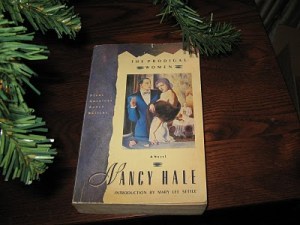
I am hesitant to call this a feminist novel, though some of the characters are feminists.  The writer Mary Lee Settle, in the  introduction to the 1988 Plume paperback of The Prodigal Women, explains it most clearly.

Plume paperback edition.

Plume paperback edition.

Settle writes,

It is too easy to categorize it as an early feminist novel.  It most certainly is “feminist”–though the use of that word is far more “contemporary than the book itself–but it follows the tradition that existed long before women began using a self-conscious langauge in their appraisal of where they were  and what they wanted.  …  [Nancy Hale’s] female revenged are as ancient as Medea or Electra.  But neither does she condone the excesses of “feminine wiles.”  These, too, are punished–terribly.

The ‘feminist’ novel, if that is what is meant by novels where men are interpreted in less than heroic manner, goes back to the great classics by women. The list is formidable: George Eliot’s Middlemarch, where Dorothea’s choice between Casaubon and Will Ladislaw is hardly a choice, and which is enough to frighten any sensitive woman out of marrying; Ellen Glasgow’s Jason Greylock in Barren Ground, the author’s terrible revenge on Southern men for losing the Civil War and drinking too much; Edith Wharton’s Newland Archer in The Age of Innocence; Willa Cather’s Jim in My Antonia. Here they are–strong women, frail men–a genre, a tradition, and a revenge for all the natural insults that female flesh considers itself heir to. Like these great women novelists, Nancy Hale’s women are more alive, stronger, both more sympathetic and more destructive than her men.”