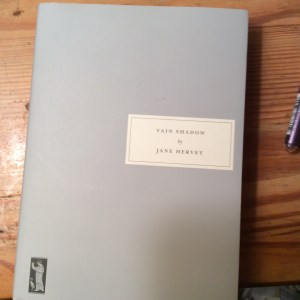
Musings on Jane Hervey’s Vain Shadow & a Giveaway

imageLast fall, after a trip to the Persephone store,  I read Jane Hervey’s Vain Shadow.   I did not take notes, because I was at a Costa Coffee at Trafalgar Square, slightly distracted by a German couple’s argument about “geld,” i.e., money.  (I sympathized, because they were buying big, expensive coffee drinks. COFFEE ADDICT’S TIP:   stick with the black brew or you go broke.)

Vain Shadow, written in the ’50s and published in 1963, is the story of a family funeral.  The prose is spare and lean, and the story goes at a rapid clip. At first I was uneasy with the truly horrible characters. Four members of the Winthorpe family have slept through the night, leaving Colonel Winthorpe to die upstairs alone with a nurse. Does it seem heartless?  Yes, because they knew he was dying.

Upjohn, the maid, brings Mrs. Winthorpe the news of her husband’s “peaceful” death along with the morning tea tray.  He died in his sleep at 2:30 a.m. Mrs. Winthorpe is relieved she’ll never have to kiss him again.

She tells Upjohn:  “And you’d better tell Mr. and Mrs. Jack and Mr. Harry when you call them…that it’s all over.”

Good God!  I  had never heard of anything quite like that, though there is usually some ugliness and bad behavior before a death. Even in dysfunctional families, somebody usually keeps watch on the dying, or at least personally breaks the news to relatives. (Of course, my family being what it is, they e-mail.)

Jack is the oldest son, an artist who was threatened with disinheritance by the crusty colonel.  He is irritated by the maid’s use of the phrase “passed away,” and wonders why women can’t say “died.” His much younger, lower-class former actress wife Laurine was terrified of “Father” and is relieved he’s dead.  She is naively sure that Jack will be a rich man and they will be able to afford a maid and a car.

A younger son, Harry, who seems slightly OCD, is a stay-at-home bachelor who loves to crochet. He takes charge of the funeral, and he knows he’ll be getting money. But their brother Brian, whom they delay calling, is furious, not because he wasn’t telephoned right away, but “because they had all gone trooping off to bed, calmly and obliviously sleeping while the Old Man died. And if that was not bad enough, they had actually not even allowed themselves to be disturbed by having the news broken to him that he had died.”

As you can imagine, Brian is one of my favorites, because he is at least human.  And he takes over the funeral, being the only one who knew their father wanted to be cremated.
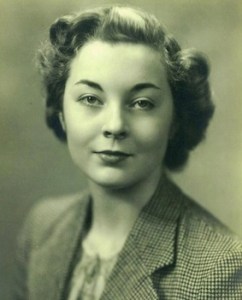
Jane Hervey

Jane Hervey

But the most truly sympathetic character is Joanna, the rebellious granddaughter who is determined to leave her psychologically abusive husband, Tony, for a man she loves.  She realizes her cruel grandfather twisted her notions of love, and that’s how she ended up with Tony.  Harry admires Tony, who is charming on the surface and has come whining about Joanna’s affair.  Harry hopes to tie Joanna to Tony by tightly controlling the money left in trust for her. The colonel’s twisted authority may continue.

This harsh comedy portrays the ugliness of a death in a family where most are focused on money.  It is starker than appalling but comic scenes you’ve probably read, like the quarrel in War and Peace over Count Bezúkhov’s will (two women tug at a portfolio in angry silence) or the rage in Middlemarch over Mr. Pennyworth’s will. Vain Shadow is a desperate black comedy–desperately realistic and horrendous.

Much as I admired this very solid, well-written little book, I will not reread it.  Hervey is quietly effective, but nowhere in the class of Isobel English, whose stunning Every Eye I also purchased at Persephone and read last fall.  (I wrote about it here.)

And so I am giving away my copy of Vain Shadow.   If you would like it, leave a comment or email me at mirabiledictu.org@gmail.com
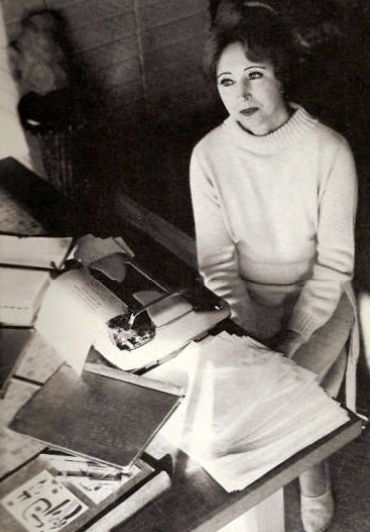
The Typewriter vs. the Computer

Anais Nin with her Olympia typewriter, 1963

Anais Nin with her Olympia typewriter, 1963

WordPress stats tell me how many readers I have at Mirabile Dictu and whence they hail, mostly from the U.S., UK, and Canada.  The stats are not invasive, as they are at some blog platforms:  they refrain from recording every move your readers make and give you more privacy.  I assure you, I have no idea who you are.

That’s because most of the stats pertain to my own writing. I idly looked at them tonight:  I have written 872 posts in three years.  Oh, dear, I was startled by that stat.  Surely I could have written a book in that time.

Why don’t bloggers write books? Look at Ree Drummond at the Pioneer Woman:  her blog is  fun, she writes cookbooks, and she has her own cooking show. But her chatty style works better at her blog than in her humorous memoir, The Pioneer Woman: Black Heels to Tractor Wheels–a Love Story.  The humor at the blog, complemented by glossy pictures of the ranch in Oklahoma, her husband (Marlboro Man), children (homeschooled,) and dogs, seems more natural..

I’m not Pioneer Woman;  I’m a city gal!  I’m not that amusing. I’m not looking at cows, I’m not photographing my beagles, I don’t have any beagles, and  I’m in the house playing string with the cats.  String is the only game they’ll play  now.  I’ve rolled their  “busy balls” (plastic balls with little bells inside) across the floor and tossed their small stuffed animals in vain.  They lie on their sides and watch ME play.  Most embarrassing.

Essentially this is a book journal, not a collection of reviews. I jot my impressions of books and bookish subjects. Occasionally posts are review-ish, but not reviews. I  type some notes, I revise a little, and then I post the same day.

But I do wonder if I shouldn’t have been working on something else.  Do you ever feel that you were better on paper?  In school my notes were intercepted by a teacher who laughed and read them aloud. She said she thought I could be a journalist.  (And I did that for a while.)  I switched from writing by hand to a typewriter when I got a Smith Corona for my birthday. I typed on manual typewriters and, later, electric typewriters until I was forced to abandon my Luddite ways for work.

Vintage typing image.

Vintage typing image.

I loved my typewriter so much I took it on vacation. Like everyone else, I worked on a novel. I finished it, but never tried to publish it, because it wasn’t good enough, though I could probably have cobbled it into what was then called chick lit. But I stayed in the hotel and read and wrote –by Day Two  I was into vacation reading form–and I remember how annoyed I was when I got home and discovered I had missed an assignment for an airline magazine.  That was before cell phones and computers and constant checking of messages.  On vacation we were more or less on vacation.

Here’s what I think when I go back and look at my early stuff:  my prose was cleaner and crisper.   Even the wordy typing exercise “The quick brown fox jumps over the lazy dog” was leaner than much of what’s on the net.

Our local newspaper now looks like a blog.  They fired all the senior writers or gave them early retirement and have hired young writers who turn in lists and photographs instead of articles. Their degrees are in something called Communication.  I don’t know if their editor has any experience in journalism.  Is there such a thing as journalism?  Often the front page of the features section is one huge picture with a couple of very silly paragraphs beneath.  And the real feature writers are publishing on the front page, presumably because there are no reporters left.

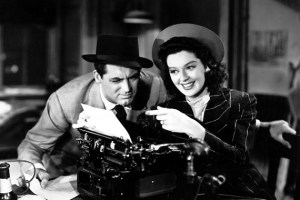
Cary Grant and Rosalind Russell work together on a story in "His Girl Friday."

Cary Grant and Rosalind Russell work together on a story in “His Girl Friday.”

And so I miss typewriters and the days of The Front Page and My Girl Friday.  Even though, I must admit, you’re in danger of losing your soul if you’re a journalist, because you write the same kind of stories over and over and then You Think You Know Human Nature.  (You don’t.)  My old typewriter is in the basement.  Should I get it out?  At least I’m not on the internet if I’m writing on a typewriter.

Naturally, I’m not the only typewriter aficionado.  (N.B. I’m not adding hyperlinks below, because I’m pretending I’m on a typewriter.  You’ll just have to hyperlink yourself. ) The award-winning writer Stephen Dixon, who uses a manual typewriter, told the Baltimore Sun that he typed only once on a word processor and hated it.  “I don’t like to work on anything electric. I feel creative on a manual. I love the keyboard action. It’s like playing the piano.”

Will Self said in an interview at Shortlist that he went back to using a manual typewriter. “I think the computer user does their thinking on the screen, and the non-computer user is compelled, because he or she has to retype a whole text, to do a lot more thinking in the head.”

And what do I say?  If I can find a working typewriter in the basement, I will experiment with writing the first draft of my blog on it.  Will there be a difference?  Who knows?

TYPE TYPE TYPE TYPE TYPE TYPE TYPE TATTA-TAT-TAT-TATTA-TAT-TAT

Quotation of the Week: Fifteen Dogs by André Alexis

Fifteen Dogs Alexis 23129923I recently read the Canadian writer André Alexis’s Fifteen Dogs, a poignant, witty novel that won the Scotiabank Giller Prize and the Rogers Writers’ Trust Fiction Prize last year.  I picked it up because I am fond of novels about talking dogs.

Do you ever wonder why books about dogs are sad?  (Novels about cats are not.)  And there are a surprising number of books about talking dogs, among them Clifford D. Simak’s science fiction classic, City, Mikhail Bulgakov’s Soviet satire, Heart of a Dog, and Carolyn Parkhurst’s fantasy The Dogs of Babel.

Fifteen Dogs starts as a comedy. Greek gods are unpredictable, as everyone knows, and in the opening chapter, Hermes and Apollo are out for a drink in Toronto.  Hermes wonders what animals would be like with human intelligence, and Apollo bets him a year’s servitude that any animal–any animal of his choice–would be unhappier with intelligence than humans are.

And so they randomly give the gift of intelligence to fifteen dogs in the kennel in the back of a veterinary clinic.  With their new intelligence, the dogs break out of the clinic and run through the streets of Toronto, forming a pack. But their new senses and language are confusing.  Prince, a mutt, loves it:  like Homer, he composes oral poetry. Atticus, the leader, starts an anti-language movement: he wants everyone to shut up and go back to being a dog.  But Majnoun, a brilliant black poodle capable of enormous love and loyalty, tells Atticus that  Prince thinks beautifully.

Majnoun struggled with the question and struggled with the thoughts within him. All sometimes seemed so hopelessly muddled. He wondered if Atticus wasn’t right, in the end. Perhaps it was best to be a dog as dogs had always been: not separated from others by thinking but part of the collective. Perhaps anything else was futile or, worse, an illusion to take you away from the good. But although their new way of thinking was bothersome –a torment at times –it was now an aspect of them. Why should they turn their backs on themselves?
–Someday, said Majnoun, we may know where the sky ends.
–Yes, said Atticus, someday or someday not.

Parts are humorous, parts are poetic–and parts are extremely sad. Of course I cried.  Beautiful language.

A Catch-Up Post: Gail Godwin’s The Odd Woman & Anthony Powell’s What’s Become of Waring

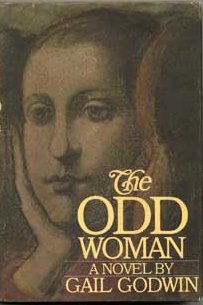
odd woman godwinOddI’m behind on writing about my reading, so this is a two-in-one. I recently reread Gail Godwin’s The Odd Woman, a brilliant novel about an English professor with an untenured job at a midwestern university,  and a first read of Anthony Powell’s What’s Become of Waring, a satire of the publishing industry.

1.  Gail Godwin, a Southern-born writer who won the Award from the National Academy and Institute of Arts and Letters in 1981, has been nominated three times for the National Book Award.  She should have won for her brilliant novel, A Mother and Two Daughters, a women’s classic which has never quite gotten its dues.

The Odd Woman, published in 1974, in many ways lays the groundwork  for A Mother and Two Daughters. The Odd Woman explores a woman’s academic and personal life: Godwin, who has a Ph.D. from the University of Iowa and taught at Vassar and Columbia before becoming a full-time writer, knows about balance.  Her sympathetic portrayal of a bookish heroine, Jane Clifford, a visiting English professor whose teaching contract is soon to expire, is utterly realistic. But what can Jane do?  Hers is the plight of thousands of instructors with Ph.Ds.

Born in the South, Jane is an odd woman at the midwestern college, single and in her thirties. Her married friend Sonia, a tenured professor, is in her corner, but there are no openings at the college.   And the rest of her close relationships are long-distance.  Her flamboyant best friend, Gerda, who publishes a radical feminist newspaper in her basement in Chicago, is impatient with Jane’s reserve and loneliness.  And Jane’s married lover Gabriel, an  ineffectual art history professor who lives in the next state and does endless research  (he is like Casaubon in Middlemarch, Jane eventually realizes) but never completes his book about the Pre-Raphaelites, is so timid that he insists she have a separate hotel room on a trip to  New York in case one of his colleagues figures out he is having an affair . And Gerda says that is typical of Jane, to fall in love with a guy with his head in the clouds who hides even in huge New York City.

Jane is in a state of stasis.    Can Jane change? She is terrified of change.  Reading is her life. She was happiest while holed up one winter 12 hours a day in a university library writing her dissertation on George Eliot.  Everything seemed white that winter, everything seemed pure.   What does that say about her? Jane wonders.  Even her relationship with Gabriel started with a  letter. Then her grandmother’s death and a visit to her mother, who has for years been happily married to an unintellectual construction contractor, forces her to examine the shape of her life and that of her mother and grandmother, wh0 raised her to be strong. Preparing to teach George Gissing’s novel about single women, The Odd Women, for a women’s studies class, also puts her life in context.  One of the reasons I enjoy this novel is that I love Gissing.   Every word Godwin writes is brilliant, even Jane’s notes on this classic.

Slowly and thoughtfully, she underscored “COMPROMISE-REBELLION AGAINST ONE’S OWN COMPROMISE-DEATH.”  Then she wrote quickly in the margin, beside Monica’s fate:  “Theme of literally dozens of 19th century novels–the ‘Emma Bovary’ syndrome.  Literature’s graveyard positively choked with women who chose–rather, let themselves be chosen by–this syndrome; also with their ‘cousins’–who ‘get in trouble’ (commit adultery, have sex without marriage, think of committing adultery, or having sex without marriage) and thus, according to the literary convention of the time, must die.

This is a great book, especially for fans of 19th century novels.

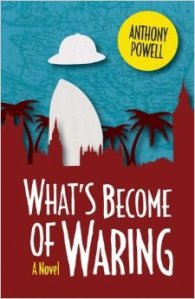
What's Become of Waring powell 51v7mwyiol-_sy344_bo1204203200_2  As a teacher at a prep school in the 1980s in a city I didn’t know, I divided my free time between running 10K races (there went Saturday morning) and browsing at bookstores (often on the same day, in the same clothes).  I’d never heard of Anthony Powell when I found a 12-volume paperback set of A Dance to the Music of Time at a used bookstore in Maryland.  I bought it for the charming covers, and read the whole thing addictively over the course of a week, laughing aloud at Powell’s wit.  I’ve gone back to it many times.

Although I had never come across Powell’s other novels, I recently added  What’s Become of Waring to my never-ending TBR list when it was mentioned in D.J. Taylor’s brilliant history of English literary culture, The Prose Factory:  Literary Life in England Since 1918 (which I wrote about here).  Waring is  a satire of the publishing industry, from the point of view of a detached narrator who works as an editor for a small publishing firm.

I started chortling on the first page of Waring.  It opens at a wedding.

As the parson was approaching the end of his discourse something flicked through the air and landed in my hat resting brim upwards on the pew beside me.  On examination the object turned out to be a page torn from the service paper, folded several times and inscribed in pencil: Put all your money under the seat or I’ll drill a hole through you. It was signed, Red-Handed Mike above a skull-and-crossbones.

It turns out to be his old friend Eustace Bromwich, back from traveling in the Near East.   We learn that the narrator used to work in advertising but is now at the publisher Judkins & Judkins.  The witty repartee never stops.

“Whom do you prefer?  Judkins? Or Judkins?”

“Judkins, emphatically.”

The best-known writer at Judkins & Judkins is T. T. Waring, a best-selling travel writer whose addictive style and thrilling adventures keep the firm afloat.  The amusing Eustace, who has also traveled in the Far East, tells the narrator he despises Waring’s books,  but whether or not Waring is literary, his absent person  is the catalyst for the ensuing comedy of errors.   When it is reported that Waring has died, Judkins & Judkins is up a creek, because they don’t have his last manuscript in hand and were depending on it. They also want to publish a biography of Waring, but have never met Waring and don’t even know where he lived.   Then bold Roberta, a freelance writer who hopes to hustle the publication of a book of her journalism at Judkins & Judkins, admits she was briefly engaged to him in France. (And she does get her book.) Another friend of the narrator, Captain Hudson, who is a fan of Waring, is assigned to write Waring’s biography. The book proceeds at a rapidfire pace, as Powell explores problems of identity, spirtutalism, seances, plagiarism, selling out, romance, and travel.

The books is very, very witty and comical, and I like the Waughish aloofness of the narrator.  There’s something about books about books.

I thought of giving it away, but I’ll probably want to reread it.

A fun novel!