The Common Reader & Four Literary Links

Nina Sankovitch

Nina Sankovitch

Last week I was still on the bench about Nina Sankovitch’s Tolstoy and the Purple Chair:  My Year of Magical Reading, her fascinating book about reading a book a day so she could sit still and grieve her sister’s death from cancer.  Blogging about the books was part of her daily routine.

After finishing the book, I loved it.  Sankovitch is a champion of the common reader.  It has always seemed to me that the common reader can explore literature with fire and avidity while the critic is tied to the convention of dry, bitter remarks even in a positive review.  Sankovitch is moved by books, and often finds connections to her own experience.  And isn’t this how we read?

She started her  project, wanting to read as she hadn’t read since she had knee surgery.

I resubmerged myself in a daily routine of hours spent reading.  But I had added a new practice to the routine.  I wrote about what I read, and I talked about books with anyone who wanted to talk with me.  In sharing ideas and thoughts about what I was reading, I found a fundamental new satisfaction in books:  talking about them.

One thing I love about this book is her enthusiasm.  In 1989, the critic Irving Howe complained in an article in The New Republic about the wide gap between literary critics and the common reader. Sankovitch wrote a letter which was published in the magazine.

I stated that as a common reader myself, I didn’t care much about what the literary critics were up to.  Neither they nor their critiques had anything to do with the books I loved to read.  When and if I did talk about books, it was not to discuss trends in narrative style or the latest critiques of text.  Instead, “it’s gossipy chatter akin to ‘what’s happening with the neighbors?’ We love our books and we love the very real people who populate them.”

Go, Nina!

FOUR LITERARY LINKS

1. Although I would no more join something called the 1938 Club (I’m more of a sixties person) than I would go to a croning event on my birthday, I very much enjoyed Karen’s six posts at her blog Kaggsy’s Bookish Ramblings on books published in 1938.  She was one of the facilitators of the event last week, and they were very lucky indeed to have such an enthusiastic, hard-working reviewer/leader.   Her post on George Orwell’s Homage to Catalonia has inspired me to get out my Orwell.   (And I’m sure Karen forgives me for not participating, since she knows I don’t do challenges.)
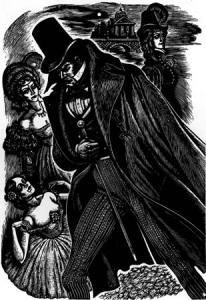
An illustration of Jane Eyre and Rochester by Fritze Eichenberg.

An illustration of Jane Eyre and Rochester by Fritze Eichenberg.

2. It’s Charlotte Bronte’s 200th birthday, and The Guardian has published an article in which Sarah Waters, Tessa Hadley, Jeanette Winterson, Margaret Drabble, Esther Freud, Andrew Motion, Maggie O’Farrell, Polly Samson, Helen Dunmore, Blake Morrison, Julie Myerson, Cornelia Parker, John Mullan, Helen Simpson, Polly Teale, Samantha Ellis, Mick Jackson, Joanna Briscoe, Linda Grant, Sarah Perry write about their reactions to Jane Eyre.

Tessa Hadley writes, “Jane Eyre is so built into the shape of my imagination that I can hardly think about it critically; I’m always in among its trees – the sturdy, northern, low-growing hawthorn and hazel bushes of its terrain – and can’t dispassionately estimate the size of the wood.”

3 I just found Zoe Brooks’ wonderful blog,  Magic Realism.  She writes, “Every week I bring you at least one review of a magic realism book.”

4.  If you’re a fan of historical novels, check out this article about the best historical novels of the year at The Telegraph.
Quotation of the Week: H. E. Bates on Skating in Love for Lydia

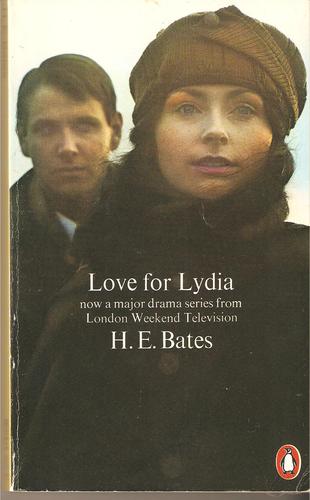
lbook with TV cover love-for-lydiaI would never have discovered H. E. Bates if not for TV.  What American woman is not glued on Sunday night to “Masterpiece Theater,” a show devoted to British costume drama?  I discovered Love in a Cold Climate, Poldark, The Forsyte Saga, The Jewel in the Crown, and many other classics through these dramatizations.

My favorite novel discovered through “Masterpiece” is H. E. Bates’ Love for Lydia.  Filmed in 1977 and shown in the U.S. in 1981, it is based on Bates’s 1952 masterpiece, which, according to the introduction in the new Bloomsbury Reader e-book edition (released next month), is the most autobiographical of his Northamptonshire novels. The film is stunning, but Bates’s novel is truly an underrated classic.  Set in Evensford, a town of leather factories, it is the story of a love triangle (or quadrangle, depending on whether or not you include Blackie, the auto mechanic), which revolves aroung Lydia, a beautiful, strong-willed young woman who comes to Evensford live with her aunts and uncle after the death of her father.

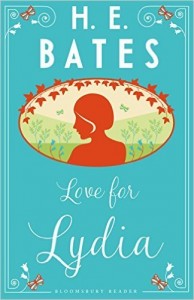
new Bloomsbury Reader edition

The new Bloomsbury Reader edition of “Love for Lydia”

The narrator, Richardson,  is a brooding, underemployed reporter for The County Examiner who hates his job.  He meets Lydia when he is sent to the Aspen house to interview the aristocratic family about the death of her father.  He is apprehensive about visiting the house, which is separated from the town by a stone wall and a perimeter of trees, and even more apprehensive about asking questions. “It was possible to live in Evensford for a long time, even for a generation, and not see the Aspen house, the Aspen garden or the Aspens themselves.”

But one of the aunts, Miss Juliana Aspen, is impressed with him and asks him to take Lydia skating.  She does not want Lydia to be cut off from the town, as she and her sister were:  she wants Lydia to be a modern girl of the 1920s.

There is something Thomas Hardyish about this novel: Lydia reminds me slightly of Bathsheba Everdene in Far from the Madding Crowd. (Everdene sounds very much like Evensford, doesn’t it?)  Like Bathsheba, Lydia is an independent well-to-do woman with a siren-like effect on men. But this is not Lydia’s fault:  she is a vivacious woman who wants to experiment sexually after a life of isolation on her father’s estate.  And this leads to tragedy, but Bates does not blame her.  It is as much Richardson’s fault as hers.

The skating brings Lydia to sexual maturity.  She is shy and awkward, then learns to skate after many falls and gains confidence.  Richardson is a good teacher, but his friend, Tom Holland, a farmer, suggests he let her go, that you have to go on your own to learn.

And suddenly she gets it!

…But all at once she began skating. She went forward in a flash of release, suddenly, as everyone does, all alone, clear and confident at last and free.

Like this, tentative but balanced and feeling her way, she skated for about twenty yards. And then, in a freer, wider swing of her arms, she lost her balance, but she regained it, bringing her feet together so that she could glide. In this moment I heard her laughing. The impetus of her strokes had taken her rather fast from thin unbrushed snow into ice that had been swept clear. She was going too fast to stop. Then I saw Tom Holland laughing too, holding up his large hands, ready to stop her. In another moment he was holding her by the red sweater and she was laughing on his shoulder.

‘Wonderful! It’s wonderful!’ she screamed. ‘I can do it! I can stand!’

Bloomsbury Reader is reissuing all of Bates’s work.  The new edition of Love for Lydia will be released in May.

National Poetry Month: A Charming Poem by Catullus

edward-john-poynter-lesbia-and-her-sparrow

“Lesbia and Her Sparrow,” by Edward John Poynter

Catullus, a brilliant Roman poet of the first century B.C., wrote lyric poetry,  epigrams,  elegaic poems, and an epyllion (a mini-epic).  He was a member of the “neoterics,” a group of young poets who rejected early Roman tradition and looked to Hellenistic models  for their poetry about modern life.   Perhaps most famous is his Lesbia cycle of poems, in which he  describes an affair from flirtation to break-up with a seductive woman who caresses him one day and is unfaithful the next.  He sometimes addresses her as puella (“girl”), other times as Lesbia (in honor of Sappho, the poet who lived on Lesbos; nothing to do with lesbianism).

Two of his most famous poems feature Lesbia’s pet sparrow.  Here is a brilliant translation of Catullus 2 by the scholar Gilbert Highet.

Tell me, sparrow, you darling of my darling
whom she plays with and fondles in her bosom,
you who peck when she offers you a finger
(beak outthrust in a counterfeit of biting),
when that radiant star of my aspiring
turns towards you, as a pleasant little playmate,
one small bird, to console her when she suffers,
by your love to relieve her burning passion—
could I possibly play with you as she does,
could I lighten the pain that still torments me?

National Poetry Month! Every Poet Needs a Bawd

VAN BABUREN's "THE PROCURESS," 1622

“THE PROCURESS,”by Dirck van Baburen, 1622

In honor of National Poetry Month, I have just finished Ovid’s Amores (love elegies), which are flashy, facile, and very funny, with roots in Roman comedy.  He wrote these when he was very young, and developed many of the themes more elegantly in his later work.  Amores I.8 is very comical indeed:  the narrator happens to be hidden behind a door and eavesdrops on a bawd/procuress who  is advising a young woman on how sluttily to attract a prosperous man who desires her.  “Beautiful women frolic; chaste is she whom no one has asked./Or, if peasant breeding does not forbid it, the woman herself asks.”

If, like me, you do not live in ancient Rome,  you are unlikely to attend such entertaining readings.  But there are many amateur workshops in every city, and you no doubt know some poets.  You are always going to some bar or dark cave of a cafe to hear your friends give a poetry reading. One friend will be talented; the rest just love to write.  “Great feminist image of the filthy t-shirt soaking in the sink,” you will say wildly.

And you dread the moment when they whip out a manuscript for you to criticize.

“This is so good!”  Say that, no matter what.  Your friend does not want your criticism. It doesn’t hurt to lie and say you read little poetry and don’t like to criticize, because (a) it will get you off the hook; and (b) make your friend feel superior, since she has no qualms about criticizing others. Don’t tell her to throw it in the wastebasket.  That is the job of the teacher at the Summer Writing Conference (and if she is a good teacher, she will be tactful).

AND NOW FOR SOME PRACTICAL TIPS.

EVERY POET NEEDS A BAWD, OR AT LEAST A PATRON.

2013-artwork-poetry-reading-sketch1. Do not ask the Poet in Residence to play the role of bawd.

A friend thought she would publish her poetry if she had contacts. She was as beautiful as the dawn, but very quiet.   She wrote pared-down poems, two or three words per line, as if she could never let go.  When a colleague poet agreed to read her work and discuss it over lunch, she was excited.   I didn’t dare say it might end badly.  She had attended some New Age workshops where everyone was positive and empowering, and had no idea how ruthless professional writers could be.  She came back from lunch furious, because he mercilessly criticized her  work. Perhaps  he dealt thus with the situation so he wouldn’t be inundated with manuscripts. He was in an awkward position.  But couldn’t he have told her he never criticized friends’ work and just had lunch?

2. If you have friends, you will sell more poetry.

Small presses are the places for poets.  Or so I thought.  Then an employee of a small press  showed me boxes and boxes of hundreds of unsold books.   “If I had my way, I’d never publish a poet who didn’t have friends,” he said sadly.   Heavens, I didn’t like the sound of that.  Were all poets garrulous?  Were they popular?  Where on earth did they make friends who buy poetry books?  The small press was local and funded by grants, so did it matter?  Well, they probably were expected to sell the books.

3. Publish a chapbook.  You’ll be happier!

I have seen many beautiful chapbooks of poetry:   they are small books or pamphlets, sometimes illustrated, sometimes hand-stitched.  Most are self-published, but no less wonderful for that. You won’t need contacts.  And you can give them to your friends!

4 Get a patron.

Poets need patrons. They need a rich person who wants to give them gifts so they can write.  You need somebody to lend you a free house on Cape Cod for the summer, equipped with a liquor cabinet and jacuzzi, and then whisk you into New York City for a poetry reading at the 92nd Street Y.  You’ll open for Robert Pinsky.  What?   You don’t have a patron?  You don’t live near the 92nd Street Y?  Well, how about Java Joe’s?  What do you mean, it’s not the same?

5. Get an agent!  Do poets have agents?

Well, I am not a poet, but I cannot imagine that many have agents!

GOOD LUCK, POETS, DURING NATIONAL POETRY MONTH!

Are We Dorothea? Reading Middlemarch on a Cold, Windy Day

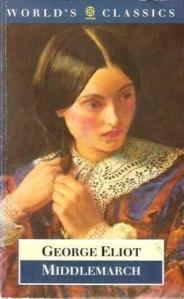
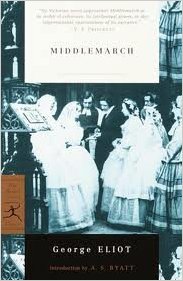
Middlemarch eliot 9780192817600-uk-300 I wanted to get out:  I wanted to ride my bike, but the wind gusts were 9 mph. Yesterday the gusts were 21 mph:  I  zigzagged through tree-lined neighborhoods to find shelter.  Today I dressed lightly, because it was sunny and I was optimistic.  As I rode into a fierce wind, I shivered and sweated.

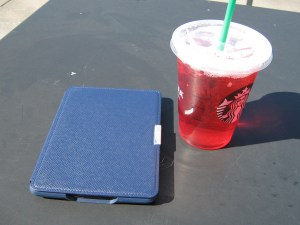
I took a break at a  coffeehouse and sat on the terrace and opened my copy (actually e-book) of Middlemarch.

An e-reader and iced ta.

Middlemarch on my unphotogenic e-reader and  iced tea.

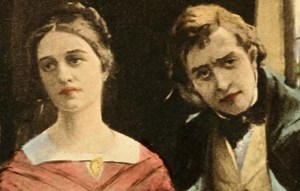
What is your favorite Eliot?  It is supposed to be Middlemarch, yes? I love it, but I prefer Daniel Deronda, whose arrogant heroine, Gwendolyn Harleth, makes so many horrendous mistakes:  she even loses a valuable necklace gambling.  Yet Middlemarch is a masterpiece, an absorbing, satiric portrait of characters in a provincial town.  And we channel our inner good girl as we read about Dorothea Brooke, the bright, fiery, naive young heroine who marries a homely middle-aged scholar, Mr. Casaubon, mistaking him for an intellectual. She wants to shine in a brighter light than the society of Middlemarch and imagines herself helping with the research and making a contribution to the world.  Mr. Casaubon, however, is unable to organize his life work, a mass of notes for a “Key to All Mythologies.” During their honeymoon, he cannot even be bothered to accompany her to art museums and churches, but toils at his useless work. His young cousin, Will Ladislaw, an artist-turned-writer whose education has been paid for by Mr. Casaubon, is in Italy, and begins to take Dorothea to galleries.  He says Casaubon’s scholarly has already been done in German, a language Mr. Casaubon does not know. Dorothea is startled. And Mr. Casaubon is jealous of Will, with reason.

Illustration of Dorothea and Will Ladislaw, publishe by the Jenson Society in 1910.

Illustration of Dorothea and Will Ladislaw, published by the Jenson Society in 1910.

E-readers are so wonderful on the road, because Middlemarch is a big book to carry  on a bike.  I was up to Chapter 50:  Mr. Casaubon has finally died, and Dorothea is infuriated by “a strange indelicate proviso” in his will stating that Dorothea will lose his money if she marries Will Ladislaw.   (Will and the will–I like the joke.)  Dorothea is humiliated–certainly she has never thought of a second marriage– but  she also believes Will should have half the money, because his mother was disinherited for marrying out of her class.

Women in Middlemarch are dependent on men.  Dorothea has her own money, but she does not have the education.  It is not Mr. Casaubon’s money that interested her, but his mind. And because of the proviso in the will, she is  exasperated to find he also expected her to continue his work  She no longer feels the obligation.

Every word Eliot writes is so vivid and brilliant, and the images are spectacular.  His useless scholarly work is “a tomb.”

…he willingly imagined her toiling under the fetters of a promise to erect a tomb with his name upon it.  (Not that Mr. Casaubon called the future volumes a tomb; he called them the Key to all Mythologies.)  But the months gained on him and left his plans belated:  he had only had time to ask for that promise by which he sought to keep his cold grasp on Dorothea’s life.

The grasp had slipped away. …now her judgment, instead of being controlled by duteous devotion, was made active by the imbittering discovery that in her past union there had lurked the hidden alienation of secrecy and suspicion.

Every word is perfect!

middlemarch modern library 31G4jQG40XL._BO1,204,203,200_There are many, many characters in Middlemarch.  I am fascinated by Lydgate, a brilliant doctor with the ambition to do scientific research. His marriage prevents him:   marriage is  a trap in Middlemarch.    I am also very fond of  Mary Garth, the smart, sharp, sometimes  bitterly sarcastic young woman who, unsuited to be a governess, prefers to work as a nurse/companion to Mr. Featherstone, a dying rich man.  Mary’s morality unwittingly spoils her friend Fred Vincy’s chance of inheriting the money: I won’t tell you how.  Characters struggle in Eliot’s fictional provinces with doing the right thing.  The right things are right, but can be costly.  It takes a gambling vicar, Mr. Farebrother, to explain why Mary was right in the long run.  (And that’s why Mary should marry Mr. Farebrother, but you know it’s not going to happen.)

Whom do you love?  Not necessarily the right person in Eliot’s world:  that’s for sure!

Any introduction to Middlemarch can give you the background you need. These are just musings.  Writing about the classics is so difficult:  it is the life work of scholars.  This is not my life work!

Eliot’s last novel, Daniel Deronda, my favorite, is even more intense.

On with Middlemarch!

A Rediscovered Classic: Sybille Bedford’s A Favourite of the Gods

the artist's wife reading bartholome DP275102

“The Artist’s Wife Reading” by Albert Bartholome

Some of us read sitting up, others read lying down.  A characteristic pose at our house is of me lolling on the couch or in bed holding up my book like the artist’s wife. One of the great things about twentieth-century classics is that they are usually slim enough to read in the supine position.   Certainly this is true of Sybille Bedford’s A Favourite of the Gods, an out-of-print classic I recently discovered.

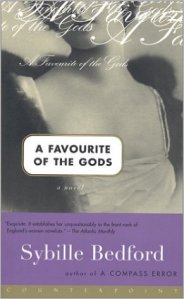
Sybille Bedford a favourite of the gods 41XWVN56X0L._SX289_BO1,204,203,200_This brilliant novel, published in 1963, is astonishing from the opening sentence. “One autumn in the late nineteen-twenties for no particular reason at all, as it would seem, we began to live in France.”  I love the whimsy of that sentence.  It describes a life of money, where such decisions can be causally made.  And because each sentence is equally glittering and perfect, I could not put this book down.  The structure is perfect:  events repeat and form a pattern in this inter-generational novel, though in each generation events have a different meaning.
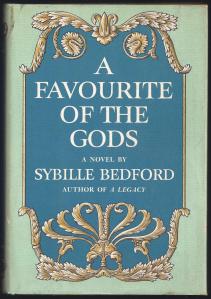
The prologue is so marvelous that I read it twice.  A mother and daughter, Constanza and Flavia, are on a train, wondering why it has stopped. They pick up their books to read, and suddenly Constanza’s brother Georgio appears in their carriage to ask a favor for one of his  “harebrained schemes.”  He leaves in a huff, and when the train crosses the border to France, Constanza discovers her ruby ring is missing.  The  ring, a gift from her father in Rome,  is her connection to the past and also shapes the events that follow.  After her mother separated from her father, the ring was all she had to remember him by.

Because of the uproar over the ring,  Constanza and Flavia miss their connecting train. They find themselves spending the night at a hotel in an unknown village in France.  They are stranded there on Saturday night, and cannot send a telegram till Monday.

Constanza isn’t very upset.  They were on their way to meet Lewis, her fiance.  She planned to marry him “to complete a design,” she tells Flavia.  She doesn’t believe in marriage for love.  Lewis intensely wants to marry her.  She has said she will, but doesn’t care greatly.

“We did half our best,” Constanza said, grinning at me.  We still did not know the name of the place and when we asked the manager, he said:  “But you are the lady with the daughter who wrote about the villa.”  Not to her knowledge, said Constanza.  The villa was ready for her to look at after luncheon, said the manager.

Naturally, Constanza and Flavia rent the villa.  “As a matter of fact we stayed for eleven years.”  And so Flavia begins the story of her mother and grandmother.  And we switch from first person to third person.

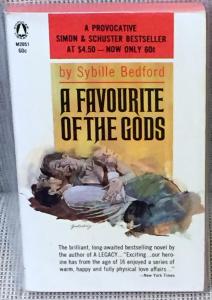
Somehow this cover doesn't fit...

Somehow this cover doesn’t fit!

Bedford blends the elements of two of my favorite writers, Henry James and Nancy Mitford.  (I know, I know, they have nothing in common:  James is a Europhile and Mitford is a humorist. ) In fact, Mr. James is a character in Bedford’s novel.  His friend Anna is an American heiress,  who marries an Italian prince.  They are happy and in love, and divide their time between Rome and a country house.  Anna thinks nothing of traveling for six months to India with friends, so much does she trust the prince.  But many years later when she learns the prince has had a long-term affair with one of their friends, she is maddened and goes to England with  Constanza, who is very Italian and does not understand that  father’s affair is the cause.   She thinks perhaps he has embezzled money.

During their years in England, Constanza lives what I think of as a Nancy Mitford life.  It’s not that Bedford is hilarious–she is not–but there is a bit of Linda Radlett, the charming heroine of The Pursuit of Love, in Constanza.  She loves England, has many eccentric friends, marries a young affected man who shares her mother’s love of art (the marriage is her mother’s idea), has no patience with fools, has an affair with a charming Greek poet, does war work, and is upset when the Greek poet enlists.  When Simon drops his artistic airs to practice law and go into politics, he falls in love with a more conventional woman.  Constanza nobly volunteers to go to a hotel with a man so adultery can be “proved” and Simon’s political reputation won’t be hurt.  She will miss Simon, but did not love him like a husband anyway.  And he has no interest in their daughter Flavia, so she will not lose Flavia.

Bedford, born in Germany,  was raised by her father, a German baron,  after her parents separated.  When he died, she moved to Italy to be with her mother.  Then she was sent to England to be educated (which never happened), and England eventually became her home.  She wrote her books in English.  Her novel A Legacy has been reissued by NYRB.  Her novel Jigsaw:  An Unsentimental Education was a finalist for the Booker Prize

But the really thrilling thing about discovering a splendid “new” writer?  There are so many new books to read.  I can’t wait.

a favourite of the gods sybille bedford old copy 14074755425

More Books from the Planned Parenthood Book Sale

planned parenthood book sale 635787938090989435-dmrdc5-5c0tm3808qq457a6n6a-original

The Planned Parenthood Book Sale in Des Moines.

It was one of those lovely Sundays when there is nothing to do, when you take a walk or work in the garden,  and then remember it’s 50%-off day at the Planned Parenthood Book Sale in Des Moines.

It was much more crowded than on Thursday, the first day of the sale, and we were glad to see the crowd.  By Sunday the sale is picked over, and some of the tables are actually bare, but the books are easier to see on the thinned tables.  Today I looked through several categories I hadn’t managed to get to the first night.

And, thank God, it was a different selection from Thursday’s “Cozy Fest,” when I brought home mainly middlebrow books by Margaret Kennedy, Cornelia Otis Skinner, Margery Sharp, and the like.  It’s not that I won’t enjoy them, but I need variety.

HERE ARE SOME OF THE FINDS.

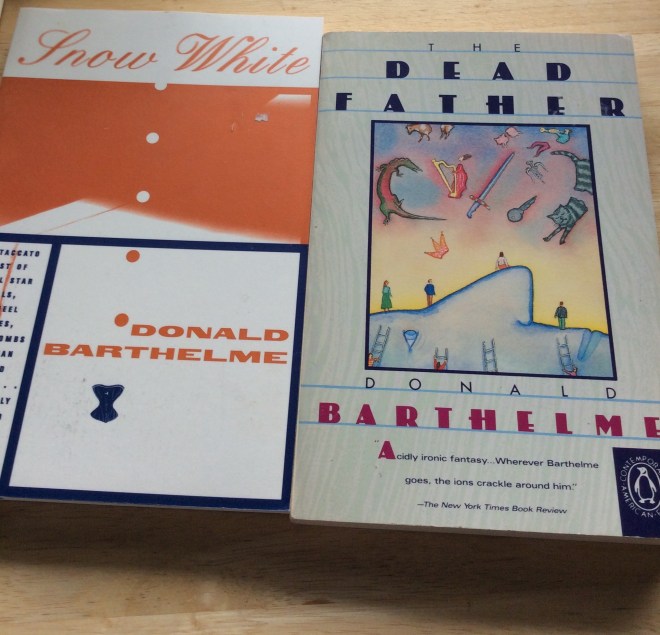
It has been years since I read Donald Barthelme, one of the best American postmodern writers of the 20th century. I love his short stories (Sixty Stories), and this will be my second try at his meta-fairy tale, Snow White, which struck me as very sexist in my radical feminist days.  This time I am reading only for style:  there are some good things about maturing.  The Dead Father, about which I know nothing, looks fascinating, too.

image

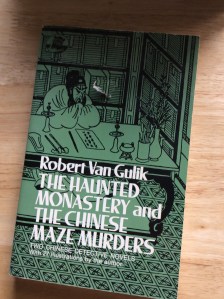
My aunt was a great fan of Robert van Gulik’s Chinese mysteries, though somehow they never appealed to me until I found this two-in-one Dover edition, with  The Haunted Monastery and The Chinese Maze Murders, and illustrations by the author.

image

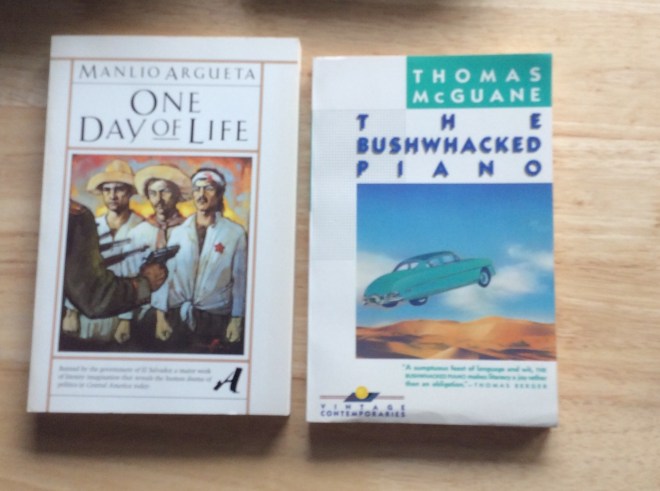
Manlio Argueta is a Salvadoran author, and the jacket copy of One Day of Life says it describes “a typical day in the life of a peasant family caught up in the terror and corruption of civil war in El Salvador.”  We are huge fans of Thomas McGuane and read aloud parts of The Bushwacked Piano years ago on a bicycle trip, but didn’t get through much since I fell asleep in the tent around 6 p.m.  I recommend McGuane’s 2015 collection of short stories, Crow Fair, if you want a place to start.

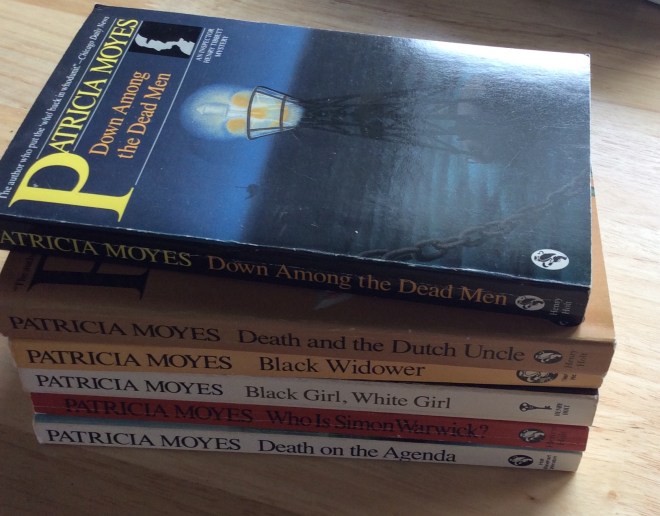
imageThere is a certain kind of detective story I find irresistible.   I have always enjoyed Patricia Moyes’s mysteries.  Have I read all of these?  Maybe.  I’ll know when I read them.
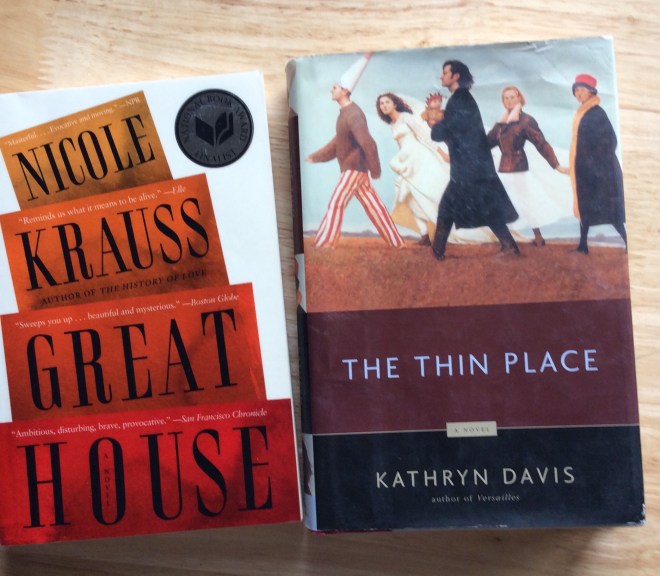
imageIn the contemporary fiction section, I found two books I have  long meant to read.  Nicole Krauss was nominated for the National Book Award for Great House, and that is an literary award I take seriously, possibly because the prize is judged by writers instead of journalists.  (A few years ago the journalist judges of the Pulitzer Prize had a hissy fit and decided not to award the prize for fiction.)   Kathryn Davis is a lyrical, original writer, and her novel The Walking Tour is one of my favorites. I am ridiculously behind in reading contemporary literature, and cannot believe I missed The Thin Place.
image

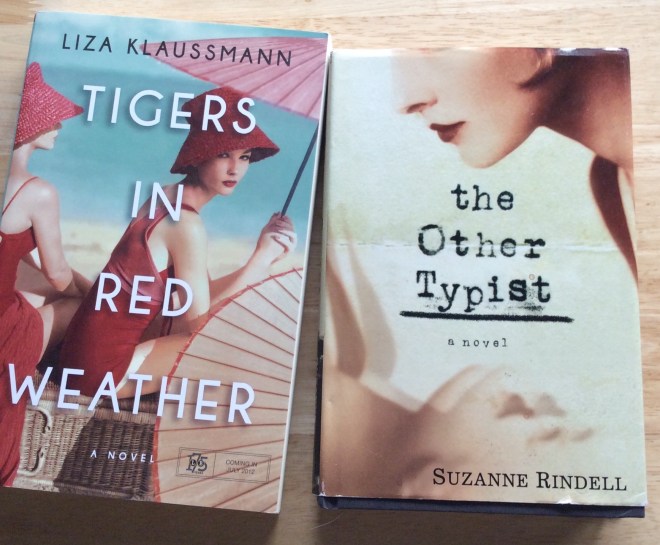
Similar covers on the two below, no?  Both Tigers in Red Weather and The Other Typist got positive reviews,  in 2012 and 2015 respectively.   Summer reading?

image

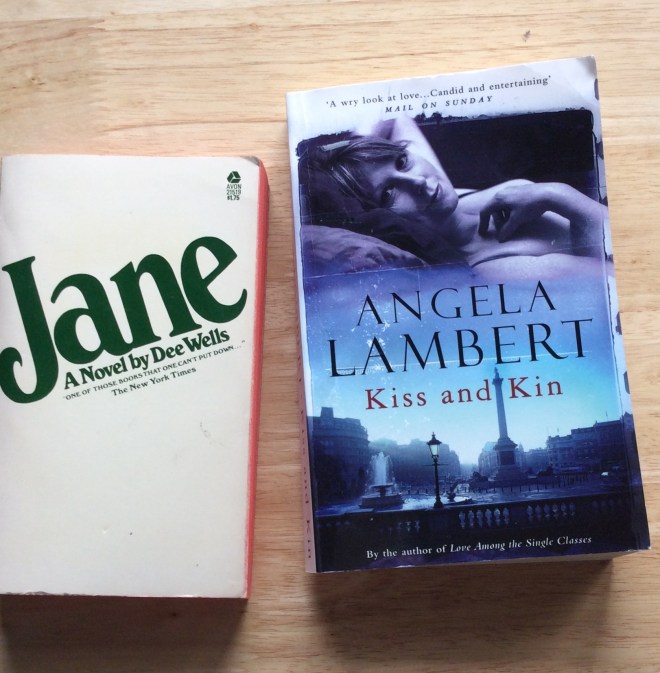
And below are two more exciting finds.  According to the jacket copy of Jane: “Meet Jane…34, single, an American journalist living in a colorful London loft with a cat…” I’m in!  And Angela Lambert is the author of the wonderful novel, Love Among the Single Classes.  Like so many literary novels by women, Kiss and Kin has a “pop fiction” cover, but I expect good things.

image

The Planned Parenthood Book Sale continues through 6 p.m. tomorrow.

Winner of Giveaway of John Thorndike’s Anna Delaney’s Child

By a coin toss (as we do at the Iowa caucuses), Ellen is the winner!  Send me your address.

The Planned Parenthood Book Sale & A Giveaway of John Thorndike’s Anna Delaney’s Child

planned parenthood book sale f8cc00b600a10e1b386843f6e29ddf2b

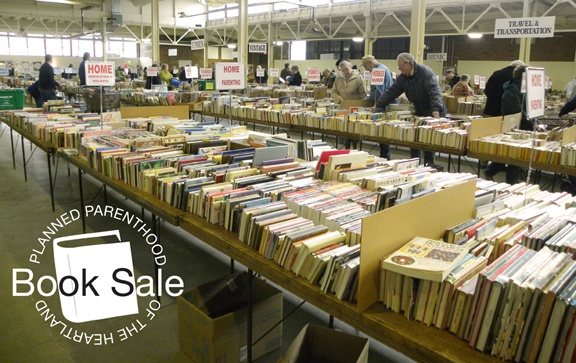
The Planned Parenthood Book Sale is a perk of Midwestern living.   I have found Viragos, an almost complete set of Oxford paperback Trollopes, and books by obscure Midwestern writers.   It is held every six months in the 4-H Building on the Iowa State Fairgrounds in Des Moines.  If you’re in the area this weekend, it is worth a trip.  The sale started today and goes through Monday the 11th.

As usual, we came home with a couple of boxes of books.

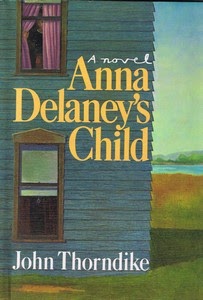
Thorndike Anna Delaney's childJohn Thorndike’s out-of-print classic, Anna Delaney’s Child, is one of my favorite books. It’s hard to find, so I’m giving away this hardcover (which I bought for $1).   This stunning 1986 novel delineates the despair and gradual healing of a group of characters in Fell River, Ohio, who have suffered enormous losses. Anna Delaney, a farmer, has lost her eight-year-old son, Kevin, in a car accident; her father’s beloved wife, Anna’s mother, has died of cancer; Susan, now a paraplegic after a recent climbing accident, longs for the sports that kept her centered; and Anna’s ex-husband, Paul, has moved to Fell River with his unresolved drug problems.  But of course it is Thorndike’s lyrical writing that makes this novel a small masterpiece.  If you would like the book, leave a comment.  The giveaway is open only to Americans and Canadians (because I can’t afford postage to the UK and Europe!).  I highly recommend this.  Everybody loves this book and gasps and wonders why it’s not in print.

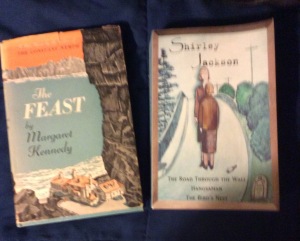
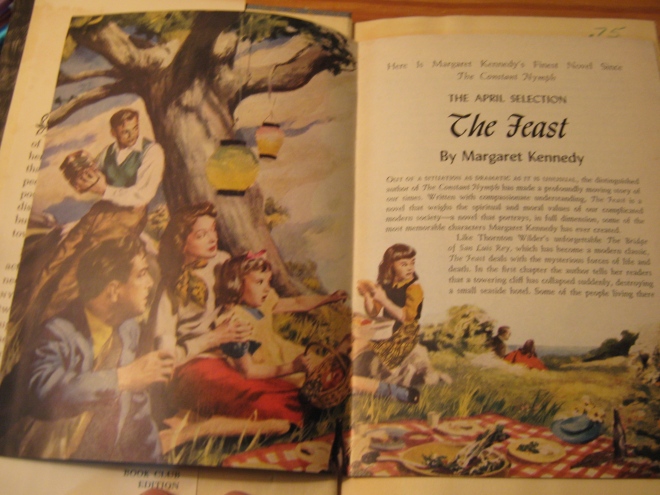
imageI was thrilled to find a paperback omnibus edition of three of Shirley Jackson’s novels, The Road Through the Wall, Hangsman, and The Bird’s Nest.  And even better is this book club edition  of Margaret Kennedy’s The Feast (75 cents), which was the main Literary Guild selection in April 1950. The book club’s illustrated review brochure, Wings, is glued on the endpage.  It devotes eight pages to The Feast and features a short interview with Kennedy.  Wouldn’t you love to have a job writing a fun book club magazine?  They weren’t like that in my day!

IMG_3589 Don’t the Wing illustrations remind you of the Dick and Jane books?

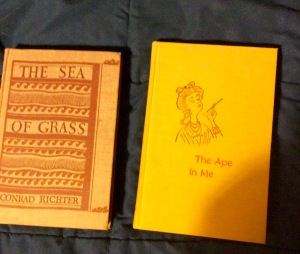
imageConrad Richter won the National Book Award in 1961 for his brilliant novel,  The Waters of Kronos, which I wrote about  here).  I look forward to  reading The Sea of Grass (1935).  It was probably my best find.  Cornelia Otis Skinner’s The Ape  in Me. is a collection of humor essays.  Skinner is very witty and is  best known for Our Hearts Were Young and Gay, a hilarious book co-written with Emily Landau about their trip to Europe after college.

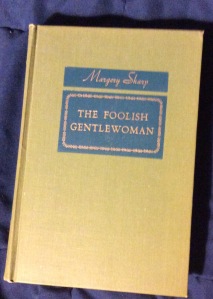
imageI know many of you swear by Margery Sharp.  Her books are very light, but I enjoyed Martha in Paris and In Pious Memory (I wrote about them here).  My favorite of her books is the Rescuers series. I love Miss Bianca.

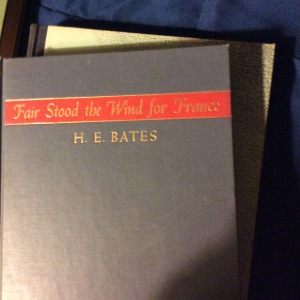
imageH. E. Bates is one of my favorite English writers.  In fact, I just reread Love for Lydia,  and will post about it soon.

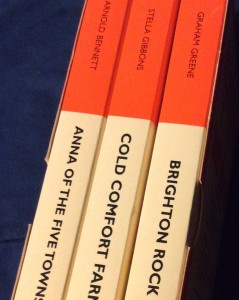
imageWe couldn’t resist this boxed set of Penguin Originals, Arnold Bennett’s Anna of the Five Towns, Stella Gibbons’ Cold Comfort Farm, and Graham Greene’s Brighton Rock.

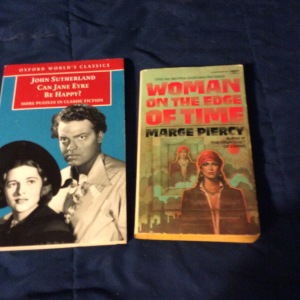
imagel couldn’t pass up a book with the title Can Jane Eyre Be Happy?  (I’ll have to see what the author John Sutherland says, but I do not think she could be happy.)  I plan to reread Marge Piercy’s excellent SF novel, Woman on the Edge of Time.

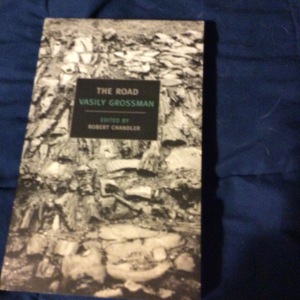
imageAnother by Vasily Grossman.  I keep finding cheap copies of his books.

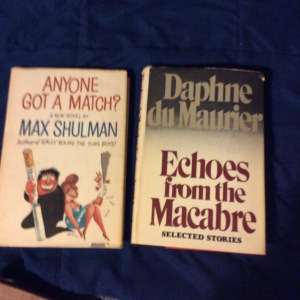
imageMax Shulman seemed very funny when I was young, but it may be dated humor. The Daphne du Maurier collection includes two of her most famous stories, “Don’t Look Now” and “The Birds.”

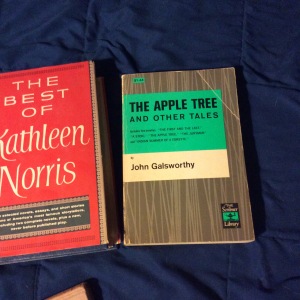
imageSomebody in an online book group recommended Kathleen Norris, a middlebrow American writer.  I tried one of her office romances some years ago and gave up.  Maybe the “best of” Norris is what I need.  I can’t wait to read John Galsworthy’s short stories, though the cover of this battered paperback will probably fall off halfway through the book, and I’ll have to find an e-book edition (surely free).

imageThis is one of my husband’s.  I have no idea what this is.  (Nor does he!)

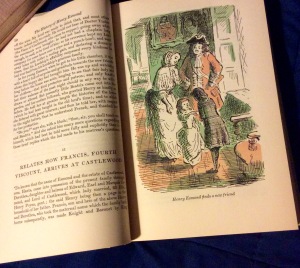
imageThis is a Heritage edition of Thackeray’s The History of Henry Osmond, with illustrations by Edward Ardizzone.  I’ve read Henry Osmond, but I couldn’t resist it for $2.50.  I may donate it back to the sale, because I discovered we already have two paperback copies, and let’s face it, paperbacks re easier to read than the oversized books.

You never find exactly what you’re looking for at a sale, but there’s always something!  Overall, I would say this was a “cozy” year.  Some years are a little more “edgy.”

Do We Need a Reading Gimmick? Books About Years of Reading & Why We Love Them

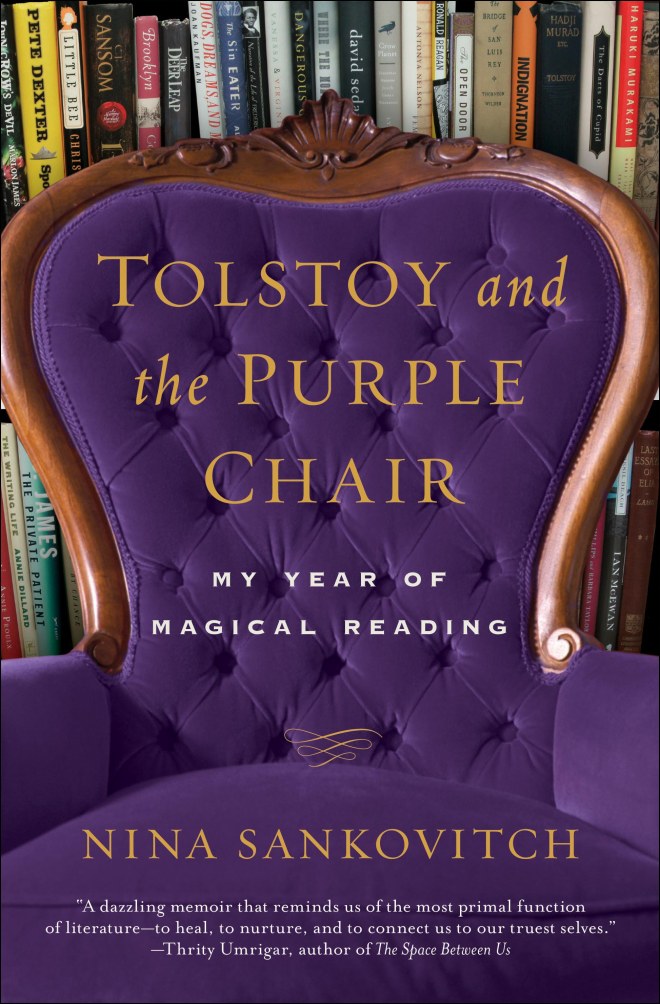
nina sankovitch TolstoyAndThePurpleChair3 Do we need reading gimmicks?  Every book website has one.  At Goodreads, you can participate in the 2016 Reading Challenge  by filling in the number of books you want to read.  At The Millions, there is a Proust Book Club (but three months into it, the writer/leader is still on Swann’s Way). At the Modern Mrs. Darcy, the 2016 book challenge might as well be called “Read Whatever You Want”:  its 12 categories include “a book you’ve meant to read for a long time” and “a book published this year.”

Books, too, are often organized around gimmicks, and I don’t mean this is a bad thing.  I am reading a fascinating reading memoir, Nina Sankovitch’s Tolstoy and the Purple Chair:  My Year of Magical Reading.  After her sister Anne-Marie’s death from cancer, Sankovitch spent three years in constant motion instead of mourning, coaching her son’s soccer team, leading a PTA committee, and following a strict fitness regime.   Finally she was exhausted:  she realized she needed to sit still to grieve.  And so she spent a year reading one book a day and blogging about the experience.  It helped her with the grieving process.

Sankovitch, a former lawyer, was so busy at home raising four children that many friends thought she’d quit the project.  She worked while the children were in school or between chores.   In her year of  a book a day, she read shorter books than usual, but since she could read 300 pages in four hours, she still had one up on most of us. (Oh,  I wish I could read that fast!)  She chose books at the library by the width of the cover:   one inch equals about 250-300 pages  She knew she had to spend an average of six hours a day reading and writing. The writing took her longer than the reading.   I think many of us can relate to her thoughts on keeping up her blog.

Just a few days’ experience of writing reviews had shown me that a review had no definite time allotment.  It could take me half an hour or five hours, depending on how much the book meant to me and how easy or hard it was for me to translate what the book meant into words on my computer screen.  I averaged out the reviewing time to about two hours and planned accordingly.

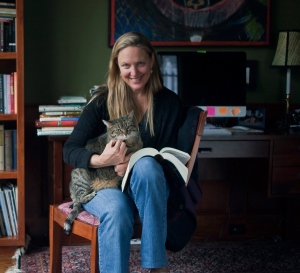
Nina Sankovitch VermeerNina_10

Nina Sankovitch

Sankovitch may not be a great critic, but she is a great common reader, and perhaps that is more important.   I very much enjoy her interweaving of memoir with her reviews.  And her recommendations are fascinating:  Muriel Barbery’s The Elegnace of the Hedghog, Saramago’s Death with Interruptions, José Eduardo Agualusa’s The Book of Chameleons, and Elizabeth Maguire’s The Open Door, a fictionalized biography of Constance Fennimore Woolson.  I am looking forward to reading some of the books on this list

Other writers, too, have organized their books around reading gimmicks.  You’re on your own with the first three on the list, but I have read and can recommend Denby’s.

  1. Phyllis Rose’s The Shelf: From LEQ to LES: Adventures in Extreme Reading.  This retired professor chose a shelf of fiction at the New York Society Library and read her way through it.
  2. Andy Miller’s The Year of Reading Dangerously.  Before his 40th birthday, he wanted to catch up on classics he’d never read.  He starts with Bulgakov’s The Master and Margarita.
  3. Ann Morgan’s The World Between Two Covers,  inspired by her year-long journey through a book from every country in the world.  Her blog is  called A Year of Reading the World.
  4. David Denby’s Great Books: My Adventures with Homer, Rousseau, Woolf, and Other Indestructible Writers of the Western World. He returned to Columbia University to rediscover the classics.

Let me know your favorite books about reading, or reading projects!