What Could Be More Predictable Than Too Frothy Summer Reading? The Virgin & the Gipsy, A Too-Cozy Cozy Mystery, and a Very Simenon-y Simenon

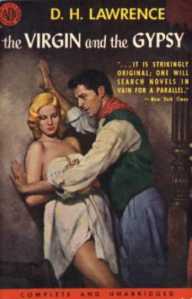
The virgin and the gipsy lawrence pulp 586-1

I’ve already done my summer reading:  three silly books that would have been better saved for that horsefly-haunted fishing lodge I will find myself in soon.

But they are no less frothy than most of what will be promoted this summer!

FIRST, THE ROMANCE NOVELLA.

D. H. Lawrence is one of my favorite English writers. I love his poetry, novels, and travel writing.  His style can be intense,  but I appreciate intensity. Why, why, why did I not get on a train to Nottingham, his birthplace, when I was in England?  Well,  he didn’t like Nottingham much. And he wasn’t that keen on England.

Is he still in fashion? I have no idea.  My obsession began when I saw the movie Women in Love, starring Glenda Jackson, who won the Oscar for Best Actress, Oliver Reed, Alan Bates, and Jennie Linden. And then I was enraptured by the novel Women in Love, though I tried to be cool about it, because my best friend thought it was very funny.  It is one of the strangest, loveliest, most seductive books I’ve ever read.  The Rainbow, its prequel, is even more stunning.  I also like  Sons and Lovers, his beautiful coming-of-age novel.
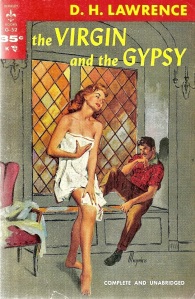
438 D H Lawrence The Virgin and the Gypsy Berkley 1And then there’s The Virgin and the Gipsy.

Mind you, I enjoyed The Virgin and the Gipsy, but Lawrence’s sexual philosophy can seem ridiculous when concentrated in a novella.  He needs a short story or a novel.

It is actually a typical Lawrence story  of forbidden sexual attraction between a middle-class woman and a lower-class man.  Think Lady Chatterley’s Lover, only sillier. It begins almost like a fairy tale.  The rebellious Yvette and her older sister, Lucille, are trapped in the rigid life of a rectory dominated by a grim granny referred to as the Mater.   We learn that their mother, Cynthia, left the rector for a penniless man when the girls were children.  And their Aunt Cissie sizzles furiously about the house hating both girls, but especially Yvette.

So, naturally, the girls like to get out.  One day the wild Yvette is out in a car with Lucille and  some other young people, and they almost run down a gipsy cart.  The cart finally gets over to the side of the road, but the driver is furious.

Yvette’s heart gave a jump. The man on the cart was a gipsy, one of the black, loose-bodied, handsome sort.

He asks if they would like their fortunes told.

She met his dark eyes for a second, their level search, their insolence, their complete indifference to people like Bob and Leo, and something took fire in her breast.  She thought:  “he is stronger than I am!  He doesn’t care!”

Yvette experiences pure sexual attraction.  This is a little overwritten, though.

Yvette has clandestine meetings with the gipsy.  Sometimes he drives his cart past their house and she runs out, other times Yvette resists.  She is also scandalizes her granny by befriending a couple who are living in sin while they wait for the woman’s divorce.

It’s a little silly.   Still, it seemed pure sex when I was an adolescent.

So maybe it’s a Y.A. book?

SECOND, THE COZY MYSTERY THAT’S TOO COZY.
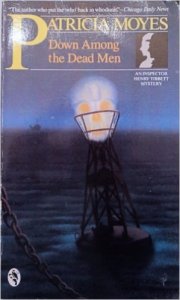
Moyes down among the dead men 41Im6NYYYiL._SX297_BO1,204,203,200_I picked up a couple of mysteries by Patricia Moyes, because they were  very nice paperback editions with crisp pages. I THINK I read about them at a blog.

Well, damn, Down Among the Dead Men is just not that  good.

Chief Inspector Henry Tibbetts and his wife Emmy go on vacation with friends, Rosemary and Alastair, who have a sailboat.  And then they (and we) have to learn everything about sailing.

Alastair looked at him pityingly.  “If the jib didn’t have a port and a starboard sheet, how could you come about?”  Henry said he had no idea, and watched humbly as Alastair picked up another rope from the deck.

If the jib didn’t…?  It’s a lot like Nancy Drew. Everything has to be explained, and over-explained, until you’re ready actually to put your backs into it and heave ho!

Anyhow, they sail with a bunch of friends, including a saucy sexpot of a woman, Ann, whom the other women hate (including me).

And Henry figures out that a friend of theirs who died tragically was actually murdered.

And Ann puts her hands all over him and makes him promise to stop saying he was murdered.

And…

Okay, but not good enough.  Maybe this isn’t Moyes’ best?

THIRD, THE SIMENON THAT’S VERY SIMENON-Y.

simenon grand banks cafe 41s2qOWJFAL._SY344_BO1,204,203,200_Of course Simenon is excellent, if you like that kind of thing.  The Grand Banks Cafe is a police procedural, straight investigation with no real rounded characters, and lots of re-creation of the crime going on in Maigret’s mind.

Maigret, a French detective, and his wife go on vacation in a fishing port so he can help clear the name of a teacher friend’s student, Pierre, who was the wireless operator of a ship whose voyage was apparently doomed.  (Lots of accidents.)  Pierre is  accused of murdering the captain after they came ashore.  The investigation gets stranger and more bizarre as Maigret discovers that a femme fatale was involved with three of the men on the ship.

Very tight, short, and fast.  One of the better Simenons.

And if you want it, it’s yours.  I’m giving away the Simenon.  Leave a comment if you’d like the book.

 

The Tale of Genji, Sassy Reviewers, & Clickbait

tale of genji cover2

My Knopf paperback of Murasaki Shikibu’s The Tale of Genji arrived in the mail today. It has a lovely, delicate cover, the print is the perfect size for reading by a nearsighted woman with bifocals (me), and it is illustrated with exquisite woodcuts from a 1650 Japanese edition.  It is also very hefty, about the size of War and Peace (1090 pages).

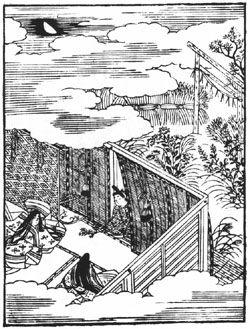
tale of genji_woodblock

A woodcut from a 1650 edition.

I already am finding  Edward G. Seidensticker’s lyrical translation (1976) of this 11th-century Japanese “novel” more elegant and readable than  Dennis Washburn’s (Norton, 2015), which I began last summer. Both have their merits,  but  Washburn’s prose is often awkward and wordy, perhaps more literal: I’m sure each translator has a different philosophy.  I’ve often thought twentieth-century translators wrote better than the new crew of writera  (the Maudes’ translation of  Anna Karenina is the best).  Well, I’m a  worshiper of the past.  It’s not a nostalgia thing:  it’s why I studied classics.

Of course Washburn will be somebody else’s classic, too.

Here are the opening paragraphs of both translations.

First the stunning Seidensticker:

In a certain reign there was a lady not of the first rank whom the emperor loved more than any of the others.  The grand ladies with high ambitions thought her a presumptuous upstart, and lesser ladies were still more resentful.  Probably aware of what was happening, she felt seriously ill and came to spend more time at home than at court.

And here is Washburn’s more verbose version.

I N WHOSE reign was it that a woman of rather undistinguished lineage captured the heart of the Emperor and enjoyed his favor above all the other imperial wives and concubines? Certain consorts, whose high noble status gave them a sense of vain entitlement, despised and reviled her as an unworthy upstart from the very moment she began her service. Ladies of lower rank were even more vexed, for they knew His Majesty would never bestow the same degree of affection and attention on them.  As a result, the mere presence of this woman at morning rites or evening ceremonies seemed to provoke hostile reactions among her rivals, and the anxiety she suffered as a consequence of these ever-increasing displays of jealousy was such a heavy burden that gradually her health began to fail/

Very different books, yes? It’s a matter of preference.

I’ll check in here occasionally to express my thoughts on this classic.

THE SASSINESS NEVER STOPS.

Reviewers can be nice, reviewers can be nasty.  I have no doubt that a sassy review at a mainstream publication  has the power to  kill a book.

But sassiness is not only endemic at mainstream book review publications.  It is also in many ways the main character at Goodreads.  Mind you, there are Goodreads reviewers  who  write thoughtfully and analytically  about the context of Lawrence Durrell’s modernist novels, but yesterday I was floored by a one-star review of The Tale of Genji by someone named “Smenkhare.”

“Smenkhare” doesn’t have an elegant way with words.  He/she writes:

i hate this book only a little less than i hate ‘twilight’. the historical and literary significances are really impressive (it was the first novel written – and by a woman, for that matter), and it’s the source of pretty much everything we currently know about heian court life, but genji is the wimpiest, rapiest protagonist ever. he is literally so mind-crushingly whiny, childish and just plain unlikeable that in my opinion, he ruins what is otherwise a pretty compelling story.

“Smenkhare” deals in superlatives, you will notice.

N.B.: I should tell you: The Tale of Genji is NOT the first novel.  The ancient Greeks and Romans wrote novels long before the 11th century .  Seidensticker  refers to The Tale of Genji as “a very long romance,”and Washburn “a long fictional narrative.”

THE SASSIEST REVIEWER OF ALL IS:

Jessica Crispin?

No, I’m joking.  But she has gotten a lot of play at the Guardian lately.  In a new essay at The Guardian, she says she stopped publishing her popular book blog/webzine Bookslut partly because advertisers have ruined the internet.

She writes:

I know that nostalgia is a stupid emotion, but still I regret the day money found the internet. Once advertisers showed up, offering to pay us to do the thing we were doing just for fun, it was very hard to say no. Or understand exactly what the trade-offs would be.

She discovered through her stats that readers were less interested in reviews of the small-press books she favored than in the same few books reviewed in every mainstream publication. She writes,

You have to indulge in clickbait. You have to narrow your conversation down to the one that is already happening elsewhere.

I’ve never heard that word “clickbait.”

Your_brain_on_clickbait-400x258We’re pretty much under the radar at Mirabile Dictu. Clickbait wouldn’t work here:  there aren’t enough readers. Heavens, I get complaints if I “disrespect” Jane Austen, which I don’t do, but which someone thought I did.  I don’t  sell ads–it’s too much trouble to be an Amazon associate and add book links to Amazon, on top of all the scribbling I do. Anyway I’m only a one-woman operation and “review”only a couple of books a week. The rest of the time I’m writing about vaguely bookish topics that don’t sell anything except whether I heart (or don’t heart )reveiwers/writers/ bloggers, depending on what I’m saying.

True, when I get sassy and  critical the numbers of readers spike. After Jenny Diski’s recent death, I noticed dozens of people flocking to  a post in which I defended Doris Lessing from Diski’s  LRB columns complaining about Lessing’s opinions and behavior when Diski was kicked out of Peter Lessing’s school and invited to live with the Lessings..  I immediately hid the post–took it out of the “published” categroy and made it private–because I did not want to upset Diski mourners or  fans. After all, de mortuis nil nisi bonum (“about the dead say nothing except good.”).  I don’t knuckle under to everybody, because (a) it doesn’t pay (yet another money metaphor), (b) I’m not great at slavishly concealing my opinion, but I really don’t want to add salt to any wounds.

Periodically, when the nuances get too much for me, I even shut off my comments.  Sometimes I like silence.  Lawrence Durrell in Justine writes, “Does not everything depend on our interpretation of the silence around us?”

I do keep up with six or seven blogs–not nearly enough, I know–and try to leave comments, hoping I write enough to show my very real interest.  It all takes a certain amount of time, because I’m not a master of the comment.  I think it would be easier if I branched out and read blogs about subjects I know very little about.  I’m not in any particular network of blogs:  I just visit the ones I like!

So have I used any clickbait?  What do you think about clickbait and sassiness?

The Dollmaker by Hariette Arnow

The Dollmaker Harriette Arnow hardback 84ea46d71c55db0634a9317324a642be-300x456

American working-class women’s literature can be devastating.  We’re not talking Raymond Carver’s out-of-work drunks or Arthur Miller’s tragic Death of a Salesman:  we’re talking about women’s shattered lives as their husbands work for starvation wages as tenant farmers or factory workers. Sometimes the women take in laundry or baby-sit, but they still cannot eke out a living.   In fact, working-class American literature is often so bleak and gritty that people find it too depressing to read.

Harriette Simpson Arnow’s masterpiece, The Dollmaker, is one of the great American novels of the twentieth century.  That said, it has quietly disappeared from the canon. Published in 1954 and a finalist for the National Book Award, it is now a women’s “cult classic,” passed on by word of mouth.   I admit, it  is too shattering to be a popular read, but the writing is beautiful and the story unforgettable.

Set during World War II, it centers on Gertie Nevels, a tenant farmer in Kentucky whose feckless husband, Clovis, takes off to Detroit to work in a factory and make “big money.” Gertie  has always been the farmer, while Clovis tinkered on people’s trucks and other machines and lost money.  She has secretly saved money to buy a farm.

When the Army  doesn’t need him right away, he flits off to Detroit and doesn’t write to Gertie until he has a job.  Gertie figures Clovis will come back after the war, when the factories lay people off.  And she is relieved that he won’t interfere with her buying the farm.

The Dollmaker Harriette Arnow 41DPlekRBGL._SX326_BO1,204,203,200_The first 150  pages or so are idyllic. The land is peaceful and beautiful, and Arnow’s glorious descriptions of nature and the changing seasons are exquisite.

The heroine,  Gertie, is one of my favorite characters in literature.  She is a big, tall, strong woman who enjoys working on the farm and, while the men are away at war, she helps other women dig potatoes and carries heavy loads for them.  She is also brilliant, though she has minimal education.  She meditates on theological questions and teaches her children at home from McGuffey readers.  She is also an artist:  she “whittles’  dolls and pine cone turkeys, and is sculpting a figure of Christ in huge block of wood .

Living in gorgeous Appalachia, she appreciates not only the beauty of the land but the quirky people in her family.  Her interactions with her daughter Cassie are especially empathic.  Cassie, who has an imaginary friend, Callie Lou, cannot learn to read.  This imaginative child is jeered at and accused of lying by her sensible, unimaginative older sister, Clytie.

Here is a beautiful passage that shows the sensitivity of Gertie on a walk to her parents’ farm.

She walked faster, but slackened her pace when she heard Cassie’s prattle, behind her, now. She looked back and saw her high in a wide-branched pine by the road, and called, “You could fall, climben so high,” her tone kindly with no scolding, speaking less in fear that Cassie might fall than to fling some sound into the silence of road, pine tree, and sky.

“Callie Lou, she’s th one that’ll fall. She’s clean to th tip-top branch. Cain’t you see her red dress?”

“She’d better git down,” Gertie said, walking on.

Arnow’s use of dialect is masterly, but perhaps dialect abbreviates a book’s  shelf life.   Yes, we all used to read The Adventures of Huckleberry Finn, but nowadays people who don’t understand Twain’s humor want it censored or excised from curricula. I don’t believe anyone writes in dialect anymore, and yet we all used to hear it.. In my home state, people used to say “warsh” for wash and “git” for get.  I don’t miss it, but I wonder:   has dialect vanished?  And are books with dialect somehow controversial?

In The Dollmaker, the idyll of Kentucky ends.  Roll over, Mommie Dearest, because Gertie’s hysterical bitchy mother decides it is Gertie’s  duty is to go to Detroit. I won’t tell you what evil deed she does to ensure Gertie can’t buy the farm, but it ends in tragedy.

So the family goes to Detroit, with the 10-year-old son, Reuben, smoldering, hating his mother for knuckling under. And guess what Detroit, a gloomy city on Lake Erie, holds for the Nevels?  Is it beautiful?  No, it is not.  Is there money?  No.  When they get off the train, they can hardly believe how cold and ugly it is.  And when the taxi driver takes them to the address Gertie gives him, all of them are bewildered.

She stared straight ahead past the dirty alley snow, littered with blowing bits of paper, tin cans, trampled banana skins, and orange peels, at a high board fence. Past the fence she saw what looked to be an empty, brush-grown field; but while she looked a train rushed past. Everything was blotted out in the waves of smoke and steam that blew down; tiny cinders whirled with the snow against the windshield, and the smell and taste of smoke choked her. The noise subsided enough that she could hear the driver say, “Well, this is it.”

Jane Fonda in "The Dollmaker"

Jane Fonda in the TV film, “The Dollmaker.”  It’s on Youtube, though I haven’t watched it.

The sky is ugly, red and smoky from the steel industry.  They live in a tiny “unit” in workers’ housing on an alley, which I gather is like the projects.  Naturally, Clovis’s money amounts to nothing.  And everything has to be a cookie-cutter pattern in Detroit; there is pressure to buy the same things and the children must abandon Appalachian words like “young-uns.”  The children struggle at school, and there is fighting among the different ethnic groups fight. The Catholic Daly family is especiallyy: Mr. Daly is in with the police and the union stewards and if he takes against you, you’re in for it.

Gertie is lost and horrified. The eggs are not fresh and the meat is often bad.  When she sells some whittled dolls and whittles a crucifix for a Catholic neighbor, Clovis gets greedy.  He wants her to stop whittling and carve out coookie-dutter dolls from a patterned saw (a jigsaw?_.  The dolls are hideous, and Gertie feels her integrity is compromised.  Of course these don’t make money, either.

There is one tragedy after another.  But the book is not only stunningly lyrical and unputdownable but an American classic, in the same class as Dreiser’s An American Tragedy.

How to Relax on Saturday Night: Margery Allingham’s The White Cottage Mystery

allingham TheWhiteCottageMystery

There are “do’s” and “don’t’s” for Saturday night.

Do: Listen to the Grateful Dead.  What can be mellower than “Box of Rain?”

Don’t:  Watch the original Star Trek.  Popular with SF geeks, Trekkies who dress up like Klingons, and recovering addicts in rehab, it is almost too exciting “to explore strange new worlds, to seek out new life and new civilizations, to boldly go where no man has gone before.”

Do:  Read a Golden Age Detective mystery of the 1920s, ’30s, or ’40s.  There is something soothing about a murder investigation,  especially with a discerning English detective at the helm.  The brilliant detective interviews people and finds clues, but all violence is off the page.  There are cottages, manors, London flats, fens, helpful butlers…and other elements that make it relaxing.

I recently spent a Saturday night immersed in Margery Allingham’s first detective novel, The White Cottage Mystery, published in 1927. Allingham, one of the Golden Age Detective Fiction writers of the 1920s, ’30s, and ’40s, is best known for her wonderful Albert Campion detective series.  (Now I must reread them.)  The White Cottage Mystery was recently reissued as an e -book by Bloomsbury Reader.

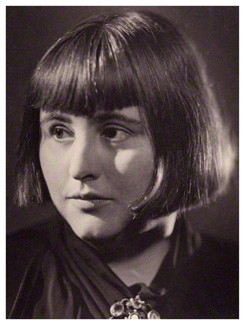
NPG x2396; Margery Louise Allingham by Howard Coster

Margery Allingham

Allingham has a gift for writing natural dialogue and inventing unsolvable plots (at least I never solve them).  This entertaining, fast-paced book opens with a young man, Jerry, offering a lift to a beautiful young woman who has alighted from a bus.

“God bless you!  It’s about a half mile down this road, and I’ve such a blister on my heel!”

He drops her off at a house called White Cottage.  He stops a little way down the road to put the hood up on his convertible and smoke a cigarette. He borrows a match from a constable and they chat.  Minutes later, a screaming parlourmaid runs down the road.  There has been a murder at White Cottage.  A neighbor, Mr. Eric Crowther, has been shot and killed in the dining room.

Jerry’s father happens to be Inspector W. T. Challoner of the Yard, and it is he who investigates the murder.  It is baffling, because everyone is a suspect, and everyone denies having seen the crime.  In spite of  Jerry’s protests, W. T. insists on questioning everybody, including the girl Jerry gave a lift to, Norah.  She is the sister of Mrs. Grace Christensen, whose husband, Roger, a war veteran in a wheelchair, owns White Cottage.

Everybody has a motive.   That’s the problem.  Mr. Crowther has tortured everybody with his  knowledge of their pasts, and threatened to tell their secrets.  Everybody says he was a devil who deserved to be dead.  He visited Joan almost every day, despite her wishes to the contrary, and the sense is that he harassed her. She found the body but says she was in the garden with her daughter before the shot, but the little girl says she was at the other end of the garden.   Estah, the child’s nurse, says she wishes she had killed Crowther herself, because he was the devil.  As you can imagine, his servants didn’t like him, either:  Crowther’s valet, Clarry Gale, is an ex-convict with a special hatred of him; and Mr. Cellini, Crowther’s Italian companion, has disappeared.

Penguin-4616 Allingham White Cottage MysteryAllingham  explores the ethics of a murder investigation.  They track one of the suspects to France, and when they meet up with Joan and Norah there, W. T. says there is no choice bu tto investigate them further.  Jerry is upset:  he wants his father to leave Norah alone and asks, “What does it matter who killed him?”

‘Jerry,’ he said, ‘in our business one must never be afraid to know the truth. You want me to throw up this case –a thing I could never do for my own self-respect’s sake –because you’re afraid to face what you believe to be true. You believe Mrs Christensen fired that shot –don’t interrupt me –I repeat you believe she murdered Eric Crowther, and you’re afraid to prove it. That’s no good, my boy –a doubt is always dangerous. For her sake as well as for everyone else’s we’ve got to find out all we can….’

Jerry sighed. ‘Then you won’t give up.’

A fascinating philosophical discussion.  Who is right?  W. D. or Jerry?  There is a very weird ending, utterly unexpected.

What a stunning little book!  I absolutely loved it.

The Summer Giant Book Project: After Broch’s The Death of Virgil, What? Perhaps The Tale of Genji

No more Broch: There's a new sherrif in town!

No more Broch: There’s a new sherriff in town!

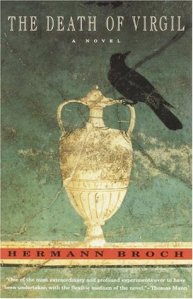
It is a running joke in my family that I have a Giant Book Project every summer. I am happy to read a giant Dickens, a giant George Eliot, or a giant Sigrid Undset. No one would  be surprised to see me lugging a set of Balzac in one of those carts you attach to your bike.   In 2010,  I made a mistake: I decided to read Hermann Broch’s modernist classic, The Death of Virgil. I have started it, abandoned it, and restarted it for six summers… and after 100 pages last year I crossed it off my list as unreadable.

Naturally it should be the perfect book for a former Latin teacher who taught Virgil’s Aeneid many times.  (Arma virumque cano, Troiae qui primus ab oris/Italiam, fato profugus...  And if I were your teacher, you memorized more.)

What could be more intriguing to a Latinist than a novel depicting Virgil’s dying days, in the form of poetic stream-of-consciousness, with the sole action in the first 100 pages being the dying man’s ogling  a boy  as Virgil is carried on a stretcher from Augustus’s ship to the palace?  Give me a cereal box.  Give me the directions to the microwave.  Give me The New York Review of Books. Snore zzzzzzzz

Lovely prose, if you like your sentencesto go on for pages.

And floating in his awareness, floatingly borne aloft over the shouting heads, floatingly borne aloft over the festival fires of uproarious Brundisium, floating, held high in the undulant movement of the present, he experience the boundless contraction of trime’s onrush in the style of immutalibity:  everything was his, all was embodied in him…

That floating goes on for a couple of more pages.

In Mary McCarthy’s academic satire, The Groves of Academe,  she sketches a hilarious picture of a “progressive” college where the students have tutorials instead of classes, and major in whatever they want, even if it is Broch’s The Death of Virgil and they don’t know Latin.  I can ditch the whole problem of what is possibly a bad translation of Broch and reread Virgil in the original.

So what will my Big Book of the Summer be?  You know, the one I’ve always meant to read, but never finish!

POSSIBILITIES

The Tale of Genji.

tale of genji dennis washburn 51lpKmqt3yL._SX331_BO1,204,203,200_Years ago I read 300 pages of this lyrical  if rambling eleventh-century Japanese novel in Tyler Royall’s translation (Penguin).  l enjoyued it up to a point, but shut the book one day and realized I preferred reading Fielding’ randy rambling Tom Jones  to Lady Murasaki’s  randy g1100-plus page masterpiece.  But Last summer I had second thoughts: I bought an e-book of Dennis Washburn’s new scholarly translation for $2.99.  I quite liked it in moderation, but I was critical of Washburn’s style.  It has that slightly awkward air of this-may-fit-well-in-Japanese-but-the English-is-improvised-Western-man-meets-Lady Marasaki.

I am, however, not wedded to this transltion.  In Ian Buruma’s review in The New Yorker last summer, he described the difficulties of translation, named the former translators, and  compared  their styles of other tarnslators.

Arthur Waley's translation

Arthur Waley’s translation (abridged)

seidensticker genji 61YAAC0KNXL

Edward Seidensticker’s translation

He explains,

The chief difficulty in translating “Genji,” into modern Japanese almost as much as into English, is the extreme elusiveness of Heian-period court Japanese—not just the language itself but also the many references and allusions. Every page is sprinkled with poems or phrases pointing to Chinese and Japanese literary sources that an eleventh-century aesthete might have been proud to notice but are lost on most Japanese today, let alone the reader of an English translation. Another problem lies in the character names. Since it was thought to be rude to call people by their birth names, most of the people in “Genji” are identified only by rank. A common solution in translations is to use nicknames derived from poems the characters compose or from their physical surroundings or qualities: Lady Rokujo lived in a mansion on Rokujo, or Sixth Avenue; Lady Fujitsubo lived in the Fujitsubo, or Wisteria Pavilion. Genji’s grandson, Niou, a devastatingly handsome womanizer, is known as the Perfumed Prince, because of his exquisite smell (niou, in Japanese).
A literal translation of “Genji” would be unreadable. And the vagueness, so poetic in Japanese, would simply be unintelligible to the Western reader. The trick is to retain the flavor of Murasaki’s lyrical style while transmitting, with some degree of precision, what she meant to say. Since we often don’t really know what she meant, much has to be left to guesswork and interpretation.

The two most famous English translations of “Genji”—Arthur Waley’s, in the nineteen-twenties and thirties, and Edward Seidensticker’s, in 1976—could hardly be more different. Waley regarded gorgeous prose as more important than accuracy. When he found a passage, or even a whole chapter, too boring or obscure, he just skipped it. He compensated for the vagueness of the original Japanese by making up something equally lyrical in Bloomsbury-period English.

This is all very interesting, and I’m thinking of trying the Waley or Seidensticker.

Have any of you read this?

Any recommendations?

Sigrid Undset’s Marta Oulie & Goodreads Gladiators


Sigrid Undset Marta Oulie 31vrQ2hXW6L._SX320_BO1,204,203,200_Sigrid  Undset, who won the Nobel Prize in 1928, is best known for her brilliant historical trilogy, Kristin Lavrandsatter, and The Master of Hestviken tetralogy.  I recently reread Kristin Lavransdatter, one of my favorite books of all time.  (I wrote about it here.)
I just read Sigrid Undset’s breathtaking novella, Marta Oulie (1907), her first published book, available in a new translation by Tina Nunnally.

Told in the form of a diary, this beautifully-written novella is the story of Marta Oulie, a woman crushed with guilt because she has been unfaithful to her husband, Otto.  He is dying of tuberculosis in a sanatorium, and his letters bore her, another cause for guilt.  He knows nothing about her affair with Henrik, her cousin and his business partner.  He always asks about their youngest daughter, Ase, his favorite child, but she is actually Henrik’s child.

She knows it would shatter him to learn the truth.  She has to bear the burden of her guilt.

I know only his life would be destroyed so thoroughly that nothing would be left of it.  Where would he turns with such a boundless, appalling grievance?  The fact that we betrayed him, while he himself was so faithful, painfully faithful in every way.  Ever since we were married, I’ve seen how he lives for his home, for me and the children–as if we were his creditors, and it was our right to take every hour that he could spare and every ore he earned.

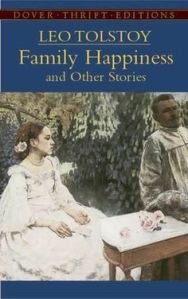
Marta Oulie is reminiscent of Tolstoy’s early story, Family Happiness, a predecessor of Anna Karenina.

tolstoy family happiness 1c94ec11a4834908724063c680f68249In both stories, a marriage begins happily, but becomes boring to the women.  Both heroines (Marta and Tolstoy’s Masha) tire of their constricted lives. Marta, a teacher, is restless. She was very much in love with Otto when they married, but after her second child she needed something else.
I think it actually began as a kind of weariness.  I had become sated with happiness.  I’ve read somewhere that happiness is always the same. And it was.

This is a powerful allusion to the opening of Anna Karenina :  “All happy families are alike; each unhappy family is unhappy in its own way.”  And it certainly foreshadows the tragedy of Undset’s plot.

Happiness can turn into unhappiness very quickly.The heroine of Marta shifts speedily from the mere flirtatiousness of Masha in Family Happiness to the infidelity of Anna Karenina. Otto, a successful if not very bright businessman,  is annoyed when she returns to teaching after the birth of their second child.  He wants her at home, where it can be seen that he supports her financially, and he also objects to her spending time at  women’s clubs where she discusses, among other things, women’s rights.  She does not want to be reduced to “nothing more than one of the entries” in her husband’s “catalog of blessings.”

Her affair with Henrik began because she noticed he was attracted to her.  He says he has been in love with her since childhood.  Of course they break it off eventually, but Otto’s illness is a heavy price to pay.  Not only does she realize that Otto is a good man as he lies dying but frantically realizes she is losing the protection of a man.  Otto converts to a dramatic form of Christianity before he dies; Marta cannot believe. What will her future be without Otto?

This book is billed as “a novel of betrayal,” but it is actually a “novella of betrayal” (just so you’ll know! ).  It is a perfect little book.  Not my favorite Undset, but one i’ll reread.

GOODREADS GLADIATORS & KINGSLEY AMIS

kingsley amis the old devils vintage 41c1d74LerL._SX324_BO1,204,203,200_ I know, I know:  you don’t expect me to wrtie about Goodreads.  I trashed it at this blog once. But I am now a full-fledged gladiator of the consumer culture.  “We who are about to read salute you!”

Some of the reviews are great, others absurdly brash.  What do I enjoy?  The star ratings. I disapprove, but they’re so much fun! Sigrid Undset’s Marta Oulie?   I gave it 5 stars out of 5. Kristin Lavransdatter?  5 stars.  D. E. Stevenson’s Katherine Wentworth?  5 stars.  Laura Caspary’s Bedelia?  5 stars.

I gave everything 5 stars!

Until…

amis_the-old-devils-fcx-700pxI gave 4 stars to Kingsley Amis’s The Old Devils.

And now I’m guilt-racked.

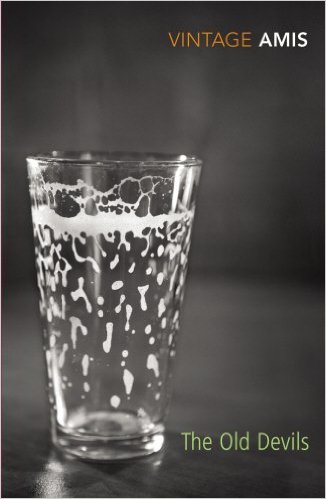
I haven’t blogged about Amis’s brilliant Booker Prize-winning novel because I didn’t enjoy it much.  It’s not that it’s not a perfect book:  it is!  But Bookerish?  I’m not sure.   I was in the mood for another satiric Lucky Jim. and naturally he did not write the same book over and over.

In the short, sharp-edged novel, The Old Devils, Amis portrays a group of elderly couples in Wales whose lives are disrupted when their friend Alun Weaver, a self-promoting Welsh poet,  returns from England to retire. His cronies, who spend their days drinking hard, have their own problems (constipation, nightmares, not being able to reach down to cut their own toenails), and are not impressed by Alun.  In fact, they disapprove of his schmoozing with reporters.

Their hard-drinking wives also”know’ Alun a little too well.  But this story of old people drinking together is amusing , because of his perfect characterizations and honest sketches of the indignity of aging.  Charlieo has panic attacks and nightmares but shoots straight from the hip when it comes to criticism of Alun’s work; Dorothy is always drunk and ranting about New Zealand, where her daughter lives, but her old friends put up with her; Peter, an unhappily married fat man who had an affair long ago with Alun’s wife, Rhiannon, still loves her; and Rhiannon, my favorite character in any Kingsley book, is both charming and kind.  Honestly, if we could all be that kind and charming.  And as good-looking!  The novel rolls along easily but…

Why CAN’T I give it four stars? It’s not my favorite, and the average rating is 3.35.  But I just can’t do it.  IT’S  THE FORMER SCHOOLMARM IN ME. My professors would be spinning in their graves if they saw Goodreads. Thank you for the liberal arts education, by the way.   The average Goodreads rating for The Old Devils  is 3.35–a C!  I have to laugh… and if I’m going to be a Goodreads Gladiator I must change my four-star rating to a five in the pursuit of fairness!  Let’s face it:  whether or not I enjoyed it, it is brilliant book.

Here’s a synopsis of the Goodreads page (sans consumer reviews).  Sorry, it doesn’t allow me to copy the page with stars and images for some reason.  But it looks sort of like this.

the-old-devils amisThe Old Devils by Kingsley Amis, John Banville (Introduction)


3.35 · Rating Details · 1,989 Ratings · 143 Reviews
Age has done everything except mellow the characters in Kingsley Amis’s The Old Devils, which turns its humane and ironic gaze on a group of Welsh married couples who have been spending their golden years—when “all of a sudden the evening starts starting after breakfast”—nattering, complaining, reminiscing, and, above all, drinking. This more or less orderly social world i …more
Paperback, 320 pages
Published October 2nd 2012 by NYRB Classics (first published 1986)

Outrageous Criticism

Everyone's a Critic 43060641_b3494810a6

I am in Book Review Limbo these days. I still subscribe to The New Yorker, but I recently canceled my subscriptions to the TLS and LRB because  (a)  I was only interested in coverage of classics, which was diminishing;  (b) Mary Beard’s free blog was obviously the go-to place for classics; and  (c) I decided I’d rather blow a couple of hundred dollars on jeans.

So where do I read reviews?  Blogs partially fill the gap.  I like the voices in personal blogs, whether polished or rough, because we get to know the individual writers.  Their voices are usually much tamer and diluted in blog/webzines, alas, but Bookslut was the best of these.   So I was sorry to hear that Jessica Crispin, the writer, critic, and editor of Bookslut, shut down her book blog/webzine, which covered mostly small press books. She says she got tired of it, and my guess is she doesn’t need it anymore, now that she has published two books.  Bookslut always seemed a little young to me, but I liked to know it was there.

So why am I writing about Bookslut if I didn’t spend much time there?  Because The Guardian sucked me in with the title of an article,  “Jessica Crispin “We’re Not Allowed to Say the Paris Review Is Boring.”

It’s so much fun to read a quote like that.  We all love an outrageous critic.  She is an outsider–she started Bookslut while she was working at Planned Parenthood in Texas–and what she learned about the New York publishing industry didn’t impress her.  I actually like The Paris Review, and used to buy it at Borders, which is no longer an option.  I still have a decades-old copy with an article about someone who went looking for J. D. Salinger.

The author of the Guardian article writes about Crispin,

In fact Crispin’s long run at Bookslut, where she did basically what she wanted, gave her a vision into the world of publishing that made her ill. She would open Bookforum, for example, she said, and find it reviewing only a certain set of books. “As things get kind of more chaotic for publications,” she said. “They get narrower and narrower and more elite and nepotistic.” It bothered her that the industry thought of itself as being intellectually honest when it was obsessed with “money and celebrity”.

I know very little about the New York publishing industry, but I have gleaned from years of reading reviews  and seeing the same few books and authors boosted in every bookstore and every review publication  that  writers who get reviewed have (a) Ivy League connections, (b) graduated from an MFA program,  (c) or, as in Hollywood…well, we can’t say that.    As for English publishing, it seems miraculous that anyone who didn’t go to Oxford or Cambridge would ever  get a gig.

By the Way, The Paris Review has published a response to Crispin’s words.

The Secret’s Out: We’re BORINGASFUCK
May 9, 2016 | by The Paris Review

Subscribe now and receive 10 percent off with the promotion code BORINGASFUCK.

Better get crackin’, guys, because that offer is finite!

Wear Your Love Like Heaven, Mom! & Five Novels About Motherhood

"Wear Your Love Like Heaven," Mom!

“Wear Your Love Like Heaven,” Mom!

Mother’s Day is a national holiday.  Too bad for moms it’s not on a Monday so they can have a day off from work.

I loved my mom, but I had problems with Mother’s Day. It’s a greeting card holiday. The whole point is to buy Mom a nice present, right? You want to be a perfect daughter, but what does Mom want?

“Anything,” she always said brightly. Or, if pressed, “Nothing.”

Oh, dear. We were both collectors, but did not have the same taste. With me it was always books (and dust); with her it was the bounty from Hobby Lobby, sidewalk sales, Gifted, and craft fairs.  I tried giving “anything”:  embroidered handkerchiefs from Woolworth’s a la Little Women (we didn’t believe in sewing on buttons, let alone embroidering), and the much-advertised Yardley’s Eau de Love spray, with its signature Donovan song (“Wear Your Love Like Heaven”), not quite aimed at women of my mother’s age.  Later I got better at gifts:  decorative playing cards (she was a bridge fiend), pantsuits ordered from catalogues (sometimes they fit, sometimes not)  and studio photos of me in the pre-selfie century ( though I hated having my picture taken).  I also sent flowers as a desperate gesture of filial love.

She didn’t like flowers much.  In fact, she didn’t like the outdoors much.  She complained that her neighbor’s wild flowers were “weeds,” bringing down the price of her property. (Later she and the gardener became friends.)   Her knickknacks filled the house and caused me much embarrassment as a child.  My best friend laughed hysterically over the JFK bust, and her highbrow parents, who didn’t know any knicknack collectors, referred to me as “the normal child in the Addams family.”  Well, I always thought Morticia Addams, the mother of the monstrous TV family, was very pretty, and come to think of it Mom’s hair was rather like that!  So maybe it was a backhanded compliment.

I often wish my life were like Mom’s. Life to death in the same town, seeing the same neighbors and friends from childhood to old age. Women of my generation were gypsies and left town to find work. As a young woman she and her friends worked in offices and went to dances and vacationed in Clear Lake and Chicago, where they stayed at the Palmer House.  She met my father in Clear Lake, which was, as far as I can figure out, a resort then.

There were some rocky periods when  she found out I lived with a boyfriend.  What a lecture I got! But it all smoothed out eventually.   We learned to keep it light and went to brunches and the mall.  And we became close at the end of her life.

So, Happy Mother’s Day, Mom, and I hope the Yardley Eau de Love spray, obviously not marketed at women in their thirties, is finally appropriate in Heaven!

And here are a few excellent motherhood novels I’ve blogged about.  Great summer reading!

  1. mother and two hardback gail godwin516P2u0ym5L._SX353_BO1,204,203,200_Gail Godwin’s A Mother and Two Daughters, the story of three women entangled by family ties and daily conflicts that make it hard to see one another clearly. It is told from alternating points of view and in distinctive voices: Nell Strickland, a happily married woman who lives with her husband, Leonard, a lawyer, in a house with a view of the mountains in North Carolina; Cate, her wildly rebellious daughter, is an English professor at a college in Iowa, who has been married twice and is ending an affair with the Resident Poet; and Lydia is the dullest, a 36-year-old housewife and mother of two who leaves her husband for two reasons: (a) to take a lover and (b) to go back to school.
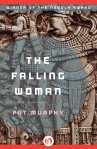
  2. falling woman pat murphy 91fN01GqVsLPat Murphy’s The Falling Woman (1986), which won the Nebula Award and was billed as SF, reads like literary fiction, with a touch of mysticism. The setting is an archaeological dig on Mexico’s Yucatan peninsula. There are two heroines: the chapters alternate between the viewpoints of Elizabeth Butler, an archaeologist and expert on Mayan civilization, and her daughter, Diane, who was raised by her father but after his death shows up unnanounced at Elizabeth’s dig.
  3. Drabble The Pure Gold BAbyMargaret Drabble’s The Pure Gold Baby revolves around Jess Speight, an unmarried anthropologist whose child, Anna, has developmental problems. After Anna’s birth, Jess switches her focus in anthropology from Africa to England and embarks on a career of freelance journalism so she can care for Anna at home.  The narrator, Nelli,e is fascinated by Jess’s refusal to tell the father, possibly a married anthropology professor, if indeed he is her lover, because Nellie is not sure whether he exists or whether Jess made him up. Anna is an easy baby, but when her developmental difficulties become evident and Jess must take counsel from a doctor, we are reminded of Drabble’s early novel, The Millstone, in which the unmarried narrator, a scholar, has a baby who needs surgery, and she must navigate the health system, eventually playing the upper-class card so her baby will get good care.
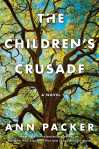
  4. ann packer the-childrens-crusade-9781476710457_hrAnn Packer’s The Children’s Crusade, a brilliant novel about five decades in the lives of the Blair family, Packer asks questions about the American family: is the “bad mother” responsible for all her children’s woes? Is she even necessary when her husband, a saintly pediatrician, is the perfect parent? The women at the group are no-holds-barred angry about the artist Penny Blair’s withdrawal from her family. Having seen many styles of parenting, some much worse than Penny’s, I suggest that Bill, who responds to every crisis with caring questions and psychoanalytical language, is also part of the problem. But censure of Penny is the order of the day.
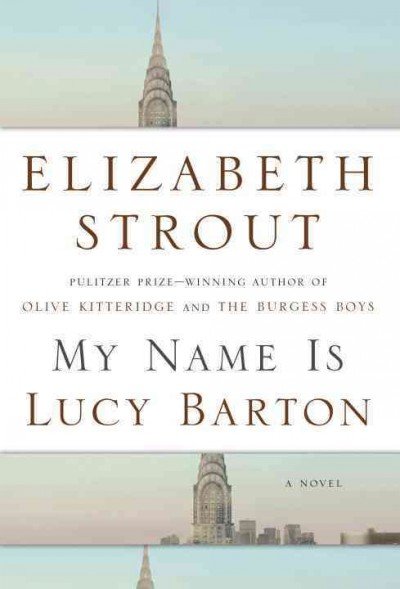
  5. Pulitzer Prize winner Elizabeth Strout’s My Name Is Lucy Barton a gorgeous, lyrical novel about a complicated mother-daughter relationship. The narrator, Lucy Barton, escaped a harrowing, impoverished childhood through a college education. She reinvented herself as a wife, mother, and writer in New York.  During a hospitalization, her mother visits her and they reconcile.  And this has a huge effect on Lucy’s writing.  Possibly this is the best book published in 2016.strout my name is lucy barton 9781400067695_custom-3102f059730b66633fef44e3287ef91337c0495f-s400-c85

The Dessie Question: The Popularity of D. E. Stevenson & Why I Love “Katherine Wentworth”

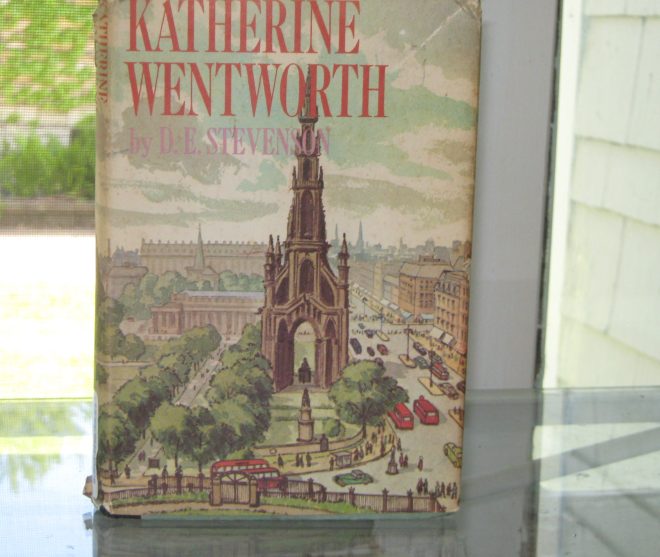
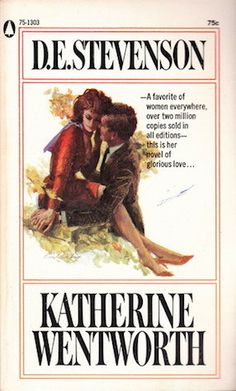
IMG_3630 D. E. Stevenson Katherine WentworthD. E. Stevenson (1892-1973) has hundreds of fans.  There are 345 members of the Dessie group at Yahoo.  Although some categorize her books as light romances, I consider them domestic fiction.  Stevenson is far too discerning and humorous to write a typical love story.

Most of her books are out of print, but several have been reissued in the last decade.  My favorite is Mrs. Tim of the Regiment (Bloomsbury Reader), a comic novel written in the form of a diary  of the wife of an Army officer.   It is based on Stevenson’s own diary.  And Persephone Books has reissued two more and  Sourcebooks has reissued eight.

I am unwilling to pay $25-$50 for an out-of-print DES, but I recently picked up a cheap edition at a sale of Katherine Wentworth,  one of her most captivating books. The atmosphere if not the content falls somewhere between Dodie Smith’s I Capture the Castle and  Richmal Compton’s slightly more wobbly middlebrow novels. You sink immediately into the warmth and stability of Stevenson’s narrative.  Her style is simple and straightforward, getting the job done.  It is her  life-like characters and warm, vivid observations of life that make one read her addictively.

One of the mass-market covers (oh dear!)

One of the mass-market covers (oh dear!)

This charming book is narrated by Katherine Wentworth, a pragmatic, observant widow with a sense of humor. She is struggling to raise her twins and her teenage stepson alonesince the death of Gerald, her archaeologist husband.  The family lived happily in Oxford before; now they live in a small flat in her hometown, Edinbugh.  She is very busy.

Then one day she is walking down the street and an old friend recognizes her.  Katherine has no idea who she is.

The speaker was a woman in a mink coat and a smart green hat with a feather in it; her ace was pale and fine-drawn; her hair, which lay in smooth waves beneath the green hat, was yellow.  I had a vague sort of feeling I had seen her before, but when and where…

Don’t you love her description of fashion?  There are a lot of tweeds in her books, but her women are as fond of clothes as E. M. Delafield’s Provincial Lady and Jan Struther’s Mrs. Miniver.  Zilla is obviously going for a stylish effect.

It turns out that  Zilla went to school with Katherine.  Katherine remembers her as an older girl who was good at games (so was Katherine). And Zilla is heartbreakingly lonely, never married, but  lives with her brother and socializes with shallow rich people.   Zilla insists Katherine come to tea, but has a very possessive nature.   She is annoyed by her brother Alec’s attraction to Katherine, and tries to keep them apart.  Katherine doesn’t care much:  she is busy with the children.

Alec soon becomes a part of the Wentworths’ lives, taking them out for drives and later, when they borrow Zilla’s house in the country for a cheap vacation, he drives them there. Zilla is always having hysterics about his seeing Katherine, so he tries to hide the fact that he is seeing her.  Katherine likes him and is amused by him, but he can she really fall in love with a man who’s afraid of Zilla?  She helps him learn to confront her.

There is an odd romantic plot twist:  Katherine’s late husband left his family, refusing to stay home and manage their estate.  The family has never met Katherine or the children.  Suddenly Simon becomes the heir, and Katherine must visit them.

Well, nothing turns out the way you think it will!  And that’s why I like DES.  The book is a bit uneven, but while you’re reading it you don’t notice.

And that’s why I am a huge fan of Stevenson (though I must admit that not all of her books are good).  Sometimes a comfort read is necessary.

“Girlitude” Week: Tillie Olsen’s Yonnondio

Yonnondio olsen 51QIefHk7XL._SX336_BO1,204,203,200_

It’s Girlitude Week!  It’s my women’s lit binge–last time I called it Gal Up! Week– and I am off to a good start with TILLIE OLSEN’S YONNONDIO:  FROM THE THIRTIES. 

Olsen (1912-2007) was an American feminist writer, best known for her award-winning short story,”Tell Me a Riddle.” She was a powerful presence at a reading, and those of us who attended were mesmerized by her charm and eccentricity.  She wrote only three books, Tell Me a Riddle,  a brilliant collection of four short stories (“I Stand Here Ironing” is widely-anthologized); Silences, a study of why writers (often working-class, women, or people of color) fall silent; and Yonnondio, an unfinished novel.

I procrastinated reading Yonnondio (written in the ’30s, published in 1974), since I am not a fan of unfinished lit. But lo and behold!  it s is Olsen’s best work, a tour de force, the powerful story of a working-class family trying to survive during the Depression. Her lyrical style combines stream-of-consciousness and naturalism:  it is like Dreiser and Harriette Arnow high on Faulkner and Walt Whitman.

Olsen, a union activist who worked for low wages as a maid, packinghouse worker, and factory worker while raising four daughters, lived for many years in poverty.  In this harrowing portrait of the Holbrook family trying to get by on starvation wages, they fall lower and lower down the ladder of the American class system.  The Fourth of July means nothing to weary Anna Holbrook, who is annoyed when her husband spends money on fireworks:  the celebration of freedom has nothing to do her family.  Jim works like a slave in a coal mine, then as a tenant farmer, and then in the slaughterhouse.

In the beginning, when he is a coal miner in Wyoming, it is a stark life.  How could it get starker? we wonder.  The miners are brutal and often drunk, while the woman  try to protect the children and help them get an education.  There are shades of D. H. Lawrence’s Sons and Lovers in Yonnandio, though Lawrence’s Morel family is more refined than the Holbrooks.

yonnondio bison books 51xLzDkJdnL._SX311_BO1,204,203,200_Olsen sketches the family with a harrowing simplicity.

For several weeks Jim Holbrook had been in an evil mood.  The whole household walked in terror.  He had nothing but heavy blows for the children, and he struck Anna too often to remember.  Every payday he clumped home, washed, went to town, and returned hours later, dead drunk.  Once Anna had questioned him timidly concerning his work; he struck her on the mouth with a bellow of “Shut your damn trap.”

But Anna doesn’t stand up to the situation as well as Lawrence’s better-educated Mrs. Morel.

Anna too became bitter and brutal.  If one of the children was n her way, if they did not obey her instantly , she would hit at them in a blind rage, as if it were some devil she was exorcising.  Afterwards, in the midst of her work, regret would cramp her heart at the memory of the tear-stained little faces.  “‘Twasn’t them I was beatin up on.  Somethin just seems to get into me when I have something to hit.”

And the mines are dangerous:  there are explosions, and Jim is lucky to survive.  And after a schizophrenic man tries to throw their daughter Maizie down a mine because he thinks it is hungry, Jim decides to move.

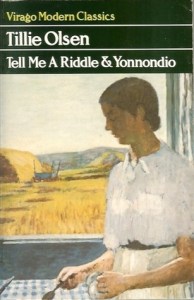
tillie olsen virago 21140689They live on a tenant farm in South Dakota, where they grow their own food and at first are very happy. The children thrive on the land and finally have a chance to go to school. This is Anna’s dream for them:  she wants them to go to college.  Mazie, the oldest child, is especially quick, imaginative, and  creative.  She invents stories about nature for her brother (myths about the wind, leaves, and stars).  But Anna is constantly pregnant and sick, having and losing babies.  Maizie is traumatized when her father leaves her alone on the farm with her mother in labor, and her mother is furious that he takes the other children and leaves the little girl.  As soon as Jim comes back with a woman from the farm,  Maizie runs and hides and covers her ears.  She doesn’t quite understand what is happening, but she knows it is terrible.

The bank owns the farm but the bank and takes all the money, so they move to Omaha, where Jim slaves in a slaughterhouse.  VIolence, brutality, and the stink of dying cattle and the meat processing dominate their lives and make them sick.

What a stunning book!  And what a shame that we lost all those years of Olsen’s work.  But who can write when she must work round the clock at a job and raising children?  In the early ’70s Olsen found four complete chapters of the book and some fragments.  She says she began it in 1932 in Fairbault, Minnesota, and worked on it until 1937, as she moved around the country.  She cobbled it together and polished it.

She writes,

Judgment had to be exercised as to which version, revision or draft to choose or combine; decision made whether to include or omit certain first drafts and notes; and guessing as to where several scenes belonged.  In this sense–the choices and omissions, the combinings and reconstruction–the book ceased to be solely the work of that long ago young writer and, in arduous partnership, became this older one’s as well.

I loved it, and it’s one of the best books I’ve read this year.  It is available from  Bison Books, an imprint of University of Nebraska Press.