“Parenthood,” Cats & Trees

It was supposed to look like this!

It was supposed to look like this!

I’m not  a holiday kind of gal.   Christmas is for families, not couples.

But I’ve been sick this week, with the cold from hell.  Really.  I was so wrecked from cold pills and Nyquil that I binge-watched Season 4 of Parenthood, a high-end prime time soap opera (2010-2015).  I love the characters, three generations of the Braverman family, who are beautiful, talented, dysfunctional, and occasionally very annoying.  Sarah (Lauren Graham from The Gilmore Girls) wrecked her relationship with her fiance, Mark (Jason Ritter), the most adorable English teacher on the planet, to accompany her moody photographer boss, Hank (Ray Romano), to L.A. for a “work” weekend.  (Sarah, you will never find anyone like Mark again!)  Julia, a corporate lawyer on the partner track, made a huge mistake at work and surprisingly resigned to stay home with her adopted son, Victor.  And my favorite character on the show, Christina (Monica Parter), had breast cancer.  Poor Christina!  She’s the rock of her family.  The season was very dramatic.

Christmas is a big deal for the Bravermans. Nobody acts out on Christmas.  It’s TV. And I loved Julia’s Christmas decorations.

And so I decided to decorate. My options were limited, since I was sick. I ordered two artificial trees, a  6-ft.-tall tree for the living room and a small tabletop tree for the study.   I mean I’m not going to get real trees, right?  I’m not going to plant them afterwards.

My plan? I would assemble the trees while my husband was at work and surprise him.

Want to know how this went for me?

First, the 6-ft. tree came without an instruction booklet.  I was told there were no spare instruction booklets and offered a  discount.  I assembled it by myself–sort of.  You have to “fluff out” the branches.  Ouch.  They’re scratchy.  And the bolts didn’t fit in the tree stand.  It was wobbly.  It looked okay once decorated.

And, yup, after I left the room, the cats knocked it over.  Now it’s leaning against the bookcase in the study.  Rickety, but Christmasy.

The tabletop tree is fine!  A nice steady stand, thank God.  Since it can stand up alone, it’s in the living room.  But the cats are hilarious.  Unfortunately they will not leave the decorations alone.

Forget the ball-shaped ornaments.  The two youngest cats jumped up and down athletically, determined to rip them off the tree.  The balls are now cat toys.

The youngest cat spent an hour pawing tiny gold bells and miniature fake packages off the tree.

So they’re now officially cat toys.  Every morning I get up, put the decorations back, and vacuum.  But I don’t mind.  The cats are so happy!  And the winter is so boring for them.
Pushkin’s Eugene Onegin, Why I Wish I Knew Russian, & a Pushkin Giveway

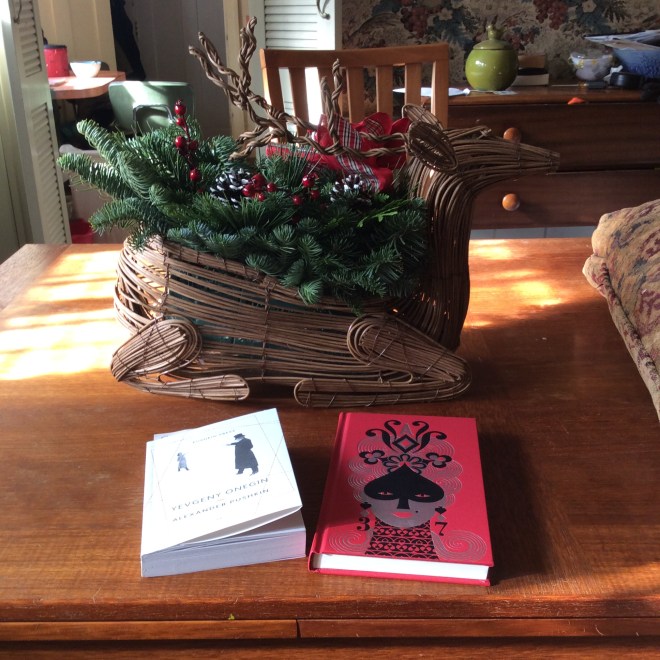
Pushkin under the wicker reindeer!

Pushkin’s Yevgeny Onegin and a Folio Society “Queen of Spades” notebook, with reindeer.

I love Pushkin.

Who doesn’t?

The Russians consider him their best writer.

After a a few days of barely looking up from Pushkin’s  Collected Stories (and you must read “The Queen of Spades,” a ghost story about a gambling grandmother), I decided to reread Eugene Onegin.

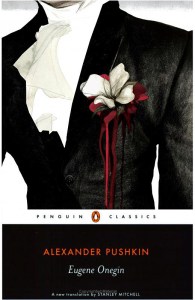
I first read Pushkin’s lively novel in verse in college, as did my husband. We lost our identical copies years ago, and have no idea what translation it was.  And then two years ago I got a hankering to reread it.  I picked up a new Penguin and enjoyed Stanley Mitchell’s elegant, charming translation of Eugene Onegin.

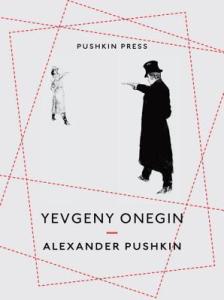
So why did I need Anthony Briggs’ new translation, Yevgeny Onegin?  Because Nicholas Lezard at The Guardian listed it as one of his favorite books of the year.

Eugene Onegin Pushkin 56077-largeAlthough Briggs’ and Mitchell’s approaches to verse and word choice are different, both translations are readable. I wrote here in January 2015 about Mitchell’s translation:

In this brilliant novel in verse, Pushkin tells the story of Eugene Onegin, a rakish Byronic hero who, bored by carousing, wine, women, song, writing, and even books, moves from St. Petersburg to the country after inheriting an estate. He befriends a young poet, Lensky, to whom he is very devoted.   And yet he thoughtlessly wrecks their friendship by flirting at a dance with Olga, Lensky’s fiancée. The result is a duel with Lensky. (Eugene doesn’t want it, and yet somehow he doesn’t say no.) And the whole thing is complicated by Eugene”s rejection of Olga’s sister, Tataina, who writes a love letter to him.

The narrator’s voice is almost always ironic, and the poem mixes lyricism with realism. Olga soon forgets Lensky and marries someone else. Tatiana visits Euegene’s deserted house and falls in love with his library. Eugene only falls in love with Tatiana years later, after it is too late.

Briggs’ translation is intelligent, but less elegant than Mitchell’s.  That  is not, however, why I am giving it away to a lucky reader. (Leave a comment if you’d like it.)   It’s because  I DON’T LIKE THE DESIGN. The Pushkin Press book is small, pretty, and chic, but has smaller print than the Penguin and is somehow less comfortable to hold.   I had this same problem with the Dorothy Project’s chic edition of Barbara Comyns’ Who Was Dead and Who Was Changed, another  little square book.  

Briggs' translation.

Briggs’ translation.

What I like most about  the Briggs edition is the scholarly introduction, which explains the history of Pushkin’s  invention of the Russian literary  language and his prosody, inspired by Shakespeare.

Briggs writes,

The writer’s greatest achievement, apart from the literary quality of his work as a whole, in which the disciplines of classicism mesh with new freedoms released in the age of Romanticism, is nothing less than to have reformed the national language.  This bold claim is no exaggeration.  As he grew up, the young Pushkin was presented with at least three different linguistic forces existing as separate entities in his large country .  Posh people spoke French, ignoring or despising ordinary Russian, though Pushkin heard a good deal of this tongue from the local lads and from his dear old nanny…(who makes an endearing guest appearance as Tatiana’s nurse in the third chapter of Yevgeny Onegin).  In addition, he was continually subjected in church and at school to the rich sonorities of Old Church Slavonic.  By some miracle, almost without thinking about it, he created modern Russian simply by using it, choosing at will between elegant Gallicisms, vernacular Russian and his nation’s equivalent of the King James Bible and Book of Common Prayer, with a sensitivity to sound, style and meeting that gives him an elevated place in the annals of linguistic reform.

Long ago, the beloved professor of my Russian lit in translation class examined the themes of maturity and metamorphosis in Eugene Onegin. He also lectured on the relationship between the narrator of Eugene Onegin and the reader, the narrator and Eugene, and the narrator and the work of literature.

If only I had taken better notes!

WHY I WISH I COULD LEARN RUSSIAN.

Why do Russian translations read so well?  I do wish I could learn Russian.  Translation (literally a “carrying across,” from the Latin transfero) is a precarious art:  it  captures sense but not sound, and only crudely suggests word arrangement, figures of speech and meter.

For years I devoted myself to classics and read little in translation.  Why?  Snobbishness and foolishness.  One of my best and most snobbish classics professors (and “classics professor” implies excellence and snobbery) used to tell us, ” You can’t do serious work in translation.”  I understand what he means–Mary McCarthy in The Groves of Academe also laughs at a student who writes her thesis on Broch’s The Death of Virgil, without being able to read Virgil –but where can we all find the time to be linguists?  I was committed  in grad school to eight to ten hours a day of ancient languages, studying for comps, and teaching  elementary Latin and a Virgil’s Aeneid independent study.   Learn Russian?  Forget it!

Fewer people in the U.S.  have opportunities to study foreign languages today.  The culture is now very business-oriented, and many colleges and universities are slashing humanities courses.  The state universities in the area are hanging on  by a thread to their language departments.   I do not expect this to get better under Trump’s rule.

Where I live?  All language departments eliminated at the local “private” university!

A Giveaway of Guy Gavriel Kay’s River of Stars

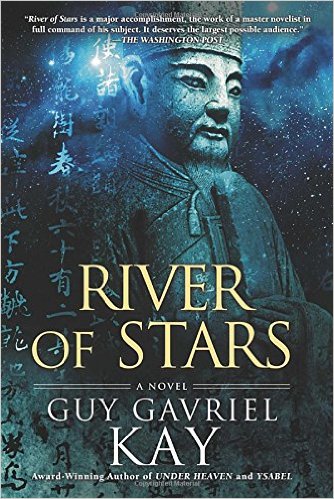
river-of-stars-kay-51b0gwircsl-_sx332_bo1204203200_You don’t have to be an SF/fantasy fan to enjoy Guy Gavriel Kay’s beautifully-written River of Stars, an engrossing novel of  war, politics, poetry, and love, set in a fictional  country inspired by China in the Northern Song Dynasty. 

I began to read Kay’s gorgeous fantasy novels after I read Washington Post critic Michael Dirda’s review of Under Heaven, the first book in this  series.  Dirda wrote,

Guy Gavriel Kay’s “Under Heaven” isn’t quite historical fiction, nor is it quite fantasy. It’s set in a slightly reimagined Tang dynasty China, sometimes seems reminiscent of films like “Crouching Tiger, Hidden Dragon” and depicts the unimaginable consequences of a single generous gift. Most important of all, it is the novel you’ll want for your summer vacation.

The second novel, River of Stars, set four centuries later,  is equally intriguing but heartbreakingly sad. I only hope there will be a sequel. My only real criticism?   Like George R. R. Martin’s  Game of Thrones, Kay’s novel has a huge cast of characters and  switches constantly from one character’s narrative to another. I found this annoying, because just as I’m getting used to one character he shifts.  But  obviously fans of Martin don’t mind this kind of thing, and  reviewers of River of Stars were very enthusiastic.

Anyway, here  is a quote from Laura Miller’s review at Salon:

Kay’s exquisite Asian-inspired epic fantasy offers a fresh twist on intrigue and adventure…  Here you’ll find all the scheming and skulduggery that give Game of Thrones its zest, refined to the subltlest of arts.

Leave a comment if you want the  book!  Anyone in the U.S. or Canada is eligible, but, alas, I can’t afford the postage elsewhere.  (Nor can you!)

Rachel Ferguson’s Stocking Stuffers: A Doll’s Grand Piano & a Play about Seneca

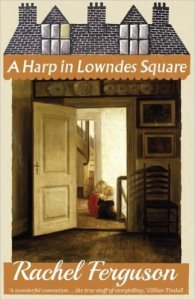
harp-in-lowndes-square-ferguson-515nrd9tpyl-_sx322_bo1204203200_I love Rachel Ferguson’s brilliant novel, The Harp in Lowndes Square, which I wrote about briefly yesterday.

Her sharp observations and witty prose are irresistible.  And I love the captivating voice of the narrator, Vere.  She has to muster all her humor and stoicism to cope with Lady Vallant, the evil grandmother from hell.

Today I’m writing about Vere’s creative ideas for Christmas stocking stuffers. I  wonder if I could find a doll’s tin grand piano on the internet, and I wish I were clever enough to write an original play about Seneca, or any Roman for that matter.

Last summer I reread Seneca’s letters, in preparation for reading Peter Stothard’s excellent book, The Senecans:  Four Men and Margaret Thatcher.  I even dusted off my old Roman Letters notes.  So when Vere gives her  actor friend, Cosmo Furnival, a satiric two-minute tragedy  she has written about Seneca, I could not but laugh.

Here is her complete list of stocking stuffers:

I had filled stockings for them both; in Enid’s, a mass of tiny sparkling silliments including a celluloid goldfish in a talc ball and a doll’s tin grand piano; in Cosmo’s, a property monocle of window glass to which I had attached six yards of watered silk ribbon, and a tiny booklet I had made and written, containing a tragedy in verse called Seneca, which consisted largely of the direction, Another and more expensive part of the Forum: Enter Cosmo Furnival as Seneca, and whose concluding lines ran:

Bleed, wrist! and free my spirit from its chains,
Rome take my blood that gushes from these veins.

And you might as well add Ferguson ‘s A Harp in Lowndes Square to your gift list.

I hope you’re all inspired!

The Unpaid Booksellers of Cyberspace

taintor-looking-for-trouble-000_01354looking-for-trouble-posters-500x500

The publishing world, except for journalism, is closed to most aspiring writers and editors. Bbibliophiles who long to wield a blue pencil on manuscripts of masterpieces at New York publishers have a slim chance of getting a job, unless they went to Ivy League schools or Seven Sisters colleges. Even slimmer are their chances of publishing that novel in a drawer. I hear it is slightly easier to break into genre fiction: for instance, SF embraces outsiders, much in the way journalism does.

And yet there is so much talent out there. That’s why the internet is a blessing. Creative people wear fingerless gloves in attics and write novels or poetry, but now they also have blogs and Facebook pages.

I love the concept of blogging, though I will be the first to admit we bloggers are control freaks.  We write what we like, and damn the torpedoes full speed ahead! Nobody can tell us what to say.  We’re garage bands.  Trolls try to interfere:  are they secret CIA agents????   Another way of looking at blogging is, “Power to the people, smash the state,” as we used to chant at protests, and though I don’t know quite what I meant , I do believe people should have a voice.  Audiences at blogs tend to be small, but people do find their way to read them. I don’t quite have the technical part of cyberpublishing down:   As  I have learned from deleting a post at my subversive book journal, it has already gone out to a few hundred subscribers, even if it no longer appears at the site, so my cyberspace publishing is scatty, with bits here and there in cyberspace, appearing and disappearing, like Billy Pilgrim in Vonnegut’s Slaughterhouse Five.

Anyway, we are the unpaid booksellers of cyberspace.   So who minds a few glitches?

And I have  some very good news about a blogger who has bridged the gap between bloggers, booksellers, and publishers in cyberspace:  Scott, the author of the Furrowed Middlebrow blog, has ventured into publishing.  He now has his own imprint at Dean Street Publishing, and he has reissued some remarkable interwar fiction, mostly by women.

harp-in-lowndes-square-ferguson-515nrd9tpyl-_sx322_bo1204203200_I am a great fan of Rachel Ferguson, so I was very interested to read a TLS review of  three of her novels reissued by Furrowed Middlebrow.  I have almost finished Ferguson’s A Harp in Lowndes Square (1936), and it is not only the wittiest book I’ve read the year, but one of the best books I’ve ever read. (I know I said the same about Barbara Comyns’ Our Spoons Came from Woolworths, and it is true of both in different ways.)   You may know Ferguson as the author of The Brontes Went to Woolworths (Bloomsbury Reader) and Alas, Poor Lady (Persephone). Her voice is sharp, witty, mercilessly observant, and whimsically post-modern.

In A Harp in Lowndes Square, the narrator, Vere, is not only witty and brilliant, one of three children in an unconventional single-parent family,  but the twin of James, with whom she shares a psychic bond.  They see and hear ghosts of Henry VIII, their family, and others. Vere breezily tells the often comical story of the adventures of her dysfunctional family , and are very close to their mother and older sister, Lalage. But they are disturbed by their mother’s withdrawal and obvious dread of their grandmother, Lady Vallant, on rare visits to Lowndes Square.  As an adult, Vere investigates the tragic family history.

I’ll post about this stunning book in detail when I have time, but meanwhile here os a charming passage about Vere’s schooldays to show off the charm and style.

We were happy there and never overworked, and my memory of it will always be bound up with lilac, may trees, laburnum, syringa and the plays of Euripides in an eternal warmth and impossible summer. The headmistress, a gentle, uncertificated woman with a flexible nose and a bun, had a passion for school plays, and selected the Greek drama as being the most respectable, whereby we spent a large portion of nearly every term declaiming about curious and bloody vengeances, morbid elopements with a wordy fellow called Death, and singularly uncivil passages between sons and aged fathers.

By the way, if you have Kindle Unlimited, you can read Ferguson’s books for free.  (Well, it’s $10 a month or something, but you can read as many as you like with the Unlimited label during that month.)  I will definitely buy a hard copy of A Harp in Lowndes Square., because I love it,  but an e-book also has its virtues.

We have colds at our house, and I wish you a Happy Weekend.  No, I do not think you can catch my cold by reading my blog!  That’s a troll’s wish!

Wit’s End

taintor-phone-51oe1i3dnulWhen the top of my screen lights up with a blog comment symbol, I check it right away:  Great!  It’s one of my two-to-three-max comments a day!

But I am also psychic, and I had a bad feeling about this one.  I’d seen this commenter overstepping boundaries and dripping venom all over the blogosphere.   Finally I read the comment:  a long, incoherent attack on a very light, harmless post I’d banged out about a book I love.

I was not offended or shattered or whatever I was supposed to feel.  I was bored.

And my experience with family mental health problems has taught me to interpret such comments in terms of mental afflictions. My husband always says, “Kat, that person’s not undiagnosed Bipolar 2; he’s an asshole!” And he’s probably right 90% of the time.  But if you have close friends or relatives with mental illness, you let off steam by joking inappropriately.  Besides, I skimmed the Diagnostic and Statistical Manual of Mental Disorders during one of my cousin’s appointments at the hospital and would love the chance to diagnose somebody.

MEANWHILE:

I prescribe Pushkin for all bloggers who have had to read nasty comments, because he will charm you and take your breath away.   Thank God for Russians!

I prescribe Emily Dickinson for all the commenters I like.  They will exalt you!

And the nasty commenter I just had the pleasure of censoring had better read Pollyanna or something about morality, because I don’t want to hear one bad thing from you ever again, Missy!

Emily Dickinson’s “There’s a certain slant of light”

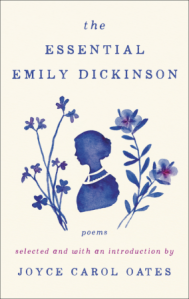
the-essential-emily-dickinson-y450-293Here is one of my favorite poems by Emily Dickinson.

There’s a certain Slant of light (320)

There’s a certain Slant of light,
Winter Afternoons –
That oppresses, like the Heft
Of Cathedral Tunes –

Heavenly Hurt, it gives us –
We can find no scar,
But internal difference –
Where the Meanings, are –

None may teach it – Any –
‘Tis the seal Despair –
An imperial affliction
Sent us of the Air –

When it comes, the Landscape listens –
Shadows – hold their breath –
When it goes, ’tis like the Distance
On the look of Death –

Brutal Winters in Willa Cather: Why Aren’t Women’s Clothes Warm?

a lost lady cather vintage 1972 51nRiPWgiIL._SX298_BO1,204,203,200_Winters can be brutal in the Midwest.  Think  Willa Cather. She was the first writer I read who described the bitter winters of Nebraska (and  contiguous states).  I spent winter nights my senior year in college reading her books in a chilly rented room in a run-down house.  One of the pleasures of winter is reading about winter.

In one of Cather’s most brilliant novels,  A Lost Lady, the heroine, Marion Forrester, can hardly bear winter in Nebraska. She and her husband, a railroad magnate, used to winter in Colorado Springs.  He was an officer for a bank in Denver, and when it failed, he  compensated the bank customers’ losses with his own money.

Marion Forrester is gracious and sophisticated, but she wishes he had kept some of the money.  Temperamentally she is unsuited for country life.

“Oh, but it is bleak!” she murmured. “Suppose we should have to stay here all next winter, too,… and the next! What will become of me, Niel?” There was fear, unmistakable fright in her voice. “You see there is nothing for me to do. I get no exercise. I don’t skate; we didn’t in California, and my ankles are weak. I’ve always danced in the winter, there’s plenty of dancing at Colorado Springs. You wouldn’t believe how I miss it. I shall dance till I’m eighty.… I’ll be the waltzing grandmother! It’s good for me, I need it.”

I have known desperate women in small towns, and who isn’t desperate in winter?  Gradually Marion compromises herself in her association with Ivy Peters,an exploitative lawyer she has known since boyhood who speculates dishonestly.  All of Cather’s characters are vivid, perhaps because they were her friends and acquaintances in real life.  Cather based the Forresters on a gracious couple in her hometown, Red Cloud, Nebraska.  The model for Captain Forrester was Silas Garber, the fourth governor of Nebraska, and the founder of the Farmers’ and Merchants’ Bank in 1889.  When the bank failed in 1893,   he gave his own money to the customers. (Would anybody do that nowadays?)   Like Niel, the narrator of A Lost Lady, Willa frequently visited Mrs. Garber (the model for Mrs. Forrester), a charming woman who, in the words of my guide on a Cather tour of Red Cloud, ” brought sophistication to the town.”

Keeping warm is half the battle of liking winter.  All of my friends had trouble keeping warm.  None of us had a car. We all walked and walked.  Our rooms were within walking distance of downtown and campus.  We wore  parkas with fur-trimmed hoods, or layers and layers under wool coats from thrift stores.  The best thing about working–and everybody had part-time jobs–was that we were temporarily in a very warm building.

The thing is, it is harder and harder for women to find warm clothes.   You can’t get them at the mall.  You need to order from outdoorsy catalogues.  Here’s what I’ve noticed.  The jeans and corduroy pants from Lands End are thinner than they used to be, and no longer have pockets. When I walk out the door, my trunk is warm because of the parka, but I need long underwear under these thin girlish pants because my legs are freezing even when it’s over 30 degrees.   These clothes are made for women who walk from the house to the car, and then from the car to work.  For long distances, you need warmer clothes.

It’s like saying to women, “You aren’t supposed to be outdoors.  You’re supposed to be ornaments.”

Nobody should say that to women ever.  Not if they take walks and bike. And we do.

In Which I Am Surprised by Pushkin’s Stories

collected-stories-pushkin-51pnqsbvwhl

God bless the state universities!  Without education for the people, this particular Iowa City girl might never have read Pushkin. I went to college on Pell grants, loans, and part-time jobs, and had to sell my books to buy tampons, but who didn’t?  It only took seven years’ working at a poverty-level job to repay the loans.  Here’s a little secret they don’t share with Millennials: the economy back then was terrible, too.

One of the best reasons to go to the university:  you can read Pushkin as part of your work. I loved Eugene Onegin, a playful novel in verse, and enjoyed a few of the stories, though not as much.

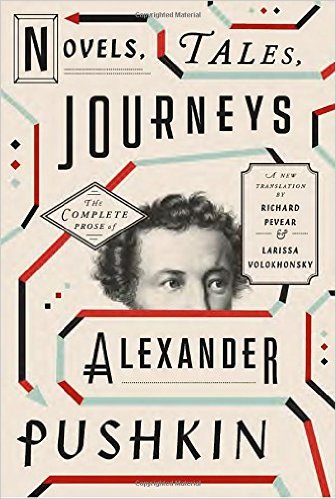
At the Barnes and Noble Review,  Heller McAlpin writes about a new translation by Richard Pevear and Larissa Volokhonsky,  Novels, Tales, Journeys: The Complete Prose of Alexander Pushkin.  Mind you, I don’t have the new book but  I got out my trusty Everyman edition, The Collected Stories, translated by Paul Debreczeny.

pushkin-pevear-volokhonsky-51nhpudozxl-_sx334_bo1204203200_

New edition of Pushkin’s prose.

McAlpin hopes that Pevear and Volokhonsky’s lively new translation will help new readers discover Pushkin, but has compared translations and does not find them very different. He writes,


In the brief introduction to her translation of my well-worn Everyman edition of The Captain’s Daughter and Other Stories, Natalie Duddington wrote, “As a poet, Pushkin is untranslatable: the exquisite beauty and the austere simplicity of his verse cannot be rendered into a foreign tongue . . . But his prose has none of this poetic quality and loses but little in translation. It is vigorous and straightforward and sounds as simple and natural today as it did a hundred years ago.”

Clearly, prose is easier to translate. So it’s not surprising that a comparison of Pevear and Volokhonsky’s new edition with earlier translations — by T. Keane, Rochelle Townsend, and Natalie Duddington — reveals just minor differences: “gloomy Russia” becomes “sad Russia,” “the damned Frenchman” becomes the more humorous “that cursed moosieu.” More salient is the title of Pushkin’s frustratingly unfinished novel based on his great-grandfather Ibrahim Gannibal: The Moor of Peter the Great instead of the more common The Blackamoor of Peter the Great or Peter the Great’s Negro. Despite the avoidance of the racial epithet, none of the ironic edge of this comment is lost in translation: “Too bad he’s a Moor, otherwise we couldn’t dream of a better suitor.”

And so I quickly fell into my book.  The first narrative,  The Blackamoor of Peter the Great, is based on the story of Pushkin’s maternal grandfather, an African who was taken hostage as a boy and purchased for Peter the Great, who raised him as his godson.  In Pushkin’s fascinating story of the relationship between the czar and the hero, Ibrahim,  a handsome, charming black man, Pushkin explores attitdues toward race.  In Paris, Ibrahim is eventaully accepted, to the point that his color is almost forgotten, partly because he attracts women, and he has an affair with a duchess.  But when the czar writes wishing his godson were bakc in Russia,  Ibrahim dutifully deserts his Duchess and goes to Petersburg, where he works very hard for the brilliant czar.  But ironically this relationship does not guarantee the Russians’ acceptance of Ibrahim in society.  An aristocratic family resists the czar’s suggestion of a marraige between Ibrahim and their duaghter.

And then suddenly the story ends, six paragraphs into Chapter 7, and I thought I’d gone out of my mind.

So I skimmed the introduction and learned The Blackamoor of Peter the Great is an unfinished novel.

And now I’m haunted by the characters and will never know what happens.

I do wish the fragments were labeled as such in the contents.  I read a sample of the new translation by Pevear and Volokhonsky, and the introduction is better organized.  There are other prose fragments as well.

Here are a few sketchy notes about why you should read Pushkin.

  1. Pushkin established intimacy between the reader and writer.  Explored basic themes of maturation and metamorphosis.
  2.  Pushkinesque–opposed to romantic–clear, spare; few similes, metaphors, metonymic style, contiguity, evocative.
  3. Pushkin played with form.  More natural prose.
  4. Attempt at psychological fix. The beginning of realism for Russian novel.

Okay, you’re just going to have to read an introduction, because I’m done!

In the Mood to Read Emily Dickinson & Literary Links

the-essential-emily-dickinson-y450-293I am in the mood to read Emily Dickinson.

Unable to find my copy of The Complete Poems because of the recent black mold chaos of moving bookshelves, I ordered a lovely little book, The Essential Emily Dickinson, edited by Joyce Carol Oates. Oates’ introduction is erudite and witty: she begins with a comparison of Dickinson and Walt Whitman.

Between them, our great visionary poets of the American nineteenth century, Emily Dickinson (1830-1886) and Walt Whitman (1819-1892) have come to represent the extreme, idiosyncratic poles of the American psyche:  the intensely inward, private, elliptical and “mystical” (Dickinson); and the robustly outward-looking, public, rhapsodic and “mystical” Whitman.  One declares, “I’m nobody!  Who are you?”  The other declared:  “Walt Whitman, an American, one of the roughs, a kosmos…”

I must reread Whitman, too.  By the way, I loved the “I’m nobody!” poem in junior high.Remember those gigantic anthologies we staggered to English class with?  Walt Whitman wasn’t in it.   Too gay?

Emily Dickinson is very fashionable these days. Well, she was never out of fashion.  But who would have guessed my decision to read Emily would coincide with the publication of Dan Chiassan’s essay (Dec. 5, 2016) in The New Yorker, “Emily Dickinson’s Singular Scrap Poetry.” He writes,

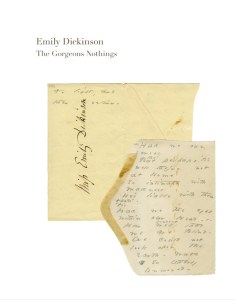
gorgeous_nothingsThe poems of Emily Dickinson began as marks made in ink or pencil on paper, usually the standard stationery that came into her family’s household. Most were composed in Dickinson’s large, airy bedroom, with two big windows facing south and two facing west, at a small table that her niece described as “18-inches square, with a drawer deep enough to take in her ink bottle, paper and pen.” It looked out over the family’s property on Main Street, in Amherst, Massachusetts, toward the Evergreens, her brother’s grand Italianate mansion, nestled among the pines a few hundred yards away. Dickinson had a Franklin stove fitted to a bricked-up fireplace to keep her warm, which meant that she could write by candlelight, with the door closed, for as long as she wanted. In much of the rest of the house, the winter temperature would have been around fifty degrees. Though she usually composed at night, Dickinson sometimes jotted down lines during the day, while gardening or doing chores, wearing a simple white dress with pockets for her pencils and scraps of paper. A younger cousin recalled her reciting the “most emphatic things in the pantry” while skimming the milk.

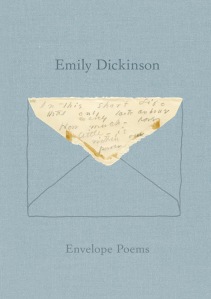
I also learned that New Directions has published two books about the scraps, Envelope Poems and The Gorgeous Nothings, both edited by Jen Bervin and Marta Werner.  I’d love to have these!  Oh, well, after my Dickinson marathon, and if I can find The Complete Poems in one of my boxes.

envelope-poems-dickinson-unnamed

LITERARY LINKS

1. William Trevor died last week.  You might want to read George O’Brien’s excellent article in The American Scholar, “Injurious Entanglements:  Remembering William Trevor’s Anglo-Irish Stories.”  Here is an excerpt:

William Trevor, who died on November 20,is conventionally and conveniently thought of as an Anglo-Irish writer. But to consider him in that way is less to apply the finality of a category than to initiate an exploration of the distinctive significance of his work. It’s true that, in a literal sense, Trevor was Anglo-Irish. Born William Trevor Cox in 1928 in Mitchelstown, County Cork, he was reared and educated in Ireland. But his adult life was spent in England, first in London, then in Devon. Yet, the hybrid identity that the Anglo-Irish label typically brings to mind, together with its divisions and fidelities, is only one of many contexts featured in the body of work produced during the 50 years of Trevor’s prolific career.

2 In The Rumpus, there is an interview with novelist Alice Mattison about her new book on writing.

kite-and-the-string-mattison-51bc33sysml-_sx329_bo1204203200_Mattison’s newest book, The Kite and the String, is a meditation on her lifelong journey through the craft of writing. Taking a balanced approach of warmth and realism, she welcomes readers into a conversation about not only what makes for good writing but also of the necessary balance between the independent, solitary writer and the social writing community. She draws upon her years as a poet and prose writer, supported by her many decades of teaching children and adults alike. Accessible and unbiased, Mattison is an encouraging guide for new and seasoned writers; she is cautious in advising that a strategy of success for one will easily not work for all, but pushes her readers to try most anything that may better enhance their work. Nerves are to be harnessed and channeled into production, while the quieter, more sedentary moments between writing spurts must be equally cared for and valued. We are reminded through wit and honesty that a career in creative writing is most certainly an uphill endeavor with innumerable and unpredictable obstacles. The rewards, however, can be of equal if not unparalleled significance.

3 At Open Letters Monthly, Rohan Maitzen, an English professor, writes about Ishiguro’s The Remains of the Day.

This term it’s Kazuo Ishiguro’s subtle, devastating novel The Remains of the Day that resonates with current events in ways that seemed unthinkable just a few weeks ago. Ishiguro has said in interviews that he used the appeasement era as an abstract cautionary tale about how we are all, in our own ways, butlers, including politically: going about our jobs either unable or unwilling to see how we might be serving larger agendas, finding dignity in doing our work well rather than in ensuring we do the right thing. He wasn’t literally warning us not to give Nazism a second chance — and yet here we are.

A very good week of reading online!