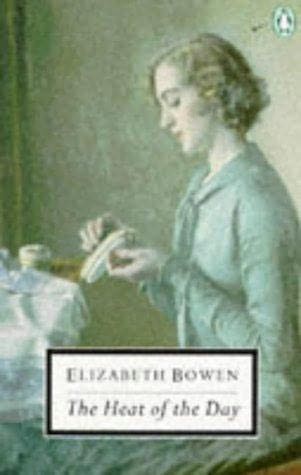
Elizabeth Bowen’s The Heat of the Day

“You might like Elizabeth Bowen,” said a classics professor during a chat about, of all things, the pros and cons of the style of Virginia Woolf.  I had correctly identified a passage by Virginia Woolf, as well as the authors of several other long excerpts from famous books, on a mystifying diagnostic test which had little to do with our subject.  Woolf was then my favorite English writer; he preferred Bowen, who was influenced by Woolf.  Now he is dead, and I prefer Bowen.  The cycle of life…

I recently reread The Heat of the Day, Elizabeth Bowen’s spy novel.  The narrative is oblique and elaborate, and I love her lyrical style, and what the biographer Victoria Glendinning calls her “contortionist manner of sentence construction.”  Glendinning says that Bowen had a difficult time writing this book:  she wrote the first five chapters in 1944, and then rewrote them in 1945 because her reality had changed.  Glendinning writes, “It was thus the very subject of The Heat of the Day–the war–that held up the writing of it; and she did not get around to finishing it until the war was over.”

In this convoluted novel, set during World War II, the middle-aged heroine Stella lives alone in London in a furnished flat while her son Roderick is in the army.  She knows three languages and two or three countries and is “employed in an organization better known as Y.X.D., in secret, exacting, not unimportant work.”  She is approached by Harrison, an English spy who reminds me of Uriah Heep.  He has tried to become her boyfriend: she has rejected him.  She has a lover, Robert.   When Harrison insists on seeing her one last time, he attempts to blackmail her:  he says he has spied on Robert, and claims that Robert is a spy for the enemy.  Harrison says he will not turn him in immediately if she  drops Robert and becomes Harrison’s lover.    Could any situation be more morally repugnant?

Stella doesn’t know if any of it is true:  is Harrison a spy? Could Robert, who  works at the War Office,  be a spy?  She defends Robert, and sends Harrison away.  She says nothing to Robert, but she becomes nervous and vigilant. What is real?

The narrative is very much a hall of mirrors.  In the beginning of the novel, we see Harrison through the eyes of a young working-class woman who approaches him at an outdoor concert.  She has liked his unconsciousness of everything around him, but her impression changes when he looks at her:  “–one of his eyes either was or behaved as being just perceptively higher than the other.  This lag or inequality of his vision gave her the feeling of being looked at twice–being viewed then checked over again in the same moment.”

And in a scene when we see Stella waiting for Harrison, we also see the obliquity and eeriness of angles.

Propped on the chimney-piece above the built-in electric fire were two photographs, not framed yet–the younger of the two men was Roderick, Stella’s twenty-two-year-old son.  Over the photographs hung a mirror–into which, on hearing Harrison’s footsteps, she looked; not at herself but with the idea of studying, at just one more remove from reality, the door of this room opening behind her, as it must be.  But no, not yet:  he was still knocking into something, putting down his hat in the tiny hall.  This gave her a moment to reconsider–she swung around again, after all, to face him–stood stock still, arms folded, fingers spread over the sleeves of her dark dress.  There came to be something dynamic, as he entered, about her refusal to move at all.

Although it is occasionally melodramatic, I admire this tense, carefully-plotted novel about love and betrayal.  Is it her best?  It is not my favorite.  But she raises complex issues, and the twists and turns are surprising.  The  situation is heartbreaking.  And shouldn’t Hitchcock have made a film of it?

I thought I might have written about other of Bowen’s books at this blog, but I haven’t.  I shall try to do so.  She is a great writer–perhaps out of style these days?
“Daylight Savings Time” by Phyllis McGinley

Phyllis Mcginley

I love the underrated Phyllis McGinley, who won the Pulitzer Prize for Poetry in 1960.  The prize was controversial, because she was dismissed as a suburban housewife who wrote “light verse.” Personally, I like light verse, the more bubbly and comic the better, but there’s more to her charming poems than meets the eye.  Here is one of her lightest,  “Daylight Savings Time.”

Daylight Savings Time

We turn the clock an hour ahead;
Which means, each April that arrives,
We lose an hour out of our lives.

Who cares? When autumn birds in flocks
Fly southward, back we turn the clocks,
And so regain a lovely thing
That missing hour we lost in spring.

“Irregardless” Is Not a Word

“Irregardless” is not a word.

One wonders if some experts say it to get attention.

I was irritated when the lexicographer Cory Stamp, author of the popular book Word by Word, asserted in the  New York Times  that “irregardless” is a word.  And I was bored when Penny Modra, a “grammar enthusiast”with dubious credentials,  said in a recent article in The Guardian that people will be disappointed if they want her to “solemnly rule that ‘irregardless’ is not a word.”

That’s all very cute. Really.  And doubtless it sells dictionaries, popular books, and newspapers.  But why pretend “irregardless” is acceptable?  The editors of  The New York Times and The Guardian use the correct form “regardless,” except in cute articles about grammar divas.

I am sure many of  you, like me, are traditionalists.  We want to speak and write as well as we can.  If we say “irregardless,” we have a problem:  we have a double negative.  The  prefix “in-” (“ir-” in front of the letter “r”) means “not.” The suffix “-less”also means “not.”   So “irregardless” means “having regard; heedful, mindful (of),” or “with concern to advice or warning.” It means the opposite of what you intended.  “Regardless” means “having no regard; heedless, unmindful (of)”; or an adverb meaning “without concern as to adcive or warning.”  (Ex.  They told the lie regardless.)  The word you want is “regardless.”

These days Cory Stamp and Penny Modra trawl Twitter and allow the illiterati to determine grammar and invent silly new words. I can understand reading newspapers to find new words.  But Twitter is not about words, is it?

The Roman poet Horace spoke about the introduction of new words to Latin poetry. In The Art of Poetry (Ars Poetica), Horace writes about the need for poets to choose an appropriate style for their subject matter.  And he also talks very specifically about the changes in language.  He says he is not opposed to  new words, “if they fall from a Greek source and are only slightly changed.”  Of course that  is quite a bit stricter than the liberal changes via Twitter.

Horace continues, “It always has been and always will be acceptable/ to produce a word stamped by the present mint-mark./  As leaves in forests change in the fleeting years,/ and the first leaves fall, so the old age of words dies,/and like young men new words bloom and flourish.”

Words change, but Horace wants poets to keep the Greek in mind.

Here’s Horace’s Latin:

…Licuit semperque licebit
signatum praesente nota producere nomen.
Ut silvae foliis pronos mutantur in annos,               60
prima cadunt, ita verborum vetus interit aetas,
et iuvenum ritu florent modo nata vigentque.

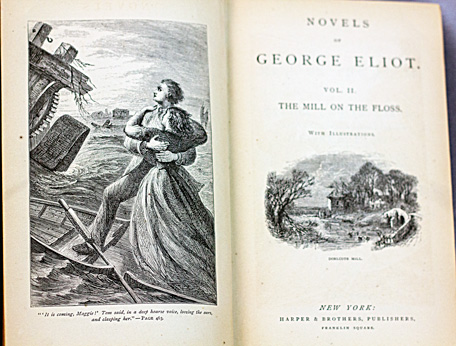
George Eliot’s The Mill on the Floss: On Landscape, Women’s Education, & Floods

Why do I love George Eliot?  It’s strange, isn’t it?  A Midwestern woman reader of the 20th and 21st century avidly reading about Victorian English heroines.

Reading Eliot is satisfying, but rereading her is the ultimate pleasure.  I recently reread her second novel,  The Mill on the Floss:  it was like a psychedelic trip from one reality to another.   Eliot’s effervescent language is so evocative that I saw the landscape, the mill, the river Floss, and the woods.

The first time I read The Mill on the Floss,  the place riveted me.  I transposed our local landscape on Eliot’s, though I had no idea of scale:  I miniaturized our own river, sprawling fields, and wildflower-dotted meadows, because wasn’t England smaller?  Later, I pictured it all as a BBC film (I haven’t seen the Eliot adaptations, so I saw it as  Far from the Madding Crowd). I would love to travel to George Eliot country,  but perhaps it is unnecessary.   Rebecca Mead, author of My Life in Middlemarch, didn’t find her trip to Nuneaton particularly evocative:  Griff House, Eliot’s childhood home, is now a hotel.

But isn’t place especially vivid in Eliot’s books?  I’m afraid that says too much about me!  The first chapter of The Mill on the Floss is devoted to a spectacular description of the setting, St. Ogg’s and its environs.

Even in this leafless time of departing February it is pleasant to look at,–perhaps the chill, damp season adds a charm to the trimly kept, comfortable dwelling-house, as old as the elms and chestnuts that shelter it from the northern blast. The stream is brimful now, and lies high in this little withy plantation, and half drowns the grassy fringe of the croft in front of the house. As I look at the full stream, the vivid grass, the delicate bright-green powder softening the outline of the great trunks and branches that gleam from under the bare purple boughs, I am in love with moistness, and envy the white ducks that are dipping their heads far into the water here among the withes, unmindful of the awkward appearance they make in the drier world above.

So idyllic:  a landscape from the past, already past in a novel published in 1861.  And throughout the book Eliot emphasizes the wildness of the Floss, which ominously swells and frequently floods, which foreshadows the ending.

The landscape is one thing, the characters another, but I intertwined the one with the other, as Eliot intertwines them.  Why do I so identify with Maggie Tulliver, the heroine of The Mill on the Floss?  Is there a kind of imprinting of women’s lives from the past? I  never romped on the banks of a river, but I certainly rooted for Maggie when she pounded nails into her doll’s head in vexation and cut her thick hair after her mother and aunts denigrated it.   But it is the  question of Maggie’s education that especially interests me.

Boys and girls were educated differently.  I wonder if it was this book that persuaded me I wanted a 19th-century gentleman’s education, i.e., classics.  Maggie’s very average (bordering on slow) brother Tom learns Latin and Euclid by rote at a parson’s house, though even her father says Maggie would have benefited more from such studies.  When she visits Tom, she tells him she can help him with Latin.  The dialogue is hilarious.

“You help me, you silly little thing!” said Tom, in such high spirits at this announcement that he quite enjoyed the idea of confounding Maggie by showing her a page of Euclid. “I should like to see you doing one of my lessons! Why, I learn Latin too! Girls never learn such things. They’re too silly.”

“I know what Latin is very well,” said Maggie, confidently, “Latin’s a language. There are Latin words in the Dictionary. There’s bonus, a gift.”

“Now, you’re just wrong there, Miss Maggie!” said Tom, secretly astonished. “You think you’re very wise! But ‘bonus’ means ‘good,’ as it happens,–bonus, bona, bonum.”

“Well, that’s no reason why it shouldn’t mean ‘gift,'” said Maggie, stoutly. “It may mean several things; almost every word does. There’s ‘lawn,’–it means the grass-plot, as well as the stuff pocket-handkerchiefs are made of.”

Isn’t that amusing, innocent, and realistic?  We read a lot about Tom’s education, but almost nothing about Maggie’s. She goes to a girls’ boarding school with her cousin Lucy, but we hear about it only after she is called home by  her father who has lost all his money in a lawsuit and become very ill.  At home she finds solace in religion and in  her own studies of Latin and algebra, but none of it is  enough.

Maggie Tulliver drawn by Frederick S. Church

Education was not an issue for me, I used to think, but as I grew older I realized that it was.  I am a feminist, and conscious of discrimination against women, but never believed discrimination happened to me–and this was part of my strength.  In fact the schools in my hometown were very good, and the teachers, mostly women, encouraged me.  I was an excellent student until my parents’ divorce, and then I lost my mojo.  My college-educated mother wanted me to go to college; my uneducated father did not.  Eventually I  wangled jobs, grants, loans, and an assistantship, but it was catch as catch can and good luck.   I could easily have been a Maggie stuck with an unappreciative brother,  or an undereducated Gwendolen Harleth (Daniel Deronda), unable to make a living..  The 20th century was better for women in most ways than the 19th century.    But the 19th century had George Eliot, who could hold her own with the best-educated men of her time, and didn’t she contribute more than most?

Near the end of The Mill in the Floss, sex becomes the major question, and sex and the flooding of the Floss become one and the same.  There are elements of melodrama.  Maggie is courted by two men, Philip, the crippled son of her father’s enemy, and handsome Stephen, a banker’s son, who is engaged to Maggie’s lovely cousin Lucy.  Tom says he will not speak to Maggie if she continues her romance with Philip, whom she would like to marry.  But Stephen and Maggie are wildly attracted to each other, and when they go out in a boat,  Stephen more or less abducts her, taking her farther than they had planned, so they have to spend the night on a commercial boat.  Maggie loses her reputation, though not her virginity, and Tom kicks her out of their home.

Poor Maggie!  We are used to 19th-century novels in which the sexually active woman must die.  Anna Karenina, Madame Bovary, The Awakening… But Maggie doesn’t actually have sex.   And she is horribly punished by death anyway, swept away with her brother Tom in a boat  (yes, another boat!).  Both drown  in the flood.

It all seems unreal and melodramatic–did Maggie and Tom hae to die in a flood?–and what does it have to do with sex?  Yet floods happen and are melodramatic: there have bee n many terrible floods in the Midwest this century, destroying homes, art museums, libraries, downtowns, you name it.

What does the flood in The Mill on the Floss mean symbolically?  In Tim Dolin’s George Eliot, he sums up different theories.  “It has been argued that the flood has the effect of neutralizing the novel’s own commentary, contradicting or negating everything that comes before it and bringing the novel ‘hard up against its own realism’ by indulgently releasing Maggie from the narrow, unjust, oppressive world that social realism has to depict.”

All right.  I’ll accept that–sort of.  Though this is not all he says.  Frankly I need a book of criticism. And so to one of the older libraries we shall have to go one of these days.

London without a Shovel

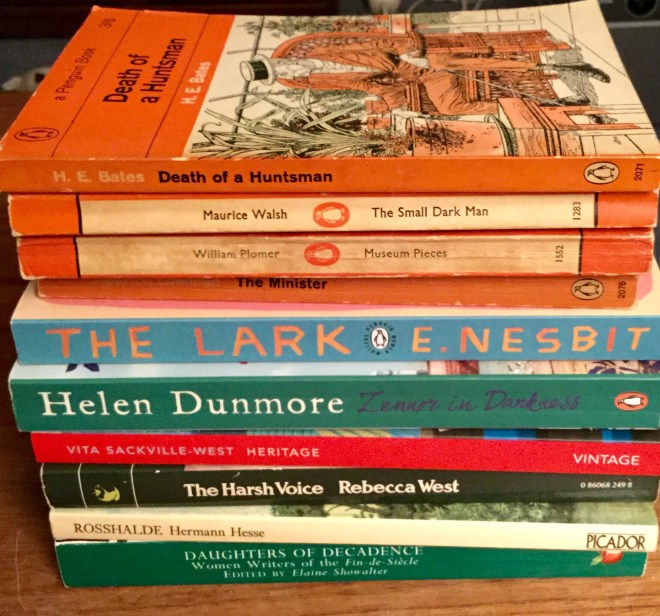
Some of the books I bought in London.

Take the 5 pence,” I said at Oxfam.  Snow was falling, and I needed a bag for my books.  (You pay 5 pence per bag in London, as a way to reduce the use of plastic bags.)

Mind you, I had a Waitrose bag, a Foyles bag, and a Westminster Abbey bag in my hotel room.

There wasn’t much snow in London. Possibly an inch or two.  But it was packed down, slushy, and slippery.   Nobody shoveled the sidewalks.  I saw nary a snow plow nor a snow blower. It took me a day to realize the city seemed empty because the snow had shut it down.  (N.B. Other parts of the UK really got a lot of snow, but London just expected snow.)

Even though Londoners are wusses about the snow, I’m a wuss about the cold. My mother taught me always to take off my coat inside,  but that wasn’t possible in cathedrals.   I froze my ass off at St. Paul’s Cathedral and Westminster Abbey, though I kept my jacket zipped.  I also visited Waterstones on the day the furnace broke.  At the lovely, warm, almost-empty National Portrait Gallery I sat on a bench and was amazed to find myself looking at  portraits of Andrew Marvell and a very young Milton. Later, at an almost empty Pret a Manger, I ate a fruit cup, drank coffee, and enjoyed Virginia Woolf’s essays on London.

Definitely not an ideal season for tourism, but I loved making the rounds of the bookstores.

In the window of a used bookstore on Charing Cross Road, (possibly) Any Amount of Books, I saw a very old copy of Trollope’s Can You Forgive Her?,  but knew there wouldn’t be room in my suitcase.

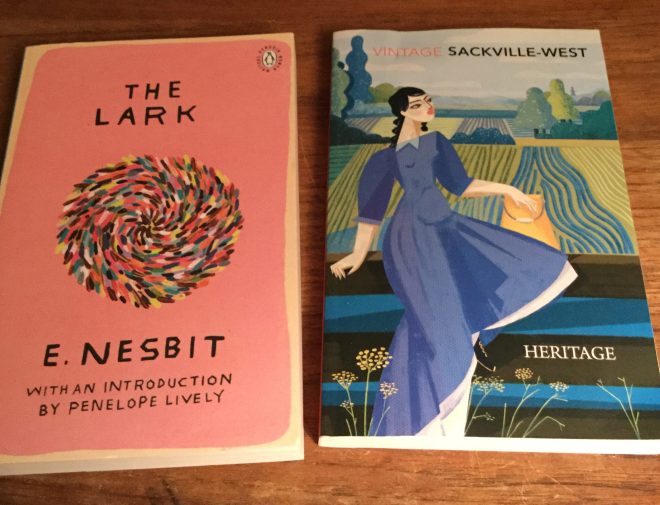
At Foyles, I browsed in the fiction, essays, and  foreign language sections.   I bought a copy of Susan Hill’s Jacob’s Room Is Full of Books, which is very much like her previous book about books, Howards End Is on the Landing. I couldn’t fit it in my suitcase, alas!  but read it in the hotel.   I also bought E. Nesbit’s The Lark, (which I read as an e-book a few years ago and wrote about here), with an introduction by Penelope Lively.

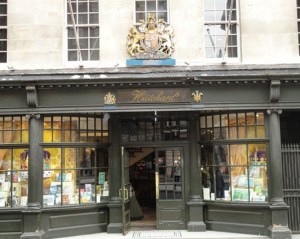
I came across Hatchards,  the UK’s oldest bookstore, which was founded in 1797, in a very elegant building on Picadilly (the original building). It is my new favorite bookstore in London.   I bought a copy of Vita Sackville-West’s Heritage.

Hatchards

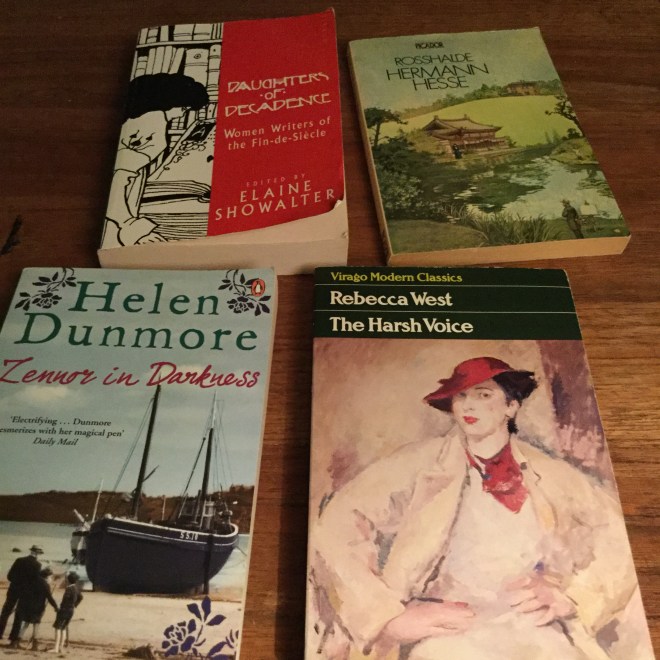
I bought used  paperbacks at Oxfam and  Skoob.  Here’s a list:

Helen Dunmore’s Zennor in Darkness

The Harsh Voice by Rebecca West

Daughters of Decadence, edited by Elaine Showalter.

Hermann Hesse’s Rosshalde

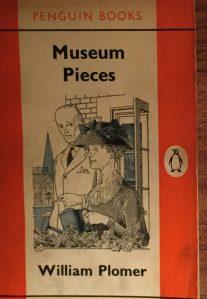
William Plomer’s Museum Pieces (looked interesting: I’ll let you know)

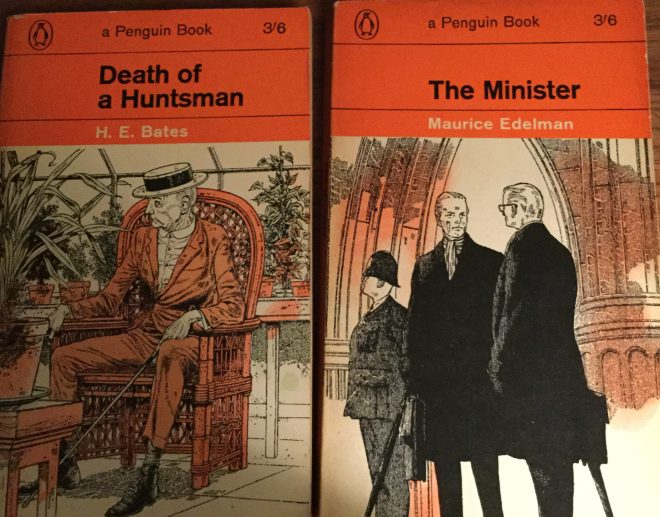
H. E. Bates’s Death of a Huntsman (I’m very fond of H. E. Bates)

The Minister by Maurice Edelman. (Never heard of it:  looks amusing)

So did I buy great books or junk?  Only time will tell.

And I hope you have all thawed in London.

“Frump with a Bun?” & Other Literary Matters

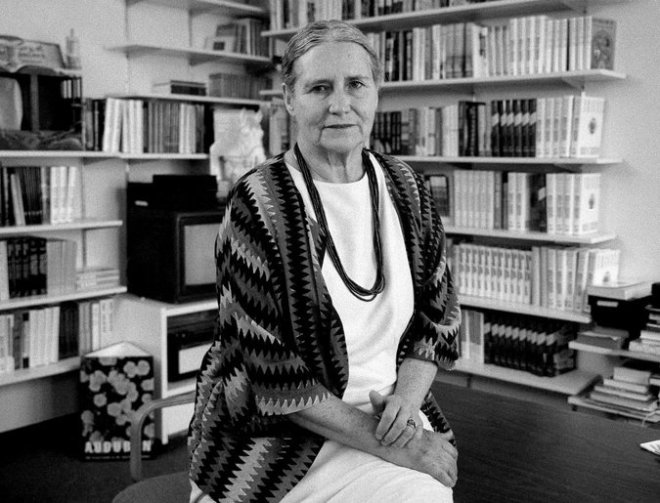
Doris Lessing

Although I have cut back on reading reviews because I don’t have room on the shelves for more books (sound familiar?), I was excited to discover Sara Wheeler’s fascinating review at The Spectator of Lara Feigel’s new book,  Free Woman: Life, Liberation and Doris Lessing.  

“Free Woman,” a phrase Lessing uses throughout The Golden Notebook,  is a smart title for a book that is a mix of criticism and personal writing.  As I  wrote about The Golden Notebook last fall,  “The heroine, Anna Wulf, a blocked writer, and her friend Molly, an actress, are both single mothers and ‘free women,’ as they ironically call themselves.”

What does it mean to be a “free woman”?  Are we “free”?  Were we ever? Lessing doubted it.   And we are now so big on censorship online–do say this,  don’t say that, and apologize on Twitter if anyone complains–that I wonder what Lessing would say.   One phrase in Wheeler’s excellent review bothered me.  I must emphasize that I am not complaining, but criticizing one phrase.    Wheeler says  that Feigel’s book moves chronologically “from childhood… [to] the post-menopause adoption of an identity of asexual frump with a bun.”  And I hate that word “frump.”

Why concentrate on a writer’s looks at all?  We don’t talk about male writers as frumps, do we? But from George Eliot (ugly) to Virginia Woolf (beautiful), from Carson McCullers (a bit odd) to Mary McCarthy (great smile), we are fixated on women writers’ looks.

In one of my favorite novels, The Summer Before the Dark, Lessing criticizes the pressure to look young and writes about the transformation of the middle-aged heroine Kate’s looks.  When her family is away for a summer, she takes a job as an interpreter and has an affair.   And then she spends the remainder of the summer in a rented room in London, having a breakdown.  At the end, as a middle-aged woman, she ceases to try to look youthful.

Her experiences of the last months, her discoveries, her self-definition; what she hoped were now strengths, were concentrated here–that she would walk into her home with her hair undressed, with her hair tied straight back for utility; rough and streaky, and the widening gray band showing like a statement of intent.  It was as if the rest of her–body, feet, even face, which was aging but amenable–belonged to everyone else.  But her hair–no!  No, no one was going to lay hands on that.

Personally, I think Lessing was beautiful, but I don’t have a problem with frumps. Some of us do our hair, some do not.

Wheeler’s review certainly made me want to read Lara Feigel’s Free Woman. The book is not available in the U.S. yet.

AND NOW FOR LITERARY LINKS

Erin Kelly at The Guardian wrote a fascinating article, “Ebooks are not ‘stupid’ – they’re a revolution.”  She wrties,

I was a relatively late convert to the e-reader, getting my Kindle five years ago when it became clear that reading 600-pages of A Suitable Boy while breastfeeding wasn’t going to work. After a frenzied few months of almost exclusive e-reading, I returned largely to the traditional printed book for a number of reasons: screen fatigue, a tendency to scrawl in margins, because I want my kids to see me reading, and because I’m a passionate supporter of bookshops and booksellers. Hachette Livre CEO Arnaud Nourry recently called ebooks “stupid” – but last summer, they changed my life.

The Women’s Prize longlist has been announced.  The only one I’ve read is The Idiot–I loved it and wrote about it here.

3.  And Barnes and Noble just launched its first nationwide book club.  The first selection is Meg Wolitzer’s The Female Persuasion,  and you get free coffee and a cookie at the book club.  May 2 is the date.

Adult Education by Annette Williams Jaffee

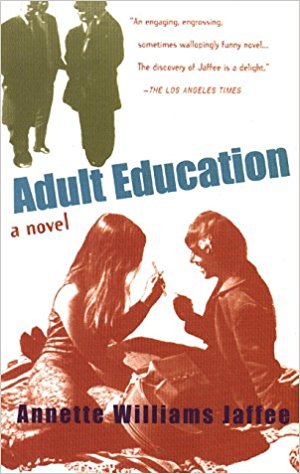
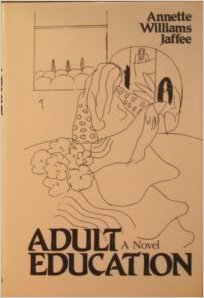
I have recently read some brilliant women’s novels, many of which, alas, are out-of-print.  Annette Williams Jaffee’s Adult Education (1981), which was praised in The New York Times, The Washington Post, and the TLS,  is a comical, discerning novel about women’s friendship. It was published  by Ontario Review Press, a small press founded by Joyce Carol Oates and her husband Raymond Smith.

It’s odd what women’s novels survive and what do not.  Why does one remain popular, and another popular novel vanishes from the shelves? I found a paperback copy of Adult Education on a wintry day in London, when I was clomping from bookstore to bookstore on unshoveled slushy sidewalks.  (I plan to teach an adult education class on snow removal next time I am in London.)

Adult Education is hilarious, snappy, and slightly subversive.  Becca and Ulli  are both pregnant when they meet in an adult education class.  Becca, a former dancer who graduated from Bennington, is emotional and affectionate, also incredibly witty about her Jewish childhood in Chicago, while  Ulli is a cool, Swedish blonde, a former model who is happy to be a housewife, free from the pressures of looking stylish.  The third-person narrative is from Becca’s comical perspective, and that is a good thing, because we can relate to Becca as we can’t to Ulli.  I was hooked from the opening witty paragraph.

Becca met Ulli in an Audlt Education course in Pre-Columbian Art.  They were both pregnant with their first children and sat like two Marimekko pumpkins in a field of withering vines, a group of professors’ widows.  The widows were off to Mexico when the course ended, with the instructor, who was as brown and round as a Toltec jug.  Becca later thought of them during the long winter of her motherhood, imagined their knotty legs in support hose, climbing the Pyramid of the Sun at Teotihuacan, an endless Paradise, while she shuffled back and forth like a tired obedient cow.  She knew from her Lamaze training that Childbirth was the Ultimate Experience, but that winter she sometimes wished she’d gone on the trip instead.

Soon Becca and Ulli become best friends.  They take adult ed classes in photography, pottery, and tennis:  Ulli can do everything; Becca’s only talent is dance. Becca took ballet as a child and majored in dance at Bennington.  When she is pregnant with her second daughter she decides to dance for Ulli, but can’t squeeze into her toe shoes.  Becca is proud of  her long toes and blackened toenails, the result of dancing on point; she explains pain is a badge of honor for ballerinas.  But her “restrained pirouettes” make her look like the dancing hippo in Fantasia, she says.

Naturally, it is Becca who becomes a feminist first. Ulli is too practical to think in those terms.  Becca’s husband, Gerry, a sociology professor, is unfaithful (an hour before his Ph.D. graduation she catches him having sex in a library carrel with his former girlfriend) and she tells Ulli that playpens, diaper  pins, and cribs are “symbols of oppression.”  Ulli disagrees.

“Ah, Becca, every housewife is not Emma Bovary,” objected Ulli, mending overalls.

“Oh, yeah?  Well, you’re wrong, Ulli.  I see us as an entire nation of Sleeping Beauties!”

Jaffee’s plain, brisk style is both funny and touching as she describes Becca’s dramatic life, witnessed at every turn by Ulli. When the two women vacation with their children at the beach, there is a rare period of calm:  their husbands join them only on weekends, and they are happier without them.   The bond of friendship is stronger than the bond of marriage.

The years roll by.  Becca attends a consciousness raising grou0, writes poetry, and falls in love with her impotent poetry teacher.  When Becca’s husband learns about the poetry teacher, he calls it an “affair” and threatens to divorce Becca and take away their two daughters. Eventually he leaves  Becca for a younger woman, his student assistant.  But at least Becca still has her daughters.

Women take care of women in this novel, and when Ulli gets sick, Becca cares for her when Ulli’s husband and son pretty much opt out. Perhaps the men don’t care enough, or can’t let themselves feel enough.   I sniveled and cried over Ulli’s illness (a brain tumor), but the novel is more hopeful than sad.  If the U.S. had a Virago press, Adult Education would undoubtedly be a women’s best-seller.

Virginia Woolf

Virginia Woolf

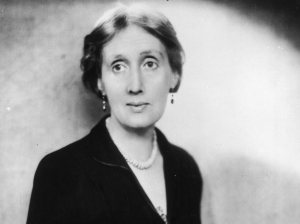
I used to be in the modernist camp of Virginia Woolf groupies.  What changed my mind?  The snobbery.

I am still a fan. I adore The Years (which I wrote about here), To the Lighthouse and Between the Acts.   But a recent rereading of some of W’s early work reminded me of her unsubtle early “classism.”  Is anyone more annoying than  Katharine Hilbery, the patrician  heroine of Night and Day?  Katharine has a sense of humor, but is she intelligent?  Woolf writes, “The quality of her birth oozed into Katharine’s consciousness from a dozen different sources as soon as she was able to perceive anything. Above her nursery fireplace hung a photograph of her grandfather’s tomb in Poets’ Corner, and she was told in one of those moments of grown-up confidence which are so tremendously impressive to the child’s mind, that he was buried there because he was a ‘good and great man.'” Naturally, Denham, the earnest young man Katharine dislikes on their first meeting, falls in love with Katharine instead of the plainer Mary Datchet, the radical office worker who is the only really interesting character in the novel.  But beauty, class, and dullness win.    And that makes Woolf more traditional in her first books than were some of her female predecessors, like George Eliot.

Woolf writes so beautifully.  Does anyone write more beautifully?  But I prefer her essays to her novels these days.  The Common Reader is deceptively simple, a book of Woolf’s literary criticism that doesn’t sound like criticism.  Now that I’m older, I realize the ideas are not always original, but the style is.  Who has better summed up the problems in translation, in any language, than Woolf in “The Russian Point of View”?  And I dearly love her brilliant essay about the even more brilliant George Eliot.

But Woolf is so snide.  She is malicious in “The Patron and the Crocus” about Henry James, the American who tries too hard but doesn’t really understand England, in her view, and she is horrifically snobbish in “Modern Fiction” about the realistic fiction of Galsworthy, Wells, and Bennett.  She writes, “If we fasten, then, one label on all these books, on which is one word materialists, we mean by it that they write of unimportant things; that they spend immense skill and immense industry making the trivial and the transitory appear the true and the enduring.”

Well, I love modernism, but I so much prefer D. H. Lawrence to Woolf.   Woolf may be a lesbian, which is part of her appeal these days, but Lawrence was equally elegant and more egalitarian.

And I am very keen on “the materialists,” who do not write as well as Woolf but deserve better than that slinging of arrows.  Surely “the quality of…birth” doesn’t have to  “ooze.”  Woolf is brilliant, but I find I can’t read more than one of her books a year now.  And, honestly, I have to ask, Has she stood the test of time?  For most, but not for me.