Doris Lessing’s The Memoirs of a Survivor & Under My Skin

Doris Lessing memoirs-of-a-survivor-my-copy

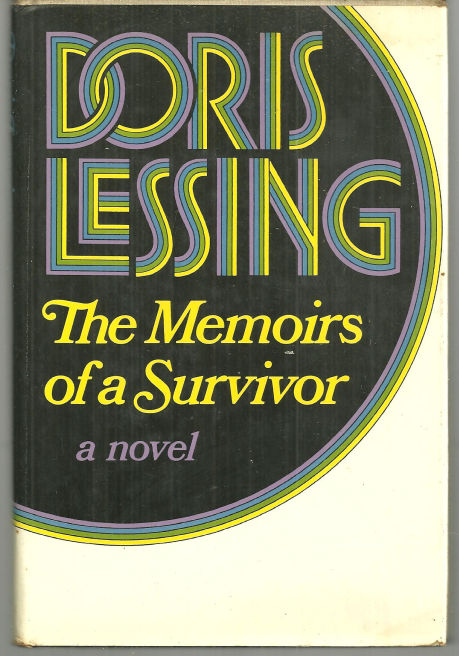
I’m checking in briefly to make a few remarks about Doris Lessing.   I  just finished rereading her superb 1974 post-apocalyptic novel, The Memoirs of a Survivor, and want to say a few words about it while it is fresh in my mind.

Some read The Memoirs strictly as dystopian fiction, but it is also a psychological, often surreal, portrait of Lessing. The narrator, an “older woman,” tries to understand the breakdown of society as the city crumbles around her and the media become increasingly unreliable and propagandistic.  She knows that eventually she will have to leave her flat, because the city is becoming dangerous, people must scrounge and barter, tribes of young people are leaving the city, and only the rich are still on the grid.  In a surreal scene, she becomes the guardian of a young girl, Emily: throughout the novel, the narrator struggles to help Emily, obviously her younger self  (and very like Martha Quest in The Children of Violence series).  You should also know that Lessing’s mother was named Emily, and that Lessing frequently explored mother-daughter relationships in her work.

A few years ago  Jenny Diski, in her “memoir” of Doris Lessing, which was first published in the London Review of Books, claimed that she was Emily in the novel.  Well, I was skeptical, but my assumption was that all writers and most sophisticated readers  realize that memoirs are to a certain extent made up, and that all would take this with a grain of salt.  Some of the material in Diski’s book is mined from Lessing’s novels,  without attribution.  So I was surprised that so many bloggers, at least, read her book as the literal truth about Lessing.  And so it makes me wonder about the breakdown of critical thinking, as well as the breakdown of society.  (But has there ever BEEN critical thinking?)
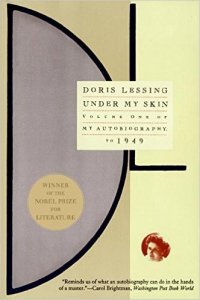
under-my-skin-lessing-41gwuvmd8yl-_sx330_bo1204203200_Well, obviously I’m not writing a thesis about this, but  tonight I opened Lessing’s Under My Skin:  Volume One of My Autobiography at random, and, as I suspected, my reading of The Memoirs is correct:  Emily IS Lessing (and sometimes Lessing’s mother)!

Compare these two incidents, one from Memoirs of a Survivor and one from Under My Skin, in which Emily/Doris is sadistically tickled by her father, a World War I veteran.  In Memoirs of a Survivor,  we see this scene because the narrator frequently visits the past: she travels behind the walls of her flat where there is another house in a different dimension in which rooms (her psyche) need tidying, painting, etc.  She also visits Emily/Doris’s past, set in different times, sometimes at the turn of the (20th) century, sometimes mid-century, but always long before the time of the events of the novel.  Well, Lessing was born in 1919, hence our travels through the 20th century.

From The Memoirs of a Survivor:

In a large chair set against the curtains, the soldier-like man sat with his knees apart, gripping between them the small girl who stood shrieking.  On his face, under the moustache, was a small tight smile. He was “tickling” the child.  This was a “game,” the bedtime “game,” a ritual.  The elder child was played with, was being made tired, was being given her allowance of attention, and it was a service by the father to the mother, who could not cope with the demands of her day, the demands of Emily.  …  her body was contorting and twisting to escape the man’s great hands that squeezed and dug into her ribs, to escape the great cruel face that bent so close over her with its look of private satisfaction. …  She shrieked, “No, no, no, no”…helpless, being explored and laid bare by this man.

From Under My Skin:

And then the moment when Daddy captures his little daughter and her face is forced down into his lap or crotch, into the unwashed smell–he never did go in for washing much, and–don’t forget–this was before easy dry-cleaning, and people’s clothes smelled, they smelled horrible.  By now my head is aching badly, the knocking headache of over-excitement.  His great hands go to work on my ribs.  My screams, helpless, hysterical, desperate.  Then tears…

… But I did not stop having nightmares about those great hands torturing my ribs until I was seven or eight.  Those nightmares were clear in my mind now as they were then, though the emotion has long gone away.  I became an expert on nightmares and how to outwit them when I was a small child, and the nightmare of being helpless and “tickled” was the worst.

A horrifying scene!  And I’m sure there is more, much more, in her autobiography to  parallel scenes in this novel.  I am writing this because I think it is important to realize that this novel is not about Jenny Diski.

Here is what Diski said (I don’t have her book, but I copied this excerpt from the LRB into a blog post a few years ago):

t made familiar and disturbing reading. I could see Emily in me, just as I could see my elderly neighbour’s description of me aged three. It is as accurate a reading of me as Emily’s harsh commentary on others. It is true, but it is, of course, a doubly edited version, a view of me from the narrator’s point of view, which itself has been taken and worked for fiction’s purpose from Doris’s point of view. If there is pity in the narrator’s response to Emily, it is strained for. I discovered after a while that Doris had a habit of describing people in fiction and in life as, for example, ‘heartbreaking’ in her most distant, coolest tone, as if to mitigate her dislike of them. She saw it as being fair, I think.

I do not believe for a minute that The Memoirs of a Survivor is about Diski.  It is a misreading, and, believe me, this is one of her kinder interpretations of Lessing.  I guess it’s possible to publish anything, if you say it’s about Doris Lessing.  Honestly!  Writers.  (I really have nothing against Diski,  but this book…ugh.)
Blathering: The Future of Social Media

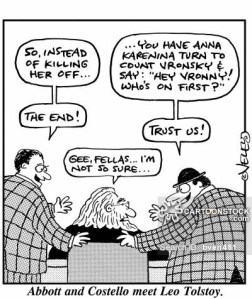
Abbott and Costello meet Leo Tolstoy.

Abbott and Costello meet Leo Tolstoy.

This year I’ve been re-evaluating my use of social media. In the last year, I have lost interest in the internet. Power to the people—but the people are not always knowledgeable.  Absurdities are tweeted,  marketers mine Facebook and other platforms, and ads pop up everywhere.  For what it’s worth, I can read international newspapers and journals online. For what it’s worth…will it be worth it in the end?

The internet started as a way of building community, or so they say.  But a lot of good it has done it:  it  has destroyed public libraries. Many people plugged into the net have problems evaluating sources:  Wikipedia and even sketchy results of Google searches have taken the place of  scholarly books, reference books,  journals, etc..  In England, hundreds of libraries have closed, as fewer people use them.  In the U.S., the use of libraries has also declined. According to a recent Pew research study , only 44 percent of Americans visited a library or bookmobile over the last 12 months. Three years ago that figure was 53 percent.  On the rare occasions when I visit university libraries, I do not see  students reading books. All are glued to their computers. Shouldn’t university students be expected to read books?

Social media give everyone a voice. But books are not, as far as I can see, improving as a result of publishers’ mining data from consumer reviews. If anything, worse.  And many journalists, critics, and writers–and who can blame them, since the internet has destroyed their work?– are bitter about social media. In Howard Jacobson’s savage satire, Zoo Time,  the hero, Guy, a novelist, is furious that  his books are out of print.  His publisher is depressed because he is expected to ask Guy to “twit” and “blag.” (Tweet and blog.)  But Guy wants to tell him that”the blog is yesterday,” and that the blame lies on “myBlank and shitFace and whatever else was persuading the unRead to believe everybody had a right to his opinion.”

Well, Jacobson is very harsh,  though I know what he means about the unRead, and doubtless he considers me one. I can hardly say much against blogs, since I have one. Generally, the blog is a “no-harm” medium.  It can be used as a diary, an op/ed page, a collection of thoughts, even as a site for polished essay. (The latter is rare.) But I want to assert that mine is a book journal with informal notes about books:  I am not writing reviews. Very few bloggers are writing reviews. The problem is that the average blogger does believe he or she is writing  reviews.  And now that marketers have colonized blogs–I   turned down a review copy yesterday, of an e-book, not even a real book! –the “review” factor is even shakier than it used to be.

In general, bloggers read short books and earnestly, or whimsically, as the case may be, tell you their opinion of the book.  I find blogs very skimmable, but in recent years have read fewer. Every few weeks I read the bloggers who comment on my blogs, and then I leave comments, because it’s an obligation. But I am still as unconnected to other bloggers as Hillary Clinton was to the electorate.  Deep down, I know  that most of this internet writing is a waste of time, and that Bernie should have been the Democratic candidate.

Some bloggers love to read, but have no background in literature and are completely baffled by classics .  If you don’t often read blogs, you may be surprised, as my husband was the other night, to find a blogger declaring  Herman Mellville’s short novel Billy Budd “worthless”  and giving it a  D-. Yup, some bloggers actually grade books or work on the movie review star stystem.  The thing I’ve noticed is, when bloggers read classics, they often pick a short book,  presumably so they can tick it off a list–they’ve done Melville–without dong any real work.

My husband was so fascinated by this nervy blogger that he and I decided to write short fake  reviewettes by an imaginary cranky blogger.   Here they are.

FIVE FAKE REVIEWETTES OF BOOKS HATED BY AN IMAGINARY BLOGGER

Melville’s Billy Budd.  86 pages. ZERO STARS. “Could have 1 star if he cut out all the stuff about sailing. It’s crap! Don’t read Moby Dick.  I bet it’s crap!  Where’s Gordon Lish?”

Henrry James’s The Turn of the Screw.  121 pages.  1 star.  “James can’t write. Boy, was this a waste of time.  Crap!”

Colette’s Gigi.   68 pages.   1 star.  “God, what crap. I don’t care about the characters. Read at a blog that C was an immoral lesy.”

Doris Lessing’s The Grass Is Singing.  208 pages.  ZERO STARS.  “The worst book I’ve ever read.  Everybody pretends they  read The Golden Notebook but they don’t. Jenny Diski hated Lessing, and SHE wrote short books. so knows.  A bitch online said Doris Lessing satirizes TGIS in The Golden Notebook but  she’s so full of crap. I hate feminists.I voted for Trump. I will never read another book by a woman.”

Tolstoy’s Anna Karenina.  838 pages.  ZERO STARS.   “I didn’t like Oblonsky, Levin, Dolly, Kitty, Anna, Karenin, Vronsky, Nikolai Dmitrievich, or Princess Betsy.  Pevear and Volokhonsky are bad translators.”

Okay, you get the idea?

I’m going to look back at all the hours I’ve spent online–and wonder.

Trollope’s Doctor Thorne

doctor-thorne-trollope-41fcbtvv3tl-_sx324_bo1204203200_I cannot tell you how much I love Trollope’s Doctor Thorne.  Have I ever had more fun reading a book? If you want to read a charming, lightning-fast comedy, this is your novel.

Trollope’s brilliant six-book Barsetshire series (The Warden, Barchester Towers, Doctor Thorne, Framley Parsonage, The Small House at Allington, and The Last Chronicle of Barset) was tremendously popular in the 19th century, and is, I would imagine, still his most popular series.  I enthusiastically recommend beginning with Doctor Thorne,  the third, because Trollope is always better when he writes long than when he writes short, and you don’t have to read them in order. (Of course some of you will read the short just to cross him off your list.)   Doctor Thorne is light, bright, and entertaining, and though the novel has its serious, even dark, moments, it is not grounded in darkness like two of his masterpieces, He Knew He Was Right (which I wrote about here), or Phineas Redux (which I wrote about here).

doctor-thorne-trollope-51nmupbvcxl-_sy344_bo1204203200_Trollope had reservations about the best-selling Doctor Thorne.  He wrote, “The plot of Doctor Thorne is good, and I am led therefore to suppose that a good plot,–which, to my own feeling, is the most insignificant part of a tale,–is that which will raise it or most condemn it in the public judgment.”

Well, it is true he has a good plot, but character is the most important element.  Get past the opening melodramatic pages, which provide background,  and the characters are brilliantly-drawn, the dialogue scintillating, the satire of the aristocrats is hilarious, and the writing much more sophisticated than Trollope is ever given credit for.   David Skilton wrote, “…one of the  most remarkable things about Doctor Thorne is how little he exploits the sentimental or sensational possibilities…”

The book revolves around marriage, as so many of Trollope’s books do.  The strong-minded, plainspoken Doctor Thorne has a successful medical practice, and a happy home life  with his orphaned niece, Mary Thorne, the daughter of his dead ne’er-do-well brother, Thomas.  Years ago Thomas seduced a beautiful lower-class woman, Mary Scatcherd, whom he despicably pursued after he learned she was engaged to a tradesman.  When Mary’s stonemason brother, Roger Scatcherd, found out she was pregnant, he killed Thomas in a rage.  Doctor Thorne felt some sympathy for Roger, and arranged for his defense: Roger served six months in prison.  And Doctor Thorne has raised their niece, not thinking it prudent to tell Roger that his sister’s baby lived.

trollope-doctor-thorne-oxford-51fx2zh7x5l-_sy344_bo1204203200_Mary does not know her own identity, though, as Doctor Thorne’s niece, she assumes she is good enough to marry anyone.  When Frank Gresham, the 21-year-old heir of a great estate, flirts with her and says, at first half joking, in a spontaneous moment while walking with her at his coming-of-age party, that he loves her, one of his sisters, Augusta, overhears him and tattles to their aunt, Countess de Courcy (a ridiculous woman right out of Jane Austen). Frank’s mother, Lady Arabella, agrees with the countess that Frank must marry money.  Why?  Because her husband, Squire Greshem, is in debt, partly because of Lady Arabella.  He has sold much of their land, has borrowed huge amounts from Sir Roger Scatcherd, and the estate is mortgaged.

Mary meditates on whether or not she should marry Frank. He repeatedly asks her.   Of course she loves him; of course she knows that Lady Arabella opposes the match.  And so she  ruminates,

If she were born a gentlewoman! And then came to her mind those curious questions; what makes a gentleman? what makes a gentlewoman? What is the inner reality, the spiritualised quintessence of that privilege in the world which men call rank, which forces the thousands and hundreds of thousands to bow down before the few elect? What gives, or can give it, or should give it?

And she answered the question. Absolute, intrinsic, acknowledged, individual merit must give it to its possessor, let him be whom, and what, and whence he might. So far the spirit of democracy was strong with her. Beyond this it could be had but by inheritance, received as it were second-hand, or twenty-second-hand. And so far the spirit of aristocracy was strong within her. All this she had, as may be imagined, learnt in early years from her uncle; and all this she was at great pains to teach Beatrice Gresham, the chosen of her heart.

Mary is such a good soul!

The more adamantly Lady Arabella opposes the match, the more Frank is determined to stick to Mary.  He is ordered on a visit to his Aunt de Courcy’s castle to woo one of the most comical, intelligent characters in the book, Miss Dunstable, a thirtyish heiress to the” Ointment of Lebanon” business.  Frank believes she must be 40, and doesn’t find her attractive, but she is a smart conversationalist. She teases him out of his flirtation–she is used to everyone trying to marry her–and becomes one of his best friends.  She reminds him throughout the book that love of Mary Thorne is worth more than marrying an heiress he doesn’t love.  Without Miss Dunstble, it is probable that he might not have married Mary.

There is not just a marriage plot; there is a potential in-law plot.  It is not uncommon for potential in-laws to oppose a marriage.  In-law problems are usually treated as comical, but very often they are not comical at all.  And Lady Arabella is especially vicious in her treatment of Mary:  she bans Mary from the house, and prevents her daughter Beatrice from meeting Mary even at other people’s houses.  Beatrice and Mary, educated together, have been inseparable for years.  This is very painful for Mary and angers Doctor Thorne.  The whole village knows Mary is no longer welcome at Greshamsbury.

Sir Roger Scatcherd also plays a big role in this novel.  After six months in prison, he manages slowly to get on in life and eventually makes a fortune building railways.   He does not know that Mary is his niece, but he knows Doctor Thorne.  And his sweet wife, very uncomfortable as a “Lady,” has Mary over on a visit and loves her, not knowing the relationship.  And their sickly son, Louis, is like a shadow figure of Frank, drinks hard, has no morals, but also likes Mary and proposes to her.

As for Trollope’s writing, Adam Gopnik put it well in his article, “Trollope Trending,” in The New Yorker (May 4, 2015):

Yet, beyond saying that his writing feels like life, it’s hard to say just how he works his magic—and a little digging shows that a sense of Trollope as a slightly guilty pleasure has been around since people started reading him.

Trollope is a pleasure, but I don’t regard him as a guilty pleasure.   I think he is a better writer than most people admit.  I promised yesterday I would point out some of his high-flown (!) rhetorical figures of speech. Trollope was a great fan of Cicero the orator, whom he wrote a life of, and Cicero had an influence on his prose.

The two sentences below illustrate parallelism: the elements of the sentence are repeated in the same order.

There, in one big best bedroom, looking out to the north, lay Sir Louis Scatcherd, dying wretchedly.  There, in the other big, best bedroom, looking out to the south, had died the other baronet about a twelvemonth since, and each a victim to the same sin.

And here is an example of chiasmus,  a reversing of the order of words in corresponding pairs of phrases.

“I hope so.  I have had much doubt about this, and have been sorely perplexed; but now I do hope so.”

Trollope is not as flamboyant as Dickens, whose knowledge of rhetoric astounds all of us, but he is clever,  consistent, and positively Ciceronian at times.

Reading the Victorians, Lost in Trollope, & Why I Don’t Read Their Modern Equivalents

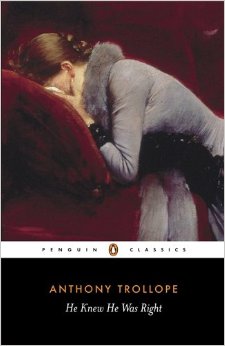
He Knew He Was Right trollope 41RJjyDTOLL._SY344_BO1,204,203,200_

If you wonder why I’m not writing more on my reading lately,  it’s because  I’m in a Victorian phase.  Some of the books are very, very, very, very long.  And you do not want to read me every day on the Victorians, because so many excellent books have been written, there are scholarly introductions to all the books, and there is not much for us bloggers to do except enthuse or condemn. Since I am so chatty, you will soon know all.

MY READING THIS WEEK:  I’ve been reading Swinburne’s poems, and I love his reinterpretations of myths, but mostly I let the poetry wash over me. Can I admit that?  Does anyone know a good book about the pre-Raphaelite poets?   I’m  also reading Trollope, and of course I can drone on about Trollope, because he’s so accessible:  we don’t really need notes on Trollope, who is one of the greatest storytellers of the nineteenth century. But I have read so many excellent introductions to his books, plus Glendinning’s biography of Trollope, that it’s overwhelming.

Last weekend I turned down a day trip to Iowa City and said I had do things around the house, which I did, but I actually was reading  He Knew He Was Right, his brilliant retelling of the Othello story.  This is my third reading of this stunning novel about Lewis Trevelyan, a jealous husband, and his strong-minded wife, Emily.  They separate because he goes mad from jealousy of a flirtatious friend of Emily’s father’s, who does try to egg him on. (I did jot some notes about the book here in 2015.)

Since I love the Victorian novelists, whether they wrote short (Mrs. Gaskell’s Cranford) or long (Trollope’s He Knew He Was Right), I wonder why I don’t care much for today’s equivalent popular “literary” novelists. Were the Victorians better writers because they were  better-educated, even if they were not formally educated? I have a theory about why we all love Trollope.  It’s not just the engrossing stories and the vivid characters.  He read Cicero every day–he even wrote a life of Cicero–and his style reflects Cicero’s rhetorical skill:  for instance Trollope uses parallelism, tripartite structure, and anaphora (the repetition of a word or words at the beginning of successive phrases or clauses). Today’s stylists just don’t (can’t?) do that.  Do they?   Can they?  There are some great writers out there, but literature is very different.

Some of today’s prize-winning literary writers seem overrated, among them Jonathan Franzen,  Jeffrey Eugenides, Jennifer Egan,  Donna Tartt, Elena Ferrante, and even Ann Patchett (by far the worst of this lot).  It’s not that I dislike these writers–I don’t–but can we even begin to compare them to the great 19th-century novelists?

Perhaps these critically-acclaimed best-selling authors ARE the great writers of today.  Who am I to say? But will they be read in 50 years?  All right, my guess is yes, Franzen will be read, because he says something about American life.  (He is not my favorite: it’s just a hunch.)  Jeffrey Eugenides, ditto:  I loved The Marriage Plot, with all its references to Victorian novels, though honestly found The Virgin Suicides misogynist.  I think of Jennifer Egan as artsy dystopian–will that play in the future?  Everyone loves Elena Ferrante, and she writes insightfully about women’s lives and Euripidean emotions, so how can she go wrong?  But I prefer her earlier more “experimental” (if that’s the word) work.  Picky, picky, aren’t I? I am just getting ready to read Tartt’s The Goldfinch and it looks very good.  I waited for the hype to fade.  I would say Patchett, who is really in the pop category, absolutely not will be read, unless everybody’s brains have caved in.

Do you read these writers?  Whom should we read instead?  Are any writers like the Victorians?

There are many excellent contemporary writers, and I PROMISE to write about them soon.  I admired Laura von den Berg’s literary dystopian first novel, Find Me, though it is not a perfect book,  but it probably deserves a better reception than it got.  And I admired Elizabeth Tallent’s collection of stories, Mendocino Fires, last year, the first book she’d published in (I think) two decades.  And she is undoubtedly at the height of her powers, even if the powers are very different from those of the prize winners.

This or That? Multiple Copies

The Penguin or the teeny-tiny Oxford?

The Penguin or the teeny-tiny Oxford?

Many years ago, our calico kitten, Maxie, squeezed herself into a bricks-and-boards bookcase and scratched the top edges of many of our favorite books.  The tops of the pages of several Willa Cathers and Colettes are jagged.  But she was just so cute!   Eventually she grew too big to play with the edges as though they were her piano.

Books on the floor are also a problem.  Lulu, a black cat who did gymnastics and sang opera from the top of the refrigerator, ripped the cover off a big Webster’s Dictionary, and believe me, I need my reference books.  So the books live in boxes if there’s no room on the shelves.   This year I have  weeded dozens of books in an effort to display all our books.

But I have a problem.  Duplicates.  Sometimes I can’t decide which to keep.

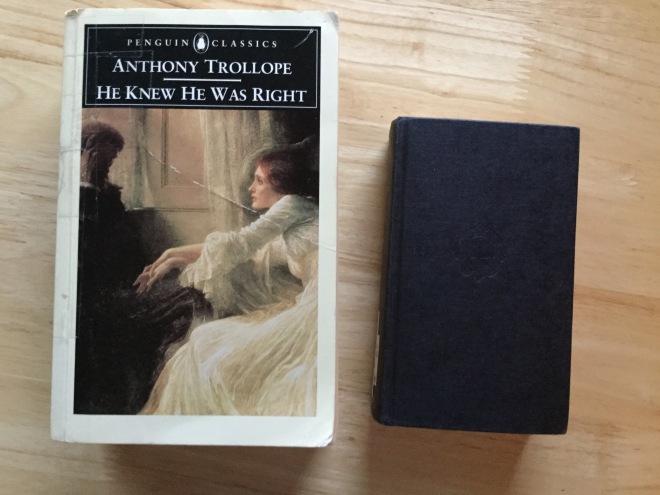
I have two copies of Trollope’s He Knew He Was Right.  I love my Penguin and read it several times, but the cover is Scotch-taped on.  Recently I also acquired a teeny tiny Oxford hardback, whose print is actually bigger than the Penguin. But The Penguin has an introduction, and the tiny Oxford hardcover does not. And can the whole text really be in that mini-Trollope?  Well, I have done some beginning and end of chapter checks, and it seems to be.

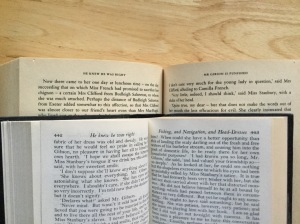
Here’s the difference in print size:

Print size: Penguin (on bottom) and Oxford.

Print size: Penguin (on bottom) and Oxford.

Bizarrely, the Oxford print seems to be bigger.But the Penguin is close.  Do I want a bigger or a smaller book?  And will I need the biggest possible print someday?  Well, I must keep them both, because I can’t decide.

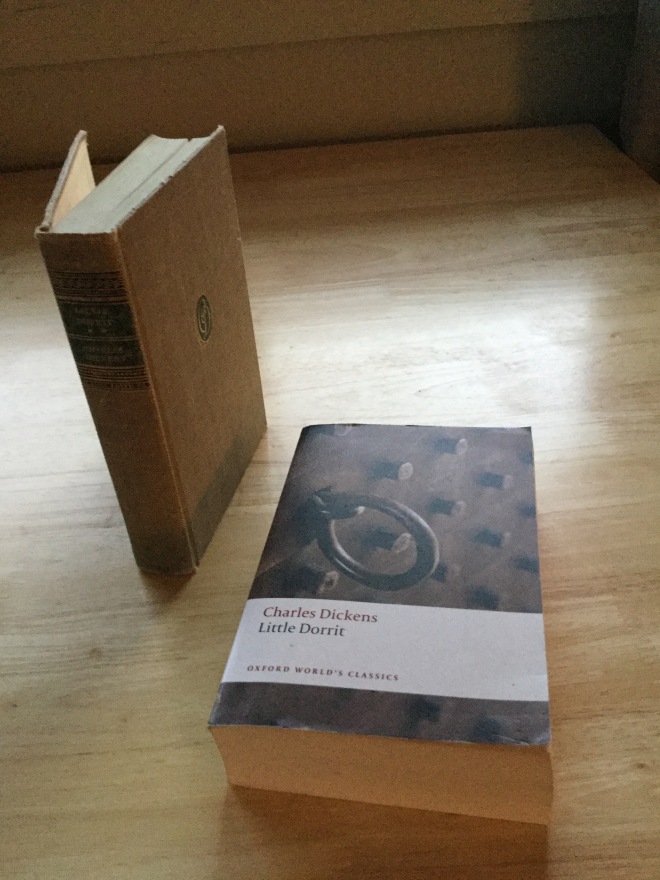
The Walter J. Black book club edition of Little Dorrit and an Oxford.

The Walter J. Black book club edition  and an Oxford of Little Dorrit

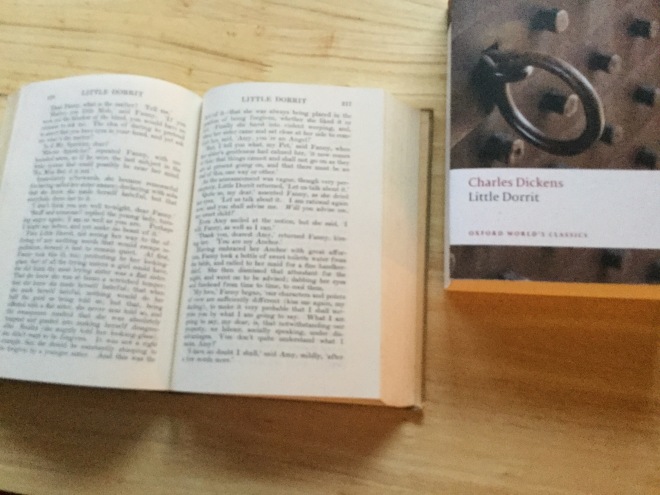
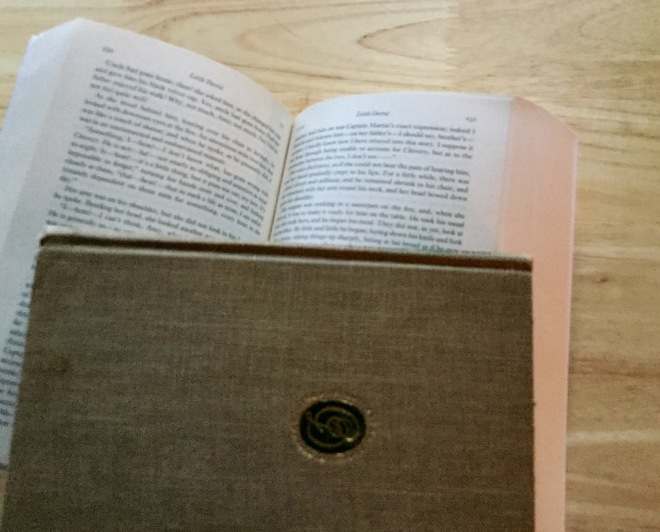
And what about Little Dorrit?  It is far from my favorite Dickens, but you will not be surprised to learn I have two.  When I was a teenager I bought a partial set of Walter J. Black hardcovers at Alandoni’s bookstore. Each title is divided into two volumes, with the original illustrations and huge print.   In the photo, you can see one slightly soiled (from many rereadings) volume of the Walter J. Black, complete with Maxie’s scratches.  As you can see, we also have a newish Oxford paperback, also with illustrations.

Here’s the print comparison:  Walter J. Black in top photo,  Oxford in bottom photo.

little-dorrit-walter-j-black-print-size

little-dorrit-dickens-oxford-size

I had planned to get rid of the Walter J. Black, but you know what?  That big print might come in handy someday. And it has sentimental value.  My first Dickens set!

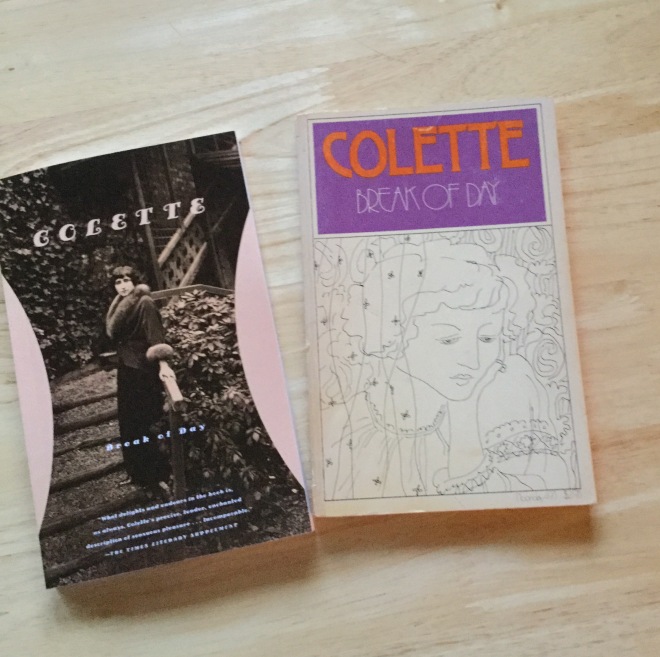
break-of-day-colette-2-copiesI have two copies of Colette’s Break of Day,  but the one on the right  HAS to go because the binding is broken.  I have hung onto it because of sentimentality, because I bought and fell in love with almost the entire FSG Noonday Press series of Colette series at the Union Bookstore and have read them multiple times.   OH, well, here I must stick with the new version, because the pages are all there!.

I tried to persuade my husband we need a bigger house for our books, but he says I must weed instead.  Too bad.  There are several in the area that have what I want:  three, maybe four floors.  Alas!

Abortion 1973-Now and in Ancient Rome: Ovid’s Poems about Abortion (Amores 13 & 14)

Women still marching after all these years (the Women's March on Washington)

Women still marching for rights after all these years (the Women’s March on Washington)

”Good job,” my professor said, smiling.

He was talking, thirtysome years ago, about a letter to the editor I’d written about abortion rights. He joked that I could count it as a publication. The department was big on publication. .

Having finished my master’s,  I was working as the volunteer coordinator of a state abortion rights organization, and I was standing at a table in the foyer of B—- Hall, collecting signatures for pro-Choice petitions and postcards, with the slogans,  “I’m pro-Choice and I vote” and “Keep abortion safe and legal.” Over a period of three months, we collected thousands of signatures. And then I packed a suitcase full of postcards and petitions and transported them to Washington, D.C.,  because I was going there anyway, and it saved the organization postage costs.

Who would have guessed that in 2017 women would still be marching for abortion rights and Planned Parenthood?

I am passionate about reproductive freedom.   I never had an abortion; I was good at  birth control: the diaphragm, because it wasn’t smart to take hormones. Many of my friends wisely chose abortion over dropping out of college.  While sharing a house, I brought cup after cup of Celestial Seasons tea to a housemate after her abortion. She was discreet about her sex life, which was conducted entirely outside our house, and one afternoon she wobbled into the kitchen to tell us she was “woozy” after an abortion and could we please sit with her. She soon fell asleep, and the next day she was completely fine and went to classes and work.

On a recent long walk, I thought about the Republicans’ plans to defund Planned Parenthood and criminalize abortion. In some ways, the attitude is very like that of men in ancient Rome.  Concerned about the low birth rate among the upper classes, the emperor Augustus  attempted to regulate marriage and the family with rewards and penalties. Starting at the age of 20, women were penalized for being single and childless; beginning at age 25, men were penalized for not marrying and childlessness.  Women were rewarded for having three children.  As Sarah B. Pomeroy said in her excellent book, Goddesses, Whores, Wives, and Slaves, “Augustus’ marriage legislation was designed to keep as many women as possible in a married state and bearing children.” But Roman women did use contraceptives, some more effective (the barrier method) than others (charms and potions). And abortion was practiced, sometimes by drugs, sometimes by surgery.

Ovid Amores 419-MO1CbKL._SX320_BO1,204,203,200_

Ovid wrote two poems about abortion (Amores 13 & 14). Other poets had written about their mistresses’ illnesses, but he is the first, to my knowledge, to write elegies about abortion.  The first elegy in Ovid’s diptych, though not quite pro-Choice, is certainly sympathetic to his mistress Corinna, whose abortion has gone drastically wrong.

He begins the first poem (and this is a literal translation, so don’t expect poetry):

While she rashly is overthrowing the burden of her pregnant womb,
Corinna lies exhausted in danger of her life.
Having attempted so great a danger without telling me
She deserves my anger, but my anger dies with fear.
But indeed she had conceived by me, or I believe,
It is often for me a fact because it can be.

In the next several lines Ovid writes a formal prayer, which is not unusual in ancient poetry. He prays to Isis, a maternal goddess and healer who had a cult in Rome, and assures her that Corinna honors her and has participated in her rites on given days. Then  he prays to Ilithia, the Greek goddess of childbirth. He assures her he will bring gifts and incense.  “I will add the label, Naso has given this for Corinna’s recovery.”  (His full name is Ovidius Publius Naso.)

He is frantic about Corinna’s illness.  He wants above all for her to live. He is not criticizing the act of abortion per se. But he ends the poem with a gentle rebuke,

If it is right to have warned in such great fear,
let it be enough for you to have struggled in this combat once.

The second elegy in the diptych is a raging attack on abortion.  It begins with a reference to Euripides’s Medea, who said, “I would rather stand in front of the shield three times than give birth once.”  Ovid writes,

What does it help for girls to loiter exempt from military service
and not to wish to follow the wild troops armed with Amazon shields
if they suffer wounds with their own weapons without Mars
and arm their blind hands in their own fates?

He brutally attacks women who have had abortions, saying the first to do so should have died as a result of her action. He adds that he himself, as well as Corinna,  mythological heroes, and the entire Roman population would not have been born if their mothers had had  abortions. He says Medea’s killing of her children was understandable because she wanted revenge on Jason; the tearing of an embryo from the womb is wrong, because it must naturally grow first and why deprive it of its life?   (Nothing about exposing babies, especially female babies on a hillside, which was sometimes done). As always, it is easier for men to deal with the fetus, just an idea to them, than with actual human begins.

Interestingly, the last two lines relent somewhat and echo the last two lines of the first poem.

Gods, concede that safely she has sinned once.
and it is enough: let her bear the punishment a second time.

I love Ovid.  Don’t get me wrong.  But he was macho and sexist, and in this case, at least in the second elegy,  he seemed to stand with the state.   But which poem did he mean?  The first is much gentler than the second.  The points of view are very different, almost contradictory.  Is he angry now that Corinna has survived, if she survived? But the name Corinna is not mentioned in the second poem.  Only the last couplet seems to link it to the first poem.

Well, it is fascinating.  Roman women did not necessarily want to have many children.  They did have abortions.

Corinna and I are still struggling.

Are You Reading New Books? and What I’m Reading

Too many old books?

Too many classics?

My husband and  I have switched genres.  For years we both read the classics.  We met in a classics class.

Then I switched to new books. (It was partly for my job.) He continued to read the classics.

Now he has switched to new books.  I’m back to the classics.

Recently he read the latest Erdrich and The Collected Stories of Barry Hannah. I’m dying to read the Erdrich.  Still, I have a bone to pick.  My wacky theory is that if you’re reading mostly books reviewed in The New Yorker (which I’ve often done), you’re not really reading “new” books.  When  you’re guided by the essays of James Wood, Hilton Als, or Alexandra Schwartz, you’re reading such a tiny percentage of what’s published that it is not “new” but  “New Yorker.” (I’m hoping I’ve deconstructed “new.”)  Every intellectual from coast to coast will read Ferrante, Rachel Cusk, and Katie Kaitamura.  We love Ferrante, but I am quite sure  you need to browse sometimes and try something strange.  Though maybe if I were guided by The New Yorker, I’d strike out less often.

My cousin recently put a hold on my library card (supposedly for fines) but actually because she was sick of my ordering “The Complete Books of Tedious Windbags” through interlibrary loan, as she said.

“Read something new!”

I adore Turgenev and Tolstoy (their names must begin with T), but  even I must take a break from “translatese.”   And I love James, but can’t always be ecstatic over his beautiful use of participles.

So what new books am I reading?

laura-van-den-berg-find-me1. Laura van den Berg’s Find Me.  This literary dystopian novel, published in 2015, is eerie and gorgeous.  A plague of forgetfulness has descended on the U.S. and wiped out much of the population, but the narrator, Joy, is immune, a survivor among empty streets and overflowing garbage.  She has no one:  she grew up in foster homes and group homes , and worked in a convenience store, taking Robitussin for highs.  One day a doctor approaches her and takes her with several survivors to a hospital in Kansas. They are locked in and can’t commune with the outside world, while the doctor and nurse supposedly work on a cure for the outside world.  But eventually Joy escapes, in search of her mother, whom she has googled on the internet.

Van den Berg is s stunning writer, and this is much, much better than most of the dystopian novels that have hit the market in recent years.

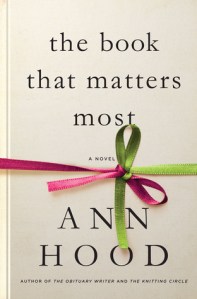
ann-hood-book-that-matters-most-268895212. Ann Hood’s The Book That Matters Most.  Ann Hood is a  “middlebrow” writer, and I very much enjoy her novels.  Her style is simple and clear, which I wish I could say for every writer.  A few years ago I loved The Obituary Writer, which I wrote about here. Recently, looking for a light read, I picked up a copy of her new novel, The Book That Matters Most.

Is it a light read?  Well, not so much.  It intertwines the stories of a mother and a daughter: Ava, a French professor, is grieving for her beloved husband, who has left her for an exhibitionist knitter who puts sweaters and mufflers on local statues and is often on the TV news. Ava joins an elite book group, run by her friend, for distraction, while her daughter Maggie, who has had many problems, is living in Paris as a kind of junkie hostage of an art dealer who supplies her with drugs.  Her mother thinks she’s in Florence.  She thinks Maggie is doing well.

It is a very odd, uneven book, and so I am stuck.  Why?  Because Ava doesn’t read the books for her book group.  When they read Pride and Prejudice, and she watches the movie, I am disappointed.  Will she eventually read one of the books?  And I am not that interested in Maggie’s story.

It is a bit rocky so far, but I will continue.  Hood will bring it together, I’m sure.

ARE YOU READING SOMETHING NEW?  And who or what is your guide?

Henry James’s The Wings of the Dove

wings-of-the-dove-james-51epwu96axl-_sx323_bo1204203200_

Yet shall ye be like the wings of a dove, that is covered with silver wings and her feathers like gold.
—The Sixty-Eighth Psalm

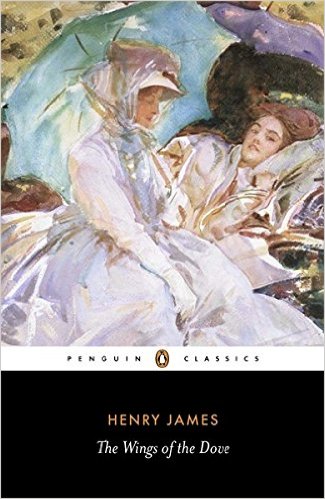
Perhaps the most fascinating characteristic of Henry James’s novels is not his exquisite prose but the force of the plots. You don’t need the notes. You read greedily; there is no time for the notes. James is a bit like Dickens.  Both are masters of melodrama.  One will never quite tread the hyperbolically foggy streets of Dickens’ London (where is the fog?), but one glimpses reflections  as one stomps on a guided tour of Dickens’ London, and though there is no tour of James’ London, to my knowledge, you can imagine Milly Theale, the heroine of The Wings of the Dove,  as she wanders through the National Gallery, or Kate Croy and Merton Densher scheming on a bench in Kensington Gardens.

wings-of-the-dove-modern-library-17884be09381b5da747bc607da31b37aIn The Wings of the Dove, the melodrama unfolds like the symbolic wings so often referred to of James’ dove, i.e.,  the heroine Milly Theale. (There are other winged women in Wings: the wealthy Aunt Maud,  interested in Milly solely as the lion of the season, is said by her niece Kate to have the wings of a vulture.)  Milly, a dying American heiress, is a Dickensian orphan, curious and observant, traveling around Europe with Mrs. Stringham, her companion. She is dying of an unnamed disease; but she is determined to live as long as she can, and her doctor indicates that she will live longer if she does what she likes.

Odd as this may sound, and perhaps it is a stretch, I am reminded of Dickens’ orphan Esther Summerson in Bleak House.  Like Milly, Esther is modest, sweet, lively and charming, and though, unlike Milly, she know nothing of her parents, she is connected to wealth.  She  does not die, but is very ill with smallpox, contracted through an act of charity.   Both heroines have a razor-sharp wit beneath the sweetness and both capture the love of those around them. Both are in love with men they aren’t sure they can have.   Could James have written The Wings of the Dove without Bleak House? Well, yes: his cousin Minnie died young, and I think he knew a couple of other young sickly women.  (I’m not doing research:  I’m doing the New Criticism thing.)  But I love Milly and Esther equally.  And I can imagine some readers dismissing Milly as too good, just as they do Esther.

In this reading of The Wings of the Dove, I read an edition with no notes: I wanted the experience of reading as a 1902 reader would. Having just reread The Golden Bowl, I was struck by the similarity of the plots (I wrote about Golden here):   in Wings, Milly is almost the victim of a plot by her charming trusted English friend, Kate Croy, who, when she discovers that Milly is dying, persuades her boyfriend, Merton Densher, to court Milly . Densher does it only to please Kate, and doesn’t quite take in the enormity of what she asks. Milly’s companion, Mrs. Stringham, also wants him to propose, not caring what his motives are, just wanting Milly to get what she wants while she is alive.

A horrific plot! And yet we like Kate so much in the beginning. In the opening chapter, she visits her father, an impoverished middle-aged dandy, and offers to throw in her lot with him and share her small income.  She is living with rich Aunt Maud, who insists that Kate give up her father if she continues to live with her. But Kate’s father says to give him up with his blessing. Follow the money.

And so we see the morals of Kate. She struggles, but there is nothing to convince her of the greater good, or anything but the good of wealth.  She cannot marry Densher, her journalist boyfriend who has no money, if she wants her aunt’s money, and she has never liked anything so much as her rooms at Aunt Maud’s, so she must give him up, too. And so she hatches the plot.  Milly is going to die, so why shouldn’t she and Densher have the money?  That’s her reasoning.

As a young woman, I identified with Milly–I was so silly–and I simply loved her. I still do. Milly has a sense of adventure and a sense of humor and wants so desperately to live:  at the National Gallery in London, she sits on a bench, humorously studying the lady copyists.  And it is this passage that reveals the lonely Milly’s secret dash and fun.

Milly yielded to this charm till she was almost ashamed; she watched the lady-copyists till she found herself wondering what would be thought by others of a young woman, of adequate aspect, who should appear to regard them as the pride of the place. She would have liked to talk to them, to get, as it figured to her, into their lives, and was deterred but by the fact that she didn’t quite see herself as purchasing imitations and yet feared she might excite the expectation of purchase. She really knew before long that what held her was the mere refuge, that something within her was after all too weak for the Turners and Titians.

When Milly discovers the plot, she behaves beautifully, almost too beautifully. But when I was young, I very much hoped I would behave like Milly in similar circumstances.  These days I prefer The Golden Bowl, because  Maggie, who discovers a similar plot, lives.  The older we get, the more skeptical we are of our heroines’ demises.

But James  was traumatized by the deaths of beloved young women.  And so the text takes me only so far, but it is far enough.

Colette under Different Titles & a 1951 Anthology of Six Novels

short-novels-of-colette-good-pictureHave you ever discovered  a “new” book by a favorite author?  And then it turns out you have already read it—under a different title?

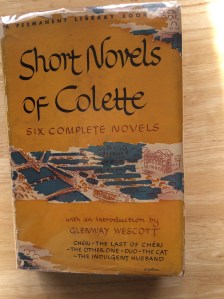
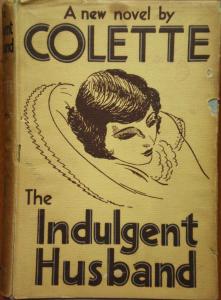
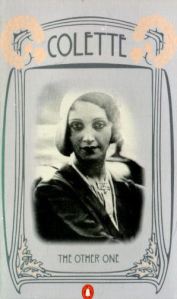
That was the case with one of the books in Short Novels of Colette, a 1951 omnibus including Cheri, The Last of Cheri, The Other One, Duo,  The Cat, and The Indulgent Husband.

I bought the anthology for The Other One, which IS new to me, but I was also unfamiliar with The Indulgent Husband.  Turns out it is just the third Claudine book (Claudine Married), under a different name–my least favorite Claudine.  It’s the one where Claudine has an affair with a seductive young woman who turns out to be her husband’s lover—ewwww!

Colette wrote the (slightly) risqué Claudine books for Willi, her first husband, who employed and exploited dozens of ghostwriters.  (He spent so much time commissioning work that he could easily have written it.)  The Claudine books were fantastically popular and adapted for the stage.

the-indulgent-husband-colette-cfee468a9027beb3623a24ac01456d46Oh, well,  it is worth having the anthology for The Other One, and  for Glenway Westcott’s 57-page introduction   He loves every word Colette wrote, good or bad.  Proust and Gide wrote letters to Colette about their great admiration of her work.  Westcott writes,” …now that the inditers are both dead and gone, Colette is the greatest living French fiction-writer.”

Westcott’s introduction is a mix of biography, separate sections with incisive criticism, and personal comments about his love of Colette. He gushes about her looks and the artistry of photographs of her.

“I wish we could have illustrated this volume with photographs of Colette; there are plenty, entrancing, at all ages. The first written description of her that I ever read was an entry in Jules Renard’s Journal, November 1894: her appearance at the first night of Maeterlinck’s translation of ’Tis Pity She’s a Whore, bright-eyed, laughing, ‘with a braid of hair long enough to let the bucket down a well with”; Melisande-like.”

The Other One was a first read for me, and if the translation by Viola Gerard Garvin is stilted, it still captures Colette’s originality.  It is rather stagy, which is appropriate, because the heroine, Fanny, is a  playwright’s wife accustomed to the intrigues of the theater. She is happy except for one problem:  Farou has affairs.

colette-the-other-one-101049Fanny lives  with Farou and her stepson, Little Farou.  It is summer, and there is much emphasis on her laziness, the heat, and  her Oriental eyes.  Contrasted with the dark Fanny is their cool ash-blond housemate, the efficient Jane, Farou’s smart secretary, who  helps Fanny with the housekeeping. The lives of Fanny and Jane revolve around Farou.  When he is away, they wait for word from him.

The novel begins:

The postman brought nothing at eleven o’clock. If Farou did not write last night before going to bed, it’s certain he had a late rehearsal.”

“You think so, Fanny?”

“I’m sure. ‘The House Without Women’ is not difficult to stage, but little Asselin isn’t at at all the type of woman to play Suzanne.”

“She’s very pretty, though,” said Jane.

Fanny shrugged her shoulders.

“My poor Jane, how does it help her to be pretty? No one ever wanted a pretty woman to play Suzanne. It’s a part for a Cinderella like Doriyls. Didn’t you see the play when it was first produced?”

Jane’s comment about Suzanne’s prettiness is the first clue to her  jealousy.  Jane is having an affair with Farou.   It is Little Farou, who has a crush on Jane, who tips off Fanny.  And when  Fanny sees her husband embracing Jane, and then a minute later Jane mimics Fanny and her habit of saying “oo-la-la,” we see the ugliness of an otherwise pretty woman.   Fanny realizes that her friend of four years is far from a friend. But she hides her knowledge while she figures out what to do.

The ending is abrupt, and not altogether believable to me, but in the world of Colette–who know?  And in a way it is the shock of the sophistication of the women that makes it true.

I so much love reading Colette, even if it’s not the best Colette

Reading the Dead & Dead Review Copies

Reading the classics.

Reading the classics.

I have been reading the dead.

Not the recent dead.

The long dead. Ovid, Turgenev, and Henry James.

It was not my intention to read the dead this year.  But it has restored a sense of normalcy .  It reminds me why I loved to read in the first place.

Why do we read?  We don’t read to keep up with the new best-sellers; we don’t read to review or blog; and do not feel the need simultaneously with everyone else to reread Orwell’s dystopian classic, 1984, even if it is No. 1 on the best-seller list. I prefer  Gabriel Garcia Marquez’s magic realismCharlotte Bronte’s  Jane Eyre, and Ovid’s poetry of exile, Tristia and Epistulae ex Ponto.

I am on a temporary break from new books.

Tonight I even  scrolled down the list of titles on my e-reader to  delete last year’s unread review copies.  (I no longer accept new review copies.)  There weren’t as many as I thought.  Thank goodness!  And I may read some of them after all.

REVIEW COPIES I DIDN’T READ OR FINISH.

Alice Hoffman’s Faithful. It’s not bad, but it’s not her best.  The heroine Shelby and her best friend were in a car accident.  Shelby survives physically intact, but her best friend is in a coma for years.   Shelby turns to drugs, shaves her head, and has sex with her drug dealer,  but occasionally receives anonymous postcards that say “TRY.”  Eventually she finds redemption in a pet store and rescues animals… and  some people..  Why didn’t I finish it?  It’s good, but the words on the screen are not quite compelling enough. The physical books would have made me feel more connected.

The Six: The Lives of the Mitford Sisters by Laura Thompson. I love biographies of the Mitfords, but the formatting of this fee “review copy” e-book was off-kilter.  And anyway biographies are better as physical objects, so you can see the   photographs and family trees.

The Sea Change by Elizabeth Jane Howard. I enjoy Howard’s books and  forgot I had this one.   I also have a physical copy, so will try to read it this year.

The Photographer’s Wife by Suzanne Joinson.  I very much enjoyed Joinson’s novel  A Lady Cyclist’s Guide to Kashgar.  I’m afraid I forgot all about this.

Siricusa by Delia Ephron.   Another badly formatted free e-book.  Lots of weird numbers inserted in the middle of sentences.

Well, so it went.  Deletion is done!