William Gibson’s Neuromancer

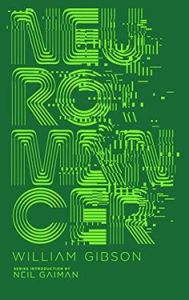
neuromancer-penguin-galaxy-556df0886068133afc3c967e7ee28c22The new Penguin Galaxy series is a collection of six hardcover science fiction classics:  T. H. White’s The Once and Future King, Robert Heinlein’s Stranger in a Strange Land, Frank Herbert’s Dune, Arthur C. Clarke’s 2001:  A Space Odyssey, Ursula K. Le Guin’s The Left Hand of Darkness, & William Gibson’s Neuromancer.  These beautifully-designed books with literally glittering titles are a good incentive to explore science fiction.  I highly recommend Dune, an ecological classic (which I wrote about here) and The Left Hand of Darkness (which I wrote about here).   Neil Gaiman’s introduction is reprinted in each volume.

I recently reread William Gibson’s Neuromancer, the 1984 cyberpunk classic that won the Nebula Award, the Philip K. Dick Award, and the Hugo Award.

We’re not quite where Gibson thought we’d be, and thank God for that. But before cell phones and the internet, he described a high-tech world of hackers, cyberaddiction, artificial intelligence, virtual reality, war games, and a dangerous divide between rich and poor. Gibson is a visionary, and his flamboyant language is like SF noir on acid.

This action-packed novel had a huge impact on “cyberpunk” science fiction.  And, in a strange way, the bleak atmosphere and lost, desperate quality of the hero remind me of another 1984 novel, Jay McInerney’s Bright Lights, Big City.  Could the two books be more different?  No, and yet…

But of course this is SF, and Gibson’s hero is a hacker, not a fact-checker.

Neil Gaiman gives the background in the introduction:

Neuromancer is sui generis, while at the same time having a direct and solid science-fiction lineage:  an unholy fusion of Samuel R. Delany’s prose and world-building and Alfred Bester’s narrative fireworks. Above all, Gibson heeds Raymond Chandler’s observation that when writing a pulp adventure, ‘the demand was for constant action:  if you stopped to think, you were lost.  When in doubt, have a man come through the door with a gun in his hand.’  In Neuromancer, men come through the door, and women too, and things not always human, all with weapons in their hands.  We never stop to think.  It’s safer that way.

A very '80s William Gibson/

A very ’80s William Gibson.

The hero of Neuromancer, Henry Case, is a former hacker on a suicidal downward spiral in Chiba City, Japan.  His career in the Sprawl is dead and he is down and out: he stole money via computer from his bosses, and as a punishment they destroyed his nervous system.  Now he deals and takes drugs to survive and sleeps in a rented coffin.    And he is doing so many drug deals that even the bartender with the antique artificial arm knows he has a death wish.

The language is impressionistic and often hallucinatory. The events are also dream-like.  When Case hears from his ex-girlfriend, Linda, that his drug distributor boss, Wage, wants to kill him, he runs.  There is an eerie chase scene in an arcade, though who is chasing him he doesn’t know.  And he knows he’s crazy, because he is elated.

Because, in some weird and very approximate way, it was like a run in the matrix.  Get just wasted enough, find yourself in some desperate but strangely arbitrary kind of trouble, and it was possible to see Ninsei as a field of data, the way the matrix had once reminded him of proteins linking to distinguish cell specialties.  Then you could throw yourself into a high-speed drift

And then he is hired, i.e., forced to work, by Armitage, an ex-colonel with no affect who was traumatized by a mission in Russia.  Case is bribed by the promise of neurosurgery so he can once again work as a hacker.  All is well except for one thing:  a poison sac is inserted to wreck his pancreas if he doesn’t finish the job in time.  And he does not even know what the job is.

Case and his colleague, Molly, a samurai warrior with weird implants, save each other multiple times.  Another colleague is a computer program copy of the brain of the dead best hacker he ever worked with, McCoy Paulie.

Sound complicated?  Well, yes, it is. Do I know exactly what is happening all the time?  No. Is it Gibson’s best book?  It is great.  My own favorite is Zero History, an SF thriller about postmodern marketing, fashion brands, and corrupt American military contractors.

I never realized that  Neuromancer was the first of a trilogy.  More great SF to read.

Ethelinde by Charlotte Smith, edited by Ellen Moody

charlotte-smith-ethelindeNow that the election is over…

One good thing happened!

Today I received in the mail a copy of 18th-century novelist Charlotte Smith’s Ethelinde, edited and with an introduction and notes by my friend Ellen Moody.  This beautiful paperback is published by Valancourt Books.

According to the jacket copy, Smith (1749-1806), the author of 10 novels, wrote to support herself and her 10 children after her husband was imprisoned for debt.

In the introduction, Ellen  compares it to Anna Karenina.  Here’s a brief excerpt from the introduction:

Ethelinde is centered on a depiction of adulterous love more sympathetic and true to experience on the sides of both the novel’s hero, Sir Edward Newenden and his once loved wife, Maria, Lady Newenden, than what is found in Tolstoy’s Anna Karenina.  It is the story of Newenden’s gradual falling in love with Ethelinde Chesterville, the novel’s primary heroine, his physical as well as emotional need for her in the face of his wife’s increasing distaste for him, for his idealistic and ethical values, and for his children; of his efforts to repress his longing for the congenial, sensitive, readerly Ethelinde; and of the final thwarting of his intensely compelling and sexual desire for Ethelinde.

Ellen is a superb writer and blogger and an expert on 18th century literature.  You can read her work at Ellen and Jim Have a Blog, Two and Reveries under the Sign of Austen, Two.

More on this later!

A Patriot’s Grief

Hillary Clinton

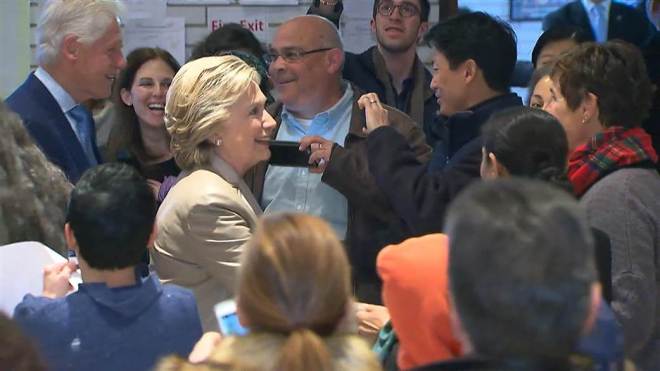
Hillary Clinton gives her concession speech, Nov. 9, 2016.

I didn’t cry, but I felt grief when I saw the election results.  I have passed the day in a state of blankness.

Clinton waited till this morning to give her concession speech.  At first I thought it an odd decision, but in retrospect it was smart. It stopped us looking for answers on the internet that just aren’t there. Listening to her at 10:30 a.m., I was impressed by her eloquence and common sense.  And I wondered whence the myth was born that this brilliant, pretty woman is unlikable?  Powerful American women don’t get a break.

I felt sustained by her words, and also realized how seldom I see women in strong roles even in the twenty-first century.    (On TV and in movies they are perpetually dissolving in tears.)  Mind you, I’m fine with crying,  but I don’t want to shed any tears for being a feminist patriot in the year when Americans inexplicably elected  Trump and the Republicans.  (The good news:  even George W. Bush didn’t vote for Trump.  He left the top part of the ballot blank.)

Clinton urges us to hold on to our ideals and never give up working for what we believe in. And she reminds us of the need for a peaceful transfer of power.

Here is an excerpt from her stunning speech.

I know how disappointed you feel, because I feel it too. And so do tens of millions of Americans who invested their hopes and dreams in this effort. This is painful, and it will be for a long time. But I want you to remember this.

Our campaign was never about one person, or even one election. It was about the country we love and building an America that is hopeful, inclusive, and big-hearted. We have seen that our nation is more deeply divided than we thought. But I still believe in America, and I always will. And if you do, then we must accept this result and then look to the future. Donald Trump is going to be our president. We owe him an open mind and the chance to lead. Our constitutional democracy enshrines the peaceful transfer of power.

Our campaign was never about one person, or even one election. It was about the country we love and building an America that is hopeful, inclusive, and big-hearted. We have seen that our nation is more deeply divided than we thought. But I still believe in America, and I always will. And if you do, then we must accept this result and then look to the future. Donald Trump is going to be our president. We owe him an open mind and the chance to lead. Our constitutional democracy enshrines the peaceful transfer of power.

We don’t just respect that. We cherish it. It also enshrines the rule of law; the principle we are all equal in rights and dignity; freedom of worship and expression. We respect and cherish these values, too, and we must defend them.

We’ve lived through other Republican regimes, and we’ll survive this one, too.  Obama has invited Trump to the White House.  Let’s hope they can work together, because, as Hillary’s slogan says,

stronger_together

Election Day in the Age of Global Warming: Hillary Clinton, Gravitas, & Obama’s Basketball

hllary-tdy_clinton_vote_161108-today-vid-canonical-featured-desktop

It’s a beautiful day in the Age of Global Warming, 60 degrees, sunny.  We are having an informal “eclectic-election” party in the backyard, and I’ve been lolling on an Adirondack chair swigging Diet Coke.   My cousin snuck inside to check her phone, which we forbade her to bring outside.

“It’s too early for the news!”

On the one hand I am confident that Hillary Clinton will be our next president, on the other hand I am  apprehensive about the alternative.   If Hillary wins, this is a historic day for the U.S.   She will be our first woman president, and  can you believe it has taken almost 100 years?  The 19th amendment (women’s suffrage) was ratified in 1920.

If the alternative happens, I will read Sinclair Lewis’s It Can’t Happen Here.

But that won’t happen.

Yet, oddly, it is Obama, not Clinton, who has the power to move me.  I teared up this morning when I read  a New York Times article,  “‘Fired Up’ Obama Makes Final Push for Clinton, and His Legacy,” about Obama’s campaigning for Hillary in Ann Arbor yesterday.  Here’s an excerpt from the article.

“I already voted,” he added. “I voted for Hillary Clinton, because I am absolutely confident that when she is president, this country will be in good hands — and I’m asking you to do the same.”-

“I love you!” supporters kept shouting at the president as he turned serious to lay out the stakes of an extraordinary race.

“I love you back — I do,” Mr. Obama said in Michigan. “But tomorrow, you will choose whether we continue this journey of progress, or whether it all goes out the window.”

Why did I tear up?  It’s a rock concert thing, yelling “I love you!” But I realized that I, too, love Obama, and  it’s not a word I use lightly:  I am beyond enjoying wispy love lyrics of rock songs. I think very little about politics, but out of the corner of my eye and ear I have had faith in his judgment and gravitas.  Who else could have passed the Affordable Care Act?  God knows, others , including Hillary, have tried. He is brilliant and eloquent. He is popular.  He took over the government in the mess after the financial crash of 2008.  He is, and I can’t believe I’m saying this, a great role model.  He reads.  His conversation with Marilynne Robinson was published in The New York Review of Books.  He exercises.

President Barack Obama carries a pair of sneakers as he arrives for a private game of basketball at Fort McNair in Washington, Tuesday, Nov. 8, 2016. Playing basketball on election day is a tradition for Obama. (AP Photo/Pablo Martinez Monsivais) ORG XMIT: DCPM107

President Barack Obama arrives for a private game of basketball at Fort McNair in Washington.

This morning Obama played basketball with friends at Ft. McNair in Washington:  it is one of his election rites.  He  played basketball on every election day when he ran for president.   And this time he’s playing basketball for Clinton.

My husband thinks it would be a good idea if we all  played basketball today.  I took a walk instead, because I am not good at sports involving throwing round objects.

I’m one of the leftists (left-middleists?  middle-leftists?) who has rallied behind Hillary Clinton, because Bernie Sanders’ campaign was just a beautiful dream, and Clinton will continue the great work of Obama, who has been the best president of my lifetime. I didn’t sign on to be a grown-up, mind you, it just happened. Voting for the better candidate is part of being an adult.   Secretary of State, Senator, First Lady: Clinton has gravitas.

I’m waiting for the results!

peace signs yike8dMpT

The Dickens Set I Didn’t Sell & Three Literary Links

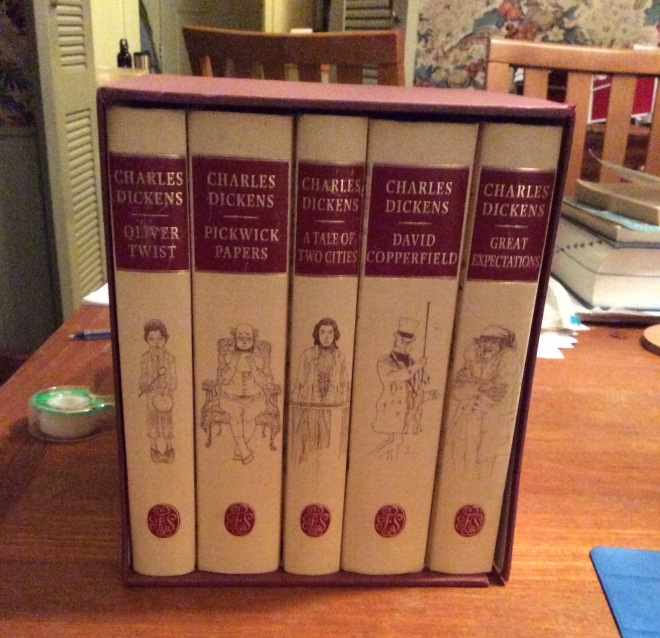
My Dickens set!

The Dickens set

For weeks I intended to go to Half Price Books, the only used bookstore in town, one of a 120-store Texas-based chain.  I wanted to try to sell my Folio Society five-book Dickens set (1985).

The problem was my husband wanted to divvy the Dickens up in our panniers and bike there.  I wasn’t enthusiastic about biking with ten or more pounds of hardbacks.  And so weeks went by, but I finally persuaded him it was worth a trip in the car (we seldom take the car). We weren’t even sure we would sell the Dickens, because they used to pay a laughable 25 cents per paperback.  I had in my mind a lowball price beneath which I would not go.

Many people sell their books at Half Price Books.  Stacks and stacks of romances and vampire books were piled on the counter.   People wheeled them in on dollies.   More kept coming in.

They offered me $10.  I declined.

Well, I didn’t expect much, but I did expect more than $2 per book.  It’s a set, in excellent condition. At a garage sale I might sell it for $20.   On Abebooks the lowest price is $79.  I’d rather give it to the Planned Parenthood Book Sale than Half Price Books.

Heavens, I see why people sell them online!

Does anybody sell books online?  Do you have good experiences?

LITERARY LINKS.

1. The Literary Hub recently published the article, Hillary Clinton vs. Donald Trump:  What Do They Read?”   Who has good taste?  Who does not?  Clinton recommends The Brothers Karamazov and The Clan of the Cave Bear,  while Trump doesn’t have much time to read, except his own book.  (Obama is a more literary reader.)

brothers-karamazov-51hgj-nc7bl-_sx312_bo1204203200_2. The classicist Mary Beard recently wrote  about Max Beerbohm’s novel, Zuleika Dobson, at A Don’s Life her blog at the TLS.   (Statues of Roman emperors play a part.)  I must admit  Zuleika Dobson is one of the more misogynist novels I’ve read, but  her lively essay makes me want to reread it.  Here is an excerpt.

The story is a simple one. It tells of the young, exotically named, and stunningly good looking Zuleika who arrives among the dreaming spires to stay with her grandfather, who is the head of the semi-fictional Judas College. Not only does Zuleika herself fall in love for the first time; but all the male undergraduates fall in love with her. Literally all of them: and so badly in love that they end up killing themselves for her, every single one. At the end of the novel the unworldly dons seem hardly to have noticed that the students are all dead (even though the dining hall is strangely empty); meanwhile on the very last page, Zuleika is found making inquiries about how best to get to Cambridge . . . and it’s not too hard to guess what will happen there. It’s a satire not only on the dangers of women, but also on the madness of this masculine university world.

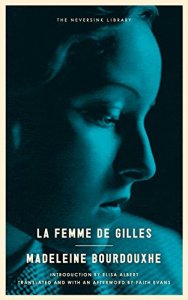
zuleika-dobson-beerbohm-zd3. The stunning novel La Femme de Gilles, by Madeleine Bourdouxhe, translated by Faith Evans, is one of the 10 Must-Read Books for November at Flavorwire.  On May 26 I wrote at this blog,

The Belgian writer Madeleine Bourdouxhe’s exquisite first novel, La Femme de Gilles, published in 1937 and translated by Faith Evans in 1992, explores the pain of adultery. It is told mainly from the point of view of Elisa, the faithful wife who is in love with her handsome husband Gilles, a factory worker.

We don’t think of working-class marriages in fiction as erotic. In most working-class novels, marriages are exhausting and unhappy: in D. H. Lawrence’s Sons and Lovers, Paul’s refined mother despises her coal miner husband; in Hariettte Simpson Arnow’s The Dollmaker, Gertie’s factory worker husband squanders her savings; and in Tillie Olsen’s Yonnondio, Jim works in a slaughterhouse and beats his wife and children.

la-femme-madeleine-bourdouxhe-51nuwgbobdl

Comments! Let’s Chat

women-gossip-black-and-white-coffee-gossip-kitsch-favim-com-2658218I have turned the comments back on.

Click on the post title and they’ll show up!  It’s a different format, but it works.

If you have any problems, email me at mirabiledictu.org@gmail.com


Catherine Lacey’s Nobody Is Ever Missing

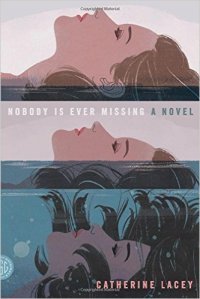
nobody-is-ever-missing-catherine-lacey-51-h5uhfejl-_sx331_bo1204203200_Sometimes even the most gorgeously-written of contemporary novels wear me down.  This year, in the course of trying to read more new books, I have discovered that talented millennial women  often hamper their narratives by affecting ennui.  I wonder, Why are their heroines so wispy? What does feminism mean to young women?  And what are the authors trying to say?

Catherine Lacey’s elegant, spiky novel, Nobody Is Ever Missing, is the third debut novel I have read this year with an almost self-parodically self-destructive heroine.  Emma Cline’s The Girls is the best of the three, the narrative shifting  back and forth between the heroine Evie’s present existence as a caregiver/housesitter to her memories of a summer in the ’60s when she was  peripherally involved with a Manson-like cult.  Natasha Staggs’ Surveys is another brilliant novel, the story of an underemployed college graduate who goes from working in a mall survey office to internet fame after becoming involved with an almost-famous person online.

catherine-lacey-96c33e_5257b3bd3d2c1e43a297161162a0feaeLacey’s uneven Nobody Is Ever Missing is the least effective of the three.  She writes long, lyrical, winding sentences, a cross between Kerouac and Joan Didion’s Play It As It Lays.  The narrator, Elyria, a brittle woman named after a town in Ohio,  leaves her life in Manhattan and gets on a plane for New Zealand without telling anyone.

Why does she leave?  Well, that’s not quite clear. It seems Elyria, a soap opera writer, has not been the same since her adopted Korean sister Ruby committed suicide six years ago. She married the math professor who was the last person to see her sister alive, though her alcoholic mother pointed out that this was not the best foundation for a relationship.   The couple are happy briefly, but the marriage deteriorates:  they fight all the time, their good memories are consumed by their differences, and in her husband’s sleep he is often bizarrely violent.

So what happens to Elyria in New Zealand?  Well, nothing much. In New York she was upper-middle-class (or upper?); now she is a bum.  She hitchhikes.  She stays with a poet on his farm, but he kicks her out, because she is too troubled even for him.  She befriends a transgender woman, but any relationship is too much pressure.  Elyria runs deeper into solitude, sleeping on the beach, in a shed, and then settling for months in a caravan outside the cabin of a generous vegetarian hippie couple, Luna and Amos.  By the end of the novel, Elyria has fallen to the bottom tier of society.   She wants to be missing to herself.

Here is one of Lacey’s beautiful sentences, describing Elyria’s depressed thoughts.

And after I had deleted my history on Amos’s computer I realized that even if no one ever found me, and even if I lived out the rest of my life here, always missing, forever a missing person to other people, I could never be missing to myself, I could never delete my own history, and I would always know exactly where I was and where I had been and I would never wake up not being who I was and it didn’t matter how much or how little I thought I understood the mess of myself, because I would never, no matter what I did, be missing to myself and that was what I had wanted all this time, to go fully missing, but I would never be able to go fully missing—nobody is missing like that, no one has ever had that luxury and no one ever will.

The reviewers were enthusiastic about this novel, and many of you may be, but I am not.  Lacey can write beautifully, and sometimes she does, but her sentences are often purple prose.  And I do not comprehend the narrator’s wish to go  missing, which must be very uncomfortable after living on the West Side.  This uneven book, published in 2014, has its points, but is far from the best new book I’ve read this year.

The Best of Balzac: Père Goriot

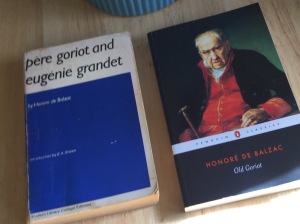
penguin-old-goriotDuring my Balzac phase in 2013, I loved Père Goriot(The title of the Penguin is Old Goriot.)  I experienced the thrill of falling into a  spellbinding story and recognizing a tour de force. Père Goriot is said to be one of the best books in Balzac’s La Comédie Humaine (The Human Comedy), a cycle of approximately 90 novels, novellas, and short stories portraying 19th-century French society during the period of Restoration and July Monarchy.

Recently I had to read Père Goriot in two different translations for the usual reason:  my old Modern Library paperback fell apart.  Yes, the tape could no longer hold it together, so I hustled to get a replacement copy.   The Modern Library edition (translated by E. K. Brown,  1946) is out-of-print, so I switched to the Penguin (translated by Marion Ayton Crawford, 1951).

pere-goriot-and-old-goriotObviously there was a call for translations of Old Goriot in the mid-twentieth century, with two translations for two different publishers.

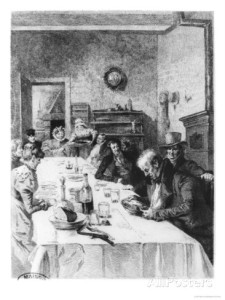
Albert Lynch's illustration of the boarding house.

Albert Lynch’s illustration of the boarding house.

Much of the book is set in a boarding house.  I am fascinated by tales of boarding houses–I did rent a room in college, as did most of my impoverished friends. (We had to feed ourselves in the attic kitchen, though:  no landlady made sloppy meals.) In this stunning classic, Eugene Rastignac, a poor law student who rooms in Madame Vauquer’s shoddy boarding house in the Latin quarter of Paris, becomes obsessed with luxury and women.  After attending a party at his cousin Madame Claire de Beauséant’s house, he wants what the rich have.  He borrows the savings of his mother and sisters so he can attain this ambition. Will he be able to pay them back?  In the glittering upper-class society, he finds incomprehensible social barriers, debts, and infidelity. He plans to use his new connections–but how?  And he goes home at the end of the night to his bare room.

He does not realize that Pere Goriot, one of his more eccentric fellow lodgers, has links to high society.  When Eugene sees Goriot leaving the beautiful married Countess de Restaud’s house by the back stairs, he tells her that Goriot lives at Madame Vauquer’s.   Turns out Pere Goriot is her father and she is ashamed of him. So she bars Eugene from her house, and, as an act of minor revenge, he courts her sister, Baroness Delphine de Nucingen, a banker’s wife who is also ashamed of her father.  They have an affair.

The boarders play a big part in Eugene’s life.  A strange man named Monsieur Vautrin advises Eugene to claw his way up through society by marrying a fellow boarder named Victorine, a disinherited heiress who he promises will soon be rich.  Vautrin has an evil plot…I He tells Eugene he will never rise unless he is ruthless.  Eugene is terrified.

On the other hand, Goriot is delighted with Eugene’s dallying with his daughter Delphine. He wants any news of his daughters, and Eugene can tell him about their clothes and parties.  Goriot used to be rich, but has given his daughters almost all his money.

Even in translation, the power of Balzac’s writing comes through.  And both translations are powerful, though I slightly prefer the lushly written translation by E. K. Brown in the Modern Library edition.  Here’s a sample paragraph of the Brown near the beginning.

The chariot of civilization, like Juggernaut’s, is barely delayed by  some heart which does not break as easily as others, and holds back its wheels; soon the heart is shattered, and the chariot continues its glorious march.  And you will do the same you who hold this volume in a white hand, and, sinking back in a soft armchair, say to yourself:  “Perhaps this book is going to entertain me.”  After you have read of the hidden sorrows of Pere Goriot, you will dine with a keen appetite and blame the author for your insensibility, accusing him of poetic exaggeration.  Oh, you may be sure that this drama is no work of fiction, no mere novel!  It is all true, so true that everyone may recognize its element within himself, perhaps in his very heart.

Here is Crawford’s translation.

The chariot of civilization, like the chariot of Juggernaut, is scarcely halted by a heart less easily crushed than the others in its path.  It soon breaks this hindrance to its wheel and continues its triumphant course.

And you will show the same insensibility, as you hold this book in your white hand, lying back in a softly cushioned armchair, and saying to yourself, “Perhaps this one is amusing.”  When you have read of the secret sorrows of old Goriot you will dine with unimpaired appetite, blaming the author for your callousness, taxing him with exaggeration, accusing him of having given wings to his imagination.  But you may be certain this drama is neither fiction nor romance.  All is true, so true that everyone can recognize the elements of the tragedy in his own household, in his own heart perhaps.

They are very close, aren’t they? But Brown is more vivid and elegant.  At first Crawford seemed awkward to me, but I didn’t notice after a while.

Translation, translation, translation!  I depend entirely on translations for French. Which is better? The Brown reads better.  The Crawford is what I have now.

The same few Balzacs are translated again and again, and I do wish there were new translations of the others.

What are your favorite Balzacs?   The original 19th-century translations are available free online, if you want to try them.

The Continuing Comedy of Small Print

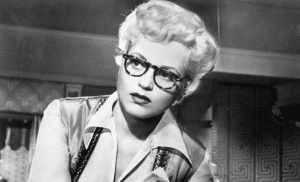
Judy Holliday in "Born Yesterday" needs serious glasses!

Judy Holliday in “Born Yesterday” obviously can see small print!

Everyone wears bifocals eventually.  The readers, the non-readers, the cool people, the uncool.   It doesn’t mean you have four eyes.  It means you have “two distinct optical powers” (Wikipedia).

When beautiful Diane Keaton wears glasses in a movie or at an event, you can bet she’s wearing bifocals. (She is 70.)  When Gleb Savchenko wears glasses in a jazz dance on Dancing with the Stars,  you can bet he’s not wearing bifocals because (a) he’s young and (b) the glasses are part of his costume.

Gleb in glasses on Dancing with the Stars

Gleb on Dancing with the Stars

Diane Keaton in glasses.

Diane Keaton

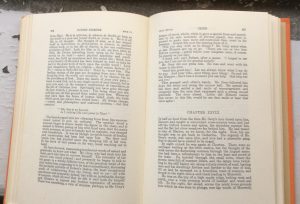
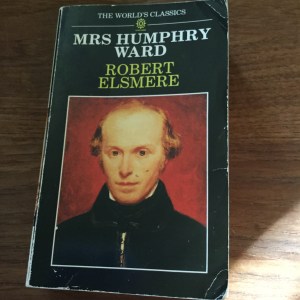
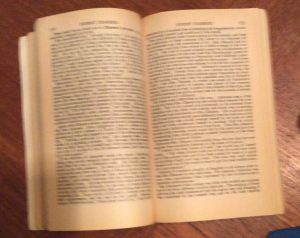
Recently I was racing through an Oxford paperback of Mrs. Humphry Ward’s Robert Elsmere and troubled by the tiny print.  I don’t know the point size, but it was microscopic.   Even my bifocals didn’t help.

I read the free e-book and that worked fine.  Still, I loved this book so much I wanted a hard copy.  I ordered a University of Nebraska Press ex-library book copy for a penny, and it came today.

Here’s the funny thing about it.  IT HAS THE EXACT SAME TINY TEXT AS THE OXFORD COPY.  So they copied the original 19th century text and reprinted it?  Isn’t that too bad?  Oh, and the binding is broken too.

Darn, darn, darn.

robert-elsmere-ward-nebraska-version

Small print in Robert Elsmere (University of Nebraska Press edition, 1967)

When Print Is Too Small: Mrs. Humphry Ward’s Robert Elsmere & Others

mrs-humphry-ward-robert-elsmere

…the afternoon sun, about to descend before very long behind the hills dividing Long Whindale from Shanmoor, was still lingering on this May afternoon we are describing, bringing out the whitewashed porch and the broad bands of white edging the windows, into relief against the gray stone of the main fabric, the gray roof overhanging it, and the group of sycamores and Scotch firs which protected it from the cold east and north.”–A lovely descriptive passage from Mrs. Humphry Ward’s Robert Elsmere

I was raised on Jane Austen, Charlotte Bronte, and Thomas Hardy, and cannot get enough of Dickens.

In recent years, after reading and rereading my favorite nineteenth-century classics,  I have turned to the “third-rate” Victorians.  Call them minor, but they are better writers than your average 21st-century computerized pisseur de copie. Mrs. Humphry Ward, the author of 25 novels,  is intellectually and stylistically in the same class as George Meredith, Mrs. Gaskell, and Mrs. Oliphant.   I recently read  and loved  Robert Elsmere, Ward’s most famous novel.

Yes, it is a religious novel, but don’t be put off:  the characters are vivid and surprising, love and marriage don’t always work out, and the plot doesn’t go where you think it will.  At the center is Robert Elsmere, an inspired but delicate clergyman whose body  breaks down when he works too hard.  He tells stories and lectures on history to the poor, nurses the sick with the help of his wife, and insists on the importance of good drains.  But his contact with an intellectual atheist changes his  own beliefs.

The print is small….

Women play a big role in this 1888 novel and are more sympathetic than the men.  My favorite characters are the Leyburn sisters, who really dominate the book:  Catherine, who marries Robert, a very bright and diligent but rigid woman whose vicar father entrusted to her the religious care of her mother and sisters before his death; Agnes, a smart, witty, tactful spinster who unfortunately drops out of the narrative far too soon; and the youngest, Rose, a wild, beautiful, talented pianist who worries Catherine with her penchant for the arts. Although there is much intellectual discussion of church history, Christianity, and atheism  (see the introduction!),  there is also plenty about love, art, and the value of social work.  What I love most:   the way Ward creates an atmosphere.  I love her country walks, idyllic woods and pastures, and later the ugly smoky vividness of 19th century London.

Alas,  the print in my out-of-print Oxford World’s Classic edition, which was large enough when I first tried to read it pre-bifocals, is now too small for me.  There is almost no space between the lines. I was exasperated.   I read much of it on an e-reader.  Do your eyes ache after hours on an e-reader? Mine do.

Old books last, but some of mine have seen better days.

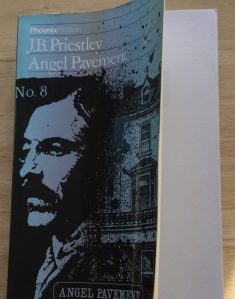
angel-pavement-j-b-priestley

A curly book!

J. B. Priestley’s Angel Pavement is a charming, lively novel,  but after one read my used paperback copy began to curl.  There is nothing wrong with it, but why do covers curl?   I loved the book, the story of a group of sad, desperate people who work in an office, Twigg & Dersingham.  (I wrote about it in 2014 here.)

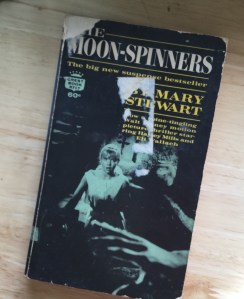
moon-spinners-stewart

Chewed by a cat.

The Moon-Spinners is my favorite book by Mary Stewart, though this 1964 paperback is  bunged-up.  My cat ate a corner of the cover,  but I love the photo of Hayley Mills in what the blurb calls the “spine-tingling Walt Disney motion picture.”

This has seen better days.

This has seen better days.

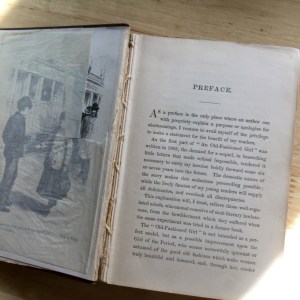
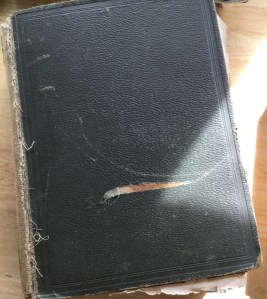
The binding of this nineteenth-century edition of An Old-Fashioned Girl, my favorite book by Louisa May Alcott, is falling to pieces.  Thank God paperbacks are cheap and e-books are free.

A Greek dictionary

A Greek dictionary

The cover of this scholarly nineteenth-century Greek dictionary, bought for $29 when I was in school, is turning from a book into wood and dust.  Just look at that cover.   The pages are still readable, though.

margaret-drabble-held-together-with-tape

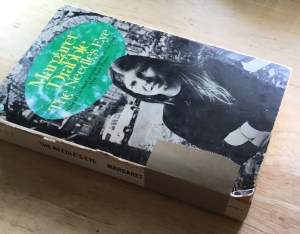
Held together with tape.

The Needle’s Eye is my favorite novel by Margaret Drabble.  My paperback is held together with tape.  I love the picture of Drabble on the cover!

Have your books suffered from small print, curled covers, etc.?  We can’t replace our books!