What We’re Reading This Weekend: Lionel Shriver’s The Mandibles & Trollope’s The Claverings

lionel shriver the mandibles 41m4GoRGmnL

Don’t use clean water to wash your hands!”–Florence Mandible in Lionel Shriver’s The Mandibles

It is hotter than usual this summer. Very hot.  It was 87 at noon, and that is a cool wave.  We don’t like it, but we’re used to it now.  What helps?  Water.  Lots of  water.

But will we always have water?  In Lionel Shriver’s clever, witty dystopian novel, The Mandibles:  A Family, 2029-2047, water is a luxury. There is no water in the West and there is a shortage in New York.

Shriver writes about four generations of the Mandible family.  The Mandibles have always been rich:  their fortune was built, ironically, on diesel engines (obviously a contributing factor to the pollution in 2029).  But this book is really about money:  what happens when the economy tanks in 2029 after the dollar is declared worthless in the global economy?    The U.S. has already survived “the Stonage,” when the internet was knocked out, the only real source of communication since people stopped reading print books and newspapers.  (The internet’s back.)  The Mandibles assumed there would always be money, and that they would inherit when  99-year-old Douglas Mandible, a former literary agent, died.

Now they’re poor.

My favorite character, Florence Mandible, has a “moronic double major in American Studies and Environmental Policy” and barely makes a living at her job at a shelter.  But she is good at managing water at her house in Flatbush for her partner, Esteban, and her son, Willing.  When Willing wants to take a shower, Florence thinks,

Her thirteen-year-old had bathed only five days ago, and knew full well they were all allotted one shower per week (they went through cases of comb-in dry shampoo).  Willing complained, too, that standing under their ultra-conservation shower was like “going for a walk in the fog.” True, the fine spray made it tricky to get conditioner out, but then the answer wasn’t to use more water.  It was to stop using conditioner.

The other Mandibles are fascinating though less likable:  Florence’s  therapist sister, Avery, can barely deny herself gourmet food even when her dinner guests can’t afford smoked salmon and fine wine, and her husband, an economist/professor, is a twit who tries to play by the old rules of the economy and loses all their money.  (And they have spoiled children who can’t believe they can no longer attend Sidwell Friends School.)  Florence and Avery’s father, Carter, a former journalist, must take in his father,  Douglas, and his younger wife, who has Alzehimer’s, after they are evicted from their palatial home in an assisted living/nursing home compound.   (Carter won’t let Douglas take his rare books.  He says impatiently that Douglas can download books.)

Information about money is presented in dialogue, and perhaps there are too many details. Like Florence, I’ve always found money “drear.”  But Shriver makes it simple, and if you read science fiction, you’re used to lots of complicated background that makes the future world believable.

I’m only one third of the way through it, and it’s entertaining.
the claverings oxford trollope 9780192817273-us-300AND NOW FOR TROLLOPE’S THE CLAVERINGS.   Trollope is a remarkable writer, one of the most consistent of all the Victorian writers.  He wrote 47 novels: perhaps that’s why he is underrated, as everyone says, though it does seem to me that every blogger reads Trollope.  The Claverings is not well-known, but it is very good indeed. And, according to the introduction to the Dover edition, the biographer Michael Sadlier called it one of Trollope’s three “faultless books,” the other two being Doctor Thorne and Harry Hotspur of Humblethwaite.

The Claverings revolves around love and marriage: a typically Victorian plot, but imaginatively and originally treated. The hero, Harry Clavering, the son of the rector at Clavering, is in love with Julia Brabazon, a wicked, witty woman who is honest about her mercenary nature.  She jilts Harry and marries Lord Onger, a rich, dissipated, drunken man who looks 20 years older than his age (36).   Harry’s cousin, Hugh Clavering, a baronet, is Julia’s brother-in-law, and introduces her to Lord Onger.  He very cynically doesn’t care what happens to Julia.

Harry is inconsolable–for a while.  But he apprentices himself for a year to an engineer/surveyor,  Mr. Burton, and falls in love with and proposes to Burton’s daughter Florence, who is smart, likable, and ladylike. I like Florence, but she is only sketched (or so it seems so far) and Julia is clearly Trollope’s favorite. ( I must confess, she is my favorite, too.

After Lord Onger dies, Julia comes back to England.  And guess who falls in love with Julia again?

What I like about this is that Trollope doesn’t idealize Harry.  In London, away from Florence, Harry is weak and prefers Julia.  He is not heroic.

He longed to go again to Bolton Street, but he did not even do that.  If there, he could act only as though Florence had been deserted for ever;–and if he so acted he would be infamous for life.  And yet he had sworn to Julia that such was his intention.  He hardly dared to ask himself which of the two he loved.  The misery of it all had become so heavy upon him that he could take no pleasure in the thought of his love.  I must always be all regret, all sorrow, and all remorse.

No spoilers here, because frankly I don’t know what happens.  Will it end conventionally?  Well, probably.  But in the meantime I am glued to it.

Carolyn See, & Is This Headline Anti-Woman?

Carolyn See Scan_121468618271Carolyn See, one of the best American writers of the twentieth century, died on July 13.  Barbara Eisenberg wrote in The L.A. Times:
The celebrated writer and teacher Carolyn See, who died in Santa Monica last week at 82, was born in Los Angeles and never really left home. She described raw silk as the flannel of the desert, and wrote evocatively of her home state in nearly all her books. For her, California was the repository of America’s dreams, a place that is to America what America is to the rest of the world.

I recently reread See’s The Handyman (and wrote about it here), and  I recommend Making History and Golden Days.

2. Is the following headline for a review at The Spectator anti-woman?

peacock and vine byatt 9781101947470“Who let A.S. Byatt publish Peacock and Vine?”

I am aware that the reviewer Douglas Murray did not write the headline!  He says of Peacock and Vine: Fortuny and Morris in Life and at Work:

There is a moment at the start of most authors’ careers when it is hard to get anything published, and there is a moment towards the latter stage of some authors’ careers when it is hard to stop everything being published. A.S. Byatt is in the latter stage of her career, and however great the claims for her back (and future) catalogue may be, it hard to see why Peacock and Vine came to be here.

English reviewers are often acerbic, but Booker Prize-winning Byatt is one of my favorite novelists. I don’t know English  culture, but my husband says it reminds him of Hillary-bashing!  (I’ll have to read the book when it’s published here and see for myself.)

Larry Watson’s As Good As Gone

As Good As Gone Watson 51MYIt7XSXL

On a shelf above the neatly made bed is a short row of books, and though Bill can’t see the titles, he doesn’t have to.  These are his father’s copies of Virgil, Horace, Juvenal, Ovid, Cicero, Catullus, and Pliny.”–Larry Watson’s As Good As Gone

Set in Montana in 1963,  this engrossing novel about a middle-class family in the small town of Gladstone, Montana, will knock Garrison Keillor’s Lake Wobegone right out of your mythology.  Watson examines the eruption of violence in a small town:  how do you protect your family? What happens if you ignore it?  The Sideys are middle-class and comfortable, but macho jerks (of all classes),  the deserving poor, the undeserving poor, and the ignorant also reside in Gladstone.  If this were the twenty-first century, there would be meth. As it’s not, there are allusions to Shane, the classic Western.

Bill Sidey, a realtor and family man, hates his father, Calvin. During a family emergency, he visits Calvin’s trailer to ask a favor.  We understand Bill’s resentment when we learn the family history:   Calvin, once a successful realtor, deserted Bill and his sister after his beloved wife died on a trip to France, and has since worked as a cowboy, replacing fence posts more often than lassoing cattle.  (Being a cowboy is not romantic.)  Sidey lives in a tiny trailer with no electricity. Bill is stifled not just by the heat, but by his father’s Latin books, indecipherable to him.  Bill asks Calvin to look after the children, Ann and Will, while he takes his wife Marge to Missoula to have an elective hysterectomy.  Calvin agrees, but adds that the hysterectomy is probably unnecessary, which further alienates Bill, because he actually thinks the same thing. And so the father-son relationship is established.

Watson’s simple, direct prose is very effective.  Each chiseled short sentence, written in the present tense, builds carefully one on another, so that the tension builds and no detail is extraneous.  The fast-paced story powerfully reveals the intricacies of each character.   For instance,  Calvin’s scrutiny of why he agreed to look after his grandchildren gives him both a stolidity we didn’t suspect and a sense of irony.

Calvin watches his son drive away.  He wonders why he said yes to his son’s request, which, he can’t help noticing, was offered without a please and accepted without a thank-you.  Hadn’t he banished long ago any feelings of obligation to others?  Did he say yes simply because of blood?  Could he have said no to anyone but his son?  Or is this solitary life less endurable than he believes?  Maybe he would have listened to any request that tried to bring him back inside the human circle.  Well, no point in speculating.  He said yes.

Calvin is no Western cowboy, though there are many allusions to the classic Western, Shane: he is the product of class and civilization, gone rogue. His Roman literature  represents a complex civilization not translatable to his son. He recklessly opted out of American culture and civilization after his wife’s death, and  he thought he had dropped the Roman notion of pietas ( obligations to the gods, one’s country, and family).  No, he does not read Virgil’s epic about pius Aeneas: he reads Catullus’ often flippant lyric poetry instead, charming love poems, bitter denunciations of girlfriends who reject him, elegies to his dead brother and his girlfriend’s dead pet sparrow, and often obscene invectives against Caesar and other characters, some historical, some not.

One could say that Calvin becomes a Catullan cowboy while Bill and Marge are away.  After a dog scatters garbage all over the lawn and Calvin confronts the dog’s owner, he and the next-door neighbor, Beverly, become friends (and soon lovers).  And Calvin observes problematic details about his grandchildren that mild Bill and self-centered Marge had ignored.  Seventeen-year-old Ann,  who is working at J. C. Penney, is strangely jumpy about a car that keeps circling the house.  An ex-boyfriend is stalking and terrorizing Ann.  And 11-year-old Will, who is hanging out with a couple of very  tough boys , frantically tries to protect his sister from their plan to spy on her at night and see her naked.

When Calvin learns the truth about Ann’s ex-, he meets violence with violence.  This is family; this is blood.   He can deal with Ann’s rich ex-boyfriend with a show of toughness rather than a fight, but later he is out of his league.   After an American Indian ex-felon shows up at the house and threatens Beverly (whom he mistakes for Marge Sidey) because his girlfriend has received an eviction notice from Bill Sidey,  Calvin, to protect his son’s interest,  goes looking for him.  Beverly does what she can to put the brakes on Calvin, but he goes way, way too far in this battle.

Still,  Calvin’s head-on approach is not for nothing:  both Ann and Will are grateful .  Their parents’ ignorance of the violence in Gladstone and their failure to teach them how to report it or fight it had somehow kept the children from either talk or action.   We don’t completely lose sympathy for Calvin,  but there is too much violence.  Through a misunderstanding, he shows Will how to defend himself. At the same time, this protects Will from committing violence (and from getting in a great deal of trouble).

Meanwhile, Beverly’s son, an unemployed teacher, lives in her basement and is writing a Western. Will reads a page and recognizes a line from Shane.

So who is Shane?  Calvin, though he’s rather too old?

And I must admit, I have never seen the movie Shane.  I had to read about it at Wikipedia!

I did very much enjoy this western-anti-western.  It’s fascinating, well-written, and about going too far.  Hubris can be self-destructive.

Angelica Gorodischer’s Trafalgar

Trafalgar gorodischer 1618730320.02.LZZZZZZZSmall presses have their niche, The Atlantic tells us. As big publishers gamble on potential best-sellers, small presses fill the gap with obscure  literary books.  (Well, sometimes they are literary.)

One such niche publisher is Small Beer Press, founded by writer Kelly Link (Get in Trouble) and her husband Gavin Grant.  Small Beer publishes science fiction and fantasy: in addition to short stories by  Ursula K. Le Guin, Joan Aiken, and Karen Joy Fowler, they published Sofia Samatar’s first novel, A Stranger in Olondria, which won the British Fantasy Award and the World Fantasy Award in 2014.

I learned about the Argentine science fiction writer Angelica Gorodischer (published in translation by Small Beer) from Jo Walton’s remarkable book about rereading SF, What Makes This Book So Great. She understands the difficulty of translation.  She writes,

There’s one way around the problem of clunky translation and that’s having a world-class English stylist do the translating for you. It doesn’t happen often, but we’re lucky it ever happens. Ursula K. Le Guin’s translation of Angelica Gorodischer’s Kalpa Imperial is wonderful.

Le Guin’s translation of Gorodischer’s Kalpa Imperial: The Story of an Empire That Never Was is surely a classic in any genre.  First published in 1983 in Argentina, it is a strange, often surreal collection of legends and a  history of an imaginary empire that spans thousands of years. It is like being on  a  trip guided by Calvino, Herodotus, and Le Guin herself.

I expected to enjoy Gorodischer’s Trafalgar, also published by Small Beer Press, a collection of tales told by the eccentric hero, Trafalgar Medrano, who claims to have traveled to unknown planets in distant solar systems.

The slangy short sentences in Amalia Gladhart’s translation are completely unlike the baroque web of words we find in Kalpa Imperial.  I missed the poeticism.  Well, style isn’t everything.  The book opens cleverly with a two-page Who’s Who entry about Trafalgar, an affluent doctor’s son who did not pursue medicine as his parents hoped,  but rather has become a rich successful interplanetary businessman, or so he claims in his tall tales.  The ten stories are told in easygoing dialogues between the narrator, a prosperous lawyer, and Trafalgar. Trafalgar is a coffee fiend–he drinks endless cups of coffee during their chitchat at the Burgundy bar–but mainly tells his latest stories of travel to distant planets.  The narrator  frequently interrupts with  questions or sarcastic comments:  “The what did you say?”  or “That’s it how?  They wrote a whole history book for that stupid little story?”

My question is, Are those questions English?

The first tale, “By the Light of the Chaste Electronic Moon,” is one of my favorites.  On the planet Veroboa, which is run by an “aristomatriarchy” of a thousand women,  or at least female-like people, Trafalgar makes the mistake of selling comic books (well, he didn’t know they were illegal). The events on the planet itself proceed rather like a comic book story.  He is summoned by the governor, who is blonde, “with a pair of legs that if you saw them, you’d have an attack,” and she rebukes him for the comics.

He adds,

“There’s no need to recite the whole conversation.  Besides, I don’t remember it.  Those witches had executed the poor guy who tried to sell my comic books,” he drank a little more coffee, “and they had confiscated the material and decided I was a delinquent.”

He learns he must be interviewed by another member of the Central Government,  the Enlightened and Chaste Lady Guinivera Lapis Lazuli.  She keeps canceling appointments, and he is forbidden to leave the hotel, but finally he gets fed up and bribes a waiter  to give him her home address.  He finds her naked in bed in her hideous marble palace, staring at him with desire, so he gets into bed and they have fabulous sex:  she keeps calling him Mandrake.   It turns outs  she  hooked up to a virtual sex machine, which Trafalgar switched off, not knowing what it was, and when she realizes she is in bed with an actual man instead of fantasy Mandrake, she goes berserk.

In “The González Family’s Fight for a Better World,” he visits the planet Gonzwaledworkamen-jkaleidos (called Gonzalez for short). It turns out the undead rule the  planet:  While Trafalgar is having sex with his temporary landlady, her dead husband shows up to pick a fight. The dead aren’t buried, because they won’t stay dead, and they are more annoying than anything.  Trafalgar schemes a way to keep them dead.

I also enjoyed “Constanza,” in which a lone queenly woman (who reminds Trafalgar of Nefertiti) is hiding in the ruins of a bleak planet, armed and ready to shoot to kill.  She tells two tales of who she is:  like Trafalgar, she may or may not be telling the truth. A very strange story.

This collection of stories is not quite for me.  The content is sometimes amusing, but I found Gladhart’s  translation very awkward.  I am, however, looking forward to reading Gorodischer’s Prodigies, a novel translated by Sue Burke.   How fascianting that  three different translators were hired to translate Gorodischer’s books.

Do We Need to Read or Reread Every Book by Our Favorite Authors?

Do we need to read or reread every book by our favorite authors? What happens when we read (or reread) all of Dickens, Trollope, and the Brontes?

First, on rereading Dickens. I was doing well until I got to Hard Times.

hard times dickens cover.jpg.rendition.460.707Mind you, I loved Hard Times when I first read it, and it would be a masterpiece if anyone else had written it.  But Dickens’s best novels (Bleak House, Our Mutual Friend) are so exciting, vigorous,  unpredictable  and wildly comic that this reads like Dickens “lite.” Dickens does better when he writes long than when he writes short.
The plot is entertaining, if messy, but some of the objects of his satire–education, for instance–he has done better elsewhere (Nicholas Nickleby, David Copperfield).  But I am fond of the characters:    Louisa  Gradgrind, a young woman educated to care only about facts and then married off in a state of emotional shock to a dishonest factory owner, Josiah Bounderby;  Sissy Jupe, the abandoned daughter of an aging clownand is a failure of the Gradgrind educational system ; and Merrylegs, the circus dog who saves Louisa’s brother, Thomas.

Hard Times is amusing, it is stylishly written, and it is socially pertinent, yes.  Set in a factory town, it is partially an exposé of the exploitation of factory workers.  Dickens also satirizes education:  Mr. Gradgrind raises the intelligent Louisa and her dissolute brother Thomas on facts, and oversees a school educating children only in facts.  The moral:  If you’re raised on facts and have no education, you are a psychological mess.

Dickens always makes brilliant use of rhetoric.  In the first paragraph, the opening speech of Mr. Gradgrind,  he repeats “Facts”  five times and “principle”  twice.

‘Now, what I want is, Facts. Teach these boys and girls nothing but Facts. Facts alone are wanted in life. Plant nothing else, and root out everything else. You can only form the minds of reasoning animals upon Facts: nothing else will ever be of any service to them. This is the principle on which I bring up my own children, and this is the principle on which I bring up these children. Stick to Facts, sir!’

Hard Times seems more suited to, dare I say it, high school classrooms.  The same with Tale of Two Cities, which we read in ninth grade.  Have you noticed how teachers so often pick the shortest books?

What is your favorite Dickens?

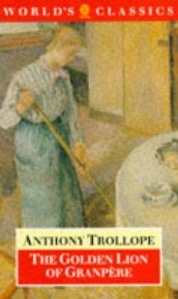
Golden lion of Granpere trollope 6Should I read all of Trollope?  Well, I am a Trollope fan.  I love his long novels, especially Can You Forgive Her? and He Knew He Was Right.  But I have not enjoyed his short novels.

Well, I recently embarked on  The Golden Lion of Granpere, set in France.  What kind of Victorian novel is set in France?  I wondered.  Not one I want to read, I decided.  There’s an innkeeper, and he doesn’t want his son to marry his niece.  But somehow this plot works much better in England!

It’s only 260 pages, and somebody will like it, but since Trollope lacks Dickens’s rhetorical brilliance and also needs space to develop his leisurely plots, his short novels seem blank to me!

Does this mean I like only long books?  No.

anne bronte tenant of wildfell hall 51Sp7PW34wL._SY344_BO1,204,203,200_Anne Bronte is a master of the short novel.  I recently reread The Tenant of Wildfell Hall. You will be relieved to know that I enjoyed it.
Although her style is not as poetic or striking as that of Charlotte or Emily, I love The Tenant of Wildfell Hall, Anne’s feminist novel about the perils of romantic love. The frame construction reminds me of Wuthering Heights. We get to know the heroine, Helen Graham, through the narrator’s intense letters to a friend, and then through the diary she gives him to read, and then back to his letter. Helen, who says she is a widow, is actually one of the first “battered women” in literature: she has escaped from her violent husband and lives  in a secluded house with her four-year-old son, supporting herself by art.  And she is so passionate and wedded to her isolation that she reminds me very slightly of a female Heathcliff.

So it’s worth it to reread all the Brontes again and again!

Do you feel it’s necessary to read every book by a favorite author?

Summer Reading: Elizabeth Jane Howard’s Odd Girl Out

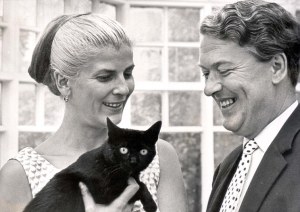
Elizabeth Jane Howard, her husband Kingsley Amis, and a cat.

Elizabeth Jane Howard and  Kingsley Amis (her husband) and a cat!

Elizabeth Jane Howard (1923-2014), best known for the Cazalet Chronicle, a five-volume literary family saga, seems to be having a revival.

In January Hilary Mantel wrote in The Guardian that Howard’s books are underrated.  She especially likes The Long View.

But the real reason the books are underestimated – let’s be blunt – is that they are by a woman. Until very recently there was a category of books “by women, for women”. This category was unofficial, because indefensible. Alongside genre products with little chance of survival, it included works written with great skill but in a minor key, novels that dealt with private, not public, life. Such novels seldom try to startle or provoke the reader; on the contrary, though the narrative may unfold ingeniously, every art is employed to make the reader at ease within it.

Fortunately, Open Road Media has recently reissued all of Howard’s books as e-books.  And several bloggers have reviewed them, including  The Bookbinder’s Daughter, The Homebody, and Dovegreyreader.

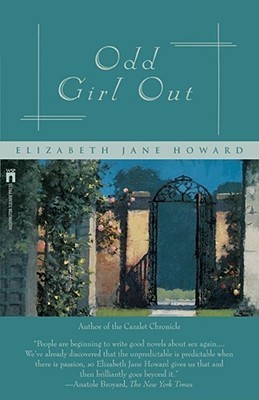
I discovered Howard in the ’90s and started with the Cazalet Chronicle.  Over the years, I have tracked down the rest of her books and loved them. In the mood for some fast summer reading, I rummaged through my bookcase and recently picked Howard’s  Odd Girl Out (1972).

odd girl out howard 194348 Odd Girl Out is, as you might guess, the story of a triangle. It is  deftly written, bold, and curiously modern,  though it is not Howard’s best book.  It is, however, a compelling summer read, with the frankness and eroticism  of so many women’s novels of the late twentieth century.

It begins with an idyllic scene:  Anne and Edmund Cornhill, a sexy married couple, are eating breakfast in bed in their lovely country house.  They are discussing the imminent visit of Arabella, the daughter of Clara, Edmund’s stepmother during a very brief marriage to his  father.

Anne is very easygoing about the visit.

“Of course I don’t mind, my darling.  Of course I don’t.” She wore the top half of his pajamas and was putting cherry jam on a piece of toast.  She thought for a moment, and then added, “It will be lovely for me to have someone to talk to while you’re in London.”

This happy couple, who have fabulous sex every night, do not anticipate disruption.  Edmund works in London as an estate agent; Anne is a housewife who enjoys gardening, cooking, and Elizabeth Taylor’s novels.

Howard is a master of third-person point-of-view narrative and, in short segments, shows us perspectives of several characters.   Before we meet Arabella, we are introduced to her rich mother Clara and the latest in a string of husbands (this one is a prince), who are planning a Caribbean cruise and plotting to marry the problematic Arabella off to a rich old man; and Janet, a penniless housewife and mother of two whose actor husband, Harry, whom she no longer loves, has deserted her for another woman (Arabella).

We meet Arabella while she is having an abortion, lying on a “high, hard, humiliatingly uncomfortable table.” Afterwards, she spends the day in pain sitting on benches at the zoo and visiting her favorite gorilla:  she has no home, because she has walked out on Janet’s husband, Harry, and is waiting to  take the evening train to Henley, because the Cornhills are the only people left for her to visit. Ann and Edmund somehow mistake her for a child:  she has very good manners and demands very little.

But, yes, she wedges her way into their life.  She has been neglected by her rich mother and feels she has never been loved. She adores the atmosphere of the Cornhills’ home and and wants to be a part of it.   Edmund seduces her, but she has known it would happen and has bought a new outfit for the occasion, and afterwards she asks him happily if he loves her more and says that’s why she slept with him. Then, while he is away in Greece for weeks on business, she seduces Ann.  Of course Anne and Edmund have no idea Arabella is so promiscuous.

Arabella is the link between every character in the novel, and she wreaks havoc. She is not an entirely unsympathetic character:  she is simply so rich and has been brought up so badly she doesn’t know how to have relationships.   She stays with various people for short periods of time and then she leaves.   But the Cornhills are a real couple, and she wants what they have.

Howard can see all points of view. During their idyllic affair, Arabella and Ann have long conversations about whether women are nicer than men.  (The bisexual Arabella favors women.) Edmund is the least sympathetic character, self-centered and insensitive.  But Arabella’s unwitting effect on Janet, the wife of Harry, her  last boyfriend, turns out to be so dire that we can’t overlook it.

A Few Words on Paul Scott’s The Jewel in the Crown

Jewel in the crown scott 146746

One Monday in 1984, after going through two boxes of Kleenex in a single weekend and losing my voice, I stayed home from work and read  Paul Scott’s The Jewel in the Crown, the first novel in The Raj Quartet.

Was it a great book, or was I simply swept away by the British TV series shown on  “Masterpiece Theater?”  Scott, who won the Booker Prize not for a volume of the tetralogy but for Staying On, a superb novel about an English couple who stay on in India after they retire, is most famous for The Raj Quartet, which has a much broader sweep.

I recently reread and loved The Jewel in the Crown.  It is so vast, so ambitious, told brilliantly in interwoven chapters of traditional narrative, interviews, a memoir, and  journals.

Set in 1942 in the city of Mayapore, The Jewel in the Crown delineates the escalation of tension between the British and Indians over the question of independence. The British temporize and justify their presence by the proximity of the Japanese and possibility of invasion; the Congress is sympathetic to Ghandi and his followers, who practice civil disobedience in their campaign for independence.  There is a huge cast of characters, both Indian and British.  The catalyst of the action in The Jewel in the Crown?  Attacks on two Englishwomen during riots after the Indian Congress votes to support Gandhi and independence.

I certainly do not have the background to discuss colonialism in India, but I was especially struck by the central role of two English women of different generations and contrasting attitudes toward India and the Raj, Miss Edwina Crane and Miss Daphne Manners.

In the opening chapter  Scott introduces us to cranky, eccentric Miss Edwina Crane, the Superintendent of the Chuch of England mission schools, who has spent most of her adult life educating Indian children. She loves India, and her work here has saved her from a drab life as a governess.  But she regards Gandhi’s civil disobedience as a betrayal of the Raj, and when she takes his picture down, the Indian ladies she has entertained  at tea every  Tuesday stop coming. Miss Crane entertains English soldiers instead.  She muses,

Reacting from her newly found distrust of the Mahatma and her disappointment in the behavior of the ladies (the kind of disappointment she had actually become no stranger to), she wondered whether her life might not have been better spent among her own people, persuading them to appreciate the qualities of Indians, instead of among Indians, attempting to prove that at least one Englishwoman admired and respected them.

jewel in the crown everyman 51UlGGLkxUL._SX305_BO1,204,203,200_Miss Crane’s hubris during a day of social unrest and  rioting–she insists on returning home from the village where she has spent the night at the house of an Indian teacher and his family, though the phone lines have been cut and the police advise her there has been violence–results in the murder of the Indian teacher who insists on accompanying her, when she simply can’t make herself put her foot on the accelerator and drive through the crowd.  After his death, Miss Crane’s entire view of every good deed she thought she had done in India is dust.  She commits suttee, as if she were the wife of the teacher.
The true heroine is Daphne Manners, a young orphaned English woman who is the niece of a former governor of the province.  After she is orphaned (her father and brother die in the war), she visits Lady Chatterjee (“Aunt Lili”), an Indian aristocrat, at MacGregor House in Mayapore.  Daphne becomes acquainted both with the English at the club (where Aunt Lili can’t go) and with Indians.  Daphne falls in love with india and with Hari Kumar, a handsome Indian raised in England who returned to live with his aunt in India after his father’s death.  He is working well below his potential as a reporter for an Indian paper.  Both Daphne and Hari are in India to stay; but Hari is not acknowledged as English in India because of his color. And they live on opposite sides of the river:  they are not actually supposed to socialize.  Aunt Lili tolerates their meetings but does not encourage them.   Daphne loves India; Hari hates it.

Then Daphne is gang-raped by a group of  Indian men the night after Congress votes for independence. Ronald Merrick, a racist policeman who wants to marry Daphne and is out to discredit Hari,  arrests Hari and six “political” men who obviously have nothing to do with the rape.  This appalling incident shatters Daphne. But surprisingly she decides to keep the child.  She and Hari have been lovers, and she hopes the child will be hers.

This is really a vast novel, complex, intelligent, vivid novel.  Here’s a brief example of the writing, in the opening paragraphs:

Imagine, then, a flat landscape, dark for the moment, but even so conveying to a girl running in the still deeper shadow cast by the wall of the Bibighar gardens an idea of immensity, of distance, such as years before Miss Crane had been conscious of standing where a lane ended and cultivation began: a different landscape but also in the alluvial plain between the mountains of the north and the plateau of the south.

It is a landscape which a few hours ago, between the rainfall and the short twilight, extracted colour from the spectrum of the setting sun and dyed every one of its own surfaces that could absorb light: the ochre walls of the houses in the old town (which are stained too with their bloody past and uneasy present); the moving water of the river and the still water of the tanks; the shiny stubble, the ploughed earth, of distant fields; the metal of the Grand Trunk road. In this landscape trees are sparse, except among the white bungalows of the civil lines. On the horizon there is a violet smudge of hill country.

Gorgeous writing and a great book!

You can read about the tetralogy in detail in Peter Green’s stunning 2013 article in The New Republic, “The Origins of Paul Scott’s Vast Masterpiece.”

What Bloggers Are Reading: Main Street, Midnight in the Century, Getting It Right, & a Poem by Ellen Moody

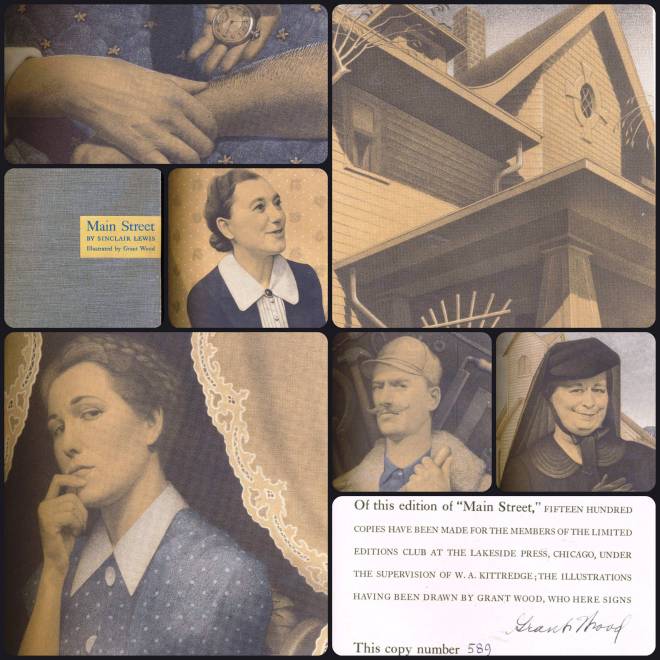
main street lewis limited editions wood-collage-31

I read several blogs yesterday and added ten books to my TBR pile.  That cannot be good!

Let me share the joy.

1 Thomas at Hogglestock.com has posted pictures of his  beautiful Limited Editions Club copy of Sinclair Lewis’s Main Street, with illustrations by Grant Wood. It is signed by Wood.  I’m gobsmacked!

And Thomas is a fellow Lewis fan.  He writes,

Nine years before Virginia Woolf published A Room of One’s Own, Lewis’s heroine Carol Kennicott asked for a room of her own in Main Street. Even though Main Street is seen a classic take down of small town America, I think it should be read as well as an early feminist classic.

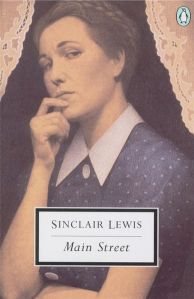
sinclair lewis main-street

The Penguin cover art by Grant Wood

If you haven’t read the Nobel Prize-winning Lewis, you’re in for a treat.  I often think of him as the American John Galsworthy, another Nobel Prize winner whose popular books are now relegated to the musty middlebrow arena.

I first read Main Street in an Images of Women in American Fiction class at a midwestern university.   I  identified with Carol Kennicott, a versatile young woman who  at “Blodgett College” (Lewis, a Minnesota native who got away, can’t help but mock Midwestern culture ) flirts with art, music, drama, and even playing basketball and wonders what her special talent will be.  She knows she will have to earn her living.  But how?  Almost all of us in the class were wondering the same thing.

But how she was to earn it, how she was to conquer the world—almost entirely for the world’s own good—she did not see. Most of the girls who were not betrothed meant to be teachers. Of these there were two sorts: careless young women who admitted that they intended to leave the “beastly classroom and grubby children” the minute they had a chance to marry; and studious, sometimes bulbous-browed and pop-eyed maidens who at class prayer-meetings requested God to “guide their feet along the paths of greatest usefulness.” Neither sort tempted Carol. The former seemed insincere (a favorite word of hers at this era). The earnest virgins were, she fancied, as likely to do harm as to do good by their faith in the value of parsing Caesar.

Carol goes to library school in Chicago and works in a public library in St. Paul, but her patrons don’t need her recommendations.  So she  falls in love  and marries the robust Dr. Will Kennicott, and moves to his small conservative hometown, Gopher Prairie. Her fantasies of importing culture to Gopher Prairie are sweet but absurd and Lewis gently satirizes her, but at the same time traces her growth and maturity.  She is one of my favorite American heroines.

And is Gopher Prairie as bad as it seems?  Yes and no.

serge midnight2 Karen at Kaggsysbookishramblings has almost convinced me to read the Soviet writer Victor Serge. (I have a roll of “Dostoevsky pills” handy –Necco wafers!– in case it proves too depressing.)    Midnight in the Century sounds fascinating, if grim.

Karen writes,

Victor Serge is fast becoming an author I turn to when I want a book that I know will be enthralling and beautifully written. After discovering him via his “Conquered City” in 2014, I was recently bowled over by “The Case of Comrade Tulayev”. And after spending some time in the rarefied world of (fictional) history (I’m reviewing a little out of order here), I felt that I needed to read something that dealt with the human side of the past and how it affected people on a smaller scale – so Serge seemed the ideal choice.

3 Melissa at The Bookbinder’s Daughter reviewed Elizabeth Jane Howard’s Getting It Right, which has been reissued by Open Road Media. And, guess what, I found my old paperbook copy with the tanned pages.  Those tanned pages are the reason for e-books! I love Howard’s witty women’s fiction and must reread something by her soon..

getting it right howard 1566243Meanwhile, Melissa begins her review of Getting It Right:

Gavin Lamb is a thirty-one year old virgin who still lives at home with his parents.  It’s not that he can’t afford to move out because he has a very lucrative career as a hairdresser in London.  But he doesn’t like change and moving out of his childhood home would be more change than he could possibly handle.  His doting and old-fashioned mother would also have a very hard time letting go of her son.

4 Ellen Moody has written a stunning poem, “Washed Away by Sorrow.” You can read it at Under the Sign of Sylvia.

Here is the first stanza.

Sorrow is not the same as sadness:
For me it’s been a great dissolver
It has washed away many emotions
that used to actuate me
however obscurely, however blindly
however misunderstood.

Why We Love Goodreads: How an Outrageous Review Put a Book on My Wishlist!

Pile-of-Books woman readingGoodreads is brilliant, it is fun, it is silly, it is serious. It has 50 million members. Yup, 50 million readers who cannot be controlled by the establishment.  We rate and review books, join book groups, and read about new books.

Professional writers aren’t keen on it.  Why it matters to them I don’t know.  It annoys them that amateurs can scribble and post, while they spend hours honing their prose.  A posh male book reviewer–who and at what publication I don’t remember– referred to “the boredom of Goodreads.”  I noted it.    Another posh male reviewer sneered at “the plot summaries at Goodreads.”  Well, aren’t boredom and plot summaries a part of reviewing?  It is obvious that most of these consumer reviews are personal notes: it would be mad to post literary criticism at Goodreads!

Like everybody on Goodreads, I follow Lori, the founder of “The Next Best Read Book Club” and a reviewer of small press books. I also follow some authors.  Genre writers, who are used to establishing a fan base at conventions, make better use of Goodreads than literary writers.

On my wishlist, because of Goodreads.

On my wishlist, because of Goodreads.

But here’s the real reason we like it:  outrageousness!   The following outrageous Goodreads review  of Daniel Menaker’s  memoir, My Mistake, is far from flattering, but it makes me WANT to read the book.  This happens often.

Are you ready?  Here is Liz Waters’ review.

“My Mistake” by Daniel Menaker is an interesting book. It destroyed any illusions I had about ever having my fiction published. That was probably the last dream I had left, and Mr. Menaker took care of that. While I have often noticed that the new stars in Hollywood are often related to the old stars in Hollywood, I surely should have assumed that such connectivity applied also to the publishing world of New York. That I did not was my mistake.

Daniel Menaker was born into the erudite and exclusive world of publishing and landed a position checking facts for the New Yorker, a magazine I once adored. He did not try to hide the fact that family connections helped him get there. His elitist Swarthmore (et al) education helped him along as well, a fact that he doesn’t hesitate to remind the reader of every few pages. He went up ladders and jumped from one ladder to another painlessly in that world that so few get to know. Even fewer get to know it with the name-dropping intimacy Daniel Menaker enjoyed.

If this review reeks of crass envy, so be it. Of course any aspiring writer would be envious of Mr. Menaker’s life in writing. He tells of a world that none of us ordinary mortals will know. And, he makes it pretty daggone unattractive.

If you enjoy reading about how the other half lives, you will adore this book. I found the fact that it is history written in the present tense a little tedious, although I enjoyed the subject matter. In my opinion, the past is past and using the present tense doesn’t put me in the moment, it simply sets my teeth on edge. However it is certainly correct in the literary sense, or Mr. Menaker would never have chosen this particular form to tell his story. I didn’t like the book, but that doesn’t mean that you won’t like it. Read it yourself and decide.

Outrageous! This would never have been published anywhere!  Daniel Menaker, a memoirist, fiction writer, and book editor, started his career as a fact checker at The New Yorker. As executive editor-in-chief at Random House, he worked with Salman Rushdie, Elizabeth Strout, and Colum McCann (if Wikipedia is correct). It would never have occured to me to read My Mistake if one of my “authors” hadn’t rated it,  and if I had not read Water’s review. Now it’s on my wishlist, though first I have to read all the books on my TBR….

Addendum:  I learned about Menaker’s book because Larry Watson, a writer I follow,  gave it five stars at Goodreads.  Most of the Goodreads reviewers love it, but oddly  Waters made me want to read it because she was hilarious  about class envy.  Who hasn’t felt that?  Anyway I am very interested in reading about Menaker’s life in New York (I could never find my way around that city) and his publishing career.  If it’s good enough for Larry Watson…

Two Extraordinary New Books: Charlotte Wood’s The Natural Way of Things& Anne Tyler’s Vinegar Girl

pile of books open_books

Oh, we bloggers.  We are so picky.  I have impeccable taste, the blogger says.   Well, don’t we all, you say (and it’s probably true). But we can be particular, because we  don’t get paid for our opinion.  If we got paid we might be kinder or unkinder, who knows?   If I don’t like a new book after 25 pages–or 50 tops, if I have been conned by a hyperbolically positive review–I toss it.  Why?  Because I’d rather be reading Trollope.  And by the way, the critic Laura Miller is leading a discussion of Trollope’s Barchester Towers this month at Slate.

Some extraordinary new books are being published, if we can only find them.    I serendipitously read two pitch-perfect novels this week:  Charlotte Wood’s The Natural Way of Things, winner of the 2016 Stella Prize in Australia (and published by Europa Editions), and Anne Tyler’s Vinegar Girl–well, I read everything by Tyler, and everyone is reading it, so I can’t say it’s really a discovery.

Wood and Tyler are  prominent writers of very different types, both well worth reading

Natural Way of Things Wood cover_9781609453626_683_600First, the must-readCharlotte Wood’s The Natural Way of Things is one of the strangest and most powerful novels I’ve read this year. Slightly reminiscent of Margaret Atwood’s The Handmaid’s Tale, it describes and explores a misogynist society’s hatred of women’s sexuality.  Wood’s staccato style and weird, vibrant imagery keep this feminist novel well above the level of the popular formulaic dystopian novels.

The plot is bizarre and mysterious.   A group of young women wake up to find themselves drugged and imprisoned on an abandoned property in the Australian outback.  Why are they there?  What do they have in common?  Yolanda and Verla, the two strongest of the women, become silent friends.  Talking is rarely permitted except at night when they are alone and locked into the “shearer’s quarters,” kennel-like tiny rooms in a corrugated metal building.   Gradually they recognize one another from TV: each woman has been involved in a public sex scandal.

Yolanda, who at first thinks she’s in an asylum, hope they’ll increase the dose of drugs so she won’t have to deal with the horror.  When she is shoved into a room with Verla, who vaguely remembers being held down on a yellow bus and handcuffed, they make eye contact and Yolanda takes the initiative and speaks: “Have you got a cigarette?”  Verla is fascinated by the 19th-century ugly canvas smocks, calico blouses, and boots Yolanda wears.  Then she realizes she is wearing them, too.

Verla feels she recognizes Yolanda.

It seems to Verla she has known this girl once, long ago.  As if Verla had once owned or abandoned her, like a doll or a dog.  And here she is, returned, an actor on a stage, and Verla there too, both of them dressed in these strange prairie puppets’ clothes. It could all be hallucination.  But Verla knows it isn’t.  The doll opens her mouth to speak again and Verla says, “No,” at the same time as the doll-or-dog girl asks, “Know where we are?”

Humiliated, shorn of their hair, and clipped together by chains on a lead, they are forced to do pointless work–they build a road– and are frequently beaten by Boncer, the cruel keeper who breaks a woman’s jaw on the first day.  Teddy, who thinks he is here for a summer job, is slightly less cruel but he also despises them.  And Nancy, the only woman keeper, likes to play “nurse” and experiment with medications and hypodermic needles when the women get ill.

Much of the novel operates on the level of metaphor and symbol:  the heroines’ visions of white horses, kangaroos, brown trouts, the power of hunting, and a river that is “a wide rope of bronze silk twirling” are utterly enchanting and liberating.  When the power goes out and Verla discovers there is very little food left,  the tables are turned on the keepers.  They still have weapons but they are terrified:  Boncer, Teddy, and Nancy take drugs to cope.  But the women learn to survive,:  Yolanda becomes a hunter, Verla gathers mushrooms, and others gain new skills, too, as they get in touch with their animal nature.  The ending has a twist you won’t see coming.

Tyler vinegar girl ows_14661160223620Next, the light read. Pulitzer Prize-winning Anne Tyler’s Vinegar Girl, a retelling of The Taming of the Shrew, is clever, charming, entertaining, and  hilarious. This is the third in Hogarth Press’s Shakespeare Project, retellings of Shakespeare’s plays by “acclaimed and bestselling novelists of today.” Tyler, who is either the most underrated American writer working today (a woman at a party said) or the most overrated (a man at the same party), is always enchanting and manages to pull it off.

Twenty-nine-year-old Kate, an assistant at a preschool who often gets into trouble for saying exactly what she thinks, is odd but likable.  She wanted to be a botanist, but she still lives at home with her absent-minded scientist father and her popular teenage sister, Bunny, because  she was kicked out of college for calling a professor’s explanation of photosynthesis “half-assed.” She has never wanted to go back,  and though she would like another job, she knows she doesn’t interview well.  Kate is the kind of confused, isolated character we meet in all the Tyler books.

The plot is allusive to The Taming of the Shrew, but Tyler has made  it more subtle.  To cut to the chase, Kate’s father is trying to make a match between Kate and his Russian assistant, Pyotr, because Pyotr needs a green card.

Naturally, Kate doesn’t like the idea, but Pyotr is charming in an odd kind of way.  He woos her and tells her he likes her long hair and asks her how long she has grown it.

“Oh. Since eighth grade, maybe. I don’t know. I just couldn’t take any more of that Chatty Cathy act.”

“Chatty Cathy?”

“In the beauty parlor. Talk, talk, talk; those places are crawling with talk. The women there start going before they even sit down—talk about boyfriends, husbands, mothers-in-law. Roommates, jealous girlfriends. Feuds and misunderstandings and romances and divorces. How can they find so much to say? I could never think of anything, myself. I kept disappointing my beautician. Finally I went, ‘Shoot. I’ll just quit getting my hair cut.’ ”

Oh, it’s so charming!  I do know what she means.

It’s one delightful scene after another. Kate is very annoyed at first (and so are we), but Pyotr looks better and better, as Kate realizes she doesn’t have a chance with the guy she has a crush on at the preschool.  Kate, like her father, understands  statistical odds. She doesn’t have much of a life.   Her sister Bunny, who turns out to be the real feminist, can’t believe she is considering the deal.

And what will happen?  It is a surprise.

Well, I loved the book, thought I didn’t quite buy the epilogue.  But enough said!  So entertaining!