Alternative Culture & Yasunari Kawabata’s The Old Capital

By Vanessa Bell

I procrastinate.  Every time I look at my blog I think, Oh, no! Must I really write a  900-word post about Yasunari Kawabata’s The Old Capital?

I’m a typical American “lady” blogger…just wordy.

I used to feel like a member of an alternative culture, or a girl group. But blogging isn’t as much fun as it used to be: it is more mainstream now that Netgalley offers us the same review copies which traditional media review.  Our charm and quirks are lost in our earnest plot summaries.  We even have our own blogging rituals, like Women in Translation Month in August and All Virago, All August.

Twelve of my blogger friends have stopped blogging in recent years. I miss Nancy at Silver Threads, who wrote lively posts on her reading of the classics and older books, and  Tom at A Common Reader, who reviewed literature in translation and crime fiction.

And now  I Prefer Reading is tired and has gone on break.  She wrote,

I’ve been feeling less enthusiastic about blogging for a few months now. I’ve been watching quite a bit of Book Tube & I like the idea of maybe a Book Haul & a monthly wrap up instead of longer reviews with a bit of Literary Rambling thrown in. I don’t know but I need a break to think about it all.

It is no small thing to write posts, columns, or reviews as a hobby.  But mainstream publications no longer deride book blogs, presumably because we are no longer  a threat.

And so, while reflecting on the changing “alternative”  blog culture, I will write very briefly about Kawabata’s The Old Capital, set in Kyoto and published in 1962.

In this spare, elegant novel, Kawabata describes the consolation of nature and its changing depictions in design in post-war Kyoto: can  traditional kimono design, hand-weaving, and other crafts survive industrialization and the shattering changes wrought by World War II?

In The Old Capital, the  heroine, Chieko, is an ardent nature lover:  she feels bliss at the sight of the first violets of spring, the blossoms on the weeping cherry trees, and the gigantic camphor trees.  She also marvels over the details of the joyous seasonal festivals she attends and the elaborate ceremonies at temples.

Chieko lives with her adoptive parents, her father, Takichuro, a kimono designer, and her practical mother, a housewife.  But Takichuro’s dry goods business is foundering and he believes  has lost his talent for design.  Chieko gives him a Paul Klee book, which inspires him to do an abstract obi design.  But the talented young weaver he hires to weave the obi is  harsh in his criticism of the new design.  Only Chieko believes in her father.  (And with reason.)

Chieko could not ask for more loving parents, but she  is curious about her origins. Her parents  tell her they kidnapped her (her mother says, “Your real parents were probably crazed with grief” ).  She says, “Tell me the truth.  I was a foundling, wasn’t I?” But her mother feels the pain of abandonment would harm her daughter.

Then by chance at a festival Chieko  meets a woman who looks just like her.   Naeko is her identical twin, and is overjoyed to find her  sister, whom she knew her father had abandoned.  But Naeko, a laborer, does not want to transcend class boundaries, and says it is enough to have met her once.  But they do see each other a few times, and their bond is cemented  via their love of nature and a modern obi design.

A gorgeous book!  This is very spare, but I loved it.  The translation is by J. Martin Holman.

And I’m well under 900 words.   I can breathe again.

Workshop Woes & Reading K. M. Peyton’s Flambards

The Iowa Writers’ Workshop

In Bleak House, a satire of the judicial system, Dickens warns us to be wary of time-and-soul-wasting cases and complaints.

Although it is not quite Dickens, I was fascinated by an article in the Iowa City Press Citizen about a rejected writer.   Sixty-eight-year-old Dan Thomson has filed a federal complaint accusing the University of Iowa Writers’ Workshop of age discrimination.

Although there are hundreds of MFA programs, Thomson applied only to Iowa, where  800 to 1,000 people apply for the 25 slots every year.  Graduates of the program include award-winning writers T. C. Boyle,  Jane Smiley, Michael Cunningham, Denis Johnson, Jorie Graham, Rita Dove, Eleanor Catton, Donald Justice, and A. M. Homes.  Thomson believes he should have been accepted.

The university says age is not a factor: the applications  go directly to the Graduate School, while the Workshop receives only the writing samples.

But the statistics do favor the young: most of the graduate students are in their twenties (but then that is always true). Between 2013 and 2017,  approximately half of those accepted  were between the ages of 18 and 25.  In the last five years, no applicants age 51 or older were accepted. The  median age for all applicants was 36, and the median age for accepted applicants was 34½.  (Read The Iowa City Press Citizen article for more information.)

Well, I thought: perhaps there is age discrimination. But the real question is:  does Thomson have talent?

I checked out the Amazon sample of Thomson’s self-published novel, The Candidate. Uh oh.  He is writing genre fiction, which is not a good fit for the very literary Iowa.

And the book could use some work.

Here are the opening paragraphs of Chapter 2:

The beautiful young blond with a face like Ingrid Bergman was a two thousand dollar a day call girl. She was flown to Norman Telos’ yacht anchored in Mobile bay by helicopter.  At 4 in the afternoon Norman and Jane Gray were lying relaxed and naked in Norman’s king size bed sipping Martinis.  Jane asked, “So what is next for you, Norman?”

Norman, “Two hours of latency recovery and then either my 65 year old penis will rise on its own for more loving, or I will give it more chemical inducements.”

The writing is clunky and cliche-ridden.  I am not saying nobody would read it, but I would not.   Phrases like “a face like Ingrid Bergman” must go.  A few hyphens would not be amiss.

Iowa is not for everybody. So why not pursue another program?  Studying al fresco is by far the most fun:  Thomson could  pick up as much at a  summer writers’ conference as in two years of critiques by Millennial students.   Writers of literary and genre fiction of all ages are treated with equal respect at these conferences.

Let me add here that I took a couple of great fiction writing classes as an undergraduate at the University of Iowa.  Anybody could sign up!

Great Bedtime Reading:  Flambards

So what’s on my bedstand?  K. M. Peyton’s award-winning Flambards trilogy.  I decided to reread it after watching the stunning TV series on DVD.

The trilogy is set in the early 20th century, before, during, and after World War I.   In Flambards, the first book, the  heroine, Christina Parsons, an orphaned heiress, goes to Flambards to live with her equine-obsessed uncle. He is crippled and lives vicariously through his oldest son, Mark, a keen horseman.  He hopes Christina will marry Mark, so the money will go into the estate, but she shrewdly realizes Mark is a womanizer and a bully

But she prefers his witty, kind, aviation-mad second son, Will, who  falls off his horse and breaks his leg and then deliberately walks on it before it heals to avoid the hated riding (he fears horses) so he can become a pilot. Ironically, he becomes (slightly) crippled like his cruel father,  though not as badly, and his stiff leg does interfere with flying.  But Will adjusts.

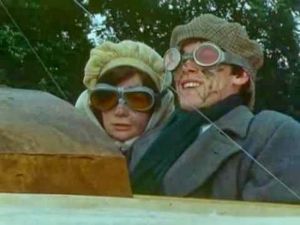
Christina and Will

In the second novel, The Edge of the Cloud, Christina and Will move to London and marry.  Christina works as a receptionist at a hotel, and Will is a  mechanic, engineer, and stunt-flier.  Then World War I breaks out and Will, a pilot, crashes.

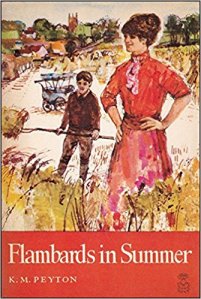
The third novel, Flambards in Summer, describes Christina’s return as a widow to Flambards, where she is determined to succeed as a farmer.  Christina is self-reliant but devastated by the loss of Will, irritated by the class snobbery at Flambards,  and determined to succeed though the men are at war and she has trouble finding farm laborers. When she finds out she is pregnant, she is more determined than ever to renovate the estate. And she loves horses, so one of the first things she does is buy a horse no one else will take a chance on.

And then at a farm sale, the past fuses with the present.  She sees a car for sale, and vividly flashes back to driving with Will.

Someday I shall drive to sales in my own motor-car,” Christina said to the smart Ford. It would not be for preference, only to show status, and her success with wheat. Will had taught her to drive a motor-car. A picture of Will, leaning out of Sandy’s Model-T with his arm stretched out to pull her up, his dark eyes laughing, cap on back to front, came into her mind very suddenly, very vividly. For a brief instant Will was as near and as real as he once had been in fact. Christina gripped the horse’s halter and shut her eyes, but the dream was past almost before it had come. Her mind reached to recall the vision, but it was irrevocable, dissolved like thistledown.

I love all three of these books.  A fourth, Flambards Divided, was published in 1981 after the TV series was filmed.  I will have to find my copy.

Notes on Michiko Kakutani & the Man Booker Prize Longlist

Michiko Kakutani

“Any intelligent person can review a book.”  This kind, generous book review editor believed in “buying local”before it was a trend, and assigned reviews to local writers, among them literary housewives, teachers, and advertising (mad)men.

“We’re not doing criticism here,” (s)he said wryly.  “We’re not the New York Times.”

Reviews and criticism are different.  Criticism is the job of Michiko Kakutani.  And now Kakutani has announced she is leaving her job as Chief Book Critic at the New York Times.

Kakutani is irreplaceable.   Who knows more about the  trends in fiction and nonfiction from 1983 to the present?  (My own erratic reading, mainly of fiction, identifies yuppiebacks  through wispy millennial fiction, with  many, many gaps.)   Kakutani could write an entire critical history.   And , by the way, I do respect a critic who appreciates Mary Karr and disparages the overrated Jonathan Franzen.

At The New Yorker, Alexandra Schwartz wrote about Kakutani’s toughness:

A good review brought on elation. “It was like having the good fairy touch you on the shoulder with her wand,” Mary Karr told NPR. A bad one incited rage, sometimes despair. Nicholson Baker compared getting a negative Kakutani review to undergoing surgery without anesthesia; Jonathan Franzen called her “the stupidest person in New York.” (She had deemed his memoir “an odious self-portrait of the artist as a young jackass.”) What made her scary to writers made her reliable to readers: you couldn’t easily predict where her favor would fall.

Well, I shall miss her. This is a sign of getting older, I know!  but the New York Times Book Review on Sunday seems  more “pop”  than it used to.  I do like pop, but if I go to The New York Times I want something intellectual. That’s why I hope the daily critics continue to thrive.

THE MAN BOOKER PRIZE LONGLIST.

Although I haven’t read a Man Booker Prize winner since 2010, I love the Booker longlist.  It was great fun when the blogger Kevin from Canada read the complete longlist every year and posted his reviews, along with his blogger friends. (We all miss Kevin from Canada.)  Has the blogger tradition continued?  I am not sure.  But I  still read a few books on the longlist  every year.

Last year I loved David Means’ literary SF novel, Hystopia, an alternate history of the 1960s. (I posted about it here.)

This year’s list has some great names on it:  I already love Sebastian Barry and Zadie Smith.  And Colson Whitehead’s The Underground Railroad, which Bruno actually mentioned on Dancing with the Stars in the spring, just won the Arthur C. Clarke Prize.

Naturally, there are holds on most of these books at the library, and I would buy them except…you know…too many books.

Here is the list:  and if you’ve read any of them, do let me know.

  • Paul Auster, 4 3 2 1
  • Sebastian Barry, Days Without End
  • Emily Fridlund, History of Wolves
  • Mohsin Hamid, Exit West
  • Mike McCormack, Solar Bones
  • Jon McGregor, Reservoir 13
  • Fiona Mozley, Elmet
  • Arundhati Roy, The Ministry of Utmost Happiness
  • George Saunders, Lincoln in the Bardo
  • Kamila Shamsie, Home Fire
  • Ali Smith, Autumn
  • Zadie Smith, Swing Time
  • Colson Whitehead, The Underground Railroad

Abortion in Literature: Margaret Millar’s Do Evil in Return and Colette’s “Gribiche”

There are advantages to menopause.

We no longer bleed on our skirts, we secretly like the new crepey texture of our skin, and, finally, we are no longer defined by our sex.  And we are all waiting for the organic yam “lube” concocted by Frankie (Lily Tomlin) on Grace and Frankie.  (Alas, it seems to be fictional, but there are others.)

But as menopausal women become more powerful, menstruating women must still worry about the future of reproductive rights.  When even Planned Parenthood is under attack, we are all shocked.  It looks as if the pro-choice button will never go out of style.

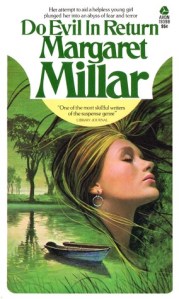
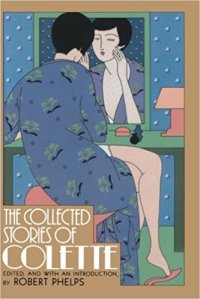
Coincidentally, I recently read two fascinating works of fiction on the perils of illegal abortion, Margaret Millar’s suspense novel, Do Evil in Return,  and Colette’s  “Gribiche” from The Collected Stories of Colette.

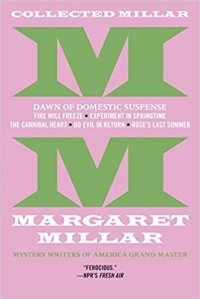
Syndicate Books has recently reissued Margaret Millar’s classic crime fiction, and I am racing through  Collected Millar:  Dawn of Domestic Suspense. The addictive fourth novel in this volume, Do Evil in Return (1950), is an eerie exploration of the consequences of illegal abortion.

What happens when a young woman dies, not because she has an abortion but because she cannot find a doctor to perform one?

A wan young woman, Mrs. Violet O’Gorman,  shows up at Dr. Charotte Keating’s office.  Violet desperately wants an abortion: she was impregnated during a one-night stand, not by her husband.   Charlotte gently explains that she cannot perform an illegal  abortion.

This decision sets in motion an unstoppable Greek-style tragedy.  The Eumenides (the Furies) are milling and thronging.

In Millar’s taut, short novels, the dialogue is spare and snappy.  In addition to writing novels,  Millar wrote screenplays for Warner Brothers–and it shows.   This would make a brilliant noir film, but perhaps it is too radical these days.

The girl let out a cry of despair.  “I thought–I thought being you was a woman like me–being you…”
“I’m sorry,” Charlotte said again.
“What can I do?  What can I do with this–this thing growing inside me, growing and growing, and me with no money and no job and no husband.  Oh, God, I wish I was dead!”  She struck her thighs with both fists.  “I’ll kill myself!”

Charlotte is not heartless.  She believes she may have made a mistake in denying Violet the abortion, as she tells her married boyfriend Lewis Ballard (the two met because his “nervous” wife Gwen is Charlotte’s patient). But Lewis points out that Charlotte was not obligated to break the law to help a strange woman.

“You’ve had cases like this before.  Why does this one worry you?”
“Because of us, Lewis.  Don’t you see…?”
“No.”
“If we go on together, if we become lovers, I might accidentally end up in the same boat she’s in.”

In a fit of conscience, Charlotte attempts to find Violet at her uncle’s rooming house in a  bad neighborhood.  Violet is out, and the visit ends in violence. Charlotte is attacked in front of her garage and robbed of her purse.

When Violet is found drowned, it looks like suicide.  Detective Easter does not buy it.  Easter likes Charlotte, but unfortunately she is linked to the death when a card with her name typed on it is found in Violet’s purse.

As Millar turns upside down our ideas of powerful and powerlessness–is the well-educated doctor the most powerful woman in the book, or not?– Charlotte investigates on her own.  She falls into a trap of blackmail, betrayal, and violence. No line is wasted, every word matters, and Charlotte is a champ.  But the noir tragedy that unfolds makes Aeschylus look like Aristophanes.

Colette’s short story “Gribiche” (1937), in The Collected Stories of Colette,  is lyrical, poignant, and heartbreaking. The narrator is Colette herself: her fictional counterpart is working as a music-hall artist in a revue, as Colette did after she left her husband Willi.

In the witty opening scene, she describes a typical night in “the women’s quarters” at the theater. The steps of the iron staircase clang like a xylophone, the fifty pairs of high heels are “clattering up and down like hail,” and the basement dressing rooms smell of powder, makeup, and different perfumes.

But that very night a young actress in a chorus of soldiers faints, falls down the stairs, and is bleeding heavily.   When Carmen, “a little green-eyed Basque,” says that things are going “pretty badly,” Colette asks what she means.

Carmen looked slightly embarrassed.
“Oh! Colettewilli, don’t be nasty, dear. Gribiche, of course. Not allowed to get up. Chemist, medicine, dressings, and all that…”
“Not to mention food,” added Lise Damoiseau….
“But where’s she been hurt, then?”
“It’s her..back,” said Lise.
“It’s her stomach,” said Carmen, at the same time.

And then Colette realizes Gribiche had an abortion.

The women at the theater are sympathetic, and every one of them believes in the right to abortion.  But this dark, un-preachy story realistically describes the danger of backstreet abortions.

Colette writes beautifully, and I highly recommend this story.

Do I Have a Crystal Ball? The Tolstoy Renaissance

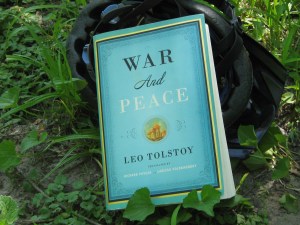
War and Peace in my bike helmet on a summer’s ride.

There is a Tolstoy Renaissance this summer.

How do I know? Hundreds of (probably idle) internet surfers and (possibly)  Tolstoy fans have visited my posts on Anna Karenina and War and Peace.

I’m not surprised.  Tolstoy is the consummate entertainer.  He is to some of us what Jane Austen is to the hundreds of thousands of readers who participated in  the death bicentenary Lollapalooza.  I fall into Tolstoy’s novels as if I am listening to a  Grateful Dead song.  His books are absorbing Oscar-winning movies or popcorn reads. I come up for air hundreds of pages later,  concerned about Nicholas Rostov”s military exploits,  or Marya Bolkonsky’s attempts to  persuade her servants to move her beyond Moscow as Napoleon approaches.

My husband holds Tolstoy responsible for my back problems.  “Have you considered the e-book?” he asks when I sit down every New Year’s Day for my annual rereading of War and Peace.

“I’m reading the first hundred pages in the Constance Garnett, the second hundred in the Pevear and Volokhonsky, the third in the Anthony Briggs, the fourth in the Rosemary Edmonds, and the rest in the Maude.”

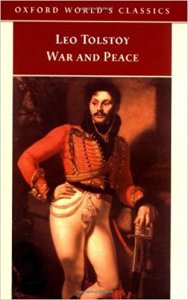
And so every year you will find me wilting under the weight of my huge Penguins, Oxfords, Modern Library editions, Yale, Folio Society, Vintage classics, and Heritage Press editions.

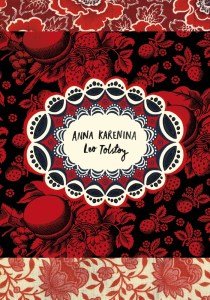
A recent addition to my Anna K collection, the Vintage Russian Classics Series edition (Maude translation)

Mind you, I don’t criticize Tolstoy at my posts. I don’t even summarize (the blogger’s curse: it’s easy, so we do it).   No, I like to keep it light: my most popular Tolstoy posts this summer are (1)  “Translations of Anna Karenina: Constance Garnett, Maude, or Pevear & Volokhonsky?” and (2) “The War and Peace Collection.’

And I must admit these enthusiastic posts make me laugh!

From the pop AK post:

I collect editions of Anna Karenina the way a friend collects Bakelite bracelets. At the moment I have five, one of them a glitzy Folio Society edition. I have four different translations, but my favorite is Aylmer and Louise Maude’s, the translation approved by Tolstoy–and get it while you can, because Everyman and Dover are now its only print publishers, I think. (You can also find the Maude in a used Oxford World Classics edition, but beware, the 2016 paperback has a new translation by Rosamund Bartlett.)

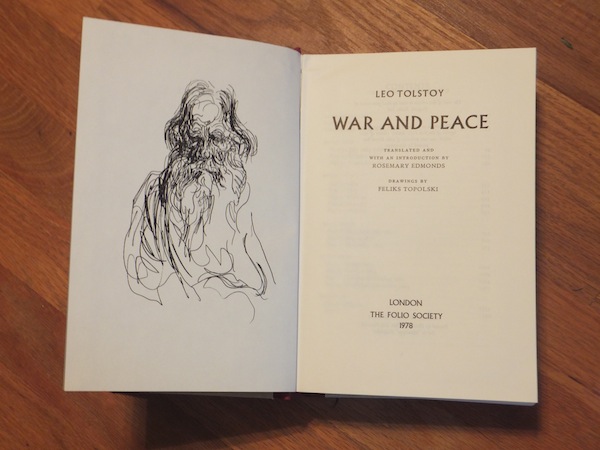
Frontispiece of the Folio Society edition, 1997 reprint of Edmonds translation

My most popular W&P post is exuberant.

I reread War and Peace every year.

I started reading it again on New Year’s Day and just finished it a few hours ago.

And now I’m ready to start again.

No, Kat, you cannot!

But War and Peace says everything, no?  Why read anything else?  The translator Rosemary Edmonds wrote,  “War and Peace is a hymn to life.  It is the Iliad and the Odyssey of Russia.  Its message is that the only fundamental obligation of man is to be in tune with life.”

The Maude translation.

Last January, during my annual rereading of W&P,  I claimed the translation by Louise and Alymer Maude is my favorite. (It is by far the most graceful.)  In another post I chat about the virtues of the Anthony Briggs translation.  (Also very good.)

In my favorite W&P post, “Not Quite Writing about War and Peace,” I admit that I used to identify with Pierre.

When I first read WAP many years ago, I identified with Pierre, because as a young woman I talked very seriously at parties. When I read the first chapter, where poor Anna Pavlovna Scherer, a maid of honour of the empress, tries to interrupt Pierre in his earnest conversations and  get  him to chat more lightly with the groups, I had to laugh.

And then I explain why Princess Marya Bolkonsky is now my favorite character.

These days I am a little weary of Pierre, especially during the Freemason scenes.  And so this reading, for the first time ever, I identify with Princess Marya Bolkonsky, who was based on Tolstoy’s mother.  It’s not that she and I are alike, because that isn’t quite how fiction readers identify:  it’s more that I understand why she is the way she is, and why I am the way I am.  She is not socially graceful, like Tolstoy’s more sympathetic heroine, Natasha, who sings, dances, and chatters happily until she goes though a love-related depression.

Marya grows up in a serious household of intellectual men, and doesn’t think about marriage, living in the country as she does.  Her raging father makes her do math and practice piano every day.  He intimidates her, though she loves and respects him.  She is deeply religious, almost Zen (well, Christian!) in her refusal to judge others, and is also very kind to the hangers-on who live with them, like her companion, Mlle. Bourrienne.

The good news:  I never met a translation of Tolstoy I didn’t like.   Warning:  you will not understand W&P unless your edition has notes.

The best translator?  I agree with Mona Simpson, who said in her review of Anthony Briggs’ translation in 2006 at The Atlantic that Briggs manages to do something new but she still prefers the Maude.

And yet, if it is a bilingual novel (it certainly is a novel about a bilingual culture), the previous translations don’t convey that as definitely and easily as this one does. Briggs has developed a swingy, natural way of describing how characters go from French to Russian, depending on the circumstances, and he comments on the tone of their French, using the quality of their language as another way of suggesting qualities of character.

That being said, I still prefer the Maudes’ translation. But either way, Tolstoy is one of the most translation-proof writers, because his originality lies not in language (at least not for the reader in English; in all the available translations it’s fairly standard), nor in theme (he sticks to the big-ticket eternals: Life, Death, Love), but in character and in the intricacy and contrapuntal symmetry of his plots.

Are you reading Tolstoy this summer?  Is it going well?  Any speed bumps?

Humor & Humility: A Jane Austen Anniversary Overdose

Were you gobsmacked by the 200th anniversary of Jane Austen’s death?

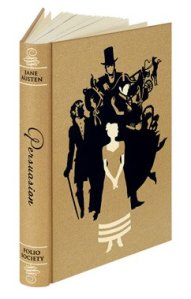
I certainly was. And the more articles I read about Austen, the sillier I felt for buying into it in the first place.  Because there is no question that I, along with many others,  “bought.”  I took my beautiful  Folio Society edition of Pride and Prejudice out of the box only to discover I have read this comedy of love and money far too often to enjoy it.  Godspeed, Elizabeth and Darcy!

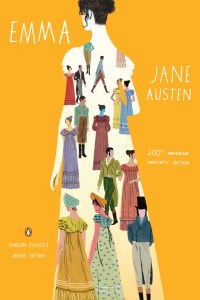
So am I a fan of Jane Austen?  To be exact, I am a  fan of Emma and Persuasion.  The rest–I can take them or leave them, but I usually take them because she wrote better than anyone else.

Our scholarly blogger friend Ellen Moody wrote at Reveries under the Sign of Austen, Two about the press coverage of the “anniversary hoopla.” She especially admired the articles in the Jane Austen issue of the TLS, and her favorite was “Passages to India,” by Charlotte and Gwendolyn Mitchell, about the  identification of a few of Austen’s relatives in a painting by Reynolds.

Amid all the hoopla 200 years on from Jane Austen’s death on July 18, 1817, one essay stands out: Charlotte and Gwendolen Mitchell’s identification of Austen’s aunt, her cousin, and their husband/father and maid in a painting by Reynolds. The essay comes at the end of a series of articles discussing the celebrity status of Austen, recent and older books on her, the films, and fandom (as it’s called) in the July 21, 2017 issue of Times Literary Supplement, a compilation resembling the one I described found in the New York Times Book Review (and doubtless countless others in other magazines, periodicals, websites, blogs, video media), in this case closely as to pages (16). The quality of the articles, the tone, and (by virtue of this essay alone) substance is much better than the NYTimes Book Review. I’ll review these briefly before turning to the pièce de résistance of the set, original research on a painting hanging in a gallery in Berlin.

Ellen’s scholarly article is excellent and I highly recommend it.  It was refreshing to read her analysis of this  “celebration” of Austen.  (Clearly they have run out of anniversaries when they get to the death one!)

But this  year the humor eclipsed the scholarly, as far as I was concerned. Ellen was much less keen than I on the lead essay at the TLS by Ian Sansom, “Jane Austen on the Money.” In some ways,  Sansom’s amusing essay is  an odd choice for the lead article in a scholarly publication. But in other ways it makes perfect sense.  The editors must have asked, “What can we do that is different?  How can the TLS steal attention from every other British and American publication on the same topic?”

Certainly the TLS essay is witty. Sansom, a mystery writer and a comparative literature professor, read and reread Austen’s books for the first time since he was “at university.” He  hilariously muses on his reactions to the books–Emma is his favorite–as well as writing about Austen’s obsession with money and the Austen industry.  He is well-organized, and a good storyteller.

Like Ellen, I did feel slightly taken aback that the essay was written by someone who is not an Austen enthusiast.  (Perhaps it was Sansom’s idea in the first place, though.)  But I thoroughly enjoyed it, because he is clearly a professional writer.  After reading so many serious Austen reviews and articles, I was happy to have a chance to laugh.  The only other writer as witty as Sansom is the novelist Emma Straub at The Washington Post on her favorite book, Emma.  Coincidentally, Sansom, Straub, and I are all mad about Emma.

Although I am a blogger and read many thoughtful Austen blogs, I must admit I laughed at the following.

Sansom writes,

These days it might be possible for someone to spend their entire time studying and thinking about the many blogs and social media posts devoted to Austen without ever having to study or think about Austen herself – indeed, some PhD student at Poppleton is doubtless doing so even now. So, tweet me. “Jane Austen” has become a signifier of such high semiotic intensity, possessing such incredible power both within and outside the academy that it has finally become the ultimate fiction: money. As if she weren’t already ubiquitous enough, you can now find Jane lurking in your pocket, on the £10 note, and also on commemorative £2 coins. When the new £5 notes were recently released, a small number were engraved with a special Austen micro-portrait, making each fiver, according to the Daily Mail, and my mother, worth approximately £50,000. Thus, men and women up and down the land were finally reduced to searching for Jane Austen with a magnifying glass.

Oh, no, more indecipherable English money!

And in Straub’s essay at the Washington Post, “Is it too late to read your first Jane Austen novel?” she describes her joy when a customer at her bookstore comes up to the register with a copy of Emma. Straub adds, “…and one of my chattiest, most wonderful booksellers yelped, ‘This is my favorite book!’ which I happily seconded.”

She writes,

I don’t often admit that “Emma” is one of my favorite books because it’s sort of embarrassing to love a book named for a character whose name you share — especially because Emma Woodhouse is thought of so dismissively within the Austen canon. Elizabeth Bennet she’s not. On the face of it, “Emma” is a novel about a bored rich girl with too much time on her hands, and yet it was the final paragraph of “Emma” that my husband and I typed by hand over and over again and set at each guest’s table setting at our tiny wedding. It’s Jane Austen’s mix of irony and satire and true generosity to her characters that makes Emma Woodhouse so charming, and what makes the book so pleasurable to read.

So on both sides of the pond you can find some humorous essays of interest , if you so inclined.   And, by the way, you can order a special book collection of the TLS articles on Jane Austen.

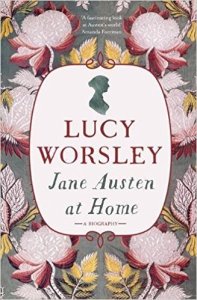
Between bloggers and professional writers, I have made  a long TBR of Austen books.   At the moment I am reading  Lucy Worsely’s Austen at Home, one of the most enjoyable books I’ve read on Austen this year.   Thanks to Nicola at Vintage Reads for recommending it!

The Laura Ingalls Wilder Butter Sculpture & Margaret Millar’s Domestic Suspense

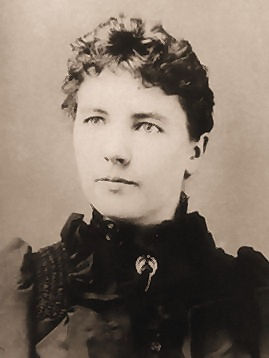
Laura Ingalls Wilder

Summer is vacation time.  Now if you can just agree on where to spend it…

Some hike the Appalachian Trail.  Others travel to Yosemite or Yellowstone, wanting to see the parks before they are fried by global warming.  Others go to cultural events, Shakespeare in the park (in whatever city), or a music festival. And still others go to Dollywood or Graceland.

I hope your vacation was better than ours.

We spent our (one-day) vacation in Clear Lake, where I was stricken by a piercing headache/migraine in a hot car en route to a Shakespeare Festival in Winona.  We never got to Winona, because we were too busy sightseeing in Clear Lake:  the convenience store where we bought Advil, the park where I lay on a picnic table, and the coffee shop, Coffee Cabin, where I attempted a caffeine cure.  Once home, I remembered that my parents met at the Surf Ballroom in Clear Lake.  Oh, my!  That marriage ended in divorce. But my mother and her best friend told me years later that they enjoyed the train trip.

Oh, well.  Missed the Surf Ballroom, but in August there is much, much more fun ahead.  The Iowa State Fair.

Why should the bookish go to the fair?   The fair is not just rides and fried food.   This year there will be a butter sculpture of Laura Ingalls Wilder beside the traditional sculpted butter cow.

And why is Laura sculpted in butter? you may ask.

It is her 150th birthday, and, since the Ingalls family moved frequently and lived all over the Midwest,  almost every Midwestern state claims her as its own.  She and her family  lived in Burr Oak, Iowa, for a few years, after a grasshopper plague drove them out of Minnesota.  And so she’s a butter sculpture.

Am I a great fan of Wilder? Well, no.   By the time I discovered her books I was nine or ten, and they  seemed too stylistically simple.  The only one I enjoyed was These Happy Golden Years, the story of Laura’s struggles to teach in a one-room school. I was interested because both of my grandmothers were one-room school teachers.  And they never talked about it.  Oral narrative isn’t big in Iowa.

All right, we will never go to the State Fair.  But we will watch the 1945 movie, State Fair, with Jeanne Crain and Dana Andrews.

And that’s the news in Iowa.

COLLECTED MILLAR:  DAWN OF DOMESTIC SUSPENSE

Syndicate Books is reissuing the classic crime fiction of the award-winning American-Canadian writer, Margaret Millar, who won the Edgar for her novel Beast in View in 1956. She was the wife of Kenneth Millar, who wrote the Lew Archer mysteries under the name Ross MacDonald.   I found this big pink volume in the mystery section, Collected Millar:  Dawn of Domestic Suspense, and couldn’t resist.

The first novel in the volume, Fire Will Freeze (1944), is a fast-paced locked-room mystery.  A group of people on a bus headed for a ski resort end up spending the night in a big, isolated house when the bus breaks down.  Bizarrely, people keep disappearing and dying. Could the killer be the mad woman whose keeper locks her in her bedroom?  And Miss Isabel Seton, a smart spinster in her thirties, is more observant than the others, but she is hardly a detective.  The plot thickens, and her intelligence works overtime.

A locked-room mystery is always fun.  But I really loved Experiment in Springtime (1947), one of the eeriest  psychological novels I’ve ever read.  It is not exactly a mystery, but as we get to know the personalities of the characters, their strengths and weaknesses, their instability and hysteria, we can tell that something is going to happen.  And the woman, Martha,  is at the center of a triangle.

Millar begins,

In April, Charles almost died.  His wife, Martha, nursed him assiduously and with a certain grim efficiency that Charles, in his moments of clarity, found amusing. Even on the point of death, he knew he bored her.

Charles is a rich 36-year-old businessman, and Martha  a beautiful, voluptuous young woman who married him for money.  Martha has accidentally poisoned him with aspirin, and Charles wonders if she did it on purpose.  He had a headache, and she didn’t know he was allergic to aspirin.  But Charles is so weak and sick that he  broods and becomes increasingly paranoid.  Even the doctor has some doubts, though he believes Charles has psychological problems. It is tough to feel sympathetic to Charles, who is quite misogynistic.   Finally, the doctor lends Charles a cottage by the lake. And Charles  won’t give Martha the address.

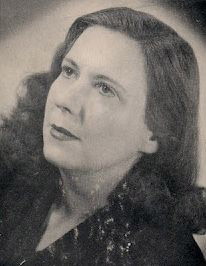
Margaret Millar

Martha is relieved that he’s gone.  She cannot bear sex with Charles.  Is she frigid?  That’s what we think at first.  She dresses in black tailored suits to mask her sexuality, and buys pretty things only for her mother and sister, who live with them in their big new house.  Martha loves to shop: it is her only solace for having married Charles.  The chauffeur drives her downtown, and we follow her through a giddy shopping trip, and see her delight as she accumulates bags of presents.  (Don’t all us shopaholics feel that way?)  Then on her way back to the car, she meets her handsome ex-boyfriend, Steve, just back from the war. It is awkward.  They used to be engaged, and Steve broke it off.   And we see a different side of Martha, an uncertain side.  And when Steve, a former reporter who is suffering from PTSD, moves from a sleazy hotel into the apartment above Martha’s garage, it’s only a matter of time before Martha undergoes a complete personality change and begins to wear colorful clothes.

So what will happen?

Not what you think, because I thought it too.  The ending is a complete surprise.

I can’t get enough of Margaret Millar.  When I finish this volume, with six novels, I may have to read the others.

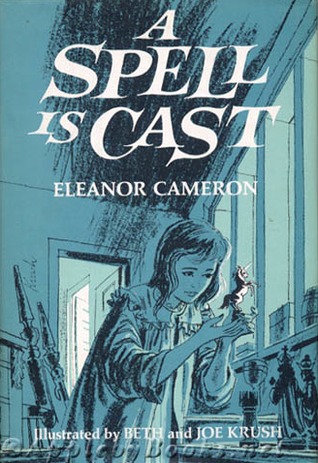
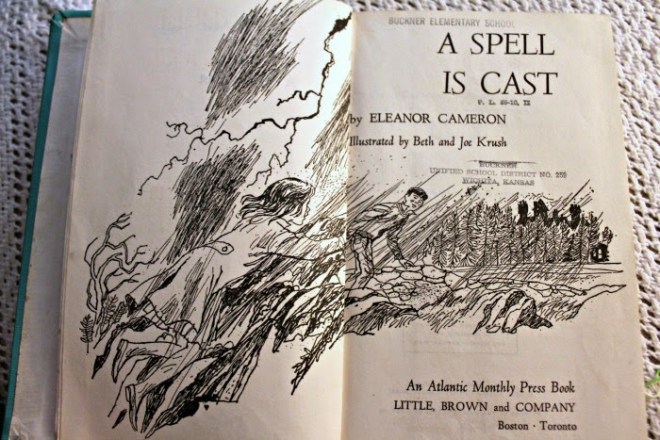
Eleanor Cameron’s “A Spell Is Cast”

 The other day I decided to reread Eleanor Cameron’s beautifully-written novel, The Spell Is Cast.   It is that rarity, a  children’s book that can be read with as much interest by adults as children.  There is even a Dali-esque dream sequence, just as vivid as the dream in Alfred Hitchcock’s film, Spellbound.  And the book won the Silver Medal, 1964 Commonwealth Awards; was nominated for the Edgar; and was a Horn Book Fanfare Best Book of 1964.

I wrote this book journal entry in 2010.

October 17, 2010

I spent most of the afternoon sitting in a lawn chair reading Eleanor Cameron’s A Spell Is Cast.  Cameron is a children’s author, best known for her Mushroom Planet series, but her realistic novels are my favorites.  I especially have wonderful memories of A Spell of Cast, one of the remarkable novels my fifth-grade teacher read aloud to us.  Mrs. W. loved reading, and I am awed by her taste as I think back.  We were mesmerized by The Pushcart War, Snow Treasure, A Long Way to Go, The Alley, and Rascal, to name a few. She was very quiet, but looking back, I realize her reading aloud had an intense influence on me.  I have only to open A Spell Is Cast to recapture warm, rainy afternoons, with the windows open, and that muddy scent that is  redolent of storms in the midwest.  And of course I could never wait for Mrs.W. to finish the novels before I read them myself. I usually ran over to the public library and checked them out.

A Spell Is Cast is the story of Cory Winterslow’s stay with her grandmother and Uncle Dirk in California.  Her adoptive mother, Stephanie Van Heusen, an actress, is always on tour, and leaves Cory with a series of hired helps.  But during this tour, she has sent Cory to California, and Cory has looked forward eagerly to being part of a family. She is intensely disappointed when Uncle Dirk, who has written charming letters, doesn’t show up at the airport.  This is the first of her adventures. A neighbor gives her a ride part of the way home, and when the car runs out of gas, a boy her own age, Peter, leads her on a short cut across the beach. A storm breaks and they shelter in a cave.  At home she learns that her mother sent the wrong date to her family and that they had expected her tomorrow.  And she learns from her grim grandmother that Stephanie has never legally adopted her, which is a blow.

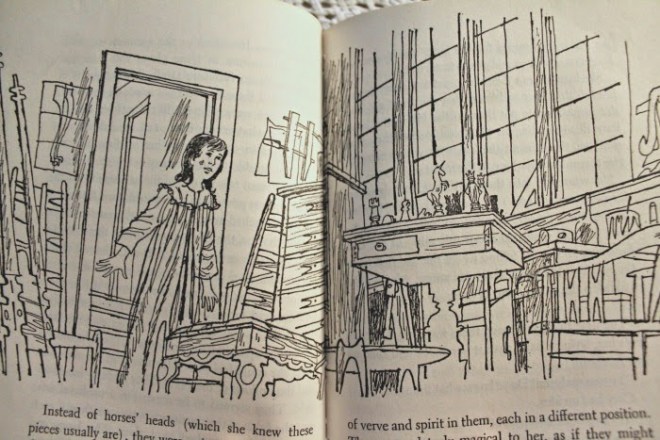
The Van Heusen relatives have many family secrets.  During a long dream sequence when Cory has a fever–have I ever read a dream sequence in another children’s book?–she finds herself in a music room where there is a chess set with carved unicorns instead of horses.  It turns out later that this part of the long dream is true.  It is atmospheric moments like this that made this novel such an intense experience when I was young.

Cory discovers the unicorn chess set she dreamed about.

The descriptions of the beach made me quite desperately want to leave the midwest, and perhaps my frequent vacations at the beach as an adult were inspired by this.

…Cory explored the whole beach, keeping a watch on Peter’s house to see if she might catch sight of him, but he did not appear.  Gradually, she began humming to herself as she searched for treasures.  She found a small bleached bird’s skull, ivory-colored and perfect and not in the least fragile.  She found a curiously shaped piece of driftwood with peaked shells clinging to it, and another shell among a pile of seaweed.  It was oval, like a little saucer, a rough, dull greeny-yellow, the precise color of the seaweed to which it was stuck.  But when she finally managed to pry it off and turn it over, she discovered that on the inside it was glistening smooth as glass, pearly around the outside and with a pool of rich color in the center like frozen sea water.

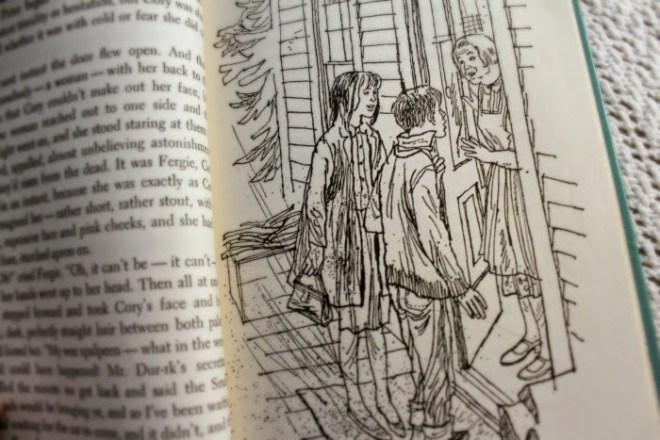
It is a breathaking novel! I also like the illustrations by Joe and Beth Krush.

Alas, this book is out-of-print: let’s hope some publisher rediscovers and reissues it.

“Jane Austen” by Jill Bialosky

The bicentenary of Jane Austen’s death was on Tuesday, July 18.  Here is a lovely poem by the American poet, Jill Bialosky.

“Jane Austen”
By Jill Bialosky

“A fine Sunday in Bath empties every house of its inhabitants, and all the world appears on such an occasion to walk about and tell their acquaintance what a charming day it is.” —northanger abbey

I awoke from the tunnel
to the fields of yellow rape,
seventeenth-century buildings, and cobbled
streets as she would have seen them.
It was rainy; the rain came and went,
came and went so that you could not escape
its dampness. I understood the need for tea
and the luxury of cremes and pastries
and why the ladies longed for a strong shoulder
to see them through the winter.
The seagulls cried overhead,
though there was no sea, only a muddy river
from Bath to Bristol. The scavengers
lived on the rooftops and if desperate
enough would swoop down and take
a sandwich from your hand.
I secured my room at the Royal Bath Hotel.
It was a hovel, really, with a carpet
as old as the early century.
Walking through the hotel,
I sensed something lurid
in the air, every eye upon me as if they knew
I was a foreigner in a strange land.
Over the bed, a burgundy bedspread
dusty and faded as vintage wine,
made me long for the bright color of red.
In the next room, sleepless, I heard
through thin walls the sounds
of an un-tender coupling.
I looked in the warped mirror
and found myself ugly
and when I turned from it,
could not escape the vision.
It lingered. The rain came and went,
came and went. I took an umbrella
and began my walk, hoping to come upon
her quarters. I passed the Roman Baths,
the statues not beautiful,
but puckered and fossilled
and the Pump Room where her protagonist,
other self, doppelgänger,
good, strong, loyal Catherine,
longing for companionship, fell
under the seduction of Isabella
and her reprehensible brother.
Even then her coming out
seemed less magisterial,
and Bath a representation of the emptiness
and evils of society where a woman’s dowry
might confine her forever,
than a reprieve from country life.
I gave up my search.
Images were everywhere.
And my mind had been made up.
I perceived no romance
in the wind, no comfort in the hard
glances of strangers, girls with chipped nail polish,
lads unkempt as if there were no hope of glory.
The next morning I boarded the train
to the modern world and it wasn’t until a sheet
of blue slipped out like a love letter
from its envelope of dark gray sky
that I knew the journey had ended
and, like Catherine, I was finally safe.

What to Read in the Heat!

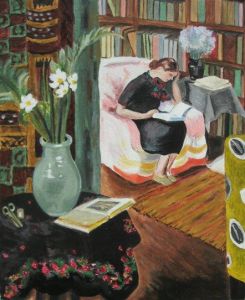
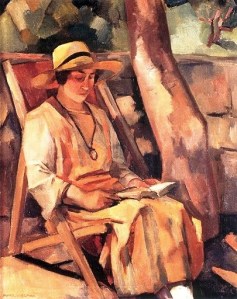
“Reading Woman” by Matthieu Wiegman

Drink a glass of water before you read this, because it’s very, very hot.

So far this month we have had 13 days in the nineties.   It was 90 degrees when I took my bike ride this morning and it was 95 when I got home.  And so I flopped down in the decadent air conditioning and made a list of:

WHAT TO READ IN THE HEAT!
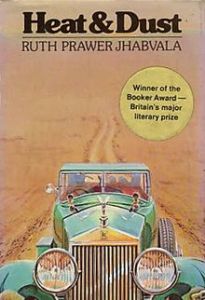
1. Heat and Dust by Ruth Prawer Jhabvala.  Jhabvala won the Booker Prize for this stunning novel. I am lazily borrowing the Goodreads description:

“Set in colonial India during the 1920s, Heat and Dust tells the story of Olivia, a beautiful woman suffocated by the propriety and social constraints of her position as the wife of an important English civil servant. Longing for passion and independence, Olivia is drawn into the spell of the Nawab, a minor Indian prince deeply involved in gang raids and criminal plots. She is intrigued by the Nawab’s charm and aggressive courtship, and soon begins to spend most of her days in his company. But then she becomes pregnant, and unsure of the child’s paternity, she is faced with a wrenching dilemma. Her reaction to the crisis humiliates her husband and outrages the British community, breeding a scandal that lives in collective memory long after her death.”
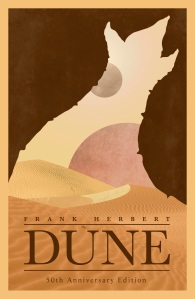
2. Dune by Frank HerbertDune, the winner of the Nebula and Hugo Awards in 1966, is an ecological classic.   As I said here last year:  ” It is, to a large extent, about the politics of water. Water is the most precious commodity on the planet, though the ruling class are never dehydrated and live in luxury.  The native Fremen in the desert must wear “stillsuits” that recycle every drop of sweat and urine while they travel or work in the spice mines.  When someone dies, the water is taken from the body to be reused, because 70% of the body is water.  Plastic dew collectors save every drop of condensation for growing plants. Dangerous sand and dust storms blow up to 700 kilometers an hour and ‘can eat flesh off bones and etch the bones to sliver.’  There are also giant worms.  But the planetologist, who knows exactly how much water is needed to make the planet green over the next few hundred years, teaches the people how to change.”
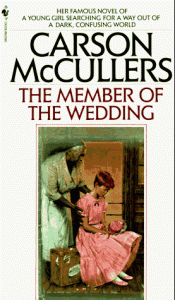
3. The Member of the Wedding by Carson McCullers.  This is the 100th anniversary of McCullers’ birth, and this is my favorite of her books. Set in the South during the summer, you will feel the sweltering weather!   The Goodreads description says:  “Here is the story of the inimitable twelve-year-old Frankie, who is utterly, hopelessly bored with life until she hears about her older brother’s wedding. Bolstered by lively conversations with her house servant, Berenice, and her six-year-old male cousin — not to mention her own unbridled imagination — Frankie takes on an overly active role in the wedding, hoping even to go, uninvited, on the honeymoon, so deep is her desire to be the member of something larger, more accepting than herself. “A marvelous study of the agony of adolescence” (Detroit Free Press), The Member of the Wedding showcases Carson McCullers at her most sensitive, astute, and lasting best.”
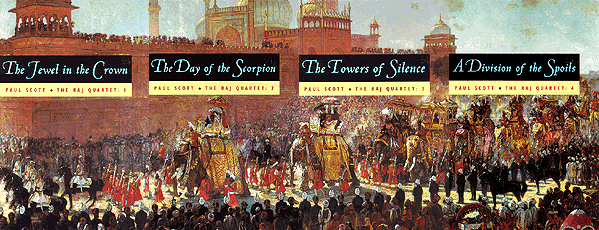
4.  The Raj Quartet by Paul Scott.  I love Scott’s brilliant quartet!  As Goodreads says, “richly recreates the last days of India under British rule–“two nations locked in an imperial embrace”–as Paul Scott’s historical tour de force, ” The Raj Quartet.” “The Jewel in the Crown” opens in 1942 as the British fear both Japanese invasion and Indian demands for independence.

I blogged briefly about the first book in the quartet, The Jewel in the Crown, here.
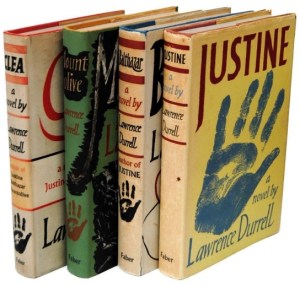
 

These are first editions. I wish I had these…

5. The Alexandria Quartet by Lawrence Durrell.  I wrote about this remarkable tetralogy here in 2015:  “In Durrell’s  gorgeously-written, percipient tetralogy, Justine, Balthazar, Mountolive, and Clea, the prose is moody and lush.  The narrative is psychologically-oriented and fragmented. Over the course of the quartet, Durrell’s narrator, Darley, reiterates and augments a series of events in the lives of his lover Justine and a group of friends in Alexandria, Egypt.  Other characters, particularly Balthazar and Clea (Mountolive is the hero of the prequel), contribute their viewpoints, so that a clearer picture is revealed.  Published from 1957 to 1960, these books are elegant but occasionally too flowery.   In the ’50s, Durrell’s poeticism flourished.  I love every word!”

6.  Dante’s Inferno.  The first book of the Divine Comedy is the powerful poetic narrative of Dante’s finding himself in “a dark wood” in the middle of his life, and  Virgil guiding him on a tour of the nine circles of hell.  A good companion book to Dante’s masterpiece is Erich Auerbach’s Dante: Poet of the Secular World (NYRB)
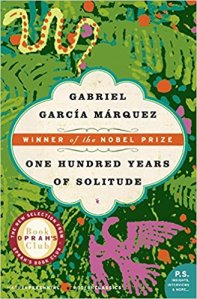
7.  One Hundred Years of Solitude by Gabriel Garcia Marquez.  There’s plenty of heat in Garcia Marquez’s masterpiece.  The Amazon.com review says:

The story follows 100 years in the life of Macondo, a village founded by José Arcadio Buendía and occupied by descendants all sporting variations on their progenitor’s name: his sons, José Arcadio and Aureliano, and grandsons, Aureliano José, Aureliano Segundo, and José Arcadio Segundo. Then there are the women–the two Úrsulas, a handful of Remedios, Fernanda, and Pilar–who struggle to remain grounded even as their menfolk build castles in the air. If it is possible for a novel to be highly comic and deeply tragic at the same time, then One Hundred Years of Solitude does the trick. Civil war rages throughout, hearts break, dreams shatter, and lives are lost, yet the effect is literary pentimento, with sorrow’s outlines bleeding through the vibrant colors of García Márquez’s magical realism. Consider, for example, the ghost of Prudencio Aguilar, whom José Arcadio Buendía has killed in a fight. So lonely is the man’s shade that it haunts Buendía’s house, searching anxiously for water with which to clean its wound. Buendía’s wife, Úrsula, is so moved that “the next time she saw the dead man uncovering the pots on the stove she understood what he was looking for, and from then on she placed water jugs all about the house.”

8. The Sheep Look up by John Brunner.  l wrote last year  (and you can read the rest of the post here):

In this terrifying post-modern literary SF novel,  pollution has rendered the U.S. practically a wasteland.  The poisoned air blows into Canada and sometimes across the ocean to Europe (sound familiar?);  everyone is sick; antibiotics no longer work; fleas and rat infestations in houses and apartment house can no longer be controlled because they are immune to poison; the acid rain in NY is so bad that you need to wear plastic outside; the water is poisoned (there are frequent “no-drink water” days); intelligence levels are dropping (lead in the air and water); a virus causes spontaneous abortion; the oceans are so polluted that people vacation in Colorado rather than California; and big businesses are profiting by selling air filters, water filters, etc.
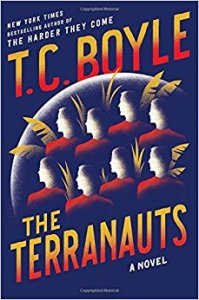
9.  The Terranauts by T. C. Boyle.  Boyle’s brilliant novel was based on an actual experiment in Arizona.   Here’s a paragraph form the Goodreads description:  “It is 1994, and in the desert near Tillman, Arizona, forty miles from Tucson, a grand experiment involving the future of humanity is underway. As climate change threatens the earth, eight scientists, four men and four women dubbed the “Terranauts,” have been selected to live under glass in E2, a prototype of a possible off-earth colony. Their sealed, three-acre compound comprises five biomes—rainforest, savanna, desert, ocean and marsh—and enough wildlife, water, and vegetation to sustain them.”

10.  Flight Behavior by Barbara Kingsolver.  I blogged about this wonderful novelin 2013:  “When Barbara Kingsolver’s novel, Flight Behavior, was published last fall, critics asked if it was possible to write a good novel about climate change.  Having inhaled this stunning literary novel in two days, I can answer, Yes, it is.  Kingsolver boldly interweaves the science and politics of climate change with the everyday lives of a struggling family.  She creates a plausible fictional overview of a  problem that will not go away.”
You can read the rest of the post here.

And what are your favorite books to read in the heat?