Reading on Christmas: We Made It through the Holiday!

prozac-holidays-taintor-screen-shot-2013-12-03-at-5-20-47-pmWe made it through another Christmas.  It was foggy and rainy:  too wet for a walk, so we went to the gym.  And then we got out the books we bought at Barnes and Noble for our gift exchange.  They say you can’t read all the time–my father said reading made me a “non-participant in life”–but I say,  You Can and It Didn’t.

everybodys-fool-russo-fool_coverI am racing through  Richard Russo’s brilliant new novel, Everybody’s Fool, a sequel to Nobody’s Fool. (You probably saw the great movie  Nobody’s Fool, with Paul Newman, Bruce Willis, and Melanie Griffith.)

Russo’s new comedy, a pitch-perfect multi-character saga, is set in  North Bath, New York, a run-down small town. (And I guarantee it was never visited by Garrison Keillor!)   Russo chronicles the lives of barflies, misfits, and romance readers, the barely middle-class  and the downwardly-mobile.  Residents envy nearby Schuyler Springs, a prosperous sister town that is a tourist destination and has three colleges.   But even the springs in Bath have dried up. (They’re still bubbling in Schuyler Springs.)  And a horrible sewage-like stench has settled over Bath.  What IS it?

The rich cast of characters is endlessly fascinating.  Sully, the hero of Nobody’s Fool, is 70 years old now, living in a trailer outside the house he inherited from his eighth-grade English teacher, Beryl Peabody.  He has a heart condition, but refuses to have surgery: if he has only a year or two to live, he wants to go out with a bang. His old girlfriend, Ruth, the owner of Hattie’s diner, sees him every day and still occasionally has sex with him, but is focused on family problems:  she is furious that her obese husband, a junk scavenger, has installed an airplane-hangar-size shed in their yard, with the help of Sully, and  terrifed by the violence of her daughter Janey’s ex-husband Roy, just out of  prison.

My favorite character is Raymer, the policeman who was Sully’s nemesis in the first book. He has been elected chief of police, in spite of a campaign slogan malapropism that said,  “We’re not happy till you’re not happy.”  Raymer is depressed and a recent widower:  his beautiful wife, Becca, tripped down the stairs and broke her neck when she was leaving him for a lover she never identified.  Raymer didn’t have a clue she was unfaithful until she found her good-bye note.  With the help of a strange garage door opener found in Becca’s car, he hopes to point and click his way to her lover.  But then he faints at a funeral and falls in the grave and loses the garage door opener. He will do anything to retrieve it…

This book is funny, sad, and charming…and I must admit, terrifying when Russo reveals the consciousness of Roy the ex-con.   Russo is one of the best American writers working today, and though he won the Pulitzer for Empire Falls, he is underrated.  I agree with  T. C. Boyle’s reveiw  in The New York Times Book Review:

Nonetheless, taken together, at over 1,000 pages, the two “Fool” books represent an enormous achievement, creating a world as richly detailed as the one we step into each day of our lives. Bath is real, Sully is real, and so is Hattie’s and the White Horse Tavern and Miss Peoples’s house on Main, and I can only hope we haven’t seen the last of them. I’d love to see what Sully’s going to be up to at 80.


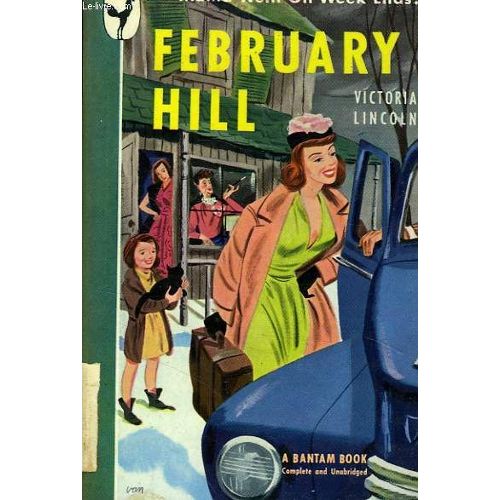
Why We Need Magazines & February Hill by Victoria Lincoln

bantam-paperback-february-hill-lincoln-victoria-february-hill-livre-ancien-875667148_l

People used to read more.  According to an article in The Atlantic in 2014, the number of American non-readers has nearly tripled since 1978. I may sound like a cranky old lady, but in the days of twentieth-century “print media,” when dozens of magazines like McCall’s, Good Housekeeping, The Atlantic, and Harper’s  published short stories and poetry in every issue, Americans took for granted a rich cultural treasure trove of literature.

Was fiction better then?  Well, I think so.  I have been slowly making my way through a three-volume set of  Short Stories from The New Yorker, published on the 25th anniversary of the magazine.  In this wonderful anthology I have read brilliant stories by neglected writers like Kay Boyle, Nancy Hale, and Tess Slesinger.

One of the many forgotten New Yorker writers who has fallen off the literary map is Victoria Lincoln (1904-1981), a novelist and biographer.   There is very little information about her online.   According to her obituary in The New York Times, she was born in Fall River, Massachusetts, attended Radcliffe, and was  best known for her 1934 novel, February Hill, ”a harum-scarum story of an enchanting family that lives by its wits and the grace of the local police force outside Fall River.’

february-hill-victoria-lincoln

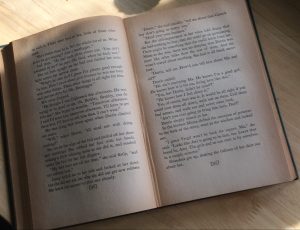
I wish I had found a nicer copy than this!

I am all for harum-scarum, so I ordered a cheap hardback copy of February Hill at Amazon.  The pages are brittle and tanned, but I am delighted to have found it at all.  This quirky, well-written novel is part comedy, part Gothic romance.  Think Faulkner’s poor white trash characters, only matriarchal, crossed with the “loam-and-lovechild” types made famous by English writer Mary Webb.

This story of this shiftless but genial matriarchal family is charming and fast-paced but also poses philosophical questions.  What is morality?  What is loyalty?  Do these qualities have to do with the law, or survival?  The Harris family is poor but lively and contented.  Grandma, an ex-prostitute who wears a startling curly chestnut wig and sings old Vaudeville songs, moved north from Georgia when authorities became too interested in her activities.  She thinks it’s a miracle that the police and social workers have not interfered with them in Fall River.   Her cheerful, party-loving daughter Minna, a  prostitute, supports the family, with a small contribution from her oldest daughter, Dottie, a factory worker. Minna’s husband Vergil, an  alcoholic ex-Harvard scholar, stays home and pretends to read Greek while he drinks himself into oblivion. Two of their children, Jenny and Joel,  have dropped out of school before the legal age, but the schools seem not to have noticed:  Jenny, an unusually pretty girl, takes day-long walks, hitchhikes, and  steals frivolous “presents” for her family.  She lies and plays a character when she cadges food off a farmer’s wife, but part of this is spinning the fantasies of an adolescent.   Joel is very close to Jenny, and often articulates her feelings through his quoting of Shakespeare.  Like his father, he is studious and weak.  Their sturdy younger sister Amy sits on Grandma’s lap and asks for songs, but “talks tough” and shocks visitors with her casual references tos “sonsovbitches.”

Their ramschackle house reflects the personality of family.

The Harris family lived in a shanty, but it was a good, tight, waterproof shanty, and if you called it a house you might have found yourself some justification, chiefly in the assured though rakish air with which it wore an indubitable front porch.  But for my part, I withhold the term, front porch or no; for it was a brazen slattern of a place if ever there was one, and its porch, of which the balustrade was broken down for fully half its length, was like a toothless leer upon its dirty face.  The shabby tangle of young maple and birch that screened it from the road could not hide its disgrace.  It was blatant of shamelessness and discreditable poverty.

Victoria Lincoln

Victoria Lincoln

Is morality determined by convention or class, law or family loyalty? When Jenny marries Berkley Howard, the grandson of a rich socially prominent farmer, he is so ashamed of her family he forbids her to see them.  And yet he himself works as a “rum runner,”  but has a double standard when it comes to prostitution.  Jenny remains loyal to her family, because she knows they are intrinsically good.

Dottie, who marries a French-American factory worker, despises the family as much as Berkley but her hatred backfires.  And  Joel is sent to live with his father’s rich mother in Maine, but this is also a mistake.

Minna makes such an impression on one of her clients, a rich businessman from Texas, that he asks her to marry him. She could leave February Hill.  But how much can a person do for money?  Where do her loyalties lie?

A fascinating novel, a little shaky at times, but overall one of my favorites of the year!

And, by the way, it was adapted for the stage as Primrose Path, and made into a movie with Ginger Rogers and Joel McCrea.

A Louisa May Alcott Idyll: The Tasha Tudor Figurines

alcott-figuresMy cousin Megan gave me my Christmas gift today. After the P.O. delivered the package she had ordered from eBay, she came over unannounced to give me “the present of the century.”

“Open this now,” she said when she arrived at my house to find me, for the sixth day in a row, picking up Christmas decorations the cats have knocked off the tree and designated as their toys.  “It will put you in the Christmasy mood.”

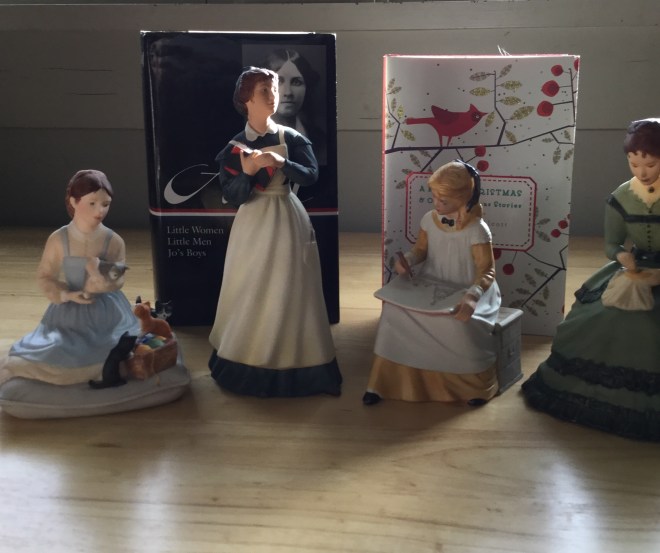
It took 20 minutes to cut through the layers of tape and unwind the contents from mummy wrappings of brown paper and bubble wrap.  Inside were nestled  four hand-painted porcelain Little Women figurines, designed by Tasha Tudor and manufactured by Franklin mint.  In order of appearance in the DIY photo above are Beth with kittens, Jo holding a book, Amy sketching, and Meg sewing.

As Megan said, “It makes me want to play dolls.”

Instead, we just rearranged them in different groupings.

I have long been a fan of Louisa May Alcott, as readers of this blog may or may not remember. (I myself have trouble remembering where I read what online.)  Anyway,  my favorite Alcott is An Old-Fashioned Girl, which I wrote about here.  I posted about Eight Cousins here; and spent a lot of time musing on a strange TLS review of Beverly Lyon’s excellent book, The Afterlife of Little Women, here.

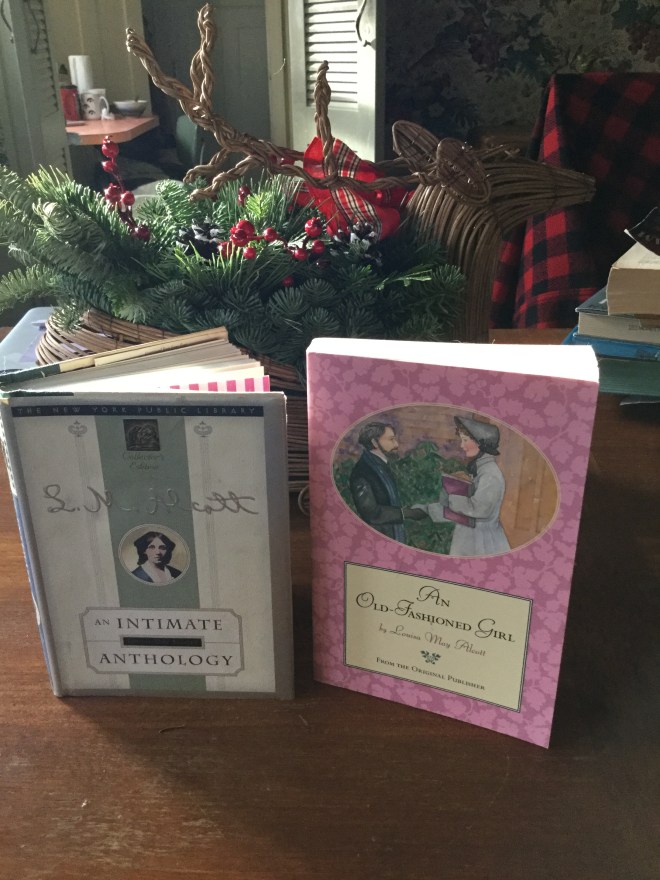
Although I do not have a large Alcott collection, I photographed the six books of hers I found on the shelves. This is a blogger kind of photoshoot, is it not?

My first copy of  Little Women was an adapted version, which I no longer have, alas,  purchased at the supermarket when I  was seven. Later I was given a Junior Illustrated Classic, with the complete text.  I longed to  whistle tomboyishly with my hands in my pockets, and cry out, “Christopher Columbus” and “capital!” like Jo.  I also wanted to be a writer.  And I loved the way Jo cares nothing for fashion, or inky pinafores.

Every few weeks she would shut herself up in her room, put on her scribbling suit, and “fall into a vortex,” as she expressed it, writing away at her novel with her heart and soul, for till that was finished she could find no peace.  Her “scribbling suit consisted of a black woolen pinafore on which she could wipe her pen at will, and a cap of the same material, adorned with a cheerful red bow, into which she bundled her hair when the decks were cleared for action.  This cap was a beacon to the inquiring eyes of her family, who during these periods kept their distance, merely popping gin their heads semi-occasionally, to ask, with interest, “Does genius burn, Jo?”

After my first reading of Little Women, I checked out all the Alcotts I could find from the library:  Eight Cousins, Rose in Bloom, Under the Lilacs, and Jack and Jill, to name a few.

Library of America editions of Alcott

Library of America editions of Alcott

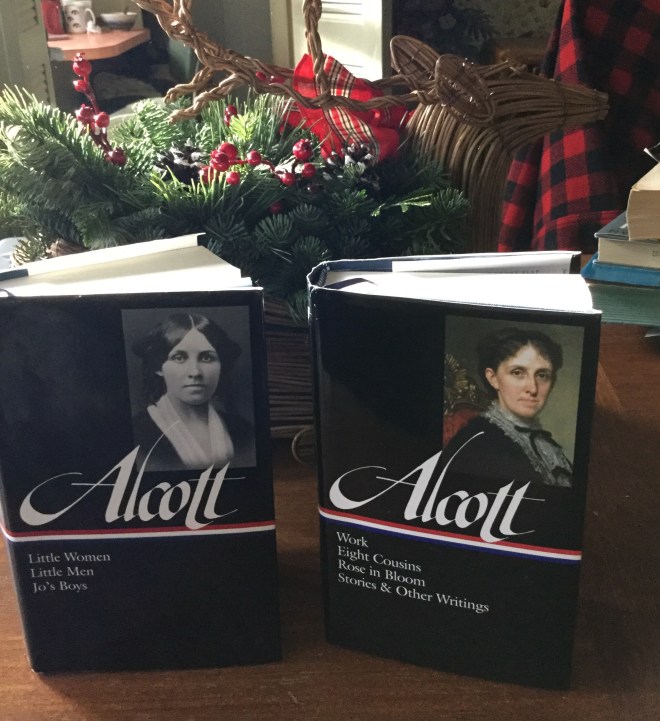
I began to acquire my “adult editions’ of Alcott about a decade ago.  When Library of America published a collection of  Little Women, Little Men, and Jo’s Boys  in 2005, I reread these entertaining, witty classics.  In 2014  LOA published a second Alcott edition, comprised of Work (known as the adult Little Women), Eight Cousins, Rose in Bloom, Stories & Other Writings.

An Intimate Anthology is a wonderful collection, and An Old-Fashioned Girl is my favorite Alcott.

An Intimate Anthology is a wonderful collection, and An Old-Fashioned Girl is my favorite Alcott.

I strongly recommend The New York Public Library edition of An Intimate Anthology, a collection of Alcott’s stories, diary entries, letters, and verse, including Transcendental Wild Oats, about life in her father’s commune, and Hospital Sketches, a fictional account of her experiences as a Civil War nurse.  And, as I have mentioned,  An Old-Fashioned Girl is my favorite of Alcott’s books.

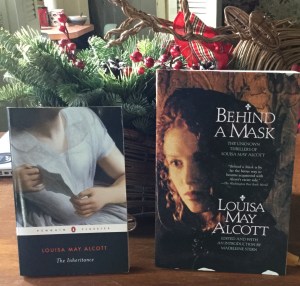
alcott-sensation-fiction-behind-a-mask-inheritanceAnd here are Alcott’s sensational writings!  Behind a Mask is a collection of the thrillers she wrote for money, and The Inheritance, a Gothic romance she wrote at 17.

What is your favorite Alcott book?

Now I just want to sit here and admire my figurines some more.

Last Minute Christmas Gifts, As If! Your Personal Shopper Speaks

SHE WILL NOT WEAR THIS!

THERE WILL BE TEARS!

Last-minute gifts are a bad, bad idea.

This is your life.  This is your wife’s life, too.  That is why I, your personal shopper, am interceding.  Your stressed-out wife may or may not want a diamond necklace from Gales–I don’t know her, but I wouldn’t –but she will not be amused if you present her with a Broncos stocking cap you picked up at an airport shop.

And when you ask her if pears from Harry and David’s will arrive before the holiday, guess what?  She believes you are sending them to her.  If your mother gets the pears and she gets the stocking cap, There Will Be Tears.

Okay, I’ve been there.  I’ve failed in spousal gift-giving, too. That organic watch?  Turns out it wasn’t organic:  he explained the corn resin manufacturing processes pollutes, and the company was preying on my environmental  conscience.  He accidentally dunked it in the dishwater.

And so we had to rethink our gift-giving process. Dramatically.  We go to a bookstore on Christmas Eve and each of us picks out a book.  And now we have a Happy Christmas!

If your wife loves to read, here are Five Last-Minute Items That Probably Won’t Offend Her.  Just be sure you get a gift receipt.

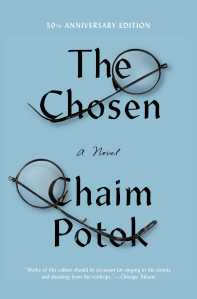
potok-the-chosen-9781501142475_hr1. The fiftieth-anniversary edition of Chaim Potok’s modern classic, The Chosen.  has a new introduction, critical essays, and rare papers and photos.  A best-seller in the ’60s, this beautifully-written novel is the story of two  friends, one an Orthodox Jew and the other a Hasidic Jew, and their clashes with their fathers and their faith.  Loved it when I read it, and would like to reread it.

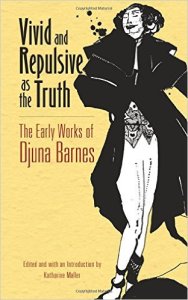
vivid-and-repulsive-51mwfr9nsal-_sx310_bo1204203200_2.  Dover has published a beautiful paperback edition of Vivid and Repulsive as the Truth: The Early Works of Djuna Barnes. Best known for her modernist 1936 classic  Nightwood, she explored Bohemianism, feminism, and lesbianism in her writing. This  wonderful collection of Barnes’ early journalism, fiction, and poetry is a joy.

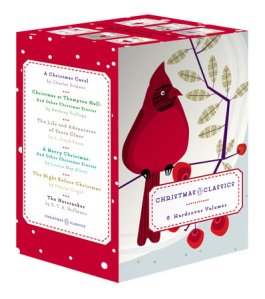
penguin-christmas-classics-97801431297833. The Penguin Christmas Classics. You can buy these individually, or you can buy a boxed set.  These six beautifully-designed books comprise Charles Dickens’ A Christmas Carol, Anthony Trollope’s  Christmas at Thompson Hall and Other Christmas Stories,  L. Frank Baum’s The Life and Adventures of Santa Claus, Louisa May Alcott’s A Merry Christmas and Other Christmas Stories, Nikolai Gogol’s The Night Before Christmas, and E. T. A. Hoffmann’s The Nutcracker.

penguin-galaxy-all_front_white-1274x12004.  The Penguin Galaxy SF Series.  This selection of science fiction classics is quirky and surprising, and the introductions are by Neil Gaiman.  The series consists of Heinlein’s Stranger in a Strange Land, William Gibson’s Neuromancer, Frank Herbert’s Dune, Ursula K. Le Guin’s Left Hand of Darkness, Arthur c. Clarke’s 2001:  A Space Odyssey, and T. H. White’s The Once and Future King. 

ross-maconald-loa-41kq458b9l-_sy344_bo1204203200_5. Michael Dirda has written extensively about the mystery writer, Ross MacDonald, whom he calls the best American detective novelist of the ’50s and ’60s.  Check out this Library of America edition of  Ross MacDonald’s Three Novels of the Early 1960s:  The Zebra-Striped Hearse, The Chill, and  The Far Side of the Dollar

All right, do you know what’s expected now?  Really, don’t give her anything from Scheels unless she’s a jock!

Cookery Gone Wrong: When Good Women Cook Bad Food

Tina (Carrie Snodgrass) at party with her husband (Richard Benjamin) in "Diary of a Mad Housewife"

Tina (Carrie Snodgrass) at party with her husband (Richard Benjamin) in “Diary of a Mad Housewife”

In the late 1960s, when I was a teenager,  I began to read John Updike (Couples) and Sue Kaufman (Diary of a Mad Housewife). I pictured the chic, adulterous, party-going characters as Barbie dolls, in sparkly black cocktail dresses, accompanied not, well, by Ken, but perhaps Mick Jagger.  In Updike country, women passed the canapes and downed highballs, while their husbands flirted and networked. Sometimes the women are jealous; other times they’re making their own assignations.  What I learned:  being a good hostess and great cook  has nothing  to do with marriage.

In the same era, my own mother did not attend cocktail parties, nor did she call anything a canape.  She opened soup cans, fried chicken, and tossed iceberg lettuce with French dressing, but we ate out much of the time, in a decade when most people ate in.  She had that ’60s thank-God-for-packaged-and-prepared-food attitude that meant cooking was a thing of the past:  she was relieved not to be a prisoner of the kitchen.

She stopped cooking after her divorce, because she literally fell apart for a few years.  And, unfortunately, like a typical teenager,  I vowed I would never be like her, not understanding the reality of DNA.

Cooking  did not come naturally to me.  I make quick, healthy sandwiches and soups because I do not enjoy cooking and do not run to a sous chef.  What do I serve guests?  Chili or roast chicken.  Yup.  Two unadventurous dishes it’s hard to go wrong with.  My mother served Stouffers lasagna and McDonald’s hot fudge sundaes at bridge club parties.

And over the years I have had my failures, when I attempted something out of my comfort zone.  These days I empathize with my mother.

And I have taken comfort in CULINARY DISASTERS IN LITERATURE!
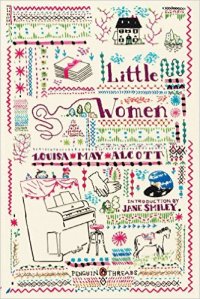
little-women-alcott-penguin-threads-61xwdwbgael-_sx331_bo1204203200_1.The witty  Louisa May Alcott, one of my favorite writers, preferred  “blood-and-thunder” stories to her popular books for girls, which she wrote to pay the bills.  Sure, there are morals in every chapter, which I loved as a girl, by the way, but Alcott is a feminist with strong heroines and subversive subtexts.  Her characters must master boring domestic skills, because they are poor and don’t have a house full of servants, but it is not their raison d’être.  Jo in Little Women sells blood-and-thunder stories to newspapers, and Mother and the girls are proud, but patriarchal Father, if I remember correctly, puts the kibosh on that. In a later novel, An Old-Fashioned Girl, creativity is valued:  the heroine Polly is not only an excellent, if impoverished,  musician and music teacher, but hangs out with a community of artistic women.

In Little Women, the March sisters loathe housework and cooking as much as I do. This satisfied me deeply when I was a child.   In Chapter XI, “Experiments,” they beg Marmee to let them off chores for a week of their vacation, because Meg, a governess to a rich family, and Jo, cranky Aunt March’s companion, are  tired of trying to please others and want some leisure. And yet the leisure palls, and they are almost glad when Marmee  and Hannah, the servant, declare they are taking a day off.  No problem!  They’ll do the housework.  The slangy, writerly, tomboyish Jo makes lunch, but she boils the asparagus till the tips fall off,  burns the bread, and has to crack open the lobster with a hammer.  And she must serve it to guests, Laurie and Miss Crocker, as well as her sisters.

Poor Jo would gladly have gone under the table, as one thing after another was tasted and left, while Amy giggled, Meg looked distressed, Miss Crocker pursed her lips, and Laurie talked and laughed with all his might to give a cheerful tone to the festive scene. Jo’s one strong point was the fruit, for she had sugared it well, and had a pitcher of rich cream to eat with it. Her hot cheeks cooled a trifle, and she drew a long breath as the pretty glass plates went round, and everyone looked graciously at the little rosy islands floating in a sea of cream. Miss Crocker tasted first, made a wry face, and drank some water hastily. Jo, who refused, thinking there might not be enough, for they dwindled sadly after the picking over, glanced at Laurie, but he was eating away manfully, though there was a slight pucker about his mouth and he kept his eye fixed on his plate. Amy, who was fond of delicate fare, took a heaping spoonful, choked, hid her face in her napkin, and left the table precipitately.

But she is sure of the dessert.  How can you go wrong with strawberries and cream?

Salt instead of sugar, and the cream is sour.

Later in the book, Meg, too, has a culinary disaster when her husband brings  home a guest while she is making jam that won’t set.  And then there is “An Old-Fashioned Thanksgiving,”which I wrote about here.

Clearly Alcott’s sympathies are with the undomestic!  Her characters master plain cooking and housework but only from necessity.

everybodys-fool-russo-fool_cover2. In Richard Russo’s Everybody’s Fool, a sequel to Nobody’s Fool, Ruth, the owner of Hattie’s diner, recalls her domestic dim-wittery when she got knocked up years ago and married the junk-scavenger Zack.  They lived with his horrible mother, also named Ruth, who sabotaged her attempts to learn to cook.

Eventually she had grudgingly copied out on notecards the recipes for a few of Zack’s favorite meals.  They never turned out right, though.  The recipes either left out key ingredients or were unclear about techniques or got the proportions wrong, which made Ruth look like a very slow learner indeed….Only after Ruth finally tumbled to the fact that her culinary efforts were being sabotaged, and compared the notecard recipes with others in cookbooks she’d checked out from the library, did she begin to improve.

I’m glad Ruthless Mother, as she is nicknamed, is not my mother-in-law.

3. In the memoir, The Gastronomical Me, MFK Fisher describes simple French food which she made accessible to Americans in her food writing.  But she started out a simple California girl who liked to cook. One night, when her parents were out,  Mary Frances decided to cook supper for herself and her sister.  She chose  a recipe for something called “Hindu eggs,” and quadrupled the amount of curry powder in the cream sauce.  The girls ate as much of it as they could, pretending to be nonchalant about the spice.  But it did not end well.

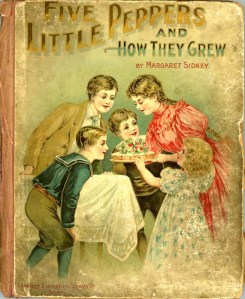
gastronomical me mfk fisher 3040324.In Margaret Sidney’s charming classic, Five Little Peppers and How They Grew, Polly Pepper is determined to bake a birthday cake for Ma.  Naturally, there are difficulties: they don’t have the ingredients,  their nearly-deaf next-door neighbor can’t find the recipe she has in mind, and there is a hole in the stove that makes the oven temperature uncertain.  But eventually the cake comes out of the oven.

Oh dear!  of all the things in the world!  The beautiful cake over which so many hopes had been formed, that was tot have given so much happiness on the morrow to the dear mother, presented a forlorn appearance as it stood there in anything but holiday attire.  It was quite black on the top, in the center of which was a depressing little dump, as if to say, “My feelings wouldn’t allow me to rise to the occasion!”

But a posy in the middle hides the hollow in the cake, and Ma is delighted by their efforts.
five-little-peppers-sidney-tumblr_mk3plvz6yf1rrnekqo1_1280

5.  In Anne Tyler’s Vinegar Girl, the 28-year-old heroine, Kate, keeps house for her scientist father and younger sister Bunny, and makes the same meal every night.  When her father’s Russian genius assistant, Pyoty,  decides to court Kate, he, too, must eat her cooking.

She turned back to the stove. She was reheating the concoction they had for supper every night. Meat mash, they called it, but it was mainly dried beans and green vegetables and potatoes, which she mixed with a small amount of stewed beef every Saturday afternoon and puréed into a grayish sort of paste to be served throughout the week. Her father was the one who had invented it. He couldn’t understand why everybody didn’t follow the same system; it provided all the requisite nutrients and saved so much time and decision-making.

Oh, Kate!

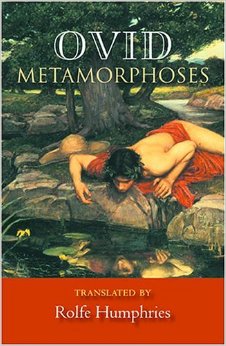
Tyler vinegar girl ows_146611602236206. Cover your eyes!  This one is gory.  In Ovid’s epic poem, Metamorphoses, one hideous bad dinner party is memorable.  King Tereus marries Procne, daughter of Pandius, who begs him to sail back to her home country and bring her sister, Philomela,  for a visit.  Instead, Tereus rapes Philomela, cuts out her tongue so she can’t talk, and leaves her in the woods.  When Philomela weaves a tapestry of the story and finds her way to her sister, they plot revenge.  They kill Procne’s son, Itys, and serve him up as a “ritual” meat dish to Tereus.  Ugh!

If you can think of any other bad cookery stories in literature, let me know!
Ovid Metamorphoses 51QQ3C0NSYL._SY344_BO1,204,203,200_

“Parenthood,” Cats & Trees

It was supposed to look like this!

It was supposed to look like this!

I’m not  a holiday kind of gal.   Christmas is for families, not couples.

But I’ve been sick this week, with the cold from hell.  Really.  I was so wrecked from cold pills and Nyquil that I binge-watched Season 4 of Parenthood, a high-end prime time soap opera (2010-2015).  I love the characters, three generations of the Braverman family, who are beautiful, talented, dysfunctional, and occasionally very annoying.  Sarah (Lauren Graham from The Gilmore Girls) wrecked her relationship with her fiance, Mark (Jason Ritter), the most adorable English teacher on the planet, to accompany her moody photographer boss, Hank (Ray Romano), to L.A. for a “work” weekend.  (Sarah, you will never find anyone like Mark again!)  Julia, a corporate lawyer on the partner track, made a huge mistake at work and surprisingly resigned to stay home with her adopted son, Victor.  And my favorite character on the show, Christina (Monica Parter), had breast cancer.  Poor Christina!  She’s the rock of her family.  The season was very dramatic.

Christmas is a big deal for the Bravermans. Nobody acts out on Christmas.  It’s TV. And I loved Julia’s Christmas decorations.

And so I decided to decorate. My options were limited, since I was sick. I ordered two artificial trees, a  6-ft.-tall tree for the living room and a small tabletop tree for the study.   I mean I’m not going to get real trees, right?  I’m not going to plant them afterwards.

My plan? I would assemble the trees while my husband was at work and surprise him.

Want to know how this went for me?

First, the 6-ft. tree came without an instruction booklet.  I was told there were no spare instruction booklets and offered a  discount.  I assembled it by myself–sort of.  You have to “fluff out” the branches.  Ouch.  They’re scratchy.  And the bolts didn’t fit in the tree stand.  It was wobbly.  It looked okay once decorated.

And, yup, after I left the room, the cats knocked it over.  Now it’s leaning against the bookcase in the study.  Rickety, but Christmasy.

The tabletop tree is fine!  A nice steady stand, thank God.  Since it can stand up alone, it’s in the living room.  But the cats are hilarious.  Unfortunately they will not leave the decorations alone.

Forget the ball-shaped ornaments.  The two youngest cats jumped up and down athletically, determined to rip them off the tree.  The balls are now cat toys.

The youngest cat spent an hour pawing tiny gold bells and miniature fake packages off the tree.

So they’re now officially cat toys.  Every morning I get up, put the decorations back, and vacuum.  But I don’t mind.  The cats are so happy!  And the winter is so boring for them.

Pushkin’s Eugene Onegin, Why I Wish I Knew Russian, & a Pushkin Giveway

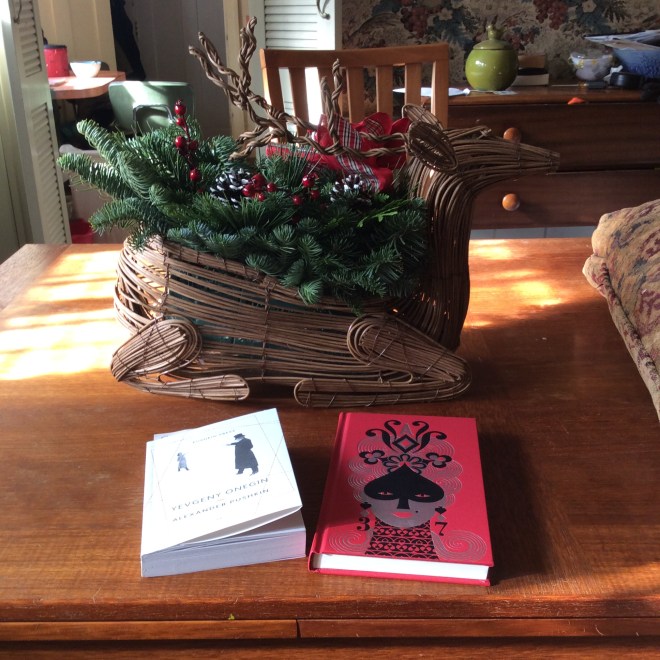
Pushkin under the wicker reindeer!

Pushkin’s Yevgeny Onegin and a Folio Society “Queen of Spades” notebook, with reindeer.

I love Pushkin.

Who doesn’t?

The Russians consider him their best writer.

After a a few days of barely looking up from Pushkin’s  Collected Stories (and you must read “The Queen of Spades,” a ghost story about a gambling grandmother), I decided to reread Eugene Onegin.

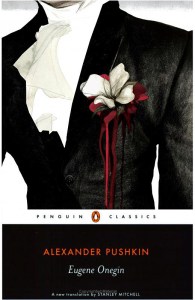
I first read Pushkin’s lively novel in verse in college, as did my husband. We lost our identical copies years ago, and have no idea what translation it was.  And then two years ago I got a hankering to reread it.  I picked up a new Penguin and enjoyed Stanley Mitchell’s elegant, charming translation of Eugene Onegin.

So why did I need Anthony Briggs’ new translation, Yevgeny Onegin?  Because Nicholas Lezard at The Guardian listed it as one of his favorite books of the year.

Eugene Onegin Pushkin 56077-largeAlthough Briggs’ and Mitchell’s approaches to verse and word choice are different, both translations are readable. I wrote here in January 2015 about Mitchell’s translation:

In this brilliant novel in verse, Pushkin tells the story of Eugene Onegin, a rakish Byronic hero who, bored by carousing, wine, women, song, writing, and even books, moves from St. Petersburg to the country after inheriting an estate. He befriends a young poet, Lensky, to whom he is very devoted.   And yet he thoughtlessly wrecks their friendship by flirting at a dance with Olga, Lensky’s fiancée. The result is a duel with Lensky. (Eugene doesn’t want it, and yet somehow he doesn’t say no.) And the whole thing is complicated by Eugene”s rejection of Olga’s sister, Tataina, who writes a love letter to him.

The narrator’s voice is almost always ironic, and the poem mixes lyricism with realism. Olga soon forgets Lensky and marries someone else. Tatiana visits Euegene’s deserted house and falls in love with his library. Eugene only falls in love with Tatiana years later, after it is too late.

Briggs’ translation is intelligent, but less elegant than Mitchell’s.  That  is not, however, why I am giving it away to a lucky reader. (Leave a comment if you’d like it.)   It’s because  I DON’T LIKE THE DESIGN. The Pushkin Press book is small, pretty, and chic, but has smaller print than the Penguin and is somehow less comfortable to hold.   I had this same problem with the Dorothy Project’s chic edition of Barbara Comyns’ Who Was Dead and Who Was Changed, another  little square book.  

Briggs' translation.

Briggs’ translation.

What I like most about  the Briggs edition is the scholarly introduction, which explains the history of Pushkin’s  invention of the Russian literary  language and his prosody, inspired by Shakespeare.

Briggs writes,

The writer’s greatest achievement, apart from the literary quality of his work as a whole, in which the disciplines of classicism mesh with new freedoms released in the age of Romanticism, is nothing less than to have reformed the national language.  This bold claim is no exaggeration.  As he grew up, the young Pushkin was presented with at least three different linguistic forces existing as separate entities in his large country .  Posh people spoke French, ignoring or despising ordinary Russian, though Pushkin heard a good deal of this tongue from the local lads and from his dear old nanny…(who makes an endearing guest appearance as Tatiana’s nurse in the third chapter of Yevgeny Onegin).  In addition, he was continually subjected in church and at school to the rich sonorities of Old Church Slavonic.  By some miracle, almost without thinking about it, he created modern Russian simply by using it, choosing at will between elegant Gallicisms, vernacular Russian and his nation’s equivalent of the King James Bible and Book of Common Prayer, with a sensitivity to sound, style and meeting that gives him an elevated place in the annals of linguistic reform.

Long ago, the beloved professor of my Russian lit in translation class examined the themes of maturity and metamorphosis in Eugene Onegin. He also lectured on the relationship between the narrator of Eugene Onegin and the reader, the narrator and Eugene, and the narrator and the work of literature.

If only I had taken better notes!

WHY I WISH I COULD LEARN RUSSIAN.

Why do Russian translations read so well?  I do wish I could learn Russian.  Translation (literally a “carrying across,” from the Latin transfero) is a precarious art:  it  captures sense but not sound, and only crudely suggests word arrangement, figures of speech and meter.

For years I devoted myself to classics and read little in translation.  Why?  Snobbishness and foolishness.  One of my best and most snobbish classics professors (and “classics professor” implies excellence and snobbery) used to tell us, ” You can’t do serious work in translation.”  I understand what he means–Mary McCarthy in The Groves of Academe also laughs at a student who writes her thesis on Broch’s The Death of Virgil, without being able to read Virgil –but where can we all find the time to be linguists?  I was committed  in grad school to eight to ten hours a day of ancient languages, studying for comps, and teaching  elementary Latin and a Virgil’s Aeneid independent study.   Learn Russian?  Forget it!

Fewer people in the U.S.  have opportunities to study foreign languages today.  The culture is now very business-oriented, and many colleges and universities are slashing humanities courses.  The state universities in the area are hanging on  by a thread to their language departments.   I do not expect this to get better under Trump’s rule.

Where I live?  All language departments eliminated at the local “private” university!

A Giveaway of Guy Gavriel Kay’s River of Stars

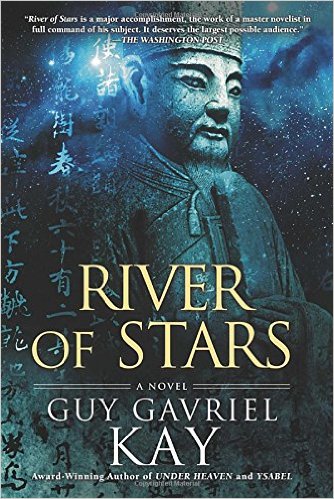
river-of-stars-kay-51b0gwircsl-_sx332_bo1204203200_You don’t have to be an SF/fantasy fan to enjoy Guy Gavriel Kay’s beautifully-written River of Stars, an engrossing novel of  war, politics, poetry, and love, set in a fictional  country inspired by China in the Northern Song Dynasty. 

I began to read Kay’s gorgeous fantasy novels after I read Washington Post critic Michael Dirda’s review of Under Heaven, the first book in this  series.  Dirda wrote,

Guy Gavriel Kay’s “Under Heaven” isn’t quite historical fiction, nor is it quite fantasy. It’s set in a slightly reimagined Tang dynasty China, sometimes seems reminiscent of films like “Crouching Tiger, Hidden Dragon” and depicts the unimaginable consequences of a single generous gift. Most important of all, it is the novel you’ll want for your summer vacation.

The second novel, River of Stars, set four centuries later,  is equally intriguing but heartbreakingly sad. I only hope there will be a sequel. My only real criticism?   Like George R. R. Martin’s  Game of Thrones, Kay’s novel has a huge cast of characters and  switches constantly from one character’s narrative to another. I found this annoying, because just as I’m getting used to one character he shifts.  But  obviously fans of Martin don’t mind this kind of thing, and  reviewers of River of Stars were very enthusiastic.

Anyway, here  is a quote from Laura Miller’s review at Salon:

Kay’s exquisite Asian-inspired epic fantasy offers a fresh twist on intrigue and adventure…  Here you’ll find all the scheming and skulduggery that give Game of Thrones its zest, refined to the subltlest of arts.

Leave a comment if you want the  book!  Anyone in the U.S. or Canada is eligible, but, alas, I can’t afford the postage elsewhere.  (Nor can you!)

Rachel Ferguson’s Stocking Stuffers: A Doll’s Grand Piano & a Play about Seneca

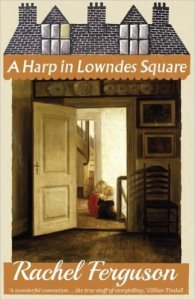
harp-in-lowndes-square-ferguson-515nrd9tpyl-_sx322_bo1204203200_I love Rachel Ferguson’s brilliant novel, The Harp in Lowndes Square, which I wrote about briefly yesterday.

Her sharp observations and witty prose are irresistible.  And I love the captivating voice of the narrator, Vere.  She has to muster all her humor and stoicism to cope with Lady Vallant, the evil grandmother from hell.

Today I’m writing about Vere’s creative ideas for Christmas stocking stuffers. I  wonder if I could find a doll’s tin grand piano on the internet, and I wish I were clever enough to write an original play about Seneca, or any Roman for that matter.

Last summer I reread Seneca’s letters, in preparation for reading Peter Stothard’s excellent book, The Senecans:  Four Men and Margaret Thatcher.  I even dusted off my old Roman Letters notes.  So when Vere gives her  actor friend, Cosmo Furnival, a satiric two-minute tragedy  she has written about Seneca, I could not but laugh.

Here is her complete list of stocking stuffers:

I had filled stockings for them both; in Enid’s, a mass of tiny sparkling silliments including a celluloid goldfish in a talc ball and a doll’s tin grand piano; in Cosmo’s, a property monocle of window glass to which I had attached six yards of watered silk ribbon, and a tiny booklet I had made and written, containing a tragedy in verse called Seneca, which consisted largely of the direction, Another and more expensive part of the Forum: Enter Cosmo Furnival as Seneca, and whose concluding lines ran:

Bleed, wrist! and free my spirit from its chains,
Rome take my blood that gushes from these veins.

And you might as well add Ferguson ‘s A Harp in Lowndes Square to your gift list.

I hope you’re all inspired!

The Unpaid Booksellers of Cyberspace

taintor-looking-for-trouble-000_01354looking-for-trouble-posters-500x500

The publishing world, except for journalism, is closed to most aspiring writers and editors. Bbibliophiles who long to wield a blue pencil on manuscripts of masterpieces at New York publishers have a slim chance of getting a job, unless they went to Ivy League schools or Seven Sisters colleges. Even slimmer are their chances of publishing that novel in a drawer. I hear it is slightly easier to break into genre fiction: for instance, SF embraces outsiders, much in the way journalism does.

And yet there is so much talent out there. That’s why the internet is a blessing. Creative people wear fingerless gloves in attics and write novels or poetry, but now they also have blogs and Facebook pages.

I love the concept of blogging, though I will be the first to admit we bloggers are control freaks.  We write what we like, and damn the torpedoes full speed ahead! Nobody can tell us what to say.  We’re garage bands.  Trolls try to interfere:  are they secret CIA agents????   Another way of looking at blogging is, “Power to the people, smash the state,” as we used to chant at protests, and though I don’t know quite what I meant , I do believe people should have a voice.  Audiences at blogs tend to be small, but people do find their way to read them. I don’t quite have the technical part of cyberpublishing down:   As  I have learned from deleting a post at my subversive book journal, it has already gone out to a few hundred subscribers, even if it no longer appears at the site, so my cyberspace publishing is scatty, with bits here and there in cyberspace, appearing and disappearing, like Billy Pilgrim in Vonnegut’s Slaughterhouse Five.

Anyway, we are the unpaid booksellers of cyberspace.   So who minds a few glitches?

And I have  some very good news about a blogger who has bridged the gap between bloggers, booksellers, and publishers in cyberspace:  Scott, the author of the Furrowed Middlebrow blog, has ventured into publishing.  He now has his own imprint at Dean Street Publishing, and he has reissued some remarkable interwar fiction, mostly by women.

harp-in-lowndes-square-ferguson-515nrd9tpyl-_sx322_bo1204203200_I am a great fan of Rachel Ferguson, so I was very interested to read a TLS review of  three of her novels reissued by Furrowed Middlebrow.  I have almost finished Ferguson’s A Harp in Lowndes Square (1936), and it is not only the wittiest book I’ve read the year, but one of the best books I’ve ever read. (I know I said the same about Barbara Comyns’ Our Spoons Came from Woolworths, and it is true of both in different ways.)   You may know Ferguson as the author of The Brontes Went to Woolworths (Bloomsbury Reader) and Alas, Poor Lady (Persephone). Her voice is sharp, witty, mercilessly observant, and whimsically post-modern.

In A Harp in Lowndes Square, the narrator, Vere, is not only witty and brilliant, one of three children in an unconventional single-parent family,  but the twin of James, with whom she shares a psychic bond.  They see and hear ghosts of Henry VIII, their family, and others. Vere breezily tells the often comical story of the adventures of her dysfunctional family , and are very close to their mother and older sister, Lalage. But they are disturbed by their mother’s withdrawal and obvious dread of their grandmother, Lady Vallant, on rare visits to Lowndes Square.  As an adult, Vere investigates the tragic family history.

I’ll post about this stunning book in detail when I have time, but meanwhile here os a charming passage about Vere’s schooldays to show off the charm and style.

We were happy there and never overworked, and my memory of it will always be bound up with lilac, may trees, laburnum, syringa and the plays of Euripides in an eternal warmth and impossible summer. The headmistress, a gentle, uncertificated woman with a flexible nose and a bun, had a passion for school plays, and selected the Greek drama as being the most respectable, whereby we spent a large portion of nearly every term declaiming about curious and bloody vengeances, morbid elopements with a wordy fellow called Death, and singularly uncivil passages between sons and aged fathers.

By the way, if you have Kindle Unlimited, you can read Ferguson’s books for free.  (Well, it’s $10 a month or something, but you can read as many as you like with the Unlimited label during that month.)  I will definitely buy a hard copy of A Harp in Lowndes Square., because I love it,  but an e-book also has its virtues.

We have colds at our house, and I wish you a Happy Weekend.  No, I do not think you can catch my cold by reading my blog!  That’s a troll’s wish!