Tessa Hadley’s The Past

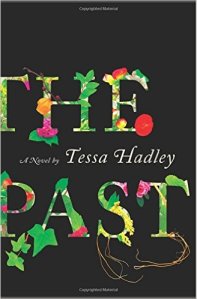
Tessa Hadley the past 51n7rWGvpYL._SX326_BO1,204,203,200_

I have always read compusively in the English canon.  As a girl I indiscriminately read Rumer Godden, E. Nesbit, Jane Austen, Georgette Heyer, and Dickens, and unconciously read them as fantasies, so different were they from my life.   Later, I considered moving to England.  And then I discovered the novels of Margaret Drabble, whose characters, especially Rose in The Needle’s Eye, an heiress who chooses to live in a rundown house in a crumbling London neighborhood, convinced me I was  living an English life in the U.S. anyway (except the heiress part).

A few years ago, I discovered the writer Tessa Hadley.  Although she is not as polished as Drabble, she is continuing  the tradition of Drabble’s intelligent novels about the vicissitudes of  middle-class women’s lives.  Hadley’s writing is lyrical yet slightly flat, and, like Drabble, she seamlessly interweaves English life, history, literature, and the changing culture.  Reading her new novel, The Past, is a transcendent experience: every sentence is exquisitely crafted, and every character brilliantly alive. The book has a tripartite structure:  “The Present,” “The Past,” and “The Present.”
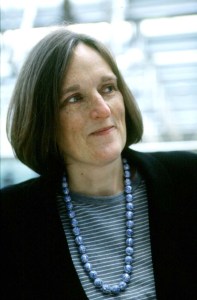
Tessa Hadley

Tessa Hadley

In the first and last sections, called “The Present,” four adult siblings spend a three-week vacation together in the dilapidated, moldering rectory where their mother grew up and their grandparents lived for decades.  They must decide whether to keep or sell this summer cottage.  The characters are irritating as they obsess and bicker.

Fortunately this is interrupted by the powerful middle section, “The Past,” which elucidates our understanding of their entwined yet separate views of the past, and makes this a luminous novel.

In “The Present,  two of the siblings are content with their holidays; the others are deeply bored or confront their unhappiness. Harriet, the oldest, a former radical, advises asylum seekers and has an unsatisfying personal life; Roland, a popular philosopher, pays little attention to his sisters because he has a new wife, Pilar, a beautiful lawyer from Argentina; Alice, a former actress, is the most imaginative and connected to their past; and Fran, a math teacher with two unruly children, is furious at her husband, Jeff, who is away with his band. Alice has also invited an old boyfriend’s son, Kasim, who is bored in college, and he falls for Molly, Roland’s teenage daughter by an earlier wife.

Alice, the middle sister, is the central character, a kind of actressy Antigone who refuses to bury the culture of the past.   It is she who loves the moldering country rectory uncritically, though it needs a new roof and many other repairs.  She is the most nostalgic character, and recaptures the past by rereading their mother’s and their own children’s books–she starts with E. Nesbit’s  The Wouldbegoods–and their grandmother’s letters. But, typically, she arrives without her key, and begins the visit by looking in the windows.

From the beginning, the siblings squabble about what the past means.  Alice holds forth “in one of her diatribes against modern life”  that modern objects are not beautiful and have no meaning.  Roland is “wary of [her] evaluative judgements,” while Harriet dismisses her romanticism.  Fran also gangs up against her.

–It’s a bit late for peasants carving bowls, Alice, Fran said.–I don’t think you’re going to get that particular genie back into its bottle.

–Not just peasants.  It’s the way that people lived more slowly, and kept the same things all their lives, and took care of them.  Our whole relationship to the things we owned was different.  I hate how we throw everything away now.

Alice was more of an actress in her private life, Roland thought, than she ever was in the years when she had tried to be one on the stage.

The children also play a complicated part in the story.  There is danger in the beautiful woods for all four of them, from the youngest to Kasim.   While Kasim sleeps outdoors, Fran’s young children, Ivy and Arthur, wander into a deserted cottage; they  find porn magazines and a dead dog.  Horrified, they recognize the dog as Mitzi, a neighbor’s dog.  They tell no one, and Ivy revisits the scene, then brings back Arthur, where they play a complicated game.  They are both upset by the death of Mitzi, and yet tell no one.

Why all the dead dog scenes?  Dogs in literature so often meet a terrible end, have you noticed?  And the meaning of the dead dog is…  well, I never figure that out. MIt’s a bit Gothic.

But all is forgiven after reading “The Past,” the illuminating story of Jill Fellowes, their mother, who,  in 1968, leaves her adulterous journalist husband  and takes her three children to her parent’s house, hoping to start a new life there.  She is sweaty, earthy, and sexy, and candidly admits that she and the children stink after a long ride on the train and the people who drove them from the station will have to air out their car.  Jill loves being on her own, and looks at houses for rent, including the cottage in the woods (where the dead dog now is).    This section reads like a miniature Margaret Drabble novel.  And Jill happens to be reading a library book by Margaret Drabble.  Tragically, Jill dies of cancer.  It is “The Past” that makes the rest of the book so luminous.

According to Hadley in the acknowledgements, she has borrowed the structure from Elizabeth Bowen’s The House in Paris.  Reviewers have all discussed the influence of Chekhov’s The Three Sisters.  No mention of Drabble, but it’s here.  Hadley wrote a fascinating article for The Guardian on Drabble’s The Millstone.

An excellent read!
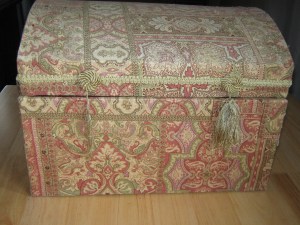
What If We Were Neatniks?, My Mother’s Treasure Chest, & the Hillary Caucus Kit

My mother's treasure chest!

My mother’s “treasure chest,” faded from the sun and detassled by cats!

This week I am “decluttering.”  After I disposed of several bags of recyclables and just plain trash, my husband began to worry about our future.

“Wouldn’t if be awful if one of us was a neatnik?” he wondered, as I cleared out cupboards to make room for his penny jars, notebooks, paperclips, reference books, and ski paraphernalia.

He needn’t worry.  I am doing this because I miss my neatnik mother.  While I put away our CDs, hung up sweatshirts, and tossed away ” cat fishing poles” from which toy mice and feathers hd been chewed off, I suddenly remembered I had her fabric-covered “treasure chest” on the sun porch.  I brought it inside, realizing it would be perfect for storing some  miscellanea.

But first I had to sort the papers inside.  There were many funeral programs and obituaries.   She also saved newspaper articles about St. Pat’s Church, destroyed in a tornado in 2006 and rebuilt on the edge of town in 2009  (too far for her to drive in her cautious eighties, alas).   She kept records of her generous donations to the church:  $20 a week.  And there was a very well-written letter from a retired priest, who had gone to Fordham.  My goodness!  If all priests were that well-educated!

There were wedding invitations and announcements of graduations.  I was very envious of a wedding invitation in the form of a booklet, with long quotes from the bride, groom, and their friends about where and how they met.

But most touching was the fact that Mom kept her “Iowans for Hillary Caucus Kit” from 2008.  And now the caucuses are coming up again!

IMG_3580

                 2008 “Iowans for Hillary Caucus Kit”

My mother loved Hillary!  She was mad about two political families:  the Clintons and the Kennedys.  Although the Clintons were less glamorous (and not Catholic!), she followed Hillary’s career with the sharp eyes trained by a bachelor’s degree in political science. She was impressed by Hillary’s record on health care, the economy, and her criticism of the War in Iraq.   For one of my birthdays Mom gave  me Hillary’s memoir, because she thought “it was important.” I will never dare to weed it!

I feel, eerily, that this Hillary kit is from my mom.  Coincidence?  Well…  At the caucuses, there  is milling and thronging,  sitting idly on bleachers or folding chairs, people arguing and switching sides (if their candidate is not viable, i.e., has too few supporters), and finally, many hours later, a  head count. County by county they are added up. The results determine the “win, show, place” positions of candidates and  the number of delegates for each candidate.

Anyway, I shall TRY to go.  Though my mother didn’t like the caucuses, either. But one vote can make a difference.  We saw that with the whole Howard Dean thing in 2004.

Here is an excerpt from a letter from Hillary in the 2008 kit.   It does make me want to caucus!

Everyone agrees the race in Iowa is close and could be determined by a handful of supporters.  If just one in three on my supporters stays at home, I will not be successful here in Iowa.  But if you and all the  other Iowa Democrats who support my candidacy participate on caucus night, we can take a giant step toward securing the Democratic nomination and winning this election….

And below is another side of the brochure in the 2008 Hillary caucus kit:

IMG_3583

See, I don’t need a current Hillary Caucus Kit!

Recyclers’ Guilt: How Do You Get Rid of Your Diaries?

"Bacchante" by Leighton

“Bacchante” by Leighton

I have always been a rumpled, indifferent housewife.  Now I have become the frenzied bacchante of decluttering.

“Hire a maid now so you can ask for help later when you need it,” my cousin suggested.   She has a maid come in once a week.  I always feel comfortable in her very clean house.

I started cleaning so I could hire a maid. Then, in theory. the maid comes in and does “deep cleaning.”

But once I started cleaning, I realized I could BE the maid. Might as well do it yourself.  Once you get started, it’s kind of fun.

Vacuuming, scrubbing the floor, cleaning the toilet:  nothing is harder than throwing out things.  Our basement is full of  junk we’ve kept because of  recyclers’ guilt.  Today I stumbled across a box of ancient vacuum cleaner attachments.  Good God, why?  I guess we were hoping the city would one day include them in their recyling program.

But mostly our mess is paper.

Sort the mail.  Neaten piles of magazines. Stick in recycling bin.   Put books back on shelves.  A big part of tidying here.

We are inundated with newspapers, catalogues, and, now, brochures from Hillary and Bernie (the caucuses are next month).  The worst paper clutter culprits are The New Yorkers.  They sit on a table in the living room for months, because my husband cannot bear to part with them. Some of them wander into the kitchen at breakfast.  I read them at breakfast myself.  He says he will sort them, but I end up holding each issue one by one in front of him until he assents.  Today I picked up the pile and dumped it in the recycling bin.  I left him three issues.   And he didn’t notice the rest were missing. He chatted about an article by Louis Menand on War and Peace. (I’d already read it online.)

But here is my biggest problem.  How do you get rid of your diaries? Open burning is against the law because of of toxic emissions into the air.  I kept a journal for fifteen years.  I wrote when I was unhappy.  And very dreary they are. I can imagine bored recyclers sitting around reading them.

While you solve my problem for me, I will share the one really amusing entry I wrote on a bike trip the summer I was  30.

8-16-??

Pedal and eat, eat and pedal.  I feel like some wacky scifi heroine welded to her  buzzy, zingy, creaky Schwinn machine.  It’s 4:00.  I’m binging on frosted molasses cookies picked up at a sleazy supermarket on a piece of highway called Bristol.

Cookie No. 4.  My husband had to ride back to the ranger’s station to tell him our site number.

Today I was extremely inattentive, a pedaling zombie. The road was boringly familiar from last week’s jaunt but my sleeping bag kept slipping off the back of the bike, DH’s brakes kept rubbing against the tire, and a million other mishaps.

Ate at Wendy’s in M,  A slow Wendy’s.  An Amish couple and a guy with a couple of tattoos who looked  like a regular civilian.

A lot of dead frogs on the road. Yuck. Squishy little varmints.

……………….,,,,,,,,,,…….,,,,,………………

I hadn’t thought of that in years.

Decluttering, Margaret Kennedy’s The Forgotten Smile, & A Giveaway

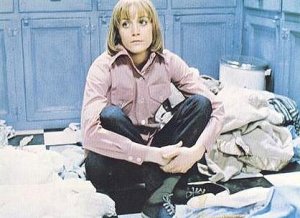
Carrie Snodgrass in "Diary of a Mad Housewife"

Carrie Snodgrass in “Diary of a Mad Housewife” is weary of decluttering.

I am not really a decluttering person.

Except now I am.

Number of bookcases:  17.  Number of boxes with books:  20.  Number of books on the floor: 100 (before this weekend).

And so, even though I have not yet read Marie Kondo’s The Life-Changing Magic of Tidying Up:  The Japanese Art of Decluttering and Organizing, I set to work.

When I declutter, I don’t mess around.  FIRST, GET RID OF THE FURNITURE.  Not all of it.   But only the cat ever liked the broken chest of drawers in the bedroom.

One of the drawers was devoted to single socks.  Yes.  A whole drawer-full.  Did I think the sock-mates would come back from the dryer and jump into the drawer?

I threw them all in the trash.  Perhaps there is a single-sock recycling center in a Third World country where all the yarn is unraveled and reknitted, but I do not know of it.

Then there was the drawer of the tiny threadbare L. L. Bean turtlenecks and t-shirts that I have kept in case I  lose weight someday.  It’s been ten years… So valete!

And the bedroom now looks spacious. We have piled the boxes neatly in the corner, and there is still a lot of room.

Then I got right down to weeding books.  My goal is to have only 17 bookcases! No books on the floor ever.  So I weeded:  I got rid of all the SF (except John Wyndham) and mysteries (except Dorothy Sayers).  I also discarded several excellent novels  I will never reread.  They are the kind of books I deem library reads, though unfortunately my library doesn’t have them.

GIVEAWAY:  If you would like my copy of Beryl Bainbridge’s Sweet William (Virago:  I wrote about it here), Rosamond Lehmann’s The Weather in the Streets (Virago; I wrote about it here),  or Margaret Kennedy’s The Forgotten Smile (Vintage:  below), write me at mirabiledictu.org@gmail.com

The forgotten smile margaret kennedy 51kakyDgaSLAll right, now on to Margaret Kennedy’s The Forgotten Smile.

I have enjoyed several books by the English novelist, Margaret Kennedy (1896 – 1967), reissued by Virago in the ’80s:  my favorite is Together and Apart, one of the most stunning novels about divorce I have ever read.

She is an intelligent middlebrow writer of domestic comedies. She is an elegant writer, though her books tend to be unevenly plotted and structured.  I recently read The Forgotten Smile,  first published in 1961 and reissued by Vintage Classics in 2014.    I bought it because of the attractive cover, always a wholesome influence on us readers!

Kennedy is a mistress of comedy. The first chapter opens  in Greece, with a humorous encounter between Selwyn Potter, a former editor, artist, and brilliant classicist, and a smug, nasty eccentric classics professor, Dr. Percival Challoner.  At first Dr. Challoner does not recognize Potter as his former student: he is one of those annoying academics who doesn’t notice people and cannot enjoy anything out of his narrow area of expertise.  He is standing in front of the sculpture of a griffin.  When he says the griffin looks familiar, Selwyn suggests he might have seen one in a contemporary art gallery. (Actually, the griffin looks just like Dr. Challoner.)

Dr. Challon congratulates himself on not knowing art.  He disapproves of art.

This was another penny for the slot and it drew from Dr. Challoner a smug assertion that he knew nothing whatever about contemporary art.  He had always taken a kind of pride in confessing total ignorance of any subject save one:  upon late ancient Greek he claimed to be an absolute authority; and this claim was, it seemed, partially based on a determination to know nothing whatever about anything else.

Very funny and believable!

Dr. Challoner is there for a reason:  he has inherited a house on a tiny Greek island, Keritha. Since he knows no modern Greek,  Selwyn acts as interpreter and accompanies him on the  boat to the island.  Once there, they discover that the island is very primitive, aside from the fact that the islanders have discovered Coca-Cola.   But the elegant house, occupied for years by two siblings, Freddie and Edith Challoner, is beautiful and huge:  it is known on the island as “Freddie’s palace.” Freddie was not only benevolent and a lover of poetry, he was also the unofficial governor of the island, who discouraged tourists and protected ancient Greek culture .  Naturally, Dr. Challoner is horrified by the islanders’ belief in the gods.  He hates magic and, frankly, mistrusts the stuff of the Greek poetry he reads and lectures on.  For him, that is just on the page.

Just as Selwyn is Dr. Challoner’s interpreter, Kate Benson, an Englishwoman, becomes their interpreter of the island culture.  The reserved Kate left her family in England to spend time with the Challoners:  she took care of Edith when she was very ill with diabetes. After Freddie died, she stayed on to welcome Dr. Challoner.

It is a shock to both Kate and Selwyn to discover they have met before. (Another coincidental meeting.)  As an undergraduate, Selwyn once attended a  party at her house :  he broke a table.  Kate is not eager to know him, thinking of the big man as a bull in a china shop, but they have more in common than they think t.  Selwyn, an orphan, has always thought of her as an ideal mother .  His  wife used to ask him when the children misbehaved, “What would Mrs. Benson do?” Kate is touched by his simple liking for her.

Kate is by far the most interesting character. Does Kennedy write better about women?  Kate has temporarily left her family.  Her lawyer husband may or may not be having an affair with a rich client, Pamela, but he is certainly indifferent to Kate.

Downright infidelity in Douglas she could have forgiven and understood. Had Pamela been his mistress there might have been more sense in it.  With mere sentimental philandering she had no patience. Sherry, sighs, lingering looks, expressive silences, and flattering attention were all any man ever got from Pamela.

When  she discovers that, behind her back, her son Andrew has been scheming with Pamela to land a new job and move into her elegant home, Kate is furious.  She is determined to defy them all by leaving on a very disorganized Aegean cruise that prides itself on not having  tour guides.  While traveling, she receives some extremely cruel letters from her children and husband, harping on her shortcomings. When the boat stopsont the island of Keritha, she coincidentally runs into her childhood friends, Freddie and Edith.  They were outcasts in England, but are aristocrats on Keritha.  And the island is so lovely there that she stays.  The Challoners say there is no such thing as coincidence.  She was meant to come.

A good thing she stays, too, because almost everybody on the cruise dies.  Kennedy has a mordant sense of humor.

Much of this book does depend on coincidences, but it is not always clear what line Kennedy takes.  Death (Charon the ferryman, who charges an obol for the boat ride) technically brings both Dr. Challoner and Selwyn to the island. Dr. Challoner is the heir of his more liberal, artistic relatives, and Selwyn is mourning the death of his beautiful wife.  The story of his romance with a well-educated ex-debutante  is almost incredible both to him and to Kate.  But Kate realizes they had been blissfully happy. Too happy for the gods tolerate.  Clearly the island of Keritha operates on more than a literal level in this novel.  Free of tourists and commerce, it guides Kate and Selwyn.

Kate, too, has come back from the dead:  she was presumed dead by her family in England because her letters went astray and many died on the cruise.  . And her husband and children having divided her goods and sold her house, had no place for her.  They encouraged her to go back to the island.

This is a graceful, richly-colored novel, though the multiple story lines are not  always quite in sync.   Kennedy tries to do too much, alternating in time and space between England and Greece. We get to know quite a lot about Kate’s horrible family, who take her for granted and consider her a bored housewife, and  Freddy and Edith Challoner, with their gift of living in the present.  Then there is the thread to the hidden Greek island. How we’d love to go to there!  But it may be in danger , because of Dr. Challoner’s fear of the gods.  He wants to bring in someone who will dig up artefacts and denounce the island’s heritage.  He’s a classicist, but one who hates Greek culture.  How strange!

I’m sure a reread would make this clearer!

It is a very good read, with parts that are above “good read “status.”

It is one of my giveaway books, so if you want it let me know.

A Short, Perfect Novel: Beryl Bainbridge’s Sweet William

sweet william bainbridge 9780807608166-uk-300

I am always on the lookout for a short, perfect book.  Books have grown 25% longer since 1999, according to a study by James Finlayson of Vervesearch. Yet some of the best books of the twentieth and twenty-first century are short, beautifully-crafted, and brilliant.

I have recently been reading Beryl Bainbridge, known for her brief, strange, graceful novels. She was shortlisted five times for the Booker Prize.  A  posthumous Man Booker Best of Beryl Prize was awarded to her novel, Master Georgie, in 2011.

I have always been a fan of English women’s novels, but must admit I did not care for Bainbridge when I first came upon her work in the ’80s.   I considered her 1984 novel, Watson’s Apology,  a dud:  the story of a Victorian clergyman’s murder of his wife, based on an actual case, had no appeal for me.

But try, try again.  I have pulled some of her other books off the shelves.

I recently very much enjoyed and admired her wicked, witty 1975 novel, Sweet William, notable for its pared-down prose and spiky realism.   Bainbridge’s edgy brevity perfectly matches the desperate comedy of the passive heroine’s life.  In the opening chapter, we meet Ann at the airport, saying good-bye to her fiance, who has accepted a job at an American university. Ann is upset.

Suddenly the girl’s face, reflected in the chrome surface of the tobacco machine, changed expression. Clownishly, her mouth turned down at the corners.

“You should have taken me with you,” she said. “You should have done.”

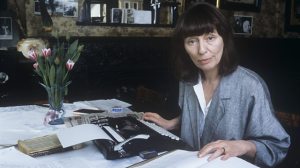
Beryl Bainbridge

      Beryl Bainbridge

He says he’ll send for her “very soon.”  Ann mopes.  She lives in Hampstead and has a job at the BBC, but she is not very clever. She is never in charge.  She capitulates to the will of others.

Ann’s life alone in London is trying.   Her visiting mother, furious that Ann had sex with Gerald in the flat while she was there,  cuts the visit short and storms out of the flat.   Her landlady, a potter, Mrs. Kershaw, comforts Ann, but also takes advantage of her: she asks Ann to go in her place to a Harvest Festival religious service at her children’s school the next day. Ann’s reasons for assent are comically interwoven with a recital of her own plans to clean the house.  I love the domestic comedy.

Ann couldn’t refuse her.  Mrs. Kershaw never said a word about people coming to stay–not like some landladies–and she must have known that sometimes Gerald had stayed all night.  It was a nuisance, though, having to put off all the jobs she’d intended doing:  there were the sheets to collect from the laundry, the smears of soap and dried-up toothpaste to be removed from the glass shelf in the bathroom, the cooker to clean–Ann had meant to take the whole thing apart and scrub round the gas jets.

Sweet william bainbridge virago isbn9781405513692-1x2aThe next day, at the Harvest Festival service,  William, an attractive Scottish playwright, hits on her.   At first she thinks he has mistaken her for someone else.  No, he just loves women.   And he insists on sending a TV to her flat so she can watch him interviewed on a talk show.  They fall passionately in love.   Ann knows he has an ex-wife and children, whom he frequently visits. What she doesn’t know is that he is remarried, and cheating on his wife and Ann with other women, including her cousin Pamela.

Why doesn’t she get rid of William?  Poor Ann.  She gets pregnant. She moves into a flat with him.   She is mesmerized by him, even to the point of agreeing to a home birth.  But when he continues to cheat, she moves back to Mrs. Kershaw’s flat.

In the introduction to the Virago edition, Alex Clark quotes a Paris Review interview with Bainbridge:

When I started writing in the 1960s, wasn’t it the time when women were starting to write about girls having abortions and single mothers living in Hampstead and having a dreadful time?  Well, I’m not going to do that; I’m not bothering with all that rubbish.

But Clark comments,

She did bother with ‘all that rubbish’, but only sort of:  Sweet William’s Ann, who has fled the claustrophobic family home in Brighton to begin a career at the BBC, does live in Hampstead; her cousin, Pamela, does have an abortion; Ann herself does become a single mother.

I admit, I do like a good women’s “Hampstead novel.” But I prefer the intelligent, likable characters  in my favorite ’60s and ’70s novels by Margaret Drabble and Lynn Reid Banks.  We know the Anns exist, but we become impatient with them. And that makes it harder to like Sweet William.

Who’s the Ship? The iPad and I

the ship who sang anne mccaffrey 9780345018816-us-300A few years ago, after Anne Mcaffrey died, I resolved to reread my favorite of her SF novels, The Ship Who Sang.  Alas, I couldn’t find my copy. But, as I recall, the heroine, Helva, a human being born with severe physical disabilities, is implanted in a spaceship as its brain. She chooses  a human partner to live and work with:  the human provides the brawn.  Sadly, they have different life spans:  she outlives her partners and is “widowed” more than once.

I love SF, and any excuse to read it will do. But I also thought  it might illuminate the complexity of our modern communion with computers.

I love my new iPad, but today, after several hours reading on it, I developed a headache.  The screen was too bright:  I haven’t quite got the hang of adjusting it.  And once again I thought of The Ship Who Sang. I wondered about my relationship with my tablet.  Which of us is the brain and which the brawn?  Which of us is Helva?

It’s hard to say.

Well, I’m not goofing around with Siri or any complicated smart apps, so I consider myself the brain and the tablet the brawn.   I confess I am using it as an e-reader, because it provides e-book apps for the Kindle, Nook, Kobo, and iBooks.  Between us, my husband and I have had six e-readers of various persuasions over the years (they don’t last forever).   On my iPad,  I have access to ALL my different  e-libraries except the Sony Reader.  It’s great!

It is ironic that I am getting serious about e-books when others are going back to the book, or so the newspaper articles say.  But, honestly, I have so many books that it verges on clutter.  I never thought I’d say that. I don’t mind all the bookcases, but I don’t even know what we have in the boxes.  I give away books the minute I finish them these days.

Then there are the local bookstore problems.  I mentioned last week that I could not find a copy of  Tessa Hadley’s The Past at an indie.  What I didn’t tell you was that I couldn’t find it at our local B&N, either.

Sigh.

So I bought the e-book.

Hadley’s The Past is very enjoyable.  Four siblings spend three weeks in the old house where they grew up, which is disintegrating yet redolent of enchantment and fairy tales.  The middle sister, Alice, 46, adores the cottage and  loves her grandmother’s letters, the beautiful china, and especially their childhood books.  She picks up a copy of E. Nesbit’s The Wouldbegoods and is transported to another time.

And here’s where I know I’m letting down the side by reading e-books.

The very weight of the book in her hands, and the thick good paper of the pages as she turned them, and the illustrations with the boys in their knickerbockers and the girls in pinafores, seemed to bring back other times–the time when she had first read this, and behind that the time when such children might have existed.

Heavens, E. Nesbit was my favorite writer when I was growing up.  I even know those illustrations by H. R. Millar!

So what am I doing with these e-books?

Well, it’s modern life.  What can I say?

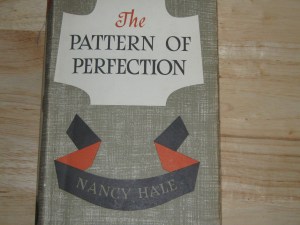
Nancy Hale’s The Pattern of Perfection

IMG_3576Nancy Hale‘s work is out-of-print, but she is a great American writer.

Some of her books are masterpieces.   A descendant of Harriet Beecher Stowe, she was a journalist, novelist, and memoirist. Eighty of her stories were published in The New Yorker.  I am a fan of her comical novel, Dear Beast, the story of a Southern woman who writes an anonymous novel about her small town, and her stunning memoirs, A New England Girlhood and A Life in the Studio.  In 2012, a collection of seven of her short stories, along with critical essays on her work, was published,  Nancy Hale: On the Life & Work of a Lost American Master.

I recently read The Pattern of Perfection, a collection of 13 stories.  I have 10 sticky notes marking the pages of my copy, not for criticism but because the passages are delightful.

In my favorite story, “The King of Fancy’s Daughter,” the heroine, Isabel Congdon, takes out the trash and catches her husband in the driveway embracing the “bosomy, perfumed Mrs. Clarity, the baby sitter.”  She puts the two children in the car and drives hundreds of miles to her parents’ house.  On the way, she keeps going over and over her conversation with her husband.   When she said, “I suppose you’ve been having affairs with everyone in the neighborhood while I’ve been totally unaware of anything,” he denid it.  But he asks coldly if they always have to talk baby talk.  She is shattered, because she had felt their little family was united against the world.

Her well-bred parents behave as though there’s nothing unusual about Isabel’s visit.  They talk about their collections of antiques and books.  Mr. Hooper has begun collecting science fiction.

“Space travel,” Mr. Hooper repeated, laying down his knife with a gratified air.  “Those chaps are doing extraordinary things.  Bradbury.  Asimov. Leinster.  I’ve made rather a study of science fiction in recent months.  I fancy I own everything in the field worth reading–a very sound investment in firsts,” he added modestly.

Isabel discovers that her parents’ marriage is imperfect, too: they have separate bedrooms.  But she cannot get rid of the image of her husband and Mrs. Clarity.  Nothing is decided.

In the brilliant story, “In a Penthouse,” Bernadine has a vague undiagnosed illness that prevents her leaving their New York penthouse to follow her husband to Michigan.  The dialogue in this story is priceless.  “Oh, hon,” she cried.  “Don’t I just wish I could?  But I just don’t dare go that far.  Doctor Lewis says I should continue to play it cautious and conservative.”  Doctor Lewis does not believe her husband loves her, but Bernadine is rightfully secure.  By the time Doctor Lewis asks her out, Bernadine has figured out she wants to fly away.

In “A Summer’s Long Dream,” Penelope and her mother and aunt spend a month in the late Miss Carrie Lennox’s summer cottage, The Ledges.  Penelope spends most of her time cooking and administering medication to the old people. At a garden party, the old people bloom, but poor Penelope becomes involved in an impossibly complicated explanation of how they come to be staying in the house when Miss Carrie Lennox is dead.

These stories are great fun, and the best are great.

A Walk on the Wild Side

The Bookworm in Omaha is one of our favorites.

The Bookworm in Omaha is one of our favorites.

I shop at Amazon and Barnes and Noble, but I would like to be a cool person who shops at independent bookstores.  For years we’ve been told indies are better.  Writers prefer indies to corporations.  All right! Go, writers!  Obama shops at Politics and Prose.  Hurrah, I voted for him twice!

But take a walk on the wild side in the Midwest.  You won’t find what you’re looking for at indies (if they exist at all) in:

a) Cedar Rapids, Iowa (where you can smell  the Quaker Oats factory when the wind is right )

b) Cedar Falls (a university town)

c) Des Moines (the capital of Iowa, sometimes called “Dead” Moines)

e) Mankato, Minnesota (Maud Hart Lovelace’s hometown, known as Deep Valley in the Betsy-Tacy books)

I took a walk today.  My brain told me I would be able to buy Tessa Hadley’s The Past at the local indie. Everybody is reading Hadley, right? She was interviewed in the “By the Book” feature in The New York Times.

So I took a brisk walk and then burst into the bookstore, in the space that used to be Hair Ph.D.

AND THEY DID NOT HAVE IT.  Nor did they have Elizabeth Strout’s new book, My Name Is Lucy Barton.  So I said I was browsing.  I finally bought a paperback.  I’ll read it eventually, I suppose.  But the sad truth is that I should have gone to  Amazon or B&N.

God, I miss bookstores!

I could make a list of dozens of great bookstores that went under in the ’90s.  (And I miss Borders.)

Sorry, I have to wait till I go to Omaha or Iowa City, London or New York,  Washington or San Franciso, to support independent bookstores.  I tried!

The Collected Stories of Jean Stafford

jean stafford the collected stories 51VK74FJJ8L._SX331_BO1,204,203,200_

I love The New Yorker.  I always look forward to the fiction.  Stars rise and fall. I wonder whether even  publication in The New Yorker can ensure a writer’s future.

Jean Stafford is a neglected New Yorker writer.  Her books are still in print, but her name is seldom mentioned.  One of her stories, “The Interior Castle,”  was anthologized in The Best American Short Stories of the Century, edited by John Updike, but she is missing from the new anthology, 100 Years of the Best American Short Stories, edited by Lorrie Moore.  Stafford died in 1979, so  perhaps we have to skip back a few generations to find fans of Stafford.

The Collected Stories of Jean Stafford won the Pulitzer in 1970.  I love her work. I used to drink coffee and read her stories  as I sat on the bank of the Iowa River behind my (now defunct) high school.

IMG_3577

Scotch tape is the answer: the pages are loose!

Stafford’s stories are Jamesian, powerful, comical.  How can such a brilliant writer be so little-known?

The masterly stories in her Pulitzer-winning collection were published between 1944 and 1969.  It was the era of the polymath, of  a love of arcane multi-syllabic words.  These perfectly-wrought stories, set in Europe, New England, and the West, are  both subtle and shocking; her descriptions and dialogue are precise and pellucid. Does she go too far for our pseudo-sensitive smiley-face sensibilities?  Are her  New England spinsters too rich, mean,  and snobbish for the modern reader?  Is the shocking culture clash between Americans and Germans after Nuremberg  too graphic? (It is a horrifying story.) Are the pretentious teachers with new master’s degrees too condescending?  (Yes, they are, but that’s so realistic!)  Is the obese philology student in Heidelberg too monstrous:  she eats whole cakes,  uses a sucker as a bookmark, and ominously talks about a dead thin twin.  ( I’m fat, and not at all offended!)  What about the cruise captain who exaggerates his racial prejudice (or does he?) to tease a liberal young woman described as “a natural victim”?  (At the end,  she is far from a victim.)  These characters are vividly portrayed, realistic,  and are sometimes as obnoxious as people we know in “real life.”

Rereading Stafford’s stories is a delight. In the Jamesian story “Life Is No Abyss,” Lily, a young woman whose pilot parents ironically died in a plane crash, is scandalized by a visit to 80-year-old Cousin Isobel in the poorhouse.  Lily has vivid memories of Isobel and her ancient father, the Judge, entertaining the whole clan in their rich, elegant North Shore summer house.  Yhe elderly Cousin Will, described as “the worst and most ingratiating investor who had ever lived,” has ruined Cousin Isobel through bad invesments, and she insists on living in the poorhouse to get revenge.  She refuses to move into the apartment on Will’s renovated third floor, or the even more opulent apartment in rich Cousin Augusta’s house.

Cousin Isobel is hilariously, if nastily, eloquent.  She is as astute as a social worker when she desribes the conditions of the poorhouse  where she doesn’t have to live.

“The whole place is a scandal. It is a public shame.  If they would give me pen and paper–don’t ask me why they won’t, for their regulations are quite incomprehensible to my poor brain–I would write to people in high places, where I daresay the name the name Judge James Carpenter has not been forgotten.  I have never gone in for seances; I have never been taken in by the supernatural; if she telephoned me personally, I would not believe that Mary Baker Eddy was ringing up from her tomb in MOunt Auburn Cemetery.  But I swear I know that good man, the august Judge, turns in his grave when his immortal soul considers where I am.  He never liked Will Hamilton.  Small men are shifty.”  Before arthritis had shortened her, Cousin Isobel had stood six feet in military heels.

I love these stories.  My copy is starting to fall apart, though.  The cover is torn and the opening pages are loose!  I’ll have to find another copy after this reread.

My Tablet’s in the Next Room!

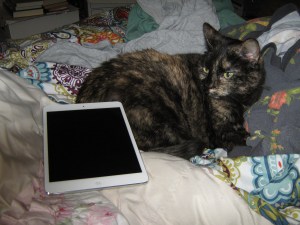
Cat with IPad!

Cat in nest of sweatshirts, with IPad!

I have no idea where I am, but my tablet might.  Call it Siri.

As you know, I am far, far behind the electronic gadget curve.   I have a land line, a laptop, and an e-reader, while you have smart phones, iPads, and whatnots.

And now I, too, have acquired a whatnot.   I bought an iPad because my old Nook tablet died.  Now I can fly with the  blasé travelers who  keep their library and office on the same small machine!

The Nook was primitive, as tablets go.  I bought it in 2011 when my mother was in the hospital in Iowa City. During a blizzard, the phone and TV went dead at her house.  The wind howled unnervingly while I tried to read in my old bedroom.  We had 15 inches of snow, and  I felt as isolated as a character in a Laura Ingalls Wilder book.  When I finally made it to the hospital, climbing over snowbanks and falling on the ice several times, I uttered a sigh of relief because there was wifi.

After the blizzard in Iowa City, Wednesday, Feb. 2, 2011

After the blizzard in Iowa City, Wednesday, Feb. 2, 2011

And now, lo and behold! I now have a small  iPad that can do everything:  take pictures (but I already have a camera), navigate via Siri (but I prefer maps), find my iPhone (but I don’t  have one!), surf the web, play R.E.M. videos, and has Kindle, Kobo, the Nook, and iBooks apps.

It can almost do too much, you know what I mean?  I keep it in another room so I don’t constantly go online and check out a link….and then another link…  A dedicated e-reader is better for reading e-books, if the internet tempts you too much.  But the iPad is a sleek machine, and it will be lovely for travel.

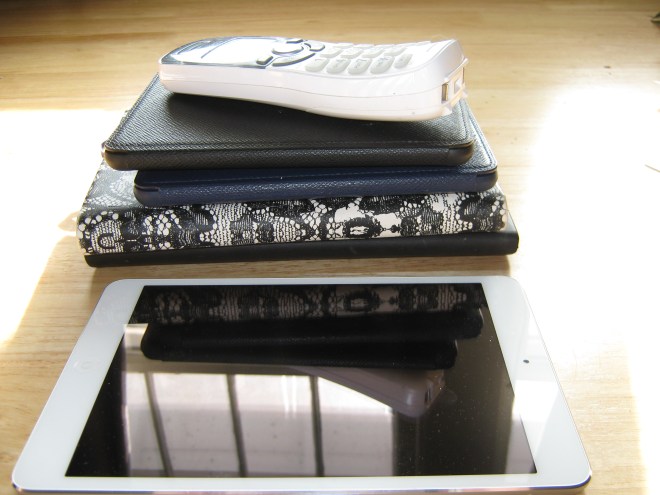
I am a Luddite by some standards, but we have many gadgets (some alive, some dead).  Check out this picture of portable “apparati,” as Gary Shytengart calls electronic gadgets et al in his comic novel, Super Sad True Love Story.   Alas, where are the antiques? Our Sony Reader and a palm pilot are missing…

Some of our gadgets!

Some of our gadgets!  (Yes, that’s a real landline phone on top!)