A Short, Nearly Perfect Book: Ruth Prawer Jhabvala’s A Backward Place

a backward place jhabvala 81295_320In the twentieth century, many classics were only 200-300 pages long. Think Barbara Pym, Eudora Welty, and Peter Taylor.

Then, suddenly, in the twenty-first century, books started getting longer.  I love Hilary Mantel, but her historical novels are doorstops.  And, according to a study by James Finlayson of Vervesearch, the length of books has increased by 25 percent, from 320 pages in 1999 to 400 pages in 2014.

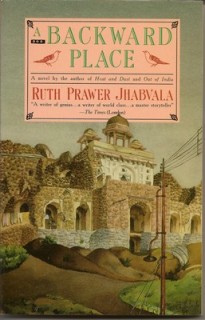
And hence my inauguration of  a new  “Short Book of the Week” feature: today’s post is on the underrated writer Ruth Prawer Jhabvala’s A Backward Place.

Ruth Prawer Jhabvala ph_0111204734-Jhabvala

Ruth Prawer Jhabvala

Jhabvala (1927-2013), who is best known for winning the Oscar for her screenplay of Howards End, also won the Booker Prize in 1975 for  Heat and Dust, a luminous novel that alternates the story of a young English woman in India in the 1970s with that of her grandmother, Olivia, a rebellious English wife of a civil servant who caused a scandal by challenging the mores of colonial society.

A Backward Place, a brilliant comic novel published in 1965, is another masterpiece.  Set in Delhi, it delineates the connected lives of several expatriates and their Indian friends and spouses.  Every beautifully-crafted sentence is  evocative of character and place.

At the center is Judy, the English wife of an aspiring Indian actor.  Judy rather  harriedly works as a secretary to support Bal and their two children. While she struggles to pay the bills, Bal hangs out in coffeehouses and dreams of becoming a movie star.  They share a house with Bal’s brother and his wife, Shanti, to cut expenses.  And they have taken in an impecunious widowed aunt, who has moved from family to family.

Judy is content in India:  she doesn’t miss her life in England, where her father worked in a factory.  She fell in love with Bal at 17.  She hangs on fiercely to her job at the Cultural Dais, a society that sponsors lectures by writers and academics. (Jhabvala’s witty descriptions of the tedium are hilarious.)  Judy is an assistant to the General Secretary, Sudhir Bannerjee, who conspires with her to cover up her mistakes.  When Sudhir, an intellectual who thinks he is wasting his life, talks about leaving Delhi, she is terrified.  She doesn’t think she could keep the job without him.

Many of her expatriate friends are richer, more urbane, and more carefree than she.  The novel opens with her sophisticated Hungarian friend,  Etta,  eating a cream cracker in bed and lecturing Judy on why she should leave her husband. (Etta has had a few husbands and many lovers of her own.)

“My dear Judy, you’ve made a mistake… but if you would only face up to it and get out before it’s too late.”

Judy  loves Etta . Still, there are limits, even when you have a sense of humor.

Judy was tempted to say that it was already too late (after all, she had been here nearly ten years and had two children) but she refrained, because she knew Etta didn’t care to have her assertions contradicted.  And anyway, as far as Judy was concerned, the discussion was purely theoretical, so she didn’t mind much what was said.

Etta has some money and a beautiful European apartment, but her relationship with a rich  Indian hotelier is waning and she is panicked.   Clarissa, an English expatriate, scorns her upper-class family in English and lives in a filthy little room in Delhi, but frequently visits rich friends.  She, too, is terrified when she learns she is about to be evicted.  Mr. and Mrs. Hochstein, a German couple who are living in India for only a couple of years, have a secure perspective:  they don’t expect too much from India, because they don’t have to stay.

Much of the novel revolves on the founding of a  theater group.  Bal had the idea, but lost interest after a visit from a film star friend from Bombay.  And so the theater group comes into being without Bal, and with a minimum of talent..

It is, oddly, the Indians who want to leave Delhi, while Judy wants to stay.   Bal wants to be a film star in Bombay, and Sudhir wants to teach in a backward place.   It is English security vs. Indians’ dreams and taking chances.  Who in the end is right?

Really a stunning novel, with an unexpected ending!  The details are minuscule, unexpected, and crystalline.  And the theater group’s production of Ibsen’s A Doll’s House is quite droll.

I loved it. I look forward to reading more Jhabvala!
The Cats’ New Toy & Three Literary Links

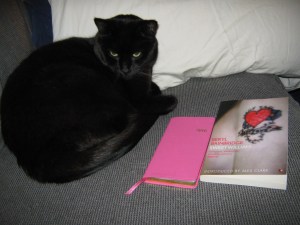
IMG_3541

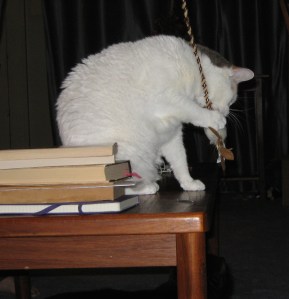
“Books are fine,” the cat said before the electronic mouse came to stay.

The cats have everything.

A pink 2016 calendar with a ribbon bookmark, a copy of a Beryl Bainbridge novel,  and their own personal  couch with a furry slipcover!

What more can they want?

While my husband was away on a business trip, I became their cat. They insisted on “Modern Family” reruns from 6-6:30, a lovely dinner of Whiskas, and then requested Shawn Colvin.  They prefer “Sunny Came Home” and “Window to the World!” to alternative rock.  Who knew?

Okay, we were fine.  I was a little tired after they figured out how to open the bedroom door, but then I barricaded the door.  I was in charge!

And then…

A friend brought a gift for them.  It is an electronic mouse, attached to a piece of yarn on a stick.  When you swing the stick, it chirps and its eyes blaze electronically.  I’m scared to death of it!

The cats want to see it move all day long!

Reading?  No way, Mom.

Play with the mouse! they say.

Cats with new electronic mouse!

Cats with new electronic mouse!

I’m not sure I approve of electronic toys for cats.  Is this how my mother felt about Chatty Cathy, the talking doll?  I pulled the ring over and over so she would chat:    “I love you,” “Can I have a cookie, “Take me with you” all day long!

And the mouse?  Chirp, chirp, chirp!

Moby on coffee table with mouse


Only the white cat is truly enthusiastic.  The others are slightly apprehensive.  They just like to watch the white cat play with it.

I plan to reinstitute kitty soccer this weekend.  I’m sure the plastic balls with bells in them are somewhere…

AND NOW FOR SOME LITERARY LINKS!

1 I enjoyed D. J. Taylor’s article in The Independent, “How the Books We Read Shape Our Lives.” He discusses the importance of the books we  read as children and muses on how our tastes develop.

…the sociological questions that lie behind what might be called the origins of the literary sensibility are a great deal less easy to answer. How do people learn to read? How do they fashion their own individual tastes? How do they establish why they prefer one type of book to another type? Where do they acquire the information that enables them to make these selections, and, having acquired it, what do they do with it? After all, there are no hard-and-fast rules about aesthetic choice and how it operates: it was Anthony Powell who, presented by an admirer of his novel sequence A Dance to the Music of Time with an ornamental clock on which the names of Poussin and Proust had been engraved, truly remarked that books “have odd effects on different people”.

2 In The New York Times, Michiko Kakutani reviews Tom Holland’s Dynasty: The Rise and Fall of the House of Caesar, a fascinating history I immensely enjoyed and do plan to write about eventually. She writes,

Mr. Holland, the author of “Rubicon,” about the last years of the Roman republic, writes with great authority and relish. His book is less analytic and less panoramic than “SPQR,” Mary Beard’s excellent recent history of ancient Rome. By confining his study largely to the Julio-Claudians (as the dynasty of Augustus is conventionally known), Mr. Holland gets to tell the story of Rome through a series of portraits of some of its most notorious emperors, immortalized in seminal works by Tacitus and Suetonius as larger-than-life autocrats and monsters.

3 In The Weekly Standard, Joseph Bottum writes about Michael Dirda’s new book, Browsings.

… Michael Dirda is a reader, down at the root of his being. A man who gained his scholarly knowledge and critical sensibility from reading whatever came to hand as he pawed through the dusty shelves of used bookstores. Writing—well, yes: If you’re going to keep from starving as a reader, you’ve got to find a bookish job, and writing is one of the possibilities, especially writing book reviews. He is, really, only what he claims for himself: Bookman, plain and simple. “An appreciator,” he adds, “a cheerleader for the old, the neglected, the marginalized, and the forgotten. On sunny days I may call myself a literary journalist.”

Enjoy the links!

A Use for the London Review of Books & You Can’t Be a Snob in a Caucus State

IMG_3538

The other day, I  found a use for the London Review of Books.

We like to keep the LRB in the plastic sleeve until it’s time to recycle it.

“Please get that out of here,” my husband says every time it arrives.

“There must be something in it,” I said.

Oddly, there was nothing that interested us.

According to VIDA, the LRB is London’s most sexist intellectual bimonthly review. And, indeed, much as I want to believe I am a chrone beyond gender, I can only find it in my heart to read one really famous sexist London publication a year. (We prefer the  TLS, which does a stupendous job covering classics and literature in translation.)  Last year in the LRB, I plowed through a few of Jenny Diski’s spiteful essays on Doris Lessing and an unbelievably sexist article on Hillary Clinton.  As you  see, I favor articles by or about women.  Essentially, the only regular woman writer in the LRB is Diski.

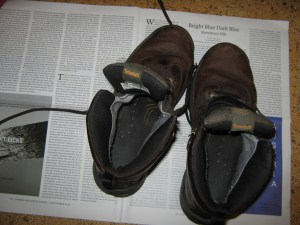
Tired of cold boots, I finally had an LRB brainstorm.  I brought the boots in from the mud room and plopped them on top of the LRB to dry.

Yup, our year’s free subscription was not for nothing.

caucus 43rd_Legislative_District_Democratic_Caucus_1

                                  Democratic Caucus, 2008

THE CAUCUSES.  We’re gearing up for the Democratic Caucuses here. It’s the Olympics of the hinterlands, only it’s political!  And there’s nothing else to do here in the winter.

Only thirteen states have caucuses: Alaska, Colorado, Hawaii, Kansas, Maine, Minnesota, Nevada, North Dakota, Wyoming and Iowa. The rest of the states  have primaries.  I favor the secret ballot, but live in a caucus state.  We’re raising hands in school gyms here.

The caucuses are a lot of work.  Are you sociable?  You’ll love it.   You mill and throng with fellow Democrats (or Republicans, if that’s your preference) at a designated location in your precinct on a winter’s night, usually a school auditorium or church.  You chat and drink a glass of cider (we Democrats are hip and that’s what we serve),  and then you stand up for your candidate, and there is a count of heads or hands.

I went to the caucus in 2004,  and we spent a lot of time persuading one of our fellow Howard Dean supporters not to go over to the “dark side,” i.e., John Edwards.   “If you go, Dean’s out of the running,” we pointed out.  And so she stayed, though she wanted to hang with her friends, and Dean, by one vote, came in third.  That was John Kerry’s year, though all the magazines said the polls favored Dean.

Hillary is said to be a sure bet this year. Do the polls know?  My mother loved Hillary and hoped to see her elected president. Hilary is a hard worker, if a bit uncomfortable at times, and I have always liked her.   I think she should have won the Nobel Peace Prize for her work as Secretary of State.  (Obama won it in 2009, essentially just for being elected.)

Actually, I don’t want to go to the caucus.

If I go, I am not sure whether to vote for Hillary or Bernie. They have the same stances on most issues, but he is slightly to the left.  And I love that “socialist” and “social democrat” thing he has going.  (Read the blog at The New York Review of Books for information on his views.)

I’m a Socialist in theory, though I never vote socialist.   In reality, I’m  a liberal Democrat. I vote Democrat, because you throw away your vote in a presidential election if you go third-party.

I am astonished by Bernie’s popularity here.  There are throngs of Bernie signs in our neighborhood.  I have seen a couple of Hillary signs and a couple of  Trump signs, but nothing for other candidates.  This is, however, a liberal precinct.

I would like to see a woman elected president.  Feminism is very important to me.   Am I beyond gender, or am I not?

I am torn. I like both candidates.  (I am sure O’Malley is going nowhere here.)  If it were a primary, I would vote, but the caucus is a lot of work.

Whether I go to the caucus or not, I will vote for the Democratic candidate in the election in November.

You Look Good!

We're not Holly Golitely!

We’re not Holly Golitely!

“It’s me,” I said.

It is not that my father has dementia.  It’s that I’ve grown older.  My hair is wild and completely white.

You look good,” he said.

I thought, Well, finally, Dad.

“You look good” is what we women deserve.  We are not Holly Golightly and we don’t breakfast at Tiffany’s.  A few years ago, my family gathered at a small-town cafe, the kind that serves chicken-fried steak and homemade pie. We all had the special (chicken-fried steak) except a second cousin I barely know. He bizarrely told me, “You could be on The Biggest Loser.”

My dad laughed and sneered.

So that’s what you really think of me, I thought calmly.  Here they were, two older men, not prizes themselves, and they thought they could judge me on my weight.  “That’s enough,” I said.

Ten years ago I gained a LOT of weight after being prescribed a medication.  So go ahead, judge me.

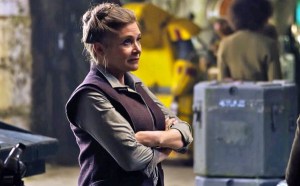
Women are judged on their looks, whether they are thin or fat, young or old.  Take Carrie Fisher, age 59.   Since appearing as General Leia Organa in Star Wars: The Force Awakens, she has been under fire for her looks.  Here’s what I want to know:  what’s wrong with them?

Carrie Fisher as General Leia Organa in "Star Wars: The Force Awakens"

Carrie Fisher as General Leia Organa in “Star Wars: The Force Awakens”

She lost 30 pounds for the film. If she hadn’t, think what they’d say.  In an interview with Good Housekeeping, she said, “They don’t want to hire all of me — only about three-quarters!  Nothing changes, it’s an appearance-driven thing. I’m in a business where the only thing that matters is weight and appearance. That is so messed up. They might as well say get younger, because that’s how easy it is.”

And then Kyle Smith, a New York Post columnist, attacked her for complaining about the weight loss.  He said it was a health thing.  Uh huh.  That’s what the studio wanted.  Health.  (Yup, take away my med with weight gain side effect, and you’ll see health–ha.)

He writes,

No one would know the name Carrie Fisher if it weren’t for her ability to leverage her looks. George Lucas only cast her in the first place because she was young, slim and cute at the time. (She turned out to be a talented writer as well, but it’s an open question whether the second career would ever have gotten off the launch pad without the fuel provided by her first. Mostly she has written about what it’s like to be Carrie Fisher.)

Good God, that’s so creepily sexist! If you don’t like Star Wars, try Hannah and Her Sisters. I am a Star Wars fan, but  I wouldn’t have bothered with the enjoyable new film if not for Fisher and Harrison Ford.  It is fun, fast-paced, and clever, almost as good as the originals, and Carrie Fisher and Harrison Ford are charming in their interactions with the new generation of actors.  I only wish Fisher had a bigger role.  (Maybe next time.)

I’m not one for Twitter, but I liked Fisher’s tweet in response to The New York Post:

Ok, I quit acting. NOW,can I not like being judged for my looks?Tell me what to do & who to be, oh wise New York post columnist.u GENIUS

That reminds me. It might be time to reread Fisher’s remarkable novel, The Best Awful, a sequel to Postcards from the Edge.  It is brilliant, hilarious and grimly truthful in its portrayal of addiction and madness. When  Suzanne’s husband, a Hollywood studio executive,  reveals he is gay and leaves her for a man, she decides to go off her meds. It is a tragic trip.  But it does end well eventually…

Read it!

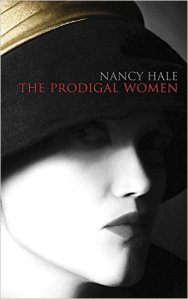
Nancy Hale’s The Prodigal Women

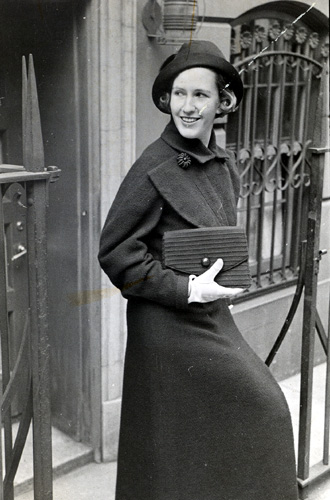
Nancy Hale

               Nancy Hale

“I specialize in women, because they are so mysterious to me. I feel that I know men quite thoroughly, that I know how, in a given situation, a man is apt to react. But women puzzle me.”–Nancy Hale in an interview at The New York Times.

I am a great fan of Nancy Hale.

Never heard of her?  Her  work is out of print.

Not for long, though.

In September, Dover Books will reissue her 1943 bestseller, The Prodigal Women.

Raised in Boston, Hale was the daughter of two painters, Philip L. Hale and Lilian Westcott Hale, and a descendant of Harriet Beecher Stowe.  She escaped from stuffy, WASPy New England to New York and became a journalist, novelist, memoirist, and short story writer.  (She was the first female reporter at The New York Times.)  A few years ago I discovered her work in an anthology , Short Stories from the New Yorker, 1925 to 1940.   I became an avid reader of her work.  My favorites are the brilliant novel, Dear Beast (which I wrote about here),  and her stunning memoirs, A New England Girlhood and A Life in the Studio (which I wrote about here and here.)

Fortchoming Dover edition

Fortchoming Dover edition

I very much enjoyed The Prodigal Women.  It is unputdownable, the equivalent of a text munchie. Want to read and read until you forget it’s fiction?  Imagine a fusion of Mary McCarthy’s The Group, Dreiser’s An American Tragedy, and Jacqueline Susann’s Valley of the Dolls.

Set between 1922 and 1940, this well-written blockbuster vividly portrays three very different heroines.  Leda March, the intellectual daughter of a well-to-do Boston family, is friendless and longs to fit in with other girls:  she is victimized first at the Country Day School in Hampton and later at a girls’ schools in Boston.  Her life changes when the Jekylls, a Southern family, move to Massachusetts because Mrs. Jekyll wants culture:  the youngest daughter, Betsy, takes Leda under her wing,  and both adore her lovely older sister, Maizie, who is surrounded by men.

As the girls grow older, their interests diverge.  Leda, who once wanted to be a debutante, rebels and moves to New York, where she becomes a successful writer.  Did Hale chose the name “Leda March” as a riff on Jo March, the tomboy writer who eventually settles for a middle-aged German professor?  Leda will never settle.

Maizie could marry anyone, but  becomes obsessed with Lambert, an artist, and entraps him in marriage.   Poor Maizie! Once she is married, Lambert becomes sadistic.  He insisted that she have an abortion in South America on their honeymoon, and Maize never quite recovers. She loses her health and spends time in mental hospitals.  Even Lambert admits he ruined her life.

But Leda doesn’t give a shit.  She  wants Lambert.  Boy, does she want him!  Since Maizie has become a frump, Leda thinks it’s fine to steal her husband.

Betsy is the most normal: a fun-loving young woman with an active social life in New York in the ’20s.  Then, unfortunately, she moves in with, and then marries, an abusive failed writer who wants a mother figure.   Betsy is strong enough to rise above domestic problems, but the situation is dire.

Are no men good enough for these women?  Hale wasn’t afraid to vilify male characters.  Nor are the women saints.

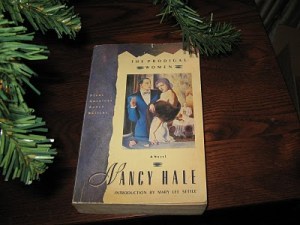
I am hesitant to call this a feminist novel, though some of the characters are feminists.  The writer Mary Lee Settle, in the  introduction to the 1988 Plume paperback of The Prodigal Women, explains it most clearly.

Plume paperback edition.

Plume paperback edition.

Settle writes,

It is too easy to categorize it as an early feminist novel.  It most certainly is “feminist”–though the use of that word is far more “contemporary than the book itself–but it follows the tradition that existed long before women began using a self-conscious langauge in their appraisal of where they were  and what they wanted.  …  [Nancy Hale’s] female revenged are as ancient as Medea or Electra.  But neither does she condone the excesses of “feminine wiles.”  These, too, are punished–terribly.

The ‘feminist’ novel, if that is what is meant by novels where men are interpreted in less than heroic manner, goes back to the great classics by women. The list is formidable: George Eliot’s Middlemarch, where Dorothea’s choice between Casaubon and Will Ladislaw is hardly a choice, and which is enough to frighten any sensitive woman out of marrying; Ellen Glasgow’s Jason Greylock in Barren Ground, the author’s terrible revenge on Southern men for losing the Civil War and drinking too much; Edith Wharton’s Newland Archer in The Age of Innocence; Willa Cather’s Jim in My Antonia. Here they are–strong women, frail men–a genre, a tradition, and a revenge for all the natural insults that female flesh considers itself heir to. Like these great women novelists, Nancy Hale’s women are more alive, stronger, both more sympathetic and more destructive than her men.”

Books That Aren’t for Me: Zola’s His Excellency Eugene Rougon & John Braine’s Room at the Top

This translation is dreadful.

This translation is dreadful.

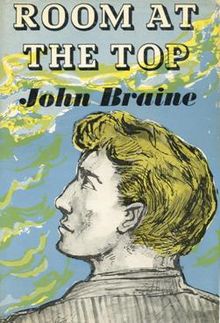
I recently tracked down Zola’s His Excellency Eugene Rougon, the sixth novel in his Rougon-Macquart series, and a copy of John Braine’s 1957  novel, Room at the Top.

Both books are minor classics, but, alas, I didn’t much care for either. Perhaps they’re the right books for you, though.

1. Readers of this blog will know that I recently enjoyed the new Oxford translations  of Zola’s Rougon-Moucquart series, a racy inter-generational chronicle of five generations of a family prone to alcoholism, addiction, madness, and promiscuity in Napoleon III’s Second Empire.  The 2012 editions are superb:  I wrote about Helen Constantine’s  translation of The Conquest of Plassans here, and Brian Nelson’s translation of The Fortune of the Rougons  here.

His Excellency Eugene Rougon may well be a great political novel about the Second French Empire, but who can tell in Ernest Alfred Vizetelly’s archaic 1897 revision of an earlier nineteenth-century translation?  Could we have a new translation, please?

In the preface, Vizetelly praises this realistic political novel.  He writes, “In my opinion, with all due allowance for its somewhat limited range of subject, [it] is the one existing French novel which gives the reader a fair general idea of what occurred in political spheres at an important period of the Empire.”

This brilliantly-structured but turgid translation of Zola’s complicated novel about a corrupt politician is compelling once underway.  The hero,  Eugene Rougon,  is a savvy lawyer who supported  Napoleon III’s coup d’etat and clawed his way up to a high position in the government. In the opening chapter, he resigns after a disagreement with the Emperor,  expecting soon to be recalled to office.  His allies and friends turn on him when he is out of power:  there are no enemies greater than friends.  The most dangerous is Clorinde, the beautiful, intelligent daughter of an Italian countess who obtains information through flirtations but seldom gives anything away.

After a few years out of the government, Eugene is desperate for power.  He suppresses information he gleans from a criminal friend about a terrorist plot.  Deaths and woundings of innocent men result, but his rival is discredited, and that’s all that matters to Eugene.  Ten days later Eugene is the Minister of the Interior.

This is the kind of reading that makes you NOT want to participate in the caucuses or vote in the primaries.

Okay, it’s a bold book.  But try reading prose like this:

For a moment the President remained standing amidst the slight commotion which his entrance had caused. Then he took his seat, saying carelessly and in an undertone:  “The sitting has commenced.”

A little of that goes a long way.

And that’s why we need a new translation.

Room_at_the_Top_(novel)_1st_ed_coverart2. I was curious about John Braine’s Room at the Top, published in 1957 and recently reissued by Valancourt.  It is  one of the “Angry Young Men” novels, and I love the  writers in this movement:  Kingsley Amis, Alan Silitoe,  and William Cooper.

But I cannot bear Braine, though he is witty, acerbic, and articulate.  The other Angry Young Men are misogynists, but this is perhaps THE most misogynistic of their novels.

The novel begins with the narrator Joe Lampton’s looking back regretfully on his eruthless rise to “the top” in his twenties.  Joe, a World War II vet and former prisoner of war, left the ugly working-class town where he was raised when he found a job in Warley as an accountant for the City Council.  He was brash and on the make:  he joined a community theater group to get to know women. Soon he hits on pretty Susan, the daughter of a wealthy man, because he sees her as a means to money and power.

He has an affair with Alice,  a bright, witty married woman  in her thirties who is the best actress in the company. He has double standards and double dealings but is in love with her. Joe’s friend tells him he cannot possibly marry an older woman without losing his reputation.

We women cannot help but hate Joe, and Joe hates himself, too.  I don’t want to give too much away, but at  one point, he  derealizes and reports his dialogue in the third person.  then he comments in the first person on this other Joe (the real Joe?).

“I expected it,” Joe said soberly…  I didn’t like Joe Lampton.  He was a sensible young accountant with a neatly-pressed suit and a stiff white collar.  He always said and did the correct thing and never embarrassed anyone with an unseemly display of emotion.  Why, he even made a roll in the hay with a pretty teenager pay dividends.  I hated Joe Lampton, but he looked and sounded very sure of himself sitting at my desk in my skin; he’d come to stay, this was no flying visit.

This uneven, well-written novel has its points, and, thank God, is short!

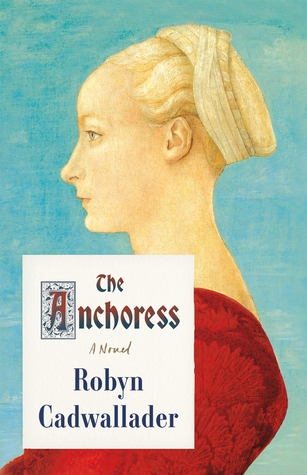
Reading From Other People’s “Best of” Lists, #1 : Robin Cadwallader’s The Anchoress

anchoress robyn cadwallader 22929570

I jotted down an embarrassing number of titles from the “Best Books of 2015” lists.

I know, I know.  It’s already 2016.  But these recommendations are a sensible way to get back into contemporary literature, if , like me, you read mainly books by the dead.   Robyn Cadwallader’s The Anchoress  cropped up on a few lists. In an article in the Guardian about publishers’ favorite books of the year, Hannah Griffiths, publishing director of Faber, said she wished more people had read and reviewed The Anchoress.

Although I am not religious, and the extent of my spiritual reading in the Middle Ages is limited to excerpts from Julian of Norwich (thank God for The Norton Anthology!), I became interested when I learned  Cadwallader is a poet. The beauty of the language makes all the difference in a book like this. This brilliant short novel not only sketches the religious life of Sarah, an anchoress in the thirteenth century, but also explores her fears, the elation of prayer, her hallucinations,  her anorexia and ill health, and her changed view of prayer as she becomes involved with the lives of her two maids, Louise and Anna, and  female visitors from the village.

Sarah  is traumatized by the senseless suffering of her beloved sister Emma, who dies in childbirth.  Sarah chooses a religious life, though Sir Thomas, a wealthy landowner, wants to marry her.  She is attracted but has a sixth sense about the kind of man he is:  he is violent.  And she knows that his father would disapprove of a match with a merchant’s daughter.

And so where does a woman go for sanctuary?  The church.

The smaller the space, the greater the suffering, the more she is the bride of Christ, or so she reasons at first. While the priests and monks have liberty to wander at large, she retires to the tiny space.  In this short, tightly-woven novel, chapters alternate between Sarah’s first-person account and a third-person account from the point of view of her confessor, Ranaulf, a scribe.

She loves the idea of giving herself to Christ, but it is much more difficult than it was in imagination.  She is terrified by the ceremony.  After the bishop says the mass, she lies on the floor of her cell listening to the men nail the door shut.  She loses consciousness for a while.  When she comes to,

I startled, fright hot and sharp in my chest.  Blows shuddered the door. I stood and pressed my hands against it, felt nails splintering wood the sound sharp in my ears, then echoing inside my head.  These hammer blows that sealed my door were the nailing of my hands and feet to the cross with Christ, the tearing of his skin and sinew.  The jolt of each blow pushed me away but I strained to feel it, the shiver of resistance humming in my body.

Sarah is not completely alone.  She communicates with her two maids, her confessor, and visitors through a small window. She is responsible for her young maid Anna’s spiritual life.  But so much about her prayer is denial of her own bodily needs, and hallucinations brought on by starvation and deprivation. She hears Agnes,  the anchorite who died in the cell, speaking to her about Christ. She makes herself bleed and, on one occasion, wears a hair shirt.  But her convictions change when she learns that her predecessor, Isabella, did not die but left the cell. And after her young maid Anna gets pregnant, she realizes she has some responsibility for what had happened. When Sarah, Louise, and the women of the village try to shield Anna from a punitive exile demanded by the church, even Ranaulf  takes the women’s side.

The Anchoress is a gorgeous novel.  Every sentence is perfectly chiseled and formed. I grew to love and respect Sarah. My only criticism?  I am not quite sure Ranaulf would have changed his mind so readily about women.  Still, it is a great book.  Had I read it a day earlier, it would have made my Best of 1015.

A Walk in Winter

A Hatless Young Woman: How Can She Stand the Cold?

A Young Woman Survives a Snowball Hit!

Stomp, stomp, stomp.  Out in my boots for the first time this winter.  I’m bundled up.  I climb over a snowbank and into the street.  I have five seconds to cross.

Some of the sidewalks are shoveled, some are not.  There are slippery patches.

A young man with a snow blower says something. Probably “Good morning.”

I suppose I’m smiling.  Am I smiling?  I’m cold.

I can’t really hear him because I’m listening to Joni Mitchell’s Court and Spark.  One of my earbuds keeps falling out.  As I listen to the beautiful insecure lyrics of “Same Situation,” I wonder if I was ever that soft.  “Tethered to a ringing telephone/in a room full of mirrors.”

Oh, Joni.  How I loved this song!  But it’s been the same damned thing since Dorothy Parker’s 1930 story, “A Telephone Call.”

“Why can’t the telephone ring? Why can’t it, why can’t it? … You damned ugly, shiny thing. It wouldn’t hurt you to ring, would it?”

I’m not tethered to a damned phone anymore!  (Many are.) There was joy in young romance, but much unhappiness, so many tears.

I wonder if we are still women after menopause. Do we become a third sex?  When we were young, we were defined by estrogen. We were defined by our reproductive systems.   We worked, but were so often at a disadvantage:  we preferred the liberal arts to business and thus were paid less.  Why were we paid less?  And when our husbands left us for younger women, we lost status and insurance.  If we got through it, we were no longer objects.  We became the subjects of our lives.

Subject, object, who the hell knows?

Here’s the Latin.

femina = subject (nominative case)

feminam = direct object (accusative case)

So here I am, a femina, walking on a day in the middle of climate change, appreciating the snow.  It is flooding in Missouri. It is flooding in the UK.

Is climate change reversible?  asks the post-menopausal woman, wondering, Why pretend?  Enjoy the snow while we have it.

Why Isn’t This Book in Print?

Why isn't this book in print?

“Why isn’t this book in print?”

We used to ask this question about the novels of Angela Thirkell, Rumer Godden, and Dodie Smith. Publishers heard the collective cry of fans and reissued these wonderful writers’ books.

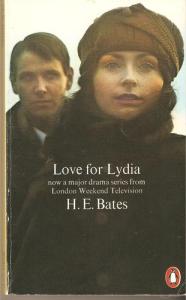
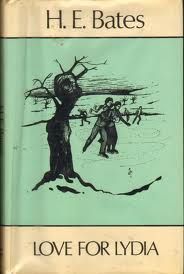
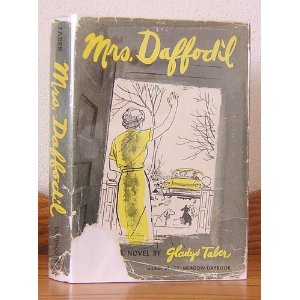
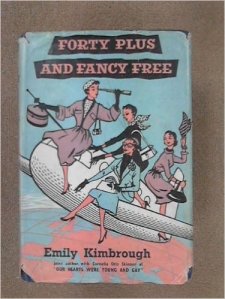
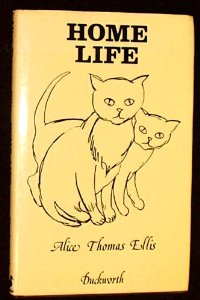
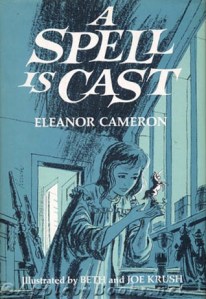
But the following are still among the missing:  H. E. Bates’s Love for Lydia, Gladys Taber’s Mrs. Daffodil, Emily Kimbrough’s Forty Plus and Fancy-Free, Alice Thomas Ellis’s Home Life, & Eleanor Cameron’s A Spell Is Cast.

1 H. E. Bates’ Love for Lydia.  H. E. Bates wrote gorgeous short stories about rural life in England, but my favorite of his books is  Love for Lydia. Set in the 1920s, this beautifully-written novel is the story of a vibrant, sexually rebellious heiress’s effect on four men in a small town. It is narrated by Richardson, a moody, aspiring writer who, at the beginning of the novel, works unhappily on a small-town newspaper. And then he meets Lydia on an assignment. He is supposed to interview her two aristocratic aunts about the death of their brother and the advent of Lydia.  Instead, the aunts, after inquiring about his family and deducing his class, coax him to take Lydia skating.  And the book takes off from there!  Lydia becomes a small-town femme fatale, but she is so full of life we don’t blame her. This book was also adapted for a splendid TV series.

love for lydia h. e. bates old d886fb016e7cad30888a0a3f8db3aa771 Mrs. Daffodil by Gladys Taber

There are many fans of Gladys Taber’s Stillmeadow books:  charming, lyrical collections of  her “Butternut Wisdom” columns for Ladies’ Home Journal, articles, and  essays about living in a beautiful, but run-down, farmhouse in Connecticut.  She and her husband bought Stillmeadow with another couple, because Taber and her ex-college roommate, Jill, desperately wanted a country getaway.   After their husbands died, they moved to Stillmeadow permanently.

Mrs. Daffodil

But the book I’d  dearly love to see back in print is her autobiographical novel,  Mrs. Daffodil.  The kind, witty heroine, Mrs. Daffodil,  is almost Taber’s twin:  she lives in the country with her widowed friend, Kay,  and they  raise children, dogs, cats, a pheasant, and a baby blue jay.  Mrs. Daffodil, a writer, happily churns out a syndicated column called “Butternut Wisdom” and romantic short stories about young love, because readers are not interested in what she knows about,i.e.,  middle-aged widows. Mrs. Daffodil has a weight problem because she loves to try out magazine recipes that call for a pint of sour cream.  When we first meet her she is having trouble zipping up a dress, and about to go on a diet.

Just like life!

3 Emily Kimbrough’s Forty Plus and Fancy-Free

Emily Kimbrough is best known for Our Hearts Were Young and Gay, a hilarious travel memoir co-written with actress Cornelia Otis Skinner.  But Kimbrough also had a solo writing career.  In Forty Plus and Fancy-Free,  Kimbrough, a fashion editor for The Ladies’ Home Journal , is trying to decide whether to travel to Italy with her friend, Sophy. Her employer agrees  to give her a vacation if she covers the Coronation in England.  I laughed hysterically over their Italian lessons at the Berlitz school, because who hasn’t had linguistic goof-ups?  When a young man follows Sophy through the streets in Italy, she cows him by telling him she is a grandmother. And there are breathtaking descriptions of views and art, though usually with humorous comments.

kimbrough forty plus and fancy-free 51xxZZUMmBL._SX373_BO1,204,203,200_4 Home Life, Home Life Two, & Home Life Three by Alice Thomas Ellis. Ellis, a novelist, mother, editor,and a conservative Catholic, wrote these brilliant domestic columns originally for the Spectator.  Home Life is vaguely like E. M. Delafield’s Provincial Lady, only urban, circa the 1980s. A white Persian cat is in the sink, so Ellis has difficulty brushing her teeth; a man mistakes her for a prostitute when she is in a bar with Beryl Bainbridge; she gets snowed in the country; and the pipes burst and inundate a set of Thackeray.

Home Life by alice thomas ellis5 Eleanor Cameron’s A Spell Is Cast is my favorite children’s book, though it is really an “all-ages” book.  It is the story of Cory Winterslow’s stay with her grandmother and Uncle Dirk in California. Her adoptive mother, Stephanie Van Heusen, an actress, tours constantly and has left Cory with a series of hired helps. But during this tour, she has sent Cory to California, and Cory has looked forward to being part of a family. She is intensely disappointed when Uncle Dirk, who has written charming letters, doesn’t show up at the airport. There are many family secrets: she learns that Stephanie has never legally adopted her.  There is a Dali-esque dream sequence   when Cory has a fever–have I ever read a dream sequence in another children’s book?–andshe finds herself in a music room where there is a chess set with carved unicorns instead of horses. It turns out that this room is real. It is atmospheric moments like this that made this novel such an intense experience when I was young.

a spell is cast eleanor cameron 344580

Emile Zola’s The Conquest of Plassans & My Year of Reading

Zola conquest of plassans 51JjkTn3gtL._SX327_BO1,204,203,200_ I have recently devoured the early books in Emile Zola’s Rougon-Macquart series, a racy inter-generational chronicle that focuses on the decadence of the descendants of a hippie-ish 19th-century matriarch, Adelaide Fouque (nicknamed Aunt Dide). She has a complicated family:  one legitimate son, Pierre, by her vegetable-salesman husband, and two illegitimate children, Ursule and Francois, by her drunken lover, Macquart, a smuggler.  Eventually Dide’s son locks her up in a lunatic asylum, while subsequent generations cheat, frolic, fornicate, and brawl.   In these enthralling naturalistic novels, Zola interweaves his theory  of heredity with family history and the history of the France of Napoleon III’s Second Empire with its politics.

A decade ago, I went through a Zola phase, and read most of the books in this fascinating series, some in 19th-century translations. In 2012, Oxford published new translations, among them the early books that were last translated in the 19th century.  Needless to say, the new translations are smoother and more accessible.   (I recently posted about The Fortunes of the Rougons here.)

I was very impressed with The Conquest of the Plassans,  the fourth book in the series, translated by Helen Constantine.  It zestfully explores the dark side of religion.   The church and politics go hand in hand in the novels of Zola and his role model, Balzac.  In The Conquest, Abbe Faujas, who has a shady history of political intrigues, has been exiled to Plassans, a provincial town.  On the advice of Eugene Rougon, a rising Bonapartist politician, Felicite Rougon persuades her son-in-law, Francois Mouret, to rent lodgings to the priest and his quiet mother.  Francois, a retired shopkeeper who still speculates on commodities, gloats  about  earning additional income.  But his wife Marthe, a contented woman who  spends much of her time sewing and looking after her mentally retarded daughter, Desiree, has doubts.  She mildly suggests the family is happy on its own.

Francois underestimates the power of religion.  He is an atheist, and since Marthe rarely sets foot in a church, it never occurs to him that religion will disrupt his family.   Soon Abbe Faujas, who stinks because he doesn’t bathe and has only one threadbare cassock,  captivates Marthe and the women of the town.  Soon Marthe is in charge of raising money for  a religious center for village girls.   She spends all her time at the center and church and neglects her home.  Lovesick and now fanatically religious, Marthe throws herself at Abbe Faujas. And Francois gradually withdraws into eccentricity while the Abbe and his family take over the garden and then the house.   Want to see the inside of a madhouse?  You’ll never guess who ends up there.

Loved this book!  It is great fun to read, and Zola is always outrageous!

Woman reading clip art vintageMY YEAR IN READING.

I posted my list of Best Books of 2015 here.

And now I’m posting my stats.

  • Fifty-seven percent of the books I read were by women and 43 percent by men.
  • Twenty-seven percent were e-books.
  • Six percent of them were galleys from publishers.

Conclusions:

  • I am narrowing the gender gap.  I read more books by women, but am consciously reading more books by men now.
  • Next year I plan to  accept fewer galleys from publishers. I am grateful for the chance to read new books, but they deflected me from books I wanted to read.  Honestly? I don’t want to become one of those bloggers who are so swayed by freebies that they become slaves of  publicists.  I have seen flattered bloggers  ruin their blogs in pursuit of mediocre free books. When they look back, will they be saddened ?  If not for the grace of God there go I…

Peace in the New Year and Happy Reading!