Kingsley Amis’s Lucky Jim: Is It Funny?

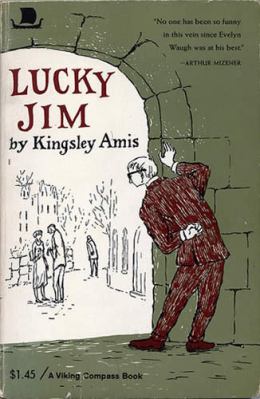
AMis lucky jim t100_novels_lucky_jimI chortled as I reread Lucky Jim.

In Kingsley Amis’s brilliant academic satire, a novel I have loved since my college days, the hero, Jim Dixon, teaches medieval history at a provincial university.   He has no interest in his subject, makes faces behind the back of the department chair, steals a taxi from one of the more genial professors, and is aware of the absurdity of an article he is trying to publish, which has the farcical title, ” The economic influence of the developments in shipbuilding techniques, 1450 to 1485.”

How could I not laugh? Kingsley Amis was an “angry young man.”  Jim is an angry young man. Jim’s article is tripe.

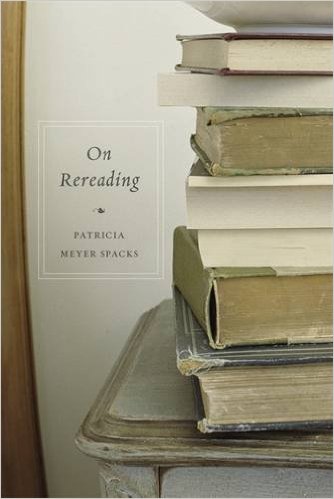
I reread Lucky Jim for a peculiar reason: Patricia Meyer Spacks trashed it in her fascinating book, On Rereading.

Spacks on Rereading 41ePBMKeIOL._SX332_BO1,204,203,200_Spacks’s vigorous, opinionated book is worth a look for the brilliant essay on Jane Austen’s Emma, but her readings of many twentieth-century novels are conservative.  Yes, she likes P. G. Wodehouse, but she dismisses Doris Lessing’s The Golden Notebook as anti-male, hates J. D. Salinger’s classic, Catcher in the Rye, and deems Lucky Jim unfunny.  These three novels all challenge the assumptions of a capitalist society.

I’m wondering if Spacks so disliked Lucky Jim because it ridicules her profession.  She is the Edgar Shannon Professor of English Emerita at the University of Virginia.

Amis’s entire novel is hysterically funny, but I especially like the scenes at the department chair Professor Welch’s arty weekend. They are expected to sing part-songs and madrigals, read a French play aloud (Jim has an odd accent), and watch a demonstration of sword-dance steps.

Although the other participants sing along jovially, Jim is unhappy.

Dixon ran his eyes along the lines of black dots, which seemed to go up and down a good deal, and was able to assure himself that everyone was going to have to sing all the time.  He’d had a bad setback twenty minutes ago in some Brahms rubbish which began with some ten seconds of unsupported tenor–more accurately, of unsupported Goldsmith, who’d twice dried up in face of a tricky interval and left him opening and shutting his mouth in silence….  Why hadn’t they had the decency to ask him if he wanted to join in, instead of driving him up on to this platform arrangement and forcing sheets of paper into his hand.

Jim escapes to the pub after a quarrel with Welch’s son, Bernard, a pompous artist. He is drunk when he returns.

I  had a similar, though less traumatic, experience as a young woman.  I was invited (I hope kindly) to a sophisticated colleague’s party.  We stood around the piano singing Gilbert and Sullivan.  It was a nightmare.

I can’t sing.  I grew up on the Beatles and the Grateful Dead. Not a single Gilbert and Sullivan record in the house.  Nope.   I drank three imported beers.  This was frowned upon.  Perhaps those three beers were for the entire party!

Lucky Jim Amis penguin 0002It is not just Amis’s satire of academia that amuses me, but Jim’s alienation of those with control over his teaching contract.  Most of us have had jobs we don’t care for.  I wonder from Spacks’s criticism if we are allowed to admit this anymore.

And then there is the episode of the burnt sheets.

After Jim returns from the pub, he falls asleep while smoking.  When he awakes, he finds  he has burned holes in Mrs. Welch’s sheets, the blanket, the rug, and a table.  He cuts the holes into rectangles.  Despairingly, he shows the damage to Bertrand’s girlfriend, Christine, who laughs as she helps him smuggle the table into a storeroom.

Will Jim’s contract be renewed?

Such a charming, hilarious book!

A Russian Literature Binge: Turgenev’s On the Eve & Chekhov’s The Collected Stories, Vol. 1

turgenev on the EVE

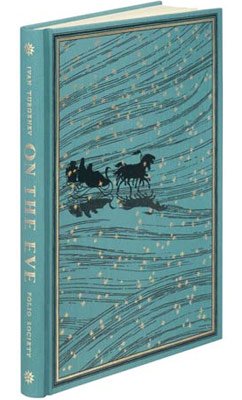
Folio Society books are expensive, but they can help one recommit to the classics.  After acquiring lovely editions of Turgenev’s On the Eve and a four-volume set of Chekhov’s short stories, I spent a happy summer indulging my enthusiasm for 19th-century Russian literature.

Turgenev is not spoken of with the same breathlessness as Tolstoy and Dostoevsky, perhaps because short books are considered less demanding.   But his lyrical style, sharp dialogue, and political and philosophical musings reflect the preoccupations of the time.  Fathers and Sons is Turgenev’s best-known work, but his other books are also little gems On the Eve (1860), his third novel, is an exquisite little book about politics and love that undeservedly has fallen out of print.  The Folio Society has reissued Gilbert Gardiner’s elegant translation, first published by Penguin in 1950.

Set on the eve of the Crimean War and written the year before the emancipation of the serfs in Russia, this novel reflects Turgenev’s own restlessness on the brink of change.  Hisham Matar quotes one of his letters in the introduction.  Like one of his own despairing characters, Turgenev asks,

Is there any enthusiasm for anything left in the world?   Do people still know how to sacrifice themselves?  Can they enjoy life, behave foolishly, and have hopes for the future?

In On the Eve, Turgenev concentrates on four characters in their twenties, Bersyenev, a kind and studious philosopher, Shubin, an artist who often plays the clown, Insarov, a Bulgarian revolutionary, and Elena, the intense woman with whom all of them are in love.  The wealthy Elena has too little to do:  she reads widely and is charitable to the poor, but longs for something to take her out of herself. The daughter of a hypochondriac and a materialistic man with a mistress,   “she struggled like a bird in a cage, though there was no cage.”  After she almost died at 18, she  longed for love or some meaningful experience.

Sometimes it seemed that she wanted something that no one else wanted, that no one dreamed of in all Russia.  Then she would calm down, and spend day after day in carefree indifference, even laughing at herself; but suddenly some strong, some nameless thing which she could not control boiled up inside her and demanded to break out.  The storm passed, the tired wings dropped without being flow; but these moods were not without their cost…

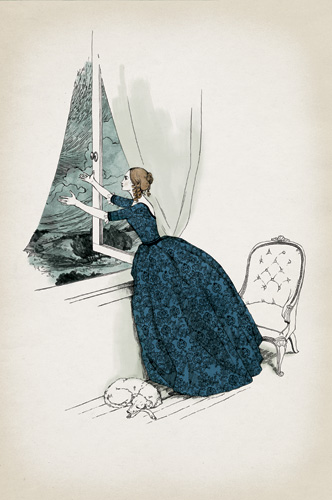
turgeneve illustration elena EVE_13105504090

Illustration by Lauren Nassef (Folio Society)

Turgenev’s descriptions of the country are lyrical, the philosophical arguments among the young heroes are hugely enjoyable, the eternal conflicts between the generations are realistic, and Turgenev’s women struggle to balance love with their ideals.  In On the Eve, Bersyenev is by far the kindest character, but he does not get the girl. The revolutionary Insarov captures Elena’s love, and she becomes as political as he is.  Virgin Smoke, his last novel, also about politics, is perhaps is a better book, but I loved On the Eve, and the ending is surprising.  If you can find a copy, I urge you to read it.

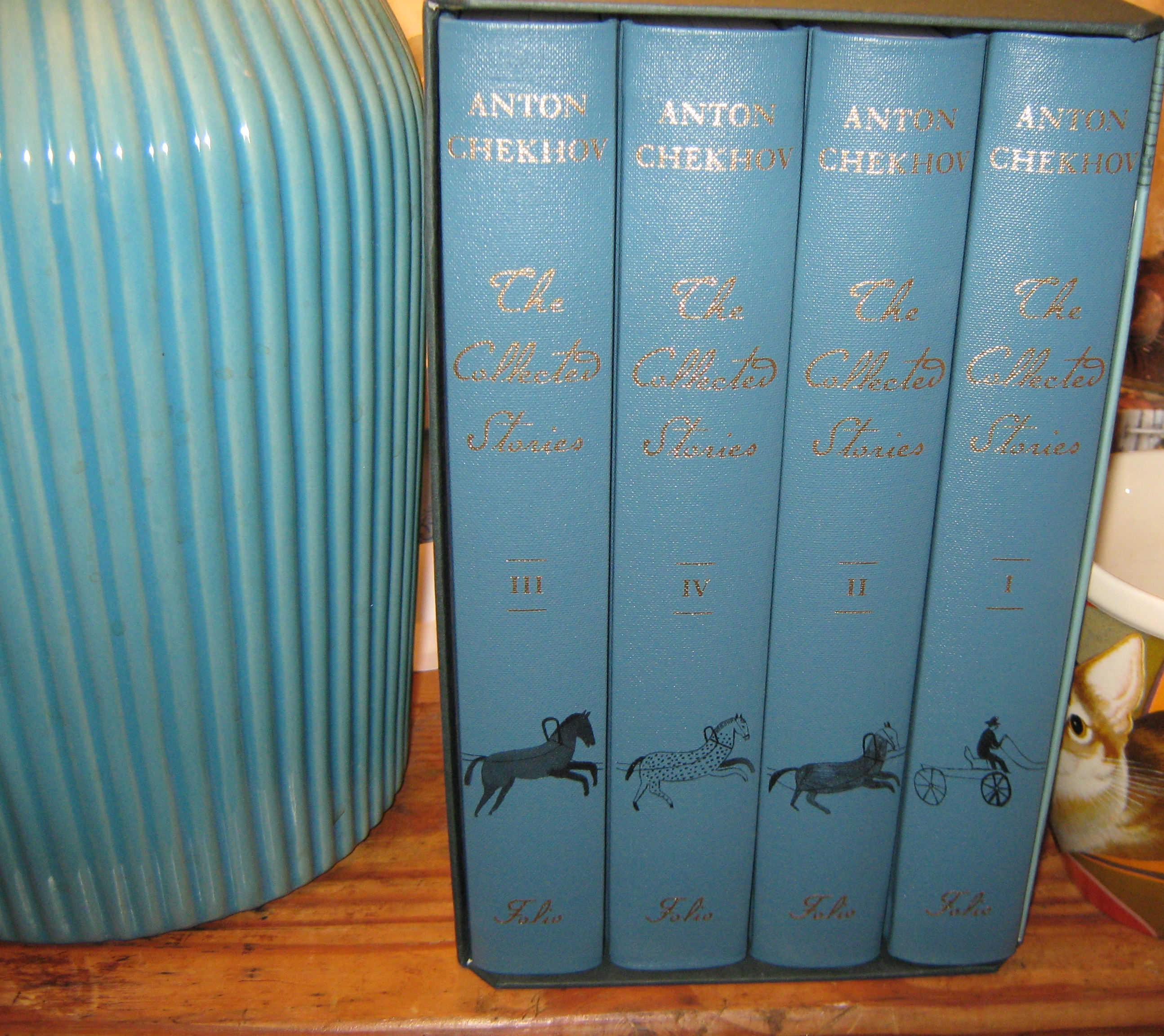
I have struggled for years to comprehend the beauty of Chekhov’s stories in Constance Garnett’s translation:  “The Kiss,” “The Lady With the Dog,” and “Ward Number Six.”  Ronald Hingham’s translations, originally done for Oxford and reissued in this beautiful Folio Society set, have finally made me value the beauty of these stories.  Today I am writing only about Volume 1.

Chekhov folio society img_31331In Volume 1, “The Steppe” is by far my favorite.  It is really a 100-page novella, and the descriptive prose is reminiscent of Thomas Hardy’s.  There isn’t much of a plot.   Kuzmichov and Father Christopher Siriyski, both wool merchants, are on their way to the city to sell their  wool; they are taking Kuzmichov’s nine-year-old nephew with them so they can drop him off to his new school.  They stop at people’s houses to have dinner, camp out in fields and chat to rustics, and enjoy the ride.  Little happens, but the dialogue is comical, and the descriptions of the country are sheer poetry.

In “Thieves,” the medical orderly, Yergunov, “a nonentity known in his district as a great braggart and drunkard,” stops at an inn in a blizzard.  Also present are Kalashnikov, a horse thief, and Merik, a gypsy.  The blowsy barmaid, Lyubka, flirts with all of them, but it is clear that she is not serious about Yergunov.  These amateur criminals are way out of his league.    And when they cheat Yergunov of his horse, he is not even surprised.  More surprising is the fact that after  Yergunov loses his  job and been out of work for eighteen months he believes he has been missing out on fun andwonders if a good burglary might not be the ticket.

Is “Peasant Women.”  Chekhov uses a frame narrative to tell the story.  A traveller, Matthew, tells Dyudya, an entrepreneur who dabbles in everything from tar to honey and cattle, how he came to adopt a boy called Kuzka.  Matthew used to live next door to a woman whose new husband goes to war. Soon Matthew is seeing Mashenka every day and advising her about her business.  Soon after that, he moves in with her.

Then the husband returns, and things turn topsy turvy.  Both men try to persuade Mashenka to go back to her husband.  Instead, she kills him with arsenic because she is madly in love with Matthew.  She is sentenced to a prison term.  The son remains with Matthew.  And the women of Dyudya’s house cry because they see that Kuzka is badly treated by Matthew.  They think he needs to be with women, but they have no power.

Characterized by unexpected details, sharp dialogue, and masterly storytelling,  Chekhov’s stories are mysterious and elegiac, precise and realistic.  Hingley’s translation is excellent, and most of these stories appear in the Oxford World Classics edition of The Steppe and Other Stories.

Literary Links & News: Karen E. Bender on the National Book Awards Longlist, Stevie Smith, Witch Week, H. G. Wells’s Birthday, & Mary Beard on Epitaphs

Every once in a while I post Literary Links and News.

Karen E. Bender

Karen E. Bender

1. Karen E. Bender’s stunning short story collection, Refund, has made The National Book Awards Fiction longlist. I wrote about it here in January and interviewed her  here.  Refund is one of the best books I’ve read this year, and I certainly hope it wins.  Go, Karen!

The complete longlist is:

Jesse Ball, A Cure for Suicide (Pantheon Books)

Karen E. Bender, Refund: Stories (Counterpoint Press)

Bill Clegg, Did You Ever Have a Family (Scout Press/Simon & Schuster)

Angela Flournoy, The Turner House (Houghton Mifflin Harcourt)

Lauren Groff, Fates and Furies (Riverhead Books/Penguin Random House)

Adam Johnson, Fortune Smiles: Stories (Random House)

T. Geronimo Johnson, Welcome to Braggsville (William Morrow/HarperCollins)

Edith Pearlman, Honeydew (Little, Brown/Hachette Book Group)

Hanya Yanagihara, A Little Life (Doubleday/Penguin Random House)

Nell Zink, Mislaid (Ecco/HarperCollins)

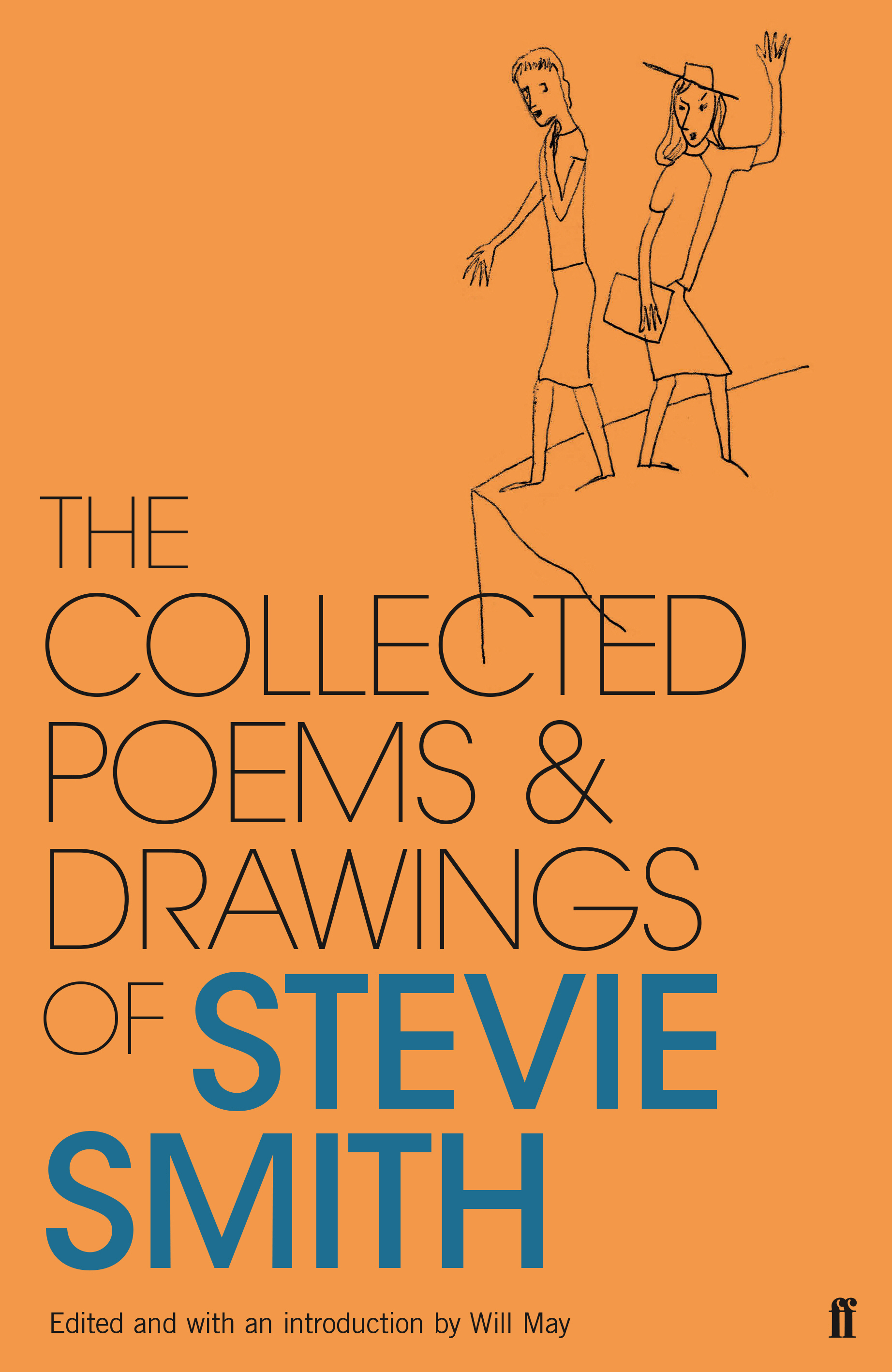
Collected poems and drawings of stevie smith 97805713113092. Will May writes about The Collected Poems and Drawings of Stevie Smith in The Guardian.  He edited the book, which will be published in October.  I covet it!

3. Lory is sponsoring Witch Week at her blog, The Emerald City Review (Oct. 31-Nov. 5). This year’s theme is “New Tales from Old,” fiction derived from fairy tales, folklore or myth, or other old stories.   Post your suggestions for reading at her blog.

HG-Wells-001

H. G. Wells

4. “H. G. Wells Invented Everything You Love” is the title of a brief essay by Leah Schnelbach at Tor.com. Today is his birthday.  Not only did he write great SF, but he slept with many of my favorite writers, among them Rebecca West and Elizabeth von Arnim.  (Okay, that’s a digression, but he did invent much that we love.)

5. At her blog at the TLS, Mary Beard writes a fascinating short piece on Roman memorials and epitaphs.  Beard is a celebrity classicist who has popularized Roman history in her accessible books and often questions our assumptions.

Doubles in Elena Ferrante’s “The Story of a New Name” & Erica Jong’s “Fear of Dying;” And Books I’ll Never Blog About

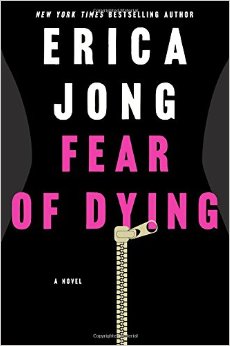
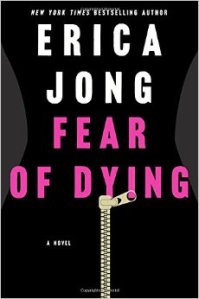
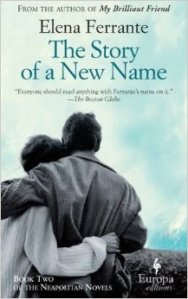
Erica Jong Fear of Dying 41zXii1q0qL._SY344_BO1,204,203,200_ The Story of a New Name by Ferrante 41nSyupOdRL._SY344_BO1,204,203,200_I am far, far behind in blogging about books. Will I ever catch up?  Well, no.  I write Mirabile Dictu four to six days a week (whew!), so I sometimes choose only marginally bookish topics.

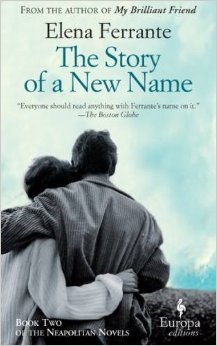
But today I had a brainstorm: doubling up on two novels about doubles, Elena Ferrante’s The Story of a New Name and Erica Jong’s Fear of Dying.

In 2013 I read the first book in Elena Ferrante’s Neapolitan tetralogy, My Brilliant Friend.  I enjoyed it, but it was a bit like reading  an Italian version of A Tree Grows in Brooklyn. And I didn’t continue with the series, till every publication in the world had praised the tetralogy. I finally read the second novel, The Story of a New Name.

It is easy to see why these books are best-sellers. Ann Goldstein’s translations are elegant, and they are very fast reads.  There is something for the literary reader, and something for the reader of pop fiction.   On the Sept. 20 New York Times Best-Seller list, My Briliant Friend is No. 6 and the latest book, The Story of the Lost Child, is No. 7.

The Story of a New Name is a delightful realistic novel.  Still, I quickly sussed out that it is about doubles, and even possession,  rather than a literal friendship.   Elena, the novelist narrator, and Lila, the troublemaker, are childhood friends who squabble, compete, adore writing, read the same copy of Little Women, and grow up in a poor neighborhood in Naples.  Lila breaks all the rules, but is ultimately the least fortunate: she drops out of school to work in her father’s shoe shop and marries the grocer’s son at 16, while  Elena achieves their childhood dreams by graduating from secondary school, going to college, and becoming a writer.

The Story of a New Name begins with Elena’s destroying Lila’s secret childhood notebooks.  Lila, fearful that her husband will  read them, entrusts them to Elena.  Elena reads them, memorizes her favorite parts, and yet is disturbed by a certain artificiality.  She  pushes the box of notebooks off a bridge because  “I couldn’t stand feeling Lila on me and in me, even now that I was esteemed myself, even now that I had a life outside of Naples….”

Later in the book, when they are on vacation at the beach without Lila’s husband, Lila swipes Elena’s boyfriend, Nino, seemingly because she has to have whatever Elena has.  She also reads the books Nino lends to Elena and talks more intelligently about Beckett and politics.  She trumps whatever Elena or Nino says.

Elena is furious.

I couldn’t take it anymore.  What I already knew and what I nevertheless was hiding from myself became perfectly clear:  she, too, now saw Nino as the only person able to save her.  She had taken possession of my old feeling, had made it her own.  And, knowing what she was like, I had no doubts:  she would knock down every obstacle and continue to the end.

By the end of the book, Elena has written her thesis on Book IV of the Aeneid, graduated from college, and published her first novel.  At home in Naples, she receives her own package of  childhood notebooks from the sister of a dead teacher. The notebooks are charming, and Elena smiles at the spelling mistakes and the “good”s and “excellent”s in the margins.  But in the midst of her notebooks, she finds Lila’s little book, The Blue Fairy, which Lila wrote as a child.  And then she realizes that Lila’s The Blue Fairy had inspired her own novel. Their lives are parallel.  They are almost like one person.  Are Ferrante’s books autobiographical, as everyone speculates?  Yes, perhaps:  we all have difficult friendships; but these also seem to be about different aspects of the same person.  Elena and Lila are like Catherine and Heathcliff in Wuthering Heights.

Erica Jong

   Erica Jong

Don’t underrate Erica Jong’s Fear of Dying a brilliant little novel about aging, sex, and death.  Jong, 73, is one of the old-style feminists who believe in power and sex for women.  She is often compared to Henry Miller, that risk-taking novelist whose lively, philosophical, autobiographical novels about sex were banned until 1964.

I thought this was a sequel to Fear of Flying, Jong’s first novel, the story of Isadora Wing, a writer in search of the “zipless fuck.” Alas, Fear of Dying is not about Isadora, but it hardly matters, because the narrator, Vanessa Wonderman, is Isadora’s friend.  They are so alike they might as well be doubles.

Vanessa, 60, is a retired actress, best known for her role as a villainess in a soap opera.  The daughter of two actors who owned a rare bookstore, she wears $1,000-shoes and is a believer in plastic surgery.  But ignore her wealth:  her feelings are the feelings of any older woman, hating the thought of moving beyond her prime.  Her rich husband, Asher,  is in the hospital after an aneurism.  When she is not at the hospital with Asher, she visits her parents, in their nineties, who are not always cognizant of who she is, and are dying in their apartment, with 24-hour caregivers, when they are not in the hospital.

Vanessa hates the prospect of losing her parents.  She also hates getting older herself.  She is losing her looks: now her daughter has them now.  Vanessa, who misses the days when men ogled her, badly needs sex. Can we blame her for looking for it at Zipless.com?  She meets a normal-looking man who takes her to a hotel and wants her to wear a rubber suit.  When she says no, he calls her a bitch.

Vanessa’s and Isadora’s sharing of women’s wisdom at frequent meetings is one of the highlights of the book.At a coffehouse, Isadora joshes her about the rubber suit.  “HOw do you know you wouldn’t like it?”

But then…

“At one point in my life I may have been a love junkie, but it taught me a lot–and I would never be fooled by a site like Zipless now–even though I named it.  Sex on the internet is much overrated.”

“Why?”

“Because most people drawn there are confusing fantasy with reality.  They think they know what they want, but they don’t.”

“What do they really want?”

“Connection.  Slow sex in a fast world.  You can’t get that from a woman in a rubber suit.  Or a man.”

I think about it.  Isadora is right.  We all want connection, and the velocity of our culture makes it harder and harder to find.

And I think that both Isadora and Vanessa are right.

Surprisingly, the book follows the trajectory of a Jane Austen novel.  Marriage is stability, and we learn whether or not the sex can be repaired.  It’s a sad book, but a very good one.  Vanessa finds what she is looking for.

Before I go, here is a  short list of books I loved but will not be blogging about.

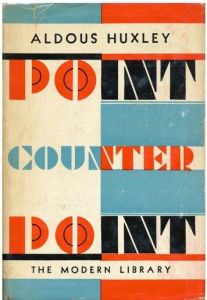
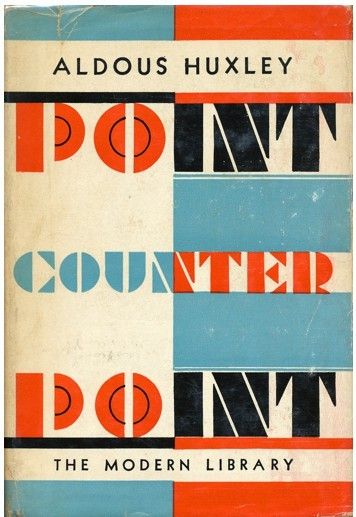
  1.  huxley point counter point c69eb10e5f34e9d21de54b8a8cbacb94Aldous Huxley’s Point Counter Point, a brilliant 1920s satiric novel about Bright Young Things, with a huge cast of characters, writers, artists, scientists, anarchists and suicides.  So many miserable love affairs!
  2. Thomas Middleton’s The Revenger’s Tragedy.  Often compared to Hamlet, this Jacobean revenge tragedy makes Hamlet’s meditation and play within the play seem tame.  Vindice chats to his dead girlfriend’s skull, vowing revenge on the Duke who poisoned her when she refused to sleep with him. That skull is really creepy.  Vindice and his brother get so carried away that almost everybody dies!  (This fascinating play, which I’d love to see, used to be attributed to Cyril Tourneur.)
  3. Margery Allingham’s Traitor’s Purse.  A classic mystery, said by A. S. Byatt to be her favorite.  She wrote the intro to the new Folio Society edition.
  4. Jean Kerr’s Penny Candy.  A delightful collection of humor pieces by the author of Please Don’t Eat the Daisies.  I laughed hard when she goes to a play and  is wearing the same dress as the transvestite on stage.

Lily Tomlin in “Grandma”: Can You Sell Your First Editions?

Lily Tomlin in

Lily Tomlin in “Grandma”

The paucity of roles for older women in Hollywood is proverbial.

A rare exception is the witty, unsentimental film, “Grandma,” written and directed by Paul Weitz.  It is splendid to see  Lily Tomlin, the stand-up comic and award-winning actress, in a dazzlingly authentic role at the age of 76.

Tomlin is believably acerbic and vulnerable as Elle, a lesbian poet at an emotional crossroads. She desperately misses Violet, her partner of 40 years, who died a year and a half ago; breaks up with her girlfriend, Olivia, a brilliant young Ph.D. dropout  (Judy Greer); and then her granddaughter, Sage (Julia Garner), shows up needing an abortion.  Elle does not have the money.  She recently paid off her debts of $27,000 and made a mobile of her cut-up credit cards.

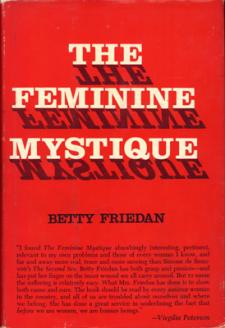
Friedan The_Feminine_MystiqueSo how can they get the $600 for Sage’s appointment later that day?   Elle wildly believes she can get thousands of dollars for first editions of Betty Friedan’s The Feminine Mystique (signed), Germaine Greer’s The Female Eunuch, and Simone de Beauvoir’s Coming of Age. 

Naturally, Sage has never heard of these books. And Elle is more upset about Sage’s  cluelessness about feminism than the low price of The Feminine Mystique ($60) on eBay.

They travel around town in Elle’s vintage Dodge, trying to borrow the money from Elle’s friends. Elle renews her bond with a transgender tattoo artist (Laverne Cox), but alienates the rest.  She screams at Carla (Elizabeth Peña), owner of a feminist cafe, when she offers only $60 for the books.  Carla leaps over the counter to throw her out.

I loved the scenes with Oscar-winning Marcia Gay Hardin, who plays Elle’s daughter, Judy, a hard bitch businesswoman who had Sage by sperm donor.

I’m really blogging because of the bookish connections—first editions aren’t worth what they used to be because of the internet –but I loved this affecting, unsentimental movie.

Filthy Jokes in Aristophanes’ The Frogs

woman writing typing+woman

           “But is it fun?”

I enjoy writing Mirabile Dictu.

But is it still fun, we ask ourselves?

Writing about MasterChef is fun.

Writing about Fashion is Spinach is fun.

Wrriting about great literature is not always fun.

Time is precious. It goes very fast.  As Ian McEwan wrote in The Guardian when he was 64, “If I’m lucky, I might have 20 good reading years left.”   Having recently had a big birthday, I know what he means.

I hate to lose my spark, so today am entertaining myself with a short piece on filthy jokes in Aristophanes.

When Michael Stipe, the lead singer of R.E.M., listed Four Plays by Aristophanes, translated by William Arrowsmith, in The New York Times as one of his 10 favorite books, I was delighted.  One for the classics!

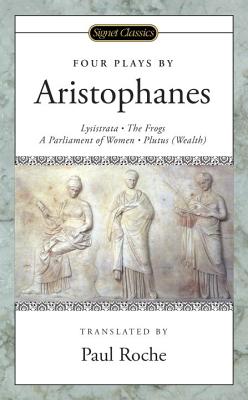
I like this translation by Paul Roche.

I like this translation by Paul Roche.

Many years ago, I fell in love with Aristophanes’ poetic comedies in a Greek seminar. His most accessible comedy is Lysistrata, a hilarious anti-war play.  But his masterpiece, The Frogs, requires a little background  (a short introduction should do it).    The Frogs is a rollicking slapstick comedy, but it is also riddled with fierce literary criticism.

In The Frogs, Dionysus, the god of wine, also associated with Greek tragedies, is disgusted with “modern” trends in playwriting.  There is no poet above ground, Dionysus says, who can write good tragedy anymore.  And so he descends to the underworld with his slave Xanthias to bring back the tragedian he calls a “clever rogue,” Euripides.

Aristophanes’ jokes are very silly, often smutty, often scatological.

And the filthy jokes frequently need a gloss.

I recently reread The Frogs in Greek.  Translating the jokes can be very difficult.

Dionysus and Xanthias are on the road, and Xanthias is in charge of the baggage.  Dionysus is telling him which stock jokes on the subject of baggage he cannot endure,

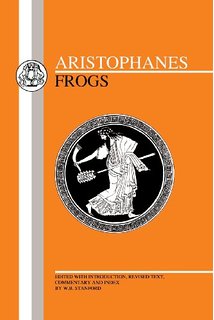
In the notes of the W. B. Stanford edition of the Greek text, he translates a joke Dionysus objects to as: “[Saying] as you change over your carrying pole that you want to ease yourself.”

Stanford goes on to explain that slaves carried baggage on the end of a short pole resting on their bladder.

A translation of “you want to ease yourself,” courtesy of me, is:  “you want to crap yourself.”

ARistophanes frogs 41bBlK7F+FL._AC_UL320_SR214,320_Actually, I’m not sure if it’s urinating or defecating.  The definition of the verb in Liddell and Scott’s dictionary is “ease yourself” or “drop dung.”

I’m trying to visualize this as I read Xanthias’s answer, which is another bad joke:  “Not even [the joke] that I’ll burst out from carrying so big a load, if someone does not relieve me, and that I’ll break wind?”

The jokes about loads, defecation, and farting are even ruder than on HBO.

But one suspects the jokes are much filthier than the dictionary lets on.  The scholarly dictionary by Liddell and Scott, published in the nineteenth century and still used by scholars, often substitutes circumlocutions for risque words.  So trying to untangle what is happening in the jokes can be arduous.

I have  always very much enjoyed Moses Hadas’s snappy translation (1962).  He translates the two lines above as:

Dionysus:  To shift your load, and say that you are pooped?

Xanthias:  Or, if nobody will relieve the strain, I’m going to ‘relieve myself’?

Paul Roche’s 2004 translation is more explicit. His version of the lines above:

Dionysius:  About your having to shift your pack and have a crap.

Xanthias:  What the heck!  I can say, surely, that if somebody doesn’t come and help, my bottom’s going to let out a yelp.

It is actually much funnier after you get past the bad jokes on the first page.  I am sure that if we were in the audience we’d be laughing hysterically.  We wouldn’t need footnotes.

I do not have access to scholarly articles or books on Aristophanes’s jokes, but it is fascinating to translate the Greek oneself, and then look at the English translations.  Writing Aristophanes in English is hard work!

Loser vs. Loser: Why We Love Reality Shows

The finalists on Masterchef: Stephen, Claudia (the winner), and Derrick.

The finalists on Masterchef: Stephen, Claudia (the winner), and Derrick.

Everybody loves to see a loser win.

Tonight on MasterChef, finalists Stephen, Derrick, and Claudia struggled to cook the best dishes for a prize of $250,000 and the publication of their own cookbook.

But would reality TV be so popular without the rise of amateur culture on the internet?

The internet and reality TV came of age together in the ’90s and the first decade of the 21st century.

According to French philosopher Jean Baudrillard via the Stanford Encyclopedia of Philosophy, the production and consumption of commodities have been replaced in postmodern society by the “hyperreality” of simulations:   images, spectacles, and the play of signs replace the concepts of production and class conflict.

Certainly Americans like their simulations:  according to Nielsen reports, the average American adult spends 11 hours per day using electronic media (TV, smartphones, computer, etc.).

And now that amateurs have their own culture online, we want to watch it on TV, too.  Losers have their chance to win.

Day job:  waitress.  Night life:  blogger and artist.  Yup, she writes film criticism, posts her quirky illustrations, and tapes her dramatic one-woman show of the Ophelia scenes in Hamlet.   Is she as mad as Ophelia? She is sure one of her blog readers is Benedict Cumberbatch (Hamlet in the production at the Barbican)!  If she dyes her hair blond and sleeps with a director, she WILL be on a reality show and then play Ophelia!

The internet is fun because we don’t have to be too serious.  We can post casual reviews or essays.

At one time I thought it might provide the ideal community. Remember the Well?  But in 20 years, I have seen dozens of online groups rise and fall. Even with a glossier presentation of the real self, the online personae frequently crack up. There are many, many silly, trivial arguments in Yahoo discussion groups, where membership  has waned drastically in recent years, replaced by other social media.  Online friends turn on each other, because they’re narcissistic or nerdy, mad or malicious.  Here’s a good thing: I don’t see arguments at Goodreads.

Reality shows are more honest than the internet, you think.  You see who the winners and losers are.

Well, hardly.

The contestants are losers, as defined by our culture.  On MasterChef, they’re usually working-class, artistic but underemployed, or barely white-collar.  Derrick is a drummer from Fort Myers, Florida; Claudia, a Mexican-American mom and an events manager who lives in a really crummy one-bedroom apartment; and Stephen Lee is an urban gardener who wildly heckles other and seems borderline-Tourettes. Yet they were neck-and-neck in creating beautiful, delicious food.

Artistic Derrick should undoubtedly have won for his eclectic contemporary gourmet food:  the pan-seared venison with root vegetables in huckleberry sauce in a puff-pastry lattice cage was breathtaking.  The lattice cage formed an arch over the venison.  Actually, the judges adored it and were wowed by his plating.

But they gave the prize to Claudia, a lovely, poised person who elevated Mexican food.  I got the impression they gave it to her because they liked her story.  Perhaps they liked the idea of helping a single mom.  She always cooked Mexican food.  Derrick was a gourmet, a true artist.

And so winning is arbitrary, no?

What I’m Reading Now: Elizabeth Hawes’s Fashion Is Spinach

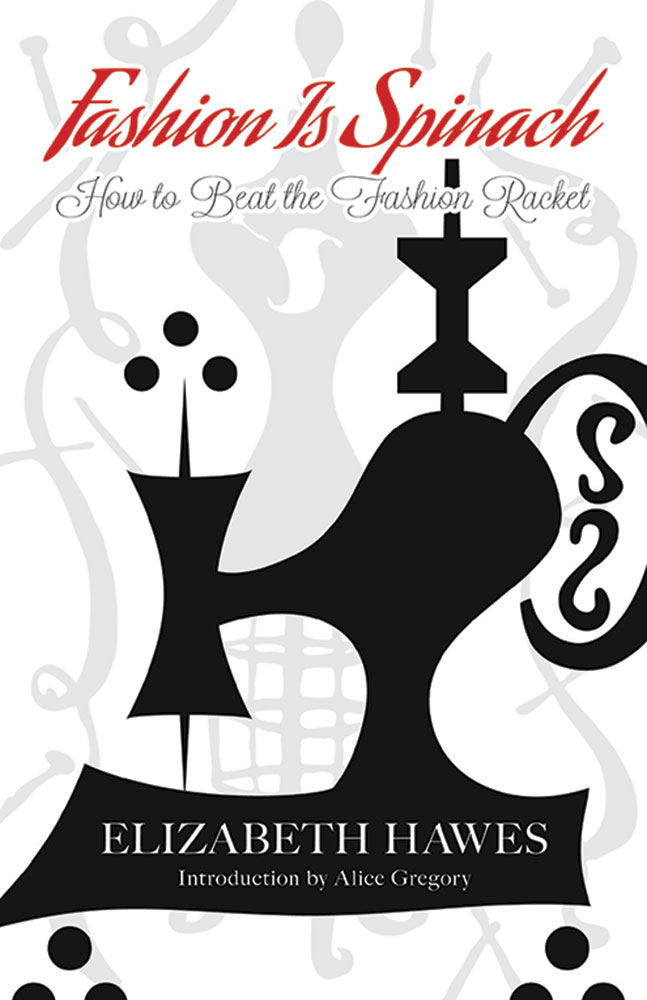
Elizabeth Hayes Fashion Is Spinach yhst-137970348157658_2381_953741503At my house, fashion means black slacks with no cat hair on them.  I am elated if an outfit can double for a bicycle trip and shopping at the supermarket.

Not being fashionable, I was surprised to fall in love with  Fashion Is Spinach (1938), a witty, addictive book by Elizabeth Hawes,  a twentieth-century fashion sketcher, reporter, critic for The New Yorker, and designer of her own line of clothing. Part autobiography, part critique and history of the fashion industry in the 1920s and ’30s, this engrossing book makes me think of the  humor writing of Cornelia Otis Skinner crossed with the radical criticism of Mary McCarthy.  It has recently been reissued by Dover.  Her eight other books are out of print.

Hawes writes dramatically, “I, Elizabeth Hawes, have sold, stolen, and designed clothes in Paris.”

Born in Ridgewood, New Jersey, in 1903 , she always loved sewing.  As a child she made hats for her Kewpie dolls and designed and sewed her own dresses.  By the age of 12, she was selling children’s dresses to a store in Pennsylvania.  She gave this up in high school because she wanted more social life, but continued to make her own clothes.

I used Vogue and Harper’s Bazaar freely, copying sketches or changing them.  This further enforced the French legend on my mind.  All beautiful clothes were designed in France and all women, including myself, wanted them.

She is thankful that she “escaped going to art school” and went to Vassar, which was a family tradition.  At first she had no direction.  She was bored by English and history.

My first year at Vassar was marked by nothing much in particular.  My sister was a senior and had a good many men for weekends.  I tried to fall in with the same plan.  It worked with fair success until the end of that year when I lost the beau I had kept hanging over from high school.  He went to Williams and, after having me to one house party, outgrew me.  I was quite unattractive and as I became progressively more serious-minded during the next three years, I had fewer boyfriends.

Having fewer boyfriends was a good thing at Vassar.  Hawes became enraptured by economics, including Labor Problems and Socialism.  She was entranced by the economic theory of Labour Party co-founder Ramsay MacDonald, and wrote her thesis on it.  Outside classes, she continued to make clothes.

After graduation, she went to Paris on a shoestring.  A couple of poorly-paid freelance fashion reporting jobs paid the rent for a small room with a basin.  (She had to give up baths.)  She knew hardly any French, and it took months to pick up.

But it didn’t prevent her working, and in Paris she learned the difference between style and fashion.

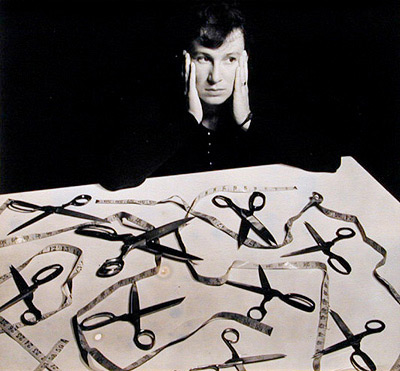
Elizabeth Hawes

Elizabeth Hawes

She tells us bluntly that there are two types of women:  “One buys her clothes made-to-order, the other buys her clothes ready-made.”

The former are lucky, the ones who had a real style and clothing created by French designers.  The rest of us must wear whatever Macy’s decides to sell.

Hawes writes:

Fashion is that horrid little man with an evil eye who tells you that your last winter’s coat may be in perfect physical condition, but you can’t wear it.  You can’t wear it because it has a belt and this year “we are not showing belts.”

Fashion gets up those perfectly ghastly ideas, such as accessories should match, and proceeds to give you shoes, gloves, bag, and hat all in the same hideous shade of kelly green which he insists is chic this season whether it turns you yellow or not.

Elizabeth Hawes

                Elizabeth Hawes

Paris fashion for Hawes in the ’20s was a crazy wild rush of  making up fashion news (there were only two big shows a year by designers), and working at copy houses that tried to get illicit previews of designers like Chanel.  Hawes got a job as a sketcher at a copy house, a dressmaking shop “where one buys copies of the dresses put out by the important retail designers.  The exactitude of the copy varies with the price… ” (Generally they were about half the price.)   She was sent to fashion shows to “copy” the clothing in sketches (which she had to do hastily afterwards from her notes on programs, and sometimes her programs were seized by the attendants.   The copy house also paid American manufacturer buyers to let them see the latest clothing before it was sent by a fast ship to the U.S.  One of their regulars was Madame Ellis.

Madame Ellis did not want to be seen at the copy house.  She insisted that someone be sent to her.

Hawes writes,

I had a very large beaver coat.  A fur coat in Paris is quite a rarity among the working class.  Mine turned out to have a special value.  I was requested to don it one day in November and go to the resident buying office through which Madame Ellis worked.  It was toward the end of the mid-season buying, the day before a large boat was to sail.

Madame Ellis opened the boxes of Chanel dresses, told her to put them under her coat, “and get them back here as fast as you can.”

This is an absolutely compelling read.  I love Hawes’s stories and her radical take on fashion.  Ready-made clothes should be made for real women, who should be asked what they want.  I couldn’t agree more.

Eventually she is disgusted by the theft of designs and finds work as a designer. And then she goes home to the U.S. to design and sew.

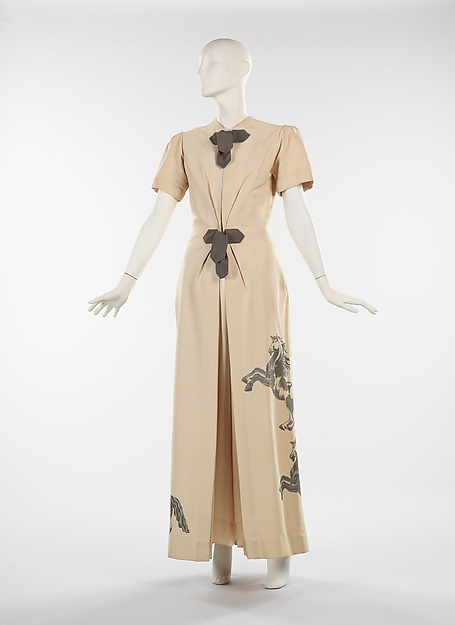
I long for these silk lounging pajamas.  You can see them at the Metropolitan Museum of Art.

By the way, Hawes was blacklisted during the McCarthy era in the ’50s.  Her career never recovered.

lounging pajamas (Metropolitan Museum of Art)

  Hawes’s lounging pajamas (Metropolitan Museum of Art)

Light Reading: J. Jefferson Farjeon’s Thirteen Guests

Yes, it's cozy and I enjoyed it!

Mystery fans have different tastes.  Some prefer cozies, others read only police procedurals.  Although I love the tough-guy-and-gal detectives of Sara Paretsky and  Elmore Leonard, I usually go for the cozies.  I am very fond of Golden Age Detective Classics of the 1920s, ’30s, and ’40s.

I recently read J. Jeffererson Farjeon’s Thirteen Guests (1936).

If you do not know Farjeon, you are not alone.  He wrote over 60 novels, but most are out of print. A few have recently been reissued in The British Library’s Crime Classics, a series of mysteries rediscovered in the British Library.  Poisoned Pen Press is now publishing the series in the U.S.

Thirteen Guests is a country house party mystery.  If you have read Agatha Christie’s The Affair at Styles (and countless others like it), you are familiar with the “closed circle” of suspects:  one of the guests is the murderer.

Farjeon is an expert plotter but the setting-up of the plot is slow.  I plodded on, trusting in the British Library.  It begins at a train station: John Foss has an accident disembarking from a train.  Nadine Leveridge, a charming widow who disembarked before him without incident, insists on giving him a ride to the village doctor’s house.  When they learn the doctor is at Bragley Court, which happens to Nadine’s destination, they drive on.  It is the home of Lord Aveling, a Conservative politician giving a house party.

Once we arrive at Bragley Court, the pace picks up and the writing gets sharper.   Lord Aveling invites John, who cannot walk on his injured foot, to stay.  The savvy politician thinks it might be good PR:  he has invited a gossip columnist for the weekend.  He is slightly concerned about having thirteen guests now, among whom are a mystery writer, a Liberal politician, and an actress.   But it will be the thirteenth to arrive, the menacing Mr. Chater, who will be unlucky.

Things soon start to go wrong.  Two of the better-developed characters are Leicester Pratt, an artist, and Lionel Bultin, a gossip columnist.  Both have sold out for fame.  First, Pratt finds that his painting of Lord Aveling’s daughter Anne has been defaced in the studio.  Then a dog is discovered with its throat slit.  The next day, a stranger (who is not a stranger to at least one of the guests) is found strangled.   Chater disappears during a fox hunt and is discovered dead.  Bultin takes elaborate notes for his column and notices odd things no one else does.  Bultin and Pratt discuss the murders.

There is much anxiety and fear, and when a brash detective is called in, he depends to a large extent on Bultin’s notes and John’s impressions.  John, confined to a loungehall and anteroom, outside of the action, is an excellent observer. But he is afraid to tell all he knows.  He worries that the likable Ann, the daughter of Aveling, might be guilty.  Nadine assures him that it cannot be so.

The chemistry between John and Nadine is charming.

This is an entertaining whodunit, and there are, as Dorothy Sayers said of his work, some “creepy” elements, like the death of the dog.  Not all the characters are well-developed, but there is plenty of suspense.  Farjeon’s Mystery in White: A Christmas Crime Story was a best-seller in the UK last Christmas.  It is always great fun to discover a new (old) writer, and I look forward to reading more of his books.