Friendship and Elena Ferrante’s Neapolitan Novels

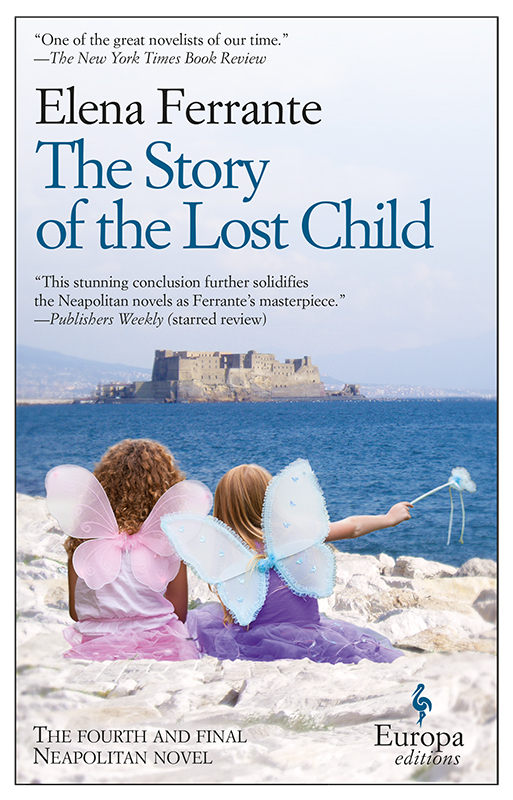
Elena Ferrante's The Story of the Lost Child Cover3Peter Stothard, the editor of the TLS, wrote enthusiastically in his Editor’s Column (9-11-2015) about Lidija Haas’s critical essay on Elena Ferrante’s The Story of the Lost Child and the Neapolitan quartet as a whole.

Stothard writes,

For four years the fame of the Italian novelist Elena Ferrante has been gaining strength. To use one of the classical parallels that her own characters like to employ, her rise in stature has been like that of Fama in the Aeneid, spreading relentlessly the love of Dido. As Lidija Haas describes this week, the pace of Ferrante-following has now so quickened that the pastel-coloured paperbacks are almost as familiar on London Transport as free newspapers. Book One – in which two Neapolitan slum girls argue (inter alia) about Latin and Greek – has now culminated in Book Four (whose plot late-adopters may prefer not to know). Haas joins the admiration of a “magic” writer and considers too the critical response – from praise for a revival of the best of nineteenth-century realism to the view that the quartet could have been written only with the postmodern at its heart. The pseudonymous author herself, also like Virgil’s Fama, remains hidden from view with her head in the clouds.

As a Latinist, I always love Stothard’s classical references. But Fama can be fickle:  in the Aeneid, IV.174, Fama is malum qua non velocius ullum (“an evil than which not any is faster”) as she spreads the rumor about Dido’s affair with Aeneas.  In the case of Ferrante, Fama is  more benevolent:  she gossips happily about the Neapolitan tetralogy in The New York Times, the TLS, at many blogs (Heaven Ali has written about Ferrante), and at a public library book club with equal fervor.  Whether Fama has done a good deed (surely not a bad deed) will be revealed by critics of the post-apocalyptic future. pic of first three books of neapolitan novels ferranteThe Neapolitan novels tell the story of a rocky decades-long friendship between two women.  (I blogged about  My Brilliant Friend in 2013.)  I haven’t read Haas’s essay yet:  I can’t until I’ve read all four.  I got up this morning and rushed out to buy the second, third, and fourth.  I had to comb the store to find the last copy of The Story of the Lost Child.

I started the second book, The Story of a New Name.  A shock of recognition rocked me when I read page 18.  The heroine, Elena, who is angry and jealous of her best friend, Lila, destroys a box of eight notebooks Lila entrusted her with so her husband would not find them.  Why does Elena destroy the notebooks?

I couldn’t stand feeling Lila on me and in me, even now that I was esteemed myself, even now that I had a life outside of Naples….  I placed the box on the parapet [of the Solferino bridge], and pushed it slowly, a little at a time, until it fell into the river, as if it were her, Lila in person, plummeting, with her thoughts, words, the malice with which she struck back at anyone, the way she appropriated me, as she did every person or thing or event or thought that touched her…”

After our friend D’s death, an artist friend and I did something similar.

When D was dying, she refused to let us visit her. Those she loved she now rejected.  She allowed everyone else to visit, and I do mean everyone:  a passive, pretty, shallow woman no one else liked (“D can dominate her,” the artist suggested), people she’d volunteered with, old neighbors, her lovely mother’s friends.  She talked to us lucidly on the phone, but only on the phone. Hearing from others about her deterioration, we were devastated.  At the end of her life, in pain, unable to swallow, her face puffy with steroids, she insisted that all personal things be removed from the room and she kicked out her husband.  It was a furious death: she looked at the living and couldn’t believe she was the one who was dying.

The artist, with whom she’d gone to art school, and I, the freelance writer sidekick who had recommended her work to editors, had what she wanted.  I understand this but I didn’t know death.  People in novels are always dying in each other’s arms.  D wouldn’t let anyone in the room.

She was a good poet who didn’t publish.  A former neighbor who had known D since childhood paid for a vanity press publication of  her poems.  I wonder how D felt about this.   I had seen her run her wheelchair angrily over a rejection letter.

The artist didn’t go to the funeral.  I, eternal good girl, did.  But we got together  a few months later and burned our copies of the “vanity” book.  I loved her poetry, but we were emotional wrecks.  I kept the print-out copies of her poems.  I sent them out to literary magazines.  They were rejected.

She asked me near the end of her life (on the goddamned phone) if I thought a life spent reading was worthwhile.

I do.  Serious as a marriage vow.

I think she was shattered that she didn’t have time to prove herself as an artist or a writer.

All that freelance writing:  what did it mean?  We should have gone to low-residency MFA programs.  Poetry for her; nonficiton for me.

Sometimes I think of her when I read.  I am sorry that she can’t read Ferrante’s novels, because she would have loved them.

As teachers we bonded in the lounge over Calvino’s Cosmicomics. We quit to become freelance writers. Although she was a paraplegic, she drove (I do not), and we used to go to the mall to shop at The Limited and Banana Republic.  Then we drank coffee and discussed the books we shared: Cynthia Heimel’s humor book, Sex Tips for Girls, Sharon Olds’ poems, Donald Barthelme’s City Life, Raymond Carver’s short stories, Faith Sullivan’s The Cape Ann, Gail Godwin’s A Mother and Two Daughters, Sue Grafton’s mysteries, Philip Larkin,  and Louisa May Alcott’s An Old-Fashioned Girl.  We went to bookstores.  Malls were much more wheelchair-friendly than the city places where I hung out.

One sees so many beautiful things as one grows older: landfills turning into prairies (though probably still not quite safe), urban trails that go past eerily beautiful closed factories and junkyards, the gorgeous blue blue lakes in Minnesota, pelicans, eagles, mountains, books.

Years after her death, a priest asked me about D’s loss of faith.  I told him I knew nothing about it.

The Book in My Bike Bag: Trollope’s He Knew He Was Right

bike council bluffs path img_0932Every summer I carry a Big Book in my bike bag.

On bike journey breaks, I flip down my kickstand (I am the last person with a kickstand), sit on a bench, and read.

It is always a Very Big Book.

He Knew He Was Right trollope 41RJjyDTOLL._SY344_BO1,204,203,200_This being Trollope’s bicentenary,  I have reread four of his books this year.  And I now admit it is possible to read too much Trollope.   I ODed on my rereading of Trollope’s He Knew He Was Right (my bike book of the summer)It  is a very great book, one of Trollope’s best, and an engrossing novel about jealousy, madness, marriage, and money.  It is a retelling of the Othello story, set in the 19th century.   I wonder if I am  critical of the flaws in the characterization of Louis Trevelyan, Trollope’s Othello,  and the looseness of the structure, because I have read too much Trollope.

He is very good, he is often great, but he wrote too much:  47 novels.  His work is uneven.

On the other hand, He Knew He Was Right is 823 pages long, so a little rambling is in order.

Trollope writes easily and well, and has a gift for comedy.  In this novel, and also in Phineas Redux, which I read earlier this year, he also shows his gift for tragedy.  (I cried at the end of He Knew He Was Right.)

The novel begins with the story of a happy marriage.  Louis Trevelyan has married Emily Rowley, the penniless daughter of the governor of the Mandarin Islands.  Louis generously invites Emily’s sister, Nora, to live with them  in London.  She is more likely to make a good marriage in London.

Louis has everything.  He is smart, “but not a book-worm.”  He is a “handsome, manly fellow, with short brown hair, a nose divinely chiselled, an Apollo’s mouth, six feet high, with shoulders and arms and legs in proportion–a pearl of pearls!”

And then Trollope adds,

Only, as Lady Rowley was the first to find out, he likes his own way.

Emily also likes her own way.  In fact, almost everyone in this novel likes his or her own way, as Trollope is quick to tell us.

HE KNEW HE WAS RIGHT TROLLOPE DOVER 7154878-LLouis and Emily are very happy at first.  But they soon begin to struggle because her father’s oldest friend, a fiftyish colonel, visits her often  and flirts with her.

Louis asks her not to see the Colonel. He is an agony of jealousy.  She says she has done nothing inappropriate and refuses to ban her father’s oldest friend.  She does not believe the Colonel is flirting.  (He is.)  Her sister, Nora, does not think there is any flirting, either, but she begs Emily to humor Louis. Should Emily or shouldn’t she have?  Would it have made things better, or would he have just become more tyrannical?

And then it takes a tragic turn.  Trevelyan is driven mad by jealousy (though is that enough to account for his madness?), and eventually he and Emily have a terrible disagreement, resulting in a separation, his spying on her, the kidnapping of their child, etc.

There are comic courtship subplots, which lighten the mood.

Louis Trevelyan’s best friend, Hugh Stanbury, is in love with Emily’s sister Nora.  She hesitates, though.  What’s wrong with him?  Well, he is poor.  He gave up the law to be a journalist.  And though Nora is in love with Hugh, she very much wants to be in love with her rich suitor, Mr. Glascock, the son of Lord Peterborough.  Why oh why can’t she be in love with the right man?   But she has to refuse Mr. Glascock.

Hugh was his rich spinster aunt Miss Stanbury ‘s favorite until he began writing for a “penny paper.”  Now she has invited his younger sister, Dorothy, to live with her, and hopes to marry her off to Mr. Gibson, the smug, conceited curate. But it is just as well that Dorothy dislikes him (she has fallen in love with someone else):  Mr. Gibson has flirted for years with two card-playing spinster sisters, Arabella and Camilla French, and his fate lies with them, if only he can figure out which one.

The third marriage subplot is smooth and without conflict.  And Mr. Glascock, Nora’s rejected suitor, falls in love in Italy with a pretty American girl, Caroline Spalding, the niece of the American ambassador. Even though Nora is engaged to Hugh, she feels jealous of Caroline.

Why read Trollope?  He’s a bit of a shaggy-dog storyteller.  Even his best books, the Palliser novels and the Barsetshire novels, ramble.

Yet he is an addictive, cozy writer.  Some will bridle at the word “cozy,” but it is true. He will not shock you. He will entertain you. We read him because he is an addictive storyteller. He is neither George Eliot nor a Dickens–but he is reliably entertaining. He is one of the best storytellers of the 19th century, and you can’t do much better than that.

Steven Brust’s The Sun, The Moon and the Stars

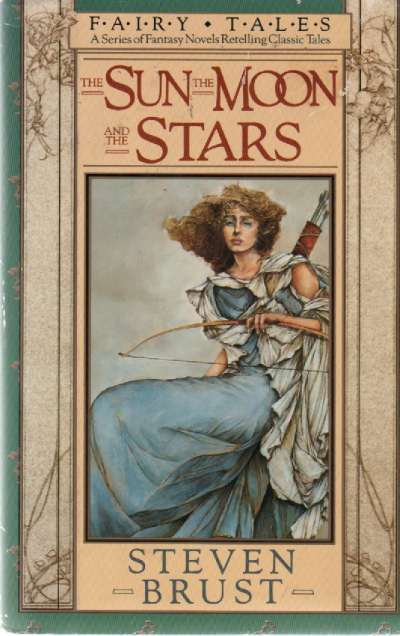
Steven Brust The Sun, The Moon, and the stars image1Last week I devoured Mervyn Peake’s modernist fantasy classic,Titus Groan; over the weekend I read another unclassifiable novel, Steven Brust’s The Sun, The Moon, and the Stars.

I picked up this lovely hardcover book because it is the first in the splendid “Fairy Tale Series” edited by Terri Windling, who recruited several fantasy writers to retell fairy tales for adults.  Some of the versions are traditional; others have a more original slant.  The gorgeous covers were designed by Thomas Canty.

The Sun, The Moon, and the Stars (1987) is a clever, carefully-crafted account of an artist’s struggle to create. The narrator, Greg Kovacs, shares a studio with four artists in Minnesota.  After dropping out of college, he earned a degree in drafting, but he has never had a drafting job, because  his photographer girlfriend supports him. Sometimes he fells guilty that she has sacrificed her art so he can paint.  He does not sell his work, nor do his friends.  And they are approaching a crisis in the studio:  they need to have a show or break up.

I am fascinated by Greg’s work:  he is creating his own myth about the Greek gods Uranus (Sky), Apollo, and Artemis, and painting it on a giant canvas he calls the Monster.  But it is the  structure of the book that dazzles me.

Each chapter is divided into six short sections, and each section bears the title of a painting.  (I didn’t figure that out until I was well into the book.)  I  am sure the paintings relate to the text, and I look forward to rereading this with an art history book in hand (or, more likely, Wikipedia).

"The Death of Marat" by Jacques-Louis David

“The Death of Marat” by Jacques-Louis David

The narrative describes Greg’s aggressive interactions with friends, and also his strong-minded philosophy of art.  He opposes modern, abstract art, but the book is modernist.

He is completely unpretentious.  He needs to look at art constantly.  In a section called “The Death of Marat,” Greg tells us that  he  looks at prints for inspiration.  Looking at the real paintings is the ideal.

He gets to know famous artists through their work.  He writes,

I do know artists who say, ‘I can’t look at other people’s work while I’m painting because their style creeps in.’  The first time I heard that, I did a cartoon of Gauguin’s style creeping into Cezanne’s work, and I called it, “Such tragedy.”  I thought it was pretty obvious, but the people who ought to get it never do.

The other artists are slowly sketched in, though we don’t get to know them well.  They ruthlessly criticize each other’s work.  Greg is very aggressive, and spares only. Karen, the only woman,  who paints landscapes and has no talent, he thinks.   (The others suggest he is sexist; his girlfriend Debbie reminds him that he doesn’t even help with the housework.)  The brilliant Dan works in a  style Karen calls “post-urban subway.”  David is a body-builder. (Naturally, I thought of the sculpture.)  Rob likes to go dancing at night.

In every chapter, one section is devoted to Greg’s telling the others a Hungarian folk tale he half-remembers, half-invents.  A taltos (wizard) has  said he will put the sun, moon and stars in the sky in exchange for king’s daughter and half the kingdom. And then there will be light!   He takes his two brothers to help.  There is fighting of dragons and their human wives and mothers-in-law.  The tale is half-humorous.  I am frankly baffled by how it fits in with the rest.  I  will pay more attention to it next time.  (Yes, I will reread it.)

I very much enjoyed this short novel.  The writing isn’t perfect, but the perfect structure shows off the writer’s brilliance.  The book has elements of fantasy, but can be read as a realistic novel about art.

Steven Brust says of The Sun, the Moon, and the Stars :

I think at a certain point, every writer has to ask himself why he writes, and what he’s hoping to do. I wrote this one to answer that question…. I have mixed feelings about it—I think I did all right with it, but it is too personal to have a very wide appeal. Still, I’m glad I wrote it, and I’m always pleased to run into people who like it.

The Case of the Missing Comments: Lost, Spammed, or Moderated?

Anne Taintor "funny I don't recall asking for your opinions' 5398_OpinionBeverageNapkin-500x500There are magical, unexplained, supernatural things on the internet.

Having grown up on the novels of E. Nesbit, where the Psammead/sand fairy grants wishes in a really twisted way, and  a magic wishing ring is likely to backfire on you, I always find the internet fantastical.  You mean it’s not magical?  Well, can’t explain any of it!

But there are also mechanical glitches.  Unless it’s witchcraft!

For instance, I have only sporadically received email alerts lately about comments posted here.  Strange.  I always got them before.  But I am not concerned about it.
And then a reader informs me that his/her comments are not appearing on my blog.

What comments?  I wondered.  I checked spam and found one.  I retrieved a perfectly intelligent comment about Mervyn Peake’s Titus Groan and approved it.

I don’t know what triggered the magic spam-sorter, which apparently did not want me to know there is a fourth Titus Groan title!

I welcome most comments.

But I have the right to moderate comments.

Yup.  It’s my blog.

Some commenters believe that blogs exist to host contentious debates.  I will write something I think is perfectly normal, and then the “trigger alert” types will go mad.  What?  I don’t wish to fight with them?   How dare I not?  They WILL be heard.

Fine, okay, just not here.

I welcome comments, but this isn’t a public forum.

People on the internet do occasionally go off on strange tangents.  In the pre-internet days before the newspapers and magazines began to die, people wrote letters to the editor.  (How quaint!)  Some letters are/were published, others are/were not. Do they believe it is their “right” to be published?

In this day and age, you do have to watch out for the “trigger alert”censorship  people. They are very “sensitive”:  just not to you!  It is where the “far left” control-freaks meet the “far right” control-freaks.  And that is way too far for most of us.

Examples:

  1.  Last spring some writers at PEN (not a majority, thank God!) boycotted the dinner in New York at which a special award was  given to Charlie Hebdo.  All I can say is thank God for Salman Rushdie, who very  articulately argued against this disgraceful protest and pointed out that today his controversial novel, The Satanic Verses, would not have been published.
  2. According to New York Magazine, a theater group at Mount Holyoke College decided not to put on The Vagina Monologues because “the material excludes women without vaginas.” I do have a controversial feminist thought: It is a fact that women have vaginas.   People with penises do not have a right to define us.
  3. Some Christian fundamentalist students at Duke objected when lesbian writer Alison Bechdel’s graphic novel, Fun Home: A Family Tragicomic, was recommended summer reading.  And according to an excellent article at the Atlantic:  “some students have called for warnings that Chinua Achebe’s Things Fall Apart describes racial violence and that F. Scott Fitzgerald’s The Great Gatsby portrays misogyny and physical abuse, so that students who have been previously victimized by racism or domestic violence can choose to avoid these works, which they believe might “trigger” a recurrence of past trauma.

Oh, God!  What a sad state of things!   There are many offensive things in the world:  reading classic  novels is not one of them.

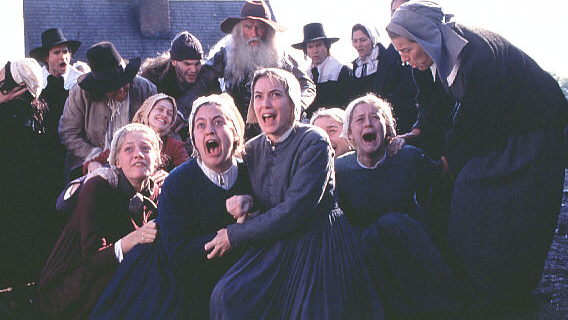
Perhaps they should read Arthur Miller’s play, The Crucible.

The Crucible (1996) movie

The Crucible (1996) movie

Why Is It So Hot? Books vs. Lawn Ornaments in Omaha

Old Market District, Omaha, in summer.

                                             Old Market District, Omaha

Omaha is a  hip Midwestern city (by our standards), with a splendid art museum and trendy shopping in the Old Market District.

It was, however, 91 today.

“It feels like 100,” I said.  It really did in the sun.

My husband says he doesn’t feel the heat till it’s 95. “It might be 92.”

The warehouses in the Old Market District in Omaha are now shops, restaurants, and lofts. You can browse at antique stores, glass stores, art galleries, and junk shops.  We drink coffee or iced tea on “dog-friendly” terraces:  a small bulldog had stepped out of Colette; surely it was Fossette from The Vagabond!.

But the question was whether to shop at a bookstore or an iron lawn ornament store.

We love to pop in at Jackson Street Booksellers, one of the best used bookstores in the U.S.

My husband says I buy too many books.  And the shelves at home do seem to be full.  Time to donate to the Planned Parenthood Book Sale again.

Iron Decor and More, Omaha

Iron Decor and More, Omaha

“You want to go to the lawn ornament store?” I have a hankering for a tacky ornament for the backyard.  They have an iron cow on a bicycle and colorful cats with springy necks.  I must admit the chicken in the picture at right is too much.

‘NO!!!!”

So we went to Jackson Street Booksellers.

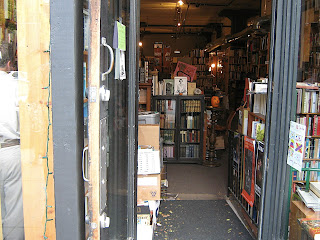
Jackson Street Booksellers interior

Jackson Street Booksellers

You know the kind of bookstore. It’s huge, and they recently expanded, and they need to expand again.  The shelves are so tall you can’t possibly see what’s on top. The store is deep and dark, with occasional spotlights.  There are also piles of books on the floor.  You can’t find the Wyndham Lewis books unless you move a tall stack of books.  (Too much trouble.)  The owner and employees sit up front and read the paper.  They don’t chat to us.  My husband thinks it’s because we’re from out of town.  I explain that the staff at used bookstores never talk to customers.

J.C. at the TLS has confirmed this.  He said of Skoob in Bloomsbury:

Here are the overflowing shelves, the arcane subject headings, the musty smell, the foreign languages on the floor, the grumpy staff…

Very like Jackson Street Booksellers..

It is crammed with literature, genre books, Americana, biographies, memoirs, art books, history, theater books, women’s books, foreign language, politics, travel, vintage books, and several shelves devoted to the coveted Folio Society editions and Heritage Press editions (books that come in a box!).

And then we went to The Bookworm, an indie bookstore in the suburbs.

Did I buy books?

IMG_3288Yes!

At The Bookworm:  Modern Latin American Literature: A Very Short Introduction (Oxford).  This beautifully designed book is one of a very clever “A Short Introduction” series of tiny paperbacks.  I almost bought one on Nothing.  (“Cheeky Brits,” said my husband.  Sorry, Brits!!)

Modern Latin American Literature- A Very Short Introduction 51sKoOlFsVL._SY344_BO1,204,203,200_At Jackson Street Booksellers:  Jorge Amado’s Gabriela, Clove and Cinnamon (a Brazilian classic).

Jorge Amado gabriela 51D10CF6CSLKay Boyle’s Three Short Novels:  The Crazy Hunter, The Bridegroom’s Body, and Decision.  (Boyle is an excellent American writer, and I was introduced to her books  by Virago.)

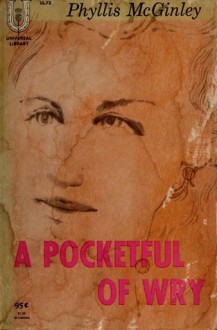
Kay Boyle Three_Short_NovelsPhyllis McGinley’s A Pocketful of Wry.  This remarkable poet won the Pulitzer for her light verse.  I posted her “Ode to the End of Summer” here.

Phyllis McGinley A Pocketful of Wry 152d32243f93b68a33c74f2e4b49c4543 More Novels by Ronald Firbank:  Caprice, Vainglory, and Illuminations  (I may have read these long ago, but my Firbank is missing!.)

3 More Novels Firbank 51xUbgGKjzL._SX323_BO1,204,203,200_Robert Grave’s Good-Bye to All That (I love his historical fiction, but not his autobiography)

IMG_3278(My cat is considering what to read next.)

After Burnout: Lawrence Durrell’s Monsieur

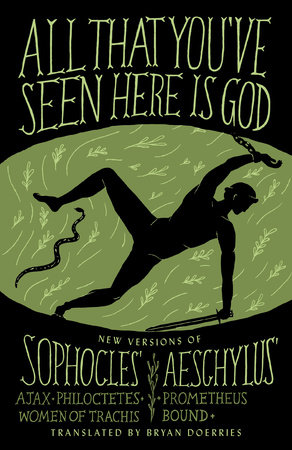
All That You've Seen Here Is God Bryan Doerries 9780307949738On Sunday night I wrote about Bryan Doerries’s All That You’ve Seen Here Is God:  New Versions of Sophocles and Aeschylus.

Readership of that post was sparse. Disappointing, because my background is in classics.

And so I had “book blog” burnout. Fortunately, I am inspired again by Lawrence Durrell, that underrated writer of gorgeous modernist fiction.

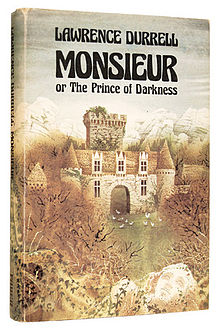
Durrell MonsieurLawrence Durrell’s Monsieur, the first volume in the Avignon Quintet, is a stunning metafictional novel.  Like Durrell’s masterpiece, The Alexandria Quartet, it plays with linked narratives from multiple points of view.  Durrell’s labyrinthine prose reflects the tortuous relationships between the eccentric, fiercely individualistic characters.  What is real?  What is invented by the novelist?

We do not care what is real, because the writing is luminous.

The relationships are complicated, as always in Durrell.  Durrell knows that the novelist is a trickster:  there are twists and surprises.  Who is the narrator?  It seems to be Bruce Drexel,  a doctor who has traveled on a train from Paris to Provence where his best friend committed suicide.  Bruce remembers his arrival at  dawn, and discovers “the Bruce that I was, and the Bruce I become as I jot down these words…”

Bruce explains:

The telegram which had summoned me southward from Prague was suitably laconic.  It told me of the suicide of my oldest and best friend, Piers de Nogaret; more than friend indeed, for his sister Sylvie was my wife, though the telegram was signed not by her but by the family notary.

And then Durrell switches to the third person, and we see Bruce from a novelist’s point of view.  In the next sentence he switches back to the first person.

He must be trying to objectify his thoughts and emotions by treating them as one would in a novel, but it didn’t really work.  As a matter of fact, in Rob Sutcliffe’s famous novel about us all, things began in exactly this way.

Who is the narrator?

Bruce reveals that their lives have been disturbingly described in their friend Rob Sutcliffe’s bitter novel about their strange relationships.  And, yes, Durrell includes many excerpts from Sutcliffe’s diaries and his novel. Who is the narrator? we ask again.

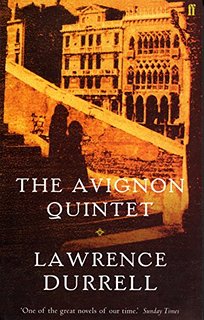
durrell avignon quintet 51GoOSphbOL._AC_UL320_SR204,320_The five main characters are wildly unconventional.  Piers was Bruce’s lover; Bruce’s mad wife, Sylvie, was Piers’s sister, and is now in an asylum.  Poor Sylvie was the last one to see Piers alive.  And Rob, the eerily far-seeing novelist, has been married unhappily to Bruce’s lesbian sister.  Then there’s Toby, a historian obsessed with the Templar Knights.

Durrell meanders, but his style is elegant and poetic.  We read him for style.  This novel is fascinating.  The five characters, especially Piers, are involved with a cult of Gnostcism. There are beautiful descriptions of their trip to the desert in Egypt, where they are introduced to the rituals by Akkad, a trickster who compels them to question everything.

The historian Toby’s research into the medieval Knight Templars circles back to Gnosticism, a subject Durrell also treated in Balthazar, the second novel in The Alexandria Quartet.

And in the final section we spend time with another novelist, Blanford, and everything we know is thrown into question.

Loved it, loved it, loved it!  I am all about The Avignon Quintet now.  Monsieur is possibly even better than Justine, the first novel in The Alexandria Quartet.

You Couldn’t Pay Me to… and Milk Duds at the Opera

Ellen has to prep for her dates with the brilliant British guy she meets at a Kandinsky

Ellen meets a very cultured professor  at the art museum.  He knows EVERYTHING.

Okay, I admit I like culture.  But I couldn’t get tickets to see Benedict Cumberbatch in Hamlet.

Am I in London?

No, so it hardly matters.

So what do we do in the Midwest for fun?

I pretend to shop at the mall like other women, but usually just stop at the bookstore.

And during the long, long, long harrowing winter nights when the wolves are howling at the door, etc,  I read Sophocles in Greek and Plautus in Latin. That’s theater, isn’t it?   If you study classics for seven years and then teach it for seven more (or more), it’s a snap.

But there are so many subjects I know little about.

And so I was laughing my head off over an episode of Ellen, the ’90s  sitcom starring Ellen DeGeneres.  In “Ellen’s Improvement” (Season 2, Episode 13), she decides to improve herself after she and her friends miss all the questions on Jeopardy.  Perturbed that she didn’t know who Kandinsky was,  she reads a book about him.

.Then she drags Adam and Paige to a museum.

Paige:   “I don’t get art.”

Ellen:  “You’ve gotta give it time.”

Paige:  “No, my mom said if it doesn’t go with the drapes it’s not worth having”

Ellen:  “Yes, this $300 million dollar Kandinsky would clash with her ceramic clown collection.”

Okay, that’s funny.  But it’s even funnier when she meets a UCLA professor from England and they have an arty chat.  Then she has to prep for her dates with him, until she introduces him to her world of watching TV on “Melrose Place” night.   Heather Locklear reminds him of Lady Macbeth.

That is my nightmare.  I love art museums but pray I don’t have to talk about art.  I have had many a trite conversation with friends who know the phrase, “Ah, the colors.”  Perhaps I’ll read a few chapters in my Sister Wendy art history book and learn a new phrase before I rush off to that Sargent exhibition at the Metropolitan Museum of Art.

I am so bored by opera that I laughed hysterically when Ellen falls asleep and her friend Adam throws a milk dud at the woman singing Madame Butterfly.

I’m sorry, but it’s just so funny!

And so I must, like Ellen, take a crash course in culture.

MY READING LIST

 Hamlet, because Benedict Cumberbatch is stunned that I’m missing his performance.  (My last Hamlet was  Paul Gross at Stratford, Ontario, 2000.)

Julian Barnes’s Keeping an Eye Open:  Essays on Art. Actually, I do want to read this.

The Amazon sample of Evan Baker’s From the Score to the Stage: An Illustrated History of Continental Opera Production and Staging.  (Just the sample!)

Crafting with Cat Hair by Kaori Tsutaya. (But it is art?  No, I’m kidding.)

Mindy Kaling’s Why Not Me?   (She’s funny.)

Chrissie Hynde’s Reckless: My Life As a Pretender  (She is a stunning rocker; rock is art; ergo, rock, scissors, paper.)

The Penguin Book of Witches, ed. by Katherine Howe.  Halloween is coming!  And I might have to talk about witchery!  And I’ve been to Salem!  Diane Purkiss, author of The Witch in History: Early modern and twentieth century representations, said in the TLS  that Howe’s anthology of witchcraft was  too American.  Good, I’m Howe’s audience!  (Howe is also a very good novelist.)

The Age of Movies: Selected Writings of Pauline Kael (Library of America).  If you read Kael’s brilliant movie reviews in the ’70s and ’80s in The New Yorker, you know how outrageous she was.

So what’s on your list?

Wednesday on Pop-up Calendar: Finishing Titus Groan!

It remains essentially a work of the closed imagination, in which a world parallel to our own is presented in almost paraoniac denseness of detail.”–Anthony Burgess,  Introduction to Overlook edition of Mervyn Peake’s Titus Groan

Wednesday on Pop-up To-Do List:  Finish Titus Groan

Titus Groan Mervyn Peake ballantine 39-11. Brew pot of Darjeeling so you can concentrate on finishing Titus Groan before book club tonight!

2. Take notes in cute new notebook.  You chose the book, and must be prepared to drone on in awkward silences.

You doodle:

   a. A great modernist masterpiece, but is it fantasy???
b.  Portrait of decadent inert civilization, but not an allegory.

3. Cat chews cover of your vintage ’60s paperback while you fetch your pink post-its. (You feel more important when you mark pages with post-its.) Reward cat’s bad behavior with snack so she will let you read Titus Groan.

4. Find your other used copy of Titus Groan, which is as yet unchewed by cat.

titus groan mervyn peake overlook 200px-Tglg5.  Your cousin calls to say she on her way over with two venti Starbucks coffees so you can zip through Titus Groan.

6. In the back yard you distractedly read 10 pages while your cousin chortles over Twitter, Reddit (or is it Rabbit?), and Instagram.

7.  She announces that Titus Groan is not available on Kindle Unlimited.  (Alas!)  But there is a great Clinique sale at Younkers!

8.  You tell her you have to read Titus Groan, and doesn’t she have a lot of Clinique? (“You can never have too much Clinique.”)  You tell her about the time you were hypnotized by ads in Cosmopolitan, bought $50 of Clinique, and discovered you were allergic to makeup.

9. You  say  you must stay home and finish Titus Groan , but she points out you have already read it.

10. You explain you haven’t read it since that vacation years ago in a fishing lodge in Wisconsin.  (I didn’t fish!  The lights went out!  Scary guys with cross-bows!  The fish museum!  I mostly stayed inside and read.)  Anyway, I’m an A- personality and must finish it.

11.  She asks if B+ isn’t good enough for “a bunch of SF losers?”

12. You  point out that B+ is a very good grade, and they’re not losers. The Game of Thrones fan with the braided beard is the only definitely odd one.

13.  She asks  if all the male members of my SF group are gay.

14.  You tell her who knows, we don’t talk about it, but it’s probably 50/50.

15.  She wonders if Mervyn Peake was gay.

16.  She looks him up online and discovers he was married and decides he was “moderately cute” in a “terrifying English way.” (He looks like one of his caricatures.)   But we are impressed when we learn he won the Heinemann Prize for Literature for Gormenghast and The Glassblowers.

Mervyn Peake

Mervyn Peake

17.  Finally we go to Younkers and come home with two sweaters for the upcoming trip to Europe.  We have another Venti Starbucks coffee.

18. You had 10 pages left to read, but nobody noticed because they spent most of the time deciding what to read next.  Another night at Book Group!

P.S..  I just finished Titus Groan a few minutes ago, and it is the best fantasy/non-fantasy novel of the twentieth century.  It is arguably one of the best modernist novels of the 20th century.  And, joy oh joy,  it is the first of a trilogy!

Recycle-a-Birthday: Forever 39 and What I’m Reading Soon

IMG_3275I had my first recyclable birthday.

It happens to everyone.

You didn’t blink an eye when you turned Bilbo Baggins’ age.  But then there’s another age you don’t like the sound of.

You are now “forever 39,” as Jack Benny said.

We enjoyed the revelry and the feast.  The pop-up birthday card (above), which turns into a music box and plays “Happy Birthday,”  was the highlight of the celebration. Yeah!  The cats loved the twirling dog on top of the cardboard cake.  And I made a real German chocolate cake in a new cake pan, and my husband surprised me with “birthday cake” ice cream.

Since I am recycling my age  (I am forever somewhat older than 39), we also recycled the birthday gifts.  I selected books I want to read off my husband’s shelves.  Some I gave him as birthday presents long ago.

IMG_3271Gifts, gifts, gifts!

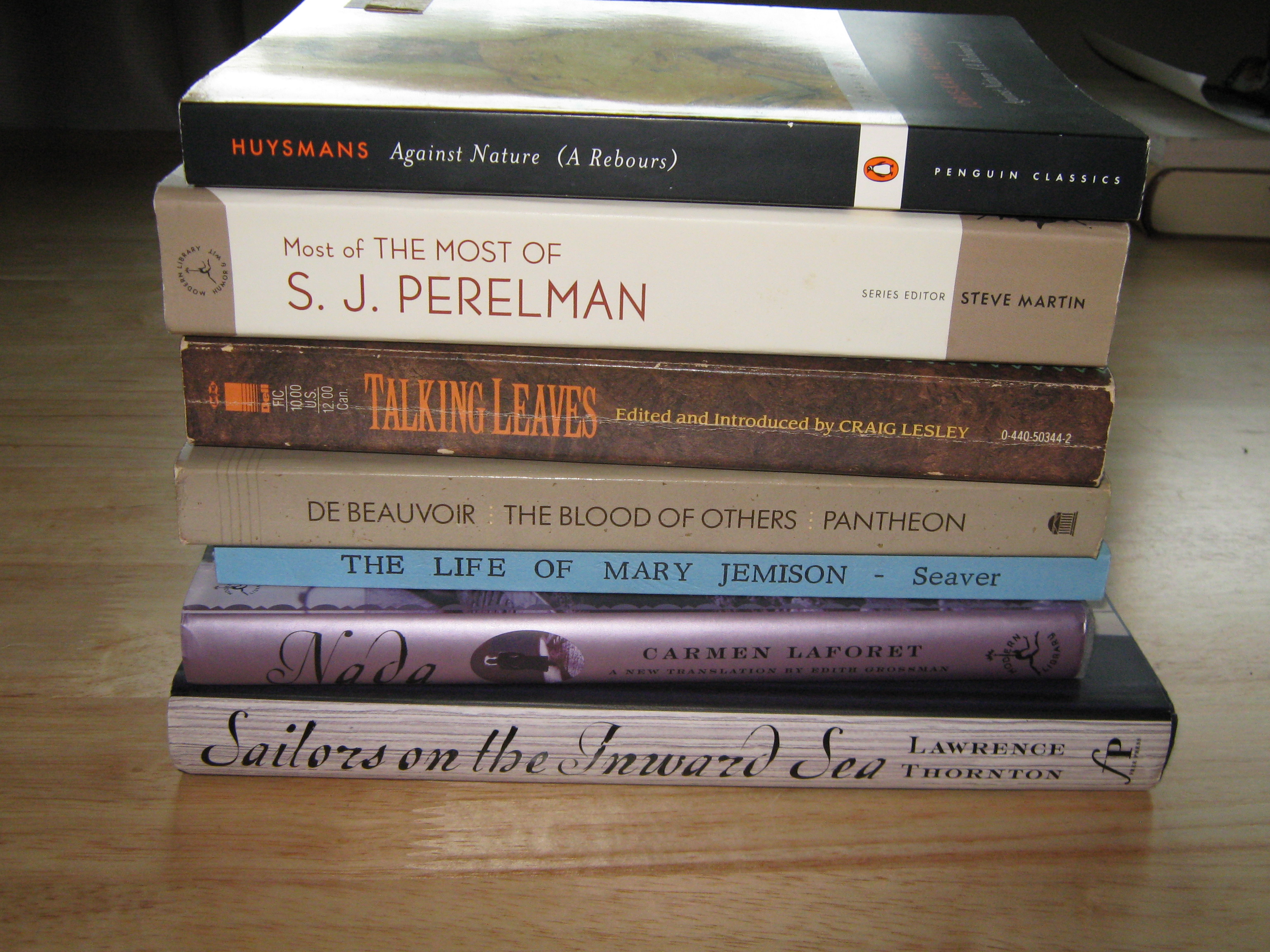
This recycle-a-birthday collection includes:

Huysman’s Against Nature, fin de siècle novel whose decadent hero retires to a villa to pursue “luxury and excess.”

Most of the Most of S. J. Perelman, edited by Steve Martin, a collection of Perelman’s humor pieces, essays, and playlets.

IMG_3264Lawrence Thornton’s Sailors on the Inward Sea,  a meta-fictional novel about a disaster at sea in which Joseph Conrad is a character.

Carmen Laforet’s Nada, translated from the Spanish by Edith Grossman, an autobiographical novel about a young woman in Barcelona in the 1940s.

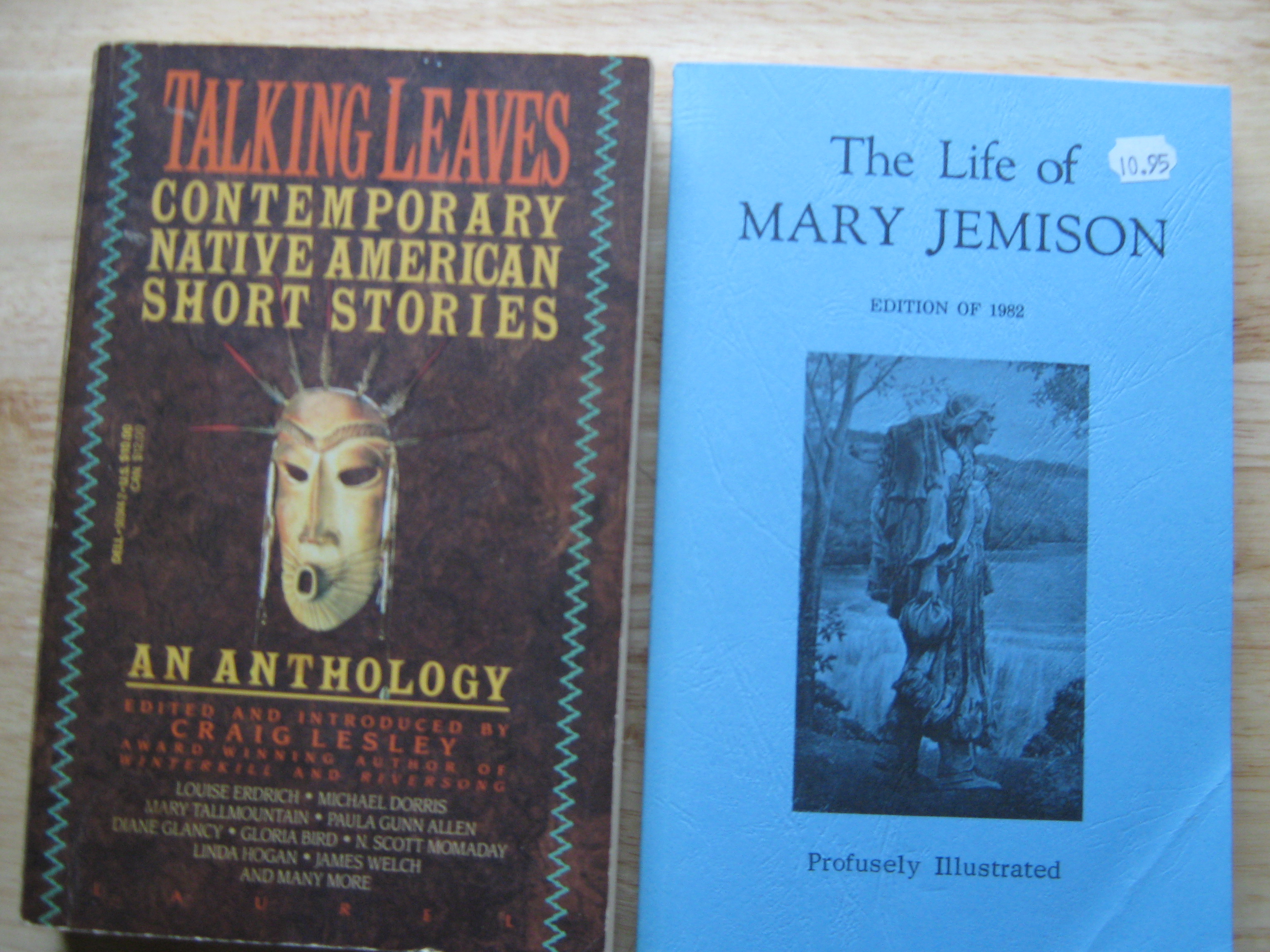
IMG_3263Talking Leaves: Contemporary Native American Short Stories, edited by Craig Lesley

The Life of Mary Jemison, “Who was taken by the Indians in the year 1755, when only about twelve years old, and has continued to reside among them to the present time.”

IMG_3266

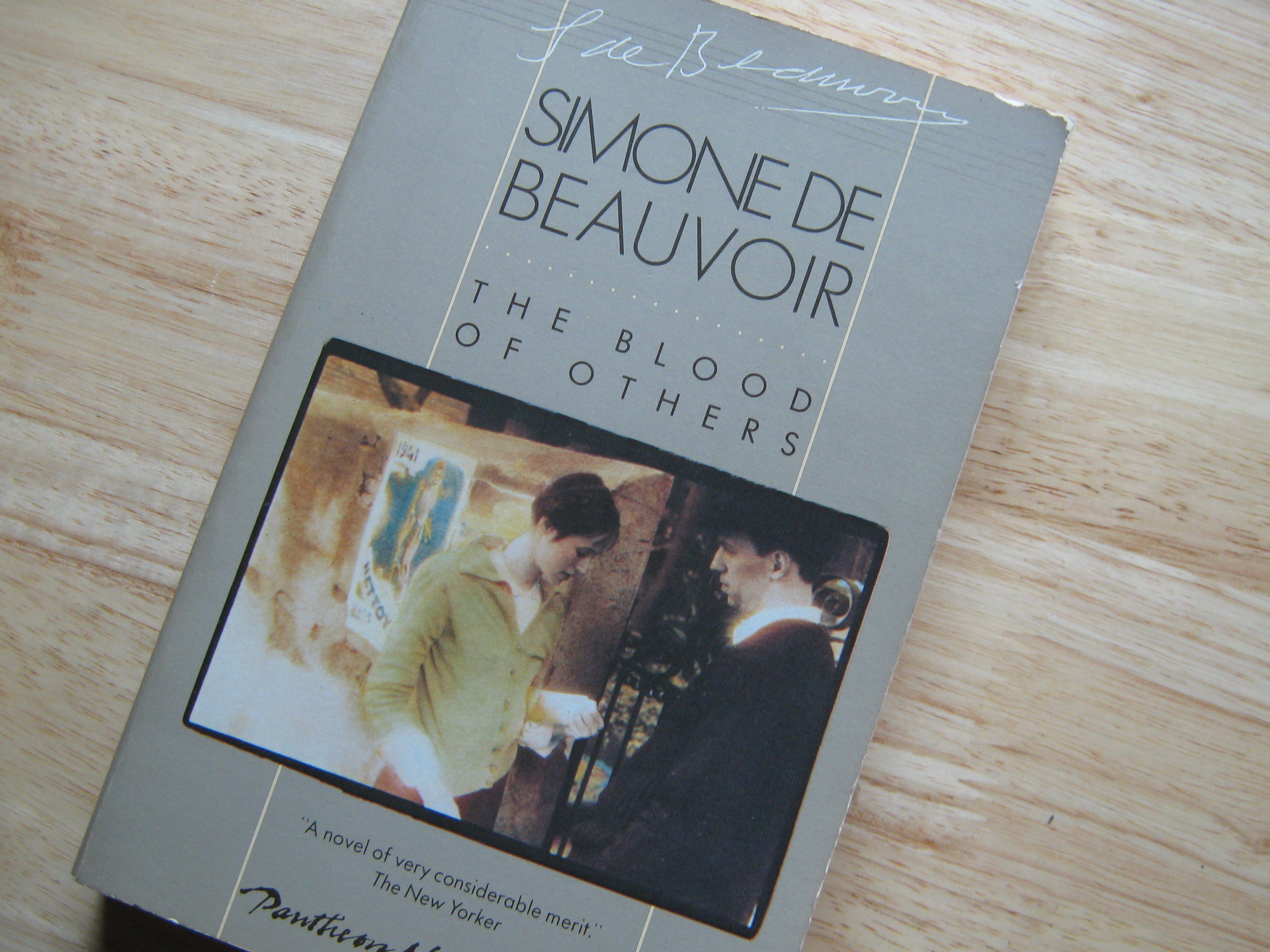
And Simone de Beauvoir’s The Blood of Others, a novel translated by Roger Senhouse and Yvonee Moyse.

IMG_3267A great birthday, yes?  I cannot guarantee that I will read all these books, but they look wonderful.

And here is pic of an alert cat helping me decide whether I should read or watch the Poldark (the DVD set of the “70s TV show was another gift!).  She seems to favor Poldark.

IMG_3268

All That You’ve Seen Here Is God: New Versions of Sophocles and Aeschylus by Bryan Doerries

All That You've Seen Here Is God Bryan Doerries 9780307949738 Any translator of Greek tragedies for new audiences has to be bold.

I was intrigued by the boldness of Bryan Doerrie’s All That You’ve Seen Here Is God, a collection of new “versions” of four plays by Sophocles and Aeschylus.  He translated them for Outside the Wire and Theater of War, two groups that give dramatic readings of plays for soldiers, prisoners, and health professionals.  They also host discussions with the audiences. Doerries has translated Sophocles’s Ajax, Philoctetes, The Women of Traxis, and Aeschylus’s Prometheus Bound.

His translations are spare and accessible, if lacking in the poetry of the Greek. The traumas of the heroes are vivid and moving to the military audiences.

Doerries explains that he is not interested in literal translation, though he starts with the Greek text.   He writes that he is trying “to build a bridge between the ancient and contemporary worlds.”

He writes,

Tragedy is an ancient military technology, a form of storytelling that evokes powerful emotions in order to erode stigmas, elicit empathy, generate dialogue, and stir citizens to action.  When you plug a tragedy into a community that is ready to receive it, the story does what it was designed to do.  Like the ancient Athenian audience in the Theater of Dionysus, the war-hardened Marines who gathered [at one of Doerries’s productions] knew the plays, not as representations of war and its aftermath, but as lived experience.

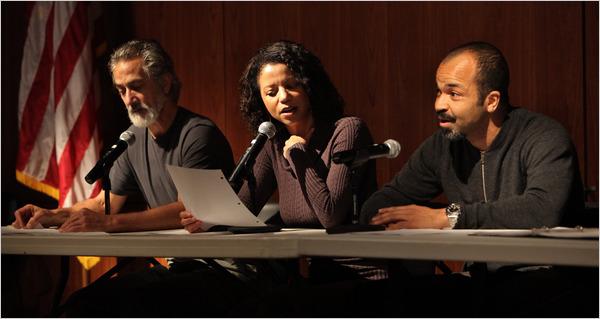
A Theater of War dramatic reading of

A Theater of War dramatic reading of “Ajax” and “Philoctetes”

So often Greek tragedies do treat issues of war and its consequences.  One of the most intense plays is Sophocles’s Philoctetes, in which the hero, Philoctetes, is abandoned by his fellow soldiers on an island. When Philoctetes stumbles into a shrine on the island, a snake (often a symbol of a god) bites him, and his screams and incurable stinking wound make him an unbearable companion and outcast.  Odysseus, the trickster “intelligence” officer, advises the Greek kings, Agamemnon and Menelaus, to leave him behind when they sail to Troy. Only Philoctetes’s bow makes it possible for him to survive on Lemnos alone.

He is forgotten until nine years later a seer, Helenus, tells the Greeks that they cannot win the war without Philoctetes and his bow. Odysseus plots with Neoptolemus, the son of Achilles, to trick and abduct Philoctetes.  But Neoptolemus reexamines his ethics after meeting Philoctetes.  And there is a deus ex machina, Herakles, who intervenes and explains what must the Greeks must do.

Doerries’s stark translation of the words of the compassionate chorus is very effective.  They know Zeus has been hard on criminals but Philoctetes has done nothing to deserve this.

But there is no story
I have ever heard
that matches the cruel
and meaningless fate
of this harmless man
who has done nothing
to deserve his pain.

I love this translation, but it is much simpler and shorter than the Greek. Here is a more literal translation of the same lines by David Grene, and the longer lines also look more like the Greek.

But I know of no other,
by hearsay, much less by sight, of all mankind
whose destiny was more his enemy when he met it
than Philoctetes’, who wronged no one, nor killed
but lived, just among the just,and fell in trouble past his deserts.

Grene captures the Greek more exactly, and naturally I prefer the poetry.

Sophocles’s Ajax is also a story of a hero who becomes an outcast due to illness.   In Doerrie’s introduction to Ajax, he focuses on the hero’s “mental disintegration” and the resulting violence, which he compares to similar incidents of madness and violence among Iraq vets.  (He cites an article in The New York Times.)  After the prize of Achilles’ armor is given to Odysseus rather than Ajax, Ajax intends to kill Odysseus and his men.  Driven mad by the goddess Athena, he slaughters cattle, believing they are Greeks.   How can he bear the dishonor after he sees what he has done?

Doerrie’s translation is powerful.  Ajax’s wife Tecmessa says,

Our home is
a slaughterhouse,
littered with cow
carcases and goats gushing
thick blood

Although the translations are short and effective, it is the introductions that mark Doerries’s intentions:  he is much more didactic than the Greeks.  (Is this an American thing?  Like Oprah?)  In Doerres’s introduction to Aeschylus’s Prometheus Bound, the story of the god who stole fire for man and then was punished by Zeus, he emphasizes the likeness of Prometheus to men and women who work in maximum-security prisons.  After performances for guards, social workers, and food-service workers in prisons, he says,

I have heard many audience members say, ‘I am Prometheus,” relating the stigma, societal judgement, and loneliness associated with their profession to the character’s solitary confinement.

The last play, Sophocles’s The Women of Trachis, is the least well-known. Heracles’s wife, Deianeira, is understanding when a beautiful woman, Iole, is brought home from the wars as “booty” (in both senses) for Heracles. But then, in the fashion of Medea, who sends her husband’s new bride a poison robe, she sends her husband a poison robe, which she has dyed with the blood of the centaur Nessus, who attempted to rape her and was killed by Herakles.  Deianeira did not, of course, intend to poison her husband: Nessus told her the blood was a love charm.   But in both cases  of Deianera and Medea, it is a younger woman who inadvertently causes the tragedy.  Burning with pain, Heracles wants his son to kill him.

The final lines of Heracles’s son’s last speech, addressed to Iole are missing from Doerries’s translation.  I have an uncorrected proof, so perhaps the lines were restored.  But Doerries reads this primarily as a play about euthanasia, and has presented it for health professionals.  Perhaps for his purpose, the last lines were deemed unneccessary.

Doerries, the founder of Theater of War and the co-founder of Outside the Wire, is a talented writer, with a laudable approach to the classics.  But I hope that university students still read the Greek and the more vivid translations by classicists  This would, however, make a very effective text for a high school or a community college, in addition to Doerries’s target audiences.