Galsworthy’s The Man of Property (The Forsyte Saga, Volume 1)

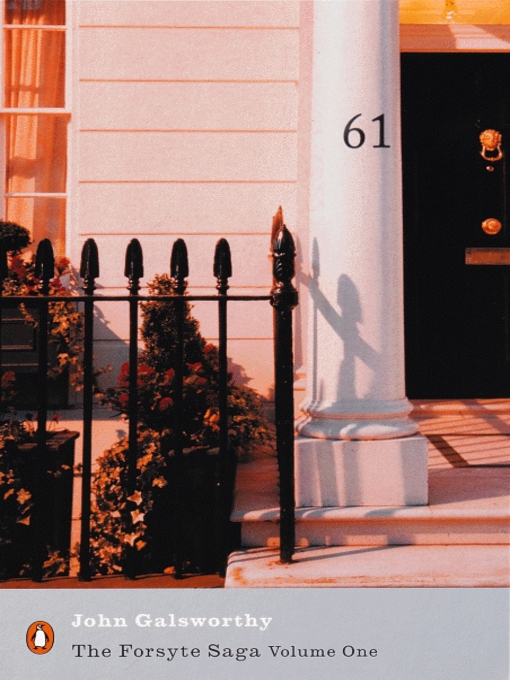
Forsyte Saga Penguin NewKaren at Kaggsysbookishramblings has embarked on a year-long reading of Nobel Prize winner John Galsworthy’s The Forsyte Saga with Heavenali and some other bloggers.

I very much approve, because I am a Galsworthy fanatic.  And so I am “reposting” my thoughts about The Man of Property from my old blog in 2012.

John Galsworthy’s work has pretty much died out except for The Forsyte Saga, a series of three trilogies, The Forsyte Saga, A Modern Comedy, and The End of the Chapter.  There was a wonderful BBC series of The Forsyte Saga in the late ’60s, and another very good Granada series in 2002.
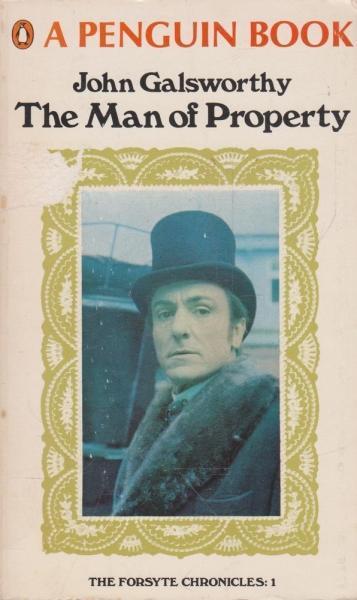
John-Galsworthy-The-Man-of-Property-The-Forsyte-Chronicles-1_1Each time I read The Man of Property, I consider it from different points of view.

Galsworthy’s Forsytes are an upper-middle-class family who are smug about their success as lawyers, real estate agents, and merchants.  They do what is expected of them–they eat mutton for dinner, chat about their money, and don’t get divorced.

Galsworthy writes,

Those privileged to be present at a family festival of the Forsytes have seen that charming and instructive sight–an upper middle-class family in full plumage.  But whosoever of these favoured persons has possessed the gift of psychological analysis (a talent without monetary value and properly ignored by the Forsytes), has witnessed a spectacle, not only delightful in itself, but illustrative of an obscure human problem.  In plainer words, he has gleaned from a gathering of this family–no branch of which had a liking for the other, between no three members of whom existed anything worthy of the name of sympathy–evidence of that mysterious concrete tenacity which renders a family so formidable a unit of society, so clear a reproduction of society in miniature.

At the center of The Man of Property is the triangle of Soames Forsyte, his wife Irene, and the architect Bosinney.  Soames is the quintessential Forsyte, a lawyer with a strong sense of property who collects art, and that includes his wife Irene.  She does not love him; she asked when they get married that he free her if it didn’t work out.  He pretends not to remember this. He believes she will eventually love him.  And after he hires Bosinney, the fiance of his cousin June, to design a house for him in the country, he pretends not to notice the growing friendship between Irene and Bosinney.
The scandal burgeons.  The other Forsytes notice.  But they keep the scandal in the family.  They will not admit that a marriage can fail.

Another Forsyte marriage has failed.  Young Jolyon, an artist, the son of Old Jolyon Forsyte, a tea merchant, left his wife and daughter June 15 years ago to live with the governess, and eventually married her.  The Forsytes have ostracized him for 15 years.  Old Jolyon has raised June.

After June’s engaggement to Bosinney, Old Jolyon makes peace with Young Jolyon.  And he rages against the Forsytes for keeping him and his son apart for 15 years.

I love Old Jolyon.

The first time I read this, I was completely bowled over by the relationship of Irene and Bosinney.  They deserved to be together, and the obstacles are tragic.
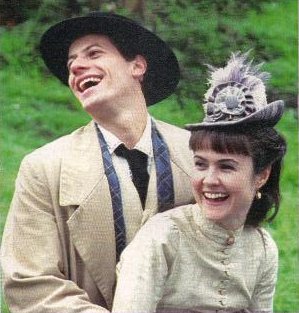
June Forsyte

June (June Barry) & Bosinney (John Bennett) in the Granads “Forsyte Saga.”

But as time goes on I think more of June, the young woman who helps “lame ducks,” and is drawn to Bosinney because of his talent and poverty.  June is so much in love with him that she tries to help him by suggesting at a dinner that the Forsytes hire him to build country houses. It backfires.

Then the engagement breaks off, without anyone’s saying anything definite, and much suffering on June’s part, after Bosinney falls in love with Irene. June is devastated, because Irene was her best friend.

One of the saddest things in the novel is when she sees Bosinney in the street and he doffs his hat without saying anything to her.

June flourishes in later Forsyte novels, but her life was partly wrecked by the wrecked romance.

She is a more interesting character than the beautiful, mysterious Irene, but perhaps only to women…  Galsworthy has his own point of view, and had an affair with his cousin’s wife, Ada; after her divorce, she and Galsworthy married and stayed together till his death.
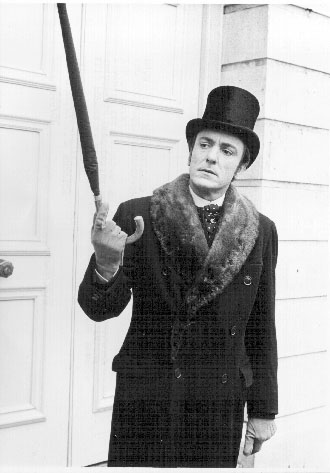
eric porter as soames-in-overcoat

Eric Porter as Soames.

It is impossible to like Soames, but one feels sympathy for him.  He loves art and literature, but if it’s not worth money, he doesn’t know what to do with it. There is a missing link in him.

This is a very, very sad novel in many ways.

Love is hard, often heart-rending, and Galsworthy knows it.
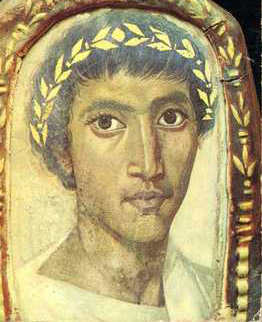
Blame It on the Editor: A Latin Nerd Finds Errors

Catullus

Catullus

I constantly find Latin errors in English books.

I am not the kind of person who pounces on typos and sends in corrections to The New Yorker. I do not particularly care to show up a writer or editor.  As a woman in classics in the ’70s and ’80s, I learned to underplay my hand with  insecure colleagues who were upset by my talent for classical languages, furious about their own failures, or just misogynists. Whether or not publishing is as male-dominated as classics used to be, it is a jittery business.  But I am such a nerd: Latin errors leap off the page at me. I am a reincarnated Roman or something. And, I must confess, I read a lot of Latin poetry.

For eleven years I was a hipster nerd Latin teacher.

This prepared me for a life of finding Latin errors.

I prepared my students for the life, too.

  • They had to diagram sentences and identify every grammatical construction in a sentence
  • They had to translate.
  • They had to sight-read and scan dactylic hexameter at sight.
  • They had to identify figures of speech.
  • They had to identify famous quotations from Virgil, Catullus, and Ovid.
  • They had to memorize poetry.

My first experience in finding a  Latin error in a book was in 1983 when I read Paul Fussell’s very amusing book, Class: A Guide through the American Class System. I gave my students  extra credit on a quiz for identifying the error. (They were delighted.)  And I wrote a letter to Fussell in the belief that he would want to correct the error in the paperback edition.

He wrote back saying he doubted the error would be corrected.

Latin errors do not seem to occur in books published, say, before 1960.  After that the errors proliferate.  One of my favorite books In 2009 was A. S. Byatt’s brilliant novel, The Children’s Book, (Vintage, the UK edition).  You guessed it, I found an error.

Gratias tibi agimus, omnipotens Deus, pro his et omnis donis tuis.  (“We thank you, all-powerful God, for these and all your gifts.”)

See the word omnis (third from the end)?  That ending should be -ibus, not –is, The word is omnibus. Yes, it’s the ablative plural of a 3rd-declension adjective.  I didn’t write to Byatt, but I did mention it on my  old blog.  Perhaps the ending was  corrected for the American edition? Probably not.

I have found many errors over the years.  I note them neatly in the back of the books.  I just found a Latin error tonight in the Dalkey Archives edition of Aldous Huxley’s Antic Hay.

There is a typo in the quote  from Catullus’s famous poem 5:

Vivamus, mea Lesbia, atque amenus

It means:  “Let us live, my Lesbia, and let us love.”

In the word amenus, the “n” should be “m”:  amemus (“let us love”).  The ending -mus means “we” (it is a first person plural ending).

I’m sure that some of you find errors in modern books, too.  What are they?

Calumny in Anthony Trollope’s Phineas Redux & Ford Madox Ford’s Some Do Not…

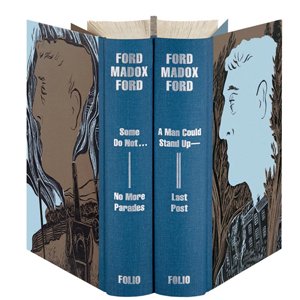
parade's end folio society PND_p1

Lovely editions: I do not, of course, have these!

If ever a young woman read too many English novels, I was that young woman. I  read so many Victorian and modernist classics that I believed the English must behave like characters in English novels. (Americans do not behave like characters in English novels.)  I spent many happy hours with Emma Woodhouse, Jane Eyre, Esther Summerson,  Christopher Tietjens, and Mrs. Dalloway, who inhabited a glimmering fantastic England unimaginably far, far away from the Midwest.

You only read like that when you are young:  perhaps no one ever really behaves like a character in a novel.

Nonetheless, these books are far from cozy.

When I recently reread Trollope’s Phineas Redux and Ford Madox Ford’s Some Do Not…, I was astounded by their dark contemporary relevance.  In these two novels, the heroes must confront the savagery of defamation of character.  Slander, gossip, and libel threaten the reputations of Trollope’s Phineas Finn and Ford’s Christopher Tietjens.

Calumny is the stuff of daily newspapers and gossip, right?

Libel, slander, rumor, gossip…

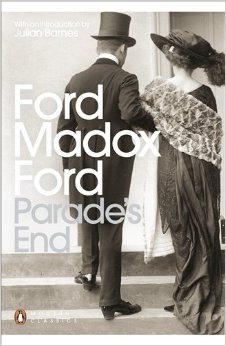
Parade's End ford madox ford 51TxQjZ6-TL._SY344_BO1,204,203,200_In Some Do Not..., the first novel in Ford Madox Ford’s modernist tetralogy, Parade’s End, Chritsopher Tietjens, an Edwardian gentleman and a brilliant statistician with a complicated code of ethics, must deal with calumny.  His cruel wife, Sylvia, has left him with her lover, but people say she left Christopher because he was promiscuous.  They think Valentine, a suffragette, the daughter of an old friend of his father’s, is his lover..  They are in love, but they are not lovers.   Christopher cannot divorce Sylvia, who is a Catholic.  He does not think it is right to involve the much younger Valentine.

Some do not…

This is just the first book, set on the eve of World War I. .

But Sylvia returns and continues to spread scandal about Christopher  She spreads the rumor that Christopher’s lover is Ethel Edith, his friend MacMaster’s wife.  One of Sylvia’s banker boyfriends manages to queer Christopher’s account and credit rating by some clever fakery that make it seem he is irresponsible and overdrawn.

Ford describes Chris’s feelings so well.

He considered that he was dull-minded, heavy, ruined, and so calumniated that at times he believed in his own infamy, for it is impossible to stand up forever against the obloquy of your kind and remain unhurt in your mind.”

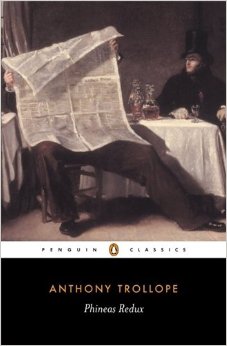
Phineas redux trollope 41gfICLC-IL._SY344_BO1,204,203,200_That feeling of helplessness:  how can Christopher stop the talk? Occasionally he finds a way to disprove some of the lies, but people are altogether too eager to believe calumny.

Trollope is a far from cozy writer, though that is his reputation (perhaps people have seen too many costume dramas?).  In Phineas Redux, the fourth in his political Palliser novels, Phineas Finn, an Irishman, returns to politics.  Chosen and backed by English friends to stand for a liberal seat in Parliament, he wins a tough, corrupt election.

There is prejudice against the Irish.  In addition, Phineas has two powerful enemies hindering his political success: Mr. Bonteen, another liberal, baits Phineas publicly and influences the Minister against him, and Quintus Slide, the editor of a tabloid, the “People’s Banner,” opposes Phineas politically and is determined to bring him down.

One of the strongest weapons used against Phineas is his attractiveness to women.  A scandal is made of his loyalty to Lady Laura Standish Kennedy, an intelligent woman who has left her mad husband, Robert Kennedy, a wealthy landowner who will not divorce her.  Lady Laura is living with her father in Dresden, partly to evade the scandal, partly so Kennedy cannot force her to return by law.  (The marriage laws are cruel.)  When Laura invites Phineas to visit them in Dresden, he feels he must, because he is obligated to them for helping him financially and politically.  He has a complicated relationship with Laura:  she turned down his proposal of marriage a few years ago, but is actually in love with him. He is not in love with her.

This visit inspires  Kennedy to send  a truly mad letter to Quintus Slides’ newspaper, vilifying both Lady Laura and Phineas.  And though Phineas’s lawyer manages to slap a cease-and-desist order on the publication of the letter,  Slide viciously prints so much other scandal about Phineas that even some of his fellow politicians believe it.  And when Phineas is accused of murder, many believe he is guilty.  It is his women friends who keep him from hanging.

The power of Quintus Slide helps us that the power of the press can be for good or ill.

Reading these two novels reminds us that gossip can be a bitch.

Both these novels are remarkably well-written, and not only good stories but  curiously contemporary in their treatment of age-old problems.

Lord a Mercy! It’s a Big Responsibility to Be a New York Editor

Amazon bookmarks 3321163964_7f29a808ff_b

Editors and publishers can’t quite get their minds around the concept that Amazon serves customers, not publishing houses.  Publishers prefer dealing with rich Independent bookstore slavies, who truckle under to their ridiculous prices.

In a Jan. 8 article at Slate, Daniel Menaker, an author of very good fiction and memoirs and the former Editor-in-Chief at Random House, explains why he is not keen on Amazon. It is mostly about prices.  Naturally he was annoyed by Amazon’s feud with Hachette over e-book pricing.  (It was resolved in November.)

Menaker says publishers and editors have the education and experience to balance art and commerce.  He writes that “between 20 and 30 New York publishers and editors…are in fact the main curators of letters.”

And he thinks Jeff Bezos and some other entrepreneurs envy publishers and want a piece of that action.

 Well, they can’t have it. Like patrons of old and some of new, they can stand back and support it, sponsor it, admire it. They can give it parties at retreats in New Mexico. They can even sort of own it. But they can’t have it. Because they need to make a lot of money. And because they don’t have the background, wide experience, native zeal, eye for talent, editorial skill, intuition, and intermittent disregard for probable profit necessary to perform the role of literary concierge.

Lord a mercy!  It’s a Big Responsibility to be a New York Editor!  If the top 20 or 30 are part of the Ivy League cocktail crowd, aren’t they milling and  thronging with Bezos anyway, who graduated from Princeton?

Where do the writers come in?

Perhaps publishing was in better shape when Menaker was at Random House. There are some very bad books being published:  I can’t be bothered to finish, say, Michael Faber’s  mediocre novel, The Book of Strange New Things (whether the writer or editor botched it, I don’t know.). And, by the way, I keep finding Latin errors, even in A.S. Byatt’s masterpiece, The Children’s Book.

I do respect many modern writers: Jonathan Lethem, D. J. Taylor, Karen Joy Fowler, Jane Gardam, Tim Winton, Richard Flanagan, and Michelle Huneven, to name a few. But I have read brilliant writers who have published a few stories in literary magazines and then disappeared.  What happened?

Amazon sells new and used books to readers like me who do not have access to great bookstores or libraries.  I can obtain titles published  by Dalkey Archive, NYRB, Europa, and many of the less popular Penguin classics.  If you think I can get these at my local Barnes and  Noble, you are crazy.

The service at Amazon is superb.

Meanwhile, publishers have tantrums about Amazon.  They don’t like the selling of used “new” books, and they don’t like the low prices on e-books.    My personal opinion is:  why publish e-books at all? Why not throw out the e-readers and go back to the book?

Yes, that’s very prim of me, but that’s how I feel.

We used to hear that Borders and Barnes and Noble were about to seize control of the book industry:  everything from book covers to content.   Now it’s Amazon.

Please.  The end of civilization is more likely to be caused by climate change and fracking.

In Which I Receive a Book in Deplorable Condition

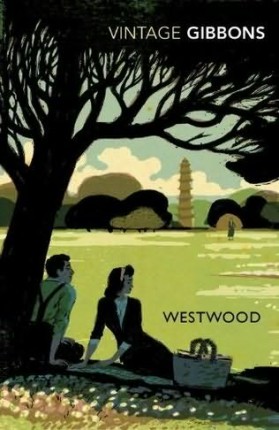
Being a fan of English women’s novels, I was agog when I learned that several of Stella Gibbons’s books have been reissued as Vintage Classics editions in the UK.

And so I ordered an inexpensive copy of Stella Gibbons’ Westwood from a UK bookseller via Abebooks.

The bookseller’s description said it was in “good or better” condition.

It has no tears to the pages and no pages will be missing from the book. The spine of the book is still in great condition and the front cover is generally unmarked. It has signs of previous use but overall is in really nice, tight condition. Shipping is normally same day from our UK warehouse. We offer a money back guarantee if you are not satisfied.

Finally the book arrived. Oh, joy!  I couldn’t wait to curl up on this snowy, freezing cold winter day with Westwood.

I hoped my book in "good" condition would resemble this.

I hoped my book in “good” condition would resemble this.

It is in deplorable condition.  In fact, I’ve never seen a book in worse condition.

There are tracks and blobs of something jammy mixed with glitter on the cover.

My cousin has this suggestion:  “Perhaps it’s jism with glitter thrown on.”

Yes, it is really that gross.  Not only is the glitter disgusting, but the spine is cocked (the book is practically bent in half) and the cover is very creased.

And so I went to the bookseller’s website to figure out where this  book has been.

In 2004, ____ was founded by a group of people who loved reading and wanted to spread the love with like minded bookworms. They found that despite the sometimes pricey nature of tomes on highstreet, there were many other cheaper sources of books which were either being thrown away, were sitting around idle on dusty bookshelves or being sent directly to paper recyclers for pulping. Having experimented in one unfortunate mother’s basement (sorry Mum!) to see if these could be sold online, they found there was great demand for used books and that customers always knew a good bargain when they saw one.

I can tell you why they’re not selling on “highstreet.”

It’s very much a “Caveat Emptor” situation when you order used books online. I have had good luck with ordering books in “very good”condition, but this “good” book was a disgrace to booksellers everywhere.

P.S.  The copy of Westwood went into the trash.  And I have written demanding a refund.

I’ll let you know what happens.

Aldous Huxley’s Eyeless in Gaza

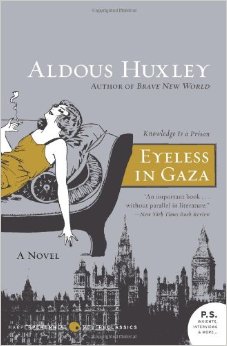
Eyeless in Gaza by Aldous Huxley 51zTlNl-wJL._SY344_BO1,204,203,200_Aldous Huxley’s best-known book is the dystopian classic, Brave New World, but some of us are aficionados of his early comic novels, such as Point Counter Point, a satire of 1920s intellectual life, and Crome Yellow, a charming frothy house-party novel in which eccentric characters exchange outlandish ideas.

In his introduction to Crome Yellow (Dalkey Archive Press), the critic Michael Dirda writes that he prefers the early novels of the 1920s.  He says, “…as the 1920s advance Huxley grew more earnest as a writer and lost his youthful pizazz.”

I am a Huxley groupie–I even read Sybille Bedford’s biography–but I know what Dirda means.   By the 1930s, Huxley was experimenting in his novels with long philosophical musings and tirades on modern life.

I recently discovered Huxley’s witty modernist masterpiece, Eyeless in Gaza, which was published in 1936.  Once I realized it was a serious novel–Huxley is so witty that at first I thought it was a comedy–I became completely absorbed and added this to my list of Huxley favorites.

In this compelling  novel, Huxley explores the vicissitudes of the life of Anthony Beavis, a sociologist who was educated at Oxford.  His emotional detachment began in childhood after his mother’s death.   Eventually, in middle age, he tries to break free of the past that has created his cynicism and dispassion..

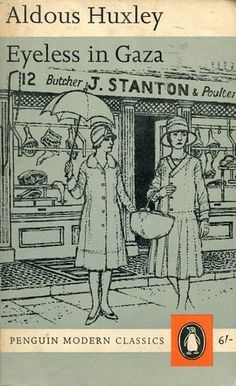
Eyeless in Gaza Penguin e1839983d310fac16b800bc80e779fbfWe first meet Anthony as a middle-aged man in 1933, looking at snapshots of his beautiful mother at the turn of the century and of Mary Amberley, the gorgeous, malicious older woman who was his first lover. The trope of the snapshots perfectly introduces Huxley’s experiment with time in narrative.  While looking at the photographs Anthony inhabits several time periods at once.

David King Dunaway’s writes in his introduction to the Harper Perennial edition of Eyeless in Gaza:

The work’s structure was controversial in its time, for this is no ordinary, begin-at-the-beginning narrative.  Broken into six time periods, the narrative cuts across time as though sawed into pieces.  Each time signature is distinct, yet based on what precedes it….  the effect of the time-shifting is fatalistic and oddly moving.

Huxley jumps back and forth between six time periods:  1933, 1934, 1902-4, 1926, 1912, and 1931.

Huxley reveals Anthony’s character through journal entries, traditional narrative, musings, sharp, witty dialogue, and chapters from Anthony’s book. We learn of the usual trials at public school, the joy of life at Oxford, the affair with Mary that ends in the death of a friend, his pacifism, and his relationship with Helen, Mary’s impulsive, socialist daughter.

The same characters crop up again and again.  Anthony’s school friends turn up at parties, sometimes much changed.  Some are heteroexual, others homosexual, and still others asexuall.  In a way, Eyeless in Gaza is a predecessor of Anthony Powell’s A Dance to the Music of Time, in which the same few characters are connected over time to the narrator.

Huxley has the gift of creating a character in a few sharp lines.  In the opening chapter, when Anthony’s lover, Helen, walks into the room, he ignores her and continues to study his snapshots.

Well, here I am, ” she said without smiling.  She pulled off her hat and with a beautiful impatient movement of the head shook back the ruddy-brown curls of her hair.  “Hideously hot!”  She threw the hat on to the sofa and crossed the room to where Anthony was sitting at his writing-table.  “Not working?”  she asked in surprise.  It was so rare to find him otherwise than immersed in books and papers.

In another scene, we see Helen as a young socialist, determined to steal something from every shop she visits with her stuffy sister.  By the end of the novel, she is passionately communist.

Huxley also fills chapters with Anthony’s writings.  In Chapter XI of his Element so Sociology, he analyzes personality and psychology.

Psychologists have no new instruments, only new techniques of thought….To be a tolerably good psychologist was possible, in the past, only for men of genius.  Compare Chaucer’s psychology with Gower’s, even Boccaccio’s.  Compare Shakespeare’s with Ben Jonson’s.  The difference was not only of quality, but of quantity.  The men of genius knew more than their merely intelligent counterparts.

Isn’t that the truth?

If you don’t have patience to read about Huxley/Anthony’s analysis of modern life, this novel is not for you, but I thoroughly enjoyed it.

Notes for the Common Reader on Eugene Onegin

Judy Holliday and William Holden e922123-05bornyesterday_main

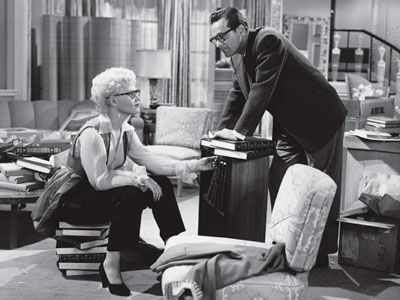
Judy Holliday and William Holden in “Born Yesterday.”

At my Big 10 university, we amused each other with what I call “smart-dumb”  chat.  Feminism was in, but bubbly blondism and dangly earrings were not out.  We Midwestern women had not gone to prep schools, we were studying hard for the first time, and we were neither pompous nor very competitive. When I went out for coffee at Things & Things & Things with a friend from Russian Literature in Translation, we chatted about Russian names.  (We were not Russian students.)

“How does one pronounce Knyazhnin?”

“K-ny-a-zzzzzzzh…in?”

“I skip over the middle letters of the names and just see the K and N.”

I still don’t know how to pronounce Knyazhnin. He was a writer, an imitator of French tragedies and comedies, according to a note in the Penguin translation of Eugne Onegin.

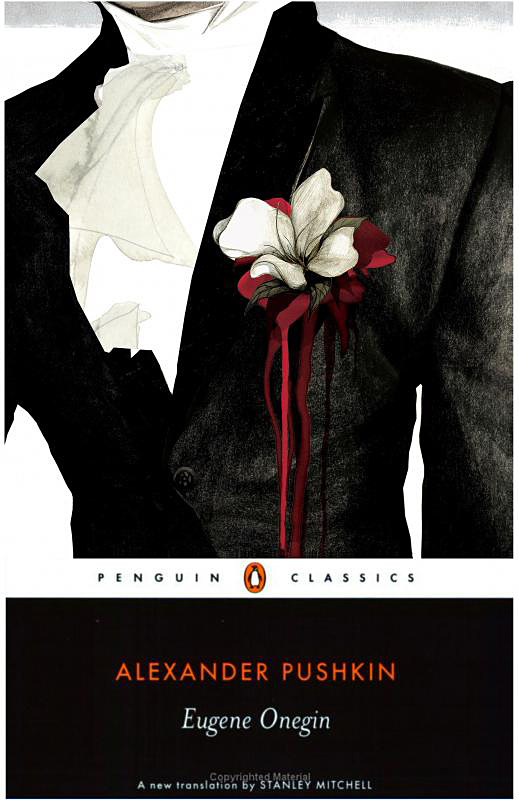
Our effervescence over Russian literature came back to me  because I reread Pushkin’s Eugene Onegin (pronounced Oh-nay-gin) in Stanley Mitchell’s 2008 translation (Penguin).

It is just as much fun as it was the first time, in whatever edition that was.

Eugene Onegin Pushkin 56077-largeIn this brilliant novel in verse, Pushkin tells the story of Eugene Onegin, a rakish Byronic hero who, bored by carousing, wine, women, song, writing, and even books, moves from St. Petersburg to the country after inheriting an estate.  He befriends a young poet, Lensky, to whom he is very devoted, but thoughtlessly wrecks their friendship by flirting  at a dance with Olga, Lensky’s fiancée.  The fiasco results in a duel with Lensky.  (Eugene doesn’t want it, and yet somehow he doesn’t say no.)  And the whole thing is complicated by Eugene”s rejection of Olga’s sister, Tataina, who writes a love letter to him.

The narrator’s voice is almost always ironic, and the poem is a mix of irony with realism.  Olga soon forgets Lensky and marries someone else. Tatiana visits Euegene’s deserted house and falls in love with his library.  .Eugene only falls in love with Tatiana years later, after it is too late.

So what is love anyway?

I very much appreciate the introduction and notes when I read books in translation.  And yet there weren’t always notes in paperbacks then.  I’m sure I depended mainly on class notes.

In the Penguin edition, Mitchell has written an exceptionally good introduction.  He quotes a letter by Pushkin:

I am writing now not a novel, but a “novel in verse”–the devil of a difference.  Something like Don Juan–there’s no point in thinking about publication; I’m writing whatever comes into my head.

Pushkin, one of Russia’s most beloved poets, was of the second generation to write literature in Russian.  He took European themes and made them Russian.  Aristocrats spoke French before Russian, and literary Russian was “new” in the late 18th and 19th century.

But what I want to do is share my love of Eugene Onegin. (You can read the introduction and notes on your own.)   Whether you like reading about  bookishness, boredom, poetry, intensity, love, partying, rejection of all of the aforementioned, or strong women, it’s all here.

It is winter here on the prairie.  What better description can I find than in Eugene Onegin?

What pastime can you find that’s pleasing?
Out in the backwoods? Walking? Try.
For all the countryside is freezing.
The naked flatness tires the eye.
A gallop in the bitter prairie?
The very mount you ride is wary
In case its blunted shoe should catch
Against an icy patch.
Under your lonely roof take cover,
Let Pradt and Scott divert your mind
Or check expenses, if inclined,
Grumble or drink, somehow or other
Evening will pass, the morrow too:
With ease you’ll see the winter through.

I very much enjoyed it.  So entertaining!

But I can’t stress how important it is to have notes.  How did we survive in the old days when even Penguins seldom had notes?

Why Do Reviewers Lie About Books?


This is not a novel to be tossed aside lightly. It should be thrown with great force.
–Dorothy Parker

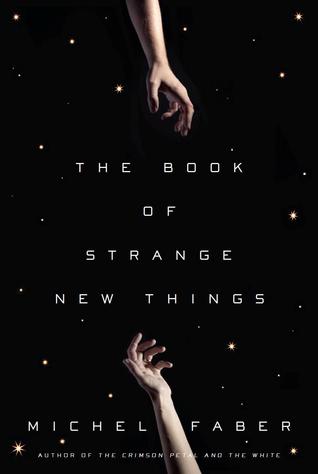
The Book of Strange Things Michael Faber 20697435For Christmas I requested Michael Faber’s The Book of Strange New Things, a literary science fiction novel praised by The New York Times, The Washington Post, and The Guardian.

Typical of me, right? I am  a fan of literary science fiction.   Many  SF books are “mainstream” classics, not to be confused with stereotypical novels about interplanetary or time travel.    Among my favorites are Jonathan Lethem’s Amnesia Moon, Karen Walker Thompson’s The Age of Miracles, Nicola Griffith’s Slow River, John Brunner’s Stand on Zanzibar,   Ursula K. Le Guin’s The Left Hand of Darkness, Philip K. Dick’s Do Androids Dream of Electric Sheep?, John Wyndham’s The Day of the Triffids, and Clifton D. Simak’s They Walked Like Men.

The Book of Strange New Things was supposed to be a masterpiece.   How could one go wrong?

I opened my present happily.

Book Woman gets tough.

Book Woman gets tough.

And so I read 117 pages on Christmas day, becoming increasingly dismayed by the colorless prose and pedestrian plot.  A “man of faith” goes on a mission to another planet.  At home his wife sees Earth deteriorating as  a result of climate change, and reports changes via “the Shoot.”  (Just email, I think.)   In the hands of Jonathan Lethem, this would have been poetic, psychedelic, and genre-bending. In the hands of Faber, it is an anonymous best-seller.

Here is a paragraph about how much Peter misses his cat.

He missed Joshua already.  Beatrice often left for work at dawn, when Joshua was still fast asleep on the bed. Even if he stirred and meowed, she would hurry off and say, “Daddy will feed you.”  And sure enough, an hour or two later, Peter would be sitting in the kitchen, munching sweet cereal, while Joshua munched savory cereal on the floor nearby.

Very dull, isn’t it?

I hunted on the internet to see if any reviewers panned it. The Boston Globe disliked it.  And though Niall Alexander at Tor.com (a science fiction website) said it was a “masterpiece,” he added a guilty caveat:

…but I was, if I’m honest, disappointed by bits of it. First and foremost, it’s slow, if not excruciatingly so; a little action in advance of the packed last act would have livened it up a lot. It’s also overlong—and I can’t help but think the book would have been better served if Faber had engaged in some way with the speculative elements of its premise rather than rinsing and repeating certain sequences. Relatedly, there are a load of loose ends, and plot holes aplenty that the science fiction faithful are sure to struggle with.

Does that sound like a masterpiece to you? Why do reviewers so often dither about books?  Are they afraid to be too hard on Michael Faber lest they lose work and friends?   Can they only criticize him a little if they first say it is a “masterpiece”?  Although reviewers in the UK are usually tougher than American reviewers, they are on the same page about The Book of Strange New Things.

From a readers’ perspective, it finally comes down to this:  the literature of the 21st century is in trouble.   Writers simply are less well-educated, and writing less well.

Some years ago, a famous writer said that he could always tell when a book was written on a computer. He himself wrote on a manual typewriter.

I miss my typewriter.   The whole process was messier but easier.  On a computer, you’re looking at a screen,.  You may have trouble controlling the drafts. It was much easier to  arrange the typewritten pages side by side or end to end and combine and compare. Sometimes we  literally cut and pasted paragraphs together.  And then we rewrote them again.  You assume your editing will improve your work but sometimes it goes to hell and you have to start over.

Well, perhaps I’ll finish The Book of Strange New Things, just because it IS well-reviewed.  Perhaps it gets better.  I don’t see it turning up as a Man Booker Prize nominee, do you?  But you never know.

Any reviewers reading this:  I do respect your work, but sometimes it goes astray.  Work harder!

Where’s My Book?

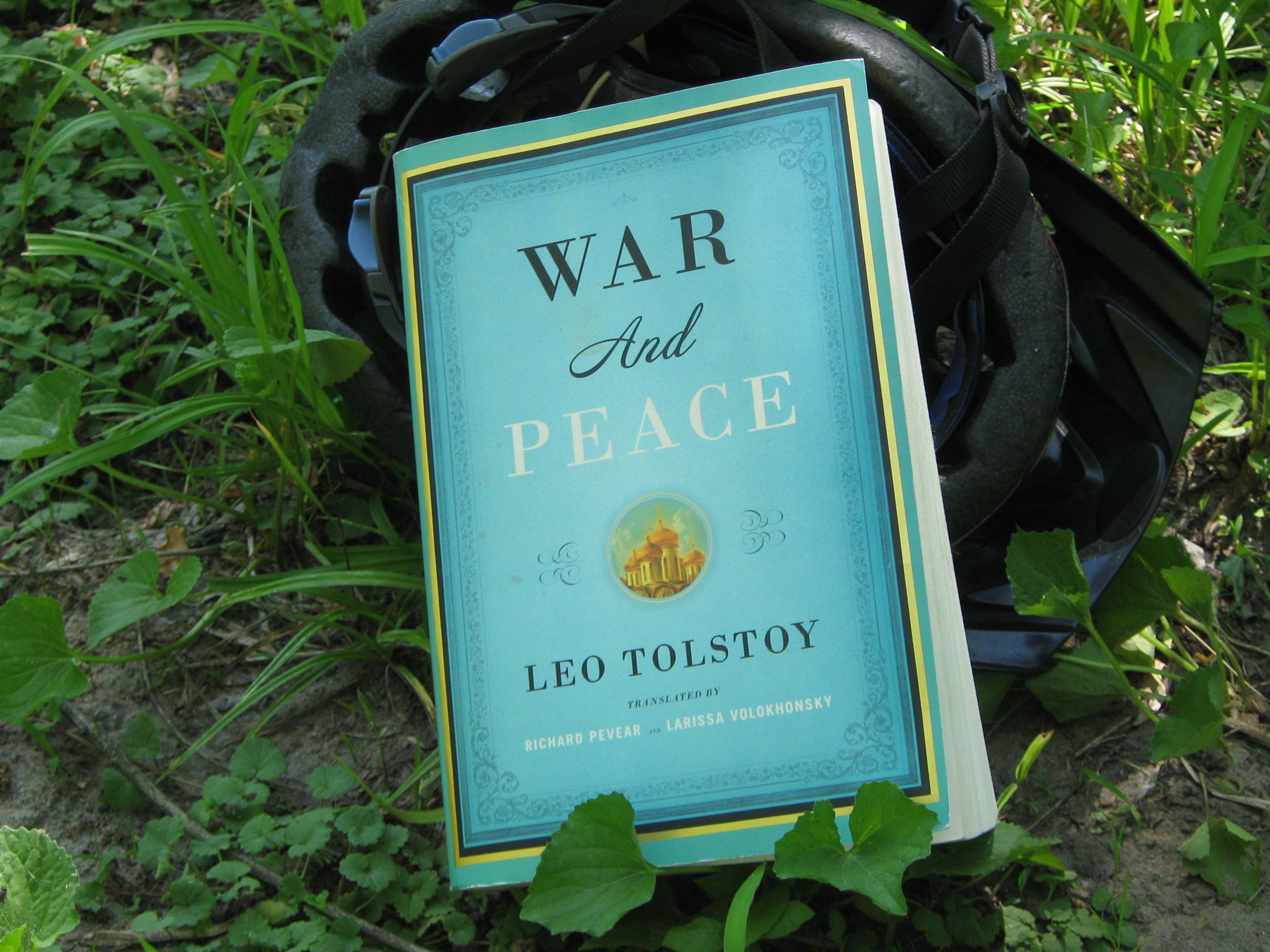
"War and Peace" in my bicycle helmet one summer!

“War and Peace” in my bicycle helmet one summer!

Today I made calls and behaved like the outspoken Marya Dmitrievna, the middle-aged le terrible dragon in War and Peace  “who told everyone her opinion as candidly, loudly, and bluntly, as ever…”

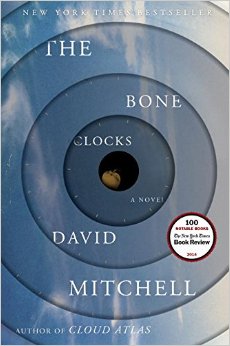
Actually I just went to my cousin’s house. I wanted my copy of The Bone Clocks back.

“Great cookie.  And is that my book?”  It was splayed face-down on a floury kitchen counter.

Where's my copy?

Where’s my copy?

“I’m slowly reading it.”

She’s on page 10.

“I want to read it now, but I’ll give it back when I finish,” I said.

“No biggie.”

Some people are very rough when you ask for your books, though.

You lend a book; you want it back.  They borrow a book; they don’t think you value it.  Hinting isn’t enough:  you have to say, “I need it back.”   I lost Lucy Grealy’s Autobiography of a Face to a woman who pored over self-help books and memoirs of ruination (I lost a few other memoirs of ruination to her, too); Kathleen Raine’s collected poetry to a friend’s girlfriend who walked off with  at a party; and almost lost an out-of-print edition of Osbert Sitwell’s short stories to a friend who insisted I had given it to her..

I had to be firm about that one.  “No, I want it back.”

Sometimes I protest, sometimes I do not.  People do not take the loan of books as seriously as they take, say, the loan of your ball gown or, er, only dress.

It is more practical to give books away than to lend them.

the haunted bookshop by christopher morley 609284Here is a quote from Christopher Morley’s The Haunted Bookshop:

“ON THE RETURN OF A BOOK
LENT TO A FRIEND

I GIVE humble and hearty thanks for the safe return of this book which having endured the perils of my friend’s bookcase, and the bookcases of my friend’s friends, now returns to me in reasonably good condition.

I GIVE humble and hearty thanks that my friend did not see fit to give this book to his infant as a plaything, nor use it as an ash-tray for his burning cigar, nor as a teething-ring for his mastiff.

WHEN I lent this book I deemed it as lost: I was resigned to the bitterness of the long parting: I never thought to look upon its pages again.

BUT NOW that my book is come back to me, I rejoice and am exceeding glad! Bring hither the fatted morocco and let us rebind the volume and set it on the shelf of honour: for this my book was lent, and is returned again.

PRESENTLY, therefore, I may return some of the books that I myself have borrowed.”

What’s your policy on lending books?

New Translations of Anna Karenina

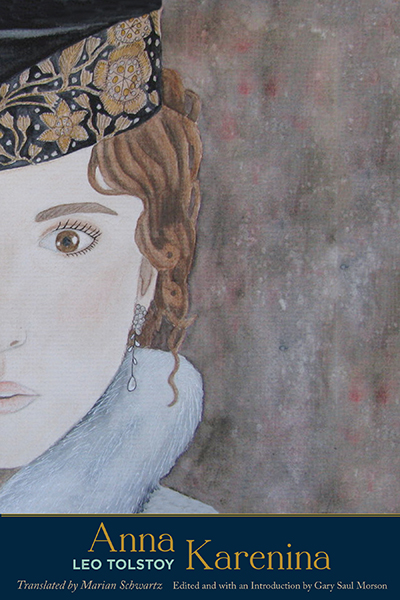
A new translation by Marian Schwartz.

A new translation by Marian Schwartz.

Two new translations of Tolstoy’s Anna Karenina have recently been published.

In the Nov. 21 issue of the Wall Street Journal, Sam Sacks praises the power and clarity of contemporary translations by Marian Schwartz (Yale, 754 pages, $35) and Rosamund Bartlett (Oxford, 847 pages, $29.95).

In the Dec. 24 issue of The New York Times Book Review, Masha Gessen, a Russian and English journalist, is technical in her brisk comparison of the English to the Russian and translators’ choices.

I don’t quite need a new translation, but it is tempting.

Anna Karenina Bartlett book_review

The new translation by Rosamund Bartlett.

I  already have read three translations of this masterpiece: the Maude (translated by the brilliant husband and wife team, Aylmer and Louise Maude, in 1918), the Richard Pevear and Larissa Volokhonsky (an excellent 2000 translation by another talented husband and wife team), and Constance Garnett (I find this 1902 translation less elegant than the other two).

Although Gessen is as incisive as a surgeon in her scrutiny, I prefer Sacks’ charming,  no-nonsense common reader’s approach to the art of translation. He explains that the new isn’t necessarily better than the old:  some of it is about familiarity.

Translations are like recipes: We tend to think that the best one is whichever we encountered first. That’s why, amid the ever-growing list of versions of Leo Tolstoy’s “Anna Karenina,” I will remain partial to Louise and Aylmer Maude’s. It was through their 1918 version that I discovered the novel—in the Oxford World’s Classics edition, the mass-market paperback with the bright yellow spine and sturdy, laminate covers. This fact alone would give them pride of place.

Sacks says there are only minor differences between the two new translations (and the other translations, as far as that goes).  He explains that Bartlett’s is a more “classically elegant translation,” while Schwartz stresses “Tolstoy’s artless, intuitive side by retaining his repetitions (whereas Ms. Bartlett deploys synonyms) and eschewing commas in long sentences.”

Gesson agrees that Bartlett’s is more readable, though she says Schwartz has a better ear for Russian.  In a comparison of one passage in four different translations–the 1902 Constance Garnett, the Pevear and Volokhonsky, and Schwartz and Bartlett–she zeroes in on different renditions of Russian words that have varied meanings .

Translators may change their sympathies for different characters with every reading, and so translations can vary in tone, she observes.

How earnest, ironic, condescending, moralistic and simply funny a Tolstoy should the translator inhabit? Perhaps the only way to render Tolstoy’s variable voice is to continue producing ever-varying translations.

Hers is a fascinating, if slightly cynical and almost overly precise, review.

Perhaps I’ll try one of these new translations someday, though I already love the Maude and the Pevear and Volokhonsky.

And perhaps I should stick with what I have.