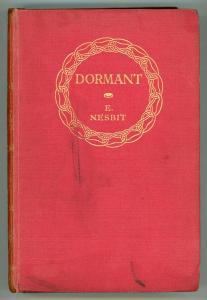
E. Nesbit’s Dormant

dormant e. nesbit 13509277644

The hardback is $350!  Thank God for the e-book.

E. Nesbit was my favorite writer as a child, and I especially loved The Enchanted Castle. One of the pleasures of having an e-reader has been discovering E. Nesbit’s out-of-print adult books.    Who knew that this brilliant writer of fantasy classics also penned eight adult novels?  I found only a couple of her adult novels at Project Gutenberg before I purchased the Delphi classics e-book,  The Complete Novels of E. Nesbit ($2.50).

Last year I read The Lark, a charming comedy about two orphaned young women, Jane and Lucilla, struggling to make a living selling flowers from their garden. (I posted about it here.)  It is also a comic riff on the romance between Jane Eyre and Mr. Rochester. Yes, Jane meets a Mr. Rochester, sans mad wife.
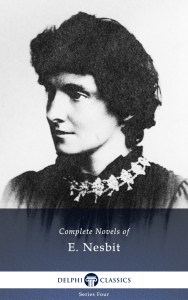
Delphi complete novels of e. NesbitRecently I read Nesbit’s strange, uneven, but compelling novel Dormant, which begins charmingly as a comedy about a group of struggling, mostly impecunious,  young people: an artist, a chemist, an editor, doctor,   a journalist, a dressmaker,  and a young man who lives off his father’s pesticide money.  They call themselves the Septet and eat, drink, and debate capital punishment  and women’s suffrage over tea.  The heroine, Rose Royal, is a likable, kind, pretty artist with a small private income.  In London She rents Malacca Wharf, where she inhabits a dilapidated house and rents a decrepit warehouse to her chemist friend Anthony.  She quells some poor children, furious that they are shut out of Malacca Wharf,  with a smile when they throw stones at her house and invites them inside.   Every weekend she invites them to “biscuit parties.”

But there is a hitch in her seemingly perfect life.  She is in love with Anthony, who is not in love with her.  On his birthday, she buys him a science book that dates back to the Renaissance, written in cipher, but with his name and coat of arms in it.  The book belonged to one of his ancestors. The subject is a form of alchemy.

I do love the dialogue.  Here is part of Rose’s conversation with the bookseller.

“I do like the smell of your shop,” she said, reaching out her hand for the book he now held; “ it’s not only the old leather, it’s something that’s like a dream of a dream.”

Later, when she arrives an hour early for tea with the Septet at William Bats’ house (Bats is an editor without much work who is in love with Rose), he jokes about the way everyone is in love with her.

“You remember,” he said, turning the pages of the book, “that the Septet was formed on the distinct basis of our all being as disagreeable as we liked to each other, and I’m the only one who has ever tried to live up to the old ideal. All the others merely grovel before you, wormlike. How you can stand it, I can’t think!”

And here’s one of Nesbit’s authorial comments about Rose’s beauty.

Rose had been the reigning beauty of the Slade, but then quite ugly girls have been that. She was the leader in her set, but then charm is not always of the essence of a leader. She had received from two to five offers of marriage every year since she was seventeen, and at least twice as many offers of platonic friendship; declarations of impermanent adoration at various temperatures …
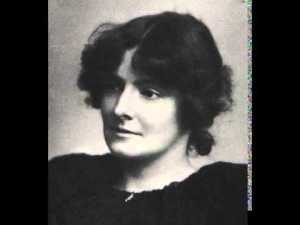
E. Nesbit

E. Nesbit

Suddenly the novel morphs into a feminist horror retelling of Sleeping Beauty  crossed with Mary Shelley’s Frankenstein. The bookseller had predicted Rose’s future:  if her beloved inherited money, it would be a disaster.   Anthony inherits money, a title, and an estate, he proposes to Rose.  But money, and a mysterious laboratory in his house, change him.  It seem Anthony’s ancestor had worked on the elixir of life in the laboratory.  The dead body of a girl named Eugenia is found in the laboratory.  When Anthony brings her back to life, is she grateful to be awake?  Not very. She knows she is a different species.  She is terrified.

This fascinating novel rambles along and doesn’t quite hold together. Nevertheless, I liked it. If you are a  Nesbit fan, you will admire her grip on this comedy-cum-horror novel.  Nesbit wrote horror and ghost stories for adults, so I wasn’t completely surprised by this.

What would Angela Carter have made of it, I wondered.

Surely E. Nesbit is some kind of foremother of retold fairy tales and horror!

Edith and her husband, Hubert Bland, were socialists and members of the Fabian Society. To support her husband and five children, Nesbit wrote children’s books. She also supported her best friend, Alice, who had an affair with Hubert, had two children by him, and became Edith’s housekeeper and secretary. A. S. Byatt’s wonderful novel, The Children’s Book, is based on E. Nesbit and her circle.

Nesbit  can be entertaining, graceful, and brilliant.  In her adult books, her plots do tend to wander. Her children’s books are seamless.

But Dormant is worth checking out.  I’ll probably reread it and decide it’s a work of genius.

How Many Sun Salutations…? and What to Read When You Ache

Apparently I did the "Not This!"

Apparently I did the “Not That!”

I ache-e-e-e-e!

My wrist hurts!

Isn’t Beginning Yoga enough to keep me flexible?

In an attempt to improve my rendition of the Downward Dog, which is oft-repeated in a sequence of exercises known as the Sun Salutation, I stretched my arms too far back  from my wrists.  My left wrist aches like a son of a bitch.  Pain in the wrists from the Downward Dog is common, according to yoga web sites. How many Sun Salutations does it take to perfect the Downward Dog (or do I mean change a light bulb)?

I have temporarily suspended yoga and frequently apply bags of frozen vegetables (our ice packs) to my wrist.  But I do miss my yoga!

Here’s What to Read While You Ache:   Humor or a Mystery!

1 Angela Thirkell’s Wild Strawberries.  I love Thirkell’s humorous novels, which are a bit like Barbara Pym crossed with P. G. Wodehouse.    In this whimsical novel, the disorganized Lady Emily Leslie has a house party.  She frequently loses her glasses and bag,  her husband can’t think of a thirkell wild strawberries 26760Spanish name beginning with “R” for  a bull he plans to sell to an Argentine rancher (“I had thought of Rackstraw, or Richmond…. But they don’t sound Spanish enough to me”), a French guest falls in  unrequited love with the Leslies’ beautiful married daughter, Agnes, who barely notices him except when he scoops one of her children out of a shallow pond, and a distant cousin, Mary, falls for their charming dilettante son, David, who has inherited money and whiles away his time in London applying for BBC jobs he doesn’t want, going to plays,  trying to write one, and flirting with women in restaurants, while their oldest son, John, falls for Mary.

I love Thirkell’s hilarious scenes in church.   Mr. Leslie, Lady Emily’s husband, tells her not to dawdle because they are late and “poor old Bannister is dancing in the pulpit.”  Lady Emily, however, insists that the “question of communion is important,” and arranges her family in the pews according to those who want “to escape” (they must sit on the edge of the pew) and those who want to go to communion, who must sit inside “to make less fuss.”

A fun read, and it not necessary to read Thirkell’s Barsetshire series in order, though it doesn’t hurt. This is the second.

I love the cover of this old edition!

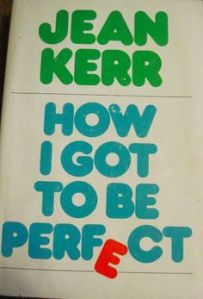
jean kerr how i got to be perfect 0a5756adddddbd45766440e15c6032902 Jean Kerr’s How I Got to Be Perfect.   Jean Kerr, the author of the Tony Award-winning play, King of Hearts, and the wife of  drama critic Walter Kerr,  was  one of the most amusing domestic columnists of the ’50s, ’60s, and ’70s.   How I Got to Be Perfect (1978) includes the best of three previous collections, Please Don’t Eat the Daisies, The Snake Has All the Lines, and Penny Candy, and a few “new essays.”  In “Marriage:  Unsafe at Any Speed,” she says that “Till death do we part”worked  in the Middle Ages when life expectations were short due to the plague, but she advises a written marriage test in our “enlightened age” of longevity.  I love her questionnaire.  In “As I Was Saying to the Geranium,” she writes about her bad luck with house plants.  In  “The Kerr-Hilton,” she describes their hilarious search for a bigger house after the birth of their fourth son.

For months and months we followed happy, burbling real estate agents through a succession of ruins, which, as the agents modestly conceded, “needed a little paint and paper to make them happy.”   These homes invariably had two small dark living rooms and one large turn-of-the-century kitchen–and I don’t mean the nineteenth century.

Eventually they go see a huge brick castle in “a style that Walter was later to call neo-gingerbread,” with  clock towers, cupolas, and  a courtyard that “strongly resembled an MGM set for Quo Vadis.”  Walter leans on some oak paneling and briefly disappears into a secret closet.  But they buy it because it’s the right size for their family and the layout gives them space from their four sons.

It’s really very funny.  I keep laughing.

3 Julian Symons’ The Man Who Killed Himself (1967).   I have a Penguin omnibus of three novels by Symons, a crime writer, editor, poet, and literary historian, and this well-written, fast-paced mystery is the first of his I’ve read.  Arthur Littlejohn, the hero–but is he the hero?–is a timid man, bullied by his wife.  No one would think he leads a double life, but he has another identity, as the roguish Major Eastonby Mellon, and a second wife, who believes he is frequently absent because he is spy. When he plans to murder his first wife,  let’s just say it gets noirishly out of hand.

julian symons omnibus 51sWRuzvBoL._SL500_SX324_BO1,204,203,200_Short posts are the best, but I must cut this short because I ache again!  More ice.

The Zen (or Non-Zen) of Book Groups: Ann Packer’s The Children’s Crusade and Carolyn See’s The Handyman

book group women Study-GroupI walk into a meeting.

Not AA, not NA, nothing exciting.

It is the first meeting of a book group for fifty-plus women, or, as I call it, the Post-Menopausal Grrrls.

I’m expecting to find a cadre of wild white-haired bibliophiles, the female equivalent of  the quixotic dreamers in my  SF/fantasy book group.  The SFers are endearingly knowledgeable about eBay deals on first editions of Alfred Bester’s The Stars My Destination and engineering problems in The Martian.  I always enjoy the unexpectedness of their dialogues.

Who will the fifty-plus-ers be?

Book groups in my city tend to be small.  And so I am not surprised to see there are only six women.  No one with white (bike) helmet hair (like mine); all are professionally dyed and coiffed. The kind leader, who gives me a nametag,  tells me there’s coffee in the urn.  I tell her I love coffee, but only fresh-ground from whole beans.

How I’d love to be a member of this group.  But it’s not what I expected.  These pleasant women are all grandmothers, poring over pictures of grandchildren on their phones.   Even after menopause, they can’t stop talking about reproduction.

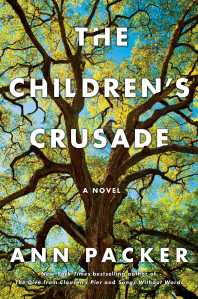
ann packer the-childrens-crusade-9781476710457_hrFinally we discuss Ann Packer’s The Children’s Crusade, a classic “bad mother” novel.

In this brilliant novel about five decades in the lives of the Blair family, Packer asks questions about the American family: is the “bad mother” responsible for all her children’s woes? Is she even necessary when her husband, a saintly pediatrician, is the perfect parent?  The women at the group are no-holds-barred angry about the artist Penny Blair’s withdrawal from her family.  Having seen many styles of parenting, some much worse than Penny’s, I suggest that Bill, who responds to every crisis with caring questions and psychoanalytical language, is also part of the problem.  But censure of Penny is the order of the day.

Some book groups have it, some don’t.  This particular group responds emotionally to parts but not the book as a whole.   The SFers would have  a more interesting take on it.

At the end of the meeting, I recommend Carolyn See.  Has anybody read her? (My SF group likes her novel Golden Days.)

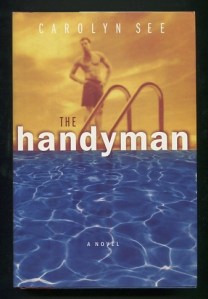
Carolyn See the handyman 17850Carolyn See, the American novelist, memoirist, and critic, is one of my favorite authors.  She writes with uncanny clarity,  interweaving brilliant insights about modern American life with graceful descriptions of the quotidian.  I recently reread  The Handyman, the story of an artist who finds his vision while working as a handyman.

See cleverly frames the story with a Guggenheim application in 2027 by an art historian, Peter Lauce, who wants to study the early and intermediate period of Robert Hampton’s art.  Then it segues from the application to  the events of the summer of 1996, when Hampton abandons his plan to live in Paris for a year and turns around and flies home to L.A..

Robert wonders gloomily, Does an artist have to live in Paris?  Can art be made in L.A.?  He thinks of Anthony Hernandez and Carlos Almaraz.

He posts his handyman flyers.  Desperate people hire him to bring order to their lives. He cleans the houses of depressed housewives,  arranges help for a young man from Ohio trying to care for his lover dying of AIDS, clears out a beautiful widow’s husband’s belongings and becomes her friend (and more), and paints the cement around a rich family’s swimming pool cerulean blue. Suddenly he notices a toddler  curled up on the bottom of the pool with his thumb in his mouth.   He saves the drowning child’s life, and is forever bonded with Angela, Tod’s mother. She is a simple, charming, honest woman, living on a different plane from her abusive rich husband.  Her philosophy of life is  immediate and mellow.

She tells Robert,

“I’ve never had any ambition.  I just want, like what we have today.  Like…that time in the day when nothing’s happening.  As if it were three in the afternoon, on a weekday. Or four. Everything’s in order. You don’t have to start dinner for a couple of hours.  And you’re out in the backyard. Or on the porch.”

Don’t we all live for those mellow hours?  She influences Robert more than he realizes as they become friends.  No wonder he falls in love with her.

Love makes art!  (I think.) Or something like that!

Voting for Utopia

Bernie and Hillary in debate.

        Bernie and Hillary in debate.

As I clean the kitchen, I listen to NPR.  I am scrubbing pots and pans as they chat about Trump and the Republicans. Finally they speak about the Democrats. I am pleased to hear Bernie Sanders is ahead in the polls in New Hampshire.

I admit, I was leery about this year’s election.   The Democrats and Republicans seem to alternate every eight years.  I had that listless burned-out feeling  that it would not matter whom I voted for.  The Democratic race between Bernie and Hillary has perked me up. A Democratic Socialist   for president?  Yes!

No one is much surprised when I say I’m voting for Utopia.  We haven’t had a candidate like Bernie in a long time.

There has been a recent uproar among Hillary supporters trying to attract young women voters.  According to The New York Times,  Madeleine Albright, the first female Secretary of State, said at a Hillary rally that the true “revolution” would be electing the first female commander-in-chief.  Okay, I see her point.  But she also reportedly said, “There’s a special place in hell for women who don’t help each other!”

Very disconcerting. No, there is not a hell for women who prefer Sanders, a Democratic Socialist, to Clinton, the Establishment candidate.  Women can help each other even if they vote for a man who supports women’s issues.

Gloria Steinem

    Gloria Steinem

Hillary Clinton had trouble attracting young women voters in Iowa, and is allegedly behind in the polls with women of all ages in New Hampshire. And so older feminists are speaking to the young on her behalf.   The New York Times reported that Gloria Steinem said in an interview with Bill Maher last Friday that women became radical when they get older.   “When you’re young, you’re thinking, ‘Where are the boys?’ The boys are with Bernie.”

As a girl  I was influenced by the savvy Steinem, and this doesn’t sound like her.  Perhaps it was quoted out of context.

Certainly life was different in my girlhood in the ’60s and ’70s when Steinem became a famous political activist.  It was intense:  irony and indifference were not trendy. I am quite sure I would  have voted for women of either party had I been able to vote in my teens. Perhaps it’s good I didn’t have that power then.   In 1972, when I heard Shirley Chisholm, the first African-American woman to be elected Congresswoman and to run for the Democratic party presidential nomination, speak in a crowded auditorium, I thought the revolution  was here.  (It was a moot point, since I wasn’t old enough to vote).

And I wasn’t a revolutionary for long.  I became absorbed in my personal life, dropped in and out of college, and finally committed to Latin and ancient Greek.  That was pure; that was enough.   I had no intention of voting the year I was finally eligible. Then an activist  from the county Democratic party headquarters offered me a ride to the polls. That was how I learned my civic duty as a voter.

And I can’t help thinking that it’s encouraging that young women are voting, whether for Bernie Sanders or Hillary Clinton.  I am not, of course, quite so happy if they’re voting for Republicans.  Are Democrats getting out the vote?  Driving people to the polls?  Believe me, it makes a difference.

There’s a long way to go before the election.  The count that will really count will be at the Democratic convention in Philly.

Meanwhile, no one can tell you whom to vote for in the primaries and caucuses.

D. J. Taylor’s The Prose Factory

dj taylor The Prose Factory“What is ‘literary culture’?  And what is ‘taste’?” asks D. J. Taylor in his immensely readable new book, The Prose Factory: Literary Life in England Since 1918.

The result is a compelling history of a century of writing, brokering, publishing, marketing, reviewing, shaping of taste, and selling of books in England.

I love reading books about books, and I admit I am partial to the list-making possibilities of reading such books.  While reading The Prose Factory, I made a long list of writers to read, among them Theodora Benson, Julia Strachey, Francis King, Julian MacLaren-Ross, and Julia Darling. What I love about this book is Taylor’s  balance between highbrow and middlebrow authors. Taylor, an award-winning novelist and biographer, knows how to tell a story, and thus has the advantage over many critics.  His story is about the impact of middlebrow fiction as well as classics, and how writers of all genres make a living.

One chapter is even entitled “Highbrows, Lowbrows, and Those In-Between.”  Taylor begins by sketching the mass readership of best-selling books in the 1920s.    He writes,

…J. B. Priestley’s The Good Companions sold so many copies at Christmas 1929 that a fleet of vans had to be laid on to deliver fresh stock to booksellers.  Simultaneously there lurked a suspicion that this new army of readers, whether clerks looking to be edified or housewives looking to be entertained, was potentially traitorous, all too ready to be lured away by the blandishments of radio, cinema and, as the interwar era wore on, television.  Even here, in an age where a six-figure copy sale of a novel that captured the public’s imagination was not unusual, it was feared that the book might soon revert to its former status as a minority interest, one among a dozen contending leisure activities, always likely to lose out in the race for novelty or to be swept away by the latest fashionable gadget….

D. J. taylor 4774

                                    D. J. Taylor

Taylor tells us how Priestley’s Angel Pavement, the story of a group of sad lower-middle-class people who work in an office, influenced Norman Collins’s London Belongs to Me, centered on a group who rent rooms and apartments in the same house, and Monica Dickens’s The Heart of London, centered on a lower-middle-class neighborhood.  (I have read and enjoyed all three of these novels.)

There is also a chapter about Hugh Walpole, a writer of popular novels who was not satisfied with popularity.  Walpole tried to court writers and reviewers, even writing letters to reviewers who trashed his work.   His attempts to charm and make friends backfired.  W. Somerset Maugham destroyed his reputation in his satire of an opportunist writer based on Walpole in Cakes and Ale.

I am very interested in middlebrow novelists, and there is a lot about them.  But Taylor is equally at home writing about Anthony Powell (whom he also writes at length about); Virginia Woolf and T. S. Eliot; George Orwell (the subject of Taylor’s award-winning biography);  the critics F. R.  Leavis, John Carey, and James Wood; the Angry Young Men movement; and women writers of the ’60s, including Margaret Drabble, Nell Dunn, and Edna O’Brien. Did you know the  Booker Prize created a market for a new kind of literary fiction?  And that the  1980s was a particularly fruitful time for literary fiction?  There is an entire chapter on A. S. Byatt’s Fredericka Quartet.  He even writes about Paul McCartney  lyrics for “Eleanor Rigby.”  He also writes about the effect of the internet on publishing.

A brilliant book, and very enjoyable.  You can read it form cover to cover, or browse around.  It is a good read, or a reference book.

I have read several of Taylor’s books, and have written about them here and here.  

The Art of Taking Notes: Just Write Everything Down!

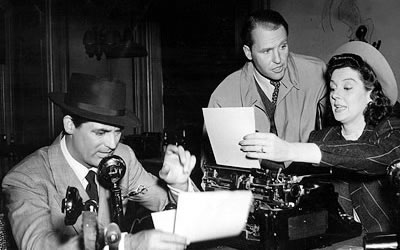
Rosalind Russell doesn't have time to take off her hat when she's typing her notes in "The Front Page."

In “The Front Page,” ace reporter Rosalind Russell doesn’t even take off her hat when she’s typing.

There is an art of taking notes. Simply Write Everything Down.

It is not the best secret, but it is mine. How will I know what I want to remember later?  And so I have been known to scribble down entire lectures by favorite professors, quotes from Oprah, and intros to music on public radio.  (I had forgotten all about Santana, hadn’t you?)   I am your go-to person if you want to know what  Professor X said in 1980 about eye disease in Aristophanes’ comedies.  (He was making a joke about the prevalence of eye infections and myopia in Greek comedy, but then decided it would make a good article.  Did he ever write it?)  Kelsey Grammer told Oprah how much he loved Steinbeck’s The Grapes of Wrath during one of her book club sessions.  Alas, I fear I’ve thrown out the notes about the reunion of Oprah and Jonathan Franzen.

image

A pile of notebooks.

When I worked as a freelance writer, I interviewed chefs, fly fishermen, and dancers.  If you’re an outline person and you’re interviewing someone fascinating, you won’t go far.   Try writing A, a1, a2, B, b1 when you’re trying to understand the mad art of fly tying. I had to explain I couldn’t thread a needle or I’d still be sitting on that stool trying to figure out how to use a bobbin.

You’ll want to catch every word when the poet James Dickey is bored on a book tour. He’s trying to draw you out because he’s already given this interview to ten other reporters, and you’re trying to talk about his 683-page experimental novel, Alnilam, which you have not finished because the editor gave it to you yesterday.  (You can read my interview with Dickey here.)  When he focuses on the book, you want to record every word.   I wouldn’t have wanted to miss the following gems:

One of the things I wanted most to do with this book is to restore the true sense of flight. I just came up here on an airline, but being on an airline is like being in a hotel at 35,000 feet. Man has been capable of true flight for less than 100 years, and these frail little trainers (planes) that these boys are in give the body the true sense of being caged in the air.

image

My Chinese diary!

Do I take notes now?  Yes, eclectically.  It’s a pity I don’t take notes on my reading, because it would make blogging easier.  But blogging is fun!  That is my motto.  I’m not going to take notes for fun.

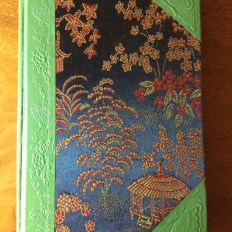
Still, I do take notes eclectically in my many notebooks.   See this adorable leather and silk diary I bought at Things and Things and Things in Iowa City when I was 20?   I scribbled down quotes from Anna Karenina.  I felt a great affection for Levin, a landowner who is devastated when  Kitty rejects his proposal.

“Yes, there is certainly something objectionable and repellant about me,” thought Levin after leaving the Shcherbatskys, as he walked toward his brother’s lodgings. “I do not get on with other people.  They say it is pride!  If I had any pride, I should not have put myself into this position.”

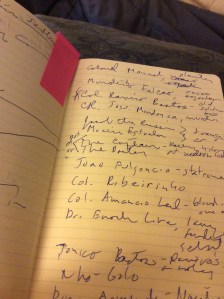
I put aside a Brazilian modernist novel, Jorge Amado’s Gabriela, Clove and Cinnamon, when I flew to London last fall.  When I returned, I had to make a long list of characters because I couldn’t keep their names straight.   Why is everybody called Colonel, I wondered..  (It’s a courtesy title:  corrupt landowners,  politicians, and other rich thugs are neither military nor quite respectable.  A stunning novel, but hard to write about it when you’re on the four-months-between-start-and-finish plan.

image

Good luck with reading this!

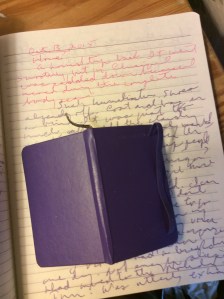
When I traveled to London last fall, I took two notebooks:  one for lists and one for a diary. Loved the trip, but there were some hitches coming back.  Naturally I wrote it up at the Chicago airport (in colored pens from Paperchase).

A horrid trip back.  It went smoothly, but in Chicago I was patted down because I moved during the complete body scan.

Such humiliation.  Shoes already off.  Coat and bag in bin.  It was  too much after all the standing in line, nothing clearly marked, no ropes to mark off lanes…  I have to say they’re more organized in London.

image

The London Lists and Diary

And so there they are!  Notes and notebooks, for all the good they’ll do me.  But they give me a sense of accomplishment.

Do you have a note-taking system? Hundreds of notebooks?  Special lucky pens? Comments are open for this post!

What to Read After Ferrante: Gail Godwin’s A Mother and Two Daughters

Gail Godwin

Gail Godwin

Women love Elena Ferrante’s Neapolitan Quartet, her hugely enjoyable pop-literary novels about a tumultuous friendship lasting from childhood through old age.

Many reviewers have asked, “What do I read after I’ve finished Ferrante?”

I have the answer.  If you like Ferrante…

Try Gail Godwin, a Southern writer who has been a finalist for the National Book Award for The Odd Woman (1975), Violet Clay (1980) and A Mother and Two Daughters (1983).  She is the author of 14 novels, two short story collections, three non-fiction books, and ten libretti.  Godwin is  both literary and popular:  she  knows how to tell a gripping story, and how to dig deep for psychological truths.  She worked as a journalist, earned a master’s from the Iowa Writers’ Workshop and a Ph.D. from the University of Iowa, and taught at various universities.  Her beautifully-written  novels explore the difficult relationships between women and their families.  Her characters are well-read and sometimes intellectual: I look forward to their discussions about Nathanael Hawthorne, George Gissing, George Eliot, and Montaigne.

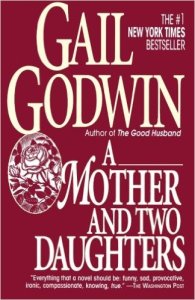
gail godwin a mother and two daughters 51xHfXMjvbL._SX322_BO1,204,203,200_My favorite of her novels is A Mother and Two Daughters, the  story of three women  entangled by family ties and daily conflicts that make it hard to see one another clearly.  It is told  from alternating points of view and  in distinctive voices:  Nell Strickland, a happily married woman who lives with her husband, Leonard, a lawyer, in a house with a view of  the mountains  in North Carolina; Cate, her wildly rebellious daughter, is an English professor at a college in Iowa, who has been married twice and is ending an affair with the Resident Poet; and Lydia is the dullest, a 36-year-old housewife and mother of two who leaves her husband for two reasons:  (a) to take a lover and (b) to go back to school.

Nell is in the middle.  She can see the strengths of wild Cate, who doesn’t care what others think, and of traditional Lydia.  Seeing them at the same time can, however, be trying.

The three come back together after Leonard Strickland, their calm, intellectual, Montaigne-reading husband and father, dies of a heart attack while driving home from a party:  Nell has a broken rib.

After Lydia picks up Cate at the airport, they drop by the house.  They sit in the living room in the house where they grew up.  The description of the room tells so much about all three of the women.

The early-winter sunset was filling the room with shadows. So much family history had happened here.  Cate had petitioned to be allowed to drop out of convent school and go to public high school.  In this room, Lydia, hardly able to contain her triumph, had made hasty wedding plans so she could accompany Max to his new job in London.  every six months, Nell Strickland would declare the room off-limits the night before it was her turn to hostess the Book or Bridge Club.  In the southwest corner, next to the huge Magnavox console, their father would sit on Saturday afternoons, upright and motionless as a Pharaoh…as he gave himself up to his operas via earphones.

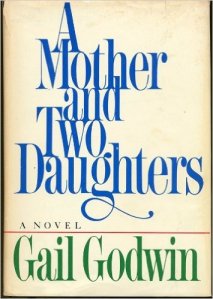
mother and two hardback gail godwin516P2u0ym5L._SX353_BO1,204,203,200_Life doesn’t stand still after the funeral.  Back at school, Cate is asked to take over a theater class after the drama teacher had “suddenly” to leave, i.e., was fired because he had made a gay pass at a student.  And so Cate meets Roger Jernigan, the father of one of her students,  known as the Pesticide King, who lives in a castle on the bluffs. Amazingly, they click.  They enjoy  their talk and are attracted.  He visits her flat in a condemned building, and she visits his castle on the bluffs.  Inevitably, Cate gets pregnant. She knows she cannot keep the child.  Ironically , her godmother, has just taken in a pregnant girl, obviously to take Cate’s place.

Godwin speaks about A Mother and Two Daughters  in an interview at nationalbook.org

The nearest I can get to the theme is expressed by “Cate”, when her mother is about to host a meeting of the Book Club on The Scarlet Letter. She says that the main thing to remember about that book is that it asks a very crucial question: Can the individual spirit survive the society in which it has to live? Paradoxically, the more completely you develop your own character, the more useful you are to society. But you can’t just be a free spirit; you have to give and blend and become part of a whole that’s larger than yourself

Really a stunning book!  Treat yourself.

A Coin Toss at the Caucuses!

At the Iowa caucuses on Monday night,  Hillary and Bernie had a “virtual tie.” Early Tuesday morning, it was determined that Hillary had won by 0.3 percent (according to CBS).   In some precincts, a coin toss decided the winner because supporters of Hillary or Bernie refused to budge.  My husband and I could not visualize this, but here is a fascinating video of a coin toss in tiny Hardin Township.  There were 29 people for Hillary and 29 for Bernie. They were very smart to film this.  (Bernie won.)

http://https://www.youtube.com/watch?v=ONP9oKpyjQ4

Giveaway: F. M. Mayor’s The Squire’s Daughter & Aldous Huxley’s Point Counter Point

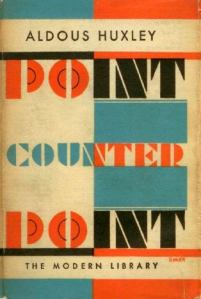
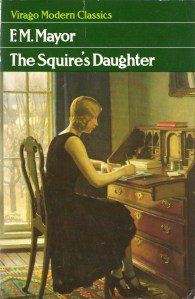
HuxleyPoint1932.bigMayor, F. M. - The  Squire's Daughter coverAnother giveaway!  I recently gave away two boxes of books to the Planned Parenthood Book Sale, but thought some of you might  be interested in  F. M. Mayor’s The Squire’s Daughter (Virago)  or Aldous Huxley’s Point Counter Point (Modern Library: it is Huxley’s masterpiece). The giveaway is open to readers in the U.S. or Canada.  Alas, the postal are now outrageous outside of North America.

Leave a comment if you’d like one or both of these, or email me at mirabiledictu.org@gmail.com.

Here is a little information about the books.

  1. Aldous Huxley’s Point Counter Point, a brilliant 1920s satiric novel about Bright Young Things, with a huge cast of characters, writers, artists, scientists, anarchists and suicides. So many miserable love affairs!  This is a Modern Library hardcover, sans book jacket.
  2.  F. M. Mayor’s The Squire’s Daughter begins at the turn of the century, a Golden Age for the aristocracy. Fast forward 30 years, and Carne, the DeLaceys’ Jacobean mansion, is too expensive, the servant problem is shocking, and the Squire is faced with selling it. His two daughters gad about London, and his son is a dilettante who socializes with arty types. But then there is their golden cousin, Rex, a brilliant, strong, attractive, athletic man (like Jamie in Diana Gabaldon’s Outlander book–Jamie, Jamie!–I must try to finish Volume 1!). If only Rex were the heir! Sir Geoffrey thinks….

The Iowa Caucuses & A Reverie on Prescription Medication

The Capitol in Des Moines.

The Capitol in Des Moines.

The Iowa caucuses are over!

For the last week, presidential candidates have zoomed around Iowa making speeches and glib promises. The media have been here.  David Muir anchored the ABC news in front of the Capitol building in Des Moines.  He was charming, relaxed, well-informed, and uncondescending.  We switched to ABC from CBS, where Scott Pelley grumbled and said that Iowa didn’t matter.

I don’t know about that.  Bernie and Hillary are tied in Iowa. That means something.

I always vote in the election, but did not attend the caucus last night.  I do not really care to stand in a gym for two hours and raise my hand for a candidate. I also had  divided loyalties.  I had planned to caucus for Hillary in memory of my mother, who idolized her and even kept her Caucus for Hillary kit from 2008.  My mother, however, also disliked the caucuses, ande only attended onece, for Ted Kennedy.

But I had a revelation.

I love Hillary, but Bernie represents the vision of America held by my deepest, truest self.  I have always called myself a socialist, and I never thought a socialist would get this far.  I was raised in Iowa City, where I breathed the air of feminism,  pacifism, whole-wheat bread, and Our Bodies, Ourselves.  I can’t forget who I am.  It’s time to go back to my (slightly) radical roots.

If I had gone to the caucus, I would have supported Bernie.

There was a record turnout for the Democrats in our precinct:  662.

And Bernie won in our precinct!  Here are the numbers:

Bernie:  52% of the votes, 342

Hillary:  42%, 280

O’Malley:  not viable:  6%, 42 votes

In Iowa Bernie and Hillary are virtually tied.

Now they’re gone:  we’ll see them in the fall maybe, but they’ve got other states to woo!

…………………………………

A brief meditation on health care.

I was horrified to learn that one of my medications would cost $1,000 a month without insurance.

I am not very political, but I know about sickness.

Every American deserves health insurance.  The creation of “Obamacare,” or the Affordable Care Act (ACA), is a miracle in our conservative country. What will happen with next year with a new president? Check the records:  Hillary and Bernie have strong records on health care, while the Republicans say they want to revoke Obamacare.

I tend to be too personal, but I will just tell you: multiple medications kept my mother alive, she lived long, and she was not ready to die when she died.  I am still middle-aged, but I, too, need  medications.  What happens to people who slip through the cracks and cannot buy the drugs they need?  Obviously, many die.

In an article in The American Scholar, “Medication Nation,” Philip Alcabes, a professor of Allied Health at the School of Nursing at Adelphi University and Director of the Public Health Program in Adelphi’s Center for Health Innovation, writes about America’s dependence on drugs. He believes drugs are over-prescribed , and cites some interesting statistics.

According to the Kaiser Family Foundation, Americans filled more than four billion prescriptions in 2014. On average, about half of all Americans use at least one prescription medication in any given month. The U.S. Food and Drug Administration reports that more than 300,000 legal nonprescription (over-the-counter, OTC) medications are also available. Eighty percent of us use OTC drugs as the first response to minor ailments.

Although I don’t doubt that many doctors overprescribe drugs, I wonder about the politics of articles like this.  They undermine the fact that many Americans do have serious health problems and desperately need medications.

Not everyone in sparsely-populated Iowa has access to  health care.  There are bleak rural areas with no doctors.   Even in the cities, there have been severe cuts to health care services.  In 2014 in Des Moines,  8,000 pyschiatric patients lost their doctors when Mercy Medical Center closed its psychiatrict hospital for adults and outpatient services.

As a consumer, I am grateful to my health care givers.  Where would we be without them?  But I was on a rocky road for a couple of years. After an excellent doctor retired, one of his/her partners proved incompetent. You may remember my account of a painful pelvic exam.

Even after you switch doctors, there are ripple effects from treatment by  incompetents.  Are you ready for this?  He/she had miscalculated the dosage of my thyroid pills.  In fact, that gave me a new disease:  my HYPOthyroidism turned into HYPERthyroidism.  (It is under control again now.)

So we need good health care as well as affordable health care.  I am very happy with my health care now!

I am very, very serious about the importance of health care.  Let me just quote our two tied Democratic candidates.

Bernie

“My view is simple: health care is a right, not a privilege. We spend far more than any other country on health care, but 29 million Americans remain uninsured and millions more are under-insured. That is unacceptable. The time has come for a Medicare-for-all universal health care system that provides every American with affordable, quality care.”

Hillary

“I’ve fought for quality, affordable health care my entire career. As president, I’ll defend the Affordable Care Act, build on its successes, and go even further to reduce costs. My plan will crack down on drug companies charging excessive prices, slow the growth of out-of-pocket costs, and provide a new credit to those facing high health expenses.”