Wit’s End

taintor-phone-51oe1i3dnulWhen the top of my screen lights up with a blog comment symbol, I check it right away:  Great!  It’s one of my two-to-three-max comments a day!

But I am also psychic, and I had a bad feeling about this one.  I’d seen this commenter overstepping boundaries and dripping venom all over the blogosphere.   Finally I read the comment:  a long, incoherent attack on a very light, harmless post I’d banged out about a book I love.

I was not offended or shattered or whatever I was supposed to feel.  I was bored.

And my experience with family mental health problems has taught me to interpret such comments in terms of mental afflictions. My husband always says, “Kat, that person’s not undiagnosed Bipolar 2; he’s an asshole!” And he’s probably right 90% of the time.  But if you have close friends or relatives with mental illness, you let off steam by joking inappropriately.  Besides, I skimmed the Diagnostic and Statistical Manual of Mental Disorders during one of my cousin’s appointments at the hospital and would love the chance to diagnose somebody.

MEANWHILE:

I prescribe Pushkin for all bloggers who have had to read nasty comments, because he will charm you and take your breath away.   Thank God for Russians!

I prescribe Emily Dickinson for all the commenters I like.  They will exalt you!

And the nasty commenter I just had the pleasure of censoring had better read Pollyanna or something about morality, because I don’t want to hear one bad thing from you ever again, Missy!

Emily Dickinson’s “There’s a certain slant of light”

the-essential-emily-dickinson-y450-293Here is one of my favorite poems by Emily Dickinson.

There’s a certain Slant of light (320)

There’s a certain Slant of light,
Winter Afternoons –
That oppresses, like the Heft
Of Cathedral Tunes –

Heavenly Hurt, it gives us –
We can find no scar,
But internal difference –
Where the Meanings, are –

None may teach it – Any –
‘Tis the seal Despair –
An imperial affliction
Sent us of the Air –

When it comes, the Landscape listens –
Shadows – hold their breath –
When it goes, ’tis like the Distance
On the look of Death –

Brutal Winters in Willa Cather: Why Aren’t Women’s Clothes Warm?

a lost lady cather vintage 1972 51nRiPWgiIL._SX298_BO1,204,203,200_Winters can be brutal in the Midwest.  Think  Willa Cather. She was the first writer I read who described the bitter winters of Nebraska (and  contiguous states).  I spent winter nights my senior year in college reading her books in a chilly rented room in a run-down house.  One of the pleasures of winter is reading about winter.

In one of Cather’s most brilliant novels,  A Lost Lady, the heroine, Marion Forrester, can hardly bear winter in Nebraska. She and her husband, a railroad magnate, used to winter in Colorado Springs.  He was an officer for a bank in Denver, and when it failed, he  compensated the bank customers’ losses with his own money.

Marion Forrester is gracious and sophisticated, but she wishes he had kept some of the money.  Temperamentally she is unsuited for country life.

“Oh, but it is bleak!” she murmured. “Suppose we should have to stay here all next winter, too,… and the next! What will become of me, Niel?” There was fear, unmistakable fright in her voice. “You see there is nothing for me to do. I get no exercise. I don’t skate; we didn’t in California, and my ankles are weak. I’ve always danced in the winter, there’s plenty of dancing at Colorado Springs. You wouldn’t believe how I miss it. I shall dance till I’m eighty.… I’ll be the waltzing grandmother! It’s good for me, I need it.”

I have known desperate women in small towns, and who isn’t desperate in winter?  Gradually Marion compromises herself in her association with Ivy Peters,an exploitative lawyer she has known since boyhood who speculates dishonestly.  All of Cather’s characters are vivid, perhaps because they were her friends and acquaintances in real life.  Cather based the Forresters on a gracious couple in her hometown, Red Cloud, Nebraska.  The model for Captain Forrester was Silas Garber, the fourth governor of Nebraska, and the founder of the Farmers’ and Merchants’ Bank in 1889.  When the bank failed in 1893,   he gave his own money to the customers. (Would anybody do that nowadays?)   Like Niel, the narrator of A Lost Lady, Willa frequently visited Mrs. Garber (the model for Mrs. Forrester), a charming woman who, in the words of my guide on a Cather tour of Red Cloud, ” brought sophistication to the town.”

Keeping warm is half the battle of liking winter.  All of my friends had trouble keeping warm.  None of us had a car. We all walked and walked.  Our rooms were within walking distance of downtown and campus.  We wore  parkas with fur-trimmed hoods, or layers and layers under wool coats from thrift stores.  The best thing about working–and everybody had part-time jobs–was that we were temporarily in a very warm building.

The thing is, it is harder and harder for women to find warm clothes.   You can’t get them at the mall.  You need to order from outdoorsy catalogues.  Here’s what I’ve noticed.  The jeans and corduroy pants from Lands End are thinner than they used to be, and no longer have pockets. When I walk out the door, my trunk is warm because of the parka, but I need long underwear under these thin girlish pants because my legs are freezing even when it’s over 30 degrees.   These clothes are made for women who walk from the house to the car, and then from the car to work.  For long distances, you need warmer clothes.

It’s like saying to women, “You aren’t supposed to be outdoors.  You’re supposed to be ornaments.”

Nobody should say that to women ever.  Not if they take walks and bike. And we do.

In Which I Am Surprised by Pushkin’s Stories

collected-stories-pushkin-51pnqsbvwhl

God bless the state universities!  Without education for the people, this particular Iowa City girl might never have read Pushkin. I went to college on Pell grants, loans, and part-time jobs, and had to sell my books to buy tampons, but who didn’t?  It only took seven years’ working at a poverty-level job to repay the loans.  Here’s a little secret they don’t share with Millennials: the economy back then was terrible, too.

One of the best reasons to go to the university:  you can read Pushkin as part of your work. I loved Eugene Onegin, a playful novel in verse, and enjoyed a few of the stories, though not as much.

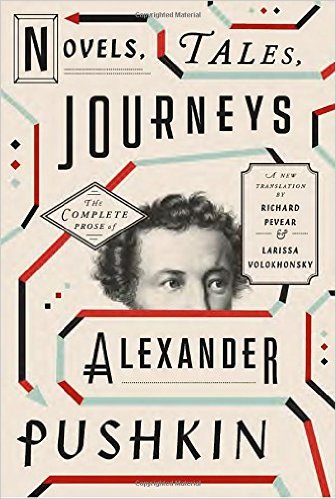
At the Barnes and Noble Review,  Heller McAlpin writes about a new translation by Richard Pevear and Larissa Volokhonsky,  Novels, Tales, Journeys: The Complete Prose of Alexander Pushkin.  Mind you, I don’t have the new book but  I got out my trusty Everyman edition, The Collected Stories, translated by Paul Debreczeny.

pushkin-pevear-volokhonsky-51nhpudozxl-_sx334_bo1204203200_

New edition of Pushkin’s prose.

McAlpin hopes that Pevear and Volokhonsky’s lively new translation will help new readers discover Pushkin, but has compared translations and does not find them very different. He writes,


In the brief introduction to her translation of my well-worn Everyman edition of The Captain’s Daughter and Other Stories, Natalie Duddington wrote, “As a poet, Pushkin is untranslatable: the exquisite beauty and the austere simplicity of his verse cannot be rendered into a foreign tongue . . . But his prose has none of this poetic quality and loses but little in translation. It is vigorous and straightforward and sounds as simple and natural today as it did a hundred years ago.”

Clearly, prose is easier to translate. So it’s not surprising that a comparison of Pevear and Volokhonsky’s new edition with earlier translations — by T. Keane, Rochelle Townsend, and Natalie Duddington — reveals just minor differences: “gloomy Russia” becomes “sad Russia,” “the damned Frenchman” becomes the more humorous “that cursed moosieu.” More salient is the title of Pushkin’s frustratingly unfinished novel based on his great-grandfather Ibrahim Gannibal: The Moor of Peter the Great instead of the more common The Blackamoor of Peter the Great or Peter the Great’s Negro. Despite the avoidance of the racial epithet, none of the ironic edge of this comment is lost in translation: “Too bad he’s a Moor, otherwise we couldn’t dream of a better suitor.”

And so I quickly fell into my book.  The first narrative,  The Blackamoor of Peter the Great, is based on the story of Pushkin’s maternal grandfather, an African who was taken hostage as a boy and purchased for Peter the Great, who raised him as his godson.  In Pushkin’s fascinating story of the relationship between the czar and the hero, Ibrahim,  a handsome, charming black man, Pushkin explores attitdues toward race.  In Paris, Ibrahim is eventaully accepted, to the point that his color is almost forgotten, partly because he attracts women, and he has an affair with a duchess.  But when the czar writes wishing his godson were bakc in Russia,  Ibrahim dutifully deserts his Duchess and goes to Petersburg, where he works very hard for the brilliant czar.  But ironically this relationship does not guarantee the Russians’ acceptance of Ibrahim in society.  An aristocratic family resists the czar’s suggestion of a marraige between Ibrahim and their duaghter.

And then suddenly the story ends, six paragraphs into Chapter 7, and I thought I’d gone out of my mind.

So I skimmed the introduction and learned The Blackamoor of Peter the Great is an unfinished novel.

And now I’m haunted by the characters and will never know what happens.

I do wish the fragments were labeled as such in the contents.  I read a sample of the new translation by Pevear and Volokhonsky, and the introduction is better organized.  There are other prose fragments as well.

Here are a few sketchy notes about why you should read Pushkin.

  1. Pushkin established intimacy between the reader and writer.  Explored basic themes of maturation and metamorphosis.
  2.  Pushkinesque–opposed to romantic–clear, spare; few similes, metaphors, metonymic style, contiguity, evocative.
  3. Pushkin played with form.  More natural prose.
  4. Attempt at psychological fix. The beginning of realism for Russian novel.

Okay, you’re just going to have to read an introduction, because I’m done!

In the Mood to Read Emily Dickinson & Literary Links

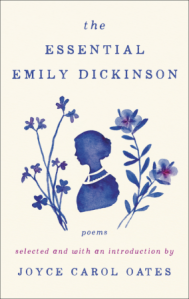
the-essential-emily-dickinson-y450-293I am in the mood to read Emily Dickinson.

Unable to find my copy of The Complete Poems because of the recent black mold chaos of moving bookshelves, I ordered a lovely little book, The Essential Emily Dickinson, edited by Joyce Carol Oates. Oates’ introduction is erudite and witty: she begins with a comparison of Dickinson and Walt Whitman.

Between them, our great visionary poets of the American nineteenth century, Emily Dickinson (1830-1886) and Walt Whitman (1819-1892) have come to represent the extreme, idiosyncratic poles of the American psyche:  the intensely inward, private, elliptical and “mystical” (Dickinson); and the robustly outward-looking, public, rhapsodic and “mystical” Whitman.  One declares, “I’m nobody!  Who are you?”  The other declared:  “Walt Whitman, an American, one of the roughs, a kosmos…”

I must reread Whitman, too.  By the way, I loved the “I’m nobody!” poem in junior high.Remember those gigantic anthologies we staggered to English class with?  Walt Whitman wasn’t in it.   Too gay?

Emily Dickinson is very fashionable these days. Well, she was never out of fashion.  But who would have guessed my decision to read Emily would coincide with the publication of Dan Chiassan’s essay (Dec. 5, 2016) in The New Yorker, “Emily Dickinson’s Singular Scrap Poetry.” He writes,

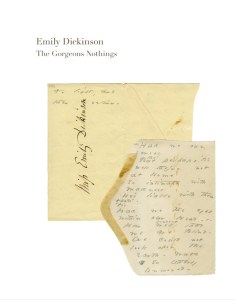
gorgeous_nothingsThe poems of Emily Dickinson began as marks made in ink or pencil on paper, usually the standard stationery that came into her family’s household. Most were composed in Dickinson’s large, airy bedroom, with two big windows facing south and two facing west, at a small table that her niece described as “18-inches square, with a drawer deep enough to take in her ink bottle, paper and pen.” It looked out over the family’s property on Main Street, in Amherst, Massachusetts, toward the Evergreens, her brother’s grand Italianate mansion, nestled among the pines a few hundred yards away. Dickinson had a Franklin stove fitted to a bricked-up fireplace to keep her warm, which meant that she could write by candlelight, with the door closed, for as long as she wanted. In much of the rest of the house, the winter temperature would have been around fifty degrees. Though she usually composed at night, Dickinson sometimes jotted down lines during the day, while gardening or doing chores, wearing a simple white dress with pockets for her pencils and scraps of paper. A younger cousin recalled her reciting the “most emphatic things in the pantry” while skimming the milk.

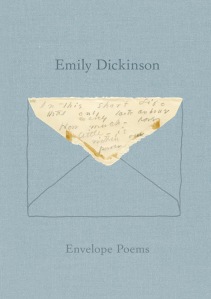
I also learned that New Directions has published two books about the scraps, Envelope Poems and The Gorgeous Nothings, both edited by Jen Bervin and Marta Werner.  I’d love to have these!  Oh, well, after my Dickinson marathon, and if I can find The Complete Poems in one of my boxes.

envelope-poems-dickinson-unnamed

LITERARY LINKS

1. William Trevor died last week.  You might want to read George O’Brien’s excellent article in The American Scholar, “Injurious Entanglements:  Remembering William Trevor’s Anglo-Irish Stories.”  Here is an excerpt:

William Trevor, who died on November 20,is conventionally and conveniently thought of as an Anglo-Irish writer. But to consider him in that way is less to apply the finality of a category than to initiate an exploration of the distinctive significance of his work. It’s true that, in a literal sense, Trevor was Anglo-Irish. Born William Trevor Cox in 1928 in Mitchelstown, County Cork, he was reared and educated in Ireland. But his adult life was spent in England, first in London, then in Devon. Yet, the hybrid identity that the Anglo-Irish label typically brings to mind, together with its divisions and fidelities, is only one of many contexts featured in the body of work produced during the 50 years of Trevor’s prolific career.

2 In The Rumpus, there is an interview with novelist Alice Mattison about her new book on writing.

kite-and-the-string-mattison-51bc33sysml-_sx329_bo1204203200_Mattison’s newest book, The Kite and the String, is a meditation on her lifelong journey through the craft of writing. Taking a balanced approach of warmth and realism, she welcomes readers into a conversation about not only what makes for good writing but also of the necessary balance between the independent, solitary writer and the social writing community. She draws upon her years as a poet and prose writer, supported by her many decades of teaching children and adults alike. Accessible and unbiased, Mattison is an encouraging guide for new and seasoned writers; she is cautious in advising that a strategy of success for one will easily not work for all, but pushes her readers to try most anything that may better enhance their work. Nerves are to be harnessed and channeled into production, while the quieter, more sedentary moments between writing spurts must be equally cared for and valued. We are reminded through wit and honesty that a career in creative writing is most certainly an uphill endeavor with innumerable and unpredictable obstacles. The rewards, however, can be of equal if not unparalleled significance.

3 At Open Letters Monthly, Rohan Maitzen, an English professor, writes about Ishiguro’s The Remains of the Day.

This term it’s Kazuo Ishiguro’s subtle, devastating novel The Remains of the Day that resonates with current events in ways that seemed unthinkable just a few weeks ago. Ishiguro has said in interviews that he used the appeasement era as an abstract cautionary tale about how we are all, in our own ways, butlers, including politically: going about our jobs either unable or unwilling to see how we might be serving larger agendas, finding dignity in doing our work well rather than in ensuring we do the right thing. He wasn’t literally warning us not to give Nazism a second chance — and yet here we are.

A very good week of reading online!

Balzac’s Modeste Mignon & Why We Need the Nineteenth-Century Translators

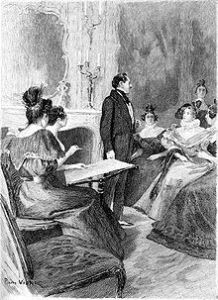
balzac-modeste-mignon-the-purse-vol2Wouldn’t it have been fun to read Balzac as each volume of The Human Comedy was published in the nineteenth century? We would have read him furtively while cleaning our master’s study (I was a maid in my previous life, which is why I abhor cleaning), or openly if we were impoverished spinster stenographers wearing fingerless gloves in an unheated garret. I first read Pere Goriot in just such a chilly rented room.

I have read many Balzacs in Penguin paperbacks, but a complete set of The Human Comedy, a series of  approximately 95 novels and stories, has not been translated since the nineteenth century.   Have you read Modeste Mignon?  Here we must thank the nineteenth-century translators.  There are no modern translations of  Modeste Mignon.  Clara Bell, who was commissioned along with Ellen Marriage and Rachel Scott by George Saintsbury at the end of the 19th century to translate Balzac’s work, wrote at breakneck pace because she needed money and the pay was low.   Modeste Mignon is very readable and  often enthralling but the long correspondence between the heroine and her lover drags.  Okay, you’re permitted to skim the letters.

It is an amusing novel about love and novel-reading:  what could we readers like better?  The heroine, Modeste, an avid reader, is determined to fall in love, though she  knows no suitable young men. (I was rooting for the smart dwarf who works in the family business, but  he has no chance.)  No, Modeste picks a poet.  If you want to have a doomed love affair, fall in love with a poet. Judging from Balzac’s description, poets were just as opportunistic then as now.

Balzac likes to bend genre.  This is a gentle comedy, and yet his heroine is as sharp as they come. Part traditional narrative, part epistolary novel, part satire, Modeste Mignon traces the fortunes of  an attractive young woman, Modeste, who wills herself to love and  gathers three suitors before the book is done.

My 19th-century edition of Modeste Mignon/

My 19th-century edition of Modeste Mignon/

As the novel opens, her father Charles Mignon is away at sea trying to recover the family’s lost fortunes.  They do not know if or when he will return.  The older Mignon daughter eloped with a man who rejected her; she returned home very ill and died. (You know the trope:  The Sexually Active Woman Must Die.)  Then  Modeste’s mother went blind, and now they live quietly with Monsieur Dumay,  a family friend and the manager of the business while Charles is away,  and his childless wife Madame Dumay, who dotes on Modeste and Mrs. Mignon. The adults conspire to shelter Modeste from relationships with men.

No wonder Modeste turns to books. She needs to live in dreams. Like Madame Bovary and Catherine in Northanger Abbey, she reads novels and romantic poetry and longs for love and excitement.  Balzac explains,

Modeste fed her soul on the modern masterpieces of three literatures, English, French, and German. Lord Byron, Goethe, Schiller, Walter Scott, Hugo, Lamartine, Crabbe, Moore, the great works of the 17th and 18th centuries, history, drama, and fiction, from Astraea to Manon Lescaut, from Montaigne’s Essays to Diderot, from the Fabliaux to the Nouvelle Heloise,—in short, the thought of three lands crowded with confused images that girlish head, august in its cold guilelessness, its native chastity, but from which there sprang full-armed, brilliant, sincere, and strong, an overwhelming admiration for genius. To Modeste a new book was an event; a masterpiece that would have horrified Madame Latournelle made her happy,—equally unhappy if the great work did not play havoc with her heart.

An illustration from Modeste Mignon

An illustration from Modeste Mignon

An intelligent but naive reader, Modeste writes philosophical, mystical,  and hyperbolically emotional tetters to a Parisian poet she has never met, Canalis.  He is not a good poet, but she loves his  verse.  Balzac too had fans who wanted to be his penpals, and he had read the correspondence between Goethe and his fan Bettina Brentano, who was thirty-seven years younger.  Canalis doesn’t want a Bettina:  he bangs our the verse for money and owes his love and loyalty to a middle-aged duchess who is his patron. It is Canalis’s secretary, the aptly named Ernest de La Briere, who replies to Modeste’s letters, under the name of Canalis, and soon the missives  are flying back and forth.  And so the comedy of their correspondence begins.

When Charles comes home a rich man, he is not exactly thrilled about the letters.

“I have read your letters,” said Charles Mignon, with the flicker of a malicious smile on his lips that made Modeste very uneasy, “and I ought to remark that your last epistle was scarcely permissible in any woman, even a Julie d’Etanges. Good God! what harm novels do!”

Modeste is now an heiress. Suddenly Canalis and a glamorous Duc are “in love” with her.  Does poor Ernest have a chance?

There are some infelicities with tone in this translation. I suspect the letters between Modeste and Ernest would be much sillier in a modern translation, because Modeste and Ernest are so naive and earnest..  But this speculation is based partly on a scene in War and Peace, in which Prince Nicholas Andreevich is ironic about his daughter Mary’ s correspondence with her friend Julie.

At the sight of the letter red patches showed themselves on the princess’ face. She took it quickly and bent her head over it. “From Heloise?” asked the prince with a cold smile that showed his still sound, yellowish teeth.

“Yes, it’s from Julie,” replied the princess with a timid glance and a timid smile.

And here’s a footnote on this passage in War and Peace from Aylmer Maude.  “The prince is ironical. He knows the letter is from Julie, but alludes to Rousseau’s novel , Julie, ou la nouvelle Heloise, which he, an admirer of Voltaire and of cold reason, heartily despised. A.M.

So you see, both fathers recognize “Julie” in their daughters’ epistolary style.


How I Became My Aunt


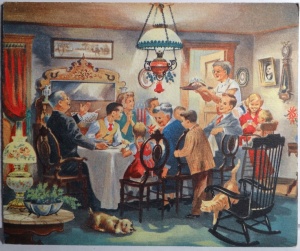
aunt-holiday-dinner-5cc05073a700688cb3b9ca2f84664805

I have been musing about favorites.

Favorite food:  omelette from Hamburg Inn in Iowa City.  Favorite TV show:  Gilmore Girls.  Favorite book: Barbara Comyns’  Our Spoons Came from Woolworths.

Speaking of favorites, I recently metamorphosed into my favorite aunt.

I was not her favorite niece. That is not how things work.   Her favorite was Sandra, my maverick cousin, a talented violinist who dropped out of college, lived in a van for a year during a cross-country trip, got an associate’s degree in graphic design, worked for a marketing firm, and later went back to college.

Mind you, I quite like Sandra.  What I’ve noticed is men don’t like Sandra.  She’s bossy.

“I thought you would be her favorite,” said my mother.

We were gossiping over a family contretemps.  Sandra  inherited everything when my aunt died, and my father felt he should have inherited everything.  It was like Middlemarch.

When my aunt retired, she moved to the small town where my father lived.  It is an extremely ugly town, but he was her favorite brother. She joined a church, became active in the community, and told me not to gossip at the cafe  because it would be all over the town within minutes. Once when I was staying at her house, I got an empathetic call from a stranger about something I had mentioned in public.

My aunt was authoritative.  Everybody shaped up.  My father no longer made inappropriate sexist remarks at the table.  I cannot say what he said elsewhere.

And she got us all together for the holidays.

“How will you feel if you haven’t seen your father before he dies?” she asked.  (N.B.  He was perfectly well.)

I thought about it.  I realized it was my duty.  It didn’t go very well, but I visited once a year.

My father didn’t appreciate her interventions or even notice my presence on those rare visits.

“She pays people to do everything for her,” he said resentfully.  Bossy women:  they just don’t appeal, do they?

taintor-dinner-from-scratch-48022d460c9463ed6c4a9cf5ac2f4b92And it was true:  she had a gardener and a cleaning lady.  She had holiday dinners  catered.  She either ordered  from Harry and David or went in for catering from the Hy-Vee.

And how lovely those dinners were!  The conversation was scintillating, considering . We learned who was protesting against the war, who was struggling to succeed as a nurse practitioner, and who was getting married or divorced.  As for me, I  mentioned reading Anna Kavan:   it upset her when I said  Kavan was a heroin addict, so I learned I had a ways to go in the fine art of conversation.

After my aunt died, the family scattered.  As I said, I am not the favorite (not outside my immediate family), and I have not been able to be a good holiday hostess.  Nor has anyone else.

For instance this year I ruined the turkey.

I turned up the temp too high.  I usually cook it at 325 degrees for a very, very long time.  This year I had it at 350.  It was the first time I’ve ever ruined the turkey.

My husband went out and bought smoked turkey and the fixin’s at the Hy-Vee.  We sat in front of the TV and ate excellent, reasonably healthy food.  AND I DIDN’T PREPARE ANY OF IT.

Thinking about my aunt, I ponder the Subject of Duty.   I am not Electra.  My father was unkind to my mother and me.

I am my mother’s daughter.

But…

It’s not just my aunt.  It’s the bloody Latin.  No, I don’t separate it from my own life.  I taught Virgil and pietas (duty to the gods, country, and family) for so many years.

What is my duty? Not to leave the students during a bloody earthquake?

If my aunt was right, it goes beyond work.

I’m still figuring it out.  But at least I know I can have my holiday dinners catered.

Booker Xenophobia: Timing, Timing & More Bad Timing

Posh Brit writers want Americans banned from Booker!

Some Brit writers want to bar Americans from Booker Prize.

A month after the African-American writer Paul Beatty won the Man Booker Prize for his novel, The Sellout, the excellent writer Julian Barnes  has said Americans should not be eligible for the prize.

Was it the Latin errors?  No, that is my thing.

The Brits want Americans out!  According to the  Telegraph, Barnes, who won the Booker in 2011, said, “The Americans have got enough prizes of their own. The idea of  being Britain, Ireland, the old Commonwealth countries and new voices in English from around the world gave it a particular character and meant it could bring on writers.”

Oh, dear–the Commonwealth!

He added, “If you also include Americans – and get a couple of heavy hitters – then the unknown Canadian novelist hasn’t got a chance.”

Well, the Canadians  have prizes, too.  This year’s Booker-shortlisted Canadian writer, Madeleine Thien, won two:  the Governor General’s Award the Scotiabank Giller Prize.

Mind you, I am an Anglophile and have read most of the Booker winners.

By all means, give the Booker to the Brits! Who cares?

But what bad timing!  To protest after the first American winner is black.

Rallying round Barnes are other white Writers of a Certain Age, A. S. Byatt, winner of the Booker for her great novel Possession, novelist Susan Hill, who was a judge on the 2011 panel,  Peter Carey,  winner of the Booker for True History of the Kelly Gang, Booker-longlisted Philip Hensher and Amanda Craig, a novelist I’ve never heard of, so I can’t connect her to the Booker.

It’s the year of Brexit and Trump:  the timing couldn’t be worse.

Didn’t I tell you I detected anti-American feeling in London?

Influences on a Common Reader: Where I Find New Books & Why I Read Them

gail-godwin-flora_hc

Published in 2013, this is one of my favorite books of the year.

Must I keep up with the latest books?

You should see my book journal: fifth century B.C., first century B.C., first century A.D., Renaissance, 19th century, and many from the 20th century.  But, much to my surprise, I have read 24 new books this year.  And by new, I mean anything since 2010!

This is a post about how I found out about the books and why I read them.  Oh, and I’ve added ridiculous personal star ratings (1-5 stars) to rank  my enjoyment,  as opposed to pure critical judgment (which ratings sometimes coincide, but not always).

TOP REASON FOR READING NEW BOOKS:  FANDOM.  In other words, I already like the authors.

1. Charles Palliser’s Rustication.  I loved The Quincunx, and oddly this is the first of his books I’ve picked up since then.  It’s Gothic, it’s eerie, and I enjoyed it. I didn’t post about it here, so you’ll have to look up the reviews.

On my personal, not critical, scale:  ***

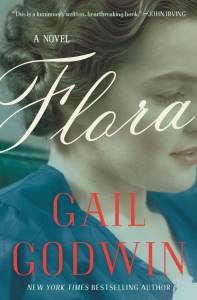
2. Gail Godwin’s Flora.  Loved it, but didn’t write about it!  The story of a life-changing summer.  Precocious 10-year-old Helen, mourning the death of the grandmother who raised her, must resign herself to a babysitter, her  mother’s bubbly cousin Flora, a 22-year-old college graduate looking for a teaching job.  Flora’s father, a school principal, is away for the summer doing  secret war work in Oak Ridge.  There are many twists and turns as Helen’s contempt and jealousy of the generous Flora darkly grows and has consequences.

Star rating:  *****

3 Bobbie Ann Mason’s The Girl in the Blue Beret.  Mason is always stunning, and this is one of her best.  Based on her father-in-law’s World War II experiences, it is the story of Marshall Stone, a World War II veteran and retired  airline pilot who  goes to Belgium and then Paris to search for the members of the Resistance who risked their lives to save him after the crash of his B-17 bomber in Belgium.  I posted about it here.

Star rating:  *****

4. D. J. Taylor’s The Prose Factory: Literary Life in England Since 1918.  In his  compelling new history of a century of writing, brokering, publishing, marketing, reviewing, shaping of taste, and selling of books in England he asks the questions, “What is ‘literary culture’? And what is ‘taste’?”     I posted my reactions here.

Star rating:  *****

5. Jo Walton’s The Just City  In this brilliant, if very strange, philosophical novel, the first of a trilogy, the bookish Athene, goddess of war and wisdom, decides to found a city based on Plato’s Republic. Her brother, Apollo, bemused by the nymph Daphne’s dramatic rejection of his sexual advances (she prayed to Artemis for help and was turned into a tree), decides to participate in the experiment, because he, too, has read Plato, and he wants to be reborn as a mortal to understand the human condition.  You can read the rest of the post here. 

Star rating:  *****

6.  Peter S. Beagle’s Summerlong.  This strange urban fantasy, a retelling of the Persephone myth, set in Seattle and on an island on Puget Sound, is about climate change. He portrays a magical spring and summer, caused by a divine contretemps between Persephone and Hades. Persephone has left her husband Hades, is hiding out in Seattle, and is working as a waitress. As you can imagine, both Hades and her mother Demeter are searching for her.  The lives of the human protagonists change because of their interactions with the gods.  You can read my post here.

7.  Jay McInerney’s Bright, Precious Days. This is the third of a trilogy about a New York couple, Russell and Corinne Calloway. Russell and Corinne were deeply shaken in the second book, The Good Life, by the trauma of 9/11, and have tried to be their best selves since. Now they are at a crossroads in their marriage and work: Russell, known for publishing literary fiction, toys with the idea of buying a commercial blockbuster because of financial problems, and Corinne, a former stockbroker coming to terms with middle age, now manages a massive food bank that distributes vegetables and fruit to the poor and thinks he should stick to his ideals.  At 50, they are having a midlife crisis about where to live and what to do.  Should Corinne leave Russell for the filthy rich guy she had an affair with after 9/11?  Will the Russells continue to summer in the Hamptons?  I can mock the rich, but I enjoyed this book.   You can read my post here.

Star rating:  ****

8.  Peter  Stothard’s The Senecans: Four Men and Margaret Thatcher.  Stothard, the  former editor of the Times Literary Supplement (he retired this year) and The London Times, is an Oxford-educated classicist who has written two other brilliant books, Alexandria: The Last Nights of Cleopatra and On the Spartacus Road. I come to this book through my love of classics, but many will be drawn to the history and politics. In this gracefully-written memoir, he recounts his fascination with Nero and Seneca and Nero’s court, especially to Seneca, the Stoic philosopher who was Nero’s tutor and political advisor. As a deputy editor at the London Times, Stothard met often with Thatcher’s four main advisors, who gave him background for The Times’ political articles. And they shared his interest in Seneca regularly. He organized a Latin class for the four advisors at a pub and reviewed/taught conjugations and declensions and read and discussed Seneca.  I wrote about it here and here.

Star rating:  *****

9.  Jhumpa Lahiri’s The Clothing of Books.  In this intelligent, charming little book, Lahiri writes about book covers as the clothing of book.  She looks at the role of the book cover in representing ideas  and selling the book and the negligible role of the author in choosing the design. Written in Italian as the keynote speech for the Festival degli Scrittori in Florence, The Clothing of Books was translated into English by her husband, Alberto Vourvoulias-Bush.  I wrote about it here.

Star rating:  *****

10.  Lionel Shriver’s The Mandibles, 2029-2047.  In Lionel Shriver’s clever, witty dystopian novel, water is a luxury. There is no water in the West and there is a shortage in New York.  The Mandibles have always been rich: their fortune was built, ironically, on diesel engines (obviously a contributing factor to the pollution in 2029). But this book is really about money: what happens when the economy tanks in 2029 after the dollar is declared worthless in the global economy? Four generations of the Mandibles are affected, and  it’s not pretty.  But it’s not zombies and apocalypse:  there is hope.   I wrote about it here.

Star rating:  ****

SECOND MOST POPULAR REASON FOR READING NEW BOOKS:  PROFESSIONAL REVIEWS & INTERVIEWS

1. Elizabeth Strout’s My Name Is Lucy Barton I was inspired to read this by Sarah Lyall’s excellent interview with Strout in The New York Times.  A lyrical novel about a daughter’s reconciliation with her mother.    I wrote about it here.

Star rating:  *****

2. Emma Straub’s Modern Lovers.  I was inspired to read this by Michiko Kakutani, who liked this light summer book.  Alas, it is the worst book I read all  year.   I won’t bother to link you to my post.

Star rating:  no stars.

3. Emma Cline’s The Girls.  I was inspired to read this by the many, many enthusiastic American reviews.  (In the UK they don’t quite get it, judging from reviews.)   If you loved Donna Tartt’s eerie first novel, The Secret History, you will enjoy this.  Told from the point of view of Evie Boyd, a middle-aged woman who at 14 was involved with a Manson-like cult in the Bay area, the narrative shifts back and forth between Evie’s present as an unemployed home aide house-sitting for a friend and her memories of the summer of 1969 when she was a lonely upper-class adolescent with a crush on Suzanne, one of the cult leader Russell’s girls. Evie did not kill anyone, but she is haunted by her memories. You can read my post  here.

Star rating:  *****

4. Maria Semple’s Today Will Be Different.  I was inspired by many, many enthusiastic reviews.  Loved it.  Narrated mostly in the first person, partly in the third person, and partly in an elliptical graphic memoir, it is witty, brilliant, alternately grumpy and effervescent. The heroine, Eleanor Flood, a former director of animation on a cartoon show in New York, is too sharp and introspective to fit in seamlessly as a Seattle housewife and stay-at-home mom. In laid-back, quirky, politically correct Seattle, she is neither the perfect wife to Joe, a hand surgeon, nor the perfect mother to eight-year-old Timby, and she never works on the graphic memoir she has a contract for.  She makes resolutions to be kind and generous to her family for one day, but soon everything spirals out of control.  You can read my post here.

Star rating:  *****

5. Charles Bock’s Alice & Oliver.  Source:  a review from Bookpage, a PR book review publication.  Based partly on his notes on Bock’s own notes on his wife’s hospitalizations and  death from cancer, it is the story of a young couple’s struggles after Alice is diagnosed with cancer and Oliver must figure out her care as well as take care of their baby.  Very, very shockingly realistic and sad.

Star rating:  ***

MY NUMBER #3 TOP REASON FOR READING NEW BOOKS:  AWARD LONGLISTS AND SHORTLISTS.

1. Elizabeth McKenzie’s The Portable Veblan.  Longlisted for the National Book Award and the Baileys Women’s Prize.  Very quirky, charming, and philosophical.  I never got around to blogging about it, but I loved it!

Star rating:  *****

2. David Mean’s Hystopia.  Longlisted for the Man Booker Prize.   Means has constructed a novel within a novel about an alternate 1960s.  Kennedy has survived the assassination attempt and is in his third term as president, but his wave-by tours in an open car attract other would-be assassins. Vietnam veterans are shipped to Michigan to be treated by the Psych Corps established by Kennedy to treat mental illness in general but especially to deal with the problem of returning Vietnam vets. The treatment, known as “enfolding,” combines a dose of a drug called Tripizoid with a reenactment of the traumatic events by actual actors, which results in “enfolding” the memories, i.e., amnesia about their tours of duty. But the drug doesn’t work on everyone, and psychotic vets are terrorizing Michigan, which is burning as a result of fires started in Detroit and Flint during riots.  Really loopy lyrical comical prose.  Loved it, but didn’t expect it to win, because it’s meta-fiction and science fiction!  My post is here. 

Star rating:  *****

3. Hannah Rothschild’s The Improbability of Love.  Longlisted for the Baileys Women’s Prize. A fascinating novel about the competition in the art world to acquire a lost painting by Watteau, “The Improbability of Love.” The details about establishing the provenance of art is slightly reminiscent of A. S. Byatt’s Possession.  My post is here.

Star rating:  ****

4.  André Alexis’s Fifteen Dogs It won the Scotiabank Giller Prize and the Rogers Writers’ Trust Fiction Prize last year. A witty, poignant novel about  talking dogs and a bet between Apollo and Hermes.  My post is here.

Star rating:  *****

# 4 REASON FOR READING NEW BOOKS: SMALL PRESSES, BOOK CLUBS & BOOKSTORES

1. Natasha Stagg’s Surveys. This small-press book was an Emily Books selection (0nline bookstore/book club).  My post is here.

Star rating:  *****

2. Catherine Lacey’s Nobody Is Ever Missing.  An Amazon recommendation.  My post is here.

Star rating:  ***

3. Allison Winn Scotch’s In Twenty Years. Found it at Amazon and it is published by an Amazon imprint. This very enjoyable light nvoel centers on the midlife crises of a group of old college friends–and, coincidentally, one of the group members in each book is a rock star.  I posted about it here.

Star rating:  ****

3.  Anna Gavalda’s Life, Only Better (Star rating:  ***) & Charlotte Wood’s The Natural Way of Things (Star rating:  ****).  Both are  published by Europa Editions.  My posts are here and here.

And so that’s how I find out about new books!

Literary Fantasy Parcel, # 2: Metamorphoses


I’m almost finished with the holiday gift fuss.  I’m  assembling book parcels, tied up with a ribbon and tucked into  cotton bookstore bags.  Every year I organize my book parcels by theme, hoping a stack of themed books will entice readers.   I am happy if my friends read one or two of the two-to-three books in the parcel.  (See yesterday’s post.)

This year’s theme is “Literary Fantasy.”  Why?  It has been a strange year. Reading fantastic literature teaches us about our conscious and unconscious selves, and can make us see our world differently.   We are still mourning the election, and our society doesn’t seem to be going in the right direction.  And so let’s read some fantasy.

Literary Parcel, # 2:  Metamorphosis

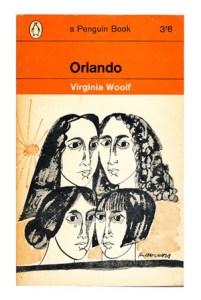
Woolf penguin Orlando+cover1. Virginia Woolf’s Orlando

Orlando is one of Woolf’s lightest books, dedicated to Woolf’s lover, Vita Sackville-West. In Alexandra’ Harris’s Virginia Woolf, a wonderful short book about Woolf’s life and work, she says that Woolf’s teasing novel is a a fanciful biography of Vita Sackville-West, with a tip of the hat to her ancestors. And it had the tone of Woolf’s playful letters to Sackville-West. The hero, Orlando, is a beautiful androgynous man, a courtier, and an aspiring poet. He lives for more than three centuries, first as a man and then as a woman.  There’s too much whimsy in this fantasy for my taste, but Woolf’s writing is gorgeous, especially her description of a Renaissance winter festival on the frozen Thames. You can read my post on Orlando here.

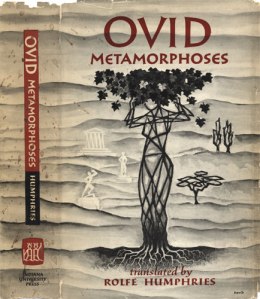
2. Ovid’s Metamorphoses

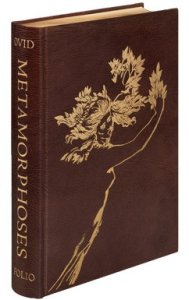
Ovid’s epic poem, a collection of Greek and Roman myths linked by the theme of metamorphosis, is the most brilliant fantastic comedy I have ever read.  As Ovid describes the clash between gods and ovid-metamorphoses-folio-mtsgoddesses, and their bizarre obliviousness and frequent violence toward human beings, we begin to understand our own reality and, beyond that, change and entropy.  We witness the extent of Ovid’s joyousness in his mythic exploration of metamorphosis in an imperfect world.  His style  is bubbly and elegant at the same time. His  descriptions of nature are charming and lovely, and his characters jump out of his vivid verbal sketches. There is much absurdity in Ovid:  Apollo, struck by Cupid’s arros, falls in love with the  nymph Daphne and asks her  to run a little slower so he can catch  her, but she prefers to turn into a tree than “marry” him, because she is a virgin dedicated to the goddess Diana.  At the same time as we laugh at Apollo, we imagine the nymph Daphne’s terror as she prays to her father, who tries to persuade her Apollo would be a good match.  In the end she turns into a laurel tree, which Apollo obnoxiously claims as his own.  So she gets away, but does she?

Here is an excerpt from Apollo’s comic complaint to Daphne

…But I, who follow,
Am not a foe at all. Love makes me follow,
Unhappy fellow that I am, and fearful
You may fall down, perhaps, or have the briars
Make scratches on those lovely legs, unworthy
To be hurt so, and I would be the reason.
The ground is rough here. Run a little slower,
And I will run, I promise, a little slower.
—Ovid’s Metamorphoses, translated by Rolfe Humphries


humphries-ovid_meta1Like Apollo, many of the gods are bullies and even rapists, but the goddesses can be equally violent: in the moving story of Ceres and Proserpina, Ceres punishes the world with drought as she searches the earth for her lost daughter.  She turns an insolent boy into an owl to vent her rage at a rude remark. Finally she learns that Hades, king of the Underworld, abducted Proserpina. Ceres appeals to Jove, who is Proserpina’s father, but he believes Hades is a good match for her.  Ceres brokers a deal whereby Proserpina lives half the year above ground (and that’s how we get spring and summer).

As Woolf in Orlando, Ovid is also fascinated by the blurring of gender and the sexes. The story of Tiresias is short and strange:  he sees two serpents mating and strikes them apart and then is turned into a woman for seven eyars; seven years later he sees them again and does the same thing so he can turn back into a man.  It does not end well:  Jove and Juno have argued about who has more sexual pleasure, men or women, and Tiresias says women do.  Juno, furious that he disagreed with her, blinds him as a punishment, but Jove tries to compensate by giving him the gift of prophecy. Some compensation, some of us would think.

Ovid understands the randomness of fate. A lucky, lucky reader will get this in her Christmas parcel.

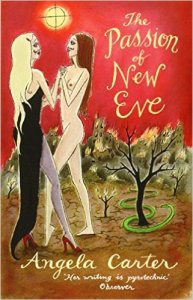
The Passion of New Eve angela carter 51BAQglKXzL._SX319_BO1,204,203,200_3. Angela Carter’s The Passion of the New Eve.  At the British Library, I saw the manuscript of Carter’s The Passion of the New Eve in a display case, and decided I wanted to read it.  A few blocks away at Skoob, a used bookstore, I found a copy.  I cannot pretend it is my favorite book by Carter, but it does fit in well with Orlando and Ovid.

In The Passion of New Eve, a surreal novel rich with symbolism and satire, she walks a fine line between feminism and tedium. In Carter’s mordant exploration of what it means to be female in a post-apocalyptic society, the ideal woman is defined by men in Hollywood, or by a cult of militant Earth-worshipping female plastic surgeons.

This novel is Carter’s homage to the myth of Tiresias, the Greek prophet who spent part of his life as a man and part as a woman. (Naturally, being a woman was best.) Well, the story is part Tiresias myth anyway: the rest is Caitlyn Jenner crossed with Charlie’s Angels.

You can read the rest of this post here.