Charlotte Armstrong’s “Mischief” in Library of America’s “Women Crime Writers: Four Suspense Novels of the 1950s”

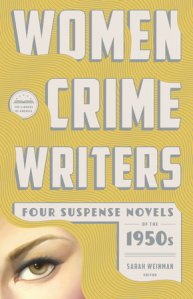
Women Crime Writers the 50s 9781598534313Last year the Library of America published two volumes of women’s noir classics, Women Crime Writers:  Four Suspense Novels of the 1940s and Women Crime Writers: Four Suspense Novels of the 1950s.  The writers included in these two volumes–Vera Caspary, Helen Eustis, Dorothy B. Hughes, Elisabeth Sanxay, Charlotte Armstrong, Patricia Highsmith, Margaret Millar, and Dolores Hitchens–were pioneers of domestic suspense.

According to editor Sarah Weinman’s introduction at the Library of America Women in Crime website,  women often set their books against a domestic background.

Women’s magazines are of particular interest in the story of domestic suspense, because of their audience:Young and middle-aged women, single and married were seeking respite from their ennui and alienation. The appearance of domestic suspense fiction poked holes in the “happy homemaker” ideal put forward by the more positive, beauty-and fashion-oriented articles.

mischief charlotte armstrong 3970846765_1f52e65198After enjoying the 1940s volume last fall, I have finally embarked on the 1950s.  Charlotte Armstrong’s clever, gritty suspense novel, Mischief (1950), is terrifying.  It reminds us that, even in the flourishing economy of the 1950s,  there was a threat to the security of domestic life.

In Mischief, the middle-class Jones family is as secure as they can be. When Peter O. Jones, the busy editor and publisher of the Brennerton Star-Gazette, goes to a convention in New York, he takes his wife Ruth and daughter Bunny along. They plan to spend a few days seeing New York after the convention.  They stay at the Majestic Hotel in midtown Manhattan.

But there’s a glitch:  Peter’s sister Betty calls to say she can’t babysit for Bunny while he and Ruth attend the dinner. Peter has to make a speech, and Ruth wants to hear it.  And so the very nice elevator man, Eddie, who has worked at the hotel for 15 years,  says his niece, Nell, can babysit. She is very quiet.  Ruth notices there’s something  slightly off about her demure manner.  But they’ll be gone only a few hours.

From the very first page, Ruth comes across as a strong, intelligent character.  Peter is kind, but he is absorbed in work, so she is the one who must protect the family from domestic problems.   On the first page she muses about hotels.

What a formula, she thought, is a hotel room. Everything one needs. And every detail pursued with such heavy-handed comfort, such gloomy good taste, it becomes a formula for luxury.  The twin beds, severely clean, austerely spread. The lamp and the telephone between.  Dresser, dressing table.  Desk and desk chair (if the human unit needs to take his pen in hand).  Bank of windows, on a court, with the big steam radiator across below them, metal topped.  Curtains in hotel-ecru.  Draperies in hotel-brocade.  Easy chair in hotel-maroon.  The standing lamp.  The standing ash tray, theat hideous useful thing.  The vast empty closet.  And the bath.  The tiles.  The big towels.  The small soap.  The very hot water.
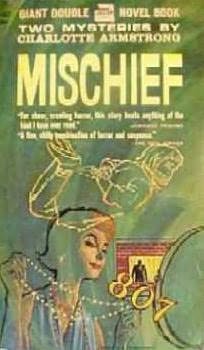
mischief charlotte armstrong dG-521a One of the fascinating things about Armstrong’s brilliant plotting is that no detail is wasted. Every item in the paragraph above is crucial to the plot.This is a short book, but no word is wasted. What looks like domestic life can’t be domestic in a hotel.

Ruth can’t get over the nagging feeling she shouldn’t leave Bunny with Nell.  She tries to overcome it with logic.

And Nell doesn’t do anything untoward at first.  After reading a story to Bunny in a monotone (Bunny is puzzled:  why is it so much more interesting when Mommy reads it?), Nell says Good night and leaves the door to the adjoining room slightly open as Ruth had requested. Then she embarks on mischief.  Nell makes a lot of expensive crank phone calls.  (The switchboard operator notices and wonders what’s going on.)  Then she goes through Ruth and Peter’s things.  She tries on Ruth’s clothes and jewelry, walks around in her mules, and spills the perfume and powder on the dressing table.  Uncle Eddie pops in on his break and nervously tries to persuade her to put everything back.  The thing is, Nell goes several steps farther than any normal snoopy babysitter would.

Another resident of the hotel, Jed, has quarreled with girlfriend Lyn on his last night in New York.  So he smokes a cigarette outside, and makes eye contact with Nell as she looks out the window. (Armstrong calls the hotel “a fish bowl.”)  He goes up to the room to flirt with her (or score), but  soon realizes Nell is a nut: when he tries to leave, she threatens him and he wants to calm her down.  When her uncle Eddie comes back, she pushes Jed into  the bathroom.  And then things get more and more berserk.
don't bother to knock marilyn maxresdefault

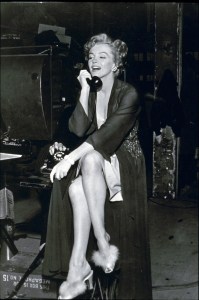
Marilyn in the film, “Don’t Bother to Knock.”

I shall say no more because the book is very plot-oriented. And, the way, it was filmed in 1952 as Don’t Bother to Knock and starred Marilyn Monroe.  (I haven’t seen it.)
Armstrong was a very prolific writer:  a playwright, a mystery writer, a suspense novelist.  She even published three poems in The New Yorker.

I used to see her books around but since I wasn’t a big fan of mysteries or suspense novels I never bothered with them.  Now I shall.

The other novels in Women Crime Writers: Four Suspense Novels of the 1950s are Patricia Highsmith’s The Blunderer, Dorlores Hitchens’s Fool’s Gold, and Margaret Millar’s Beast in View.  Perfect summer reading!

Translations of Anna Karenina: Constance Garnett, Maude, or Pevear & Volokhonsky?

anna karenina maude 0679410007.1.zoom

The Maude translation of Anna Karenina (Everyman)

“All happy families resemble one another, each unhappy family is unhappy in its own way.”–Anna Karenina, translated by Louise and Aylmer Maude

I am a fan of Tolstoy’s Anna Karenina, though I prefer his heftier classic, War and Peace, which is an action-packed popcorn read, almost like reading a movie.  But since Anna is shorter (though still long), it is more popular and accessible both to the literati and the common reader.  It was chosen as an Oprah book club selection in 2004, and though it’s not “the Harlequin romance of its day”  described at her website guide , her fans read and loved it.  And that’s what matters.

My favorite book.

My favorite book.

In fact, everybody loves  Anna Karenina.   Rufus Wainwright, Jeffrey Eugenides, Jilly Cooper, and David Brooks list it as one of their favorite books–and could a singer, a literary novelist, a pop novelist, and a New York Times columnist be more different?  The novelist  Robert Hellenga told me in 2014 in an interview here that he has read it “so often that I tend just to dip into in when I need a shot of writing adrenaline.”

I collect editions of Anna Karenina the way a friend collects Bakelite bracelets. At the moment I have five, one of them a glitzy Folio Society edition. I have four different translations, but my favorite is Aylmer and Louise Maude’s, the translation approved by Tolstoy–and get it while you can, because Everyman and Dover are now its only print publishers, I think. (You can also find the Maude in a used Oxford World Classics edition, but beware, the 2016 paperback has a new translation by Rosamund Bartlett.)

An illustration from the Folio Society edition of Anna Karenina

An illustration from the Folio Society edition of Anna Karenina

I love almost all translations of Anna Karenina–I enjoyed David Magersack’s in high school,  and recently discovered Rosemary Edmonds– but some critics are so adamant in their partisanship that they get hysterical over new translation.

Anna Karenina Tolstoy d7d5ccfc3d1fb38a346a32d3be6bdadb

Constance Garnett’s translation (the revised version(

One of these partisans is the brilliant critic Janet Malcolm. In her article, “Socks:  Translating Anna Karenina,” in The New York Review of Books (6/23-16),  she eccentrically endorses Constance Garnett’s translation.  She explains that English and American readers have “until recent years…largely depended on two translations, one by the Englishwoman Constance Garnett and the other by the English couple Louise and Aylmer Maude, made respectively in 1901 and 1912.”

She quotes the scholar Gary Morson, who is infuriated by the new translations.  He wrote,

“I love Constance Garnett, and wish I had a framed picture of her on my wall, since I have often thought that what I do for a living is teach the Collected Works of Constance Garnett. She has a fine sense of English, and, especially, the sort of English that appears in British fiction of the realist period, which makes her ideal for translating the Russian masterpieces. Tolstoy and Dostoevsky were constantly reading and learning from Dickens, Trollope, George Eliot and others. Every time someone else redoes one of these works, reviewers say that the new version replaces Garnett; and then another version comes out, which, apparently, replaces Garnett again, and so on. She must have done something right.”

I admit, Constance Garnett’s Tolstoy hasn’t worked out for me.  I found it clunky, but it was a revised edition of her translation.  (You can download a free e-book version of her original translation, and perhaps that’s the one to read.)  And Garnett has a reputation for writing rapidly and sometimes skipping parts she doesn’t understand. Malcolm thinks this is a sexist interpretation of her work.  And she may be right.

But Malcolm also admits Garnett made thousands of mistakes, and that the revisions in a recent Modern Library edition are often awkward.

Why is Garnett our only choice?  Because Malcolm and Morson  hate the award-winning translators Ricahrd Pevear and Larissa Volokhonsky (and skip anything in between). I am a fan of P&V’s stunning work, and their translations are now widely taught in American universities. Their lyrical translation of Doctor Zhivago made me finally appreciate Pasternak:  the only other English version is a lacklustre 1958 translation cobbled together hastily in a couple of months after Pasternak won the Nobel. Reading that had led me to assume that Pasternak won only for his politics.

Pevear, an American, and his wife, Volokhonsky, a Russian, have a fascinating philosophy of translation.  They don’t want to write elegant Victorian-style English:  they like to “Russianzie” the English, to capture Tolstoy’s own sometimes awkward, quick style,  complete with occasional inversions, without attempting to pretty it up.  And yet, it is elegant, if different from the Edwardian translators.

This new philosophy of more literal translation has been applied occasionally to Greek and Latin classics lately, so I am familiar with it. People try different things to capture the nuances of a language.

Malcolm wants a certain elegance.  But if you think she loathes P&V, wait till you see what she has to say about Marian Schwartz.

She writes,

Another argument for putting Tolstoy into awkward contemporary-sounding English has been advanced by Pevear and Volokhonsky, and, more recently, by Marian Schwartz,4namely that Tolstoy himself wrote in awkward Russian and that when we read Garnett or Maude we are not reading the true Tolstoy. Arguably, Schwartz’s attempt to “re-create Tolstoy’s style in English” surpasses P&V’s in ungainliness.

I understand wanting to pass on tradition and preferring the old to the new, but I also appreciate the “quiet revolution” of the new translators, as Susannah Hunnewell refers to P& V in The Paris Revew.

Pevear and Volokhonsky’s translations have been lauded for restoring the idiosyncrasies of the originals—the page-long sentences and repetitions of Tolstoy, the cacophonous competing voices of Dostoevsky. Though ­almost unanimously praised by reviewers and Slavic scholars, they have a few critics who accuse them, in fierce blog posts, of being too literal or prone to unidiomatic turns of phrase. Pevear, who is sometimes drawn into the online jousting, never apologizes for erring on the side of the unfamiliar sounding over muting the original.

I’m in both camps:  the old and the new. It is always good to have more than one translation at bookstores.

When Light Novels Are “Pastel Lit”: Emma Straub’s Modern Lovers

emma straub Modern Lovers coverPastel lit is back!  Recently at the bookstore I spotted several women’s novels with cute pastel-colored covers.   How I’d love to dip into one of those turquoise or pink  chick lit books!  I know some of you object to the phrase “chick lit,” but I use it to describe light formulaic romances like Bridget Jones.  Some use the blanket phrase “women’s fiction” for romances and pop family “issue” novels, but then what do you call literary fiction by women?

So I have coined the phrase “pastel lit” for pop women’s fiction.

And I found an excuse to read it.  Michiku Kakutani at The New York Times enjoyed Emma Straub’s Modern Lovers and didn’t think it was entirely a beach read.A nd Alex  Kuczynski in The New York Times Book Review thought it was a witty romp, though he bashed the ending.

But, unfortunately, it is strictly pastel lit.

It’s not a bad book: It has its audience.  It’s not chick lit exactly, but it is fluffy.  This superficial novel with its pared-down prose reads almost like an outline. Two well-to-do couples, Elizabeth and Andrew and  Zoe and Jane, and their two children, Harry and Ruby, who attend the same private school,  live cozily on the same street in Brooklyn.   But there are problems in both marriages.

It opens with Elizabeth, a realtor, going to her neighbor Zoe’s house for a book club.  That should have been my cue.:  book clubs in novels usually indicate the book is super-light. It turns out Elizabeth and her husband Andrew (a rich guy who doesn’t do much) and Zoe, an African-American restaurateur whose rich parents used to be a Motown duo,  were in a band called Kitty’s Mustache when they were students at Oberlin.  There was a fourth member of the band, Lydia, who had a solo career after the band broke up.  She became famous but died of a drug overdose.

Usually I like books about bands, but I got stuck on the name Kitty’s Mustache.

Straub writes,

The band was called Kitty’s Mustache, a hat tip to Tolstoy’s heroine.  They were regular college kids, in love with the idea of their own cleverness.  No one had ever thought of anything before.  It was the best night of her life to date, easy.

Nobody likes a reader who points out a mistake. BUT ARE YOU READY?   It’s not Kitty in Anna Karenina, but  Sonya in War and Peace who dresses as “a Circassian…with burnt-cork mustache and eyebrows” and goes out mumming on Christmas Eve with her cousins Natasha, dressed as a hussar, and Nicholas (whom she has a crush on), dressed as a woman.

It’s not Kitty’s mustache but Sonya’s mustache!

Tolstoy writes,

Sónya’s costume was the best of all. Her mustache and eyebrows were extraordinarily becoming. Everyone told her she looked very handsome, and she was in a spirited and energetic mood unusual with her. Some inner voice told her that now or never her fate would be decided, and in her male attire she seemed quite a different person.

Everybody falls in love with Sonya with that mustache!

I consider this mistake a failure not of Straub but of her editors.  I understand completely how Straub made a mistake, but surely somebody in publishing has read Tolstoy. And what about fact checkers?  I’ll give you a hint:  type in “mustache” on your e-book of War and Peace and tada!

Okay, Straub clearly loves literature. Elizabeth tells us the name of the band’s hit song, “Mistress of Myself,”  comes from Jane Austen’s Sense and Sensibility.  The two heroines’ names, I noticed, are “hat tips” to Pride and Prejudice:  Elizabeth like Elizabeth Bennet, the heroine of P&P, and Zoe’s last name is Bennett.  And her wife is Jane!  Lydia the dead singer:  the brat in P&P who elopes!

Andrew becomes involved with a cult, so I don’t have the faintest idea what his name refers to.

The chapters alternate between the viewpoints of the adults and their 17-year-old children. Somebody wants to make a movie about Lydia (the famous singer)… Andrew doesn’t want them to and won’t sign the forms…  Elizabeth and Zoe do and will sign..   And  Elizabeth’s smart son Harry and Zoe’s underachiever daughter Ruby who have attended the same private school forever fall in love, which is a problem. Why?

The problems of the rich!

Arnold Bennett’s Clayhanger & Do Costume Dramas Matter?

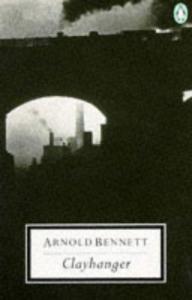
Clayhanger penguin 20th century bennett 9780140182699-usHow very much I enjoyed rereading Arnold Bennett’s Clayhanger (1910),  a compelling realistic novel in the tradition of John Galsworthy’s The Forsyte Saga!  Bennett is less known in the U.S. than the Nobel-winning Galsworthy, but they have similar strengths: both are superb storytellers, if not always elegant stylists, and their chronicles of work, marriage, and changing social mores among the middle classes in the late nineteenth and early twentieth century are fascinating, moving, and historically significant.

It has occurred to me that I owe a debt to British costume dramas.  I would never have discovered Bennett or Galsworthy without “Masterpiece Theater,” which has shown British TV adaptations of novels for many  years. Clayhanger has not been in print in the U.S. (except in print-on-demand and e-book editions) since  PBS aired the TV show in 1976.  I may roll my eyes when I read a review of Julian Fellowe’s adaptation of Doctor Thorne, but the series would have sent me running to the bookstore when I was young.

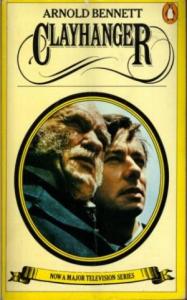
clayhanger bennett penguin tv cover 9780140009972-uk-300Bennett’s Clayhanger trilogy (Clayhanger, Hilda Lessways, and These Twain) is an enthralling story of provincial life.   Set in the fictitious Five Towns, which are based on six towns in the Potteries district of Staffordshire where Bennett grew up, Clayhanger  is a bildungsroman that follows the shy, awkward character Edwin Clayhanger from school graduation to early middle age. The son of a successful printer, he hopes to escape going into his father’s business when he leaves school and become an architect instead.  His dreams are soon squelched.  Why?  Because it is impossible to resist his father Darius, at least if you are Edwin.  And we become sympathetic when we learn Darius’ story , which, sadly Edwin never learns.

When Darius was seven, his family was evicted and they spent a brutally Dickensian night in the workhouse before a Sunday school teacher named Shushian, who remembered Darius as a promising student, saved the family and found both father and son work.  Darius had to work long hours in brutal conditions, but eventually became a printer’s devil and bought an enormous business.

Edwin doesn’t quite have Darius’s oomph, but he is smart and rapidly becomes involved in the business. When his father buys a “new” used printing machine, it is a great occasion.

The descriptions of the workplace and machinery are fascinating.  The floor has been rickety in the building for years, but Darius has ignored this.  The new machine is very heavy.

Edwin could not keep out of the printing office. He went inconspicuously and, as it were, by accident up the stone steps, and disappeared into the interior. When you entered the office you were first of all impressed by the multiplicity of odours competing for your attention, the chief among them being those of ink, oil, and paraffin. Despite the fact that the door was open and one window gone, the smell and heat in the office on that warm morning were notable. Old sheets of the “Manchester Examiner” had been pinned over the skylight to keep out the sun, but, as these were torn and rent, the sun was not kept out. Nobody, however, seemed to suffer inconvenience. After the odours, the remarkable feature of the place was the quantity of machinery on its uneven floor. Timid employees had occasionally suggested to Darius that the floor might yield one day and add themselves and all the machinery to the baker’s stores below; but Darius knew that floors never did yield.

The floor does indeed almost break under the new machine, but Edwin does something with pulleys and hooks and prevents a disaster.

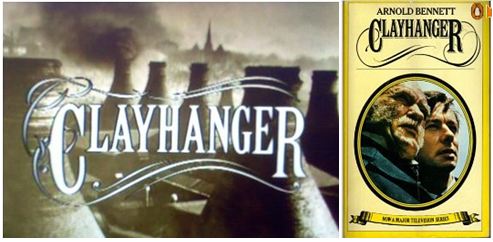
clayhanger tv and book cover ch03But how does Edwin’s soul live?  He is stimulated by the company of the Orgreave family, whose son Charlie Orgreaves (known as the Sunday) attended school with him.  Mr. Orgreave is an architect, and his wife and children read, listen to music, and discuss art and architecture.  Edwin attempts to do architectural drawings and begins to read French novels.

But what about his love life?  Janet Orgreave is charming, but he is attracted to her fierce, brooding friend, Hilda Lessways.  Hilda sometimes visits, and Edwin and Hilda fall in love, but it comes to nothing.  His father refuses to pay him more than one pound a week, even when he is 30.  It’s a very, very stuffy household.  How can anyone live?

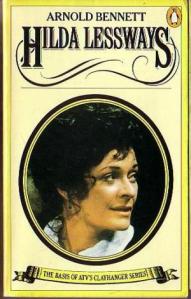
hilda lessways md6774804080So many disappointments for Edwin.  The characters are all bottled up.  But you need to read the whole trilogy to really appreciate what happens.  There are many gaps in the first book The second novel, Hilda Lessways, fills in all the gaps about her character.  And she has work, too:  she ends up running a rooming house.

Fortunately Edwin and Hilda meet again eventually and…

Bennett was influenced by French and Russian writers.  According to the intro to the Penguin, H. G. Wells said Anna of the Five Towns was ‘an underdeveloped photograph.” Bennett explained “the degree of development was that of Turgenev and Flaubert.”

Bennett has his fans, but in a way he got cheated,  because of the rise of modernism and the way it pushed everything out of its path.  You were either the brilliant (a) Virginia Woolf, H.D., Djuna Barnes, Dorothy Richardson, and James Joyce (whom Woolf hated, by the way) or  the unfashionable (b) John Galsworthy, Elizabeth von Arnim, H. G. Wells, and Arnold Bennett (whom Woolf hated, by the way.)

And so that leaves Woolf.  Woof!

No, I’m joking.  I love Woolf.

Woolf loved some books better than others

And I like more books than Woolf liked.

Four Literary Links: Two Critics on Doctor Thorne, “10 Tricks for Book Nerds,” & Robert Barnard’s Mysteries

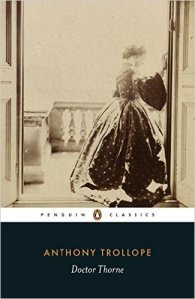
Doctor thorne trollope 51XgTazilbL._SX323_BO1,204,203,200_Oh, Anthony Trollope!  I’m besotted with you.  “How do I love thee?  Let me count the ways.” In my twenties I binge-read the Palliser series and the Barsetshire novels; then I discovered two of his most powerful  novels, The Way We Live Now and He Knew He Was Right; and in the last ten years have read most of the others.  (Many are superb.)

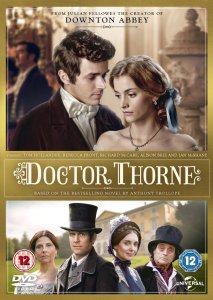
So I was thrilled to find a link in an email to Laura Miller’s essay at Slate on Julian Fellowes’ new TV adaptation of Trollope’s Doctor Thorne.  (I still erroneously think of Slate as a kids’ paper, but I’ll read anything on Trollope.)  Miller enthusiastically reread Doctor Thorne, the third book in the Barsetshire series, before she viewed the film. She loves the book, but considers the new  miniseries the worst Trollope adaptation ever.

Nonetheless, Miller will make you want to read Trollope, if you have not yet discovered him.

She begins,

Anthony Trollope’s “great, inestimable merit,” Henry James once wrote, “was a complete appreciation of the usual.” He was right: You won’t find a single uncanny moment in that Victorian author’s 47 novels. Yet reading Trollope in the 21st century can nevertheless be a bit spooky. That’s because seemingly everything that happens today has already been covered in one of his books, albeit in a less technologized form.

Yes, Trollope does write about everyday life, as Mr. James says, but he also has great psychological depth, for which he is not given sufficient credit.  As Miller points out, he has written about all things modern.  I have been astonished  by his insights on  love, marriage, divorce, church politics,  Ponzi schemes, psychological abuse, and corrupt elections. And I do think he had his “uncanny moments”:  he even wrote a science fiction novel, The Fixed Period.

Miller is very slightly condescending about Trollope. That’s the way of critics with nineteenth-century novels. She  trots out the cliché about Trollope’s digressive fox-hunting scenes and descriptons of Tudor houses.  At this point I no longer think those are digressions.  Does that mean I’ve read too much Trollope?

doctor thorne tv series MV5BMWUxZWYwZjEtNzQ5ZC00ZmMwLWEwZWYtNWFhMmZiMzNjZjVmXkEyXkFqcGdeQXVyMjExMjk0ODk@._V1_SX1024_CR0,0,1024,1443_AL_Ellen Moody, the author of  Trollope on the Net, also panned the new Julian Fellowes adaptaion at her blog, Ellen and Jim Have a Blog, Two.  Ellen, who recently taught a class on the Barsetshire novels, has read all of Trollope multiple times and knows more about his books than almost anyone.

She begins,

Julian Fellowes has managed to turn the novel Michael Sadleir ended his ground-breaking study of Trollope on (the book that first attracted respectable attention to Trollope — with preferring Dr Thorne to The Way We Live Now) into an embarrassment. A telling travesty. Reviewers veer from lamenting the very existence of this throw-back to picturesqueness as a travesty to earnestly showing how it has eliminated just about everything that counts in the novel. Viv Groskop of The Guardian suggested we take a drug to forget this disgrace. The courteous and judicious Alison Moulds of the Victorian clinic demonstrated the central matter of the tale, medicine and illness, comic and tragic, is left out. As might have been expected, Philip Hensher of the Telegraph demonstrates that the point Fellowes gets across (and by implication, Trollope’s) is that it’s impossible to cross (ontological?) class boundaries.

So what say?  Do we skip the TV adaptation?  No, I have to see it!

3.  Looking for something light to read?  Check out Jeff Somers’s “10 Tricks for Book Nerds who Want to Fit in Reading Time At Work” at Barnes and Noble Reads.

4. I very much enjoyed this post by Random Jottings on Robert Barnard’s superb mysteries, which Pan Macmillan has reissued.  (I’ve long been a fan of Barnard’s books.)

case of the missing bronte pbb cover

Do These Covers Mean “Chick Lit?” & Week Three of The Tale of Genji

DO THESE COVERS INDICATE “CHICK LIT?”

I no longer hear about chick lit.  For several years it was all Bridget Jones and novels with pink and turquoise covers on the tables at the bookstores.  Then the genre disappeared.

I was at the bookstore recently and saw several new books with woman-friendly pastel covers!  Are these chick lit indicators?  Wouldn’t you love that martini or that beach hat?   These cute books look like fun.

And now:  Week Three of My Summer Reading Project, The Tale of Genji.

How am I doing with Genji?

The prose is lush, and I am enthralled by the poems, complete with allusions to Chinese poems, exchanged by the anti-hero, Genji, and his girlfriends, as part of their courtship. The Tale of Genji is one of the first long literary works by a woman.  The author, Murasaki Shikibu, a lady of the Heian Court, entertained the Empress and Emperor with chapters from her long romance.   And this 1,000-plus-page work of art has influenced many Japanese writers.

But I lack a cultural context.

In the introduction to the Knopf edition, translator Edward G. Seidensticker explains the publisher requested minimal notes. So the prose washes over one but I’d like more background.

tale fo genji royall tyler 7042And so I tried  The Summer of Genji website, where a readalong was sponsored in 2010 by The Quarterly Conversation and Open Letters Monthly. The intelligent post-ers were not, alas, Japanese scholars,  and I can’t pretend their witty posts elucidate the text.  Is  Genji really a stalker and rapist, as some of them suggest?   Well,  he is not violent, but on the other hand he is not adverse to slipping into the rooms of bachelorettes, young wives, and randy 60-year-old women, often without permission.   But Genji is, as I understand it, a tale of courtly love!

Shikabu describes Genji early on satirically but affectionately. Here’s a paragraph from the Dennis Washburn translation:

THE RADIANT Prince—a splendid, if somewhat bombastic, title. In fact, his failings were so numerous that such a lofty sobriquet was perhaps misleading. He engaged in all sorts of flings and dalliances, but he sought to keep them secret out of fear that he would become fodder for gossips who delighted in circulating rumors about him and end up leaving to later generations a reputation as a careless, frivolous man. Genji was keen to avoid the censure of the court and, thus constrained, went about feigning a serious and earnest demeanor for a time, abstaining from all elegantly seductive or charming affairs. No doubt the Lesser Captain of Takano, that legendary lover, would have been amused.

He is clearly a flawed hero! But I see no indication (yet) that Shikibu regards his affairs as rape. He is described as stunnngly attractive, both to women and men (who all think he would attract them if he were a woman).

So what did Shikibu think of Genji, and what did eleventh-century readers think?

I did find an excellent essay online by Royal Tyler, “Marriage, Rank and Rape in The Tale of Genji,” in which he talks about this ttopic. Tyler is the translator of the Penguin edition.

He writes,

There are two basic evaluations of Genji’s love relationships. One, established for centuries and still current, accepts the position taken repeatedly by the narrator herself, to the effect that Genji is all but irresistible; that he values character as highly as he values looks; and that he never abandons any woman with whom he has established a bond. These are striking or admirable traits, and Genji has often been praised by both men and women as representing an ideal. However, a reaction against this sort of view has set in recently in Japan, North America, and no doubt elsewhere… T he dissenters charge Genji with crimes against women

The Tale of Genji 9780393047875_300I do wish I had Tyler’s translation! As it is, I have gone back to Dennis Washburn’s scholarly edition, which I bought last summer and found a little heavy-going, but I need his extensive footnotes. And in the excellent introduction he explains that Shikibu “satirizes the foibles and hypocrisies of the nobility,… while at the same time reinforcing or affirming fundamental aesthetic, moral, and religious values in a way that was flattering to the self-regard of court society.”

And about the reception of the text:

The story has been read as a moral and religious guide, as a source for historical data on court society, as a feminist text and post-feminist text, as a marker of cultural literacy and national identity. Whatever we make of these individual interpretations, taken together they serve to remind us that the privileged position of the work is not based entirely on qualities intrinsic to the text, but is instead constructed from a long, complex history of critical reception.

I do believe it is necessary to know something about the context and not think about this simply in modern terms.  Thank God for scholars!

And so I read on…

Memorial Day Weekend Reading, Elena Ferrante’s Those Who Leave and Those Who Stay, & Literary Links

The perfect beach read.

The perfect beach read.

We’re ignoring the flags but celebrating the first weekend of summer with beverages, barbecues, and books.

Beverage:  Arnold Palmers (half iced tea, half lemonade).  We rattle the iced cubes in Great-Aunt Helen’s big pink champagne glasses as we sip the tea. They are the last glass glasses in the house. We have broken all the rest–not like F. Scott Fitzgerald and Zelda, who simply did it for kicks–but because of dishwashing accidents. At this point we prefer plastic.

Books:  I’m finishing up the third volume of Elena Ferrante’s Neapolitan Quartet, Those Who Leave and Those Who Stay, set in the late ’60s and the ’70s.  Yes, it’s literature (kind of), but it’s also a beach read, perfect for a wide spectrum of readers, from fans of Middlemarch  and The Group to aficionados of The Diary of a Mad Housewife and Fear of Flying.  It’s a grittily realistic pageturner, but, honestly, I find it somewhat trying. Both Lena and Lila, the two heroines, are getting on my nerves.

I am ambivalent about Ferrante’s work.  Enjoyable as it is, it is very hard for me to catch the worldwide excitement about these ultra-traditional novels about women’s friendship.  I can see why they are popular:  these straight-ahead reads require very little work.  Ann Goldstein’s translation is  smooth and readable, though I’m finding Those Who Leave and Those Who Stay  less riveting than the first two volumes, My Brilliant Friend (which I wrote about here) and The Story of a New Name (which I wrote about here). Whether Ferrante or the translator lost pep, who can say?

The narrator Lena has published her first novel and goes on a book tour, feeling insecure about the book but also excited by its popularity.  Visiting her parents in Naples, she runs into old girlfriends who fervently praise it for the “dirty” parts, i.e., beach sex scenes which capture women’s ambivalence toward sex. She is engaged to a likable professor, who insists on a civil ceremony, and that is a point of contention with her mother, who wants Lena to have a big wedding like Lila’s. And Lena is still fascinated by her childhood friend Lila, a working-class prima donna who has left her husband, lives with their childhood friend, Endo, with whom she refuses to have sex, and now works at a  sausage factory, leaving her child with a neighbor while she works.  Lila is sexually harassed at work, but is not a victim:  she takes care of herself and knows how to say no, thank God!   But after she confides in radicals about how women are treated, they show up to protest at the factory and she gets in trouble.  Then Lena writes a newspaper article based on Lila’s carefully-written study of the factory.  No wonder her old teacher, who saw Lila’s version first,  snubs Lena and pays more attention to Lila’s writing!  Of course that’s also part of what happens to people who succeed and come back to their hometown: people begrudge the prodigal’s success!  But Lena does exploit Lila’s experience for her writing.

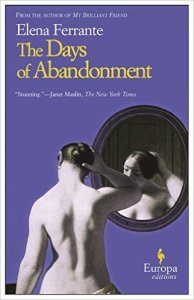
days of abandonment ferrante 51MHqt44whL._SX320_BO1,204,203,200_It’s a very fast read.  But honestly?  I  tire of Lila’s hyperbolic tantrums (are they Italian?). And Lena’s typical experiences with her insomniac baby and unsympathetic husband, who goes on writing and ignores the crying baby,  seem barely sketched in.  Of course that mightbe a translation problem.

For me, this one is the weakest of the novels (so far)!  I do want to love these best-sellers, and yet…

On the other hand, I do recommend Ferrante’s The Days of Abandonment, a truly Kafkaseque narrative  peppered with the feminist outrageousness of Doris Lessing and Marilyn French. The narrator, Olga, a housewife, goes mad when her husband deserts her for another woman after 15 years, leaving her with two children and a dog.  She is mystified by his departure, and the hours, days, and weeks that follow are described with agony, spite, and humor.  Eventually Olga gets her own back!

If you’re not interested in reading Ferrante, here are some literary links that will give you other options for Memorial Day!

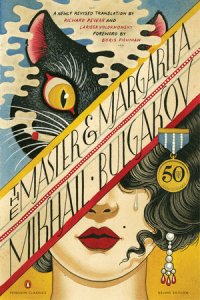
master and margarita 97801431082761  Boris Fishman writes in The New York Times about the fiftieth anniversary of the publication of Mikhail Bulgakov’s The Master and Margarita.  This excellent essay begins,

Were it a kinder world, Mikhail Bulgakov’s incandescent novel “The Master and Margarita” would be commemorating its 75th rather than 50th anniversary, for the author completed it in 1940, just as his own brief life was ending. But in the Soviet Union of the time — then concluding one of the most grotesquely violent decades in history — the fate of authors like Bulgakov was so precarious that he was fortunate to die of natural causes. Having finished the book, he reportedly said to his wife from his deathbed: “Now it deserves to be put in the commode, under your linens.” She did not even try to get it published. A censored version finally appeared in 1966-67.

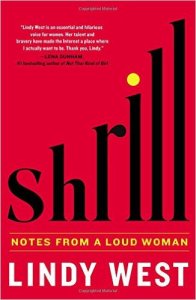
shrill 41wjF5kS+BL._SX324_BO1,204,203,200_2 At Lenny, in the article “Lit Thursday: Books That Won’t Disappoint,” Lena Dunham says she is reading Lindy West’s Shrill.

Lindy has made a name for herself as one of the fiercest and funniest feminists working today. The Internet has been her medium and she’s used it beautifully, responding in real time to trifling comedians and even less impressive trolls. But a writer as skilled as Lindy deserves long form consideration and Shrill, her hybrid memoir-cultural critique-manifesto, does not disappoint. It fulfills the promise of her many well considered (and fucking hilarious) internet offerings. Lindy deftly moves between painful personal recollections, assessments of the sorry state of body positivity, and a clear eyed view of what the feminist movement needs to do so that sisterhood doesn’t kill off its sisters. I am so happy I’ve been reading her for half a decade. I’ll be doing it for another half a century.

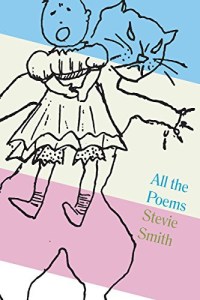
3 At The New York Review of Books, Hermione Lee reviews All the Poems by Stevie Smith, edited and with an introduction by Will May  (New Directions, 806 pp., $39.95)

stevie smith all the poems 9780811223805

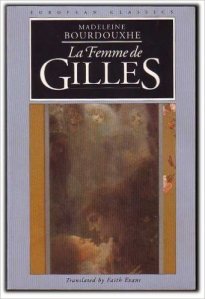
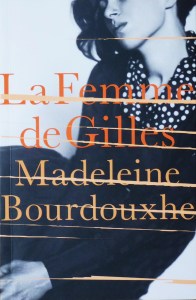
Madeleine Bourdouxhe’s La Femme de Gilles

La Femme de Gilles Bourddouxhe 51RY8Lp9quL._SX339_BO1,204,203,200_

The Belgian writer Madeleine Bourdouxhe’s exquisite first novel, La Femme de Gilles, published in 1937 and translated  by Faith Evans in 1992, explores the pain of adultery.  It is told mainly from the point of view  of Elisa, the faithful wife who is in love with her handsome husband Gilles, a factory worker.

We don’t think of working-class marriages in fiction as erotic.  In most working-class novels, marriages are exhausting and unhappy: in  D. H. Lawrence’s  Sons and Lovers, Paul’s refined mother despises her coal miner husband; in Hariettte Simpson Arnow’s The Dollmaker, Gertie’s factory worker husband squanders her savings; and in Tillie Olsen’s Yonnondio, Jim works in a slaughterhouse and  beats his wife and children.

But Elisa, a housewife and mother of twins, is happily married and sexually fulfilled.  Bourdouxhe’s sensuous opening paragraph describes Elisa’s  intense longing for Gilles as she finishes her housework.

“Five o’clock,” says Elisa to herself.  “Soon he’ll be home.”  The thought paralyses her completely.  She’s spent the whole day polishing, washing, scrubbing, making a thick soup for supper–most people round here don’t eat a proper meal in the evenings but Gilles works at the factory, and only eats an egg sandwich for lunch.  Now she finds herself transfixed, unable even to lay the table.  Her arms hang helplessly, hopelessly, at her side.  Giddy with tenderness, she clings to the metal rail of the stove, stock still, panting for breath.

The present tense of the first chapter is very vivid and effective and captures the last of their happiness.  After the first chapter, Bourdouxhe switches cleverly to the more formal past tense.

Elisa doesn’t suspect Gilles would ever commit adultery.  Yet even in the first paragraph she is clinging to a stove’s metal rail, no doubt the product of a factory.  It certainly foreshadows her misery.  Soon all she will have is the stove.

Bourdouxhe switches to Gilles’ point of view to convey his  first flash of attraction for  Elisa’s younger sister, Victorine.   It takes a while for Elisa to realize  he is having an affair.  She follows Gilles at night to see where he goes.  Heavily pregnant with their third child, she tramps through the snow wearing  pattens and eventually loses him.

daunt press madeleine bourdouxhe femmedegilles  Then one day she realizes his girlfriend is Victorine.  Elisa is crushed but determined to stay  level-headed.  She pretends she doesn’t know; then she becomes his confidant.   And she is hurt very much.
Elisa is a working-class Anna Karenina, only her Vronksy is her husband.  This is a stunning minimalist novel, graceful and pitch-perfect.

And in the Afterword, Faith Evans quotes her own conversations in the 1980s with the author and includes the following statement Bourdouxhe wrote for a French edition.

If you watch Elisa from the outside, her struggle is barely perceptible.  What I wanted to do was follow Elisa through her interior life.  I created her from a composite of the women around me.  I’d see a fleeting look, an expression, a smile, for just a moment–then it would be gone… but it emanated from something that continued to live inside them, and it was the look that created the women they were.

What a dazzling book!

Extraordinary Women & The Graveyard Competition: How Absurd We Are!

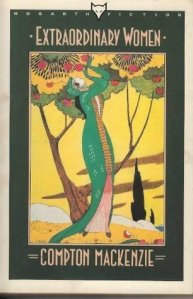
Compton Mackenzie Extraordinary Women 655430I chortled over the quotation below from Compton Mackenzie’s comic novel, Extraordinary Women.
Madame de Randan had long ago decided that the behavior of her husband entitled her to display openly the animosity and scorn she had always felt for the male. The mere contour of a man affected her mind as unpleasantly as the contour of a mountain affected the old Roman mind.

In the flamboyant first chapter, Mackenzie tells us that this grumpy character left her charming French husband because she tired of meeting his mistresses in society. In her villa on the Bay of Naples she knew “no Phaon would ever again trouble her dreams.”  But how can she prevent her 16-year-old daughter Lulu’s amorous assignations by moonlight with the chemist’s son? She sends her to the island of Sirene with the English governess. According to the jacket copy, Sirene is populated by lesbian characters based on several of Mackenzie’s friends on Capri.  Out of the frying pan into the fire?

It’s odd the things that remind us of our mothers. My father’s behavior didn’t turn Mother against men, but she never dated again. “I didn’t feel like it.”  Longing to protect me from amatory agony, she was upset when I was very young and “Phaon troubled my dreams” in the shape of an older man.  Well, if I could go back in time and pass on that one…but we learn from bad decisions.

She died in 2013, and I spoke with her ghost till this year.  I’m psychic!  If it was not her ghost, it comforted me anyway.  Now she’s done with chatting and has gone on to the afterlife.   But DNA tells:  I look at my feet and eerily see her feet–probably because we both bought the same sandals!

I recently visited my hometown.   It was difficult to find her grave: it has a flat gravestone.  It is not far from the road, between my grandparents’ grave and my uncle’s.  It’s almost Memorial Day.   I left a basket of flowers.

Last year I  didn’t get there till after Memorial Day and was dismayed to find my mom’s  grave bare and the other relatives’ decorated.   It was probably an oversight on the part of my cousin, but she lives there and I don’t.  I can’t believe I think am in a Graveyard Competition!  But I know our super-competitive DNA:   she will be frustrated that I beat her!

I am apparently a character in a D. E. Stevenson novel rather than Compton Mackenzie’s.

The Tale of Genji, Lugging It in a Bike Pannier, & The Coffeehouse Umbrella War

tale of genji cover2Well, I’ve done it.  I’m well into my Big Book of the Summer, Murasaki Shikibu’s The Tale of Genji, a stunning eleventh-century Japanese classic, which is sometimes billed as the first novel (though the Greeks and Romans actually were first.). Murasaki Shikibu, an elegant writer who served in the court of the empress Akiko after she was widowed,  entertained both the empress and emperor with parts of The Tale of Genji, her absorbing story  of the amorous adventures of  Genji, the son of the Emperor and his concubine.  At this point I haven’t gleaned enough about the culture  to understand exactly how Murasaki views her characters, though I appreciate the subtlety with which she shows the women do not always find his advances  acceptable.   In one chapter, after Genji is repeatedly rejected by the woman he is courting, he accidentally climbs into bed with the wrong lady but gallantly pretends she is the one he wanted.  In another chapter, he courts a reclusive princess simply because she never sees anyone,  and then rejects her because he finds her unattractive and unstylish.  In a very disturbing scene, he mocks the unattractive princess and makes fun of her red nose to a little girl he is raising.

So what are we to think of Genji?  My reading will gradually reveal more, I am sure.

Why am I reading this?  The gorgeous language. Genji and his girlfriends exchange poems.  It is delightful to read them.  As for the beautiful language of Murasaki’s prose, it’s  like being in an opium den, not that I’ve ever been in one, where language flows over and around you like smoke and you go into a dream and you aren’t aware of anything else  I hope I’ll eventually understand the tradition of the Japanese romance better.

Meanwhile I am fascinated by Murasaki’s life.  In Diary of Murasaki, she tells us about  learning Chinese, though women did not study languages.

When my brother Nobunori was a boy my fahter was anxious to make a good Chinese scholar of him,  and often came to hear Nobunori’s lessons.  On these occasions I was always present, and so quick was I at picking up the language that I was soon able to prompt my brother whenever he got stuck.  At this my father used to sigh and say, “If only you wore a boy how proud and happy I should be.

But she learned to conceal her knowledge of the least Chinese character, because she was told it would make her unpopular with men..

Sound familiar?

Being a girl, I meant so little to my father that he confronted me when he saw my name in the newspaper on the honor roll.   “We didn’t think you did well,” he said.

I didn’t bother to correct him. I was numb from years of put-downs and insults.  Yes, I was an honors student, I said blandly.  I knew it made him angry. All my life he had talked a lot of garbage like “Women can’t play chess,” “Women can’t do math.”  I once sassily said, “Not ‘can’t” but “refuse to.'”  Certainly he didn’t understand my interest in languages and literature.  And he didn’t give me any of the money from my so-called college fund until my last semester of college, after I had paid for my education through part-time jobs and small loans and was finally exhausted. Turned out I wouldn’t have had to take any loans. Great to know at the end of school, right?  But never fear, I paid back my loans with no problem. School was not expensive in those days.

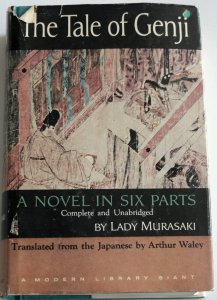
tale of genji modern library 81wldFQ881LWhen we talk about Genji, we don’t think of the weight of the book.  But if you want to carry it on the bus or your bike, you should know  that the oversize 1,090-page Knopf paperback of Edward G. Seidentsticker’s 1976 translation weighs three pounds.

I thought I could solve my summer-reading-on-the-go problem if I found a less hefty copy.  It turns out the 1960 Modern Library copy of Arthur Waley’s original translation weighs only two and a half pounds.  I figured it wouldn’t break the bike pannier.

Wrong!

The bike can’t even stand up with this book in the bag.  The pannier came unhooked from the  rack!  I had to stop a couple of times and fix it.

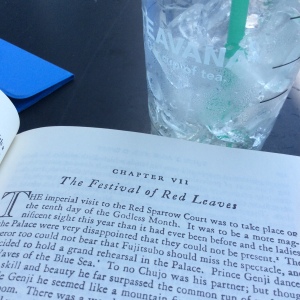
image

Genji at the coffeehouse.

Once at the coffeehouse,  I had a few problems because of the translations.  Reading the Seidensticker at home, I was introduced to the character Tayu, “a very susceptible young lady who was in court service and from time to did favors for  Genji.”  She  distracts him from his pining for a governor’s wife with the story of a reclusive princess fathered by the late Prince Hitachi in old age.  But in Waley’s translation she is called Maubo:  her whole name , it turns out, is Taifu no Mayubo.   Thank God there is a list of characters at the front.

And then there are the coffeehouse umbrella problems.

On the terrace, in the bright 80-degree sun, there were several tables but only one umbrella.  The umbrella shaded one table.  And so I huddled at the table behind it, which at least caught a little triangle of shade. And then the guy moved the umbrella so the girl had more shade.  And then I had no shade.  Very exasperating, but what can you do?  Start a coffeehouse war?  I don’t think so.  The minute a slightly shady table opened up I was there!