“Macbeth” or “Christmas in July”?

"Christmas in July"

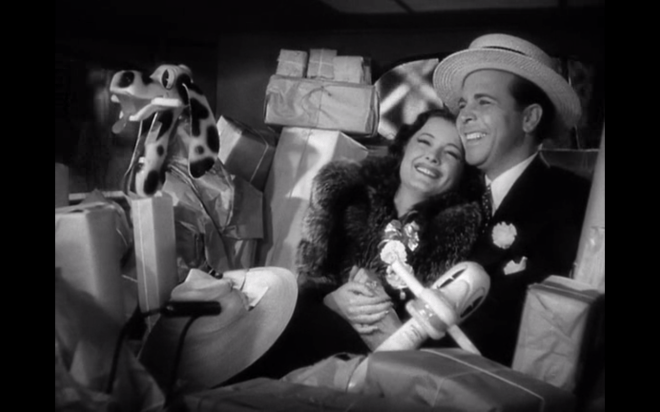
Preston Sturges’s film, “Christmas in July,” with Jane Drew and Dick Powell

It rained all weekend.

You can only read so much. You can only knit so much.

And so we decided to see the new Macbeth movie, with Fassbender.

There was a hitch:

I thought Fassbender was Rainer Werner Fassbinder, the brilliant German director of Ali:  Fear Eats the Soul.  I’m a little behind.  Fassbinder died in 1982.

Probably not my Macbeth.

Probably not my kind of Macbeth.

Turns out Michael Fassbender is an actor in movies I’ve never heard of, such as X-Men:First Class and X-Men:  Days of Future Past. To be fair, I have heard of 12 Years As a Slave. 

The movie has been well-reviewed, but I was leery when the reviewer at the Independent called it ” Shakespearian tragedy as macabre action movie. “Oh, dear. And the clip is graphically violent.  Probably not my kind of Macbeth.  Sorry, but I like my Shakespeare as in Shakespeare in the park.

And so what could we do?  All the theaters show the same movies.  None of them seemed to be aimed at adults.

The Night Before has Mindy Kaling, the brilliant creator and star of The Mindy Project,  but it is a slapstick male bonding movie, with guys on cocaine (see clip).  Not my kind of thing.

Never let it be said that I don’t go for star vehicles.  I was willing to see Trumbo, because Bryan Cranston is in it.  But my husband hated Breaking Bad.

So we stopped at the library to look for Christmas movies, because we were now in a thoroughly bad mood.

The only thing we could find with Christmas in the title was Preston Sturges’s Christmas in July.

Turns out this charming, sentimental 1940 comedy is not really about Christmas.

Preston Sturges won the Oscar for Best Original Screenplay for The Great McGinty, a satiric movie about a politician who ruins his life by a moment of honesty.  In Christmas in July, the conflict is between the naive little guy and soulless Big Business.The hero, Jimmy (Dick Powell), is an office worker.  He and his co-worker girlfriend, Betty (Jane Drew), want to get married, but they are very poor.  He dreams of winning $25,000  in a slogan contest for the Maxford Coffee Company.  His slogan is not snappy.  “If you can’t sleep at night, it’s not the coffee, it’s the bunk.”
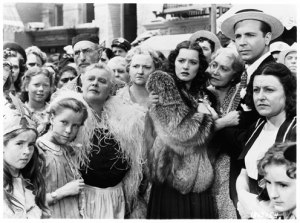
Neighbors standing with Jimmy and Betty when Maxford tries to arrest him.

Neighbors standing together with Jimmy and Betty when Maxford accuses Jimmy of fraud.

At work, practical jokers convince him he has won the contest. He claims the winning check at Maxford Coffee with no problem: no one knows what’s going on.   Jimmy  and Betty are so excited and happy: it is like Christmas.  Department store clerks know the power of the dollar and can’t do too much for  Jimmy, who buys  an engagement ring and fur coat for Betty, a  sofa bed with comical pop-up accessories for his mother,  and gifts for all their working-class neighbors.  The only one he doesn’t buy for is himself!

But even true happiness has its enemies.   Dr. Maxford learns the contest judges are deadlocked and haven’t decided on a winner. So who the hell is Jimmy?  He calls the department store, and everyone calls his lawyers.  Maxford drives to the apartment house to confront Jimmy, who is celebrating with the neighbors.  When Dr. Maxford wants him arrested, everyone is stunned.  They stand up for Jimmy’s character.  The police refuse to arrest him.

The dialogue is simple but good, and takes shots at Hitler and Mussolini.

What really got me about this comedy was the idealism.  Everybody deserves enough money to live, and so much of it is about getting a chance in the workplace.

Very different from the kind of comedy playing in most movie theaters now.
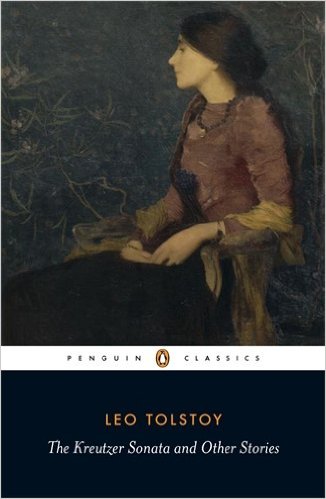
Tolstoy’s The Kreutzer Sonata and Other Stories

tolstoy the kreutzer sonata and other stories 4164Top38+L._SX324_BO1,204,203,200_I am mad about Russian literature.

And I am fascinated by the development of the nineteenth-century Russian novel, as writers began to experiment with point of view and psychologization. What a century!  Gogol, Turgenev, Tolstoy, Dostoevsky, and Chekhov.

But is there any greater writer than Tolstoy?

If you a admire his realism, beautifully-crafted scenes, and depth of characterization, you read and reread War and Peace, Anna Karenina, and Resurrection. And then you turn to his stories and novellas, though they are less satisfying than his novels:  Tolstoy needs space. The Kreutzer Sonata and Other Stories (Penguin), translated by David McDuff and Paul Foote, is a collection of four stories about the consequences of love and sex.

“Family Happiness” is an early story, a predecessor of Anna  Karenina. It is an astute, if somewhat rambling, story of a marriage. After her mother’s death, the narrator, Masha, falls in love with her guardian. They had meant to move to the city for Masha’s “coming out.” in society, but now she is stuck in the country with her governess and younger sister.  At the age of 17, she is depressed.

The loss of my mother was a very great grief, but I must admit that there was also a feeling that I was young and pretty, as everyone told me, but that I was wasting a second winter in seclusion on our estate.  Before the end of the winter, this feeling of melancholy, loneliness, and sheer boredom increased to such an extent that I never left my room, never opened the piano and never took a book in my hands….  In my heart a voice said:  “Why?  Why do anything, when the best days of my life are being wasted like this?”

Sometimes falling in love is a matter of being primed for an emotion.  Sergei, their neighbor and guardian, arrives in March for a visit, and Masha  plays the piano for him and enjoys their conversations.  Masha makes the first advances in the summer, while Sergei is, appropriately, picking cherries for her.  He feels too old for her, and they discuss the nature of love.   They  get married and are sexually compatible and very happy.  Masha has a baby.   Then Sergei takes her to the city and she finally enjoys the whirl of society.  As Masha becomes excited by flirtations with other men, she spends more time in cities and travels.  Perhaps Sergei was never her soulmate, but they do manage to work out their problems after Masha glimpses the ugliness of a potential lover’s cynical view of her. And so it is an optimistic story, though Tolstoy clearly believes that first love cannot last.

Kreutzer sonata yale 9780300189940Tolstoy’s famous novella, “The Kreutzer Sonata,” was banned in 1890 by Russian censors for its sexual content.  It is by far the most idiosyncratic  story in this collection.  It is misogynistic to the point that Tolstoy’s wife Sofia  wrote her own version, as did their son.    (The counterstories are published in The Kreutzer Sonata Variations, along with Tolstoy’s novella, translated by Michael Katz)

Set on a train, this brilliant novella is told in the form of a frame story.  In the opening chapters, the narrator describes his fellow passengers and recounts their discussion of marriage and divorce.  A merchant claims that women’s education has ruined marriage: a feminist woman believes women should not have to live with their husbands if they fall out of love.  And then another passenger, Pozdnyshev, tells his story to the narrator:  he murdered his wife but was acquitted because she committed adultery. He verbally attacks the “animal” nature of human sexuality, women’s use of contraceptives (one of the things that pushed him over the edge),  and preaches abstinence.  But Beethoven’s Kreutzer Sonata was the trigger for the murder, when he found his wife and a violinist playing it together on the piano.  One of Tolstoy’s later, quirkier beliefs was that music could be too “infectious.”  You had to be careful that art didn’t affect your mood!  But in many ways the story is redeemed by the reaction of his dying wife, who shows her contempt for him and screams, “Nurse, he’s killed me!”  He cannot take it in that he really killed her.

Fascinatingly, Tolstoy meant this story in part as an attack on Turgenev, whose lyrical, philosophical writing he disliked, according to Donna Tussing Orwin, the editor of the Penguin edition.  And “The Kreutzer Sonata” duplicates the structure of Turgenev’s First Love (1861) and Spring Torrents (1871), in which philosophical dialogues about love predominate.

Orwin writes,

In these stories Turgenev depicts failed romantic love and opportunities that his characters usually lacked the courage to pursue.  By contrast, The Kreutzer Sonata attacks romantic love, and even associates it with murder.

I admire the brilliant structure, but must admit I hate the story.

In the last two stories, Tolstoy brilliantly continues to explore sexual problems.  In “The Devil,” the hero is torn between love of his wife, who does not sexually excite him,  and lust for another woman.  In “Father Sergei,” the handsome hero breaks off the engagement when he learns his fiancée used to be the czar’s mistress.  He becomes a monk, then a hermit, to get away from women, who continue to pursue him sexually.  But his ineluctable fall is in a way his return to grace.

Tolstoy  is a superb writer, though his  philosophy is sometimes cranky.  Yet these stories are structurally little gems.

Rumors in War and Peace

The Maude translation (Everyman)Tolstoy’s War and Peace is my favorite novel–or one of them.

If I hadn’t read it so often,  I could have learned Russian and read it in the original.

Why didn’t I think of that?

And so I am looking forward to the new BBC adaptation of War and Peace by Andrew Davies, which will surely be shown eventually in the U.S.

There has been an uproar in England regarding the adaptation :  Andrew Kaufman, a Tolstoy scholar and the author of the excellent pop book, Give War and Peace a Chance, is annoyed by a gratuitous incest scene between Helene and Anatole Kuragin.  Kaufman told The Telegraph, “That has absolutely no justification in the text. It just doesn’t exist in it.”

Well,  I know from my many readings that there actually is a rumor in W&P that the Kuragin siblings have committed incest.  Kaufman obviously knows this, too,  so I conclude his quotes in the interview were edited  for maximum dramatic effect.

Give War and Peace a Chance Kaufman 51DPHjQm15L._SY344_BO1,204,203,200_Like Kaufman, I can’t imagine why the BBC writer, Andrew Davies, included a full-blown incest scene.  There is so much happening in 1,400 pages.

But the immoral brother and sister, Anton and Helene Kuragin, are horribly materialistic, stupid beautiful villains: the enchanting Helene, with the help of her father, traps the bumbling Pierre into a wretched marriage.  And Anatole can’t keep his dick in his pants: he almost destroys the reputation of charming, innocent, naive Natasha when he arranges to elope with her.  The elopement is prevented by her friends and relatives.

So is the incest hyperbole a hook for audiences ? Like the rumored incest of Caligula and Drusilla in I, Claudius, which was the last costume drama I watched?  (No, I’m joking. I watch a lot of costume dramas.)

But there has never been a good film of War and Peace.

Will it sell books?

TV Sitcoms for the Holidays

Roseanne white trash christmas santa 2877794

“We’re not doing this for tips.  We are degrading ourselves for the sheer holiday joy of it,” says Roseanne in the ’90s sitcom, Roseanne (Season 6, Episode 12, 1993), in defense of the family’s tacky outdoor Christmas decorations.

When the  neighborhood association singles them out and asks them to tone their display down, they decide, as Roseanne ironically says, to “go for the national title” of tackiness.  Dan (John Goodman)  finds  two mangers, and Roseanne says, “Dueling Saviors–hoo ha!”

Gotta love it. And it is such a joy after watching the frenetic, saccharine Christmas episodes of today’s family sticoms.

The Middle, a pretty good sitcom about a working-class family, can’t compete with Roseanne.  Why?  It’s just no longer real.  This is the seventh season, and the writers are having trouble tying up the plot with a bow.

Tonight, the colorful Heck family missed a Christmas Eve church service because  (a) the clocks are all wrong, (b) Frankie (Patricia Heaton), the mother of the family, can’t get it together, and (c) she decides they will  watch church on TV instead.   The children are reluctant, Frankie asks them to be quiet during “church,” then, during the commercial, daughter Sue asks them  to wear Santa hats in bed  for a Christmas picture (why bed?),  then she accidentally deletes the whole family album on the computer, and then Frankie lies down on the floor and cries and kicks her heels…

Work with me here. What the f…?

Bev (Wendi McClenden-Covery) onf The Goldbergs"

Bev (Wendi McClenden-Covey) on The Goldbergs”

The Goldbergs, a sitcom set in the ’80s, was a tad better.  For one thing, the Goldbergs are Jewish. For another thing, Beverly (Wendi McLendon-Covey) and Murray (Jeff Garlin) are the most outrageously funny parents on TV.

Bev, who is the ultimate iconic Jewish mother, decides to create a holiday called Super Hanukkah, which is basically a rip-off of Christmas, because her children aren’t on board for Hanukkah, eight nights of presents like underpants.  Now there are lots of decorations, a Hanukkah bush (suspiciously like a Christmas tree), and great presents.  Everybody is happy.

Until Bev’s dad, “Pops” (Geroge Segal), shames them for not honoring Hanukkah. And, wow, he is intense (I’ve never seen that side of him).  Soon Bev is in tears.  Poor Bev!  She didn’t deserve that!  The family was happily hanging out together.

In tonight’s episode there is also a riff on the movie A Christmas Story, but it isn’t as funny as the Super Hanukkah stuff. It’s apparently hell on TV writers to weave the different skits together.

So I’m sticking with Roseanne.  I know all about “White Trash Christmases.”  Believe me, I’ve spent Christmas in a lot of different places.

Amatory Lit 101: Book IV of Virgil’s Aeneid & Doris Lessing’s Landlocked

pulp love cover cd0c32c52e8a6ed2730d959432329ddeThe first amatory classic I read was Jane Eyre.  I don’t think Peyton Place,  The Robe, or Max Shulman’s Rally Round the Flag, Boys!, count, do you?  At 12, I was enthralled by Jane’s love for  Mr. Rochester.  I knew that one day I, too would fall in love with Mr. Rochester.  The operative word was “fall.”

But is “falling” love?

I suppose so.

Amatory lit can be sexy.  But so often it is not quite about love.

Take two amatory classics I read recently.  They are about sex and passion, but love?

Aeneid Rolfe Humphries c99ea633518bd50c8c3027ab79b6d8a6Book IV of Virgil’s Aeneid is one of the world’s most famous tragic love stories.  I reread it every year, preferably on the Mediterraean, actually at Ahkwabi State Park, since I never  find myself on the Mediterranean.  Dido, Queen of Carthage, is desperately in love with the Trojan hero, Aeneas, who is is driven off course to Carthage by a storm on his way to Italy.  There are many different interpretations of this elaborate, glittering poem:  it is the sympathetic portrait of a passionate woman, or a condemnation of a queen who puts love before duty, or a vindication of Aeneas’s obedience to the gods and devotion to the pursuit of power. It was the most influential Latin poem in the Middle Ages and the Renaissance,  the inspiration for Christopher Marlowe’s Dido, Queen of Carthage, Henry Purcell’s opera, Dido and Aeneas, Berlioz’s opera, Les Troyens (The Trojans), and innumerable works of art.

Dido is a powerful widowed queen in exile, building a new city for her people.  But in Book IV, she is obsessed with Aeneas, and fears it is disloyalty to her dead husband.  Virgil describes her love as a disease:  wounded by love, she feeds the wound.

One of the best translations of the 20th century is Rolfe Humphries’, which is close to the Latin and reflects the economy of the language. (I also love Robert Fagles’ translation, but he adds phrases that are not in Virgil.)  Book IV begins,

But the queen finds no rest. Deep in her veins
The wound is fed; she burns with hidden fire.

The Latin lines are alliterative and arranged in interlocking word order:  The second line of the Latin below shows the repeating v’s and c’s, as you can see here:

vulnus alit venis, et caeco carpitur igni.

(vulnus = wound)… (venis = veins),,, (caeco = blind) (carpitur = consumed)

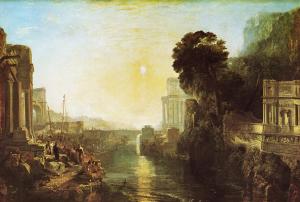
"Dido Building Carthage," b JMW Turner

“Dido Building Carthage,” b JMW Turner

The balance and style of the poem are elegant and the plot is compelling, especially for women.    During a storm, Dido and Aeneas take refuge in a cave and make love.  Dido regards their relationship as a marriage.  But Mercury comes with a message from Jove, ordering him to go to Italy, reminding him he must found Rome for his son.  Aeneas prepares the fleet’s departure without telling Dido, but she confronts him.  After he leaves, she commits suicide.  And Virgil revives the images of the fire and the wound:   she builds a pyre, then kills herself by falling on his sword.

Virgil’s description of the end of her life is  grotesque.

And her wound made a gurgling hissing sound.
Three times she tried to lift herself; three times
Fell back; her rolling eyes went searching heaven
And the light hurt when she found it, and she moaned.

Traditionally, classicists speculate that the Romans would have mistrusted the love affair, comparing  the dalliance of Dido and Aeneas to that of Cleopatra and Antony. Antony’s affair with a foreign queen fueled a war and drove Cleopatra to suicide.  And Augustus had defeated Antony, and Virgil was a patriotic poet, very much Augustus’s poet.  So would the audience  at Virgil’s poetry readings have approved Aeneas’s flight from Dido?  Or would the women have been fuming?  Should we be postmodern? Or traditional?

Love is a wound.

Lessing landlocked 328419Doris Lessing’s Landlocked., the fourth in Nobel Prize winner Lessing’s Children of Violence series.

 Landlocked, written after her masterpiece, The Golden Notebook, which certainly taught Lessing how to write about love and sex, is the most polished novel in this series.  Set during World War II, Martha waits in Africa for the end of the war to divorce the husband she married for political reasons.  She  left her first husband, a civil servant, and their daughter Caroline to  become a Communist activist and support herself as a secretary.   She made the disastrous marriage to Anton Hesse, a communist refugee from Germany, so he would not be interned in a camp or deported.  Anton is terrible in bed, they have no chemistry, and Martha insists on having affairs, reminding him that they are not really “married.”

The political climate changes, the town again become hostile to the left, and the communist group is unraveling..

But the most important aspect of the novel is Martha’s discovery of sex.   Tomas, a Polish Jew, a farmer, and a communist who simply loves women, introduces her to great sex.  She has never been happier. But the affair is a brief idyll, and she knows it.  He will not leave his wife, and is determined to go back to Europe.  She will go to London.

Nothing can wipe out the memory of violence.  Martha is  aware that if he had not left Europe with his wife, he would have died.

If he had not–well, none of his family was left alive, several dozen brothers, sisters, cousins,, relations–they were all dead, they had died in the gas ovens, on the gallows, in the prisons and the concentration camps in those years of our Lord, 1939-1945.   But here Thomas was alive.  And all her life Martha would say to herself–whatever else had  been untrue, whatever else had not existed, this had been true:  this was true, she must hold on to it, even though, when she touched Thomas it was with the anxiety that related not to Thomas now and here, but to the scene she could create by a slight dislocation in her mind: Thomas very nearly had not left Poland.

This is a gorgeous novel, with some of Lessing’s best writing.  It is the gateway to the experimental, genre-busting fifth book in the series, The Four-Gated City, which is actually my favorite.

It is so good to see Martha happy.  So much lies ahead of her after the war, when she goes to London.

Jingle Bell Rock, Catalogues & Christmas Trees

The very cool 1960s Tammy doll house!

The very cool 1960s Tammy doll house!

Looking at catalogues used to be a mother-daughter bonding activity in our household.  In the 1960s, my mother and I pored happily over the Sears Christmas catalogues.  She put checkmarks beside  mini-dresses that would look “adorable”on me,  and I circled mini-dresses for my Tammy doll, and put multiple exclamation points beside the very cool Tammy dollhouse, which had a soda fountain, ping pong table, and jukebox.

In the last years of Mom’s life, I lugged a shopping bag of catalogues  to the  nursing home.  We spent hours flipping through Talbot’s, Land’s End, and Harry and David. We speculated,  “What would Michelle Obama wear?” or  “What would Hillary wear?”

Since Mom died in 2013, I have lost all desire to shop for the holidays.  Ironically, I am so glutted with catalogues this year that I schlepped 40 directly from the mailbox to the recycling bin last week.

Happy Holidays, Jingle Bell Rock, etc. but I no longer swoon over pictures of Christmas trees and ask , “Would our Christmas be improved if we ordered a tiny decorated evergreen tree from L. L. Bean that we could later plant outside?”

Or maybe I do.

My husband says we don’t need a potted evergeen.   He says the ground would be too hard for planting it.

I say, “You wait till spring!”

He says, “But do we want an evergreen?”

No, we’d rather plant a maple.

And yet I look at the catalog and think,  MAYBE THIS IS THE YEAR.

THE YEAR OF THE REAL CHRISTMAS TREE!

tinsel christmas trees and tigger IMG_0574I love our tiny kitschy tinsel trees decorated with LED lights. Put in a battery and they light up.

And the cats enjoy an artificial tabletop tree that lives in the basement year-round. The branches are so unkempt from cat love that we no longer bring it upstairs.

My holiday decorating has always been sporadic, but Mom took it seriously.  I fondly remember her silver aluminum tree with blue ornaments. After I moved away from home, she acquired some scary huge white-clad angel dolls that moved their arms when she plugged them in.   She also had a white flocked Christmas tree in the shower in the basement.  Obviously nobody used the shower.  “Do you want it?” she would ask.  No.  Now I sort of wish I had.  What happened to the angel dolls?

“Do you realize we’ve never had a real Christmas tree?”  I ask my husband.

“We have a real Christmas tree,” he says indignantly.

“That’s an artificial tree.”

Would I enjoy a real tree so late in the game of Christmases?  I’m past the age where I would enjoy stringing popcorn while we listen to Jingle Bell Rock or watch A Christmas Carol.  And the cats really prefer batting ornaments on the floor like soccer balls to seeing them on the tree.

And guess who would vacuum up the evergreen needles?

It is unnecessary to replicate the holiday from old Christmas cards or my favorite Betsy-Tacy books.  Every family has its own traditions.  Ours?  Go to the bookstore on Christmas Eve, plug in our tinsel trees, make a dinner from Laurie Colwin’s Home Cooking, and watch Christmas in Connecticut.  It’s good enough.

Top 10 Dancing Characters in Fiction We’d Like to See on “Dancing with the Stars”

Nastia Liukin, a Gold Medal-winning Olympic gymnast, and Derek Hugh, semifinals, spring 2015.

Nastia Liukin, a Gold Medal-winning Olympic gymnast, and Derek Hugh, semifinals, Spring 2015.

I am a fan of Dancing With the Stars.  In my favorite season, Meryl Davis and Charlie White, the Olympic Gold Medal-winning ice-dancers, competed for the Mirror Ball Trophy. (Meryl won.)

This fall the show was lacklustre, possibly because two women dropped out with health emergencies. After Tamar Braxton was hospitalized for blood clots, there was Bindi, the plucky teenager whom the judges and interviewers deemed “the nicest girl in the world,” “inspiring,” “my favorite person,” and “the person whose best friend I’d like to be if I were younger.” Guess who won?  Bindi!  And she was an elegant dancer, but didn’t have much competition at the end.  Or any!  I rooted for Carlos, but he was eliminated in the semi-finals.

Here is my solution to the slump:  a list of the Top 10 Dancing Literary Characters I’d like to see on DWTS. The mechanics of bringing them to life would be difficult, but it’s Hollywood!

TOP 10 DANCING LITERARY CHARACTERS WE’D LIKE TO SEE ON “DANCING WITH THE STARS”

1 Mr. Darcy from Pride and Prejudice.  He is  “hot” (sorry, I got that horrible word from DWTS), but he is also snobbish.  After Darcy rejects the Bennet girls at a dance and deems Jane a gold digger, he notices Lizzie’s grace and intelligence. But it is too late:  Lizzie is prejudiced.   Eventually they fall in love.  Well, he was kind to her, but she also likes his mansion and  estate. So wouldn’t we like to see Darcy dancing?  Yes!  He is so proud.  How about the Samba?

2. Prince Turveydrop in Dickens’s Bleak House. I adore the harried Prince Turveydrop who runs a dancing school to support his father, Mr. Turveydrop, a model of “deportment.” And Prince is engaged to Caddy Jellyby, my favorite sulky character in literature.  Her philanthropist mother turns her into a secretary-drone, but she secretly learns housekeeping skills from Miss Flite, a sweet but addled old woman who spends her days trying to settle an imaginary lawsuit in Chancery.  Prince needs some fun:  let him do the Jive!

3. Natasha in War and Peace is the belle of the ball, and she also does a lively folk dance. She’s got passion:  let’s see her do the Paso Doble!

4. At a dance, Jo in Little Women burns the back of her dress while standing too close to the fire. Her neighbor, Laurie, rescues her,  and they dance and romp in the hallway.  What would this tomboy dance on DWTS?   Something athletic, possibly the Quick Step!

5.  Eugene Onegin in Pushkin’s Eugene Onegin.   Eugene doesn’t have much pep.  He is one of those languorous Byronic heroes.  So let’s see him dance.  How about the Cha-Cha-Cha!

6. Glencora Palliser in Trollope’s Palliser series. In Can You Forgive Her? Glencora, an heiress, is in love with Burgo Fitzgerald, an  impecunious aristocrat.  They have a dance or two, though she doesn’t marry him.  Can’t we see Glencora doing the Viennese waltz?  (Preferably with Burgo.)

7.  Donald Farfrae fiddles at a dance in Thomas Hardy’s The Mayor of Casterbridge  when he’s not reversing spoiled grain by science or marrying the Mayor’s girlfriend.  Let’s get him on DWTS:  how about  the rumba?

8.  In Nancy Mitford’s The Pursuit of Love, Linda Radlett, the charming daughter of an eccentric lord, can’t wait for her first dance.  But the dance given by the Radletts is stodgy, until the neighbor Lord Merlin brings his fashionable house guests.  Let Linda do the Charleston!  It’s her era.

9.  In Pamela Hansford Johnson’s The Last Resort,  Celia, a businesswoman who is in love with a married man, takes her happily married novelist friend Christine to a club where they dance with professional dance partners–for money!  Christine isn’t keen on it.  Let’s get Celia on the show so she doesn’t make the terrible marriage she chooses as the last resort!  Give her Contemporary!  She needs to express her feelings.

10.  In Carolina De Robertis’s new novel, The Gods of Tango, the heroine, Leda, disguises herself as a man so she can play violin in a tango band at clubs in Argentina when the tango is a new dance.  Eventually she falls in love with a woman who thinks she is a man who turns out to be a lesbian who knew she was a lesbian….  But before that there is quite a lot of tangoing. And so give her the Argentine tango)!

I would ask you for your favorite dancing literary characters, but I’ve turned off my comments!

John Williams’s Stoner

stoner 50th anniversary 51-23lasMfL._SX311_BO1,204,203,200_I am a great fan of John Williams’s historical novel, Augustus, which won the National Book Award in 1972.  This stunning novel did not, however, cause a ripple when it was reissued by NYRB last year.  In the twenty-first century, Augustus has been eclipsed by Williams’s 1965 novel,  Stoner, the chronicle of the quiet life of a profoundly decent, if flawed, professor in the Midwest.  Readers love it.  Critics love it.  And the British love it so insanely they think they discovered it: the great Julian Barnes wrote in The Guardian  in 2013, “There is a further oddity about the revival of Stoner: it seems to be a purely European (and Israeli) phenomenon so far.”

And yet I put off reading it.  It looked a bit stodgy, sentimental. We have the 2006 NYRB edition, and this fall a 50th Anniversary hardcover edition was published.

I put off reading it until I read Elaine Showalter’s article in The Washington Post“Classic Stoner? Not So Fast.”  She dismisses Stoner on grounds of sexism, the portrayals of two “crippled” villains, and Stoner’s pedagogy.  Mind you, I am a feminist, but not so fast, Elaine.

And so I finally  fell into the quiet, well-crafted story of a farmer’s son who becomes a professor.  Is it a classic?  Perhaps.  Do I agree with Showalter?  Not at all.

This engrossing novel reminds me very slightly of The Professor’s House by Willa Cather, who was the original great chronicler of quiet lives in the Midwest and West.  Her protagonist, Professor Godfrey St. Peter, has a midlife crisis after his two daughters marry and he and his wife buy a new house.  He stays on in the study in his old house for some peace and quiet, and to contemplate the strange trajectory  of his not altogether satisfying life.  One of his greatest sorrows is the loss of  his most brilliant student, Tom, a great Latinist, in World War I.  Stoner’s most brilliant student is also a great Latinist but is lost in a different way.  I’ll get to that.

stoner john williams 61UbQXxc-iLWilliam Stoner, the hero of Williams’s novel,  is the son of a poor farmer who has never questioned or felt much until he takes an English course at the University of Missouri, where he is majoring in agriculture.  He is baffled by the reading for a required English course.  He certainly doesn’t understand his professor’s passion, but he works hard, and one day  is overwhelmed by the beauty of language.  He drops agriculture to study classics and English.  He doesn’t tell his parents until graduation that he isn’t coming back to their farm.  Advised by his mentor, he goes on for a Ph.D., and  does not enlist in World War I with his two friends, one of whom dies.  He gets some flack for that, but does not regret his choice.    And then he becomes an assistant professor at the university.

He loves teaching and is good at it, and his life is utterly quiet.

That is, until he marries Edith, a neurotic, pretty blonde who fears sex, dirt, and other human beings. At first I thought she was pregnant with another man’s child, because she insisted on getting married quickly, without a big wedding or so much as a passionate make-out session first.  She tells him  she hopes to be a good wife, but she avoids him at their own wedding reception.   It turns out she has never heard of sex, and vomits after they have it for the first time.  (She says it’s the champagne.)  I felt compassion for her exhaustion by obsessive housework  and perfectionism at dinner parties.  She is abnormally exhausted, and Stoner doesn’t judge her for that.   But when she decides to have a baby, she becomes a  nymphomaniac until she gets pregnant.  Then poor Stoner is sent back to sleeping on the couch.   After she gives birth, she is bedridden.  For the first few years of their daughter Grace’s life, Stoner cares for her.  When Edith finally gets out of bed she jealously sets out to divide and conquer.   Grace and Stoner cannot be together without Edith’s making a scene.

This is where Showalter gets very busy in her criticism.  She calls Edith  “a faculty-wife version of Zelda Fitzgerald,” apparently because both are mentally ill, and both do arts and crafts, like all good psychiatric patients.  Showalter thinks the multiple symptoms of Edith’s mental illness are a joke, merely the distortion of a misogynist. Alas, mental illness is not a joke of the patriarchy.  Welcome to bipolar disorder, Elaine.

Then department politics ruin Stoner’s life.  Anyone who has gone to grad school has observed a thing or two about department politics.  Hollis Lomax, the chair of the department, a hunchback with “a matinée idol’s face,”is brilliant but sardonic, like a million professors.  But he turns on Stoner after Stoner fails his protegé, Charles Walker, in a seminar. Mind you, Charles is a lazy bum, but he is also “crippled.”  That’s a LOT of disabled people for a fictional English department.  And that “cripples” have power over Stoner is a clumsy metaphor, which certainly Williams would not use today.  After Stoner also fails Charles in his orals (everybody except Lomax thinks he failed), Lomax sets out to ruin Stoner.  Even though Charles eventually passes his orals, Lomax wants revenge.  He assigns Stoner  only freshman composition classes.

Stoner has a love affair with Katherine, a brilliant instructor who is working on her Ph.D.  She  audited the class which  Charles Walker attempted to disrupt:  Charles’s oral presentation was an extempore attack on Katherine’s well-researched presentation, rather than a paper on the subject assigned to him.  Katherine and Stoner spend all their leisure together.  It is like a marriage. Both are excellent Latinists and fascinated by Renaissance literature.  Yet the relationship cannot last.   When Lomax gets wind of it, he threatens to ruin Katherine’s career.  She leaves town.

In spite of all this, Stoner survives.  He reads, teaches, and makes peace with himself. His not very interesting, but in many ways typical, life is celebrated in this quiet novel.  And I loved it, despite its departures from political correctness.

Elizabeth Berridge’s Rose Under Glass

rose under glass elizabeth berridge 41sGi6fFVxL._SX311_BO1,204,203,200_On a gloomy, rainy day like today (where are we, England?), I turn on all the lights and curl up with a cup of Earl Grey.  If I am not writing this blog, I am almost certainly reading one of my favorite authors.  It could be Charlotte Bronte, Barbara Pym, or Elizabeth Bowen.  It is unlikely to be Hemingway or Norman Mailer.  Yes, I am a fan of women’s fiction.

One of my new favorites is Elizabeth Berridge (1919-2009).  The characters in her superb novel, Rose Under Glass, are domestic but also adventurous as they try to find, or avoid love. Berridge is little-known in the U.S., and not very well-known in the UK.  Her obituary at The Guardian called her “a writer of rare distinction who deserved more recognition than she ever received.”

I discovered her work by chance on the lists of reprinted books at Faber Finds  and Persephone Books.  I recently read Rose Under Glass.  This beautifully-written, fascinating novel tells the story of several characters in 1950s London: at the center is 45-year-old Penelope Hinton, a widow whose husband Jamie, a famous artist, recently died.  He stepped off the curb in front of  a lorry while preoccupied with cricket (or perhaps football?) scores.  A fortuneteller had predicted his death to Penelope, and she very much resents that the woman “with a dusty bang and pale eyes” dared know the future.

The marriage of Penelope and Jamie was unusually close:  they were so close that one day at tea their oldest daughter bitterly tells Penelope they ignored and neglected her.  Penelope dismisses her daughter’s complaint, but cannot stop grieving for Jamie.  She fills her day with visits to museums and parks, but they no longer mean anything to her.

They related to nothing, so, terrifyingly, she felt nothing.  Nothing revived her.  Staring at the stone emperors, she thought, “We are two stone people, face to face.”  In the past, she had loved the ceramics at the Victoria and Albert Museum, the tiny miracles of the jewelled watches and snuffboxes.  Now they shone up at her dully, dead in their glass coffins.  Neither did the compassion and depth of Rembrandt’s paintings at the Wallace Collection, revive her, although the spaciousness and cold elegance of the house itself eased her by enclosing her in its own mood of petrifaction.

The terror of feeling nothing:  in middle age this strikes as a warning.

But Penelope is not alone for long.  Shortly thereafter, she meets Pye Rumpelow at a launderette.  He owns a chain of launderettes and coffeehouses.   He came up from nothing, is brilliant, self-educated, and cultured.  Everything he touches is golden:  it is a joke that he cannot stop making money. And he finds Penelope the most golden treasure of all.

She likes him, but is terrified of his love.  Every feeling makes her feel unfaithful to Jamie.  But he shows her something new:  he takes her on a walk to see one of his favorite views.   In the middle of a bridge, they look at the Houses of Parliament, the dusky, melting river, and Big Ben.  When Big Ben chimes at 7, she has a new memory, he tells her.  He likes to remember the date and time.

As their friendship develops, he suggests she move to a new flat, away from the memories that so constrict her life.  And so she writes and offers her flat to a friend’s son,  Spencer Manley, a bookstore clerk who lives in Wales with his lovely wife, Nika, and their two children. They move to London  so he can start a publishing company with his friend Stefan, who has worked in publishing for years.

As you can imagine, things are not easy for Nika and the children.  Life in the country was idyllic: they had a garden and a pony. The boy Lewis is struggling at a tough school.  He hates London.  But Spencer no longer notices or cares much about his family; he works round the clock with  aggressive, ambitious Stefan, who is only just humanized by his lover, Bonny, a best-selling romance writer who has begun writing historical novels. Then  Pye becomes a partner, and  reins them in when they want to compromise their ethics.

As Penelope and Nika approach an emotional crisis in their love lives,  Penelope  feels she must get away.  She brings Nika with her on a Mediterranean cruise.

One of the things I love best about the book is the travel narrative, which is partly in the form of correspondence.

Nika, who doesn’t quite understand Spencer’s indifference to her, writes:

Spencer, darling,

I’m keeping a journal to show you when I get home.  It’s all so terribly exciting.  Venice was marvellous, but how I wish you had been with me!  We could have  taken a vaporetto and gone swishing down the Grand Canal to the Lido, where it was hot enough to bathe and not crowded….

Penelope, who is not sure what she really thinks or feels, writes to Pye:

Is it possible to come to Greece and remain unchanged?  In a queer way what you started, Greece is carrying on.  Here there is something painful and unavoidable in the very clarity of the air.  The sun strikes sparks from the sea as we cruise between these delicious islands, strikes sparks from the piled white houses, magnifies the details of the statues (so that even I can see them without my glasses); the honey-coloured columns of ruined temples…

I very much enjoyed this book, which is not entirely cozy:  there are a few dark turns along the way, and certainly things do not turn out perfectly.    I look forward to reading her collection of short stories, Tell It to a Stranger (Persephone).

President Obama Goes Shopping, Mad Shopping at Book Chains, & a Few Literary Links

PrPresident Barack Obama and daughters Malia and Sasha shopped at Upshur Street Books on Small Business Saturday.

President Obama and his daughters at Upshur Street Books in Washington, D.C.

I love it when President Obama goes shopping on Small Business Saturday!  He always stops at a bookstore.   Today he and his daughters brought home the following from Upshur Street Books in Washington, D.C.

“Purity: A Novel” by Jonathan Franzen
“Two Years Eight Months and Twenty-Eight Nights: A Novel” by Salman Rushdie
“Elske: A Novel of the Kingdom” by Cynthia Voigt
“On Fortune’s Wheel” by Cynthia Voigt
“Jackaroo: A Novel of the Kingdom” by Cynthia Voigt
“A Snicker of Magic” by Natalie Lloyd
“Stargirl” by Jerry Spinelli
“Diary of a Wimpy Kid: Hard Luck, Book 8” by Jeff Kinney
“Dork Diaries 1: Tales from a Not-So-Fabulous Life” by Rachel Renée Russell

I don’t remember any other President going shopping for books every year.  He has his priorities straight.

David Mitchell slade_house2. MAD SHOPPING AT B&N.  The only independent bookstore in town is about the size of a handkerchief, so we checked out Barnes and Noble instead.

What did we like?  There is a new bookcase of signed copies of popular books. David Mitchell’s Slade House is a little gem, and wouldn’t it be nice to have a signed copy of this lovely yellow square hardcover with the cutout window?

The store was crowded, and we hope it’s doing well, because every town needs a bookstore.

3. THERE ARE GREAT DEALS AT AMAZON: 30% off any book through Dec. 1, with a maximum of $10 off.  It’s a good way to shop for those of us who live in the wilds!

Wise Blood flannery o'connor 41PFiW2R1VL._SX331_BO1,204,203,200_4. I loved ISABELLA BIEDENHARN’S charming article,New Looks for Old Books:  Why Classics Are Getting Makeovers”(Entertainment Weekly).   She writes, “If familiar titles at the bookstore seem to be drawing the eye of your inner art lover more than usual lately, it’s not your imagination. Publishers are having a creative field day reissuing classic books with stunningly beautiful new covers—and lovely insides, too…”  One of the books pictured is this lovely new FSG edition of Flannery O’Connor’s Wise Blood.

5. ADULT COLORING BOOKS.  Francesca Wade at The Telegraph writes that this is the “hottest publishing trend.”   I haven’t had a coloring books since I was six and don’t feel the urge to color, but the books are lovely.

6. And, last but not least, “Christmas 2015: The 14 best translated fiction books,” at The Independent.