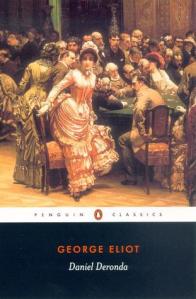
George Eliot’s Daniel Deronda & the Myth of Actaeon and Diana

Is George Eliot the most elegant writer of the nineteenth century?

Many of you have doubtless read Middlemarch, her superb novel about provincial life.  Some of you may have been introduced to Eliot in high school by  Silas Marner, her sentimental novel about a miser redeemed by a child.  Not the best introduction!

Over the years, Eliot’s books have delighted me, perhaps because I started with the best.  I read Middlemarch in an independent reading class in high school, and, then as now, identified with Dorothea Brooke, the bright, fiery, naive young heroine who marries a homely middle-aged scholar, Mr. Casaubon, because she mistakes him for an intellectual.  When I reread Middlemarch in 2010 and again in 2015 (I posted about it here), I channeled my inner good girl  as I pored over the story of Dorothea with bated breath and the crazed hope that Dorothea would not marry Mr. Casaubon.  (Do you ever hope a novel will have changed, too?  But then what would the story be?)
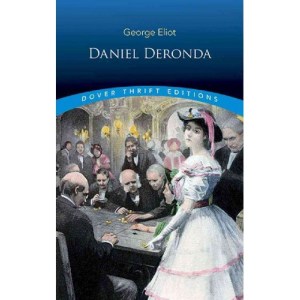
Much as I love Middlemarch, it is not my favorite Eliot, though it is a very great book.  No, I much prefer Daniel Deronda, her last novel, a strange hybrid book which is partly an inversion of the myth of Diana and Actaeon, partly the story of a man’s search for identity and his study of Judaism.

The heroine of Daniel Deronda, Gwendolen Harleth, is a spoiled, haughty young woman who marries the wrong man. Gwendolen is over-confident, beautiful, witty, snobbish, and rather lazy, and very much reminds me of Austen’s Emma. Gwendolen is accomplished, but she could be more accomplished if she practiced or studied.  She wins a golden star at an archery contest, but the golden arrow goes to someone else. She is a pleasing singer but hasn’t practiced enough to be proficient. She is a Diana, a chaste huntress, who rides to hounds wildly, and at first seems as cruel and powerful as Diana.  When her male escort falls from his inadequate mount and strains his shoulder, she appallingly thinks it funny and has no sympathy. She does not want to marry, and dreams of doing something great. But her mother loses her money, and Gwendolyn must give up her dreams. She marries the wealthy Grandcourt beause she thinks she will be able to control him–but it is the sadistic Grandcourt who controls her.

The fraught relationship of Gwendolen and Grandcourt is an inverted reinterpretation of the myth of the struggle of Diana and Actaeon. In Ovid’s version in Book III of the Metamorphoses, Diana, goddess of virginity, archery, and the hunt, is omnipotent, while Actaeon, the hunter, is stripped of power for seeing the goddess naked in the bath . She furiously throws water at him and  he metamorphoses into a stag, who then is horribly killed by his own hounds.

Gwendolen’s arrows are less accurate than Diana’s. Grandcourt first sees her at the archery competition; he admires her beauty and wants to crush her power.  Gwendolen refuses his proposal of marriage after she is approached by his mistress, who has children, but changes her mind when her mother loses her money.  Although she marries to support her mother and sisters, she had another option: her uncle had arranged for her to be a governess to a bishop’s family. And so Gwendolen, too, has committed an immoral act.
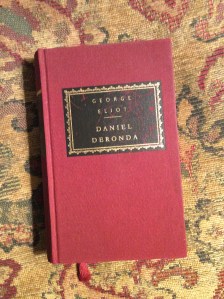
My much-read Everyman copy, with the lettering on the title fading.

Grandcourt restricts her social contacts and isolates her, forbidding her to develop a friendship with Daniel Deronda and ordering her not to invite her mother for a visit.  Gwendolen/Diana is slowly reduced from huntress to hunted.

Eliot writes,

Of what use was the rebellion within her? She could say nothing that would not hurt her worse than submission. Turning slowing and covering herself again, she went to her dressing-room. As she reached out the diamonds it occurred to her that her unwillingness to wear them might have already raised a suspicion in Grandcourt that she had some knowledge about them which he had not given her. She fancied that his eyes showed a delight in torturing her. How could she be defiant? She had nothing to say that would touch him—nothing but what would give him a more painful grasp on her consciousness.

Grandcourt has many dogs.  They dote on him, but he is indifferent, sometimes cruel.  Gwendolen observes,

“He delights in making the dogs and horses quail: that is half his pleasure in calling them his,” she said to herself, as she opened the jewel-case with a shivering sensation.

“It will come to be so with me; and I shall quail. What else is there for me? I will not say to the world, ‘Pity me.'”

Finally, Grandcourt manages to isolate her completely on a sailing trip off the coast of Italy. She is more trapped, more confined, than she has ever been on land.

But water conquers Grandcourt, as it conquers Actaeon.There is an accident, and Grandcourt  falls into the sea.  There is one moment,  Gwendolen later relates to Daniel,  when delayed throwing him the rope, paralyzed, though whether or not this would have made any difference we do not know. (Daniel says it would not.)  Guiltily, she jumped into the sea after Grandcourt. She is rescued; Grandcourt drowns.

Water killed him, but was his drowning her fault?  She believes it is.   If indeed she killed him, as she fears, the motive was her freedom, not his money:   she already knew the money would go to Grandcourt’s mistress and son if she did not produce an heir.

Diana, too,  uses water to kill Actaeon.  Here is a literal translation of Diana’s reactions (Metamorphoses III.188-190)

Though she wished she had her arrows at hand,
she took the water which she had and threw it in his virile face,
sprinkling his hair with avenging waters…

… ut vellet promptas habuisse sagittas,
quas habuit sic hausit aquas vultumque virilem
perfudit spargensque comas ultricibus undis…

Eliot’s novel is in many ways a feminist realist retelling of the myth of Diana and Actaeon. Water can be treacherous; water can be death or rebirth.    Gwendolen’s doppelganger, Mirah, the talented Jewish singer, also wrestles with water:  she is saved by Daniel from suicide by drowning.  Which heroine do we prefer?  The sinful, shattered woman who withholds the rope, or the sinful, shattered woman who tries to obliterate herself because of poverty and solitude? Curiously, Mirah, who as had a much harder life, is portrayed as almost too pure and goody-goody to be true.  Gwendolen is entirely human.  A brilliant, fascinating novel.
A Little Fanfare: Four Books You May Have Missed in 2017

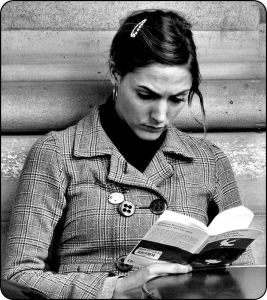
An intense commuter-reader!

No one has time to read everything.  If you work full-time, perhaps you read 50 books a year.  And that’s if you manage to read on the bus or the subway.

After  a certain age, I wanted to emulate Thomas Hardy, who, I believe, spent six hours reading every night.  And the more I read, the fussier I became.  In my forties, it seemed that either (a) much worse books were suddenly being published, or  (b) my taste was so honed that fewer books passed my standards.  (N.B.  The less exhausted you are when you read, the pickier.)

Here’s the good news:  I have read some outstanding new books  in 2017. And here’s some curious news:  I happened upon some stunning new books that were published with little fanfare. So here are four great finds you may have missed in 2017.

GENRE:  LITERARY FICTION/FANTASY.

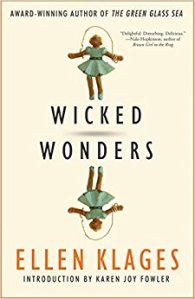
Ellen Klages crafts one perfect sentence after another in her  dazzling new collection of short stories, Wicked Wonders.  Published by Tachyon, a small press in San Francisco, this extraordinary collection is introduced by PEN/Faulkner Award winner Karen Joy Fowler.   Klages has a reputation for eclecticism:  she won the Nebula Award in 2005 for her novelette “Basement Magic” and the Scott O’Dell Award for Historical Fiction in 2007 for her Y.A. novel, The Green Glass Sea.  This pitch-perfect, genre-crossing collection demonstrates her diverse gifts:   magic realism, retold fairy tales, and some smart homages to Ray Bradbury’s brilliant work.   (You can read my entire post here.)

GENRE:  HISTORICAL NOVEL/POP FICTION

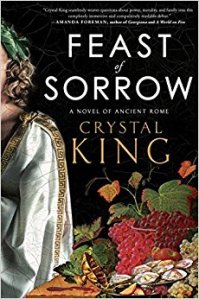
Crystal King’s clever, entertaining historical novel, Feast of Sorrow, was my favorite pop fiction read of the year.  Set in ancient Rome in the first century A.D., it is narrated by the slave Thrassius, who is the gourmet cook (coquus) for the household of  Apicius, a Roman gourmet after whom an actual Roman cookbook was named.  In King’s  novel, Thrassius is the author of the cookbook, though  Apicius takes credit for it.  It is great fun to read about the dinners (cenae), but there are also fascinating political intrigues and personal feuds. And King is a witty writer, she creates  believable characters,  and has a great sense of humor.  The pages fly.

  GENRE:  LITERARY FICTION/FANTASY

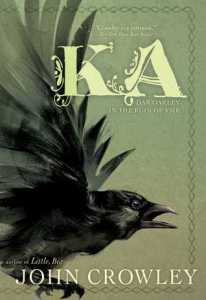
The award-winning writer John Crowley’s new novel, Ka: Dar Oakley in the Ruin of Ymr,  is brilliant and beautiful, a perfect book for  lovers of myths, legends, and epic poetry.  In this novel about a  crow who learns human language and steals immortality,  there are allusions to Dante and Virgil.  On one level,  I love the bird’s-eye view of history, and the mythic journeys of the crow Dar Oakley over 2,000 years.  On another level, it explores the meaning, or lack thereof, of  life and death.  And the crow’s autobiography is occasionally interrupted by a dying human narrator,  who is reconstructing the story from his own conversations with Dar Oakley.  I found this an enthralling read, really hypnotic.  It reminds me slightly of Kazuo Ishiguro’s literary fantasy, The Buried Giant.  You can read my entire post here.

GENRE:  NONFICTION/CLASSICS/LITERARY CRITICISM/WOMEN’S STUDIES

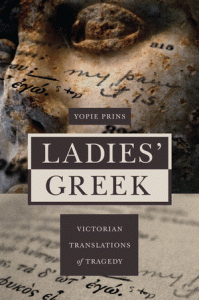
The best nonfiction book I read this year was Yopie Prins’s  Ladies’ Greek:  Victorian Translations of Tragedies.  It is the story of Victorian women writers, poets, and classicists who fell in love with Greek and translated tragedies, among them Elizabeth Barrett Browning, Virginia Woolf, H.D., Amy Levy, and Edith Hamilton.

Elizabeth Barrett Browning was very keen on Greek, and the phrase “lady’s Greek”  comes from her  novel/poem, Aurora Leigh.  The heroine of the poem, Aurora Leigh, is a passionate reader of Greek who hopes to become a  poet.  Her cousin Romney, who proposes to her on her 20th birthday  cannot resist teasing her, i.e., denigrating her education.  He mocks her Greek marginalia in a book of poems.

I adored this book, and recommend it to anyone who is interested in the education of Victorian women and the role they played (or were allowed to play) in reading and promoting classics.   You can read my entire post here.

Finally, what books do you think were overlooked or underreviewed this year?  I love lists…

Literary Links: Frankenstein, L. M. Montgomery, & More

I have read some excellent bookish pieces online lately!  Here are the links:

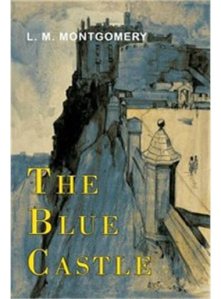
1.   I love L. M. Montgomery‘s Anne of Green Gables series, but did not read her other books.  And so I was intrigued by this excellent essay at Tor on Montgomery’s adult novel, The Blue Castle.

Mari Ness writes,

The Blue Castle is the story of Valancy, who lives a life that makes the word “repressed” sound positively liberated. In her late 20s, she lives with her mother and her aunt in a life of relentless sameness and repression, unable even to read novels, choose the decorations for her own room, purchase her own clothing or attend a church of her choosing. Part of this stems from her family, who as individuals and en masse shredded her self-confidence, but part of this is also her society: a society that sees only one fate for women, marriage. And Valancy does not have the money or education or self-confidence to escape this.

This was a reality that Montgomery knew well from her own experience—apart from the self-confidence part. Well aware that she would inherit little or nothing from her own extended family and financially shiftless father, Montgomery realized early on that she had very few financial options other than marriage. Her extended family paid for full educations (and the occasional trip to Europe) for sons, but not for the ambitious Montgomery, who paid for her one year at college by saving up money by staying in terrible boarding houses while teaching and with a small sum from her grandmother, who apparently wanted to help equip her then-unmarried granddaughter for later life.

I will check this out.

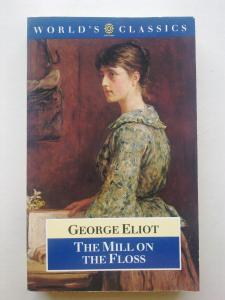
2 Do you love George Eliot?  I enjoyed Rachel Vorona Cote’s essay at Literary Hub,  “Justice for Maggie: On George Eliot’s Most Underrated Heroine.”

In this plug for the heroine of The Mill on the Floss, Cote writes,

I’m always on the watch for Too Much Heroines—women who, in the face of patriarchal dictates, cannot or will not contain themselves emotionally, sexually, physically, or intellectually. A heroine like Maggie Tulliver, one who, over the course of her life, is considered too clever and impetuous and exuberant, commits the gravest of crimes: she occupies space explicitly denied to her. Maggie emotes with lavish immoderation; reads everything her brother does, and exponentially more; and, as a child, thwarts attempts to render her a dainty specimen of girlhood. In other words, she demonstrates a fundamental aversion to gender conventions. You might reasonably compare her to Catherine Earnshaw, minus the sociopathy, or to Anne Shirley, sans the preoccupation with storybook romance, or even call her a Victorian Ramona Quimby.

My favorite Eliot heroine is the difficult, proud Gwendolen Harleth in Daniel Deronda.  Who is yours?

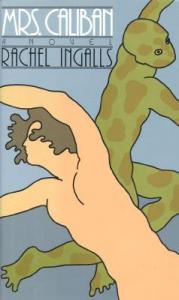
3  One of my favorite books, Rachel Ingalls’ Mrs. Caliban, has been reissued by New Directions. The heroine of this sad, witty, moving novel is  Dorothy Caliban, a desolate housewife who falls in love with a monster, Larry.  Wouldn’t you have given refuge to an amphibious monster on the run from a research lab, too, if your child had died and your husband was cheating?  Poor Dorothy!

Jean Zimmerman writes at NPR:

This season’s secret weapon in literary cocktail banter will be Mrs. Caliban, a peculiar but wonderful and long-overlooked novella by Rachel Ingalls. Originally published in 1983 and seemingly doomed to a dead end ride on the oblivion express, Mrs. Caliban was briefly rescued by an unlikely deus ex machina: The British Book Marketing Council, which in 1986 named it “one of the 20 greatest American novels since World War II.” Its 15 minutes in the public eye ended quickly enough, and this strange, unlikely fable once again sank into obscurity.

Read it as a monster novel, or as a parable.  We Are All Mrs. Caliban!  (That makes no sense, but I can imagine the words on a sign on a protest march.)

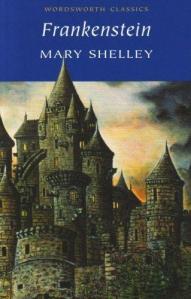
4  Did you know that 2018 is the bicentenary of Mary Shelley’s Frankenstein?  At NPR I read a fascinating review of Christopher Frayling’s new book, Frankenstein: The First Two Hundred Years.

Genevieve Valentine writes,

Half scholarly study, half art book, The First Two Hundred Years offers some great details about the story’s blockbuster success on the stage, and you-know-this-one glimpses of the movie versions of everyone’s favorite monster. But it spends the bulk of its energy on the moving pieces behind the novel itself. Mary Shelley introduced her tale in the famous story contest with Lord Byron and her husband Percy in a villa outside Geneva one dark and stormy night, but beneath it was a sea of contributing factors: Her research into galvanism, her parents’ social views, the landscape of their journey, and her own inner strain (as big a demon, Frayling suggests, as anything in their horror stories).

I do love Shelley’s Frankenstein and this book sounds fascinating.  The cover of Grayling’s book is so hideous, though, that I went with an image of Shelley’s novel.

Happy Weekend!

The Habit of Living Indoors: Are Narcissists the Best Writers?

Do you have to be a narcissist to be a good writer? Or a bad writer, for that matter.

For many years I eked out a living as a freelance writer. I scribbled book reviews, features, and PR at a rapid rate. I bubbled over with thousands of words a week, enjoying writing frivolous, fun pieces.  Alas, most of the articles were ephemera, and  I have hung on mostly to the reviews and pieces about writers.  But reviews are not lucrative:   I had to fund my habit of living indoors.

Books were my life and still are, but I have never written seriously about books. If only I’d been prettier, more charming, more political, perhaps I’d have been more successful…but I suppose I would not have liked that prettier, more charming, more political person. In that respect, I am narcissistic.   I often felt like Jo in Little Women, enjoying my blood-and-thunder stories but haunted by money worries and patriarchal disapproval–Jo/Kat’s not a serious writer! I stopped writing in my free time.   All I really wanted to do was read.

When I was 18 or 19 I was sure I’d write a novel someday–when I felt like it!  The first novelist I met, outside of a fiction writing class, was a friend’s handsome, pretentious boyfriend. I was awed that he had  finished a novel, and eagerly started to read his manuscript. He was very smart… but his prose was bombastic and unpublishable.   One sentence has stayed with me: “Even the crack of dawn made him horny.”

At that age, I had more talent than I have now.  Words unselfconsciously flowed from my pen in my free time, between classes, work, and a late dinner with my boyfriend.   One evening, when a friend and I were studying for an exam for a core psychology class we’d rarely attended and bought lecture notes for at the Union, she took time off from reading about lab rats to riffle through my desk drawers.  Why didn’t I finish my brilliant novel? she demanded after half an hour.  (There wasn’t much there.)   “Well, it’s not a novel,” I tried to explain. Fiction was not my forte.  If it was, I’d have written it.  I specialized in short ephemeral articles, and now in a blog that is really just a journal of my reading!

I did write one novellla, at a rapid pace. To show how little writers know themselves,  I was not aware of the kind of book it was till I finished.   I had aimed for literary fiction, but it turned out to be women’s fiction.  One day I may go back and revise, tighten the plot, lengthen the book, and make the characters more likable.   But the project doesn’t interest me that much.  I would rather read…

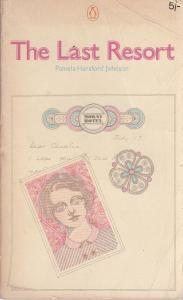
 I have recently mused about the writer characters in Pamela Hansford Johnson’s superb novels.   In her books, writers are divided between the sane and sensible camp and the narcissists.   In The Last Resort (which I wrote about here), the lovely narrator, Christine, is a successful novelist, a happy wife and mother.  At weekends spent writing at a hotel, she sees a friend made very unhappy by an affair with a married man.  And after the man’s wife dies, he marries someone else.  It is a shattering scene.

And in Johnson’s brilliant Helena trilogy, her masterpiece, which I last wrote about here, the narrator, Claud Pickering, is a writer and an art historian with a deep understanding of his dysfunctional family, especially of his narcissistic stepmother, Helena.  He is one of the sanest and most responsible of characters, a cross between Charles Ryder in Evelyn Waugh’s Brideshead Revisited and Nick Jenkins in Anthony Powell’s A Dance to the Music of Time.  Claud is the kind of guy you want to spend time with.

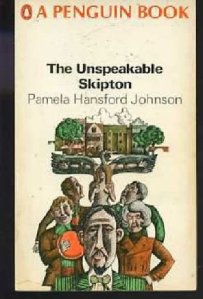
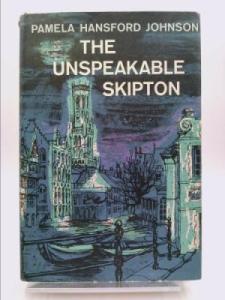
But in Johnson’s hilarious Dorothy Merlin trilogy, which I chortled over last weekend, the writers are all ridiculously narcissistic. In the first book in the trilogy, The Unspeakable Skipton, we learn that the hero Daniel Skipton believes he is the best writer of his generation. He hustles a bare living in Bruges by  exploiting tourists with various scams, but his life is writing his new novel, his masterpiece, in an attic in a mouldering house.  Unfortunately, he libels so many people that the book is unpublishable.  And he has so little sense that he even satirizes his publisher, who kindly sends advances money on books they both know Daniel will never write.

But, narcissistic and malicious as Daniel is, he genuinely loves writing.  Johnson describes his touching enjoyment of the routine.

Having had his lunch and rinsed out a pair of socks (he had only two pairs and always kept one in the wash), he took his manuscript from the table drawer, ranged before him his three pens, one with black ink, one with green and one with red, and sat down to the hypnotic delight of polishing. The first draft of this book had been completed a year ago. Since then he had worked upon it every day, using the black pen for the correction of simple verbal or grammatical slips, the green pen for the burnishing style, the red for the marginal comment and suggestions for additional matter….  It was not only a great book, it was the greatest book in the English language, it would make his reputation all over the world and keep him in comfort, more than comfort, for the rest of his life.

Daniel Skipton is not the only narcissist in the trade. His rival, Dorothy Merlin, a poet/playwright who visits Bruges with her husband, Cosmo Hines, and two friends, has an inflated opinion of her own drama in verse about wombs and motherhood, which was staged as a multi-media production in London.  When she informs Daniel that her plays have to be read “on two levels,”  he is very annoyed, because he believes his own work is deeper and  should be read on seven levels!  She says,”You see, the womb in my verse is not just my womb.  It is the womb of everyone.”  And she compares herself to the Flemish painters who add scenes of domestic life behind the Madonna.

This is the kind of narcissism we love to laugh about.  Are  writers like this in real life?  Well, perhaps I’ve  met one or two, but the majority are very kind and generous.  Writers are no more alike than, say, lion tamers or Wal-Mart cashiers. Yes, they tame the lions or punch the cash register keys, but it is their bookishness that unites them at any party in a room full of geeks scanning bookshelves.

Writers Living Cheaply: Pamela Hansford Johnson’s “The Unspeakable Skipton”

I spent the weekend in bed with a bad cold. You know the kind of thing:  there is much coughing and dizziness, you feel you might faint in line at the store,  and the cold/flu/whatever hangs on forever. (After two weeks, go to the doctor.)  It is the kind of cold which, I assure you, will be exacerbated by a cheerless masterpiece by Dostoevsky.  No, you must turn to light reading.

The eclectic English writer Pamela Hansford Johnson did not specialize in light novels, but her Dorothy Merlin trilogy is hilarious.  The first of these satires of the writing life, The Unspeakable Skipton, focuses on a narcissistic novelist/con man; the second, Night and Silence Who Is Here, is an academic satire; and the third and best, Cork Street, Next to the Hatter’s, features Dorothy Merlin, a pretentious poet/playwright, holding court in her husband Cosmo’s bookshop, along with other artistic Londoners.  By the way, these can  be read as stand-alones.

The Unspeakable Skipton is potentially a cult classic–if anyone knew about it. I chortled over this short, witty, very weird novel about the vanity of a novelist/huxter hero, Daniel Skipton, who does nefarious odd jobs to afford a cheap garret in Bruges, “in one of “the last of the patrician houses,” as he says.   He has fallen in love with the beauty of Bruges.

Yes, he thought, this was the place for him and none other: he would die here.  He had come to live in Bruges for cheapness at the end of the 1920s:  had muddled through and out of the war by means of ill-health and broadcasting in Flemish for the BBC, and had come back not for cheapness, since the country was bloated with money and everything was dear, but because he could not bear to live anywhere else.  And, so long as Flabby Anne kept up her payments, he could just about get along.

Skipton believes he is the greatest writer of his time, but his tiny output of 250 words a day, many of them libellous, belies his opinion.  He is a paradoxical mix of personal priggishness and con artist: he wears socks with individually knitted toes because he thinks it’s obscene for toes to touch, but is not at all fastidious about finance.  He  hustles advances from his publisher for imaginary projects and cadges money from a cousin he’s never met, whom he calls Flabby Anne. He also procures fake antiques for a dealer and organizes voyeuristic parties to view obscene skits in mime.

At the center of the book is Skipton’s chance meeting with a group of literary tourists and his attempts to dub them out of money: Dorothy Merlin, a poet/playwright, her husband, Cosmo, a bookseller, Duncan, a photographer, and Matthew, a mysterious aristocrat. He’s equally matched here, however, and underrates his opponents, particularly Dorothy’s husband.

Skipton despises Dorothy, who writes poetry about her fecund womb–she has had seven children–but she cares nothing for his opinion,  and the contretemps between the conceited pair is hilarious.

“I am alien to you,” said Daniel, “utterly so.  I do not sing in chorus.  I do not rattle out, in a half-baked fashion, the Freudian claptrap which has been so successful because any dirty-minded dunce can understand it. Not that I am accusing you, Miss Merlin, of being dirty-minded. Where no mind exists, it is impossible for there to be either dirt or cleanliness.”

She said with dreadful charity, “I don’t think you can be well.  Do let us help you.  I’m not in the least offended with you, I–“

Very, very funny, and I look forward to rereading the other two shortly.  This is very short, only 192 pages.  Just enough of Skipton!  A little of him goes a long way.  I prefer Dorothy:  she’s a snob but not a scam artist!

A Catch-up Post: Isabel Allende’s In the Midst of Winter

I am  sick with a cold. Propped up on pillows, coughing and sniffling, binge-watching Halt and Catch Fire on Netflix,  I try  to ignore the chaos in the bedroom.  There are three tea cups, a headless Jo/Little Women figurine (knocked on the floor by a curious and very wild cat), and a box of Kleenex on the bedside table.  An untidy stack of paperback mysteries and a review copy of an intellectual novel I rashly promised to blog about are on the bed. (Do I ethically have to review it?) My favorite cat has overturned the wastebasket and is delicately ripping the Kleenex. Another cat has shed white hair all over the nest of an old black sweater. I am overwhelmed.  I am too sick to clean. Nobody will clean if I don’t clean.   How can I clean if I can’t breathe?  Finally I drag myself  to the doctor and get some antibiotics.

While I wait for the antibiotics to kick in, I must catch up with a “review-ette”of Isabel Allende’s lovely new novel, In the Midst of Winter.

The Chilean-American novelist Isabel Allende is a dazzling writer, and her translators serve her brilliantly. As a best-selling writer Allende has straddled a fine line between literary and popular fiction, thrilling readers with her graceful style and riveting stories, and earning the praise of critics.  In her famous first novel, The House of the Spirits, she astutely blended magic realism with history in the breathtaking story of three generations of a prominent family in an unnamed Latin American country.

But not all her books utilize magic realism. Her last novel, The Japanese Lover, was realistic, and so is her latest novel.  In her new gorgeously-written novel, In the Midst of Winter, translated by Nick Caistor and Amanda Hopkinson, she deftly interweaves the complex narratives of two Latin American women and an American man, shifting back and forth in time between the present and the 1970s.

The book commences during a blizzard that shuts down New York.   Sixty-two-year-old Lucia, a visiting lecturer at NYU from Chile,  is freezing in the basement apartment of a brownstone in Brooklyn, cuddled up with Marcelo, her Chihuahua, and wondering why the hell Richard, her landlord and boss at NYU, is so miserly? Couldn’t he turn up the heat?  To be honest, she had thought that, old friends that  they were, they would keep each other warm as lovers.

Lucia is a warm, optimistic woman who still hopes to find love, despite her husband’s desertion of her when she was diagnosed with breast cancer, the recent loss of her mother, and the decades-old anguish over her brother’s disappearance  after the 1973 coup in Chile.

There are few older heroines in literature, and Allende captures the imperfections that we women are taught to ignore but must learn to accept.   Most important, Lucia knows how to love herself.

 Lucia still entertained the fantasies of a young girl despite the fact that she was almost sixty-two. She had a wrinkled neck, dry skin, and flabby arms; her knees were heavy; and she had become resigned to watching her waist disappear because she did not have the discipline to combat the process in the gym. Although she had youthful breasts, they were not hers. She avoided looking at herself naked, because she felt much better when she was dressed. Aware of which colors and styles favored her, she kept to them rigorously and was able to purchase a complete outfit in twenty minutes, without ever allowing curiosity to distract her. Like photographs, the mirror was an implacable enemy, because both showed her immobile, with her flaws mercilessly exposed. She thought that if she had any attraction, it lay in movement, for she was flexible and had a grace that was unearned, since she had done nothing to foster it. She was as sweet-toothed and lazy as an odalisque…

Richard,  the human rights professor who can’t turn up the thermostat, is a piece of work.  He  is very handsome and kind, but very uptight, an absent-minded cat owner who does everything on a rigid schedule, because he is afraid of falling back into alcoholism.   He does not want to take any emotional risks, because he ruined lives when he did that before.  He has a horrendous past, which we learn about later.

Richard and Lucia become closer under tragic circumstances.   Richard calls Lucia for help after his car collides with a Lexus driven by a Guatemalan women, Evelyn Ortega, an undocumented worker/nanny who has borrowed her boss’s car–and she is hysterical because there is a corpse in the trunk!  She doesn’t know how it got there.   Richard needs a translator, and it is Lucia who pulls everything together. She and Richard devise a plot to save Evelyn and get rid of the car and body,  and during a harrowing road trip to upstate New York, the three become friends.  Despite the horror of the past and the present, there are many comic moments, and Lucia and Richard finally have no choice but to share a bed.

Allende creates real living, breathing characters, and we care deeply about them.  The details of the violence in South America are horrifying and very real, and reading about Evelyn’s grueling journey across the border led by a “coyote” makes you want to protest all over again that terrible idea of building a wall!  Allende has devoted a lifetime to telling the stories of Latin American women and helping refugees.  She witnessed the violence of  the military coup in Chile in 1973, when  her cousin Salvador Allende, president of the socialist country, was ousted by Gen. Augusto Pinochet, who instituted his dictatorship.  She and her family fled to Venezuela in 1975 .  She has been an American citizen since 1993.

Anyway, In the Midst of Winter is tragic but also full of joie de vivre.   I plan to give it to various women friends of different tastes, because everyone will love it.   My only criticism?  The ending works out a tad too well, like Barbara Kingsolver’s early books. But I was spellbound by this brilliant, moving novel.

Lysistrata Deconstructed: A New War of the Sexes

Do we want to wake up every morning and read a list of liberal men accused of sexual harassment?

Sorry, it gets ridiculous.

Here’s where I draw the line:  Garrison Keillor.

Yes, I have my sexual harassment stories, of course, but how can Keillor be fired before the investigation of harassment?   I hate Twitter, and would never post at #metoo, but before I proceed in this partial defense of famous men, let me share my worst story.  Call it #whohasn’tbeen?

I was at a job interview.  I sat for an hour in the waiting room.  I was told to pop across the street for a physical, because the interviewers were too busy to see me yet.  The doctor listened to my heart, lungs, etc.  And then suddenly my shirt was off and he told me to run in place.   Before I left he said, “Let’s keep this between ourselves.”

I felt disconnected and rattled, to say the least.  I  didn’t mention the physical, because it was not the kind of thing you chat about at a corporate interview.

Was I surprised that I didn’t get the job?

After this incident, I became a master of the word “No.”  It is very effective.

The daily reports of sexual harassment began in October in Hollywood. Yes, sexual harassment abounds in Hollywood.  No surprise there.  I’ve always understood Hollywood is founded on sex.  Youth, beauty,  breast implants, plastic surgery, tight abs, waxed chests…  With all this, I’m amazed there’s talent, too.

Hollywood is so far removed from the realm of my experience that I paid little attention to the accusations until the newspapers began to go after writers.  I do know writers.

For instance, Glenn Thrush, a New York Times reporter in Washington, was fired after he was accused of sexual harassment, i.e., groping young women colleagues at bars.  Let me get my head around this.  There’s a lot of groping at bars.  And so he lost a book deal with Random House:  he and a female colleague had a contract to write a  book about Trump.   The women who complained, as I understand it, were able to fend him off.  Surely the corporation should have issued a warning  before firing him.

Which begs the question: Should a person be fired for being an asshole?  If that’s the case,  I have a long list.  But the problem is, some assholes are talented, smart, and powerful.   In a strange way, they are our friends; they are allies.  Not personal friends, but fellow friends of  literature, or friends of art, or friends of democracy.  You don’t have to like all your friends.

Every day, there are many new names.  So many names.  Yesterday it was 78-year-old John Casey, the National Book Award-winning author of Spartina and a professor emeritus at the University of Virginia.   A young MFA graduate  said he inappropriately touched women on the shoulders, back, and even the butt at readings.  Ms. X, I don’t know if your accusations are true, but that generation of men is like that. They were not raised by feminists.   My advice:  Frown, move away, move their hand away,  say No, and that will probably do the job.   He’s a great writer.  Don’t take that away from us.

And today another old man, Garrison Keillor, 75,  the humorist, writer, and creator of A Prairie Home Companion, has been fired by  Minnesota Public Radio.  He is under investigation because of a colleague’s accusation.  MPR has banned The Writers’ Almanac and reruns of A Prairie Home Companion.  I am not a fan of A Prairie Home Companion, by the way, but whatever the accusation, it should be illegal to fire someone before the investigation is concluded.

And don’t you think the Republicans are thrilled to see the Left divided, and their liberal opponents in the media crushed?  The lists distract from the destruction of our society and our country.  And the attention is focused on sex, instead of the very important elections and egregious destruction of our country.

Obviously, we need better sexual harassment training and assertiveness training in the workplace. But, more important, we need to elect liberal/radical women in politics, fund Planned Parenthood t, keep abortion safe and legal, assure equal pay for equal work, reverse climate change…

That list goes on.

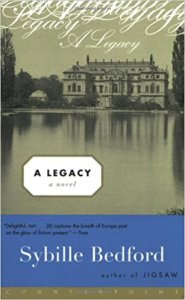
A Giveaway of Sybille Bedford’s A Legacy

Would anyone like my extra copy of Sybille Bedford’s A Legacy?  She is a stunning novelist and memoirist:  I blogged about her novels A Favorite of the Gods here and A Compass Error here.  Then I inexplicably lost my copy of  A Legacy, and, after ordering an inexpensive copy, I found the original.  So often the way.

Do leave a comment if you’d like it!  You can read the Goodreads description of this well-reviewed novel  here.

Pamela Hansford Johnson & a New Biography

The brilliant 20th-century writer Pamela Hansford Johnson has fallen out of fashion.  Her books are out-of-print in the U.S.

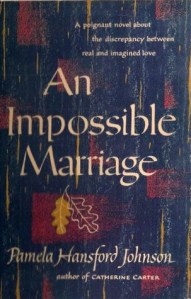
But I am an ardent fan.  One winter day in 2009, while browsing at a university library, I found a copy of her novel,  An Impossible Marriage. I admit, I’d confused her with Pamela Frankau, but the error was serendipitous.  I scrawled later in my book journal:

I started reading Johnson’s An Impossible Marriage in the car and continued to read it till bedtime. Fascinating Virago-like material, the story of a strong-willed, intelligent young woman who knows enough to dump a young man with whom she is sexually compatible but not emotionally;  but then makes the same mistake with a beautiful man 14 years older than herself. That whole experience of falling in love at first sight: can that ever turn out well? The horror: it usually involves falling for someone one believes  superior to oneself (and groveling ). Johnson describes the affair with compassion and insight.

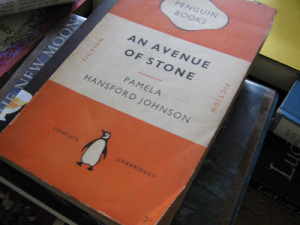
Since then, I have read 19 of her 27 novels.  I especially love the superb Helena trilogy (which I blogged about here), Too Dear for My Possessing, An Avenue of Stone, and A Summer to Decide.  In these witty, elegant, addictive novels, the narrator,  Claud Pickering, an art historian and writer, describes his fraught relationship with his histrionic stepmother, Helena, from boyhood through middle age. The cast of characters is so vivid that one day I absent-mindedly chatted about them at the dinner table, as if they were my friends.

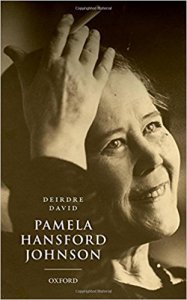
And, lo and behold!  I was reading a book by Johnson when on Nov. 3 the TLS ran a review of Deirdre David’s new biography, Pamela Hansford Johnson:  A Writing Life.  (And that’s why it’s dangerous to read the TLS: too many fascinating books.)

Miranda Seymour writes,

Despite the fact that Pamela Hansford Johnson is now the subject of three biographies – of which Deirdre David’s is by far the most insightful – this once celebrated writer remains an intriguingly neglected figure. Most admirers of This Bed Thy Centre (the debut novel with which Johnson sparked a sensation in 1935, at the age of twenty-three) and The Unspeakable Skipton (1959; a maliciously witty account of literary skulduggery and lofty pretensions, set in Johnson’s beloved Bruges) might struggle to recall the titles of others of her novels. It comes as a surprise to learn that there are twenty-seven of them. Most are out-of-print.

My copy of the biography arrived in the mail today.  I haven’t shrieked so much since I found the huge Liddell and Scott Greek dictionary in a musty used bookstore.

I do hope it’s worth it!

More later.

The Penguin Women Writers Series & Forgotten Women’s Books We Love

 We love Virago, Persephone, and the Feminist Press–and now Penguin is publishing a Women Writers Series!  I read in The Guardian that the Booker Prize-winning writer Penelope Lively and Booker-shorlisted writer Kamila Shamsie chose the first four titles.

Lively selected two of my personal favorites, Mary McCarthy’s 1971 satire, Birds of America, which  skewers both American innocence and hypocrisy at home and abroad, and E. Nesbit’s adult novel, The Lark, a charming comedy about two women who start a flower business.  (I wrote about these two novels here and here.)  And Kamila Shamsie recommended two books I look forward to reading, Sara Suleri’s Meatless Days, a memoir, and Ismat Chughtai’s Lifting the Veil, a collection of essays.

Reading the article made me think about great women’s books I’d like to see revived.

I love Nancy Hale:  her engrossing  novel Dear Beast (1959),  a kind of tougher American version of D. E. Stevenson’s Miss Buncle’s Book; and her two brilliant memoirs, A New England Girlhood, about growing up the daughter of two artists, and Life in the Studio, a memoir of her parents inspired by the relics she found while clearing out their studios after their deaths.

Hale was the first woman reporter for The New York Times and a frequent contributor of short stories and autobiographical pieces to The New Yorker.  She was the daughter of two painters, Philip L. Hale and Lilian Westcott Hale; the granddaughter of Edward Everett Hale, author of The Man Without a Country; the great-niece of Harriet Beecher Stowe (Uncle Tom’s Cabin) and Lucretia Peabody Hale (The Peterkin Papers); and a descendant of Nathan Hale.  All her books are out-of-print.

And I know you-all read a lot of women’s books, too.   What books merit a second look?