When Everything We Read Applies: Trollope’s The Way We Live Now and Cicero’s Pro Archia

“For unless I had convinced myself from my earliest years, on the basis of lessons derived from all I had read, that nothing in life is really worth having except moral decency and reputable behaviour, and that for their sake all physical tortures and all perils of death and banishment must be held of little account, I should never have been able to speak up for the safety of you all in so many arduous clashes, or to endure these attacks which dissolute rogues launch against me every day.”
—”Pro Archia,”  from Selected Political Speeches by Cicero (Penguin)
It has not been the happiest of spring breaks. Spring turned into winter, and we didn’t get out much.  Oh, well, I had the opportunity during the cold snap to reread Cicero’s Pro Archia and Anthony Trollope’s The Way We Live Now.

And here’s a bracing discovery.  Everything I read, from Cicero’s defense of a Greek poet’s Roman citizenship to Trollope’s satirical novel The Way We Live Now, applies to the political situation.  Naturally, the disgraceful political events in Washington D.C., if indeed our nation’s capital is still there and not at the Mar-a-Lago resort in Palm Beach, are at the back of our minds.  It’s not exactly comforting, but it’s obviously true that such struggles are centuries old.

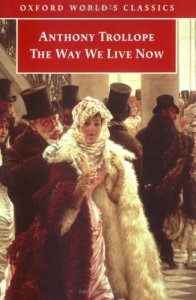
I know that many of you have read The Way We Live Now by Anthony Trollope, and indeed I wrote a short post about it in 2014.  According to the introduction of the Oxford edition by John Sutherland, Trollope wrote this superb satire in reaction to the dishonesty and corruption he observed in London when he returned after a year and a half in “the colonies.”

Trollope’s delineation of the  relationship between financial scams and politics is still very pertinent. The villain, Mr. Melmotte, a financier, floats a fraudulent railway company by selling shares for a nonexistent enterprise, and not only grows richer but buys his way into Parliament.  And Trollope’s characterization of Mr. Melmotte applies to more than one politician these days.

 He knew nothing of any one political question which had vexed England for the last half century,—nothing whatever of the political history which had made England what it was at the beginning of that half century … He had probably never read a book in his life. He knew nothing of the working of parliament, nothing of nationality,—had no preference whatever for one form of government over another, never having given his mind a moment’s trouble on the subject. He had not even reflected how a despotic monarch or a federal republic might affect himself, and possibly did not comprehend the meaning of those terms. But yet he was fully confident that England did demand and ought to demand that Mr. Melmotte should be returned for Westminster. This man was Mr. Melmotte himself.

Uncannily apt, isn’t it?

And then there’s Cicero’s Pro Archia, translated in the Penguin edition of Selected Political Speeches as “In Defence of the Poet Aulus Lincinius Archias.”  I read the Latin, but the Penguin is accessible.

Here’s the background:  In 64 B. C. a law of the tribune Giaus Papius expelled non-citizens of Rome.  (Does this sound familiar?)  Cicero’s speech was written in defense of the Greek poet Archias, who was accused of not being a Roman citizen. But Cicero’s brilliant speech is best known for its long laudation of reading, rhetoric, and, in short, the liberal arts.  Without books, poetry, and the study of rhetoric, Cicero says he could not successfully defend clients.  Archias was one of his teachers.

How could I find material, do you suppose, for the speeches I make every day on such a variety of subjects, unless I steeped my mind in learning? How could I endure the constant strains if I could not distract myself from them by this means? Yes, I confess I am devoted to the study of literature. If people have buried themselves in books, if they have used nothing they have read for the benefit of their fellow-men, if they have never displayed the fruits of such reading before the public eye, well, let them by all means be ashamed of the occupation. But why, gentlemen, should I feel any shame? Seeing that not once throughout all these years have I allowed myself to be prevented from helping any man in the hour of his need because I wanted a rest, or because I was eager to pursue my own pleasures, or even because I needed a sleep!

So here’s to the power of books!  The history is there, in novels, speeches, and poetry. And life is always, always, always a struggle.
Beware the Ides of March!

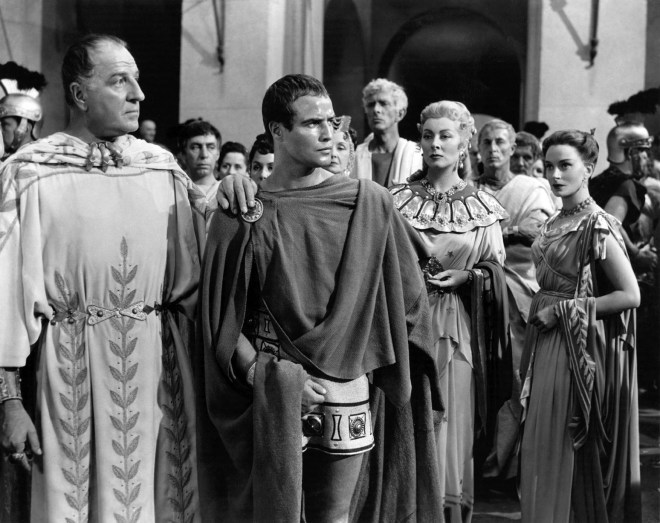
Julius Caesar (1953), with Louis Calhern as Caesar, Marlon Brando as Antony, and Greer Garson as Calpurnia.

Beware the Ides of March!

Julius Caesar was assassinated on the Ides of March (March 15) in 44 B.C.

At our house we always commemorate the Ides of March. Latin was our bread and butter, and that of many of our friends,  until we inevitably segued into better-paying professions.  At the lovely snob school where I taught, I was grammar-and-translation-oriented, but we treated this tenebrous anniversary as if it were a festival.  We drank “wine” (sparkling grape juice), played Julius Caesar Trivial Pursuit, and extra credit seekers recited 10 lines of their choice from Caesar’s Gallic War (usually a passage about the Druids, whom they weirdly loved).

Since you either don’t know or have forgotten all your Latin, here is a snippet translated by W. A. McDevitte and W. S. Bohn.

The Druids do not go to war, nor pay tribute together with the rest; they have an exemption from military service and a dispensation in all matters…. They are said there to learn by heart a great number of verses; accordingly some remain in the course of training twenty years. Nor do they regard it lawful to commit these to writing, though in almost all other matters, in their public and private transactions, they use Greek characters. That practice they seem to me to have adopted for two reasons; because they neither desire their doctrines to be divulged among the mass of the people, nor those who learn, to devote themselves the less to the efforts of memory, relying on writing; since it generally occurs to most men, that, in their dependence on writing, they relax their diligence in learning thoroughly, and their employment of the memory.

Fascinating, yes?

And since you may want to read a book or two by or about Caesar on the Ides of March, I recommend:

FAMOUS PLAYS

Shakespeare’s Julius Caesar.

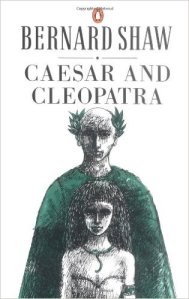
Caesar and Cleopatra by George Bernard Shaw.

BOOKS BY CAESAR:

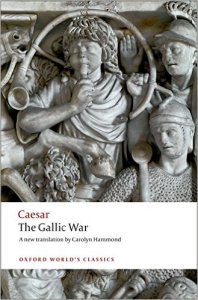
Caesar’s Gallic War, an account of his campaigns in Gaul.  Very elegant in Latin, fascinating even in English.

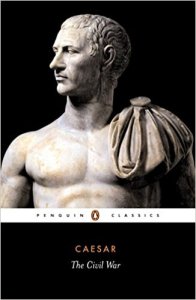
Caesar’s Civil War, an account of his struggle with Pompey to gain the leadership of Republican Rome.

NOVELS ABOUT CAESAR.

The Ides of March  by Valerio Massimo Manfredi (Europa).  This brilliant Italian historical novel is billed as a “political thriller set during the tempestuous final days of Julius Caesar’s Imperial Rome.”  And, by the way, I love Europa Editions, which publish so many remarkable works in translation.

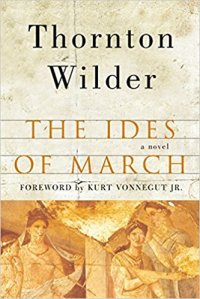
The Ides of March by Pulitzer Prize-winning playwright and novelist Thornton Wilder, first published in 1948, is billed as “a brilliant epistolary novel set in Julius Caesar’s Rome.” Honestly, I prefer Manfredi’s.

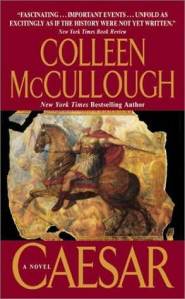
Caesar by Colleen McCullough (Masters of Rome, 5).  I’ve never read this popular series by the author of The Thorn Birds, but the Goodreads description says:  “In the long, fabled history of Rome, there was never one so beloved by so many–yet so feared and despised by lesser men whose power he eclipsed–than Gaius Julius Caesar. On the field of battle, he is invincible, and those who fight at his side would gladly give their lives for his glory. But even as Caesar sweeps across Gaul–brutally subduing the united tribes who defy the Republic–his enemies at home are orchestrating his downfall and disgrace.”

Young Caesar and Imperial Caesar, two historical novels by Rex Warner.  The latter won the 1960 James Tait Black Memorial Prize for Fiction.

HISTORIES AND BIOGRAPHIES.

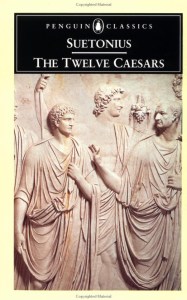
The Twelve Caesars by Suetonius.  Very entertaining short biographies  of Julius Caesar and 11 more emperors.

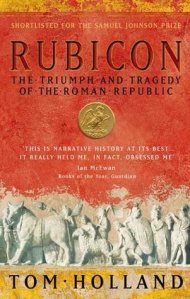
Rubicon by Tom Holland.  This compelling history is billed as “a vivid historical account of the social world of Rome as it moved from republic to empire…, [beginning] in 49 B.C., the seven hundred fifth year since the founding of Rome, [when]Julius Caesar crossed a small border river called the Rubicon and plunged Rome into cataclysmic civil war.”

And here is Casesar’s most famous tripartite sentence (the first), so savor the Latin:

Gallia est omnis divisa in partes tres, quarum unam incolunt Belgae, aliam Aquitani, tertiam qui ipsorum lingua Celtae, nostra Galli appellantur.

Tolstoy & Political Correctness

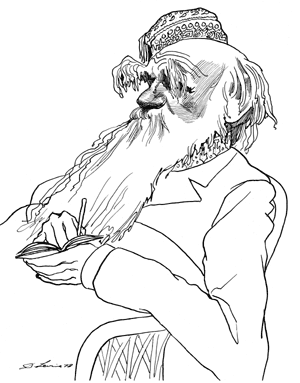
Drawing of Leo Tolstoy by David Levine (New York Review of Books)

Two English professors, Melvin Jules Bukiet and Lyell Asher, write in The American Scholar that Tolstoy is politically incorrect for students of the twenty-first century. (Was he ever politically correct?)  They say students’ exaggerated consciousness of racism, sexism, LGBT rights, etc., interferes with their ability to read and understand Tolstoy–and, in the age of trigger alerts, they  ask to be excused from class if content offends them.

Thank God they’re not teaching D. H. Lawrence’s Lady Chatterley’s Lover! (John Thomas and Lady Jane would set off trigger alerts.) But, seriously, Tolstoy is one of my favorite writers, and I pray they exaggerate students’ misreadings.

Melvin Jules Bukiet, a professor at Sarah Lawrence, recently reread War and Peace, a novel he has loved since college.  In his essay, “By the Content of Its Characters,” he writes,  “All happy writers may be alike, but nowadays they’re also different in their own special national, ethnic, racial, religious, or sexual ways. Paradoxically, they’ve become individual by category.”

Then he satirizes how Tolstoy could be misinterpreted in the trigger alert culture.

When Pierre Bezukhov, arguably the protagonist in a novel that follows scores of lives, is introduced, he is described as “fat.” Well, that’s a bit harsh, but Tolstoy created Pierre, so if he says the man is fat, he is, and I wouldn’t want a euphemistic translation like “dietarily challenged.” Fat. Fat. Fat.

He  suggests that Pierre today would be considered a pedophile because of his relationship with Natasha; that Prince Andrew Bolkonski  and Count Nicholas Rostov (Natasha’s brother), both officers in the war against Napoleon, are male imperialists;

“and the ultimate class offense finally struck me: nearly every character in War and Peace is noble.”

All right, a little satire goes a long way.

In “Low Definition in Higher Education,” Lyell Asher, an associate professor of English at Lewis & Clark College, says that he has taught Anna Karenina for more than a decade. Students often simplify this long, complex text, believing Anna is right to have an affair because of her passion, and that Karenin is an unfeeling stick figure who deserves to lose her.  They don’t see shades of gray.  (I might add, nor did I when I was young.)

Asher writes,

At more than 800 pages, Tolstoy’s saga can invite hurried reading, so a lot of class time is spent applying the brakes: “Not so fast.” “How do you know that?” “What’s it look like from her point of view?” There’s a useful speed bump in that famous first line: “All happy families are alike; each unhappy family is unhappy in its own way.” In its own way. Don’t assume you know who these people are, Tolstoy cautions, however familiar they may seem.

And he goes on to say that college administrators today encourage this over-simplified thinking.

But what happens when the administrators…—sometimes in tandem with professors who teach the courses—pretend to have so mastered the difficult questions of race, of social justice, of meaning and intention, that they feel entitled to dictate to others? What happens when they so pixelate the subject matter that what emerges is a CliffsNotes version of human experience, the very thing that a college curriculum should be working against?

What happens is that many students will accept these simplifications. Some will even cling to them for dear life. Finally a map—with shortcuts!—and a way out of bewilderment. Feeling offended implies an offense, and where there’s an offense there must be a culprit guilty of having committed it. No need to bother with the complexities of context and intention—it says here that “impact” is what matters, that how I feel is what counts. No need to wonder whether an expression of hatred is real or a ruse, isolated or endemic—assume the worst and take the part for the whole.

Well, in my day, we radical students embraced controversy, not whining, and we wouldn’t have accepted pixelated pamphlets on life.   But perhaps these students are not radicals?  Is this the common culture now?

I’m going to blame it on the internet, the way I blame everything else.

Mikhail Bulgakov’s The Master and Margarita

“Granted the circumstances surrounding its composition, and the political background of its author, one might expect this novel to be a thinly disguised attack on either Stalinism or the Revolution, but in fact, although much incidental satire on Russian life is used, any kremlinological approach to the deep creative quality of the book would be irrelevant.”
—A TLS review by Edwin Morgan of Mikhail Bulgakov’s The Master and Margarita (December 7, 1967)

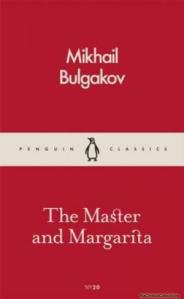
A very attractive Penguin Deluxe Classic.

I planned to reread Bulgakov’s The Master and Margarita in 2016, the 50th anniversary of its publication. I love anniversaries.  But honestly?  I didn’t enjoy it much the first time.  I’d read it during a four-day power outage:  there was much huddling on the stoop and reading while crossly waiting for the electric company trucks to arrive (we had no superstars on our street to demand “power” quickly), drives to the next town to dine in a lighted place, and the general crankiness that goes with lack of electricity.  So I decided then and there that I didn’t like Soviet literature.

Lo and behold! the TLS recently reprinted a review from 1967, and I enjoyed the reviewer’s condemnation of the “kremlinological approach”(see quote at top of post), and was persuaded to get out my old Everyman copy, a 1967 translation by Michael Glenny.  What a joy to read!

My Everyman copy: no book jacket!

Even if you know little about the Soviet Union, this satirical novel is great fun.  (I waited till after I finished the book to read the introduction).

It is a joyful read.  The language is gorgeous and bold, and there is much humor.  What’s it about?  Well, it’s hard to say.   First,  the devil, disguised as Woland, a mesmerist/professor, and his companions, including a large talking black cat, visit Moscow and terrorize writers and theatrical managers (and audiences).  The devil attacks Soviet atheism:  he assures the writers, much to their shock, that Jesus exists.

Interwoven with the fantastical narrative of Woland’s visit is a very good historical novella about Pilate and Yeshua.   Pilate is haunted by his decision to crucify Yeshua, a perfectly innocent man, who said that he was misrepresented by the muddled Matthew, a disciple who took notes but got everything wrong.

Then there is the story of Margarita, who turns into a witch after invited to be the hostess at the devil’s ball.  Her goal? To rescue her lover, the man she calls the Master, the author of the stunning novel about Pilate, who burned his manuscript and committed himself to a mental hospital.  All comes together in the end:  Woland and his sidekicks fly away with dignity having doffed their absurd human incarnations, the Master and Margarita find rest, and Pilate and Yeshua come together.

In the 1920s and ’30s, Russian writers were more and more horrifying suppressed  and discouraged from writing satire.   Bulgakov, a novelist and a playwright,  wrote The Master and Margarita secretly and gave it to his wife before he died.  It was finally published in 1966 and translated into many languages.  And in addition to Bulgakov’s  comedy and satire, he conveyed the horror and terror of a totalitarian regime:  many of the characters in The Master and Margarita are driven mad by the devil, and when they try to tell the truth they end up in  the mental hospital.

When the devil/Woland arrives in Moscow, he approaches two writers, Berlioz, a pompous editor, and Ivan Nikolayich, a poet.  As  Woland says one outrageous thing after another, they think he is a spy trying to trick them into saying something forbidden.  Here is an example of the zany dialogue.

“And what is your particular field of work?” asked Berlioz.

“I specialize in black magic.”

“Like hell you do…!” thought Mikhail Alexandrovich.

“And…and you’ve been invited here to give advice on that?” he asked with a gulp.

Then Woland claims that he is in Moscow to decipher the manuscript of a ninth-century necromancer.

“Aha!  So you’re a historian?”  asked Berlioz in a tone of considerable relief and respect….

…the professor beckoned to them and when both had bent their heads towards him he whispered:

“Jesus did exist, you know.”

“Look, professor,” said Berlioz, with a forced smile, “With all respect to you as a scholar we take a different attitude on that point.”

“It’s not a question of having an attitude,” replied the strange professor.  “He existed, that’s all there is to it.”

“But one must have some proof…” began Berlioz.

“There’s no need for any proof,” answered the professor.  In a low voice, his foreign accent vanishing altogether, he began:  “It’s very simple–early in the morning on the fourteenth of the spring month of Nisan the Procurator of Judaea, Pontius Pilate, in a white cloak lined with blood-red…”

And that is the first line of the novel about Pilate.

A classic! The novel about Pilate is elegaic, strikes a different tone.  I can’t quite put it all together:  but Pilate’s regret is a recurring theme.

Can Beautiful Books Inspire Non-Readers to Read?

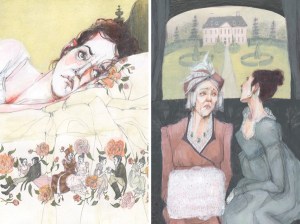
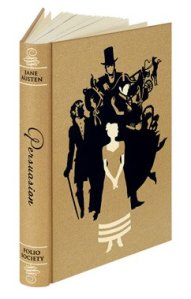
Who can resist Deanna Staffo’s  illustrations in the Folio Society edition of Persuasion?

Can readers of beautiful books inspire a reading trend among non-readers?

Well… I’m not an idealist (anymore).

According to the Pew Research Center, about a quarter of American adults (26%) last year said they hadn’t read even part of a book.

That’s bad news, but no one is surprised.

My friend Janet, my cousin Megan, and I sit outside Starbucks on a warm windy day (so windy there are wind advisories).  We’re discussing reading because we have a new project: a book-sharing project.  We three, along with relatives in Mount Pleasant, Davenport, Marshalltown, Sioux Falls, and Galena, have communally purchased classics from the Folio Society.  They’re very expensive–say, $50 to $100 a pop–but when everyone chips in, it’s not bad.

Why?  We love the paper, the beautiful covers, and the illustrations.  But we also noticed Folio Society-inspired action on a trip to Mount Pleasant last summer.

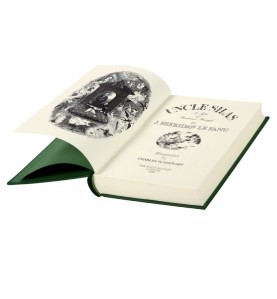
I  left my copy of Sheridan Le Fanu’s Gothic novel Uncle Silas (Folio Society) in the untidy Dickensian den of  Sue’s duplex for an hour, and when I came back her daughter, Paula, just out of rehab, was reading it. ” Beautiful book!”  she said. “Can I borrow it?”  Sue stood behind her nodding furiously and making thumbs-up signs.  Later she tried to pay me.

“No, give it back when she’s done!”

It was inconvenient, but I finished an e-book version.  If Paula tried to read the e-book , she’d be Snapchatting in a minute.  The truly f–ed up have one advantage in this world.  The rest of us frantically try to help.  It must do something for our Karma at least?

Here’s what has happened to those who have reproduced (Janet, Megan, and I did not).  The adult children have failed, they are moving home, they’re divorced, they’re in and out of rehab, can’t hold a job, don’t seem to want to much, never read, read palms, and are on their phones all day.  They went to community college or got Ph.D.s. They didn’t want to work in an office: that’s what they could do.  It’s far easier to live with Mom. (And Dad is long gone.)  Mom isn’t exactly rich.  But even in small towns they can get anything they want…

“Very rewarding, being a mom,” said Sue in Mount Pleasant.

And so we’ve got the Folio Society thing going on.

Is it a success?

Who could possibly not want to read this edition of Persuasion?

I have read Persuasion many times, but it enhances the reading of Persuasion.

Does the Snapchat generation read Persuasion?

Did Facebook, etc., mess them up too much to read Persuasion?

The women of my generation do like this book. We’re very enthusiastic. I suppose it’s too soon to say about the “target audience.”  We leave the books around.  Paula has read Pride and Prejudice and Turgenev’s First Love (her mother reports).  Paula won’t obey the rules about not eating chocolate when she’s reading the book.  Her mother has had a stern talk with her.  Their lodger, the man who lives in the basement?  Well, he’s read five of the FS books.

So not quite the target audience?

I don’t know how it’s working outside of Mount Pleasant.  Well, except in Sioux Falls, where Janet’s aunt reports that her grandson’s trans-boyfriend is on the second volume of War and Peace.

As far as I’ve heard, our project hasn’t changed anyone’s life.

You never know.

Megan wants to buy the Folio Society edition of Agatha Christie’s Miss Marple Short Stories next.

Because she thinks that everyone will enjoy that.

The Janeites, Why I Love Emma, & Anthony Lane on Sanditon

I am a Janeite.  Well, perhaps not.  I don’t belong to the Jane Austen Society, but I do love Jane and read her over and over.

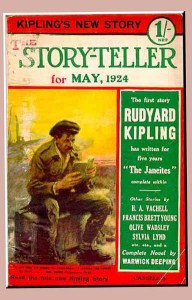
And I very much enjoyed Rudyard Kipling’s humorous, touching story, “The Janeites.” One of the protagonists, Humberstall, a hairdresser and World War I vet,  recalls how he began to read Austen when he was an assistant mess waiter.  The officers in the mess hall often discussed “Jane.”  They introduced him to the books, and he still reads them again and again.

But his friend, Anthony, has never heard of her.  Humberstall says,

‘Jane? Why, she was a little old maid ’oo’d written ’alf a dozen books about a hundred years ago. ’Twasn’t as if there was anythin’ to ’em, either. I know. I had to read ’em. They weren’t adventurous, nor smutty, nor what you’d call even interestin’—all about girls o’ seventeen (they begun young then, I tell you), not certain ’oom they’d like to marry; an’ their dances an’ card-parties an’ picnics, and their young blokes goin’ off to London on ’orseback for ’air-cuts an’ shaves. It took a full day in those days, if you went to a proper barber. They wore wigs, too, when they was chemists or clergymen. All that interested me on account o’ me profession, an’ cuttin’ the men’s ’air every fortnight. Macklin used to chip me about bein’ an ’air-dresser. ’E could pass remarks, too!’

I love his hair-cutting interest.  And, yes, Frank Churchill in Emma rode his horse to London whimsically, saying he had to get his hair cut, but actually took care of other business.

Quite a few Jane fans dislike Emma, or so I’ve heard online.  Not necessarily the book, but the character.

Emma Woodhouse?  My Emma?  Emma of my favorite book, Emma?--at least it’s my favorite Austen.  How could they dislike Emma?  It is one of the funniest books ever written.

One thing all should remember:  Jane doesn’t lie. When Jane praises Emma and shows us that she is good to her hypochondriac father and visits neighbors of a lower class, these actions count.  It is Emma’s lively conversation that sometimes gets her in trouble.

Here is the opening sentence.

Emma Woodhouse, handsome, clever, and rich, with a comfortable home and happy disposition, seemed to unite some of the best blessings of existence; and had lived nearly twenty-one years in the world with very little to distress or vex her.

Yes, that’s who Emma is. She has a “happy disposition.” I once heard someone call Emma malicious, and I almost fainted.

I am not an intense enough fan to read Jane’s unfinished novels.

But  now I want to.

Why?

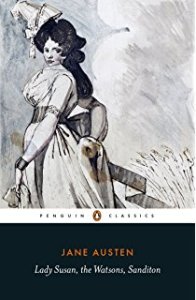
Anthony Lane at The New Yorker has written a charming, inspiring essay, “Reading Jane Austen’s Final, Unfinished Novel.”And he recommends the Penguin with Margaret Drabble’s introduction.

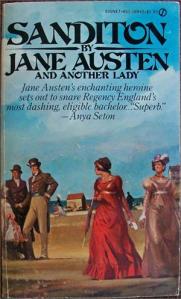
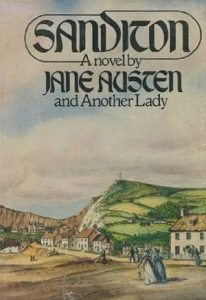
I don’t often read unfinished novels, though I wonder if I did read Sanditon “finished by another lady” when I was in high school.

Perhaps this one?

In his lively essay, Lane begins,

On March 18, 1817, Jane Austen stopped writing a book. We know the date because she wrote it at the end of the manuscript, in her slanting hand. She had done the same at the beginning of the manuscript, on January 27th of that year. In the seven weeks in between, she had completed eleven chapters and slightly more than nine pages of a twelfth—some twenty-three thousand five hundred words. The final sentence in the manuscript runs as follows: “Poor Mr. Hollis!—It was impossible not to feel him hardly used; to be obliged to stand back in his own House and see the best place by the fire constantly occupied by Sir H. D.” This is a joke. Mr. Hollis and Sir Harry Denham are dead, and it is their respective portraits that contend for social eminence in the sitting room of Lady Denham, the woman who married and buried them both. Exactly four months after writing that line, Jane Austen died, unmarried, at the age of forty-one. Her position, unlike theirs, remains secure.

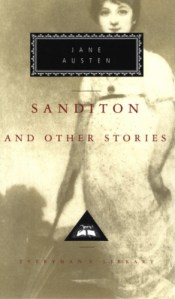
I am now yearning to get my hands on a copy of Sanditon.  Here are some of our options:

This lovely Everyman hardback fits the bill.

Oops, is that the same “Another Lady” who wrote the other one?

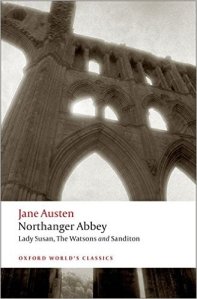
The Oxford always has nice legible print. And, look, we even get Northanger Abbey in this volume!

It’s so much fun to read Jane.  It’s been a few years, so now I can go back and reread one of my favorites.  And I must find a copy of Sanditon.

What I’m Reading: Phyllis Rose’s The Shelf: Adventures in Extreme Reading

‘The first thing I learned from my experiment…was that in the age of the Internet it is very hard to stick with a book without consulting an outside source.”
—Phyllis Rose’s The Shelf: Adventures in Extreme Reading

I am a fan of bibliomemoirs.

My favorite is Robert Dessaix’s Twilight of Love: Travels with Turgenev,  a short book that is part biography of Turgenev, part memoir/travel, and part literary criticism. I am also a fan of Nina Sankovitch’s Tolstoy and the Purple Chair, a very personal memoir of her year of reading one book a day and blogging about it to help her come to terms with her sister’s death from cancer.

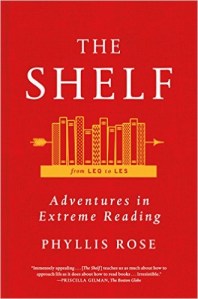
The bibliomemoir is very popular right now.   I recently discovered Phyllis Rose’s lively, entertaining, if very intellectual, The Shelf: Adventures in Extreme Reading. Rose, a retired English professor, scholar, biographer, and critic, decided to read the books on the LEQ-LES shelf at the New York Society Library.  She chose this shelf because she had always wanted to read Lermontov’s A Hero of Our Time.

She has a sense of humor and writes beautifully, but she cannot help but apply her training to the analysis of these books.  She begins,

“This book records the history of an experiment. Believing that literary critics wrongly favor the famous and canonical—that is, writers chosen for us by others—I wanted to sample, more democratically, the actual ground of literature.”

She is a great fan of the canon, but many women writers were not in it when she began to teach. She mentions  it was fine to teach Virginia Woolf at Berkeley in 1982 but to offer a Willa Cather class (which she did)  was daring. But she is not necessarily digging up lost gems on  this library shelf. She tackled some neglected writers and did her homework, but the actual reading was sometimes tedious.  She started with One for the Devil by Etienne Leroux, a South African writer writing in Afrikaans she had never heard of. She didn’t really understand or enjoy this  “experimental novel.”  She adds, “…Leroux had no interest in narrative.”

She did some research online.  She consulted Contemporary Authors , Wikipedia, a review in The Saturday Review, and followed hyperlinks here and there.  She learned  Leroux was tamember of a group of South Africa writers called the Sestigers (writers of the ‘60s), among them the award-winning Andre Brink, who were dedicated to expanding their readers’ horizons with challenging subjects and structures.  Rose discovered One for the Devil was the second in a trilogy, so she went back and read the first book.  She hated it. She decided not to read the third.

What I like most about this book is Rose’s analysis of the culture of reading in the 21st century. She writes,

“Reading is more centrifugal than it used to be. Because the material is so readily available, you want to see the author’s biography and read the reviews of the work.  You are even tempted to contact the author, who is only a Google search and some keystrokes away.”

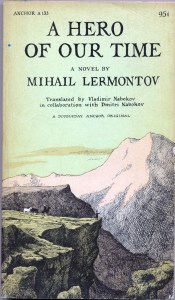
In the second chapter, Rose writes about her reading of Lermontov’s A Hero of Our Time, a short picaresque novel about a superfluous man of Russian literature.  I am a fan of Lermontov, but, alas, she was not.  Partly it was the translation she read by Nabokov and his  son–Nabokov had the eccentric idea that it was necessary to capture the  language exactly, literally, and roughly, if the prose is not graceful.   And the library paperback with the Edward Gorey cover art  (which she liked) was greasy, had tanned pages, and the worse for wear.

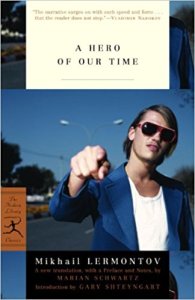
Since she disliked the Nabokov,  she downloaded a free 1853 translation on to her e-reader.  She found herself utterly absorbed in it. Then she read Marian Schwartz’s 2004 translation ( Modern Library ),  which by the way I read and liked.   And she was so fascinated by the cover photo on Modern Library edition that she emailed the book designer to learn why she’d chosen it.

What she learned: she didn’t need the physical book, even though she always thought she preferred physical books. She very much enjoyed the 19th-century translation on her e-reader.  What she needed was a readable text.

What I am enjoying most about this book is that she manages to make the reading of the books on this shelf meaningful.  I’m reading a chapter a night:  the perfect amount of reading before I go to sleep!

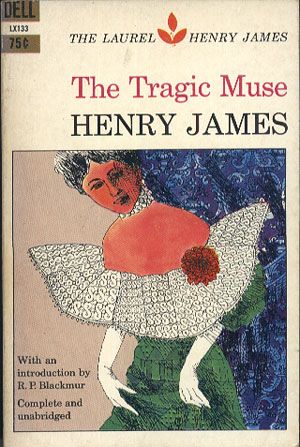
Henry James’s The Tragic Muse

tragic-muse-james-d036726715d6465fd69dae933945c933Perhaps I’ve read the best of James. I’ve read his most famous books.  But he wrote many:  20 novels, as well as short stories, travel writing, and autobiography.

So I recently branched out from rereadings and read and very much enjoyed The Tragic Muse (1890). Is it great? Well, not his best, but it is gracefully written and very entertaining.

In James’s later books, baroque language and wondrously complicated structures predominate. His early and mid-career books are simple in comparison.  The Tragic Muse is not simple, but the narrative is straightforward.  This lively, often comical novel explores relationships in a complicated, close circle of family and friends, but it also a fictional study of art.  In many of his novels, characters go to The National Gallery, or buy antiques. But here he also explores the consciousness of artists.

Can you take the arts too seriously? Perhaps.  In The Tragic Muse, two cousins,  Nick Dormer, a politician who lost his seat in Parliament and has discovered he prefers painting to politics, and Peter Sherringham, an English diplomat in Paris who loves the theater, are unexpectedly creative for savvy political men.  Nick wants to drop out and paint, but his career is the hope of his impoverished family:  his father was in politics; he is expected to follow.  Peter’s gift for diplomacy helps an actress and brings him to the verge of flinging away his career when he falls in love with her.

Miriam Rooth, the exasperating muse of the title, is not the heroine–this is not a novel about women–but we follow her career as she struggles to make connections in the theater, escape poverty, and claw her way to the top. She is Nick’s muse, the subject of his first serious portrait, and of course Peter, who helps her make connections, almost gives up everything for love of her.

tragic-muse-james-penguin-81uutgckhlIn the opening chapter, almost all the characters meet in Paris. Their fates would have been different had they not.  Nick has taken his mother, Lady Agnes, and two sisters, Grace and Biddy, to see the annual exhibition of the Salon in the Palais d’Industrie in Paris. Nick meets an old friend, Gabriel Nash, a witty aesthete and novelist, strolling with Miriam and her mother, Mrs. Rooth. They all go to lunch with Peter, who has a job in Paris. And they talk about Julia, Peter’s rich sister, whom Nick is expected to marry.  Julia sends him a telegram saying the parliamentary seat is vacant in her county (or do I mean district?) and she wants Nick to be the candidate.  And thus their relationships are cemented.

Miriam and Mrs. Rooth are odd women out.  They are of a different, unidentifiable class, and no one can quite tell what country they’re from:  they’re international.  Lady Agnes is awfully worried that the Rooths and Gabriel Nash will be a bad influence on Nick (they are).  But this lunch boosts Miriam’s career.  Due to Peter’s kindness and contacts, Miriam meets a famous French actress who informally coaches her.  And he manages to bring out the likable side of stubborn, shy Miriam.  When he asks on a walk if she would mind stopping at a cafe, she laughs and tells an amusing story of their poverty, which gives us a sense of who she is.

“Objection? I’ve spent my life in cafés! They’re warm in winter and you get your lamplight for nothing,” she explained. “Mamma and I have sat in them for hours, many a time, with a consommation of three sous, to save fire and candles at home. We’ve lived in places we couldn’t sit in, if you want to know—where there was only really room if we were in bed. Mamma’s money’s sent out from England and sometimes it usedn’t to come. Once it didn’t come for months—for months and months. I don’t know how we lived. There wasn’t any to come; there wasn’t any to get home. That isn’t amusing when you’re away in a foreign town without any friends. Mamma used to borrow, but people wouldn’t always lend. You needn’t be afraid—she won’t borrow of you. We’re rather better now—something has been done in England; I don’t understand what. It’s only fivepence a year, but it has been settled; it comes regularly; it used to come only when we had written and begged and waited. But it made no difference—mamma was always up to her ears in books. They served her for food and drink. When she had nothing to eat she began a novel in ten volumes—the old-fashioned ones; they lasted longest. “

Most of the book is told from the third-person point of view of Nick or Peter.  Nick is elected to Parliament, but soon drops out to paint, at the urging of aesthete Gabriel Nash, and that destroys his relationship with Julia.  Peter falls in love with Miriam:  it’s inevitable.   Miriam becomes a huge success, is loud and self-centered, and sits for her portrait with Nick.  One keeps expecting a triangle, but that doesn’t develop–thank god!  If there is a heroine, I would pick Julia, the rich young woman who backs Nick in politics. Julia is bright and fascinating and clearly would have made a good politician if she weren’t a woman but is pushed offstage.  Usually James is better with women characters than men, but the women in The Tragic Muse seem undeveloped.

It does, oddly, ramble in parts, as if James couldn’t quite decide what he wanted to say and couldn’t bear to leave out any of his ideas about art.  But it is a character-driven novel–lots of fun to read.

There Are More Than Two Dystopian Novels


Every day since the inauguration, journalists in the U.S. and the UK have published articles urging us to read (or in my case, reread) George Orwell’s 1984 and Margaret Atwood’s The Handmaid’s Tale. May I confess that I would rather scrub the bathroom wall tiles or give up salted caramel frozen yogurt?

One wonders: can’t they recommend other novels? Hundreds of dystopian novels have been published, dozens in the last decade.  My own preference is for  environmental/political dystopian novels: I recommend John Brunner’s The Sheep Look Up (which I wrote about here) and Stand on Zanzibar (here), Doris Lessing’s The Memoirs of a Survivor (here), Brian Aldiss’s Hothouse (here), Jonathan Lethem’s Girl in Landscape (here), David Mean’s Hystopia (here), Lionel Shriver’s The Mandibles: A Family, 2029-2047 (here), and Angela Carter’s The Passion of New Eve (here).

Many have suffered low-level depression since the election, and I hardly think a dose of Orwell and Atwood is an antidepressant. And surely we needn’t all read the same two books to understand our political problems.  There’s something very high school canon about these particular novels.

Well, it’s a matter of taste.  Even in Norwich, England, they’re pushing the same two dystopian novels.  Inspired by giveaways of 1984 and The Handmaid’s Tale at a bookstore in San Francisco, a  book group in Norwich, donated copies of 1984 and A Handmaid’s Tale to The Book Hive, an independent bookstore, for its own dystopian giveaway.

And this upset the writer Susan Hill, who canceled her appearance at the store.

You can read her essay at The Spectator, or the article about it at The Guardian. As an American, I found it confusing.  First I wondered humorously if  she canceled because she thought the store should give away her own favorite dystopian novels.  But, no, she calls the giveaway a  form of “censorship,” because, if I understand correctly, she dislikes the idea of an anti-Trump giveaway, and she also says the bookstore is not stocking Trump books.  She says they

“put their own political and personal views about the USA and its President before their business, their customers and what a bookshop is and must, more than any other sort of shop or business, be about.”

Well, that’s extreme, isn’t it?  Independent bookstores can stock what they want, can’t they? and give away what they want? Why is that censorship?  I’m all for book giveaways.  Give away whatever books they want:  I’m for it!  Even if they’re not my favorite books.

I do think my fellow Americans are doing a fine job with their own protests here, and if the English want to get involved, here’s my suggestion:  give away AMERICAN dystopian novels instead of English and Canadian!  Support American writers like Lethem, Shriver, and David Mean, who are writing very close to the bone about America.  This situation is not their fault.